
Species guide
Camellia Bonsai Care
Camellia japonica, Camellia sasanqua
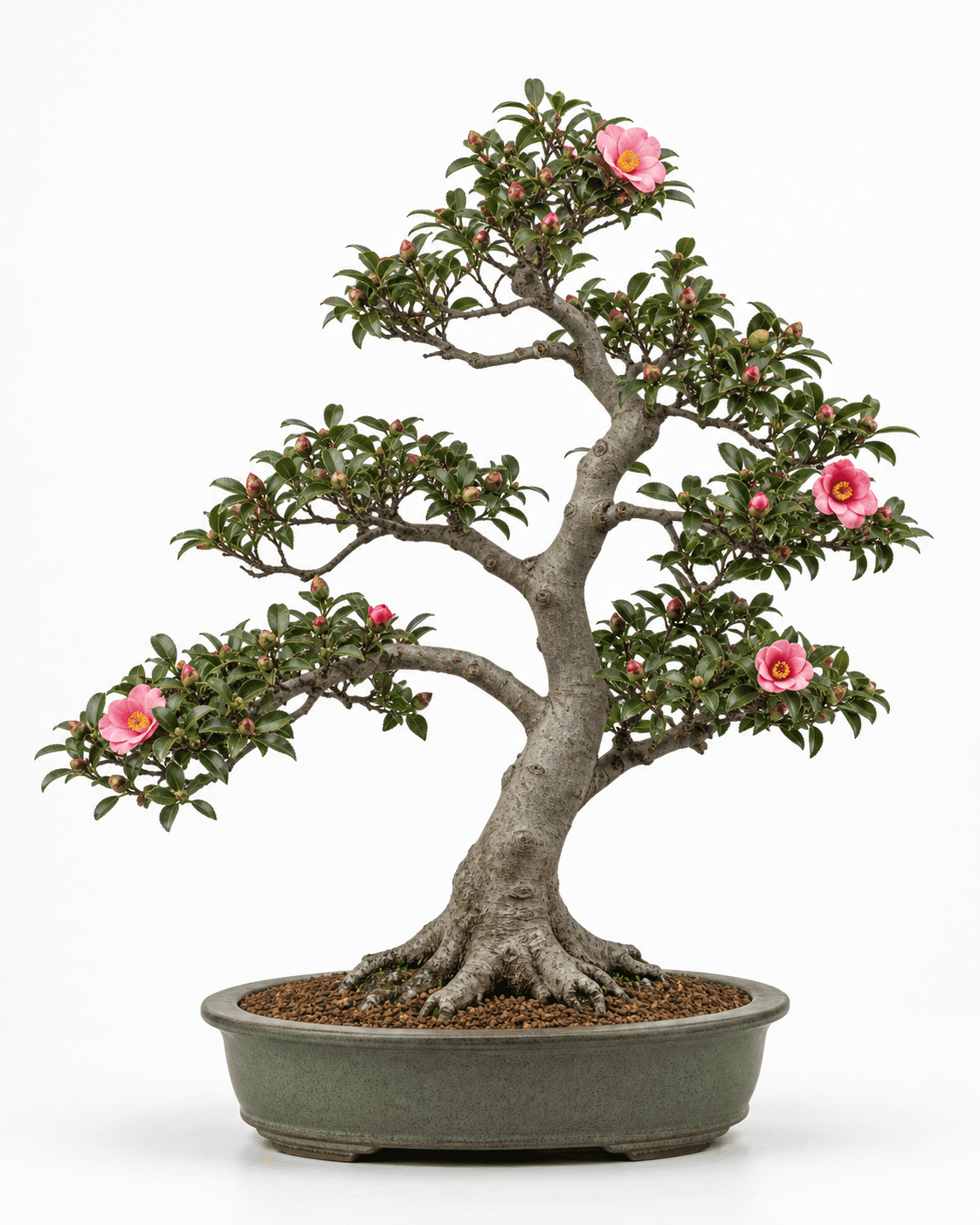
Camellia bonsai should be grown as outdoor broadleaf evergreens with acidic, moist, well-drained roots, protected bright light, spring root work, and pruning timed around flowering. The page covers the two labels most likely to appear in bonsai and nursery material: Camellia japonica and Camellia sasanqua.
Use this as a shared parent page, then identify the actual tag. Japanese or common camellia usually means C. japonica with winter-to-spring flowers and larger leaves, while sasanqua camellia means C. sasanqua with fall-to-winter flowers, smaller leaves, a more open habit, and often better bonsai scale.
The local Mirai corpus has no dedicated Camellia file, but it names camellia repeatedly inside broadleaf-evergreen method: spring repotting, post-harden pruning, container sun protection, smooth-bark wiring, sheen-based roots, and conditional defoliation. Species identity, hardiness, flower timing, pH, pests, and cultivar labels are grounded in NC State Extension, Clemson HGIC, and Kew POWO search workflows.
Updated June 11, 2026. Written by EntGrove Editorial. Last verified June 11, 2026.
Care fingerprint
Read the species through its shared care pattern.
Protect from hard freezes when species demands it, prune with active foliage in mind, and repot when roots can recover without dormancy cues. Use this as the starting point before local conditions and tree strength refine the calendar.
Note: Shared parent page for ornamental japonica and sasanqua camellia bonsai. Verify the tag before applying flower timing, leaf scale, hardiness, or cultivar claims, and keep tea plant (Camellia sinensis) as a separate evaluation.
Read the foliage first
Broadleaf stress usually shows in leaf color, leaf size, wilt, scorch, or delayed hardening before it becomes a branch problem.
Match work to dormancy
Deciduous, evergreen, tropical, succulent, and flowering broadleaf trees recover on different calendars.
Protect fine roots
Root work should preserve enough active fine roots for the tree to rehydrate quickly after the operation.
Care cadence
The calendar starts with the tree's seasonal state.
Placement
Timing: Grow outdoors in bright partial shade, morning sun, or filtered light. Sasanqua tolerates more sun when the pot stays cool, while C. japonica usually prefers stronger afternoon protection.
Watch for: Scorched or bronzed leaves, flower buds dropping, weak shade growth, drying winter wind, and hot south or west walls.
NC State Extension: Camellia japonicaNC State Extension: Camellia sasanquaClemson HGIC: CamelliaClemson HGIC: Camellia diseases and insect pestsWatering
Timing: Water thoroughly when the surface begins to dry, then let air return. Keep moisture especially consistent while flower buds develop in late summer and fall.
Watch for: Bud drop, leaf yellowing, perched water in old organic soil, dry pockets under the root crown, and sour smell after rain.
NC State Extension: Camellia japonicaClemson HGIC: CamelliaBonsai Mirai LibraryFeeding
Timing: Feed moderately during development and lightly during refinement. Use acid-loving broadleaf timing, avoid heavy spring feeding on refined trees, and wait after repotting until strong new growth confirms recovery.
Watch for: Burned leaf edges, excessive leaf drop, coarse spring extension, and fertilizing before roots have callused after repotting.
Clemson HGIC: CamelliaBonsai Mirai LibraryPruning
Timing: For flower display, prune immediately after bloom or by early summer so the next flower buds are preserved. For structure, use the spring-to-early-summer broadleaf-evergreen window on healthy trees.
Watch for: Removing next year blossoms, cutting back to bare weak wood, hedging the exterior into a green shell, and heavy pruning in the same year as major root work.
NC State Extension: Camellia japonicaClemson HGIC: CamelliaBonsai Mirai LibraryLeaf management
Timing: Use selective leaf reduction only on vigorous refined trees. Preserve interior leaves that are still feeding weak branches, and time any visible leaf cutting well before display.
Watch for: Routine full defoliation, cut leaves on a show tree, weak interior twigs stripped bare, and slow recovery in cool maritime summers.
Bonsai Mirai LibraryRepotting
Timing: Repot in spring as buds swell and weather is moving upward. Convert nursery cores in stages, anchor the tree firmly, and protect the shallow roots from late frost and heat.
Watch for: Full bare-rooting, compacted peat under a fresh mineral rim, late frost after root work, and combining hard root reduction with hard top reduction.
Bonsai Mirai LibraryClemson HGIC: CamelliaWiring
Timing: Wire after growth firms, using aluminum or carefully protected wire on smooth bark. Sasanqua shoots often set easier than older C. japonica branches.
Watch for: Wire bite under glossy leaves, bark scuffing, single hard bends, brittle older wood, and hidden wire during rapid sasanqua growth.
Bonsai Mirai LibraryPests and disease
Timing: Inspect before styling, during humid bloom periods, and after nursery purchases. Sanitation matters because camellia flower blight and scale pressure can persist.
Watch for: Tea scale on leaf undersides, cottony camellia scale, spider mites, petal blight, dieback and canker, leaf gall on sasanqua, root rot, and yellow mottle virus signs.
NC State Extension: Camellia japonicaClemson HGIC: Camellia diseases and insect pestsSourcing
Timing: Buy by trunk, root base, leaf scale, cultivar record, and pest cleanliness. Sasanqua, dwarf japonica, and old landscape shrubs can be better starting points than large-flowered florist-style stock.
Watch for: Tea scale, graft swelling, buried bases, coarse straight nursery trunks, flower-only buying decisions, alkaline-soil chlorosis, and confusion with tea plant.
NC State Extension: Camellia japonicaNC State Extension: Camellia sasanquaClemson HGIC: Camellia diseases and insect pestsSpecies guide
Apply the species profile before copying another tree's calendar.
At a glance
Camellia is a slow, flower-forward evergreen that asks for acidic roots and careful timing.
This profile covers Camellia japonica and Camellia sasanqua as a shared bonsai parent page. Both are Theaceae broadleaf evergreens with glossy serrated leaves, showy cool-season flowers, shallow roots, and a strong preference for acidic, moist, well-drained conditions. NC State Extension: Camellia japonicaNC State Extension: Camellia sasanquaClemson HGIC: Camellia
The practical difference is scale and season. C. japonica is slower, denser, larger-leaved, and usually flowers late winter to early spring. C. sasanqua is faster, more open, often smaller-leaved, fragrant, and flowers fall into winter. NC State Extension: Camellia japonicaNC State Extension: Camellia sasanqua
The bonsai method comes from Mirai broadleaf-evergreen coverage rather than a dedicated Camellia episode. That means spring root work, post-harden pruning, retained foliage for recovery, smooth-bark wire caution, and conditional leaf reduction are the working rules. Bonsai Mirai Library
Habitat
Read camellia as a woodland-margin evergreen, not a dry Mediterranean shrub.
NC State records C. japonica as native to China, Korea, and central to southern Japan, and C. sasanqua as native to Japan. Both are broadleaf evergreen shrubs or small trees from humid Asian landscapes rather than desert, alpine, or tropical houseplant settings. NC State Extension: Camellia japonicaNC State Extension: Camellia sasanqua
For care, that means filtered light, moisture consistency, acidic media, and protection from drying wind. Clemson describes camellias as shallow-rooted and slow to establish, with water competition as a critical establishment issue. Clemson HGIC: Camellia
For design, the habitat points toward quiet evergreen broadleaf forms: old shrub trunks, lower branches reaching for light, flower buds as seasonal punctuation, and foliage masses that remain open enough for air and interior leaves. Bonsai Mirai / AsymmetryNC State Extension: Camellia sasanqua
Container culture changes the light equation. Mirai notes that container-grown broadleaf evergreens such as camellia need peak-summer sun protection because small soil reservoirs heat and dry faster than in-ground roots. Bonsai Mirai Library
Reading the tree
Identify japonica, sasanqua, hybrid, or tea plant before choosing the calendar.
Start with the tag. C. japonica may appear as camellia, common camellia, Japanese camellia, or peony camellia. C. sasanqua is usually sold as sasanqua camellia, often with fall or winter bloom cultivar names. NC State Extension: Camellia japonicaNC State Extension: Camellia sasanqua
Separate tea plant, Camellia sinensis, from ornamental camellia stock. It belongs to the same genus, but this profile is written for japonica and sasanqua bonsai material, where flower display and ornamental foliage drive the schedule. NC State Extension: Camellia japonica
Then read stage. A development tree needs extension, root conversion, and branch selection. A refined tree needs restrained feeding, post-harden pruning, interior-light preservation, and flower-bud-aware choices. Bonsai Mirai LibraryNC State Extension: Camellia japonica
Bud behavior is central. NC State notes that C. japonica flower buds can drop from natural thinning, over-watering, or under-watering, and Clemson connects bud drop with moisture swings, freezing, heat, poor drainage, nutrient deficiency, mites, and site problems. NC State Extension: Camellia japonicaClemson HGIC: Camellia diseases and insect pests
Pruning
Prune after bloom when flowers matter, and after hardening when ramification matters.
For C. japonica flower display, NC State gives the clean rule: prune immediately after flowering or in early summer because next year blossoms appear on old growth. Later pruning sacrifices the next bloom cycle. NC State Extension: Camellia japonica
For broadleaf-evergreen refinement, Mirai lets the first flush extend and harden until it is energy-positive, then prunes back to usable interior buds for a finer second flush. That method builds branch structure without fighting the stored-energy first flush. Bonsai Mirai Library
Clemson says camellias require little pruning beyond damaged branches and long shoots, and that severe cutback with no leaves can be done from Valentine's Day to around May 1. In bonsai, reserve that aggressive timing for healthy development material with strong aftercare. Clemson HGIC: CamelliaBonsai Mirai Library
Avoid repeated exterior shearing. Camellia can be clipped into a landscape shrub, but bonsai needs visible branch shoulders, interior leaves, and enough light inside the canopy to keep future cutback points alive. Bonsai Mirai LibraryBonsai Mirai / Asymmetry
Roots
Repot in spring, preserve the sheen-based root system, and correct old nursery cores slowly.
Mirai names spring repotting as the standard window for most broadleaf evergreens including Camellia. Use bud swell and warming weather as the cue, then protect the tree from frost, wind, and heat during recovery. Bonsai Mirai Library
Camellia is a shallow-rooted evergreen with strong moisture expectations. Clemson emphasizes shallow planting, mulch for moisture conservation, and frequent water checks after planting, which translates in bonsai to firm tie-downs and even moisture after root work. Clemson HGIC: Camellia
Avoid full bare-rooting. Mirai groups broadleaf evergreens with sheen-based species that rely on slower water and oxygen exchange and preserved root biology. Remove compacted organic cores in stages unless the tree is vigorous and the risk of stale soil is greater than the root-work risk. Bonsai Mirai Library
Repot for function first: water must enter, oxygen must return, and roots must occupy the pot evenly. A camellia that dries only around the rim while the center stays sour needs root work before it needs more fertilizer. Bonsai Mirai LibraryClemson HGIC: Camellia diseases and insect pests
Soil and pot
Use acidic, water-retentive mineral soil with enough depth for shallow evergreen roots.
NC State gives C. japonica acidic pH at 5.5 to 6.5 and moist good drainage. Clemson also says camellias prefer slightly acid soil and well-drained organic-rich conditions. In bonsai, avoid dense potting soil and build water retention through particle choice. NC State Extension: Camellia japonicaClemson HGIC: Camellia
A development mix can start near 2:1:1 akadama:pumice:lava or 1:1:1 in wet climates, with extra akadama for refined trees where watering quality and climate can support it. Mirai gives broadleaf evergreens finer ramification in akadama-heavy soil while still allowing pumice and lava when drainage risk is higher. Bonsai Mirai Library
Choose pot depth with root function in mind. Mirai treats broadleaf evergreens as sheen-based trees that often perform better with a deeper water column than a very shallow display tray during development. Bonsai Mirai Library
For design, muted glazed or softly textured pots can support the flower display. Let the flower color decide restraint: red and pink camellias often need quieter pots, while white flowers can tolerate subtle color if the trunk is strong enough. Bonsai Mirai / AsymmetryNC State Extension: Camellia japonica
Climate
Protect roots in cold regions and protect leaves in hot-sun regions.
NC State lists both C. japonica and C. sasanqua for Zones 7a to 9b. Use that as landscape context only. Container roots can freeze faster, dry faster, and wake earlier than roots protected in the ground. NC State Extension: Camellia japonicaNC State Extension: Camellia sasanquaBonsai Mirai Library
In cold-winter regions, overwinter in a cold frame, unheated greenhouse, or protected bench where the tree gets dormancy, wind protection, and root insulation. Avoid warm indoor storage that keeps the tree photosynthesizing weakly under low light. Bonsai Mirai LibraryClemson HGIC: Camellia
In hot inland regions, use morning sun, filtered afternoon light, and enough soil volume to keep the pot from overheating. Clemson identifies excessive direct sunlight as a cause of sunscald, especially on exposed south or west sites. Clemson HGIC: Camellia diseases and insect pests
In humid regions, airflow and sanitation become more important. Petal blight, leaf gall, algal leaf spot, scale, and root disease all become easier to miss when a dense evergreen canopy is kept too wet and shaded. Clemson HGIC: Camellia diseases and insect pests
Pests
Tea scale, petal blight, canker, root rot, and leaf gall are the problems to inspect first.
Clemson names camellia dieback and canker, flower blight, root rot, and tea scale as the most important South Carolina camellia problems. In bonsai, those are also the practical first checks before styling. Clemson HGIC: Camellia diseases and insect pests
Tea scale hides on leaf undersides and weakens foliage. Clemson emphasizes crawler-stage timing for insecticidal soap and lists late-winter or early-spring horticultural oil, with temperature and drought-stress cautions that matter in small pots. Clemson HGIC: Camellia diseases and insect pests
Petal blight turns flowers brown and drops petals into the pot or bench area. Sanitation is bonsai care here: remove infected flowers and fallen debris promptly so the display bench does not become a disease reservoir. NC State Extension: Camellia japonicaClemson HGIC: Camellia diseases and insect pests
Leaf gall is especially common on sasanqua camellias in Clemson guidance. Remove young galls early, clean fallen leaves, avoid wetting foliage unnecessarily, and reduce humid, moist, shady conditions where possible. Clemson HGIC: Camellia diseases and insect pests
Wiring
Wire like the bark will remember every mistake.
Mirai specifically reserves aluminum for smooth-barked species like camellia because copper marks would be visible. Use padded guy wires, aluminum, raffia or tape when needed, and frequent inspection during active growth. Bonsai Mirai Library
Wire young or semi-hardened shoots after they firm enough to hold a bend. Older C. japonica branches can be stiff and brittle, so use clip-and-grow or replacement shoots instead of forcing old wood into dramatic curves. Bonsai Mirai LibraryNC State Extension: Camellia japonica
Sasanqua can be more useful for bonsai branch placement because its habit is more open, arching, and rapid in the NC State record. That vigor helps set structure but also means wire can bite quickly. NC State Extension: Camellia sasanquaBonsai Mirai Library
After wiring, keep tips oriented toward light and keep flower buds visible. A camellia branch should read as a broadleaf branch carrying leaves and buds, not as a conifer pad forced onto a glossy shrub. Bonsai Mirai / AsymmetryNC State Extension: Camellia japonica
Propagation
Use cuttings and layers for cultivar continuity, and seed only for long experiments.
NC State lists stem cutting for C. japonica propagation. For bonsai, cuttings are useful when a cultivar has small leaves, compact habit, or a flower form worth preserving. NC State Extension: Camellia japonica
Layering is useful when a branch has better movement and leaf scale than the base. Mirai times broadleaf-evergreen air layers after the first spring flush hardens and separates only when roots can support retained evergreen foliage. Bonsai Mirai Library
Seed can produce rootstock or experimental material, but it does not preserve cultivar flower form or compact habit. It also lengthens the path to a flowering bonsai and makes label tracking harder. NC State Extension: Camellia japonicaNC State Extension: Camellia sasanqua
Grafting appears often in ornamental camellia production, but bonsai buyers should inspect graft unions carefully. A swollen or high graft can dominate a small trunk forever. Bonsai Mirai / AsymmetryNC State Extension: Camellia japonica
Buying
Buy the base and leaf scale before the flower.
The most common mistake is buying a flower instead of a tree. Large formal flowers can be spectacular, but a bonsai candidate needs a usable root base, trunk movement, low branches, healthy roots, and leaves that can scale with the intended size. NC State Extension: Camellia japonicaBonsai Mirai / Asymmetry
Sasanqua and compact japonica forms are often easier starting points because smaller leaves, open habit, and faster growth reduce the time to structure. Landscape camellias can also be good material when the base is visible and the roots are not trapped in old anaerobic soil. NC State Extension: Camellia sasanquaClemson HGIC: Camellia
Inspect leaf undersides for tea scale and cottony scale, then inspect flowers and fallen petals for blight. A discounted blooming plant with scale under every leaf is a treatment project before it is bonsai material. Clemson HGIC: Camellia diseases and insect pests
Keep cultivar and species labels through every repot. Japonica, sasanqua, hiemalis, vernalis, reticulata, sinensis, and garden hybrids can share the sales-table word camellia but differ in bloom season, vigor, leaf scale, and winter behavior. NC State Extension: Camellia japonicaNC State Extension: Camellia sasanqua
Troubleshooting
Diagnose camellia by buds, roots, leaf undersides, pH, and sun exposure.
Symptom: flower buds brown or drop before opening. Likely cause: moisture swings, freezing temperatures, fall or spring heat, poor drainage, nutrient deficiency, bud mites, or site mismatch. Fix: stabilize water, protect from extremes, inspect pests, and improve drainage. NC State Extension: Camellia japonicaClemson HGIC: Camellia diseases and insect pests
Symptom: yellow leaves with green veins. Likely cause: alkaline soil or chlorosis. Fix: test water and soil, restore acidity, use iron chelate when appropriate, and avoid adding fertilizer to a sour wet root ball. NC State Extension: Camellia japonicaClemson HGIC: Camellia
Symptom: white cotton, crusty undersides, stippling, or sticky leaves. Likely cause: scale, mites, aphids, or related pests. Fix: isolate, wash, treat at the correct life stage, and delay styling until the foliage is strong. NC State Extension: Camellia japonicaClemson HGIC: Camellia diseases and insect pests
Symptom: brown flowers spreading from petals, followed by messy fallen blooms. Likely cause: petal blight. Fix: remove infected flowers and fallen petals, clean the bench, and avoid carrying contaminated debris into the soil surface. NC State Extension: Camellia japonicaClemson HGIC: Camellia diseases and insect pests
Symptom: bronzed or scorched foliage on the exposed side. Likely cause: sunscald from too much direct afternoon sun or a sudden move from shade to sun. Fix: shift to morning sun or filtered light and protect the pot from heat. Clemson HGIC: Camellia diseases and insect pestsBonsai Mirai Library
Symptom: sudden branch wilt with cankers or dieback. Likely cause: camellia dieback and canker, often worse in hot dry weather or after wounds. Fix: prune below affected tissue with disinfected tools and restore overall vigor before additional styling. Clemson HGIC: Camellia diseases and insect pests
Design
Style camellia as a flowering evergreen tree with negative space, not as a clipped dome.
Start with the base, trunk line, defining branch, and apex. A camellia without trunk interest can still become a good tree if the first branch, flower placement, and seasonal silhouette make the composition feel intentional. Bonsai Mirai / Asymmetry
Keep pads open and asymmetric. Broadleaf evergreens become more convincing when the viewer can see branch exits, twig hierarchy, and spaces for flowers, rather than a dense green mass with blooms pasted to the surface. Bonsai Mirai / AsymmetryBonsai Mirai Library
Japonica tends toward a denser, formal, flower-forward image. Sasanqua often supports lighter informal upright, slanting, clump, and literati-adjacent designs because the habit is more open and arching. NC State Extension: Camellia japonicaNC State Extension: Camellia sasanqua
Deadwood should be restrained. Camellia age usually reads through bark, old branch shoulders, flower buds, and clean evergreen mass. Carving can age a wound, but it should not become the main story unless the material already demands it. Bonsai Mirai / AsymmetryClemson HGIC: Camellia diseases and insect pests
Cultivars
Cultivar names matter, but bonsai scale matters more.
NC State lists many C. japonica cultivars, including Adolphe Audusson Special, Black Tie, Cinnamon Cindy, Higo Ohkan, Kramer's Supreme, Lady Clare, Magic City, Morning Glow, Nuccio's Gem, Otome, and White By The Gate. NC State Extension: Camellia japonica
NC State lists sasanqua cultivars including Cleopatra, Daydream, Green's Blues, Kanjiro, Leslie Ann, Magic Snow, Moon Mist, Our Linda, Pink Snow, Setsugekka, and Yuletide. For bonsai, inspect internodes, leaf size, branch flexibility, and trunk base before flower color. NC State Extension: Camellia sasanquaBonsai Mirai / Asymmetry
Hybrid labels need records. Winter Series, hiemalis, vernalis, reticulata hybrids, and garden-center house names can change bloom season and cold response. Keep the plant tag in the EntGrove record. NC State Extension: Camellia japonicaClemson HGIC: Camellia
Tea plant is a separate evaluation. Camellia sinensis can be grown in containers, but this page should not be used to promise ornamental japonica or sasanqua flower behavior on tea material. NC State Extension: Camellia japonica
History
Camellia carries horticultural history, but bonsai success still starts with the actual tree.
NC State notes the Camellia genus name honors Georg Josef Kamel, a Jesuit missionary and naturalist associated with the flora of the Philippines, and that C. japonica has become a southern gardening favorite. NC State Extension: Camellia japonica
Sasanqua has a different seasonal signal in the garden: fall and winter flowers, fragrant blooms, and a faster, more open habit. That can make it a more useful bonsai subject when the goal is tree structure plus flower scale. NC State Extension: Camellia sasanqua
For exhibition, the useful record is practical rather than romantic: species or hybrid identity, cultivar, source, graft status, repot dates, bloom timing, bud-drop history, pest history, and which pruning window preserves the display. Bonsai Mirai LibraryClemson HGIC: Camellia diseases and insect pests
Camellia bonsai should age with quiet discipline. A strong specimen is judged by health, flower placement, glossy but scaled foliage, clean branch exits, and a pot that supports the seasonal display without overwhelming it. Bonsai Mirai / AsymmetryNC State Extension: Camellia japonica
Species questions
Answer the beginner questions before styling.
Is camellia good for bonsai?
Yes, especially sasanqua and compact or small-leaved cultivars. Camellia makes a slower, intermediate bonsai that rewards acidic roots, protected bright light, careful pruning, and pest inspection.
Should I use Camellia japonica or Camellia sasanqua for bonsai?
Sasanqua is often easier for smaller bonsai because it grows faster, flowers in fall or winter, and has a more open habit. Japonica can work well when the trunk and flower display justify the larger, denser foliage.
Can camellia bonsai live indoors?
Use outdoor culture as the baseline. Brief indoor display during bloom is reasonable, but long-term warm indoor culture usually weakens the tree and increases scale, mites, and root problems.
When should I prune camellia bonsai?
Prune immediately after flowering or by early summer if flowers matter. For structure on healthy trees, spring through post-harden early summer is the broadleaf-evergreen window.
When should I repot camellia bonsai?
Repot in spring as buds swell and temperatures rise. Inspect every 3 to 4 years, or sooner if water stops entering the root mass. Preserve some old root biology and avoid full bare-rooting.
What soil does camellia bonsai need?
Use acidic, moist, well-drained granular bonsai soil. Akadama-heavy mixes suit refinement, while pumice and lava help keep oxygen available in wet climates or during nursery-core conversion.
Why are my camellia buds dropping?
Bud drop can come from natural thinning, moisture swings, freezing, heat, poor drainage, nutrient deficiency, mites, or site stress. Stabilize watering, protect from extremes, and inspect roots and leaf undersides.
Should camellia bonsai be defoliated?
Only vigorous refined trees should receive leaf-reduction work, and visible cut leaves should be timed away from display. Most camellias are safer with selective leaf cutting and post-harden pruning.
What pests are most common on camellia bonsai?
Tea scale is the primary pest to inspect for, especially under leaves. Cottony camellia scale, mites, aphids, petal blight, canker, root rot, and sasanqua leaf gall also deserve regular checks.
Is tea plant the same as camellia bonsai?
Tea plant is Camellia sinensis, a different Camellia species. This profile is written for ornamental Camellia japonica and C. sasanqua material, so tea plant should be logged and evaluated separately.
Sources
Species advice needs source discipline.
Next decisions
Plan the operation before copying the calendar.
A good care note for Camellia records the tree's stage, the work done, and the aftercare used. That record matters more than a month-name rule.
Related species
Compare nearby trees before transferring advice.
English boxwood
Buxus sempervirens
Japanese boxwood
Buxus microphylla
Korean boxwood
Buxus sinica var. insularis
English holly
Ilex aquifolium
Japanese holly
Ilex crenata