
Species guide
Pinyon Pine Bonsai Care
Pinus edulis, Pinus monophylla, Pinus cembroides
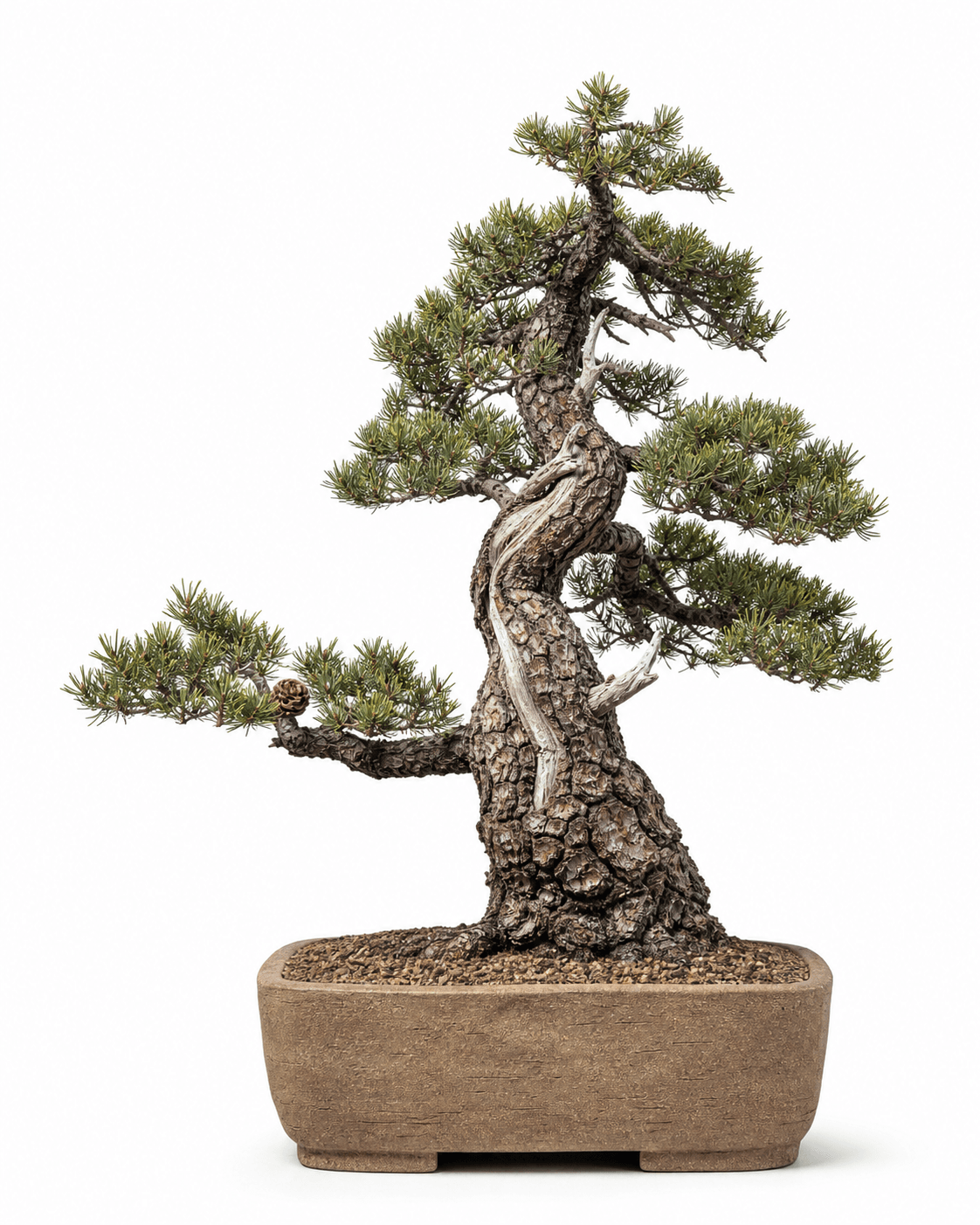
Pinyon pine bonsai is an outdoor, dry-country pine project for growers who can protect roots, preserve needle mass, and read strength over several seasons. Treat verified Pinus edulis, Pinus monophylla, or Pinus cembroides as Pine > Outlier: build vigor first, use spring pinching only after structure and health are established, and reserve full decandling for rare back-budding work on strong trees.
This guide has direct Mirai coverage from Pinyon pine design, defining outlier pines, pinching strategy, five-needle pine pruning, and energy distribution files. Kew, Flora of North America, USDA Forest Service, Colorado State, Utah State, Oregon State, and UC Davis ground the accepted names, pinyon-group label handling, habitat, hardiness, pests, and cone ecology.
Updated June 8, 2026. Written by EntGrove Editorial. Last verified June 8, 2026.
Care fingerprint
Read the species through its shared care pattern.
Protect older needles, avoid aggressive decandling assumptions, and adjust work to slow recovery, rare outlier decandling, and species-specific bud behavior. Use this as the starting point before local conditions and tree strength refine the calendar.
Identify flush behavior
Single-flush, multiflush, white pine, and compact pine groups have different pruning windows and different risk levels.
Avoid default decandling
Japanese black pine methods do not transfer safely to every pine, especially slow, weak, collected, or five-needle trees.
Use needles as strength data
Needle length, color, age, and density help show where vigor is strong, weak, or becoming shaded.
Care cadence
The calendar starts with the tree's seasonal state.
Placement
Timing: Grow outdoors in full sun with strong airflow. Give roots shade from reflected heat, and keep cold-region pots protected from freeze-thaw extremes.
Watch for: Indoor winter storage, shade-grown weak candles, black pots on hot paving, humid stagnant benches, and warm nights after heavy root work.
Utah State University ExtensionBonsai Mirai LibraryWatering
Timing: Water until the whole rootball is wet, then wait for oxygen to return before watering again. Adjust after styling because foliage removal lowers water demand.
Watch for: A dry outer mix around a wet native core, chronic dampness after repotting, algae, sour organic soil, and drought followed by repeated shallow watering.
Bonsai Mirai LibraryDevelopment feeding
Timing: Feed strongly while building roots, needle mass, and vascular tissue for future back budding. Mirai specifically calls for aggressive development fertilization before any outlier decandling attempt.
Watch for: Starving a developmental tree for short needles, styling before recovery, and cutting the battery before interior buds exist.
Bonsai Mirai LibraryOutlier decandling
Timing: Use full decandling only on a strong tree with about 70 percent strong candles after several seasons of preparation. Mirai frames it as a once-every-5-to-6-years tool, often in early June for Mediterranean-type outliers.
Watch for: Annual black-pine cycles, weak-tree decandling, needle plucking at the same time, and cutting juvenile second flush after it appears.
Bonsai Mirai LibraryPost-decandling care
Timing: Let the juvenile second flush mature fully. The following year, feed enough to move that juvenile growth into mature needle mass, then shift toward short-needle single-flush pinching and restraint.
Watch for: Trying to shorten juvenile growth for neatness, drought-stressing the second flush, and expecting mature buds immediately after the first response.
Bonsai Mirai LibraryPinching and pruning
Timing: After structure and health are established, pinch strong spring candles like a short-needle single-flush pine to keep the silhouette and move energy inward. In development, let shoots extend first.
Watch for: Pinching before wiring defines the silhouette, pinching weak shoots, and pruning before the tree has accumulated enough vascular resources.
Bonsai Mirai LibraryRepotting
Timing: Repot in early spring as buds begin moving, then protect from wind, heat, and hard freeze. Keep native root cores stable and convert soil in stages.
Watch for: Bare-rooting, stacking repotting with heavy styling, loose tie-downs, overworking dry collected roots, and fertilizing before new roots are active.
Bonsai Mirai LibraryPests and disease
Timing: Inspect in spring, during drought stress, after collection, and whenever one side of the crown fades. CSU lists pinyon-specific diseases and insects worth learning.
Watch for: Black stain root disease, dwarf mistletoe, armillaria root disease, pinyon decline, Ips beetles, pitch mass borer, tip moth, pitch nodule moth, needle scale, and spindlegall midge.
Colorado State University ExtensionSpecies guide
Apply the species profile before copying another tree's calendar.
At a glance
Pinyon pine is a slow, dry-country outlier pine for patient outdoor growers.
The search label pinyon pine can point to several species. EntGrove covers Pinus edulis, Pinus monophylla, and Pinus cembroides together because Mirai and public horticultural sources group their bonsai problem similarly: dry roots, slow growth, edible cones, reluctant interior budding, and species-level identification before technique. Kew POWOKew POWOKew POWOBonsai Mirai Library
For care, use the Pine > Outlier frame. Build strength with needles and roots, keep the container highly oxygenated, and avoid routine annual decandling. A rare full decandling is a design intervention for interior back budding, performed only after a prepared tree has the strength to answer. Bonsai Mirai Library
The three species differ. Pinus edulis is the Colorado or two-needle pinyon of the Southwest. Pinus monophylla is the Great Basin singleleaf pinyon. Pinus cembroides is Mexican pinyon, with a warmer, more Mexican and border-region range. Flora of North AmericaFlora of North AmericaUSDA Forest Service FEIS
The page is most useful for outdoor growers with strong sun, low humidity or excellent airflow, and enough patience to develop an old desert-pine image slowly. For small indoor bonsai, choose a tropical species instead. Utah State University ExtensionBonsai Mirai Library
Wild habitat
The wild model is dry woodland, hard light, shallow soil, edible seeds, and juniper company.
Flora of North America places Pinus edulis on dry mountain slopes, mesas, plateaus, and pinyon-juniper woodland from 1500 to 2100 m, occasionally to 2700 m. Utah State describes the same tree on dry mid-elevation Utah and Southwestern sites, often mixed with junipers. Flora of North AmericaUtah State University Extension
USDA Silvics describes singleleaf pinyon as a slow, low, spreading Great Basin tree on dry low mountain slopes. Oregon State adds Zone 5 hardiness, drought resistance, single needles, and a western-to-northern Baja California range. USDA Forest Service SilvicsOregon State Landscape Plants
USDA FEIS describes Mexican pinyon across western Texas, southwestern New Mexico, southeastern Arizona, and much of Mexico, usually in semiarid climates with high evaporation, rocky slopes, ridges, draws, and pinyon-juniper or pine-oak woodland. USDA Forest Service FEIS
That ecology gives the bonsai rules. Use full light, drainage, mineral soil, root heat protection, and long recovery windows. Design from dry-country compression, exposed deadwood, rounded old crowns, animal-cached seedling clusters, and pinyon-juniper woodland spacing. Bonsai Mirai LibraryBonsai Mirai / Asymmetry
Reading the tree
Read roots, needle mass, candle strength, and interior buds before deciding the technique.
Mirai describes pinyon as an outlier pine because it rarely produces spontaneous back buds, especially low and inside. The first task is building the battery: roots, vascular tissue, and enough needles to fund future work. Bonsai Mirai Library
A collected pinyon that pushes exterior candles can still be living on reserves. Strong interior buds, consistent water use, stable old needles, and root growth after repotting are better recovery signs than one optimistic spring flush. Bonsai Mirai Library
Use branch-level reading. A tree may be developmental overall while one branch is refined enough for pinching, or refined overall while a lower branch still needs extension and feeding. Bonsai Mirai Library
Needle and cone load are also readings. Pinyons can allocate heavily into seed production, and heavy cone loads on small bonsai can slow vegetative development. Remove or reduce cones when branch building matters more than display. USDA Forest Service FEISBonsai Mirai Library
Pruning
Use outlier decandling rarely, then manage mature pinyon like a pinchable short-needle pine.
Mirai gives pinyon a two-part method. In development, some powerful compact designs benefit from one full decandling to force interior buds. After that response matures, the tree shifts toward short-needle single-flush management with selective spring pinching. Bonsai Mirai Library
The decandling threshold is high. Mirai says outlier decandling should occur only after multiple seasons of vigor building, when roughly 70 percent of the canopy carries strong elongating candles. The purpose is back budding, not routine needle shortening. Bonsai Mirai Library
During full outlier decandling, every growing tip is removed so auxin suppression is released across the tree. Needles are left in place because Mediterranean-type outliers lack the water mobility to handle simultaneous needle reduction. Bonsai Mirai Library
The response can look strange. Mirai describes juvenile, spiky, green-stemmed second-flush growth after Mediterranean outlier decandling. Let that growth harden and mature before judging the silhouette. Bonsai Mirai Library
A naturally airy literati or old sparse collected pinyon may skip decandling entirely. Density should serve the tree image, and pinyon can look credible with less foliage mass than a formal Japanese black pine. Bonsai Mirai LibraryBonsai Mirai / Asymmetry
Roots
Repot with dry-site root respect and staged native-soil conversion.
Mirai says outlier pines have more sensitive root systems than Ponderosa or Japanese black pine. Do not bare-root pinyon. Keep some native or nursery core intact while establishing fine roots into a breathable bonsai mix. Bonsai Mirai Library
Repot in early spring as buds begin moving, before the major candle push. Protect afterward from hard freezes, hot wind, and rootball movement. Tie the tree firmly so new roots are not torn. Bonsai Mirai Library
Old collected pinyon can carry compacted mineral soil that dries and wets unevenly. During conversion, water by the whole rootball, check the core with a chopstick, and avoid letting the new outer mix mislead you. Bonsai Mirai Library
After heavy root work, withhold strong fertilizer until new roots are active. A light half-strength start after recovery is safer than pushing foliage before the root system can move water. Bonsai Mirai Library
Soil and pot
Use mineral oxygen, root heat control, and a pot that fits desert-pine character.
A practical pinyon soil default is 1:1:1 akadama:pumice:lava with very fine particles sifted out. The aim is complete watering, fast oxygen return, and no hidden wet organic pocket around dry-country roots. Bonsai Mirai Library
In hot regions, choose pot color and placement as part of root care. Shallow dark pots on masonry can overheat roots even when the species tolerates desert air. Bonsai Mirai LibraryUSDA Forest Service Silvics
Pot pairing should stay dry and quiet: unglazed stoneware, muted clay, rugged rectangles, soft ovals, and slab or crescent plantings for collected material. Avoid glossy refinement cues unless the tree is genuinely compact and old. Bonsai Mirai / Asymmetry
For trees with weak nebari and strong deadwood, Mirai pinyon design demonstrates using a deeper container and planting-angle change to feature the best deadwood side while keeping the root mass fully buried. Bonsai Mirai Library
Climate
Adapt pinyon by root temperature, winter protection, and summer humidity.
In the interior West, Pinus edulis and Pinus monophylla usually handle winter cold better than their pots do. Protect the container from repeated freeze-thaw, winter wind, and dry dormancy while keeping the tree outdoors. Utah State University ExtensionOregon State Landscape Plants
In desert and high-heat regions, roots need shade even when foliage wants sun. Morning sun, bench airflow, pot shielding, and careful afternoon water timing are more useful than keeping soil wet all day. Bonsai Mirai LibraryUC Davis Arboretum and Public Garden
In humid regions, prioritize airflow, mineral soil, and disease inspection. Dry-country pines can survive humidity only when the root zone drains, the canopy dries, and stress is not stacked with heavy work. Colorado State University ExtensionBonsai Mirai Library
Mexican pinyon should be protected more carefully from severe cold than Colorado or singleleaf pinyon. Treat species identity as the first climate decision. Kew POWOUSDA Forest Service FEISUC Davis Arboretum and Public Garden
Pests and disease
Watch roots, mistletoe, beetles, borers, needle scale, and drought-stress decline.
Colorado State lists major pinyon diseases as black stain root disease, dwarf mistletoe, armillaria root disease, and pinyon decline. In bonsai, sudden thinning, branch flagging, resin at the trunk, and dark root-collar staining deserve immediate diagnosis. Colorado State University Extension
The same CSU source lists common insects: pinyon pitch mass borer, Ips beetles, pinyon tip moth, pinyon pitch nodule moth, pinyon needle scale, and pinyon spindlegall midge. Drought-stressed and recently worked trees are easier targets. Colorado State University Extension
Dwarf mistletoe is especially important on collected or landscape-origin material. Inspect swollen branches, brooming, segmented shoots, and unexplained crown thinning before buying. Colorado State University Extension
Bonsai prevention is cultural: strong roots, clean drainage, no stacked insults, full sun, and quarantine for collected or nursery material. Treat pests after identification rather than spraying repeatedly into a weak root problem. Bonsai Mirai LibraryColorado State University Extension
Wiring
Wire for desert compression, lateral bud placement, and safe old-wood movement.
Mirai pinyon design uses wiring to solve both aesthetics and future back budding. Shoots with vertically stacked buds can be rotated so buds sit laterally, improving the response after an outlier decandling. Bonsai Mirai Library
Pines often tear before they break, but the water-conducting xylem is the hard limit. Protect branch crotches, support the rootball, and stop before a bend becomes a survival gamble. Bonsai Mirai Library
In late-summer heat, Mirai allows rotating a shoot onto its side, while avoiding full inversion. Heat, dry tissue, and collected old wood make movement timing matter. Bonsai Mirai Library
Do structural and detail work separately. Needle cleaning and secondary wiring can wait until the tree has recovered from the main branch placement. Bonsai Mirai Library
Propagation
Seed is normal; cuttings and air layers are not the practical path.
Pinyons regenerate by seed in the wild. USDA notes Mexican pinyon begins bearing seed around 25 years, with cone crops at intervals and dispersal by rodents, mammals, Clark's nutcrackers, and jays. USDA Forest Service FEIS
Pinus edulis seed has cultural and food history. FNA notes its seeds are eaten and traded by Native Americans, and Utah State records the seed as an important food in the Southwest. Flora of North AmericaUtah State University Extension
For bonsai, seedlings and nursery-grown young plants are the cleanest source. They are slow, but they avoid the legal, ecological, and aftercare risk of collected old material. Bonsai Mirai LibraryUSDA Forest Service Silvics
Grafting can be useful in Pinus generally, but a pinyon graft must preserve believable bark, foliage scale, rootstock compatibility, and dry-country character. Cuttings and air layers should be treated as experimental. Bonsai Mirai Library
Buying
Buy the species label, roots, and recovery record before buying deadwood.
Good material has a verified scientific name, strong live buds, retained needles, a stable rootball, no loose trunk, no mistletoe, no active scale or boring signs, and enough branch length to fuel future work. Bonsai Mirai LibraryColorado State University Extension
Label confusion is common. Pinus edulis, Pinus monophylla, Pinus cembroides, Pinus pinea, and Swiss stone pine all travel through pine-nut or stone-pine language. Confirm the species before following any care page. Kew POWOKew POWOKew POWO
Collected material should come with legal documentation and a recovery history. Freshly collected pinyon with dramatic deadwood and little new root evidence is a high-risk purchase. Bonsai Mirai Library
Nursery pinyon can be safer if the trunk has movement and the roots can be converted gradually. Reject plants in sour soil, recently root-pruned stock, and trees with one-sided branch death. Colorado State University ExtensionBonsai Mirai Library
Troubleshooting
Match the symptom to roots, water, timing, pests, or overwork.
Symptom: the crown thins evenly and old needles yellow early. Likely causes include wet roots, poor oxygen, black stain root disease, drought stress, or recent overwork. Fix culture and inspect roots before pruning.
Symptom: one branch flags while the rest remains green. Likely causes include borer damage, root loss feeding that side, mistletoe, wire injury, or a branch-crotch tear. Inspect before cutting.
Symptom: no interior buds after years. Likely causes include low needle mass, weak roots, too little sun, repeated early pruning, or a tree that has never been energy-loaded for back budding. Grow and feed before refinement.
Symptom: juvenile spiky growth appears after decandling. This can be the expected outlier response. Let it harden and mature rather than cutting it back for neatness.
Symptom: needles scorch after moving from protection. Likely causes include weak cuticle, reflected heat, or roots that cannot keep up. Transition gradually and shade the pot, not the whole tree indefinitely.
Symptom: cone production slows branch development. Remove or reduce cones on small trees when vegetative growth and ramification are the priority.
Design
Design pinyon from dry woodland character, compressed age, and restrained density.
Mirai warns against styling pinyon like Ponderosa, Japanese black pine, or Japanese white pine. Each pine species needs a design language derived from its own native habit. Bonsai Mirai LibraryBonsai Mirai / Asymmetry
Young unrestricted pinyon can grow flame-shaped, while restrictive desert conditions push older trees into irregular, compressed, free-form character. Bonsai should lean into that transition rather than forcing generic tiers. Bonsai Mirai Library
Pinyon deadwood tends to read sharp, dry, cylindrical, and sun-struck. Preserve weather direction, avoid over-carved juniper theatrics, and let deadwood explain exposure. Bonsai Mirai Library
The best foliage image is compact but not overstuffed. A powerful old trunk can justify one-shot density building, while literati and sparse collected forms may be stronger with open negative space. Bonsai Mirai LibraryBonsai Mirai / Asymmetry
Forms
Separate Colorado, singleleaf, and Mexican pinyon before applying care.
Pinus edulis is often called Colorado pinyon, two-needle pinyon, pinyon, or pinon. Kew records older synonym traffic through Pinus cembroides subsp. edulis and Pinus monophylla var. edulis. Kew POWOFlora of North America
Pinus monophylla is singleleaf pinyon, one-leaf pine, or nut pine. USDA describes it as predominant in the Great Basin, and Oregon State notes the single needle per bundle that gives the name. USDA Forest Service SilvicsOregon State Landscape Plants
Pinus cembroides is Mexican pinyon or Mexican nut pine. Kew accepts Pinus cembroides and lists two accepted infraspecifics, while USDA FEIS discusses broad-sense taxonomy and overlap with Pinus edulis. Kew POWOUSDA Forest Service FEIS
Generic pinyon-juniper woodland language can hide multiple pines and junipers. Use needles per fascicle, cone size, range, and nursery or collection records to choose the correct profile. Flora of North AmericaFlora of North AmericaUSDA Forest Service FEIS
History
Pinyon carries food, woodland, fire, and Southwestern cultural history.
FNA notes Pinus edulis seeds are eaten and traded by Native Americans and that pinyon is the state tree of New Mexico. Utah State also records its seed as an important Southwestern food. Flora of North AmericaUtah State University Extension
USDA Silvics places pinyon as an integral member of pinyon-juniper woodland across large areas, with one-seed juniper, Utah juniper, alligator juniper, and Rocky Mountain juniper as common associates. USDA Forest Service Silvics
USDA FEIS describes Mexican pinyon as part of semiarid Madrean, oak-pine, pinyon-juniper, and pygmy conifer communities, with seed movement by mammals and birds after disturbance. USDA Forest Service FEIS
As bonsai, pinyon sits in the North American native-pine and collected-material conversation. The best work respects slow response, dry roots, legal sourcing, and the woodland character that makes the species recognizable. Bonsai Mirai LibraryBonsai Mirai / Asymmetry
Species questions
Answer the beginner questions before styling.
Can pinyon pine be grown as bonsai?
Yes. Pinyon pine can be grown as an outdoor bonsai when it has full sun, high-oxygen soil, careful dry-down watering, winter protection for the pot, and slow strength-first technique.
Can pinyon pine bonsai live indoors?
No. Pinyon pine needs outdoor light, airflow, seasonal temperature change, and dormancy. Indoor display should be brief.
Is pinyon pine a single-flush pine or an outlier pine?
EntGrove places pinyon in Pine > Outlier. Mirai also describes mature post-decandling management as short-needle single-flush style, so both ideas matter.
Should I decandle pinyon pine?
Only rarely. Full decandling is a prepared outlier-pine operation for back budding on a very strong tree. Keep annual Japanese black pine routines separate.
When should pinyon pine be pruned?
Development trees should extend and build strength first. Strong styled trees can be pinched in spring like short-needle single-flush pines, while structural work is best in early spring or fall.
What soil works for pinyon pine bonsai?
Use a mineral, oxygen-rich pine mix such as equal akadama, pumice, and lava with fines screened out. Avoid wet organic cores.
How do I tell singleleaf pinyon from Colorado pinyon?
Singleleaf pinyon is Pinus monophylla and usually has one needle per fascicle. Colorado pinyon is Pinus edulis and usually has two needles per fascicle.
Is Mexican pinyon the same as Italian stone pine?
No. Mexican pinyon is Pinus cembroides. Italian stone pine is Pinus pinea. Both produce edible seeds and can sit in the outlier pine group, but they are different species.
What pests and diseases matter most?
Watch for black stain root disease, dwarf mistletoe, armillaria root disease, pinyon decline, Ips beetles, pitch mass borer, tip moth, pitch nodule moth, needle scale, and spindlegall midge.
Is collected pinyon pine safe to buy?
Buy collected pinyon only with clear legal provenance and a recovery record. Freshly collected dramatic material with weak roots is a high-risk tree.
Sources
Species advice needs source discipline.
Next decisions
Plan the operation before copying the calendar.
A good care note for Pinyon pine records the tree's stage, the work done, and the aftercare used. That record matters more than a month-name rule.
Related species
Compare nearby trees before transferring advice.
Japanese white pine / goyo-matsu
Pinus parviflora
Bristlecone pine
Pinus longaeva, Pinus aristata
Whitebark pine
Pinus albicaulis
Italian stone pine
Pinus pinea
Aleppo pine
Pinus halepensis