
Species guide
Ponderosa Pine Bonsai Care
Pinus ponderosa
Ponderosa pine is a long-needle, single-flush North American pine that succeeds as outdoor bonsai when vigor, cold dormancy, and staged root conversion come before refinement. Native Ponderosa foliage should be managed through health, fall needle-drop timing, back-budding, and conservative bud selection rather than black-pine decandling.
The local Mirai corpus has unusually strong Ponderosa coverage: dedicated maintenance, styling, yamadori repotting, deadwood, grafting, and long-needle pine files. Public sources from Kew, NC State, Oregon State, Flora of North America, USDA, UMN Extension, UC IPM, and the archived National Bonsai Foundation page ground taxonomy, range, hardiness, pests, ecology, and notable bonsai history.
Updated July 12, 2026. Written by EntGrove Editorial. Last verified July 12, 2026.
Care fingerprint
Read the species through its shared care pattern.
Do not default to Japanese black pine decandling; manage vigor through timing, needle balance, light, and conservative pruning. Use this as the starting point before local conditions and tree strength refine the calendar.
Identify flush behavior
Single-flush, multiflush, white pine, and compact pine groups have different pruning windows and different risk levels.
Avoid default decandling
Japanese black pine methods do not transfer safely to every pine, especially slow, weak, collected, or five-needle trees.
Use needles as strength data
Needle length, color, age, and density help show where vigor is strong, weak, or becoming shaded.
Care cadence
The calendar starts with the tree's seasonal state.
Placement
Timing: Grow outdoors in full sun with strong airflow. In hot lowland gardens, protect roots and bark during extreme heat while keeping the foliage bright.
Watch for: Shade, indoor display, warm winter storage, low wind through interior buds, reflected heat on bark, and heat waves that exceed the tree root system.
NC State ExtensionOregon State Landscape PlantsBonsai Mirai LibraryWatering
Timing: Water completely through the root mass during active growth, then let oxygen return. Developmental trees need enough water to create large needles and photosynthetic surplus.
Watch for: Old mountain soil that sheds water, dry pockets, stale wet cores, water starvation for needle reduction, and drought-stressed trees with no capacity to back bud.
Bonsai Mirai LibraryBonsai MiraiDevelopment feeding
Timing: Feed heavily during development and early post-collection recovery once the tree is growing strongly. Keep feeding after back buds appear so they turn into actual needle mass.
Watch for: Trying to refine before back buds become foliage, cutting fertilizer too early, weak lower branches, and treating a newly collected tree like a finished pine.
Bonsai Mirai LibraryBonsai MiraiRefinement feeding
Timing: After back buds are active and the tree is in refinement, withhold heavy spring fertilizer and feed in fall around the third-year needle color-shift window.
Watch for: Coarse long needles from overfeeding a finished tree, weak fall reserves, and applying refinement feeding to a tree still building structure.
Bonsai Mirai LibraryPruning and bud selection
Timing: Use the local third-year needle-drop window, often August through November depending on climate, for shoot selection, pruning, and major Ponderosa maintenance.
Watch for: Calendar work before old needles loosen, pruning after full dormancy, candle pinching, native-foliage decandling, and cuts that remove the foliage needed for next year strength.
Bonsai Mirai LibraryNeedle work
Timing: Clean dead and naturally shedding old needles in the fall work window. Preserve productive needles during development and balance energy by pruning to actualized interior buds.
Watch for: Needle plucking as a strength-control habit, spring cleaning during elongation, and removing needle mass before the tree has enough back buds.
Bonsai Mirai LibraryBonsai MiraiRepotting
Timing: Repot collected Ponderosa only after strong recovery, often two to two and a half years after collection, then stage field-core replacement over later cycles.
Watch for: Bare-rooting, unsupported asymmetric trunks, cutting every long crack root at once, old organic cores collapsing, and repotting a tree with weak buds.
Bonsai Mirai LibraryWiring and bending
Timing: Use the third-year needle-drop window for heavy bending and structural wiring. Keep structural support on long enough for the branch to grow into the line.
Watch for: Raffia hiding tear signals, white rings at branch junctions, sunburn on inverted foliage, wire bite, and removing wire before sparse branches hold shape.
Bonsai Mirai LibraryPest and disease checks
Timing: Inspect during heat, drought, humid needle-cast weather, post-collection weakness, and after pruning wounds or pitch flow.
Watch for: Dothistroma bands, Elytroderma-like needle cast, bark beetle pitch tubes, Ips galleries, pitch moth at wounds, dwarf mistletoe, root disease, and cone energy drain.
USDA Forest Service SilvicsUniversity of Minnesota ExtensionUC IPMOregon State Landscape PlantsWinter rest
Timing: Keep outdoors and cold. Mirai Ponderosa method gives roughly 72 hours below 32 F as a practical dormancy target and recommends setting pots on the ground below about 25 F.
Watch for: Warm-winter regions where trees decline after stored reserves deplete, frozen dry roots, hard freezes immediately before repotting, and greenhouse storage that prevents dormancy.
Bonsai Mirai LibraryNC State ExtensionSpecies guide
Apply the species profile before copying another tree's calendar.
At a glance
Ponderosa pine is the long-needle western pine that rewards restraint.
Kew accepts Pinus ponderosa in Pinaceae and lists it as Least Concern in its general conservation data. Flora of North America keeps the useful caution in view: Ponderosa taxonomy is complex, and lower-taxa labels can matter when a tree is collected, traded, or compared across regions. Kew POWOKew POWO general informationFlora of North America
For bonsai, the category matters more than the common name. EntGrove places Ponderosa in Pine > Long-Needle Single-Flush Pines, where the work is organized by one growth push, long native needles, third-year needle drop, fall vascular strength, and cold dormancy. Bonsai Mirai Library
The basic spec is demanding but clear: full outdoor sun, high oxygen soil, thorough watering, true winter rest, staged roots, no native-foliage decandling, conservative post-collection recovery, and design at a scale large enough for the foliage. Bonsai Mirai LibraryBonsai Mirai
Wild habitat
Its wild image is open western forest, rock, drought, fire, and deep roots.
USDA Silvics describes Ponderosa as one of the most widely distributed pines in western North America, from southern Canada into Mexico and from the Plains edge to the Pacific Coast. Flora of North America lists British Columbia and western U.S. states from the Dakotas and Nebraska westward, plus Mexico. USDA Forest Service SilvicsFlora of North America
The ecological pattern is dry but not simple. USDA Silvics says soil moisture is often the limiting factor, while average annual temperatures across the range generally sit between 41 and 50 F and summer dryness varies by region. Oregon State adds the horticultural summary: sun, deep well-drained moist sites, drought resistance, and alkaline-soil tolerance. USDA Forest Service SilvicsOregon State Landscape Plants
Fire shapes the look. USDA Silvics describes thick-barked old-growth Ponderosa with frequent historic surface fires that kept forests open and parklike. FEIS adds that fire exclusion and selective logging have reduced old-growth Ponderosa ecosystems in several western regions. USDA Forest Service SilvicsUSDA Forest Service FEIS
Translate that into care by function: a pot cannot replace a deep taproot, so drought tolerance becomes high oxygen plus complete watering. The tree needs enough moisture and fertilizer to generate foliage, yet the root zone must breathe like a pine from mineral forest soil. Bonsai Mirai LibraryUSDA Forest Service Silvics
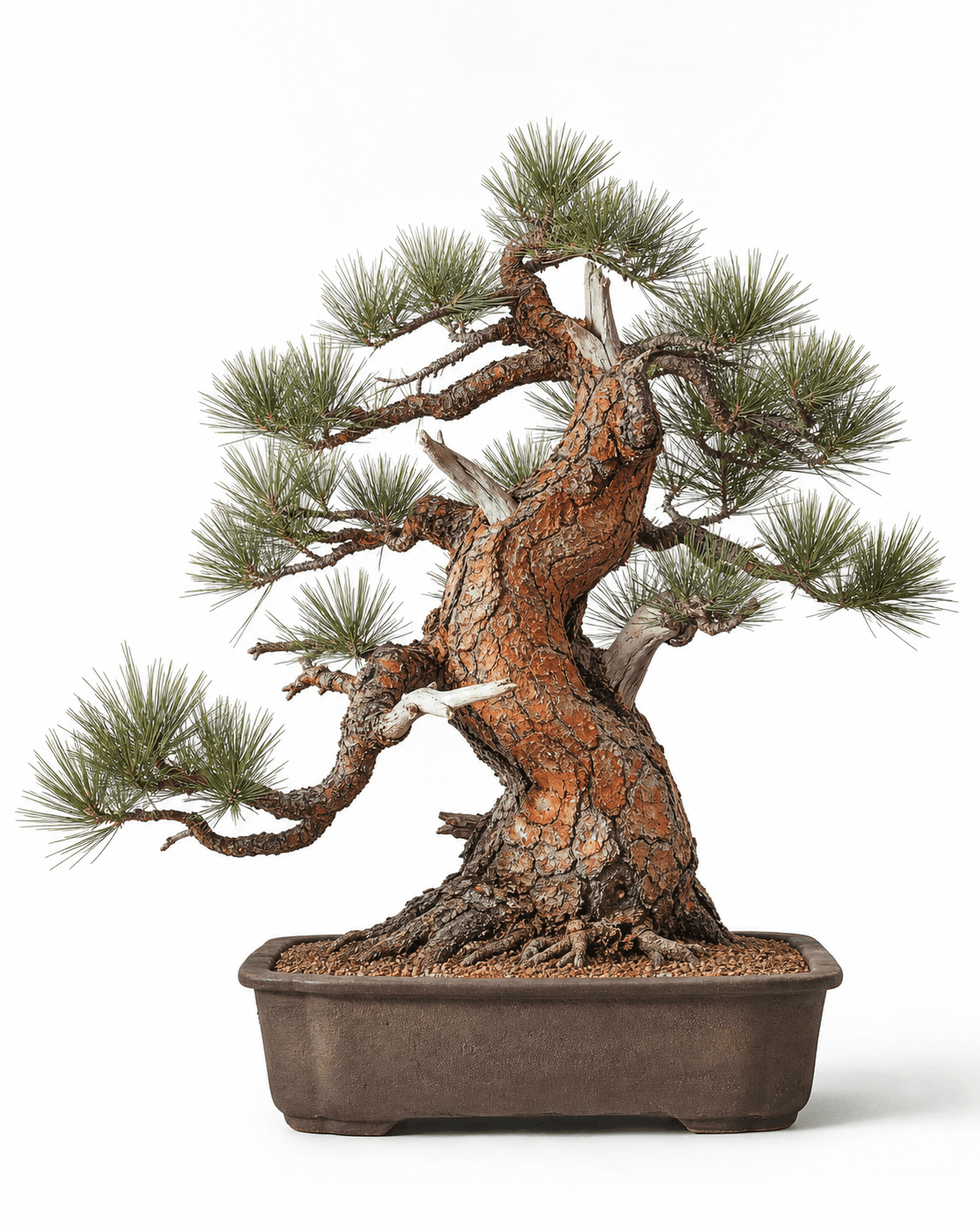
Translate it into design by age and place: orange plated bark, open canopies, low broken tops, exposed dead branches, rocky roots, crossed trunks in harsh stands, and sparse but deliberate foliage masses that read as western forest rather than refined Japanese black pine. Bonsai Mirai / AsymmetryUSDA Forest Service SilvicsUSDA Forest Service FEIS
Reading the tree
Read development, refinement, and the third-year needles before choosing work.
The core Mirai timing signal is third-year needle drop. When old needles loosen easily from the branch, even while still green, the season has reached the Ponderosa work window for pruning, shoot selection, needle cleanup, and heavy bending. Bonsai Mirai Library
A development-stage Ponderosa should look strong before it looks small. Water and fertilize enough to create needle mass, transpiration, and sugars, because that surplus is what drives adventitious buds on usable interior wood. Bonsai Mirai LibraryBonsai Mirai
A refinement-stage Ponderosa is different. Once interior buds have become actual foliage, container size and more growing points distribute finite root-supplied energy across more needles, and the individual needles shorten without starving the tree. Bonsai Mirai LibraryBonsai Mirai
Stage determines restraint. Newly collected trees may need roughly three years before pruning, needle plucking, or heavy foliage removal, with only dead-needle cleanup and pest or disease response during recovery. Bonsai Mirai Library
Pruning
Let candles extend, then work from actualized buds in the fall window.
Native Ponderosa foliage is single-flush. Candle pinching and native-foliage decandling redirect energy into fewer remaining needles, lengthen growth, and reduce the photosynthetic mass that produces back-budding. Bonsai Mirai Library
The safe refinement move is to prune strong tips back to interior buds that have already become needle-bearing shoots. That balances energy through structure rather than through wholesale needle removal. Bonsai Mirai Library
Old-needle cleanup belongs after the current season has hardened and third-year needles begin to shed. Cleaning during spring candle elongation pushes remaining needles longer because the root system keeps supplying the same seasonal energy to less foliage. Bonsai Mirai Library
Grafted trees change the rule only where the scion changes the physiology. A black-pine-grafted Ponderosa rootstock can be candle-pruned on the black pine foliage because the foliage type governs multi-flush behavior. Bonsai Mirai LibraryNational Bonsai Foundation
Roots
Collected Ponderosa roots are converted in phases, never all at once.
Mirai yamadori repotting guidance waits for strong foliar growth before the first major repot, often about two to two and a half years after collection. Fat terminal buds and long needles indicate the root system has enough recovery to support the work. Bonsai Mirai Library
The first limitation usually controls the repot. On crack-root material, reduce the long anchor roots that prevent a usable container, then preserve the rest of the functioning root system and native core until later cycles. Bonsai Mirai Library
Bare-rooting is outside the Ponderosa plan. Leave some original substrate and living root mass, set granular soil around the periphery to receive new fine roots, and address the old core in a later repot once vigor proves recovery. Bonsai Mirai Library
Large asymmetric yamadori need physical security as much as soil. Cut apart wooden collection boxes, brace the trunk before freeing the final wall, tie down along the root plane, and block rotation with props when wire alone cannot prevent shear. Bonsai Mirai Library
Aftercare is conservative. Recently repotted collected Ponderosa should stay above roughly 40 F to support root regeneration at cut sites, with protection from hard freeze, drying wind, and excess wetness until new growth confirms uptake. Bonsai Mirai Library
Soil and pot
Use a dry-leaning, oxygen-rich pine mix and size the pot to control vigor.
Mirai Ponderosa method specifies a 1:1:1 akadama:pumice:lava mix with the 1/16 in fines removed and roughly 1/8 to 1/4 in particles retained. The goal is lower moisture retention and higher oxygen than a standard pine soil. Bonsai Mirai Library
That mix still requires full watering. Oregon State and NC State both describe Ponderosa as drought tolerant in landscape culture, but Mirai separates ground survival from container cultivation: water drives photosynthesis, bud formation, and back-budding. Oregon State Landscape PlantsNC State ExtensionBonsai Mirai Library
Container size is part of needle management. Oversized pots produce excess root strength and coarse long-needle growth. Once the tree has enough branches and buds, a proportionate smaller container helps distribute energy across more growing points. Bonsai Mirai LibraryBonsai Mirai
Pot character should match the species. Straight-walled ovals, rugged rectangles, rimless forms, stone-like slabs, and restrained earth colors usually support the heavy bark, long needles, and western mountain image better than ornate containers. Bonsai Mirai LibraryBonsai Mirai / Asymmetry
Climate
Cold dormancy is part of the care plan, while heat tolerance has limits.
NC State lists USDA Zones 3a to 7b for landscape Ponderosa. A bonsai pot narrows that safety margin because roots are elevated, shallow, and exposed to drying wind. NC State Extension
Mirai Ponderosa method treats winter cold as a health requirement and gives roughly 72 hours below 32 F as a practical dormancy minimum. In warm-winter regions such as Florida, coastal Texas, or mild Southern California, trees can hold for several years before reserves decline. Bonsai Mirai Library
Cold protection is aimed at the container, not the living room. Mirai recommends setting pots on the ground below about 25 F so the soil mass gains buffering from the earth, while still preserving outdoor dormancy. Bonsai Mirai Library
Heat also has a ceiling. Mirai records heat-event injury around extreme conditions near 117 F, where low-water-mobility branches and bark can sunburn. In hot regions, cool the pot, protect bark, water fully, and avoid heavy work during heat stress. Bonsai Mirai Library
Pests and disease
Most problems start with stress, wounds, moisture imbalance, or weak roots.
USDA Silvics lists bark beetles, especially Dendroctonus species, among the most damaging Ponderosa insects, with western pine beetle and mountain pine beetle important in different regions. UC IPM also lists western pine beetle on Coulter and Ponderosa pines and describes pitch tubes and gallery patterns as diagnostic clues. USDA Forest Service SilvicsUC IPM
Needle disease requires careful diagnosis. UMN Extension says Dothistroma causes needle browning and drop, favors cool moist conditions, and damages Austrian and Ponderosa pines strongly. Mirai Q&A ties Dothistroma on Ponderosa to water and oxygen imbalance and advises against repotting an already photosynthesis-impaired tree the next season. University of Minnesota ExtensionBonsai Mirai Library
USDA Silvics identifies Elytroderma deformans as the most serious foliage disease across Ponderosa range, and also lists dwarf mistletoe, root diseases, rusts, heart rots, defoliators, pine tip moths, and Ips engravers. USDA Forest Service Silvics
Oregon State adds a practical pruning warning for its region: Sequoia pitch moth attacks around injuries and pruning cuts, and it recommends pruning only from October through January in that context. Bonsai pruning should still follow the local third-year needle signal, with regional pest pressure shaping wound timing. Oregon State Landscape PlantsBonsai Mirai Library
Wiring
Bend during fall strength and watch for tear signals instead of hiding them.
Mirai concentrates Ponderosa structural, secondary, and tertiary work in the fall third-year needle-drop window, when carbohydrate reserves and vascular activity support repair. Bonsai Mirai Library
Ponderosa bends by tearing before it breaks, so visible tissue signals matter. Mirai cautions against raffia for Ponderosa heavy bends because it can hide the white ring or opening bark that tells the operator to stop. Bonsai Mirai Library
Use guy wires, rebar, and adequate copper where the shoulder needs movement. Guy wires move the point of origin, while structural wire controls the outer line. Rebar must brace against trunk or deadwood contact points, never against a ceramic pot. Bonsai Mirai Library
Expect slow memory. Sparse collected branches may need years of support, and Mirai notes that structural wire on Ponderosa can need roughly eight to ten years before the branch holds the form without rebound. Bonsai Mirai Library
Rotate foliage into light when a branch is moved. Needles left upside down after a dramatic bend can scorch and die because the old underside is suddenly exposed. Bonsai Mirai Library
Propagation
Seed and grafting are realistic; collected old roots require legal and ethical care.
NC State lists seed as the recommended propagation strategy. For bonsai, seedlings are useful for learning pine timing, creating forests, or developing young trunks, but they will not quickly produce the aged bark and deadwood that make collected Ponderosa famous. NC State ExtensionBonsai Mirai / Asymmetry
Grafting is central in advanced Ponderosa work. Mirai corpus files cover black pine and Scots pine scions on Ponderosa rootstock, with success shaped by host vigor, branch orientation, graft timing, and protection from freeze or rain at the union. Bonsai Mirai Library
The rootstock can be valuable even when native foliage is too large for a refined image. The archived National Bonsai Foundation collection page documents a Japanese black pine whose trunk is old Ponderosa with grafted black pine branches, a public example of the conversion strategy. National Bonsai Foundation
Cuttings and air layers are not the standard path for ordinary Ponderosa bonsai. Use seed, grafting, or legally collected material, and record provenance because regional varieties and climate histories affect expectations. Flora of North AmericaBonsai Mirai Library
Sourcing
Buy recovery, legality, and scale before buying a dramatic trunk.
Quality Ponderosa bonsai material is often yamadori because old bark, sparse branches, contorted movement, and natural deadwood come from difficult western habitats. Legal permission, low-impact collection, and realistic aftercare are part of the source quality. Bonsai Mirai LibraryNational Bonsai Foundation
A good candidate has strong buds, live productive needles, signs of post-collection growth, enough branch options, a root mass that can be staged into a container, and no urgent need for styling and repotting in the same season. Bonsai Mirai Library
Avoid recently collected trees sold without recovery history, roots trapped in sour organic mountain soil, weak short candles, severe needle disease, bark beetle evidence, unstable heavy trunks, and tags that confuse Ponderosa with Jeffrey pine, Austrian pine, or generic yellow pine. USDA Forest Service SilvicsNC State ExtensionFlora of North America
Scale is a purchase decision. Mirai Ponderosa method gives a practical native-foliage scale floor around 12 to 18 in. Shohin ambitions usually require grafted finer foliage rather than native Ponderosa needles. Bonsai Mirai LibraryNational Bonsai Foundation
Troubleshooting
Diagnose by needles, roots, season, and the last major operation.
Symptom: old interior needles yellow and drop in fall. Likely cause: normal third-year needle shedding. Fix: use the loosened old needles as a timing signal for cleaning and work, then preserve productive current foliage. Bonsai Mirai Library
Symptom: long coarse needles after strong growth. Likely cause: development strength, oversized container, low bud count, or too few growing points. Fix: build back buds first, let them become foliage, then shift to refinement feeding and container control. Bonsai Mirai LibraryBonsai Mirai
Symptom: needles brown with bands, older needles fall, or lower crown thins. Likely cause: Dothistroma or another needle disease, often with moisture and airflow pressure. Fix: improve airflow, keep irrigation off needles, diagnose locally, and avoid repotting while foliage capacity is reduced. University of Minnesota ExtensionBonsai Mirai Library
Symptom: pitch tubes, boring dust, sudden branch or trunk decline. Likely cause: bark beetles or wound-associated insects. Fix: identify galleries or pests with local extension help, reduce stress, and avoid creating unnecessary wounds during high-risk periods. UC IPMUSDA Forest Service SilvicsOregon State Landscape Plants
Symptom: no back buds after pruning. Likely cause: insufficient water, fertilizer, light, or needle mass, or pruning without opening the branch to sun and wind. Fix: rebuild vigor and reposition branches so released buds receive light. Bonsai Mirai Library
Symptom: decline after moving to a warm winter climate. Likely cause: insufficient cold dormancy and gradual reserve depletion. Fix: provide true outdoor winter cold or overwinter the tree in a colder appropriate site. Bonsai Mirai Library
Symptom: root weakness after repotting. Likely cause: bare-rooting, cutting too many crack roots, poor tie-down, stale core soil, or post-repot cold and wet. Fix: stabilize the trunk, protect from extremes, and wait for strong growth before more work. Bonsai Mirai Library
Design
Style for bark, mass, sparse age, and western mountain character.
Ponderosa is a coarse pine with long needles, thick branches, and substantial vascular structure. Mirai styling files recommend leaning into bark, movement, branch mass, and deadwood rather than forcing fine Japanese black pine detail onto native foliage. Bonsai Mirai Library
USDA Silvics describes open crowns, thick old bark, wildlife snags, and fire-scarred forests. Those traits support rugged informal uprights, literati, slants, low broken apices, and forest-on-rock compositions that show struggle, light, and open western space. USDA Forest Service SilvicsBonsai Mirai / Asymmetry
Deadwood should read as pine. Mirai pine-deadwood method preserves cylindrical branch character, lets bark release over several years, and uses tearing or breaking gestures rather than juniper-style exposed interior grain. Bonsai Mirai Library
For high-elevation or exposed images, Mirai Ponderosa guidance favors a low or flat apex because tall domes carry snow-load and sail problems in the habitat. The apex should read from the highest structural point, with competing features subordinated. Bonsai Mirai Library
Forests can break conventional spacing when the ecology supports it. Mirai forest design uses crossing or intertwined trunks in a Ponderosa-on-granite image to express survival pressure in harsh Rocky Mountain stands. Bonsai Mirai LibraryBonsai Mirai / Asymmetry
Forms
Variety, cork bark, and grafted foliage change expectations.
Flora of North America lists three lower taxa in the flora, including var. ponderosa and var. scopulorum. Mirai Ponderosa maintenance identifies var. scopulorum as the preferred bonsai form for shorter needles, compact growth, back-budding, contortion, and deadwood-rich character. Flora of North AmericaBonsai Mirai Library
Kew currently accepts Pinus arizonica separately while FNA older language includes an Arizona variety. Keep Arizona pine, Jeffrey pine, and Ponderosa tags separate when applying hardiness, range, and pruning expectations. Kew POWOFlora of North AmericaUSDA Forest Service Silvics
Oregon State notes cultivated selections, usually dwarf forms such as Dixie. Dwarf selections can help scale, but rootstock, graft quality, cold history, and vigor still decide bonsai usefulness. Oregon State Landscape Plants
Cork-bark Ponderosa needs extra caution. Mirai cork-bark Ponderosa coverage treats corking as a genetic mutation that affects bending, repotting, decandling assumptions, and grafting strategy across pines. Bonsai Mirai Library
Scion-grafted Ponderosa should be labeled honestly. A black pine, Scots pine, red pine, or cork-bark pine scion carries its own foliage behavior, while the Ponderosa trunk and roots carry the old bark and water-conduit character. Bonsai Mirai LibraryNational Bonsai Foundation
History
North American bonsai gave Ponderosa a public stage.
The archived National Bonsai Foundation historical spotlight documents a major Ponderosa in the North American collection: collected by Dan Robinson from a rocky area of Gifford Pinchot National Forest, in training since 1966, and donated to the museum in 1980 for the U.S. Forest Service anniversary. National Bonsai Foundation
That tree also shows why scale matters. The NBF article describes a large bonsai around 56 in tall and wide, with large needles handled through careful pruning and fertilization rather than miniature expectations. National Bonsai Foundation
The same collection page also records a Japanese black pine whose trunk is old Ponderosa with black pine branches grafted on. That public example captures a larger North American practice: keeping Ponderosa age and bark while using finer pine foliage where the design calls for refinement. National Bonsai Foundation
In forest ecology, USDA Silvics frames Ponderosa as a major timber, wildlife, recreation, and aesthetic tree of western North America. In bonsai, its strongest role is similar: a native western icon that carries place, fire, bark, and age into a container. USDA Forest Service SilvicsBonsai Mirai / Asymmetry
Species questions
Answer the beginner questions before styling.
Can Ponderosa pine be grown as bonsai?
Yes. Ponderosa pine can be outstanding outdoor bonsai when it gets full sun, true winter dormancy, oxygen-rich soil, complete watering, staged root work, and fall timing based on third-year needle drop.
Can Ponderosa pine bonsai live indoors?
No. Ponderosa pine is an outdoor cold-dormant pine. Indoor light and warm winter storage undermine the seasonal physiology the tree needs.
Should I decandle Ponderosa pine bonsai?
Do not decandle native Ponderosa foliage. It is a long-needle single-flush pine. Decandling applies only to grafted multi-flush scions, such as Japanese black pine foliage grafted onto a Ponderosa trunk.
How do you reduce Ponderosa pine needle length?
Build vigor first, create back buds, let those buds become needle mass, then refine feeding and container strength. Starving water, plucking needles, or pinching candles works against the back-budding process.
When should Ponderosa pine bonsai be pruned?
Use the fall window when third-year needles loosen from the branch. Depending on climate, that signal can arrive from late summer into November. Avoid pruning after full dormancy as a default habit.
When should I repot collected Ponderosa pine?
Wait until the tree has recovered with strong growth, often around two to two and a half years after collection. Preserve part of the original root mass, never bare-root, and convert old field soil in stages.
What soil works for Ponderosa pine bonsai?
Mirai Ponderosa method uses 1:1:1 akadama:pumice:lava with 1/16 in fines removed and roughly 1/8 to 1/4 in particles retained. The target is high oxygen with enough water to sustain active roots.
How cold hardy is Ponderosa pine bonsai?
NC State lists landscape hardiness at USDA Zones 3a to 7b. Bonsai roots in pots need protection during deep cold, while the tree still needs real winter dormancy outdoors.
Why is my Ponderosa pine dropping old needles?
Old third-year needles normally loosen and drop in fall. Widespread browning, banded needles, or thinning outside that pattern should trigger checks for root oxygen, water stress, Dothistroma, other needle casts, and pests.
Is Ponderosa pine good for small bonsai?
Native Ponderosa foliage has a practical scale floor around 12 to 18 in. Very small bonsai usually need grafted finer foliage or a different pine species.
Sources
Species advice needs source discipline.
Next decisions
Plan the operation before copying the calendar.
A good care note for Ponderosa pine records the tree's stage, the work done, and the aftercare used. That record matters more than a month-name rule.
Related species
Compare nearby trees before transferring advice.
Jeffrey pine
Pinus jeffreyi
Bishop pine
Pinus muricata
Sugar pine
Pinus lambertiana
Eastern white pine
Pinus strobus
Western white pine
Pinus monticola