
Species guide
Aleppo Pine Bonsai Care
Pinus halepensis
Aleppo pine is an outdoor Mediterranean pine with paired needles, persistent cones, strong drought tolerance in the ground, and a warm-climate growth rhythm that makes ordinary black-pine timing unreliable. Treat confirmed Pinus halepensis as Pine > Outlier Pine: build roots and needle mass first, reserve full decandling for rare transition work, and let any juvenile second flush harden before more pruning.
The local Mirai corpus has no dedicated Aleppo-only file, but defining-outlier-pines, austrian-black-pine-shoot-selection, pinyon-pine-design, five-needle-post-flush-pruning, and Monterey pine files name Pinus halepensis directly. Public sources from Kew, RHS, Oregon State, Utah State, the European Atlas, Forest Research, and UC IPM ground taxonomy, habitat, hardiness, morphology, pests, and disease risk.
Updated June 7, 2026. Written by EntGrove Editorial. Last verified June 7, 2026.
Care fingerprint
Read the species through its shared care pattern.
Protect older needles, avoid aggressive decandling assumptions, and adjust work to slow recovery, rare outlier decandling, and species-specific bud behavior. Use this as the starting point before local conditions and tree strength refine the calendar.
Identify flush behavior
Single-flush, multiflush, white pine, and compact pine groups have different pruning windows and different risk levels.
Avoid default decandling
Japanese black pine methods do not transfer safely to every pine, especially slow, weak, collected, or five-needle trees.
Use needles as strength data
Needle length, color, age, and density help show where vigor is strong, weak, or becoming shaded.
Care cadence
The calendar starts with the tree's seasonal state.
Placement
Timing: Grow outdoors in full sun and moving air. In Zone 8 or colder container culture, protect the pot from hard freezes; in hot desert gardens, cool the container while keeping foliage bright.
Watch for: Indoor holiday-tree treatment, shaded patios, reflected-wall heat, dry wind after repotting, and cold wet benches in winter.
RHSOregon State Landscape PlantsUtah State University ExtensionWatering
Timing: Water through the entire root mass, then let air return. Aleppo pine is drought resistant in the ground, but a bonsai pot needs even hydration before controlled drying.
Watch for: Hydrophobic nursery cores, runoff around old peat, wet cold soil, dry tips during heat, and using drought as the main needle-shortening tool.
European Atlas of Forest Tree SpeciesUtah State University ExtensionBonsai Mirai LibraryDevelopment feeding
Timing: Feed strongly while building trunk, root mass, branch length, and needle mass. Mirai outlier-pine guidance requires stored energy before any decandling transition.
Watch for: Trying to force interior buds before the tree has long healthy shoots, reliable roots, and enough foliage to rebuild after work.
Bonsai Mirai LibraryRefinement feeding
Timing: After a decandling response has hardened and shoot selection is complete, moderate spring feeding so new growth does not run coarse. Resume support when recovery is visible.
Watch for: Heavy nitrogen on a finished crown, weak interior buds, and starving a tree that still needs back-bud growth to become useful branches.
Bonsai Mirai LibraryOutlier decandling
Timing: Use full decandling only on strong prepared trees, generally no more often than every 3 to 5 years or 5 to 6 years depending on response. Mediterranean outlier timing is early June in the Northern Hemisphere.
Watch for: Annual black-pine calendars, weak candles, recent root work, partial canopy decandling, and needle plucking at the same time.
Bonsai Mirai LibraryPost-decandling aftercare
Timing: Let the juvenile second flush harden completely. The following year, feed enough to mature the juvenile growth, then shift toward conservative single-flush management based on the tree response.
Watch for: Cutting juvenile shoots short before hardening, treating the flush as finished ramification, and repeating the stress before stored energy returns.
Bonsai Mirai LibraryRepotting
Timing: Repot in spring as buds swell and recovery warmth is available. Keep the tree tightly secured and preserve enough roots and foliage to power recovery.
Watch for: Bare-rooting old nursery soil, combining heavy root reduction with full styling, and leaving wet organic cores sealed inside new mineral soil.
Bonsai Mirai LibraryWiring
Timing: Wire only strong trees, preferably when the tree is energy-positive and branch movement can be checked often. Set primary line before refining small shoots.
Watch for: Wire bite on young smooth bark, crushed paired needles, bends after heavy root work, and forcing every shoot into dense black-pine pad geometry.
Bonsai Mirai LibraryOregon State Landscape PlantsPests and disease
Timing: Inspect during warm dry weather, humid disease periods, after drought stress, and after import or nursery purchase. Use local diagnosis for resin, tip dieback, nests, or fast browning.
Watch for: Adelgids, conifer aphids, sawfly larvae, pine shoot moth, honey fungus, needle cast, pine processionary moth in risk regions, pitch canker, and Aleppo pine blight symptoms.
RHSForest ResearchUC IPMSpecies guide
Apply the species profile before copying another tree's calendar.
At a glance
Aleppo pine is a Mediterranean outlier pine, not a black-pine substitute.
Kew accepts Pinus halepensis Mill. and gives its native range as the Mediterranean. RHS lists Aleppo pine and Jerusalem pine, family Pinaceae, evergreen foliage, full sun, well-drained soil, and H5 hardiness. Kew POWORHS
For bonsai, the category is Pine > Outlier Pine. Mirai names Aleppo pine with Italian stone pine and pinyon as Mediterranean outlier material that may be decandled rarely to create interior buds, then managed by the response the tree actually gives. Bonsai Mirai Library
The short care spec is outdoor full sun, thorough watering followed by oxygen return, well-drained mineral soil, spring root work, careful staged pruning, and rare early-summer decandling only when roughly 70 percent of the canopy is strong. Bonsai Mirai LibraryOregon State Landscape Plants
Wild habitat
Its wild story is heat, drought, coastal exposure, poor soil, and fire recovery.
The European Atlas describes Aleppo pine as a drought-tolerant, fast-growing Mediterranean conifer that widely covers Mediterranean coasts, especially the western basin, and is well adapted to dry summer conditions. European Atlas of Forest Tree Species
Its habitat is mainly lower altitude, mostly thermo- and meso-Mediterranean, from arid or semiarid to humid climates. The Atlas gives 350 to 700 mm precipitation, marly limestone and marl sites, and frequent presence in garrigue, maquis, abandoned land, and burned areas. European Atlas of Forest Tree Species
Care follows that habitat: high light, fast drainage, full watering, root-zone oxygen, and strong heat awareness. Oregon State adds that it takes poor soil, desert heat, and sea coast, while Utah State gives high drought, salt, and alkalinity tolerance. Oregon State Landscape PlantsUtah State University ExtensionEuropean Atlas of Forest Tree Species
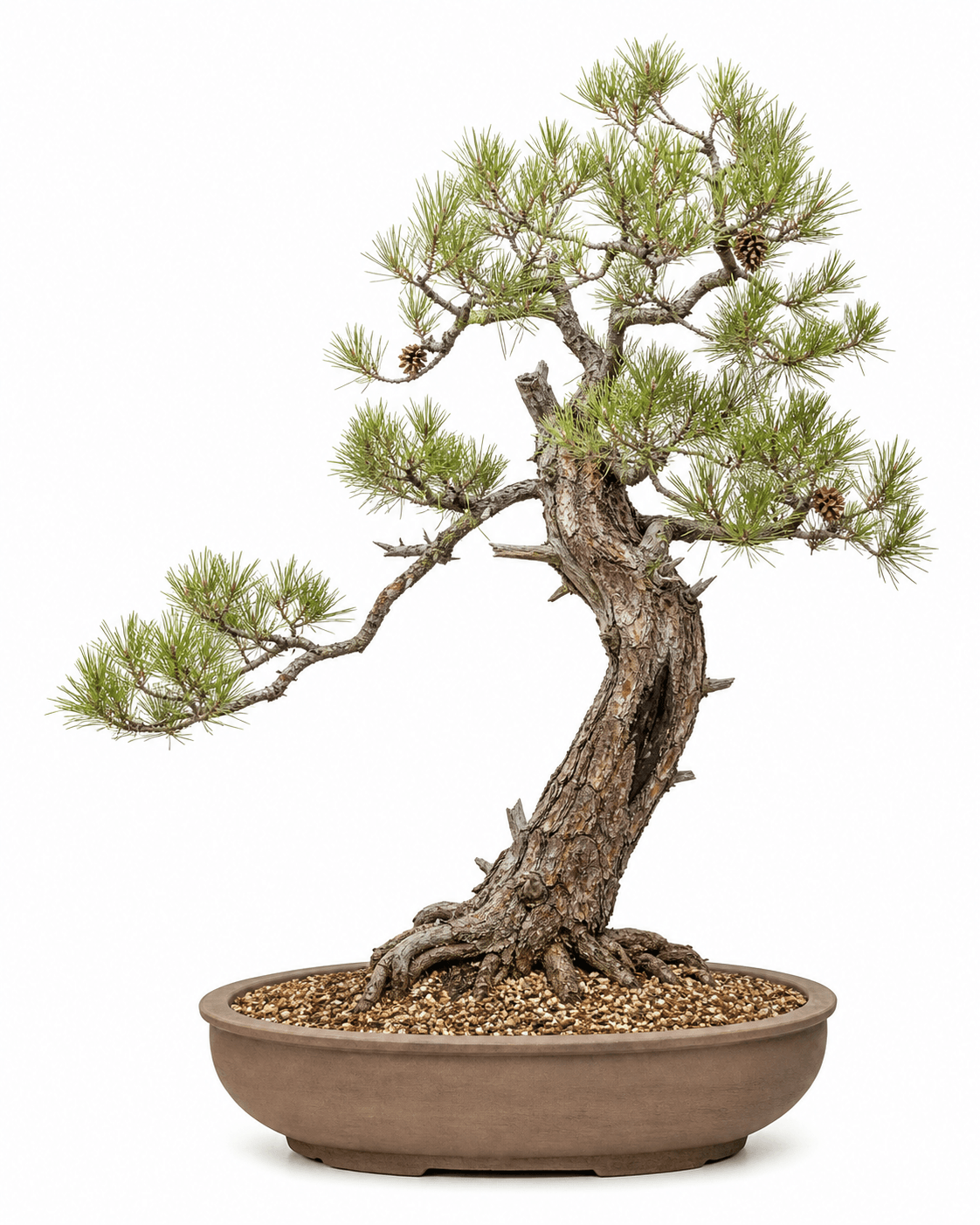
Design follows the same habitat. Use open crowns, exposed branch structure, twisted or bowed trunks, persistent cones, fire-aged bark, and sparse dry-slope negative space rather than dense tiered pads. Oregon State Landscape PlantsBonsai Mirai / Asymmetry
Reading the tree
Read roots, candle strength, interior needles, and juvenile response before choosing work.
Mirai outlier-pine guidance makes root strength the first question. Outlier pines rarely produce useful interior buds without deliberate energy accumulation, so a weak Aleppo pine should be grown, watered, and fed before refinement. Bonsai Mirai Library
A prepared tree has strong elongating candles across most of the canopy, retained old needles, a rootball that wets and dries evenly, and branch positions where future buds can become actual design options. Bonsai Mirai Library
Weak candidates show short candles, dull foliage, wet or hydrophobic nursery cores, sparse interiors, or recent heavy root work. Those trees need cultural repair rather than decandling. Bonsai Mirai Library
Juvenile growth after a decandling pass is expected in Mediterranean outlier pines. Mirai describes long internodes, pointed leaf scales, green stems, and no useful adventitious buds in those scale crotches, so the grower must let that response harden. Bonsai Mirai Library
Technique
Use decandling as a rare back-budding transition, then shoot-select patiently.
Mirai defining-outlier-pines names Aleppo pine directly. The purpose of full decandling is to force back budding on reluctant interior branches, not to shorten needles on an already refined canopy. Bonsai Mirai Library
Readiness is stricter than a calendar. Mirai uses roughly 70 percent strong elongating candles as the threshold; if only one branch is strong, continue building energy across the whole tree. Bonsai Mirai Library
The operation is complete or skipped. Remove every growing tip in the chosen full operation, including strong, medium, weak, and unemerged tips, so auxin suppression is released across the canopy. Bonsai Mirai Library
Mediterranean outlier pines are cut in early June in the Northern Hemisphere so the juvenile second flush can mature before the late-summer shutdown. Do not needle-pluck during that same operation because the tree lacks the water mobility to tolerate both stresses. Bonsai Mirai Library
After the flush hardens, shoot selection becomes the next craft step. Reduce crowded clusters to two useful lateral shoots, protect intermediate strength, and avoid creating swollen knuckles at every junction. Bonsai Mirai Library
Between decandling cycles, treat Aleppo pine conservatively. Let growth harden, prune for structure, protect enough needles, and wait multiple seasons before considering another full transition. Bonsai Mirai Library
Roots
Repot as a root-oxygen project and keep the foliage battery intact.
Repot in spring as buds swell. Mediterranean outlier pine care depends on an active root system, so heavy pruning, wiring, or decandling should be separated from major root work unless the tree is exceptionally strong. Bonsai Mirai Library
Mirai pinyon and outlier guidance treats these roots as more sensitive than Ponderosa or Japanese black pine. Stage old nursery or field soil conversion and keep the tree tied down firmly so new roots are not torn. Bonsai Mirai Library
Old container stock often contains peat or clay that dries differently from fresh bonsai soil. Remove the part that limits water movement first, keep enough working roots, and check the center after watering. Bonsai Mirai Library
After heavy root work, preserve needles, moderate exposure, and water by soil response. Existing foliage is the recovery battery that rebuilds roots and mycorrhizal function. Bonsai Mirai Library
Soil and pot
Use sharp mineral soil and a pot that keeps Mediterranean roots breathing.
Mirai outlier guidance gives Mediterranean outlier pines a standard 1:1:1 akadama:pumice:lava mix with fines sieved out. The goal is hydration followed by high oxygen rather than sustained wetness. Bonsai Mirai Library
RHS says Aleppo pine grows in any well-drained soil in full sun. Oregon State adds poor soil, desert heat, and sea coast tolerance; Utah State adds high drought, salt, and alkalinity tolerance. RHSOregon State Landscape PlantsUtah State University Extension
Adjust soil by climate. Cool wet gardens can use a sharper mix with more pumice or lava. Hot dry gardens may keep more akadama, use slightly deeper pots during development, and shade the pot rather than the foliage. Bonsai Mirai Library
Pot choice should reinforce a warm open pine image. Unglazed rectangles, ovals, soft rectangles, and rugged slabs suit an old Mediterranean crown; very shallow pots should wait until roots are refined. Bonsai Mirai / AsymmetryEuropean Atlas of Forest Tree Species
Climate
Aleppo pine likes heat, but a shallow pot changes the margin.
Landscape hardiness sources cluster around warm-zone use. Oregon State lists Zone 8, Utah State lists Zones 8 to 10 and warns against regular hard frosts, while RHS rates the species H5 on its UK scale. Oregon State Landscape PlantsUtah State University ExtensionRHS
Mediterranean and coastal gardens can keep Aleppo pine in full sun with strong airflow and sharp drainage. Rainy winters need protection from stale wet soil rather than warm indoor storage. RHSOregon State Landscape PlantsBonsai Mirai Library
Hot desert gardens should respect the pot. Utah State says the species is adapted to hot dry desert climates and needs little water in landscape use, but bonsai roots need cooler pots and steady watering during extremes. Utah State University Extension
Cold-winter gardens can grow Aleppo pine only with protection that keeps roots from repeated hard freezes. Keep light and seasonal signals, and avoid warm indoor overwintering that weakens pine physiology. Oregon State Landscape PlantsBonsai Mirai Library
Pests
Watch processionary moth, pitch canker, needle disease, blights, aphids, and sawflies.
RHS lists susceptibility to adelgids, conifer aphid, sawfly larvae, pine shoot moth, honey fungus, and needle cast diseases. These are broad pine warnings that become more serious after stress, stale roots, or weak light. RHS
Forest Research lists Aleppo pine as particularly susceptible to pine processionary moth. It describes winter and early-spring processions, foliage nests, defoliation, and irritating caterpillar hairs that can affect people and animals. Forest Research
The European Atlas names Mediterranean pests including pine processionary moth, bark beetle relatives, Monochamus, scale insects, mites, and Hylurgus, plus canker threats and large-scale dieback that can begin in lower branches. European Atlas of Forest Tree Species
UC IPM lists Aleppo pine as susceptible to pitch canker in greenhouse and field contexts. Resinous branch tips, wilting, brown needles, and bare branch ends deserve local diagnosis before pruning or moving material. UC IPM
Wiring
Wire for open movement, not dense pads.
Aleppo pine naturally develops irregular, open crowns with ascending branches and twisted or bowed trunks. Oregon State describes young trees as columnar, then umbrella or globose when older. Oregon State Landscape Plants
Set trunk line, primary branch angle, and crown direction before detail wiring. Mirai pine design guidance starts with the species character and the defining branch rather than wiring every shoot into equal shelves. Bonsai Mirai / AsymmetryBonsai Mirai Library
Protect smooth young bark and check wire during warm growth. Older Aleppo bark becomes reddish brown and furrowed, and avoidable wire scars can remain visually loud on future trunk lines. Oregon State Landscape PlantsUtah State University Extension
After root work or decandling, defer heavy bends until recovery is clear. Outlier pine styling should leave enough needle mass to build vascular tissue and future buds. Bonsai Mirai Library
Propagation
Seed is standard; collection and grafting need identity and legality.
RHS lists seed propagation for Aleppo pine. The European Atlas describes Aleppo pine as an obligate seeder with serotinous cones that can remain closed and open after fire heat. RHSEuropean Atlas of Forest Tree Species
Oregon State says cones usually mature in the third year and may remain attached several years after ripening. For bonsai, seedling material gives the cleanest root control but takes time to develop bark and trunk character. Oregon State Landscape Plants
Grafted material is possible in pine culture, but the public sources reviewed for this page do not establish a bonsai-specific Aleppo cultivar calendar. Inspect graft union, rootstock, taper, and branch placement. Bonsai Mirai Library
Air-layering should be treated as experimental for pines. Mirai pine guidance favors seed, nursery stock, documented grafted material, or legally sourced collected material over planning a layer. Bonsai Mirai Library
Sourcing
Buy confirmed outdoor material with recoverable roots and enough needle mass.
Good material has a confirmed Pinus halepensis label, outdoor growth history, strong candles, retained needles, a rootball that can be staged into mineral soil, and trunk movement that suits a medium or large pine. Kew POWOOregon State Landscape PlantsBonsai Mirai Library
Aleppo pine can be confused with Italian stone pine, Turkish pine, Austrian black pine, and generic Jerusalem or Mediterranean pine labels. Oregon State lists Aleppo pine near Italian stone pine and other pines in the genus index, so confirm the Latin name when technique matters. Oregon State Landscape Plants
Avoid weak seedlings kept warm indoors, compacted wet nursery peat, sparse interiors, resinous tip dieback, processionary nests in risk regions, or collected material without legal permission and aftercare history. Forest ResearchUC IPMBonsai Mirai Library
Regional status matters. Oregon State says Aleppo pine is now common in California and the Southwest. Check local rules before collecting, moving, or planting seed-grown material outside a pot. Oregon State Landscape Plants
Troubleshooting
Most failures trace to stale roots, weak preparation, pest stress, or copied black-pine timing.
Symptom: no useful interior buds. Likely cause: insufficient stored energy, too little needle mass, or a branch that has not been prepared. Fix: grow the tree strongly, preserve needles, and build roots before the next technique. Bonsai Mirai Library
Symptom: decline after decandling. Likely cause: weak candles, partial work, simultaneous needle removal, or cutting the juvenile flush before hardening. Fix: stop pruning, rebuild foliage and roots, and wait multiple seasons before another transition. Bonsai Mirai Library
Symptom: long juvenile second flush. Likely cause: expected Mediterranean outlier response. Fix: let it harden, feed for maturity the following year, and shoot-select only after the branch positions can be read. Bonsai Mirai Library
Symptom: needles yellow while soil stays wet. Likely cause: stale organic core, poor drainage, or reduced transpiration after foliage loss. Fix: water by root response, improve oxygen, and avoid fertilizer until new root activity is visible. Bonsai Mirai LibraryRHS
Symptom: resinous wilted tips or bare branch ends. Likely cause: pitch canker, Diplodia-like blight, insect injury, drought dieback, or Aleppo pine blight. Fix: isolate, improve culture, and get local diagnosis before cutting broadly. UC IPM
Symptom: white nests, caterpillar processions, or sudden defoliation in Mediterranean or European-risk regions. Likely cause: pine processionary moth. Fix: avoid contact, keep pets away, and follow local plant-health reporting or control guidance. Forest Research
Design
Design from dry slopes, fire, open crowns, and Mediterranean light.
The European Atlas describes Aleppo pine as drought tolerant, fire resilient, and common in coastal Mediterranean zones, with cones that support quick post-fire regeneration. That ecology supports open, irregular, resilient designs. European Atlas of Forest Tree Species
Oregon State describes short ascending branches, a columnar young habit, older umbrella or globose crowns, twisted trunks, light green needles, and cones that remain attached for years. Those are styling clues, not decorative facts. Oregon State Landscape Plants
The defining branch should explain the site: wind, dry slope, fire scar, old coastal grove, or exposed road-line pine. A strong trunk line and sparse crown usually read better than a compressed black-pine silhouette. Bonsai Mirai / Asymmetry
Use pine deadwood with restraint. Broken limbs, weathered branch stubs, subtle shari, and old fire-damage gestures can work; bright juniper-style live-dead contrast usually fights the warm bark and soft needles. Bonsai Mirai Library
Forms
Most bonsai decisions hinge on identity and provenance rather than named cultivars.
Kew accepts Pinus halepensis and lists synonyms including Pinus arabica, Pinus carica, Pinus hispanica, Pinus maritima, and others. Use the accepted name when separating Aleppo pine from Turkish pine, Italian stone pine, and Austrian black pine. Kew POWO
The European Atlas treats Aleppo pine and Turkish pine as systematically close species that can hybridize where they co-occur, while keeping them separate in the chapter. That is a useful warning for old Mediterranean labels. European Atlas of Forest Tree Species
Utah State notes an older Rehder view that treated it with Pinus eldarica, a name often used for Afghan or Eldarica pine in trade. Confirm labels before applying Aleppo outlier-pine timing. Utah State University Extension
The sources reviewed here did not establish named Aleppo pine bonsai cultivars. Treat provenance, root quality, vigor, cone behavior, and observed response as more important than a cultivar name. Bonsai Mirai LibraryOregon State Landscape Plants
History
Aleppo pine carries Mediterranean forestry, resin, honey, retsina, and fire history.
Kew records Pinus halepensis as first published by Philip Miller in 1768 and accepted today. Oregon State explains the epithet as referring to Halep or Aleppo. Kew POWOOregon State Landscape Plants
The European Atlas says Aleppo pine has been widely planted for soil protection and coastal wind breaks, especially between the 1930s and 1970s, and used for firewood, pulp, erosion control, resin, and honey production. European Atlas of Forest Tree Species
The same source links Aleppo and Turkish pine resin to ancient Greek amphora sealing and later to retsina. This history supports a warm old-Mediterranean design vocabulary that is different from Japanese coastal black pine. European Atlas of Forest Tree Species
Public bonsai documentation is thinner than for Japanese black pine or Scots pine. The strongest EntGrove treatment is method-led: name the outlier behavior, state the source-depth limit, and let ecology plus observed response guide the design. Bonsai Mirai LibraryBonsai Mirai / Asymmetry
Species questions
Answer the beginner questions before styling.
Can Aleppo pine be grown as bonsai?
Yes. Aleppo pine can be grown as outdoor bonsai when it receives full sun, mineral soil, careful watering, root oxygen, and enough scale for paired needles and open Mediterranean branch structure.
Can Aleppo pine bonsai live indoors?
No. Keep Aleppo pine outdoors. Indoor display should be brief because the tree needs full sun, airflow, and seasonal signals.
Is Aleppo pine a multiflush pine?
EntGrove places Aleppo pine in Outlier Pine. Mirai names Pinus halepensis as a Mediterranean outlier that can be decandled rarely for back budding, while annual Japanese black pine decandling cycles are too aggressive.
Should Aleppo pine be decandled?
Use full decandling only on strong prepared trees and generally no more often than every 3 to 5 years or longer. The goal is interior bud creation, not annual needle shortening.
When should Aleppo pine be decandled?
Mirai Mediterranean outlier guidance places the full decandling window around early June in the Northern Hemisphere, when enough season remains for the juvenile second flush to harden.
What soil works for Aleppo pine bonsai?
Use a fast-draining mineral pine mix such as akadama, pumice, and lava with fines controlled. The rootball should wet fully and then regain oxygen.
How cold hardy is Aleppo pine bonsai?
Landscape sources cluster around USDA Zone 8 to 10, while RHS rates it H5. Bonsai roots need protection from repeated hard freezes even when the species tolerates brief cold in the ground.
Why did my Aleppo pine push juvenile growth?
Juvenile growth after decandling is expected for Mediterranean outlier pines. Let that growth harden completely before shoot selection or further pruning.
What pests matter most for Aleppo pine bonsai?
Watch adelgids, conifer aphids, sawfly larvae, pine shoot moth, needle cast, honey fungus, pine processionary moth in risk regions, pitch canker, and stress-related tip dieback.
Is Aleppo pine good for small bonsai?
Usually no. It is better suited to medium and large bonsai because paired needles, persistent cones, open crown structure, and outlier-pine recovery cycles need room.
Sources
Species advice needs source discipline.
Next decisions
Plan the operation before copying the calendar.
A good care note for Aleppo pine records the tree's stage, the work done, and the aftercare used. That record matters more than a month-name rule.
Related species
Compare nearby trees before transferring advice.
Japanese white pine / goyo-matsu
Pinus parviflora
Bristlecone pine
Pinus longaeva, Pinus aristata
Whitebark pine
Pinus albicaulis
Pinyon pine
Pinus edulis, Pinus monophylla, Pinus cembroides
Italian stone pine
Pinus pinea