
Species guide
Whitebark Pine Bonsai Care
Pinus albicaulis
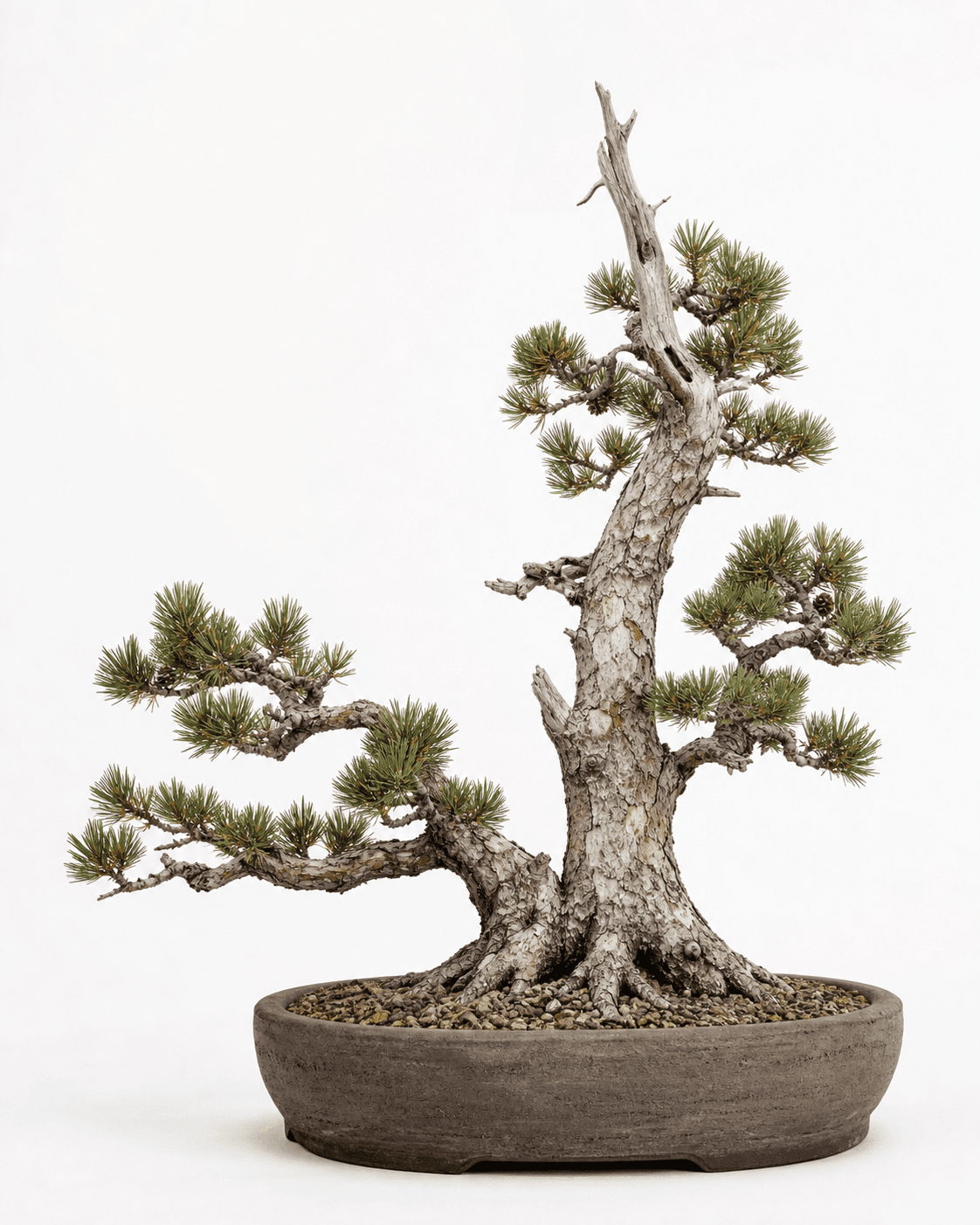
Whitebark pine bonsai is a cold-dormant outdoor pine for advanced growers. Treat confirmed Pinus albicaulis as Pine > Outlier: preserve needle mass, keep roots cold and oxygenated, avoid routine decandling, and let conservation ethics shape every sourcing decision.
This guide has direct Mirai coverage from Crater Lake whitebark field studies plus five-needle pine technique files. Kew, Flora of North America, U.S. Fish and Wildlife Service, USDA Forest Service, National Park Service, USDA NRCS, and Oregon State ground the accepted name, range, morphology, hardiness, conservation status, pest pressure, and Clark's nutcracker ecology.
Updated June 8, 2026. Written by EntGrove Editorial. Last verified June 8, 2026.
Care fingerprint
Read the species through its shared care pattern.
Protect older needles, avoid aggressive decandling assumptions, and adjust work to slow recovery, rare outlier decandling, and species-specific bud behavior. Use this as the starting point before local conditions and tree strength refine the calendar.
Identify flush behavior
Single-flush, multiflush, white pine, and compact pine groups have different pruning windows and different risk levels.
Avoid default decandling
Japanese black pine methods do not transfer safely to every pine, especially slow, weak, collected, or five-needle trees.
Use needles as strength data
Needle length, color, age, and density help show where vigor is strong, weak, or becoming shaded.
Care cadence
The calendar starts with the tree's seasonal state.
Placement
Timing: Grow outdoors in full sun, airflow, and real winter dormancy. Protect the container from severe freeze-thaw, reflected summer heat, and long wet winter spells.
Watch for: Indoor wintering, warm dormancy, shaded weak growth, black pots on paving, and protection that removes the cold season entirely.
Oregon State Landscape PlantsBonsai Mirai LibraryWatering
Timing: Water the whole root mass, then wait until oxygen returns. After pruning, wiring, or needle loss, reduce watering to match the smaller transpiring canopy.
Watch for: Wet native cores, dry outer soil around wet inner soil, algae, sour organic pockets, and watering by alpine reputation rather than root demand.
Bonsai Mirai LibraryDevelopment feeding
Timing: Feed modestly through development once roots are functioning. Needle mass and fall vascular gain matter more than a tidy silhouette.
Watch for: Fertilizer on weak roots, spring feeding that lengthens refined needles, and starving a recovering tree that has resumed strong growth.
Bonsai Mirai LibraryNeedle retention
Timing: Preserve old needles unless they release easily or the branch is strong enough for refinement cleanup. FNA records whitebark needles lasting 5 to 8 years.
Watch for: Stripping older needles for neatness, removing second-year needles, and cutting back before interior buds are strong.
Flora of North AmericaBonsai Mirai LibraryPruning
Timing: Use conservative post-hardened five-needle pine pruning on strong refined branches. Keep development shoots longer when roots or back buds are still rebuilding.
Watch for: Routine decandling, spring candle pinching on weak trees, cutting behind all current-year needles, and removing the few strong shoots that are funding recovery.
Bonsai Mirai LibraryRepotting
Timing: Repot around spring bud movement when freeze protection is available. Preserve functioning roots, retain some native core on collected trees, and anchor the tree firmly.
Watch for: Bare-rooting, stacking repotting with first styling, loose tie-downs, freezing fresh cuts, and removing the entire old root system in one event.
Bonsai Mirai LibraryWiring
Timing: Wire only strong material after growth hardens or in early fall. Keep the line naturalistic, protect branch crotches, and avoid forcing every branch into a polished pad.
Watch for: Needle breakage, crotch tears, old bark scars, heavy bends after root work, and deadwood treated like juniper rather than pine.
Bonsai Mirai LibraryBonsai Mirai / AsymmetryPests and disease
Timing: Inspect in spring, after purchase, after collection, and whenever a branch flags. Treat rust, beetles, and movement risk as serious plant-health issues.
Watch for: White pine blister rust, mountain pine beetle, bark beetle signs, branch flagging, swollen cankers, orange spore signs, and drought or wet-root stress.
U.S. Fish and Wildlife ServiceNational Park ServiceUSDA NRCS Plant GuideSpecies guide
Apply the species profile before copying another tree's calendar.
At a glance
Whitebark pine is a threatened, high-elevation five-needle pine with outlier bonsai timing.
The care headline is outdoor, cold, sunny, slow, oxygen-rich, and conservative. Whitebark pine is compelling bonsai material because its wild form records wind, snow, exposure, and animal seed caching, but the species also carries real conservation risk. Bonsai Mirai LibraryU.S. Fish and Wildlife Service
Kew accepts Pinus albicaulis Engelm. and gives the range as western Canada to the western United States. FNA records five needles per fascicle, 3 to 7 cm foliage, seed cones that stay closed without animal help, and habitat on thin cold rocky soils near timberline. Kew POWOFlora of North America
EntGrove keeps whitebark pine in Pine > Outlier. The local Mirai corpus groups true five-needle pines under sheath-drop pruning, but it also names whitebark among species whose technique remains unsettled. The public rule is restraint until a specific tree proves strength. Bonsai Mirai Library
Wild habitat
The wild model is a cold, windy, rocky timberline tree tied to animal seed caching.
FNA places Pinus albicaulis in thin, rocky, cold soils at or near timberline and montane forests from 1300 to 3700 m. USDA Silvics describes two broad distribution centers: the Coast and Cascade ranges into the Sierra Nevada, and the northern Rockies into Wyoming and Alberta. Flora of North AmericaUSDA Forest Service Silvics
USDA Silvics describes cold, windy, snowy high-mountain climate with short cool summers. In moist mountain ranges the species often occupies warmer drier exposures, while in semiarid ranges it can appear on cooler moist aspects. USDA Forest Service Silvics
The design lesson is specific. Mirai Crater Lake field files read whitebark on exposed rims as a record of wind, snow load, ridgeline exposure, and local topography. Bonsai styling should preserve those site clues rather than flattening the tree into generic pine pads. Bonsai Mirai / AsymmetryBonsai Mirai Library
The care lesson is root oxygen with real hydration. Wild whitebark survives exposed dry ridges, yet Mirai warns that arid-site pines can use substantial water in cultivation when healthy. A pot must hydrate fully, then breathe. Bonsai Mirai LibraryUSDA Forest Service Silvics
Reading the tree
Read needle mass, sheath drop, root recovery, and conservation context before choosing work.
Needle mass is the health bank. Mirai five-needle pine files tie back budding and root rebuilding to retained needles and fall vascular thickening. FNA records whitebark needles persisting 5 to 8 years, so old needles are not disposable decoration. Bonsai Mirai LibraryFlora of North America
Sheath drop is useful but not absolute. On typical five-needle pines, dropped papery sheaths mark the post-flush window for refinement pruning. With whitebark, apply that method conservatively because Mirai also flags the species as an outlier. Bonsai Mirai Library
Root recovery controls workload. A tree can push a few strong tips from stored resources while fine roots are still weak. Delay refinement until the tree shows repeated strong growth, interior buds, and stable water use. Bonsai Mirai Library
The label also matters. Whitebark, limber, western white, sugar, and bristlecone pine can overlap in common language. Confirm five-needle foliage, cone behavior, range, nursery history, and scientific name before using a species calendar. Flora of North AmericaOregon State Landscape Plants
Pruning
Use five-needle pine restraint, with no routine decandling.
For strong refined five-needle pines, Mirai uses the 2 to 3 week window after sheath drop for shortening new shoots. Cuts should leave at least one current-year five-needle cluster because buds form at retained needle bases. Bonsai Mirai Library
For whitebark pine, make that a careful branch-by-branch option rather than an annual mandate. The safest default is to preserve needles, shorten only strong branches, and let development growth run when back buds and roots are still forming. Bonsai Mirai Library
Avoid spring candle pinching on ordinary material. Mirai warns that long-needle single-flush pines respond to elongation-stage pinching with longer remaining needles and weaker design control. Bonsai Mirai Library
Avoid routine decandling. Mirai lists whitebark among pines that do not fit cleanly into standard long-needle single-flush refinement, and the available corpus gives no species-specific annual decandling cycle for Pinus albicaulis. Bonsai Mirai Library
Clean older needles only when the tree is strong enough. Dead needles and loose needles can come off; attached older needles should stay if the branch needs energy, back budding, or recovery strength. Bonsai Mirai Library
Roots
Repot as a pine: staged, anchored, oxygen-focused, and never bare-rooted.
Mirai conifer guidance warns against bare-rooting because pines depend on retained microbial and root function. For whitebark, preserve a working core and replace old soil in deliberate stages. Bonsai Mirai Library
Repot around spring bud movement when aftercare can protect fresh roots from hard freeze, wind, and saturation. The reason to repot should be functional: blocked percolation, soil breakdown, root density, design angle, or container transition. Bonsai Mirai Library
Collected or old mountain material needs long quiet periods. Mirai yamadori principles prioritize fine-root recovery, firm anchoring, and gradual core conversion over fitting a dramatic trunk into a final pot quickly. Bonsai Mirai Library
Tie-downs are horticulture. A shifting pine tears new roots and delays recovery, so use wire, braces, bamboo, or container geometry to keep the root mass immobile after root work. Bonsai Mirai Library
Soil and pot
Choose mineral oxygen and a container that supports an exposed-ridge image.
A dependable whitebark bonsai mix starts from the Mirai five-needle pine default: equal akadama, pumice, and lava, with fines removed so water moves through and oxygen returns. Bonsai Mirai Library
Do not confuse wild rocky soil with container neglect. In a shallow pot, the mix must wet evenly, drain freely, resist collapse, and hold enough nutrition for fine roots and microbial activity. Bonsai Mirai Library
Fresh collected material may need a recovery box, pumice-heavy outer soil, and a retained native core while fine roots colonize the new medium. Refined material can move gradually toward a cleaner bonsai mix. Bonsai Mirai Library
Pot pairing should feel geological: unglazed stoneware, quiet brown or gray clay, slabs, rugged shallow ovals, crescent forms, and enough mass to hold an old wind-shaped trunk. Bright glaze usually fights the species. Bonsai Mirai / Asymmetry
Climate
Whitebark wants cold dormancy, cool roots, sun, and protection from lowland heat patterns.
Oregon State lists whitebark pine hardy to USDA Zone 3. USDA Silvics records severe winter cold, short cool summers, and persistent snowpack across much of the habitat. Oregon State Landscape PlantsUSDA Forest Service Silvics
In cold continental regions, keep the tree dormant and protect the pot. Heel it in, mulch the container, or use an unheated cold frame that blocks rootball freeze-thaw extremes while preserving winter. Bonsai Mirai Library
In maritime or wet-winter regions, winter protection often means water control. Keep the tree cold, bright, and ventilated while preventing a recently worked root system from staying saturated for weeks. Bonsai Mirai Library
In hot lowland regions, the hardest problem is root heat and weak winter dormancy. Morning sun, pot shade, wind moderation, and a cold winter strategy are more important than pushing the tree through heat with extra water. Bonsai Mirai LibraryUSDA Forest Service Silvics
Pests and disease
Blister rust, beetles, climate stress, and root decline are the main risks.
FWS identifies nonnative white pine blister rust as the primary threat to whitebark pine, with mountain pine beetle, altered fire regimes, climate change, and combined stressors also driving decline. U.S. Fish and Wildlife Service
NPS Greater Yellowstone monitoring tracks blister rust infection, mountain pine beetle attack, fire, and survival. It notes that beetles preferentially attack larger mature trees, which matters when evaluating old collected or nursery material. National Park Service
In bonsai, inspect for swollen cankers, branch flagging, orange spore signs, pitch tubes, boring dust, sudden crown thinning, and one-sided decline. Quarantine suspect five-needle pine material and follow local plant-health guidance. U.S. Fish and Wildlife ServiceUSDA NRCS Plant Guide
The common cultivated failure is still root stress: wet old cores, low oxygen, warm roots, alkaline water, overwork, or drought followed by saturation. Correct culture before chasing pests with repeated treatments. Bonsai Mirai Library
Wiring
Wire with wind logic, branch-crotch protection, and restrained naturalism.
Mirai Crater Lake files show wind, snow, and terrain shaping different branch shoulders. Raised shoulders read as wind, dropped shoulders read as snow, and mixed signals make the design less convincing. Bonsai Mirai / AsymmetryBonsai Mirai Library
Pine branch crotches are weak mechanical points. Support heavy bends, distribute movement along the whole wired section, and avoid pulling old branches straight away from the trunk. Bonsai Mirai Library
Wire fewer branches than a formal first styling might suggest. The whitebark image often improves when some natural branch character remains and only the branches that clarify direction are adjusted. Bonsai Mirai / Asymmetry
Check wire early. Old pale bark and slow vascular recovery mean scars can remain visible for years, especially on branches that thicken after a strong fall feeding period. Bonsai Mirai Library
Propagation
Seed is normal in ecology and restoration; bonsai sourcing should favor legal young material.
USDA NRCS describes whitebark seed movement as almost entirely dependent on Clark's nutcracker, with germination often occurring two or more years after caching. FNA records wingless seeds and cones that do not open naturally. USDA NRCS Plant GuideFlora of North America
For bonsai, seed and verified nursery seedlings are the cleanest ethical path. They are slow, but they avoid the legal and ecological problems of removing threatened high-elevation trees. U.S. Fish and Wildlife ServiceUSDA NRCS Plant Guide
Grafting is possible within Pinus as a bonsai technique, but the long-term value depends on rootstock compatibility, graft height, bark match, and whether the scion preserves believable whitebark character. Bonsai Mirai Library
Air-layering and cuttings should be treated as experimental for this species. Serious stock is more likely to come from seed, conservation-aware nursery propagation, legal restoration surplus, or fully documented collected material. Bonsai Mirai LibraryU.S. Fish and Wildlife Service
Buying
Buy documentation before buying drama.
Good material has a confirmed Pinus albicaulis label, five-needle foliage, active buds, retained old needles, no rust cankers, no beetle signs, and roots that can be converted gradually. Flora of North AmericaOregon State Landscape PlantsBonsai Mirai Library
Because FWS lists whitebark pine as threatened under the ESA, provenance matters. Use nursery-grown plants or material with explicit legal documentation, and avoid any seller who treats high-elevation collection casually. U.S. Fish and Wildlife Service
Red flags include recent collection plus first styling, a loose trunk, little needle mass, wet native soil, branch flagging, swollen cankers, orange rust signs, pitch tubes, old wire scars, and vague white-pine labeling. U.S. Fish and Wildlife ServiceUSDA NRCS Plant GuideBonsai Mirai Library
Label confusion is predictable. Whitebark can be confused with limber pine, western white pine, sugar pine, bristlecone pine, or lodgepole pine in western mountain settings. Confirm the scientific name before following this guide. Flora of North AmericaUSDA Forest Service Silvics
Troubleshooting
Start with roots, needles, disease signs, and the last work window.
Needles yellowing across the tree usually points to wet roots, poor oxygen, old organic core, alkaline water, heat-stressed roots, recent overwork, or normal old-needle cycling taken out of context.
Sudden old-needle drop after repotting points to root loss or water imbalance. Stabilize water, protect from wind and freeze, avoid fertilizer spikes, and postpone styling.
One branch flagging yellow or brown can indicate blister rust, beetle damage, branch-crotch tearing, wire injury, root loss on that side, or drought stress. Inspect before cutting.
Long coarse needles after spring work often mean candles were pinched or foliage was reduced before the new flush hardened. Grow the tree for strength and return to conservative post-hardened timing.
No interior buds usually means low needle mass, weak roots, insufficient light, repeated early pruning, or a tree still spending collection reserves. Feed and grow before refinement.
Rust or beetle symptoms require quarantine and local plant-health guidance. Moving suspect threatened five-needle pine material can spread a larger problem.
Design
Design whitebark from exposed ridges, animal-seeded clumps, wind, snow, and survival.
Mirai Crater Lake work treats whitebark as a design reference for environmental reading. Windward voids, leeward branch extension, dead tops, sheltered lower branches, and sharp wind-line transitions can all become design evidence. Bonsai Mirai / AsymmetryBonsai Mirai Library
Clark's nutcracker ecology explains clumps and exposed-ridge placement. NPS describes the bird carrying seeds away and caching them, while Mirai notes windswept microsites where snow does not linger as germination locations. National Park ServiceBonsai Mirai Library
Use sparse foliage and large negative space when the trunk reads old. Mirai notes that extreme exposed trees reduce pad mass because large sails cannot survive persistent wind. Bonsai Mirai / Asymmetry
Deadwood should be pine-specific. Leave attrition, broken tops, cylindrical weathering, and old bark transitions where they tell the ridge story. Freshly sharpened juniper-style jin usually feels false on this species. Bonsai Mirai Library
Forms
Most whitebark work is about verified species material rather than named cultivars.
Oregon State describes Pinus albicaulis as a small to medium evergreen conifer with an irregular sprawling crown, five short needles, pale bark, and closed seed cones. That wild form is the main design reference. Oregon State Landscape Plants
Kew records synonyms including Apinus albicaulis, Pinus flexilis var. albicaulis, Pinus flexilis subsp. albicaulis, Pinus cembroides Newb., and Pinus shasta. Older labels should be normalized to Pinus albicaulis where appropriate. Kew POWO
Nursery forms are less common than with limber, white, or bristlecone pines. If a compact, blue, dwarf, or grafted whitebark label appears, inspect the graft, roots, provenance, and exact species before buying. Bonsai Mirai LibraryU.S. Fish and Wildlife Service
Do not apply whitebark styling assumptions to Japanese white pine, western white pine, Korean white pine, limber pine, or bristlecone pine just because all are five-needle pines. Shared technique does not erase species character. Bonsai Mirai LibraryFlora of North America
History
Whitebark pine is a keystone western tree whose bonsai value comes with responsibility.
NPS calls whitebark a keystone species of subalpine slopes because it stabilizes soil, affects snowmelt, enables succession, and feeds birds and mammals. Those ecological roles should shape bonsai sourcing and design language. National Park Service
USDA Silvics notes the species has limited commercial use but high value for watershed protection, aesthetics, grizzly bears, and other high-mountain wildlife. Bonsai should preserve that native-conifer context. USDA Forest Service Silvics
Mirai's Crater Lake field work frames ancient whitebark forms as scarce design references because blister rust and beetle pressure are removing old trees. The styling lesson is documentation, restraint, and species-faithful observation. Bonsai Mirai / AsymmetryBonsai Mirai Library
As bonsai, whitebark belongs to the North American native pine and yamadori conversation. It should be handled more like a conservation-aware alpine subject than a routine commercial pine. U.S. Fish and Wildlife ServiceBonsai Mirai Library
Species questions
Answer the beginner questions before styling.
Can whitebark pine be grown as bonsai?
Yes, but it is an advanced outdoor bonsai subject. Use verified Pinus albicaulis, preserve needle mass, keep roots oxygenated, and source only nursery-grown or legally documented material.
Can whitebark pine bonsai live indoors?
No. Whitebark pine needs full sun, airflow, cold dormancy, and seasonal weather. Indoor display should be brief.
Is whitebark pine endangered?
Kew cites the IUCN Endangered rating, and U.S. Fish and Wildlife Service lists whitebark pine as threatened under the U.S. Endangered Species Act. Treat sourcing as a conservation issue.
Should I decandle whitebark pine?
Avoid routine decandling. EntGrove keeps whitebark in the outlier pine group because Mirai flags its method as unsettled, so the safe practice is needle preservation and conservative post-hardened pruning.
When should whitebark pine be pruned?
On strong refined branches, use the post-sheath-drop five-needle pine window with caution. Development trees and recovering collected trees should keep more growth until roots and interior buds are strong.
What soil works for whitebark pine bonsai?
Use a high-oxygen mineral pine mix. A practical default is equal akadama, pumice, and lava, with very fine particles screened out so the pot drains and breathes.
Why is Clark's nutcracker important to whitebark pine?
Whitebark cones do not open naturally. Clark's nutcrackers extract and cache the seeds, and forgotten caches become many wild seedlings.
How do I tell whitebark pine from limber pine?
Both are five-needle western pines. Confirm the scientific label, range, cone behavior, bark, needle traits, and source history before choosing a care page.
What pests and diseases matter most?
White pine blister rust and mountain pine beetle are the major landscape threats. In bonsai, also watch for bark beetle signs, branch flagging, cankers, root rot, scale, mites, and stress from wet roots.
Is collecting whitebark pine ethical?
Use nursery-grown or fully permitted material only. Wild threatened whitebark pine stands are ecological resources, not casual bonsai stock.
Sources
Species advice needs source discipline.
Next decisions
Plan the operation before copying the calendar.
A good care note for Whitebark pine records the tree's stage, the work done, and the aftercare used. That record matters more than a month-name rule.
Related species
Compare nearby trees before transferring advice.
Japanese white pine / goyo-matsu
Pinus parviflora
Bristlecone pine
Pinus longaeva, Pinus aristata
Pinyon pine
Pinus edulis, Pinus monophylla, Pinus cembroides
Italian stone pine
Pinus pinea
Aleppo pine
Pinus halepensis