
Species guide
Bristlecone Pine Bonsai Care
Pinus longaeva, Pinus aristata
Bristlecone pine bonsai is outdoor, cold-dormant, extremely slow, and unforgiving of generic black-pine technique. Treat confirmed Pinus aristata or Pinus longaeva as Pine > Outlier: preserve needle mass, keep roots oxygenated, avoid routine decandling, and make every intervention answer to recovery strength.
This guide has strong direct Mirai coverage from Bristlecone styling, expansion, slab planting, design naturalization, Rocky Mountains field studies, and five-needle pine files. Kew, Flora of North America, USDA Forest Service, National Park Service, NC State, Oregon State, and Utah State ground the accepted species split, native ranges, elevations, hardiness, morphology, pests, and conservation context.
Updated June 7, 2026. Written by EntGrove Editorial. Last verified June 7, 2026.
Care fingerprint
Read the species through its shared care pattern.
Protect older needles, avoid aggressive decandling assumptions, and adjust work to slow recovery, rare outlier decandling, and species-specific bud behavior. Use this as the starting point before local conditions and tree strength refine the calendar.
Identify flush behavior
Single-flush, multiflush, white pine, and compact pine groups have different pruning windows and different risk levels.
Avoid default decandling
Japanese black pine methods do not transfer safely to every pine, especially slow, weak, collected, or five-needle trees.
Use needles as strength data
Needle length, color, age, and density help show where vigor is strong, weak, or becoming shaded.
Care cadence
The calendar starts with the tree's seasonal state.
Placement
Timing: Grow outdoors in full sun, wind, and real winter dormancy. Shield the pot from extreme freeze-thaw and from reflected summer heat that cooks roots.
Watch for: Indoor winter storage, warm dormancy, weak shade growth, humid stagnant benches, and black nursery pots on hot paving.
NC State ExtensionBonsai Mirai LibraryWatering
Timing: Water through the whole root mass, then wait for the mix to regain oxygen. After heavy needle reduction, water by the native core and reduced foliage load.
Watch for: Wet native soil inside dry outer mix, algae, sour organic cores, foliage reduction followed by unchanged watering, and rainy maritime winters.
Utah State University ExtensionBonsai Mirai LibraryDevelopment feeding
Timing: Feed modestly while building roots and branches. A recovering collected tree may receive stronger feeding only after it has produced multiple strong flushes and visible back buds.
Watch for: Heavy fertilizer on a tree with weak roots, starvation during recovery, and black-pine feeding intensity on a species that grows by slow stored-resource gain.
Bonsai Mirai LibraryNeedle retention
Timing: Preserve old needles until they release easily or the tree is strong enough for a deliberate refinement cleanup. Wild trees can hold decades of needles.
Watch for: Manual stripping after collection, removing second-year needles for neatness, and mistaking white resin dots for scale insects.
Bonsai Mirai LibraryFlora of North AmericaNC State ExtensionPruning and pinching
Timing: Default to post-hardened pruning and early-fall cleanup on strong trees. Spring candle pinching belongs only to strong refined bristlecone material where the response has been proven.
Watch for: Routine decandling, spring work copied from Japanese black pine, cutting weak tips, and reducing foliage before interior buds show root recovery.
Bonsai Mirai LibraryRepotting
Timing: Repot as buds swell and before candles elongate, then protect from hard freezes. In protected maritime practice, Mirai uses earlier winter timing with greenhouse aftercare.
Watch for: Bare-rooting, stacking repotting with a first styling, loose tie-downs, and exposing freshly cut roots to freezing temperatures.
Bonsai Mirai LibraryWiring
Timing: Wire only strong material after growth hardens and roots are stable. Use heavier wire than the soft branch feel suggests, then guard branch crotches carefully.
Watch for: Needle breakage, crotch tears, leverage on weak root anchors, deadwood used as if it were juniper, and wire left until old bark is marked.
Bonsai Mirai LibraryPests and disease
Timing: Inspect in spring, after collection, during humid periods, and whenever one branch flags. Five-needle pines deserve routine checks for rust, beetles, borers, mistletoe, and root rot.
Watch for: White pine blister rust, mountain pine beetle, dwarf mistletoe, heart rot, wood decay fungi, and wet-root decline after excessive watering.
USDA Forest Service FEISUSDA Forest Service FEISSpecies guide
Apply the species profile before copying another tree's calendar.
At a glance
Bristlecone pine is a cold, dry, high-elevation outlier pine with ancient-tree habits.
Kew accepts Pinus longaeva and Pinus aristata as separate species. Pinus longaeva is the Great Basin or Intermountain bristlecone from eastern California, southern Nevada, and Utah. Pinus aristata is the Rocky Mountain, Colorado, or Interior bristlecone from northern Arizona, Colorado, and northern New Mexico. Kew POWOKew POWOOregon State Landscape Plants
For bonsai, the safe headline is simple: outdoor only, full sun, true winter, very slow work, dry-leaning oxygen-rich soil, and no annual black-pine decandling routine. The species can be strong after recovery, but it spends strength slowly. Bonsai Mirai LibraryNC State ExtensionUtah State University Extension
Bristlecone carries unusual foliage history. FNA records Pinus longaeva leaves persisting 10 to 30 years, and Mirai documents wild bristlecone retaining even longer needle banks in arid alpine settings. In cultivation, needle handling is a primary health decision. Flora of North AmericaBonsai Mirai Library
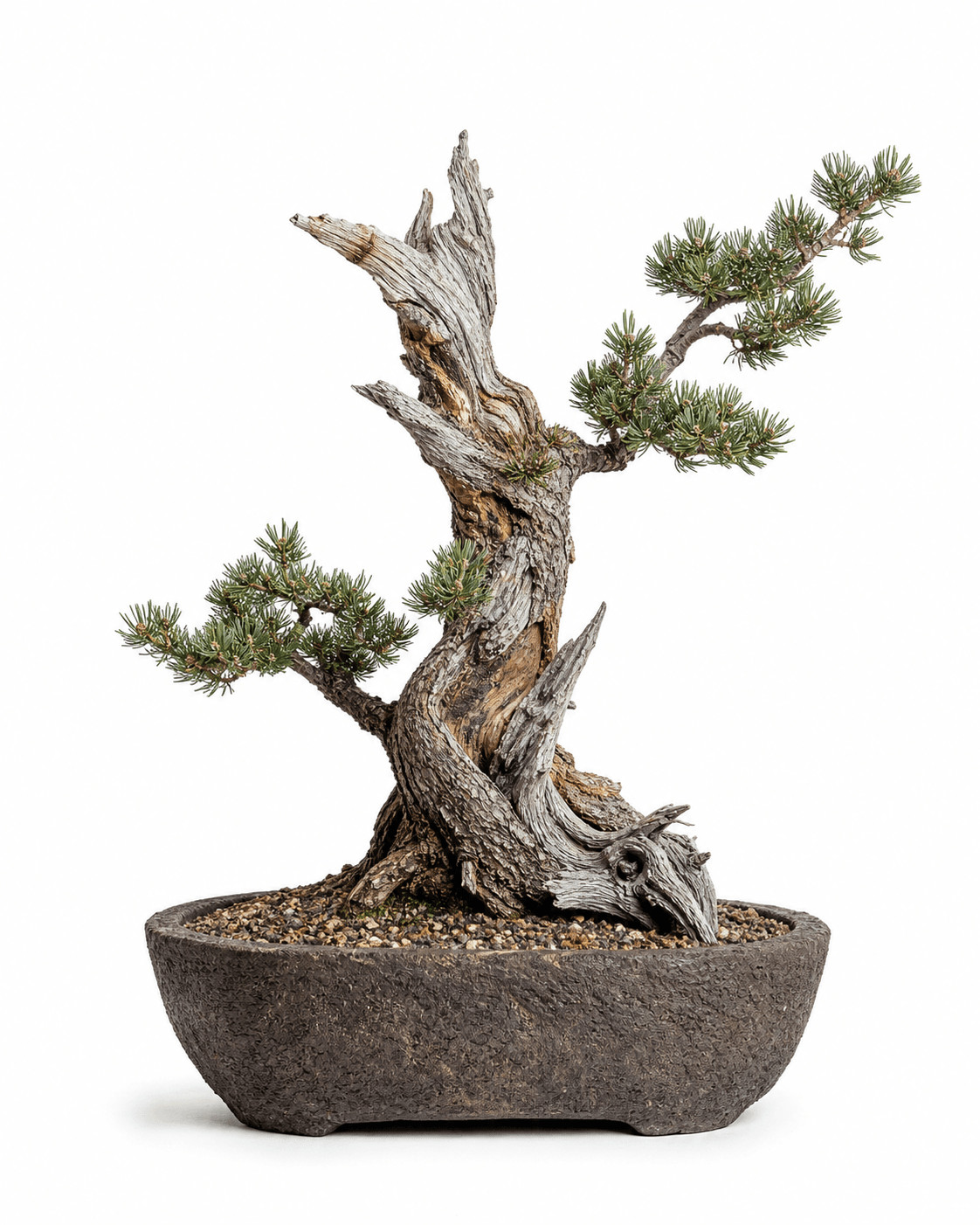
Use medium or large scale unless the material is a compact cultivar. The best designs show a sparse living vein, resilient old bark, resin-rich deadwood, compressed foliage, and the silence of an exposed mountain ridge. Bonsai Mirai / AsymmetryOregon State Landscape Plants
Wild habitat
The wild model is exposed rock, poor soil, drought, cold, wind, and slow stored growth.
FNA places Pinus longaeva in subalpine and alpine habitat from 1700 to 3400 m and Pinus aristata from 2500 to 3400 m. NPS describes Great Basin bristlecone living near treeline on limestone ridges with short seasons, freezing temperatures, wind, and very slow growth. Flora of North AmericaFlora of North AmericaNational Park Service
The soil story matters. Great Basin sources describe limestone, rocky slopes, and sites where other vegetation struggles. Utah State records high drought tolerance, low tolerance of poor drainage, and high alkalinity tolerance in its regional tree profile. National Park ServiceUtah State University ExtensionUSDA Forest Service FEIS
That ecology translates directly into bonsai care. Bristlecone wants complete watering followed by air return, a root system that never sits sour and saturated, and a pot that protects roots from heat without trapping winter wetness. Bonsai Mirai LibraryUtah State University Extension
Design also starts in the wild. Mirai field and styling files describe windward deadwood, leeward live veins, branch lift under wind, compact aerodynamic foliage in extreme exposure, and large empty spaces around the living parts of the tree. Bonsai Mirai / AsymmetryBonsai Mirai Library
Reading the tree
Read needle age, back buds, root recovery, and water demand before making any cut.
A fresh collected bristlecone may carry dense old needle banks, erratic native roots, and a rootball that is still deciding what can live in a container. Mirai advises letting post-collection material self-shed and prove recovery through strong flushes and interior back buds. Bonsai Mirai Library
Interior adventitious buds are the clearest sign that the root system has resumed funding the tree. Strong tips alone can be misleading because a tree can spend old reserves before it has rebuilt fine roots. Bonsai Mirai Library
Needle drop has context. A cultivated tree shedding old needles after several strong seasons may be normal allocation. A newly repotted tree shedding down to only two years of needles is a root-stress warning. Bonsai Mirai Library
Water demand changes with foliage mass. Mirai notes that a fully foliated bristlecone in dry heat can use water aggressively, while a heavily reduced tree needs far less. After any styling, watering must change with the canopy. Bonsai Mirai Library
Pruning
Protect needle mass and use bristlecone-specific restraint around pinching and decandling.
The Mirai corpus does not give one tidy category for bristlecone. One dedicated expansion file describes short-needle single-flush spring pinching on strong refined bristlecone, while later design and Rockies files emphasize low water mobility and long-needle single-flush restraint. Bonsai Mirai Library
EntGrove therefore classifies bristlecone as an outlier pine. The public rule is conservative: preserve needles, prune only strong material, avoid routine decandling, and treat spring pinching as an advanced operation for vigorous refined trees, not as beginner maintenance. Bonsai Mirai Library
For development, keep extensions and old needles long enough to build roots and interior buds. Cutting too early slows an already slow tree and can push next year into longer coarse growth. Bonsai Mirai Library
For refinement, clean needles that release easily, open windows for light, and shorten strong sections only after the tree has proven root recovery. Branch-by-branch reading beats a calendar routine. Bonsai Mirai Library
White resin flecks on Pinus aristata needles are normal identification marks. Do not treat them as scale unless inspection shows insects, crawling stages, honeydew, or tissue damage. Bonsai Mirai LibraryNC State ExtensionUtah State University Extension
Roots
Repot slowly, preserve the native microbiome, and never combine major root work with first-styling shock.
Mirai pine repotting guidance is blunt: do not bare-root pines. Bristlecone roots are coarse, storage-heavy, and tied to the living soil community around them, so root conversion should happen in planned stages. Bonsai Mirai Library
Timing depends on climate and protection. Without a greenhouse, repot as freeze risk passes and buds are swelling but before candles elongate. In protected maritime practice, Mirai has used winter timing with greenhouse aftercare and elevated minimum temperatures. Bonsai Mirai Library
After root work, protect from freezing, wind, and saturation. A disturbed pine root system has unpredictable freeze tolerance, and wet cold soil is a larger practical risk than cold air alone. Bonsai Mirai Library
Fresh yamadori should be left alone for years after collection, potting, or first styling. Mirai gives a two to four year quiet period before second working, and notes that full adaptation to cultivation can take a decade or more. Bonsai Mirai Library
Soil and pot
Use a dry-leaning pine mix and a pot that makes the mountain image believable.
For established bristlecone and other dry high-elevation five-needle pines, Mirai uses 1:1:1 akadama:pumice:lava with the 1/16 inch fines screened out. The goal is oxygen after watering, not constant moisture. Bonsai Mirai Library
A fresh collected tree may sit in pumice and lava with a remnant native core while roots rebuild. Once a refined root system exists, move toward the bonsai mix gradually rather than washing the old core out in one event. Bonsai Mirai Library
Slabs can suit bristlecone when the root system is ready. Mirai slab planting guidance shifts the mix drier on concave slab pockets and uses careful tie-downs, bamboo stakes, and sphagnum walls to keep the roots immobile. Bonsai Mirai Library
Pot choice should be quiet and geological. Unglazed stoneware, shallow rugged ovals, slabs, crescent forms, and muted earth colors usually support the species better than bright glazes or lush moss-heavy presentation. Bonsai Mirai / AsymmetryNational Park Service
Climate
Cold is expected, wet saturation and warm winters are the harder bonsai problems.
NC State lists Pinus aristata in USDA Zones 4a to 7b, Oregon State lists hardy to Zone 4, and Utah State lists Zones 5 to 7 for its regional bristlecone entry. Bonsai pots need more protection than landscape roots. NC State ExtensionOregon State Landscape PlantsUtah State University Extension
In cold continental regions, the tree wants dormancy, sun, and wind protection for the container. Mulch the pot, heel it into a protected bed, or use an unheated cold frame that prevents rootball freeze-thaw extremes. Bonsai Mirai LibraryNC State Extension
In wet maritime regions, winter shelter is often about water control. Keep the tree cold, bright, and ventilated, while preventing weeks of saturated soil after pruning, repotting, or heavy needle reduction. Bonsai Mirai Library
In hot-summer regions, protect the pot rather than shade the canopy too aggressively. Full sun builds compact pine growth, but roots in a small black container can overheat far beyond the species wild-root experience. Bonsai Mirai LibraryUSDA Forest Service FEIS
Pests
The main risks are rust, beetles, mistletoe, decay fungi, borers, and root rot from culture.
USDA FEIS lists Great Basin bristlecone susceptibility to mountain pine beetle, western dwarf mistletoe in parts of Nevada and Utah, and wood decay fungi. The Rocky Mountain bristlecone review adds dwarf mistletoe, heart rot, and white pine blister rust risk. USDA Forest Service FEISUSDA Forest Service FEIS
White pine blister rust matters because bristlecones are five-needle pines. Do not move suspect nursery material, and inspect for cankers, branch flagging, orange spore signs, and nearby Ribes hosts where rust is active. USDA Forest Service FEIS
Mountain pine beetle and borers are health indicators as much as pests. Keep the tree vigorous, avoid drought followed by overwatering, and investigate pitch tubes, boring dust, sudden top dieback, or one-sided decline promptly. USDA Forest Service FEISUSDA Forest Service FEIS
The common bonsai disease is cultural root decline. Utah State warns that the landscape tree is often overwatered and killed, which matches Mirai guidance around oxygen, foliage load, and winter saturation. Utah State University ExtensionBonsai Mirai Library
Wiring
Wire for memory-rich alpine wood, fragile needles, and vulnerable branch crotches.
Mirai describes high-elevation pine branches as flexible but memory-rich. Bristlecone can feel soft under the hand and still spring back, so wire gauge should match the holding need rather than the first bend feel. Bonsai Mirai Library
The most vulnerable point is the crotch. Pulling a mature pine branch away from the trunk can tear vascular tissue, trigger dieback, or split old wood. Use guy wires, braces, staged bends, and support at the bend site. Bonsai Mirai Library
Approach foliage from below and protect needles. Mirai treats damaged pine needles as poor technique, and bristlecone needles break easily during handling. Bonsai Mirai Library
Old deadwood should be handled as pine, not juniper. Bristlecone deadwood fractures in hard flat planes, weathers slowly when resin-rich, and reads best when deadwood texture varies by implied age and event. Bonsai Mirai LibraryNational Park Service
Propagation
Seed and grafting are possible, but bonsai timelines are long.
USDA FEIS records both Great Basin and Rocky Mountain bristlecone reproducing from seed, with rare favorable establishment windows. Wind and Clark's nutcracker seed movement are discussed in the ecology literature. USDA Forest Service FEISUSDA Forest Service FEIS
Seedlings are the cleanest ethical route for most growers. Expect slow trunk development and long waits for bark, but seed-grown material avoids legal and ecological problems around old wild trees. USDA Forest Service FEISNational Park Service
Grafting can be used within Pinus. Mirai notes that compatibility ends at the genus boundary, and strong terminal pine scions are the normal choice. Rootstock choice still changes vigor, needle behavior, and long-term presentation. Bonsai Mirai Library
Cuttings are not the normal bonsai path. NC State lists root cutting and seed as propagation strategies for Pinus aristata, but practical bristlecone bonsai stock is usually seedling, nursery cultivar, graft, or legally collected material. NC State Extension
Sourcing
Buy verified young material, compact cultivars, or fully legal collected trees with patience built in.
The first task is identity. Pinus aristata, Pinus longaeva, and Pinus balfouriana can be blurred in trade language. Confirm the species, source region, graft status, needle resin pattern, and cone or bud traits before applying this guide. Kew POWOKew POWOFlora of North AmericaOregon State Landscape Plants
Nursery material is safer for most growers. Look for active buds, intact needles, good drainage, no rust cankers, no beetle evidence, and a rootball that can be converted gradually. Avoid plants that have been kept wet to compensate for poor soil. NC State ExtensionUtah State University ExtensionUSDA Forest Service FEIS
Collected bristlecone can be magnificent, but the ethics and timeline are serious. Use only legally permitted material from non-protected contexts, and assume the first years are recovery, not refinement. Bonsai Mirai LibraryNational Park ServiceUSDA Forest Service FEIS
Red flags include recent collection with heavy styling, a loose trunk, old native clay kept constantly wet, white pine blister rust symptoms, bark beetle signs, major branch dieback, and a seller who cannot explain the source. Bonsai Mirai LibraryUSDA Forest Service FEISUSDA Forest Service FEIS
Troubleshooting
Diagnose by symptom, likely cause, and first correction.
Sudden old-needle drop after repotting usually points to root attrition. Stabilize watering, protect from wind and freeze, avoid fertilizer spikes, and stop styling until new roots and buds prove recovery.
Needles yellowing across the tree often points to chronic wet roots, compact soil, or low oxygen. Tilt the pot after rain, check the native core, increase airflow, and delay any top work.
White dots on needles usually point to resin exudate on true bristlecone. Confirm with a lens before treating. Scale insects show bodies, crawlers, honeydew, or tissue decline.
One branch flagging brown can mean borer damage, rust canker, branch-crotch tearing, old wire injury, or root loss on that side. Trace the branch to live vein and root history before cutting.
Long coarse candles after heavy reduction mean root energy is divided among too few tips. Rebuild ramification gradually with pruning and light, then reduce needle length by increasing growth points.
Needle cast, rust, or canker symptoms need sanitation, airflow, and local extension guidance. Do not move suspect five-needle pine material from infected areas.
Design
A believable bristlecone design is sparse, old, wind-shaped, and deadwood-forward.
Mirai bristlecone design starts with environment. Windward sides are often dead and eroded, live veins survive on protected sides, and branches may lift or compress according to exposure rather than droop in a generic windswept gesture. Bonsai Mirai / AsymmetryBonsai Mirai Library
Use deadwood and negative space as primary design features. Bristlecone foliage tends to sit above living veins, while old damage creates large quiet zones. Dense padded foliage can make the tree read younger than the trunk. Bonsai Mirai LibraryNational Park Service
Rocky Mountain material and Great Basin imagery may differ. Mirai notes straighter Rocky Mountain tendencies versus more twisted Great Basin populations, and public sources separate Pinus aristata from Pinus longaeva by range. Bonsai Mirai LibraryKew POWOKew POWO
Set the trunk line, defining branch, and apex from what the tree already offers. The best branch often explains the wind, the live vein, the old injury, or the shelf of rock the composition implies. Bonsai Mirai / Asymmetry
Forms
Compact and blue forms exist, but species identity still comes first.
NC State lists Pinus aristata cultivars and selections including Blue Bear, Blue Heron, Cecilia, Formal Form, Joe's Bess, Lemon Frost, and Sherwood Compact. Oregon State notes many dwarf and silver selections in specialty nursery trade. NC State ExtensionOregon State Landscape Plants
Compact forms can make better bonsai starts because internodes, branch spacing, and needle presentation may be closer to container scale. Verify whether the plant is grafted and inspect the graft union before buying. NC State ExtensionBonsai Mirai Library
Great Basin bristlecone, Rocky Mountain bristlecone, and foxtail pine belong to a close complex, but their ranges and public ecology differ. Avoid applying one page to all three just because the common name says bristlecone or foxtail. Flora of North AmericaFlora of North AmericaOregon State Landscape Plants
Nursery labels using older Pinus aristata var. longaeva language should be normalized to the accepted species when possible. Kew treats that name as a synonym under Pinus longaeva. Kew POWO
History
Bristlecone pine is famous because its age, wood, and tree rings changed science.
NPS describes Great Basin bristlecone pines as among the oldest non-clonal organisms, and FNA notes Pinus longaeva as the longest-lived tree known to dendrochronologists. The oldest famous living trees are protected by secrecy and site management. National Park ServiceFlora of North AmericaNational Park Service
USDA FEIS explains why the tree matters beyond horticulture. Great Basin bristlecone chronologies have supported dendrochronology, archaeology, climatology, geology, astronomy, and radiocarbon calibration. USDA Forest Service FEIS
Rocky Mountain bristlecone does not usually reach the same ages as Great Basin bristlecone, but USDA FEIS records individuals over 1600 years and a Colorado tree estimated around 2500 years. USDA Forest Service FEIS
As bonsai, the history is newer and narrower than Japanese black pine or Japanese white pine. The species asks the grower to preserve the logic of ancient habitat while working with a living container tree that still needs roots, buds, and recovery time. Bonsai Mirai LibraryBonsai Mirai / Asymmetry
Species questions
Answer the beginner questions before styling.
Can bristlecone pine be grown as bonsai?
Yes. Bristlecone pine can be grown as outdoor bonsai, especially from verified nursery or legal collected material, but it is an advanced species because recovery is slow and timing errors last for years.
Can bristlecone pine bonsai live indoors?
No. Bristlecone pine needs full sun, airflow, seasonal change, and winter dormancy. Indoor display should be brief and occasional.
Is bristlecone pine Pinus longaeva or Pinus aristata?
Both names can be called bristlecone pine. Pinus longaeva is Great Basin bristlecone from California, Nevada, and Utah. Pinus aristata is Rocky Mountain bristlecone from Arizona, Colorado, and New Mexico.
Should I decandle bristlecone pine?
Avoid routine decandling. Bristlecone is an outlier pine, and the safest maintenance is needle preservation, post-hardened pruning, and branch-by-branch work on strong trees.
Can I pinch bristlecone pine candles?
Only on strong refined material where the tree has proven the response. Many growers should skip spring pinching and use conservative post-hardened pruning or early-fall cleanup.
Why does bristlecone pine have white specks on its needles?
White specks are usually resin exudate and are normal on Pinus aristata. Inspect with a lens before treating them as scale insects.
What soil works for bristlecone pine bonsai?
Use a high-oxygen pine mix. Mirai uses akadama, pumice, and lava in equal parts with the finest fraction screened out for dry high-elevation five-needle pine material.
When should bristlecone pine be repotted?
Repot around bud swell before candles elongate, then protect from freezing and saturation. Freshly collected or recently styled trees may need several years before root work.
How often should bristlecone pine be watered?
Water thoroughly when the root mass needs it, then let oxygen return. The interval changes dramatically after needle reduction, repotting, heat, rain, and native-core drying.
Is collecting bristlecone pine ethical?
Use nursery-grown plants or legally permitted collected material only. Ancient wild groves and famous old trees should be treated as protected ecosystems, not bonsai stock.
Sources
Species advice needs source discipline.
Next decisions
Plan the operation before copying the calendar.
A good care note for Bristlecone pine records the tree's stage, the work done, and the aftercare used. That record matters more than a month-name rule.
Related species
Compare nearby trees before transferring advice.
Japanese white pine / goyo-matsu
Pinus parviflora
Whitebark pine
Pinus albicaulis
Pinyon pine
Pinus edulis, Pinus monophylla, Pinus cembroides
Italian stone pine
Pinus pinea
Aleppo pine
Pinus halepensis