
Species guide
Italian Stone Pine Bonsai Care
Pinus pinea
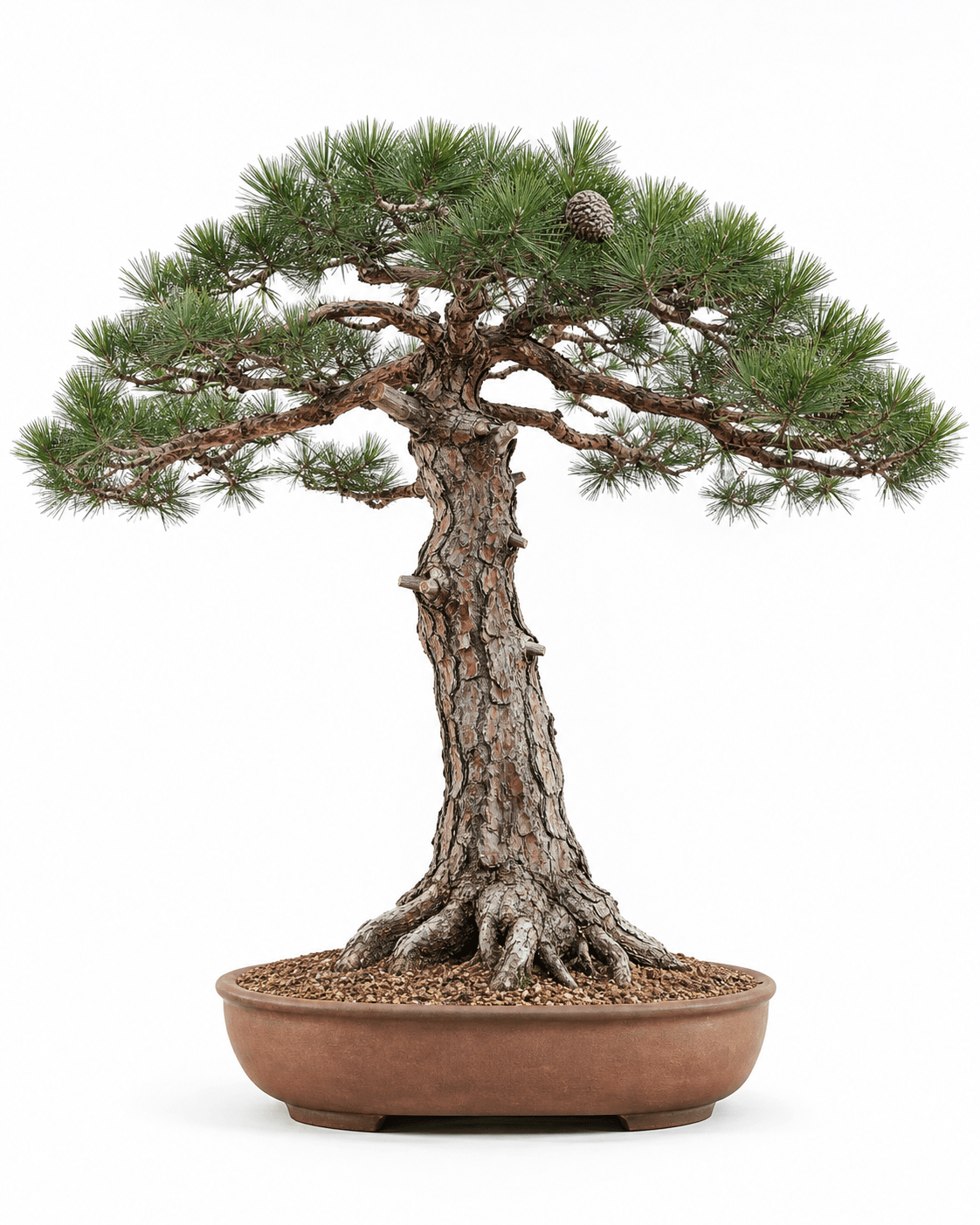
Italian stone pine is an outdoor Mediterranean pine with umbrella-crown design character, edible pine-nut cones, paired needles, and a long juvenile foliage phase. As bonsai, confirmed Pinus pinea belongs in Pine > Outlier Pine: build vigor first, use occasional decandling only as a back-budding transition, then manage the resulting shoots with short-needle style pinching or post-harden pruning based on response.
This page is grounded in dedicated Mirai outlier-pine guidance and public sources from Kew, RHS, NC State Extension, Oregon State, EUFORGEN, the European Atlas of Forest Tree Species, and Forest Research. The practical warning is that young nursery Italian stone pine can look compact and houseplant-like, while mature bonsai care still requires full outdoor sun, mineral soil, root oxygen, and species-aware pine timing.
Updated June 7, 2026. Written by EntGrove Editorial. Last verified June 7, 2026.
Care fingerprint
Read the species through its shared care pattern.
Protect older needles, avoid aggressive decandling assumptions, and adjust work to slow recovery, rare outlier decandling, and species-specific bud behavior. Use this as the starting point before local conditions and tree strength refine the calendar.
Identify flush behavior
Single-flush, multiflush, white pine, and compact pine groups have different pruning windows and different risk levels.
Avoid default decandling
Japanese black pine methods do not transfer safely to every pine, especially slow, weak, collected, or five-needle trees.
Use needles as strength data
Needle length, color, age, and density help show where vigor is strong, weak, or becoming shaded.
Care cadence
The calendar starts with the tree's seasonal state.
Placement
Timing: Grow outdoors year-round in full sun and moving air. In Zone 8 and colder container culture, protect the pot from hard freezes; in hot interiors, shade the container while keeping foliage bright.
Watch for: Indoor holiday-tree culture, weak window light, reflected-wall heat, cold wet benches, and winter storage that removes outdoor seasonal signals.
RHSOregon State Landscape PlantsBonsai Mirai LibraryWatering
Timing: Water the full root mass, then let the mineral soil breathe. Mediterranean drought tolerance should become an oxygen-rich watering cycle with controlled drying in a shallow pot.
Watch for: Hydrophobic nursery cores, wet peat under dry akadama, root-zone heat, needle dulling during summer, and using drought as the main needle-reduction tool.
EUFORGENKew POWO general informationBonsai Mirai LibraryDevelopment feeding
Timing: Feed strongly while building trunk, roots, branch structure, and needle mass. Mirai outlier-pine files emphasize energy accumulation before any decandling transition.
Watch for: Trying to create interior buds before the tree has strong candles, a stable root system, and enough foliage to rebuild stored energy.
Bonsai Mirai LibraryRefinement feeding
Timing: After interior shoots exist, moderate spring feeding so juvenile growth can mature without excessive extension. Resume more active feeding after the tree has hardened and recovered from work.
Watch for: Heavy feeding on a finished crown, coarse new shoots, weak interior buds, and confusing juvenile vigor with settled refinement.
Bonsai Mirai LibraryOutlier decandling
Timing: Use full decandling only on strong, prepared trees and generally no more often than every 3 to 5 years. Mirai places Mediterranean outlier decandling in early June so the juvenile second flush can mature before late-summer shutdown.
Watch for: Annual black-pine schedules, weak candles, recently repotted roots, partial decandling below the 70 percent canopy threshold, and needle plucking at the same time.
Bonsai Mirai LibraryPinching and post-harden pruning
Timing: For refinement, Mirai says Italian stone pine can be pinched like a short-needle single-flush pine when compact juvenile response is desired, or allowed to elongate, harden, and be pruned when mature foliage and back budding are the goal.
Watch for: Pinching weak shoots, cutting juvenile second-flush growth before it hardens, and assuming every tree should be pushed toward adult foliage immediately.
Bonsai Mirai LibraryRepotting
Timing: Repot in spring as buds swell. Keep the tree tied down tightly and preserve enough active roots and needles to recover before pruning or wiring heavily.
Watch for: Bare-rooting young nursery stock, removing roots and foliage in the same season, warm wet aftercare, and old organic cores that stay sour.
Bonsai Mirai LibraryRHSWiring
Timing: Wire after the tree is strong and before branches thicken beyond movement. Check wire often in warm growing weather and protect plated bark on older material.
Watch for: Wire scars on smooth young bark, crushed long needles, forced tight pads, bends made after heavy root work, and repeated bending of brittle older shoots.
Bonsai Mirai LibraryKew POWO general informationPests and disease
Timing: Inspect during hot dry periods, after water stress, in Mediterranean processionary-moth regions, and whenever cones, buds, or shoot tips show resin, browning, or defoliation.
Watch for: Adelgids, conifer aphids, sawfly larvae, pine shoot moth, honey fungus, needle cast, Diplodia or Sphaeropsis blight, Heterobasidion root rot, cone insects, scale, and pine processionary moth where present.
RHSEuropean Atlas of Forest Tree SpeciesForest ResearchSpecies guide
Apply the species profile before copying another tree's calendar.
At a glance
Italian stone pine has its own Mediterranean outlier calendar.
Kew accepts Pinus pinea L. in Pinaceae and gives the native range as southern Europe to Lebanon. RHS lists stone pine, Italian stone pine, and umbrella pine, and describes a mature tree with stiff dark green needles and rounded-ovoid cones. Kew POWORHS
The short care spec is outdoor full sun, warm-season vigor, thorough watering followed by oxygen return, mineral pine soil, spring repotting, and outlier-pine technique. Decandling is a rare back-budding operation reserved for transition work. Bonsai Mirai LibraryRHS
Its visual signature is also unusual. Kew describes a tall trunk with radiating branches at the top, thick plated bark, paired needles, and large pine-nut cones that ripen in the third year. Kew POWO general information
Wild habitat
Its wild story is sun, heat, sand, coastal exposure, and human cultivation.
Kew places Pinus pinea in coastal Mediterranean Europe and the Near East, on coastal dunes and flats, lower hill and mountain slopes, maquis scrubland, and low open forest, often with Aleppo pine or holm oak. Kew POWO general information
EUFORGEN notes that widespread cultivation has blurred the natural distribution, but the tree thrives in dry sunny areas with high temperatures and occurs in scattered populations from sea level to 1000 m. The European Atlas adds dry weather, strong direct sunlight, high temperatures, and tolerance of acidic and calcareous soils. EUFORGENEuropean Atlas of Forest Tree Species
Care follows that habitat: use strong light, sharp drainage, complete watering, and root-zone heat management. A bonsai pot has less thermal and moisture buffering than a dune, orchard, or open woodland. Bonsai Mirai LibraryEUFORGEN
Design follows the same habitat. The mature image should read as plated bark, a lifted umbrella canopy, long horizontal branch reach, and open negative space that carries Mediterranean age. Kew POWO general informationBonsai Mirai / Asymmetry
Reading the tree
Read the foliage phase, candle strength, old needles, and root stability before choosing technique.
Mirai classifies Italian stone pine with Mediterranean outlier pines. These trees rarely back-bud spontaneously in weak interior areas, so the grower must first build energy, then decide whether a rare decandling transition is justified. Bonsai Mirai Library
Young material can carry soft blue-grey juvenile foliage before maturing into paired glossy green needles. Kew and NC State describe young needles with a dull grey waxy coating that become dark green and glossy as they mature. Kew POWO general informationNC State Extension
Strong candidates have firm buds, elongating candles, old needles retained behind the tips, a rootball that dries and rehydrates evenly, and enough branch structure to make future interior buds useful. Bonsai Mirai Library
Weak candidates show short or stalled candles, dull foliage, wet organic cores, recent heavy root work, or long bare sections with no viable interior buds. Those trees need growth, light, and root recovery before refinement. Bonsai Mirai Library
Technique
Use outlier-pine decandling only to create buds, then manage the response patiently.
Mirai outlier-pine guidance names Pinus pinea with Aleppo pine and pinyon. The technique exists because these pines resist ordinary interior bud production, especially on lower and interior branches. Bonsai Mirai Library
A full decandling should be a rare, prepared operation. Mirai gives a 3 to 5 year or roughly 5 to 6 year spacing, depending on the file, with the common principle that the tree must rebuild energy for multiple seasons before the next attempt. Bonsai Mirai Library
The practical readiness test is stronger than a calendar date: about 70 percent of the canopy should be producing strong elongating candles. If only a small portion is strong, keep building the whole tree rather than cutting the strong area alone. Bonsai Mirai Library
Mediterranean outlier decandling is timed around early June in the Northern Hemisphere. Remove all growing tips in the chosen operation, but do not needle-pluck at the same time; Mirai warns that these trees lack the water mobility to handle simultaneous needle reduction. Bonsai Mirai Library
The second flush is juvenile. Let it harden fully and carry the energy system forward. Cutting it back to match older needle length before hardening can collapse the recovery the operation was meant to create. Bonsai Mirai Library
After the transition year, choose the management path from the tree response. Mirai says Italian stone pine can be pinched when compact juvenile refinement is desired, or allowed to elongate, harden, and be pruned when the goal is mature foliage and back budding. Bonsai Mirai Library
Roots
Repot like a pine that needs oxygen more than constant moisture.
Repot in spring as buds begin to move. Keep enough foliage to power root recovery, tie the tree firmly, and avoid stacking major shoot reduction onto the same season as heavy root work. Bonsai Mirai Library
Mediterranean outlier pines are drought adapted in the landscape, but bonsai recovery still depends on complete hydration and oxygen return. Old nursery peat or field soil should be converted across stages if it would leave too few active roots. Bonsai Mirai LibraryEUFORGEN
Young Italian stone pines are commonly seedling-grown. A seedling rootball may contain a deep or circling core that dries differently from fresh bonsai soil, so the first repot should focus on drainage, tie-down, and future root architecture rather than a dramatic bare-root conversion. Bonsai Mirai LibraryRHS
Soil and pot
Use mineral structure, warm-climate drainage, and a pot that can carry the umbrella image.
A reliable starting soil is 1:1:1 akadama:pumice:lava with fine particles removed. In cool wet regions, increase pumice or lava; in hot dry regions, retain enough akadama to keep the tree from cycling between drought and saturation. Bonsai Mirai Library
Kew says the tree grows best in sandy loam to loam with pH 5.5 to 6.5, RHS lists chalk, loam, and sand when well drained, and EUFORGEN notes preference for well-drained sandy acidic soils while tolerating calcareous soils. Kew POWO general informationRHSEUFORGEN
Pot choice should support Mediterranean age. Unglazed warm clay, shallow ovals, strong rectangles, and quiet earth-toned containers usually serve the plated bark and flat crown better than glossy or overly ornate pots. Bonsai Mirai / Asymmetry
Shohin scale is usually a fight against the species. The foliage, cone history, and umbrella silhouette read more naturally on medium and large bonsai where branch length and empty space can remain honest. Kew POWO general informationOregon State Landscape Plants
Climate
Treat Zone 8 as a landscape clue, then protect the container root system.
Oregon State lists Italian stone pine as hardy to USDA Zone 8, and RHS rates it H4. In a bonsai pot, roots can freeze or swing hot and dry faster than landscape roots, so root protection matters in both winter and summer. Oregon State Landscape PlantsRHS
In Mediterranean and coastal California climates, full sun and airflow are usually easy, while summer dry-down and root heat need attention. Use deep watering, pot shade, and mineral structure rather than shade-grown foliage. EUFORGENBonsai Mirai Library
In humid or cool regions, lean harder into drainage, airflow, and winter rain protection. Needle cast, honey fungus, and root decay become larger risks when a warm-climate pine sits cold and wet. RHSEuropean Atlas of Forest Tree Species
In colder regions, grow it as a protected outdoor pine with a cold but buffered winter. Avoid warm indoor overwintering because the tree still needs outdoor light, airflow, and a seasonal rest pattern. Bonsai Mirai LibraryOregon State Landscape Plants
Pests and diseases
Watch stress first, then diagnose the named pine problems.
RHS lists adelgids, conifer aphid, sawfly larvae, pine shoot moth, honey fungus, and needle cast diseases as possible issues for Pinus pinea. In bonsai, small root zones and recent work make those problems more consequential. RHS
The European Atlas says stone pine is rarely attacked by pests and diseases overall, but names fungal problems for seedlings and young plantations, including blister rust, twisting rust, needle rust, Diplodia or Sphaeropsis blight after water stress, and Heterobasidion decay or root rot. European Atlas of Forest Tree Species
Cone and seed pests matter when a tree is being grown for cones or old pine-nut character. The European Atlas names cone-boring beetles, Dioryctria cone-worms, and western conifer seed bug as potential cone-production pests. European Atlas of Forest Tree Species
In Mediterranean regions, pine processionary moth should be treated as both tree health and human or pet safety context. Forest Research describes larvae that feed on pine needles, defoliate trees, and carry irritating hairs. Forest Research
Prevention is mostly horticultural: full sun, open airflow, clean tools, avoiding water-stressed decandling, removing shed needles from the pot, and keeping recently repotted trees out of extreme heat or cold wet. Bonsai Mirai LibraryRHS
Wiring
Wire enough to set the umbrella structure, then let bark and branch reach do the work.
Young Italian stone pine branches can be wired while flexible, but older branches and plated bark deserve caution. Protect bark, choose wire gauge that moves the branch once, and monitor bite during warm growth. Bonsai Mirai LibraryKew POWO general information
Set primary branch angle and trunk line before refinement pinching decisions. Mirai pinching guidance requires a defined silhouette; without a design, the grower cannot tell which shoots should elongate and which should be contained. Bonsai Mirai Library
Avoid wiring every shoot into tight pads. The species reads best with lifted branch planes, long needles, and open space. Over-detailed wire can make a Mediterranean umbrella pine look cramped. Bonsai Mirai / AsymmetryKew POWO general information
Propagation
Seed is normal; grafting is possible, but bonsai value depends on roots and identity.
RHS recommends propagation by seed in spring after cones have ripened over three years, noting that chilling seed for three weeks may aid germination. Kew also records third-year cone ripening. RHSKew POWO general information
NC State lists both seed and grafting as propagation strategies. Grafted orchard or cultivar material may be useful, but inspect graft quality, root transition, trunk taper, and whether the scion growth habit suits bonsai. NC State Extension
Air-layering pines is generally unreliable in Mirai pine guidance. For Italian stone pine, seedling selection, nursery stock, or well-documented grafted material is a safer sourcing path than planning a layer. Bonsai Mirai Library
Sourcing
Prioritize outdoor tree material over temporary indoor decoration.
Good material has a confirmed Pinus pinea label, outdoor growth history, strong buds, healthy paired or juvenile foliage, an even rootball, and enough trunk or branch interest to justify a medium or large design. Kew POWOOregon State Landscape PlantsBonsai Mirai Library
Holiday-tabletop Italian stone pines can be useful seedlings if they were not kept warm indoors for long periods. Move them gradually into outdoor light, then build roots before styling. Bonsai Mirai LibraryRHS
Avoid material sold only as umbrella pine when the label could mean a different plant, weak seedlings in wet peat, trees with resinous dead tips, white web nests in processionary regions, or old landscape trees with no recoverable root plan. Forest ResearchRHSBonsai Mirai Library
Collected Mediterranean material should come with explicit legal documentation and aftercare history. Seedling-grown and nursery-grown trees are usually more reliable and ethically cleaner for this species. EUFORGENBonsai Mirai Library
Troubleshooting
Most problems trace to indoor culture, wet cores, weak roots, or copied black-pine technique.
Symptom: blue-grey juvenile foliage stays compact for years. Likely cause: young material or repeated pinching that preserves juvenile response. Fix: decide whether the design benefits from juvenile density, or allow selected shoots to elongate and harden toward mature foliage. Kew POWO general informationBonsai Mirai Library
Symptom: long coarse mature needles. Likely cause: normal species scale, strong feeding, and too few active growing points. Fix: develop more buds over time and design at a scale that suits 10 to 15 cm needles. Oregon State Landscape PlantsBonsai Mirai Library
Symptom: decline after a summer decandling. Likely cause: weak preparation, partial canopy work, simultaneous needle removal, or cutting juvenile growth before it hardened. Fix: stop pruning, rebuild foliage and roots, and wait multiple years before another transition attempt. Bonsai Mirai Library
Symptom: yellow or brown tips after wet weather. Likely cause: needle disease, stale roots, or cold wet soil. Fix: improve drainage and airflow, remove shed needles, and diagnose disease locally before more work. RHSEuropean Atlas of Forest Tree Species
Symptom: resinous or dead shoot tips after heat or drought. Likely cause: water stress followed by Diplodia or related shoot blight pressure. Fix: stabilize watering, avoid pruning during stress, and seek local diagnosis. European Atlas of Forest Tree Species
Symptom: white nests, caterpillar processions, or sudden defoliation in Europe or Mediterranean climates. Likely cause: pine processionary moth. Fix: avoid handling caterpillars, keep pets away, and use local pest reporting or professional control guidance. Forest Research
Design
Design from the umbrella crown, plated bark, and open Mediterranean light.
Kew describes a tall slim trunk with radiating spray of branches at the top, and bark that breaks into large hard plates divided by deep irregular fissures. Oregon State describes a broadly arched umbrella-shaped crown. Kew POWO general informationOregon State Landscape Plants
That ecology supports lifted branching, a broad flat apex, sparse inner space, and a warm old-pine silhouette. The tree should read as sun-grown Mediterranean pine, pine-nut grove, or Roman skyline rather than dense alpine conifer. Bonsai Mirai / AsymmetryKew POWO general information
Use deadwood sparingly and pine-like. Broken branch stubs, old scar tissue, and subtle shari can work; bright juniper-style contrast usually fights the bark and warmth of the species. Bonsai Mirai Library
The defining branch should explain the crown. A low heavy branch can make the tree read as an old open-grown pine, while a lifted first branch and broader apex can create the classic umbrella form. Bonsai Mirai / Asymmetry
Forms
Age phase and source matter more than named cultivars.
Kew lists Pinus pinea as accepted and records several synonyms, including Pinus fastuosa, Pinus maderiensis, and Pinus sativa. Use the accepted Latin name when separating this species from Swiss stone pine, Japanese stone pine, or generic umbrella-pine labels. Kew POWO
Named compact forms can appear in nursery trade, but the sources reviewed for this page did not establish a bonsai-specific cultivar calendar. Treat cultivar labels as growth-habit clues, then read the actual tree. NC State ExtensionBonsai Mirai Library
The more important distinction is juvenile versus mature foliage. A young compact seedling, a grafted nut-production tree, and an older landscape pine may all be Pinus pinea while requiring different design scale and root-conversion plans. Kew POWO general informationBonsai Mirai Library
History
Italian stone pine carries food, landscape, and Roman-pine history into bonsai design.
Kew records Pinus pinea as first published by Linnaeus in 1753 and says stone pines have been widely cultivated in Europe for ornament, seeds, and other products, with some trees known to live as long as 300 years. Kew POWOKew POWO general information
Kew notes that pine nuts have been eaten for thousands of years and were valued by Roman soldiers. The European Atlas describes ancient seed use and modern production in Spain, Portugal, Italy, Tunisia, and Turkey. Kew POWO general informationEuropean Atlas of Forest Tree Species
Oregon State connects Pinus pinea to Respighi's 1924 musical piece The Pines of Rome. That cultural image matters for design because the tree is instantly associated with old Mediterranean skylines. Oregon State Landscape Plants
Public bonsai documentation is thinner than for Japanese black pine or Ponderosa. That makes the most defensible page one that names the outlier-pine method clearly, then lets source ecology and observed tree response guide the styling. Bonsai Mirai LibraryBonsai Mirai / Asymmetry
Species questions
Answer the beginner questions before styling.
Can Italian stone pine be grown as bonsai?
Yes. Italian stone pine can be grown as outdoor bonsai when it gets full sun, mineral soil, careful watering, root oxygen, and enough scale to carry paired needles and umbrella-pine structure.
Can Italian stone pine bonsai live indoors?
No. Keep it outdoors. Indoor holiday display should be brief, followed by a gradual return to outdoor light and seasonal conditions.
Is Italian stone pine a single-flush or multiflush pine?
EntGrove places it in Outlier Pine. Mirai groups Pinus pinea with Mediterranean outlier pines that can occasionally be decandled for back budding while avoiding annual black-pine treatment.
Should Italian stone pine be decandled?
Use decandling only rarely, on strong prepared trees, and generally no more often than every 3 to 5 years. The goal is interior bud production.
Why does my Italian stone pine have blue juvenile foliage?
Young Pinus pinea often carries dull grey or blue-grey juvenile foliage before mature glossy paired needles dominate. Pinching can keep the tree in that compact juvenile response longer.
What soil works for Italian stone pine bonsai?
Use an oxygen-rich mineral pine mix such as akadama, pumice, and lava, adjusted to climate. The rootball should wet completely and then regain air.
How cold hardy is Italian stone pine bonsai?
Oregon State lists USDA Zone 8 for landscape trees, and RHS rates the species H4. Bonsai roots need more protection than ground-grown roots in freezes.
Can I keep a grocery-store or holiday Italian stone pine as bonsai stock?
Yes, if it recovers outdoors and builds roots first. Avoid styling immediately after warm indoor display or while the seedling is still in wet nursery peat.
What pests matter most for Italian stone pine bonsai?
Watch aphids, adelgids, sawfly larvae, pine shoot moth, needle diseases, root rot, Diplodia-related shoot blight after stress, scale, and pine processionary moth in regions where it occurs.
Is Italian stone pine good for small bonsai?
Usually no. The species is better suited to medium and large bonsai because mature needles, cones, bark plates, and umbrella-crown design need room.
Sources
Species advice needs source discipline.
Next decisions
Plan the operation before copying the calendar.
A good care note for Italian stone pine records the tree's stage, the work done, and the aftercare used. That record matters more than a month-name rule.
Related species
Compare nearby trees before transferring advice.
Japanese white pine / goyo-matsu
Pinus parviflora
Bristlecone pine
Pinus longaeva, Pinus aristata
Whitebark pine
Pinus albicaulis
Pinyon pine
Pinus edulis, Pinus monophylla, Pinus cembroides
Aleppo pine
Pinus halepensis