
Species guide
Prostrata Chinese Juniper Bonsai Care
Juniperus chinensis 'Prostrata'
Prostrata Chinese juniper is best handled as a cultivated Juniperus chinensis selection with low, spreading, running-juniper behavior unless the seller can document a more specific clone. Grow it outdoors in sun and airflow, preserve active foliage for root work, use open mineral soil, and prune with sharp scissors after growth hardens.
The local Mirai corpus names Prostrata directly in root-grafting, juniper refinement, Sierra juniper styling, and live Q&A material, but no dedicated Prostrata-only episode was found. This guide therefore uses those direct mentions for root-graft suitability and juvenile-reversion risk, then transfers Chinese-juniper, running-juniper, nursery-stock, live-vein, watering, soil, wiring, and design method conservatively.
Separate Prostrata from Pfitzer, Hollywood, San Jose, Foemina, Blaauw, Shimpaku, procumbens, Blue rug, Andorra, eastern red cedar, and generic Chinese juniper before copying timing or pricing. The name is useful, but the actual foliage state, rootball, branch habit, and propagation history should control the care plan.
Updated June 11, 2026. Written by EntGrove Editorial. Last verified June 11, 2026.
Care fingerprint
Read the species through its shared care pattern.
Use the running habit instead of fighting it; branch selection, live foliage preservation, and gradual styling are the main constraints. Use this as the starting point before local conditions and tree strength refine the calendar.
Note: Cultivated low Juniperus chinensis label with direct local Mirai mentions for root-graft suitability and juvenile reversion after significant reduction; verify against Pfitzer, Hollywood, San Jose, Foemina, Blaauw, Shimpaku, procumbens, Blue rug, Andorra, eastern red cedar, and generic Chinese juniper before copying timing or pricing assumptions.
Keep foliage strong
Junipers recover through active foliage, so styling choices should leave enough healthy tips to power the tree.
Protect live veins
Old junipers often depend on narrow live veins between roots and foliage; root work and carving should respect that path.
Do not stack major work
Heavy bending, major foliage reduction, carving, and repotting belong in a staged plan rather than the same weekend.
Care cadence
The calendar starts with the tree's seasonal state.
Placement
Timing: Grow outdoors year round in full sun and moving air. Give afternoon protection after repotting, air layering, heavy cleaning, or severe heat.
Watch for: Indoor display, shaded patios, reflected wall heat, dry wind after root work, and assuming parent-species toughness makes a weak bonsai pot invulnerable.
NC State Extension: Juniperus chinensisBonsai Mirai LibraryWatering
Timing: Water in repeated passes until the whole rootball drains, then wait for the upper soil to begin drying before watering again.
Watch for: Hydrophobic nursery cores, water channeling around the trunk, wet compact peat, reduced water use after foliage reduction, and stale soil after a long retail stay.
Bonsai Mirai LibraryFeeding
Timing: Feed development trees during active growth. Use lighter organic feeding after refinement pruning or when juvenile foliage is being stabilized back toward adult scale.
Watch for: Soft coarse extension, mite-prone density, fertilizer on weak roots, and starving a tree that still needs enough foliage to rebuild roots.
Bonsai Mirai LibraryPruning
Timing: Let growth strengthen and harden, then prune with sharp scissors to active side growth. Running-juniper refinement usually follows the first hardened flush.
Watch for: Pinching, hedge-shearing, cutting to bare wood, removing every low shoot before the design is known, and pruning before root recovery is visible.
Bonsai Mirai LibraryRepotting
Timing: Repot during spring movement on a vigorous tree. Keep active foliage, retain part of the conifer root system, and convert old nursery soil over staged cycles.
Watch for: Bare-rooting, combining heavy root and foliage reduction, loose tie-downs, oversized wet pots, and old organic cores that stay dry or sour.
Bonsai Mirai LibraryWiring
Timing: Wire hydrated, lignified branches after the tree is strong enough to hold a bend. Use the low line first, then detail-wire only what clarifies the design.
Watch for: Crushed scale foliage, torn crotches, wire hidden in dense pads, torsion across a live vein, and wire bite during a strong recovery season.
Bonsai Mirai LibraryPropagation
Timing: Use cuttings, air layers, or grafting to preserve a verified Prostrata clone. Mirai names Prostrata among aggressive-rooting junipers suitable as root-graft scion stock.
Watch for: Seedlings sold as cultivar material, weak cuttings stripped of foliage, undocumented graft unions, and root grafts placed near live-vein margins.
Bonsai Mirai LibraryPests and disease
Timing: Inspect dense foliage during hot dry spells, wet humid periods, winter shelter, and the year after nursery-stock reduction.
Watch for: Spider mites, scale, aphids, bagworms, twig and tip blights, cedar-apple rust, root rot, water stress, and interior browning from shade.
UC IPM JuniperUC IPM Juniper Twig BlightsClemson Extension juniper pestsWinter protection
Timing: Keep dormant outdoors and protect the pot from hard root freeze, drying wind, and thaw-refreeze cycles, especially after root work.
Watch for: Warm indoor overwintering, wet unventilated shelters, frozen dry roots, and late heavy pruning before the tree has stored enough strength.
Bonsai Mirai LibraryNC State Extension: Juniperus chinensisSpecies guide
Apply the species profile before copying another tree's calendar.
At a glance
Prostrata is a low Chinese-juniper label with useful but limited direct evidence.
Use Juniperus chinensis 'Prostrata' when the nursery record supports it, and keep the note that Prostrata is a cultivated label rather than a separate wild species. Kew anchors the parent species as accepted Juniperus chinensis in Cupressaceae. Kew POWO
The bonsai headline is low running growth. Mirai names Prostrata directly in root-grafting and refinement contexts, which is enough to publish a cautious guide but not enough to pretend the clone has the same source depth as Itoigawa, Kishu, San Jose, or species-level Savin. Bonsai Mirai Library
For practical care, start with outdoor Chinese-juniper culture: sun, moving air, complete watering, mineral drainage, spring root work, no pinching, and enough active foliage to power every root or wiring decision. NC State Extension: Juniperus chinensisBonsai Mirai Library
Wild context
Use the parent species for ecology, then design from the low cultivated habit.
Prostrata itself is cultivated material. Kew places Juniperus chinensis from the Russian Far East to northern Myanmar and temperate East Asia, growing as a shrub or tree in the temperate biome. Kew POWO
NC State gives the horticultural floor: Chinese juniper is an evergreen conifer native to eastern Asia, often adaptable across many forms from low groundcovers to tall trees, and tolerant of rocky soil, air pollution, moderate salt, and slight drought after establishment. NC State Extension: Juniperus chinensis
For care, that means outdoor exposure and drainage, not dry neglect. A low Prostrata in a bonsai pot has less root insulation and less soil volume than a landscape shrub, so water and protection must be read from the container. Bonsai Mirai LibraryNC State Extension: Juniperus chinensis
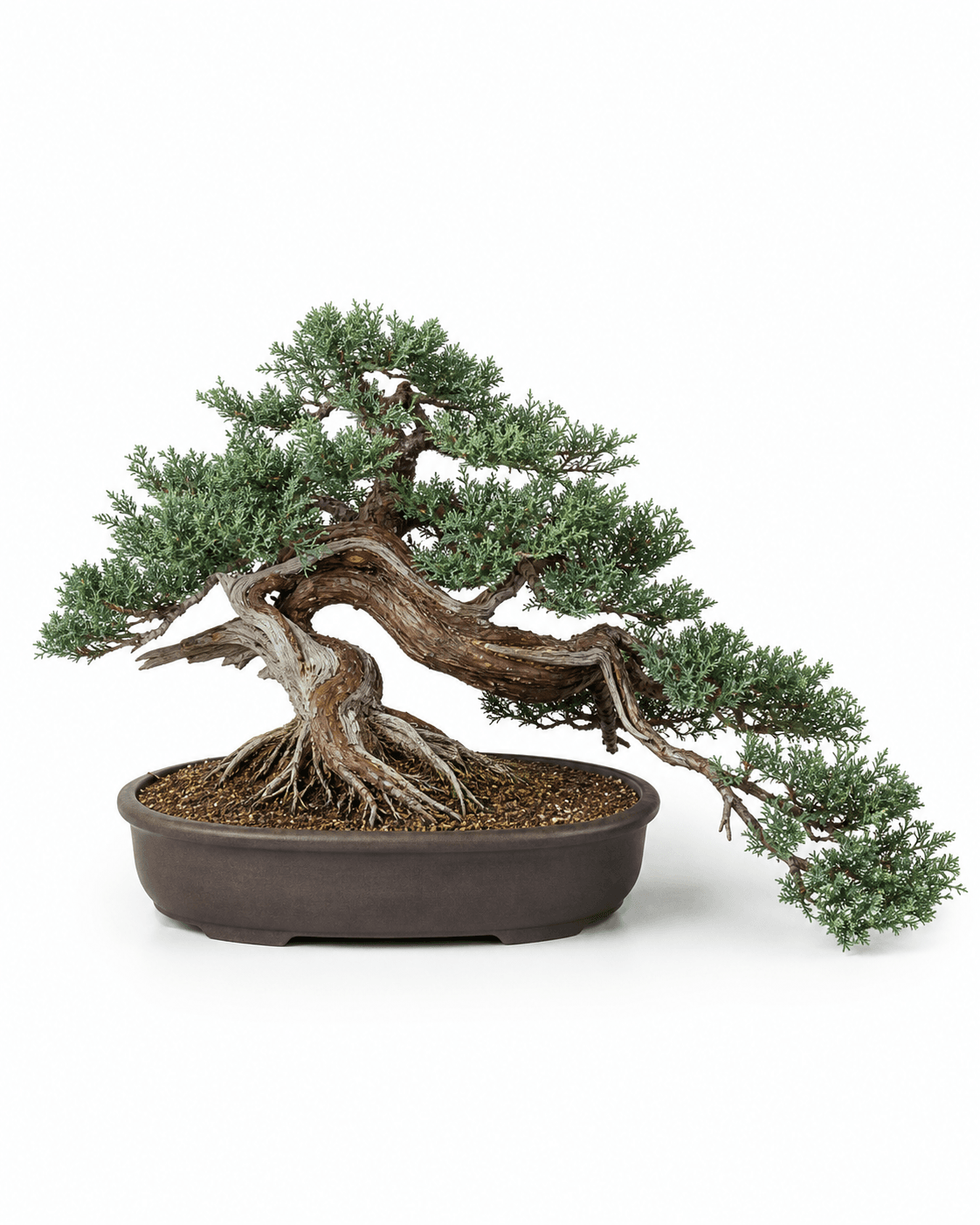
For design, translate the cultivated habit into a low line, raft, cascade, exposed-root image, or rock-gripping composition. The tree should look like its prostrate growth was selected, edited, and clarified. Bonsai Mirai / AsymmetryBonsai Mirai Library
Reading the tree
Read identity, foliage age, root wetting, and extension before any major cut.
Start by separating the tag from the plant. Prostrata, San Jose, Pfitzer, Hollywood, Blue rug, Andorra, procumbens, and generic Chinese juniper can all appear as low or spreading retail material. Bonsai Mirai juniper identificationOregon State Landscape Plants: Juniperus chinensis
Read foliage state next. Mirai notes that Prostrata can reliably revert to juvenile foliage after significant reduction. Adult scale, prickly juvenile growth, and stress shoots each call for different pacing. Bonsai Mirai Library
Read strength through extension and water use. Firm tips, new roots, and even drying suggest the tree can accept work; static green foliage with dry center soil suggests root conversion should come first. Bonsai Mirai Library
Read the low line before cleaning. The defining branch may already be on the surface, and removing every low shoot can erase the very structure that makes Prostrata useful. Bonsai Mirai / AsymmetryBonsai Mirai Library
Foliage work
Preserve active foliage, then prune after growth hardens.
Avoid pinching. Mirai repeatedly ties juniper pinching to tissue tearing, root weakness, and juvenile reversion, while scissor pruning gives a cleaner wound and a better recovery path. Bonsai Mirai Library
For running growth, let the first spring flush harden, then shorten strong tips to active side growth. The goal is to keep interior density while preventing the strongest runners from making the rest of the pad obsolete. Bonsai Mirai Library
On nursery stock, first work may be cleaning rather than styling: remove dead interior material, expose the base, identify the low trunk line, and keep enough foliage to support a later root session. Bonsai Mirai Library
If juvenile foliage follows reduction, pause detail work. Improve sun, airflow, water balance, and restrained feeding, then wait for mature scale to return before another fine pruning cycle. Bonsai Mirai Library
Roots
Spring root work should protect the foliage engine.
Repot during spring movement on a strong tree and keep enough foliage to drive root regeneration. Mirai frames juniper foliage mass as the engine that rebuilds roots after disturbance. Bonsai Mirai Library
Expect nursery-stock roots: old organic media, circling roots, dry pockets, and a center that may not wet evenly. Convert function over staged cycles before chasing a shallow final container. Bonsai Mirai LibraryNC State Extension: Juniperus chinensis
Keep part of the conifer root system intact, open water channels, remove the worst compact or sour pockets, and tie the tree firmly. A low canopy catches wind and can rock new roots loose. Bonsai Mirai Library
After repotting, shelter from drying wind and harsh afternoon sun, water accurately, and withhold fertilizer until vigorous growth confirms new root function. Bonsai Mirai Library
Soil and pot
Use mineral drainage and a container that supports the low line.
A 1:1:1 akadama:pumice:lava mix is a reliable starting point for Prostrata conversion. Adjust akadama percentage, particle size, and fines retention only after the tree has stable roots and the grower understands local drying speed. Bonsai Mirai Library
NC State gives Chinese juniper broad soil tolerance when drainage is good, including acidic to alkaline pH from 5.0 to 8.0. Bonsai soil should prioritize oxygen and even wetting over copying a landscape bed. NC State Extension: Juniperus chinensis
Training pots should be large enough for recovery and shallow enough to begin reading the eventual composition. A slab, crescent, low oval, rugged rectangle, or stone-adjacent pot can fit mature low material. Bonsai Mirai / AsymmetryBonsai Mirai Library
Avoid moss or decorative topdressings that hide dry pockets during conversion. Watering feedback is more valuable than polish while the old root core is being corrected. Bonsai Mirai Library
Climate
Treat parent-species toughness as context, then protect the bonsai root zone.
In warm dry regions, full sun and airflow are valuable, but recently worked pots may need afternoon protection. Landscape drought tolerance does not replace accurate bonsai watering. NC State Extension: Juniperus chinensisBonsai Mirai Library
In humid regions, open dense pads, avoid overhead watering late in the day, and keep drainage sharp. Clemson and UC IPM both connect juniper decline patterns to moisture, stress, blight, and pest pressure. Clemson Extension juniper pestsUC IPM Juniper
In cold regions, keep the tree dormant outdoors while insulating the pot from hard freeze and drying wind. Fresh root work and shallow containers need more protection than in-ground Chinese juniper. Bonsai Mirai LibraryNC State Extension: Juniperus chinensis
In apartments or balconies, the limiting factors are outdoor sun, wind control, watering access, and winter storage. A bright windowsill is not a substitute for an outdoor juniper bench. Bonsai Mirai Library
Pests and diseases
Dense low foliage hides mites, scale, blight, and root trouble.
NC State flags Chinese juniper as part of the cedar-apple rust cycle and points growers to conifer pest guidance. For bonsai, the first practical step is separating disease from old shaded foliage. NC State Extension: Juniperus chinensis
UC IPM lists broad Juniperus problems including mites, scale, aphids, borers, root rot, rust, scorch, water stress, and wet-soil risk. Use those categories for inspection rather than spraying by habit. UC IPM Juniper
Twig blights show as dying tips or patches inside the canopy. Clemson and UC IPM emphasize sanitation, dry foliage, airflow, and avoiding excessive soft growth. Clemson Extension juniper pestsUC IPM Juniper Twig Blights
Root trouble often appears as dull foliage, sudden branch loss after work, water bypassing the center, sour smell, or growth that stalls while the tree stays green. Fix water and oxygen before feeding harder. Bonsai Mirai LibraryUC IPM Juniper
Wiring
Wire the low structure and protect the live vein.
Start with base, trunk line, defining branch, and apex before wiring. Prostrata often has a useful low direction already, so wire should clarify rather than overwrite the habit. Bonsai Mirai / AsymmetryBonsai Mirai Library
Hydrate before bending, support crotches, and make large moves through distributed force. Juniper live veins can be damaged by torsion, especially when old deadwood and live tissue move differently. Bonsai Mirai Library
Use structural wire for the trunk and primary branches, then return later for secondary work after recovery. Hidden wire bite is common in dense low pads. Bonsai Mirai Library
Check wire during warm growth and after feeding. A wire scar on rough-barked juniper may become less obvious, but a scar across a young low branch can dominate a small composition. Bonsai Mirai Library
Propagation
Cuttings, layers, and root grafts preserve the label and solve design problems.
Named Prostrata material should be propagated vegetatively. Seedlings may be Juniperus chinensis, but they are genetically variable and should not be planned or sold as the cultivar without propagation evidence. Kew POWOBonsai Mirai Library
Mirai names Prostrata with Kishu, Itoigawa, Toyama, and San Jose as aggressive-rooting junipers suitable for root-graft scion stock. That makes Prostrata useful when a trunk has movement and deadwood but poor base function. Bonsai Mirai Library
Air layers can rescue a low trunk section or create future graft stock when foliage above the layer is strong. The layer should not be used to avoid first stabilizing a weak plant. Bonsai Mirai Library
Keep records for clone, source, cutting date, layer date, graft date, rootstock, and separation timing. Prostrata is a label that future growers will need evidence to trust. Bonsai Mirai Library
Buying
Buy a readable low line, active foliage, and a rootball you can convert.
Good Prostrata material has a credible tag, visible base, low trunk movement, firm active foliage, interior options, even water penetration, and enough health to survive staged root work. Bonsai Mirai LibraryNC State Extension: Juniperus chinensis
Red flags include generic low juniper tags, no visible base, fresh hedge-shearing, dead shaded interiors, mite stippling, scale, sour peat, hydrophobic roots, recent severe reduction, and premium pricing based on a vague Prostrata name. Bonsai Mirai LibraryUC IPM Juniper
Compare lookalikes before paying. Pfitzer is a hybrid group, Hollywood is usually Torulosa or Kaizuka, San Jose has stronger direct Mirai evidence, Blue rug and Andorra are horizontalis cultivars, and procumbens has persistent juvenile foliage expectations. NC State Extension: Juniperus x pfitzerianaOregon State Landscape Plants: Juniperus chinensis TorulosaBonsai Mirai Library
Landscape stock is acceptable when the price matches the work ahead. The first year may be observation, root correction, cleaning, and modest wiring rather than a showable bonsai. Bonsai Mirai LibraryBonsai Mirai / Asymmetry
Troubleshooting
Diagnose Prostrata by recent work, foliage form, root wetting, and identity.
Symptom: prickly juvenile foliage appears after cutting. Likely cause: significant reduction, pinching, root stress, shade, or excess vigor. Fix: stop refinement and stabilize care until adult scale returns. Bonsai Mirai Library
Symptom: the outside stays green while the inside browns. Likely cause: old shaded foliage, mites, scale, twig blight, dense wet pads, or natural shedding. Fix: inspect first, then clean gradually. UC IPM JuniperUC IPM Juniper Twig BlightsBonsai Mirai Library
Symptom: water runs around the pot wall while tips dull. Likely cause: hydrophobic nursery core or compact roots. Fix: manage soaking now and plan staged spring root work. Bonsai Mirai Library
Symptom: a low branch dies after wiring. Likely cause: torn crotch, dry branch, live-vein damage, or weak root-to-foliage connection. Fix: shelter, stabilize, and delay more bending. Bonsai Mirai Library
Symptom: the tree does not match the Prostrata label. Likely cause: Pfitzer, San Jose, Hollywood, Blue rug, Andorra, procumbens, eastern red cedar, or generic Chinese juniper. Fix: care from observed habit and relabel only with evidence. Bonsai Mirai juniper identificationOregon State Landscape Plants: Juniperus chinensis
Design
Make the prostrate line intentional.
Begin with the base and one convincing low movement. The defining branch may be the longest low runner, a cascade line, a raft section, or a branch that creates tension against the trunk. Bonsai Mirai / Asymmetry
Use negative space to show the line. A continuous green shell makes Prostrata look like landscape groundcover, while selective openings can reveal age, branch hierarchy, and live-vein direction. Bonsai Mirai / AsymmetryBonsai Mirai Library
Deadwood should be proportionate. Small jin, modest shari, and exposed live vein can work, but young nursery material usually reads better with restrained deadwood and strong foliage recovery. Bonsai Mirai Library
Pot pairing can be quiet and low: oval, rectangle, slab, crescent, stone pocket, or rugged training container depending on stage. Let the pot support the direction instead of making the plant look like a clipped shrub. Bonsai Mirai / Asymmetry
Cultivars
Keep Prostrata separate from nearby Chinese-juniper and low-juniper labels.
Kew anchors the parent species, NC State and Oregon State show the breadth of Chinese-juniper forms, and the local Mirai corpus gives Prostrata-specific mentions. Those three layers should stay separate in records. Kew POWONC State Extension: Juniperus chinensisOregon State Landscape Plants: Juniperus chinensisBonsai Mirai Library
San Jose is a cultivated Chinese juniper with stronger direct Mirai evidence for root grafting and juvenile reversion. Prostrata shares some of those direct mentions but should keep its own page because the search label and low habit differ. Bonsai Mirai Library
Pfitzer, Old Gold, Gold Coast, Sea Green, and Hetzii belong to the Pfitzer hybrid group in EntGrove records. Avoid folding those into Prostrata just because both can be broad landscape junipers. NC State Extension: Juniperus x pfitzeriana
Procumbens, Blue rug, Andorra, Blue Pacific, and common juniper can all be prostrate in ordinary language. The word prostrate should describe habit until the botanical label is verified. Bonsai Mirai juniper identificationOregon State Landscape Plants: Juniperus chinensis
History
Prostrata matters as practical material and graft stock more than as a famous named lineage.
The local Mirai corpus uses Prostrata as a known juniper name in practical work: root grafting, juvenile-foliage response, and broader juniper comparisons. That is a useful record even without a dedicated public cultivar monograph. Bonsai Mirai Library
The wider Chinese-juniper story is extensive. Kew accepts the parent species from temperate East Asia, and NC State notes many forms from low groundcovers to tall trees, with bonsai examples in its image set. Kew POWONC State Extension: Juniperus chinensis
For collection records, the valuable history is practical: source, label, first root work, soil conversion, juvenile-foliage episodes, pests, major bends, live-vein treatment, and any graft or air-layer decisions. Bonsai Mirai Library
Species questions
Answer the beginner questions before styling.
Can Prostrata Chinese juniper be used for bonsai?
Yes. Prostrata Chinese juniper can be used for outdoor bonsai when it has a visible base, active foliage, low branch movement, and a rootball that can be converted in stages.
Can Prostrata Chinese juniper live indoors?
No. It needs outdoor sun, airflow, seasonal temperature change, and winter dormancy. Indoor display should be brief.
Is Prostrata the same as San Jose juniper?
Treat them as separate labels. Mirai mentions both Prostrata and San Jose, but San Jose has stronger direct bonsai evidence and its own cultivar expectations.
Is Prostrata the same as Pfitzer juniper?
No. Prostrata is handled here under Juniperus chinensis, while Pfitzer belongs to the Juniperus x pfitzeriana or Juniperus x media hybrid group.
When should Prostrata Chinese juniper be repotted?
Repot during spring movement on a strong tree. Preserve active foliage, avoid bare-rooting, tie the tree down firmly, and convert old nursery soil over staged cycles.
What soil is best for Prostrata juniper bonsai?
Start with open mineral soil such as 1:1:1 akadama:pumice:lava, adjusted for local heat, pot depth, particle size, and watering skill.
Should Prostrata juniper be pinched?
Avoid pinching. Let new growth harden, then prune with sharp scissors to active side growth while preserving enough foliage to power roots.
Why is my Prostrata making juvenile foliage?
Mirai notes Prostrata can revert to juvenile foliage after significant reduction. Other causes include pinching, shade, root stress, heavy wiring, or excess vigor.
Can Prostrata be used for root grafting?
Yes. Mirai names Prostrata among aggressive-rooting junipers suitable as root-graft scion stock, alongside Kishu, Itoigawa, Toyama, and San Jose.
Is Prostrata good beginner material?
It can be useful beginner practice material for growers with outdoor space. The safer path is staged root work, accurate watering, no pinching, and modest styling before heavy carving.
Sources
Species advice needs source discipline.
Next decisions
Plan the operation before copying the calendar.
A good care note for Prostrata Chinese juniper records the tree's stage, the work done, and the aftercare used. That record matters more than a month-name rule.
Related species
Compare nearby trees before transferring advice.
Hollywood juniper
Juniperus chinensis 'Torulosa'
Blue rug juniper
Juniperus horizontalis 'Wiltonii'
Andorra juniper
Juniperus horizontalis 'Plumosa'
Parsons juniper
Juniperus davurica 'Parsonii'
Savin juniper
Juniperus sabina