
Species guide
Siberian Elm Bonsai Care
Ulmus pumila
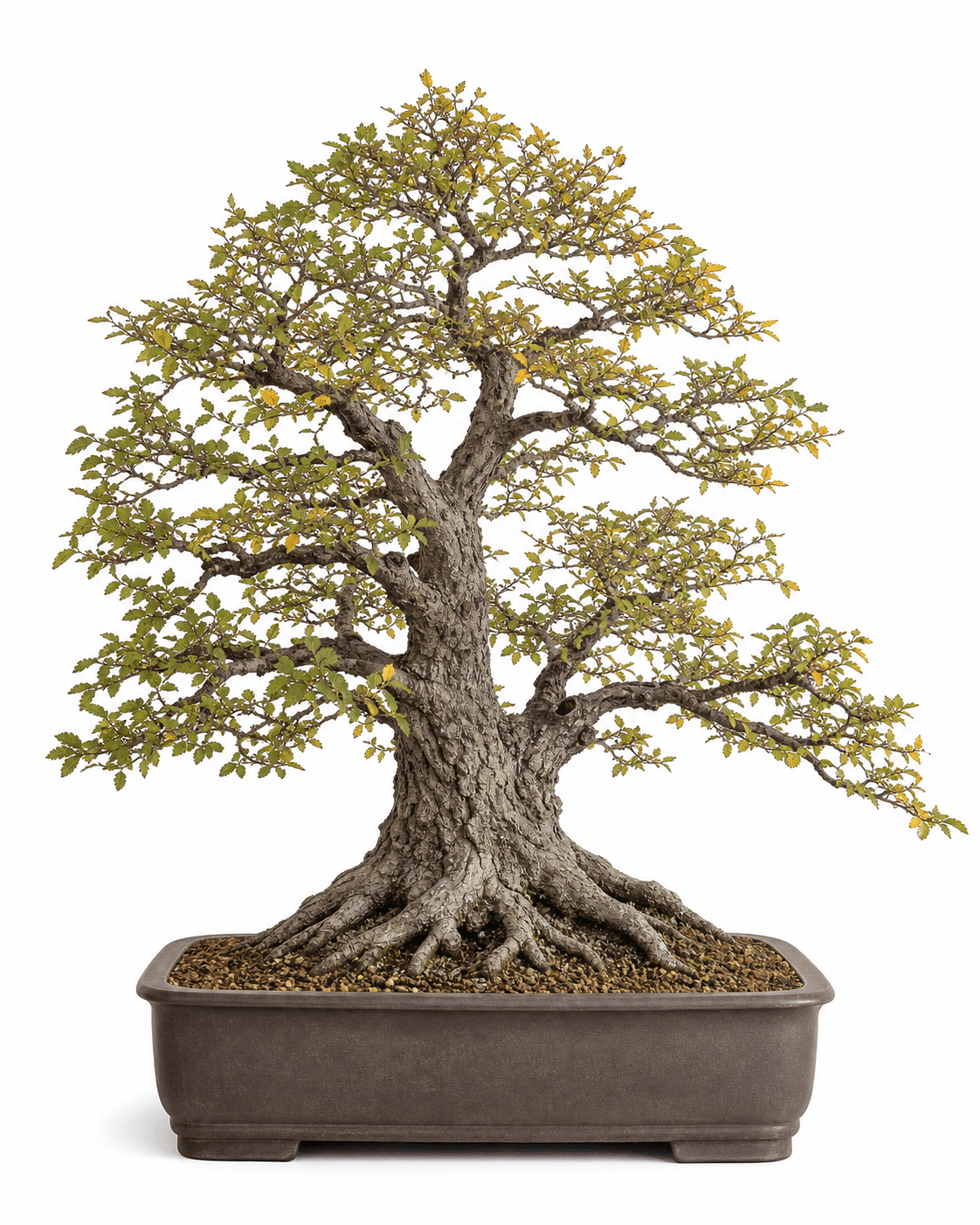
Siberian elm bonsai care starts with treating Ulmus pumila as a cold-hardy outdoor deciduous elm that grows fast, roots hard, and needs frequent structure control. Keep it outside, water by root demand instead of drought reputation, prune before vigorous junctions swell, and prevent seed escape wherever the species is invasive or discouraged.
The local Mirai corpus gives direct Siberian elm guidance in deciduous structural development and broader Ulmus, elm, shin-based root, watering, soil, pruning, wiring, propagation, energy, and design files. Kew, NC State, Oregon State, USDA NRCS, and Utah State ground taxonomy, range, hardiness, identification, pest pressure, and invasive-region management.
The main failure points are warm indoor culture, confusing Siberian elm with Chinese elm, letting shoots run until interior tissue dies back, burying a shin-based root system in stale organic soil, hard summer dry-down in a shallow pot, wire bite on fast-thickening shoots, brittle older branches, elm leaf beetle, Dutch elm disease complacency, bacterial wetwood, and late-spring seedlings under the bench.
Updated June 18, 2026. Written by EntGrove Editorial. Last verified June 18, 2026.
Care fingerprint
Read the species through its shared care pattern.
Repot and structural prune around dormant-to-active transitions; protect new leaves; time refinement work after growth hardens. Use this as the starting point before local conditions and tree strength refine the calendar.
Note: Chinese elm is a confusing alternative label for Ulmus pumila in some horticultural references, but bonsai care usually uses Chinese elm for Ulmus parvifolia. Confirm identity before applying indoor-acclimated Chinese elm advice, and avoid seed escape where Siberian elm is invasive or discouraged.
Read the foliage first
Broadleaf stress usually shows in leaf color, leaf size, wilt, scorch, or delayed hardening before it becomes a branch problem.
Match work to dormancy
Deciduous, evergreen, tropical, succulent, and flowering broadleaf trees recover on different calendars.
Protect fine roots
Root work should preserve enough active fine roots for the tree to rehydrate quickly after the operation.
Care cadence
The calendar starts with the tree's seasonal state.
Placement
Timing: Keep outside year-round with seasonal light, wind, rain, and dormancy. Protect the pot from extreme freeze, dry winter wind, and rapid freeze-thaw without waking the tree in a heated room.
Watch for: Long weak indoor shoots, late autumn growth that does not harden, winter twig dieback, and Chinese-elm retail labels that hide Ulmus identity.
Kew POWOUSDA NRCS Plant GuideOregon State Landscape PlantsBonsai Mirai LibraryLight requirement
Timing: Use full sun when water is reliable. In heat waves, give temporary afternoon protection to slow dry-down and leaf scorch, then return to brighter light when roots can keep pace.
Watch for: Oversized leaves, long internodes, weak interior buds, and a pot that dries faster than the canopy can replace water.
NC State ExtensionOregon State Landscape PlantsUSDA NRCS Plant GuideBonsai Mirai LibraryWatering
Timing: Water thoroughly when the upper soil begins to dry and the root zone still has moisture. Spring extension, full sun, wind, and shallow pots shorten the interval quickly.
Watch for: Hydrophobic root edges, stale wet organic cores, leaf flagging in wind, and translating landscape drought tolerance into bonsai drought culture.
USDA NRCS Plant GuideNC State ExtensionBonsai Mirai LibraryFertilizer
Timing: Feed by stage. Push development trees after growth begins, moderate refined trees after the first flush hardens, pause strong fertilizer in sustained 95 F or hotter weather, and prioritize fall reserve building when the tree is healthy.
Watch for: Runaway coarse extension, weak pale growth caused by roots rather than hunger, fertilizer salt stress in hot weather, and late soft growth pushed too close to winter.
Bonsai Mirai LibraryNC State ExtensionPruning
Timing: In development, let chosen shoots extend enough to thicken, then thin junctions before summer growth locks inverse swelling in place. In refinement, prune hardened shoots back to viable buds and repeat at least twice in temperate growing seasons when vigor allows.
Watch for: Four or more shoots at one point, unchecked Siberian elm dieback, weak interior shoots pruned too early, and a top that steals lower-branch light.
Bonsai Mirai LibraryNC State ExtensionWiring
Timing: Wire only the structural lines that need placement, then check as soon as the first flush hardens and branches thicken. Use guy wires, clip-and-grow, and directional pruning for older brittle branches.
Watch for: Wire bite, bark tracks, cracked brittle wood, wiring weak shoots that should grow, and a design that depends on a single hard bend.
Bonsai Mirai LibraryOregon State Landscape PlantsNC State ExtensionRepotting
Timing: Repot as elm buds swell and warmth returns. Preserve the shin, open the outer root shell, cut damaged roots cleanly, anchor the tree firmly, and avoid re-repotting inside about two years unless survival requires it.
Watch for: Random upper-canopy dieback, sour old organic soil, compacted wet akadama, circling roots, pot lift, slow drainage, and slip-pot interfaces that never integrate.
Bonsai Mirai LibraryUSDA NRCS Plant GuidePropagation and sourcing
Timing: Use seed, cuttings, root cuttings, layers, or removed volunteer material only when the resulting tree can be contained. Prevent flowering and seed where local guidance discourages the species.
Watch for: Taproot-heavy seedlings left too long, weakly rooted layers, unlabeled elm cuttings, root cuttings planted upside down, and seedlings under benches by late spring.
USDA NRCS Plant GuideUtah State Extension IPMBonsai Mirai LibraryPest and seed checks
Timing: Inspect new leaves, shaded shoot interiors, bark cracks, old wounds, and the ground under the bench from early spring through autumn.
Watch for: Elm leaf beetle feeding, lace bugs, leafminers, sawflies, borers, scale, wetwood staining, powdery mildew in humid low-airflow canopies, and wind-dispersed seedlings.
NC State ExtensionOregon State Landscape PlantsUtah State Extension IPMUSDA NRCS Plant GuideBonsai Mirai LibrarySpecies guide
Apply the species profile before copying another tree's calendar.
At a glance
Siberian elm is a fast outdoor elm that rewards control.
The botanical name is Ulmus pumila L. in Ulmaceae. Common labels include Siberian elm, dwarf elm, Asiatic elm, and sometimes Chinese elm in older or loose trade usage. Kew gives the native range as Central Asia to southern Siberia and Korea, and USDA adds northern China, eastern Siberia, Manchuria, and Korea. Kew POWOUSDA NRCS Plant Guide
Use it as an outdoor temperate bonsai. Landscape sources place it around USDA Zone 4 into warm temperate regions, with full sun, rapid growth, broad soil tolerance, spring flowers before leaves, wind-dispersed samaras, and enough drought tolerance to survive exposed sites. A shallow pot changes the care target to even moisture, oxygen, and winter root protection. NC State ExtensionOregon State Landscape PlantsUSDA NRCS Plant GuideBonsai Mirai Library
Best sizes are medium, large, clump, raft, broom, informal upright, and naturalistic collected-tree designs. The tree is useful for trunk building and hardy outdoor practice, but it is intermediate rather than casual because it needs repeated pruning, shin-based root care, wire monitoring, pest checks, and seed containment. Bonsai Mirai LibraryBonsai Mirai / AsymmetryNC State ExtensionUtah State Extension IPM
Wild habitat
Its wild pattern explains the hardiness and the weed risk.
Siberian elm comes from a cold, dry-to-mesic temperate range across Asia. USDA describes a tree that tolerates cold winters, long summer drought, poor soil, low moisture, dry roadsides, pastures, and grasslands, while still preferring well-drained fertile soil when available. Kew POWOUSDA NRCS Plant Guide
For care, the wild lesson is resilience with a narrow container translation. Full sun and wind build compact growth only when the root ball can move water. Drought tolerance in the ground becomes a warning to avoid stale soil and hard dry-down at the same time: roots must have both moisture and air. USDA NRCS Plant GuideBonsai Mirai Library
For design, read it as a windbreak, roadside, grassland, and volunteer elm rather than a delicate finished import. The most convincing images show quick growth controlled into a broom, informal upright, clump, raft, or rough-field deciduous silhouette with visible branch hierarchy. USDA NRCS Plant GuideBonsai Mirai / Asymmetry
Reading the tree
Decide whether you are building vigor or refining density.
Mirai separates development from refinement by what the tree has already produced. In development, elongation, thickening, wound closure, and vascular expansion matter most; in refinement, the work shifts to shortening internodes, managing two-bud bifurcation, and preserving interior light. Bonsai Mirai Library
Siberian elm needs a shorter leash than cork-bark Chinese elm. Mirai flags Siberian elm, birch, and zelkova as dieback-prone deciduous species that should not run unchecked during structural development; repeated pruning keeps interior tissue alive while preventing coarse junctions. Bonsai Mirai Library
Read strength from the whole system: leaf size, internodes, bud count, interior survival, root drainage, and how quickly the pot dries after watering. Random upper-canopy dieback on a shin-based elm often points to root oxygen loss before it points to a pruning mistake. Bonsai Mirai LibraryNC State Extension
Pruning
Prune Siberian elm before vigor becomes swelling or dieback.
In structural development, thin each junction down to a main line plus one useful secondary, or to one leader where dominance is clear. Mirai warns that four or more shoots from one elm junction create inverse swelling and knuckling that cannot be corrected later. Bonsai Mirai Library
For refinement, wait until the spring flush has hardened. On elm and other small-leaf deciduous trees, Mirai uses a two-bud model: cut strong elongated shoots back to viable buds that can divide into finer ramification. Leave weak interior shoots with enough leaf mass to harden and gain strength. Bonsai Mirai Library
Use fall leaf-drop pruning only when leaves are naturally abscising and the tree has had a full season to store energy. Mirai gives a two-to-three-week window after leaf-drop signals begin, and includes elms among fully deciduous species that can use this window. Heavy work after an early stress drop should wait for spring hardening. Bonsai Mirai Library
Large cuts need staged wound logic. Mirai deciduous wound guidance preserves the collar, leaves stubs where a shoulder must form, keeps small shoots around large wounds to feed callus evenly, and seals fresh cambium. On elm, finishing some large summer cuts at leaf drop reduces dieback risk. Bonsai Mirai Library
Roots
Treat Siberian elm as a shin-based deciduous tree.
Mirai places elms in the shin-based deciduous group with hornbeams, quinces, styrax, ume, apple, and crabapple. The shin is the root and soil region immediately under the trunk, where new fine roots, oxygen balance, and immunity concentrate. Bonsai Mirai Library
Repot as buds swell and warmth returns. Mirai says elms are repotted later than many deciduous trees because they need heat to break dormancy. Hydrate before work, remove the scaled outer root shell, clean the surface, sides, and bottom, preserve the interior shin, and cut torn roots cleanly. Bonsai Mirai Library
Young seedlings and volunteers need early root decisions. USDA warns that seedlings left in nursery beds more than two years develop a taproot that makes lifting harder. For bonsai, correct heavy roots while the tree is vigorous, then give recovery space before moving into a shallow show pot. USDA NRCS Plant GuideBonsai Mirai Library
Anchor the tree firmly after root work. Mirai emphasizes that a tree that can move cannot grow new roots. Fertilize only after robust new growth confirms recovery, typically at least four to six weeks after root pruning. Bonsai Mirai Library
Soil and pot
Use soil that keeps the shin oxygenated.
A reliable development mix is akadama, pumice, and lava or comparable aggregate adjusted to climate. Mirai soil guidance assigns akadama nutrient and fine-root value, pumice water buffering, and lava oxygen structure. USDA adds that Siberian elm prefers well-drained fertile soil even though it survives rougher sites. Bonsai Mirai LibraryUSDA NRCS Plant Guide
For refined deciduous trees, Mirai often uses solid akadama because the two-to-three-year deciduous repot rhythm can refresh soil before breakdown becomes destructive. Use that only when watering, repot timing, and particle quality are reliable; developing or recovering Siberian elm can stay in a more structurally open mix. Bonsai Mirai Library
Pot choice should match root stage. Mirai notes that shallow containers hold proportionally more water and less oxygen. Use deeper training containers while rebuilding the shin and root plate, then move shallower only after old soil, circling roots, and oxygen problems are reconciled. Bonsai Mirai Library
Pot pairing should feel utilitarian and temperate: unglazed rectangles, soft ovals, and deeper training pots suit rough outdoor elm material. Refined broom or clump trees can move into quieter glazed or unglazed deciduous containers once the root system is flat, fine, and stable. Bonsai Mirai / Asymmetry
Climate
Hardy in the ground still means managed in a pot.
Cold regions should protect the container, not cancel dormancy. Place pots on the ground, mulch around them, use an unheated cold frame, and block drying wind when temperatures threaten fine roots and twigs. Mirai notes that refined deciduous trees lose some cold tolerance because fine ramification stores less sugar and starch. Bonsai Mirai LibraryNC State ExtensionOregon State Landscape Plants
Hot dry regions should protect roots before leaves. USDA and NC State document drought tolerance, but Mirai watering guidance treats foliar mass, reservoir size, temperature, sun, wind, and humidity as the actual watering equation. Afternoon shade is a heat-management tool, not a permanent placement. USDA NRCS Plant GuideNC State ExtensionBonsai Mirai Library
Mild-winter regions may see longer growth and weaker dormancy. Keep the tree outside, reduce late nitrogen before autumn, and use leaf-drop or spring-bud cues rather than a fixed northern calendar. If the tree stays partially active, postpone heavy work until buds and roots show readiness. Bonsai Mirai Library
In invasive or monitored regions, regional adaptation includes containment. USDA says the plant is considered invasive by several sources, NC State says it can form large colonies, and Utah State recommends pulling seedlings before seed maturity. Remove flowers or samaras before wind dispersal where local guidance calls for control. USDA NRCS Plant GuideNC State ExtensionUtah State Extension IPM
Pests and diseases
Inspect leaves, bark, wounds, and nearby elm material.
NC State lists elm leaf beetle, larger elm leaf beetle, lace bug, elm leafminer, elm sawfly, elm zigzag sawfly, mealybugs, spiny elm caterpillar, borers, caterpillars, and scale among common insect concerns. Oregon State also singles out leaf beetles on weak-branched, insect-prone Siberian elm. NC State ExtensionOregon State Landscape Plants
The disease frame needs nuance. NC State says Siberian elm is resistant but not immune to Dutch elm disease and phloem necrosis, and also lists wilts, rots, cankers, and common elm diseases. USDA notes bacterial wetwood stains on bark. Treat flagging, vascular streaking, and wetwood ooze as extension-level diagnostic problems. NC State ExtensionUSDA NRCS Plant Guide
Mirai adds a cultural lens: fungi and insects often exploit weak roots, crowded humid interiors, excessive nitrogen, and poor airflow. Correct water-oxygen balance, thin dense growth, and restore light before escalating chemical controls. Bonsai Mirai Library
Powdery mildew can appear on elm when humidity and low airflow rise. Mirai treats it as a photosynthesis-reducing signal more than a fatal diagnosis. Open the canopy, improve sun and air, and avoid constantly wet foliage. Bonsai Mirai Library
Wiring
Wire structure selectively and respect brittle wood.
Mirai deciduous wiring is selective: primary lines once, secondary scaffolding once, then clip-and-grow and pruning carry most refinement. Wire the branches you have committed to as structure, and leave fine weak shoots alone while they gain strength. Bonsai Mirai Library
Timing depends on the move. Spring budburst gives deciduous branches high turgor and malleability; fall leaf drop can be useful for heavier broadleaf deciduous bending because water content drops while sugars and starches rise. Siberian elm branch brittleness still sets the limit. Bonsai Mirai LibraryOregon State Landscape PlantsNC State Extension
Use branch rotation and distributed bends instead of one hard crease. Mirai recommends rolling deciduous branches along their long axis while bending so fibers shear across a longer span. Stop as soon as a hairline split appears. Bonsai Mirai Library
Check wire once the first flush hardens because thickening accelerates after leaves repay energy. Use guy wires for older brittle branches, and protect rough bark from trunk-crossing wire on mature material. Bonsai Mirai Library
Propagation
Propagation is easy enough that containment matters.
Seed is straightforward but risky where the species spreads. USDA says seed should be sown as soon as ripe, kept moist, and not excessively dried or dewinged; Utah State says seed follows leaf emergence and can germinate immediately by late spring. Use seed only when local guidance allows containment. USDA NRCS Plant GuideUtah State Extension IPM
Cuttings and root cuttings are practical elm methods. Mirai notes that elms root readily from cuttings under mist, bottom heat, and well-aerated media, and that root cuttings can form vegetative buds if planted in the original orientation. Bonsai Mirai Library
Air layering can remove a usable upper section or correct poor roots. Keep the layer vigorous, wait for enough radial roots to support foliage, and stabilize the new tree firmly after separation. Bonsai Mirai Library
Grafting is mainly a repair or cultivar tool: thread grafts and approach grafts can add branches or roots while the tree is vigorous. Match cambium tightly, immobilize the union, and plan for a full growing season before relying on the graft. Bonsai Mirai LibraryBonsai Mirai / Asymmetry
Sourcing
Resolve the label and the ethics before you buy.
The label problem is real. Oregon State says Siberian elm is sometimes sold as Chinese elm, while the common bonsai Chinese elm is Ulmus parvifolia lacebark elm. NC State also lists Chinese elm as a common name for Ulmus pumila. Confirm leaves, bark, buds, flowers, fruit, and source history before borrowing any indoor-acclimated Chinese elm advice. Oregon State Landscape PlantsNC State Extension
Good bonsai candidates have a usable base, correctable roots, low buds, short enough internodes, and a trunk line that can become an elm image without extreme bending. Removed volunteers can be ethical source material in invaded sites, provided the tree is contained and prevented from setting seed. Utah State Extension IPMNC State ExtensionBonsai Mirai / Asymmetry
Avoid material with severe leaf-beetle damage, wetwood streaking, weak or split branches, irreversible inverse taper, a sour compacted root core, no lower buds, active seed production in a restricted region, or a vague elm tag that could mean Ulmus parvifolia, Ulmus crassifolia, Ulmus americana, or Ulmus alata. NC State ExtensionOregon State Landscape PlantsBonsai Mirai Library
Troubleshooting
Start with roots, timing, and identity.
Random upper twig dieback usually points to unchecked running, poor interior light, or shin-zone oxygen loss. Prune more frequently during development, open the canopy, and inspect the root core at the next spring bud-swell window. Bonsai Mirai Library
Yellow leaf margins can indicate elm nutrient issues, but broad canopy yellowing is more serious. Check water quality, drainage, root smell, fertilizer salt, and pest pressure before adding more feed. Bonsai Mirai Library
Leaf holes and skeletonized leaves usually point to elm leaf beetles or other chewing insects. Remove damaged leaves where useful, inspect undersides, improve tree vigor, and use local extension controls when the infestation is beyond hand management. NC State Extension
Brittle branch cracks mean the bend exceeded the wood. Stop, stabilize the branch if worth keeping, reduce stress, and use future clip-and-grow or guy-wire movement instead of repeating the same bend. Bonsai Mirai LibraryOregon State Landscape Plants
Volunteer seedlings under benches mean seed control failed. Remove them before maturity, clean samaras from benches and soil surfaces, and consider removing flowers earlier in regions where Siberian elm is monitored or invasive. Utah State Extension IPMUSDA NRCS Plant Guide
Design
Design it as a vigorous elm, not as a conifer.
Start with base, trunk line, defining branch, and apex. Mirai design fundamentals use those anchors to decide whether a tree should read as quiet, powerful, dynamic, or aged. Siberian elm often reads best as practical, outdoor, fast-grown deciduous material. Bonsai Mirai / AsymmetryBonsai Mirai Library
Deciduous branch hierarchy should move from primary to secondary to tertiary with upward and outward energy, not flat conifer pads. Mirai describes mature deciduous crowns as interior branches rising and then doming outward into terminal ramification. Bonsai Mirai Library
Strong styles include broom, informal upright, clump, raft, multi-trunk, and naturalistic field-collected forms. Use sacrifice growth for trunk and taper, then remove it before junctions swell or lower branches die back. Bonsai Mirai LibraryBonsai Mirai / Asymmetry
Deadwood should be restrained. Mirai broadleaf guidance treats deciduous hollows as different from durable conifer jin and shari. Siberian elm can show age through rough bark, scars, hollows, branch hierarchy, and winter twig structure without relying on preserved deadwood as the main feature. Bonsai Mirai Library
Forms
Landscape cultivar names rarely solve bonsai problems.
NC State lists Chinkota, Coolshade, Improved Coolshade, Lincoln, Morton Plainsman or Vanguard, New Horizon, and Pendula. Those names usually describe landscape traits such as cold tolerance, disease resistance, harsh-site performance, limb breakage, or weeping habit. NC State Extension
For bonsai, judge the individual tree: nebari, trunk movement, internodes, bark, bud placement, root quality, and the amount of structure that can be kept after pruning. A cultivar tag cannot repair a high graft, weak base, or unfixable inverse taper. Bonsai Mirai / AsymmetryBonsai Mirai Library
Dwarf elm and Asiatic elm may simply be common names for Ulmus pumila. Chinese elm may mean Ulmus pumila in some landscape references, but bonsai culture usually uses Chinese elm for Ulmus parvifolia. Use the scientific name whenever buying, writing labels, or comparing care. USDA NRCS Plant GuideOregon State Landscape Plants
History
Siberian elm has a windbreak history and a cautionary afterlife.
USDA says Siberian elm was introduced to the United States in the 1860s and used in windbreaks, tree strips, and harsh winter landscapes where fast growth and hardiness mattered. NC State echoes its history as a valued hardiness and windbreak tree. USDA NRCS Plant GuideNC State Extension
The same traits made it a difficult ornamental. Oregon State calls it very adaptable and resistant to Dutch elm disease, while also noting weak branches, messy habit, insect attack, and rural hedge use. NC State similarly flags high maintenance, weak wood, insects, weedy behavior, and invasive status in some states. Oregon State Landscape PlantsNC State Extension
Its bonsai value is practical rather than prestigious. A strong Siberian elm can teach outdoor deciduous timing, repeated cutback, root oxygen, and invasive-species responsibility. The best examples will usually come from thoughtful local material and long-term branch control rather than from finished retail imports. Bonsai Mirai LibraryBonsai Mirai / AsymmetryUtah State Extension IPM
Species questions
Answer the beginner questions before styling.
Is Siberian elm a good beginner bonsai?
Siberian elm suits an outdoor beginner who wants vigorous deciduous material and can prune often. It asks more judgment than a slow conifer because unchecked shoots can create swelling, dieback, coarse internodes, and unwanted seed.
Can Siberian elm bonsai live indoors?
Keep Ulmus pumila outdoors for long-term culture. It is a temperate elm that needs winter dormancy, sun, air movement, and seasonal timing; indoor display should be brief and followed by a return to outdoor conditions.
Is Siberian elm the same as Chinese elm?
Siberian elm is Ulmus pumila. Chinese elm in bonsai usually means Ulmus parvifolia, also called lacebark elm. Some extension references and trade labels use Chinese elm loosely for Ulmus pumila, so identify the leaves, bark, buds, flowers, fruit, and source before applying species-specific care.
How much sun does Siberian elm bonsai need?
Use full sun when water is reliable and the pot stays within a manageable root temperature. In extreme heat or drying wind, give temporary afternoon protection while keeping enough light for compact internodes and strong interior buds.
How often should I water Siberian elm bonsai?
Water when the upper soil begins to dry, then water thoroughly. The species tolerates drought in the ground, but a shallow bonsai pot still needs even moisture and oxygen.
When should I prune Siberian elm bonsai?
In development, shorten strong extensions before four or more shoots crowd one junction. In refinement, let the first flush harden and then cut back to one or two buds, leaving weak shoots longer until they gain strength. Fall leaf-drop pruning can reset fine structure after the tree naturally pulls resources back.
When should I repot Siberian elm bonsai?
Repot in spring as buds swell and warmth returns. Preserve the shin, open the surface, sides, and bottom of the root system for oxygen, and avoid repeated full root work inside roughly two years unless drainage, roots, or health demand intervention.
What soil works best for Siberian elm bonsai?
Use an aggregate deciduous mix that balances moisture with oxygen. Akadama, pumice, and lava or a comparable regional aggregate can work for development; refined trees can move toward an akadama-forward mix when watering, particle quality, and repot timing are reliable.
Should I grow Siberian elm if it is invasive locally?
Follow local invasive-species guidance. In regulated or discouraged regions, avoid buying or planting it. Removed volunteer material can be trained only with strict containment: remove flowers or samaras, clean benches, monitor seedlings, and compost or dispose of waste responsibly.
Why are Siberian elm leaves being eaten or skeletonized?
Elm leaf beetle, larger elm leaf beetle, sawflies, caterpillars, lace bugs, and leafminers are all plausible. Inspect leaf undersides and tender shoots, improve vigor and airflow, isolate weak trees, and use regional extension guidance before choosing a control.
Sources
Species advice needs source discipline.
Next decisions
Plan the operation before copying the calendar.
A good care note for Siberian elm records the tree's stage, the work done, and the aftercare used. That record matters more than a month-name rule.
Related species
Compare nearby trees before transferring advice.
Japanese maple
Acer palmatum
Trident maple
Acer buergerianum
Amur maple
Acer tataricum subsp. ginnala
Field maple
Acer campestre
Korean hornbeam
Carpinus turczaninovii