
Species guide
Sugar Pine Bonsai Care
Pinus lambertiana
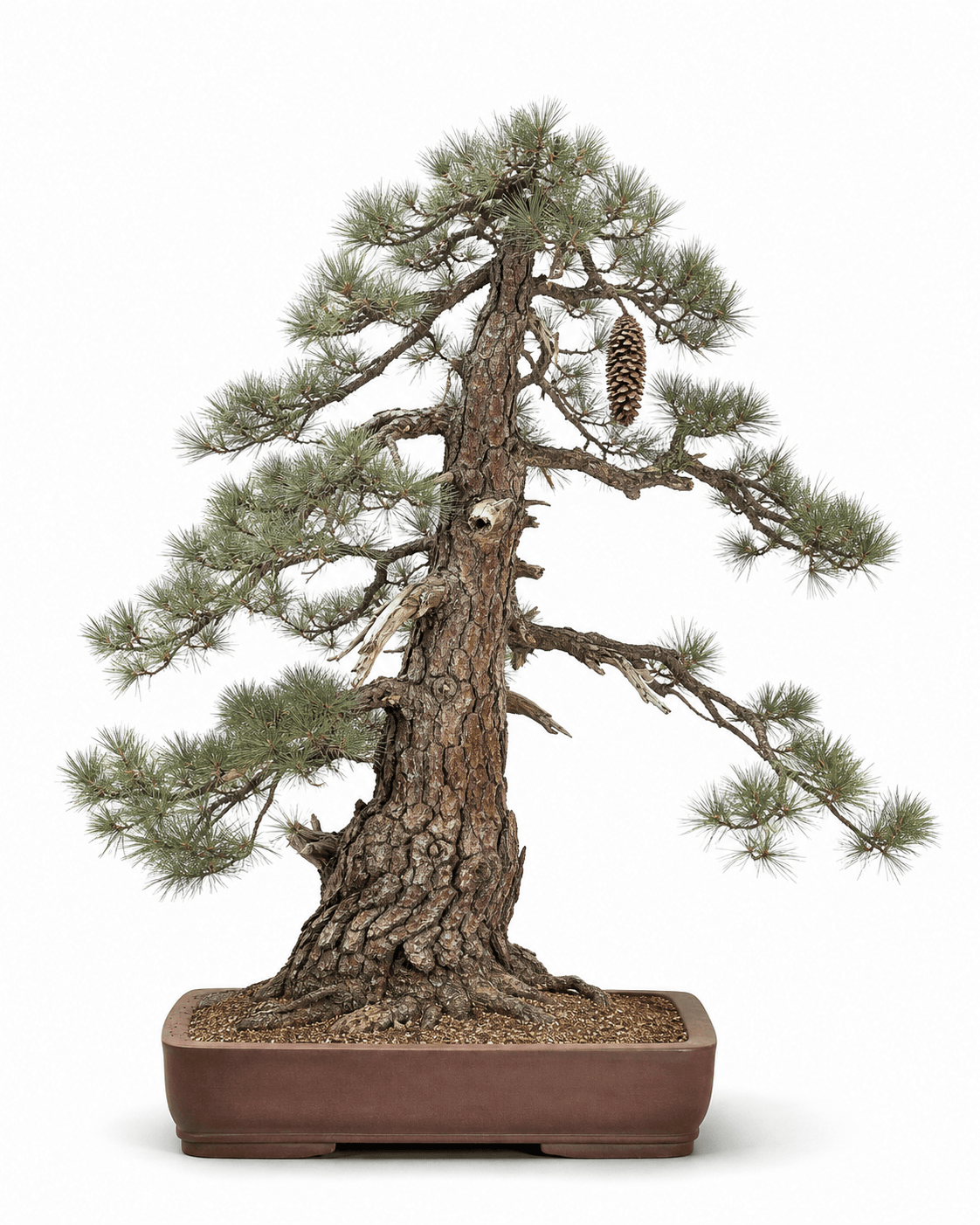
Sugar pine is a five-needle, long-needle single-flush pine for outdoor growers who can provide full sun, cool winter dormancy, mineral root oxygen, and room for a medium to large design. Its foliage, huge cones, and western mixed-conifer habitat make it a poor fit for small indoor bonsai and a strong fit for patient native-pine development.
The local Mirai corpus has direct Sugar pine mentions but no dedicated Sugar pine episode, so this profile is transparent about transferred method: five-needle pine, Ponderosa, long-needle single-flush, yamadori, grafting, pine deadwood, and foundational files provide the bonsai technique. Kew, Flora of North America, USDA Silvics, USDA FEIS, Oregon State, and UC IPM ground the taxonomy, range, morphology, hardiness, ecology, regeneration, and disease risks.
Updated June 6, 2026. Written by EntGrove Editorial. Last verified June 6, 2026.
Care fingerprint
Read the species through its shared care pattern.
Do not default to Japanese black pine decandling; manage vigor through timing, needle balance, light, and conservative pruning. Use this as the starting point before local conditions and tree strength refine the calendar.
Identify flush behavior
Single-flush, multiflush, white pine, and compact pine groups have different pruning windows and different risk levels.
Avoid default decandling
Japanese black pine methods do not transfer safely to every pine, especially slow, weak, collected, or five-needle trees.
Use needles as strength data
Needle length, color, age, and density help show where vigor is strong, weak, or becoming shaded.
Care cadence
The calendar starts with the tree's seasonal state.
Placement
Timing: Grow outdoors in sun with airflow. Use light afternoon protection or pot shading only when heat would cook the shallow root zone.
Watch for: Indoor display, low light, stagnant patios, hot reflected walls, root-zone heat above the tree response, and winter storage that stays warm.
Oregon State Landscape PlantsBonsai Mirai LibraryWatering
Timing: Water thoroughly after the root zone has dried enough for oxygen to return. Keep the entire root mass evenly hydrated during active growth.
Watch for: Dry pockets in old field soil, stale wet cores, drought used as needle control, and spring water stress while candles are extending.
Bonsai Mirai LibraryDevelopment feeding
Timing: Feed strongly while building trunk, branches, and interior buds. Development needs needles, transpiration, and vascular growth before fine refinement.
Watch for: Reducing fertilizer before back buds become shoots, pruning away the foliage battery, and chasing short needles on a tree that still lacks density.
Bonsai Mirai LibraryRefinement feeding
Timing: For five-needle pines, sheath drop in late spring or early summer is the signal that the new needles have hardened and a moderate fertilizer application can be safer than spring feeding.
Watch for: Heavy spring feeding on a finished tree, weak fall reserves, and applying refinement timing to material still in structural development.
Bonsai Mirai LibraryPruning and needle work
Timing: Let spring candles elongate and harden. For five-needle pine behavior, begin pruning and light cleanup after papery sheaths drop and needles are firm.
Watch for: Spring candle pinching, native-foliage decandling, heavy old-needle stripping, and cuts that leave no productive needle clusters behind.
Bonsai Mirai LibraryFall structural work
Timing: Use early fall, before the final four to six weeks ahead of hard freeze, for heavier single-flush pine structural work when the tree is energy-positive.
Watch for: Styling the same fall after a major repot, removing more than half the foliage without winter protection, and wiring after needles have already been damaged.
Bonsai Mirai LibraryRepotting
Timing: Repot in early spring as buds begin to move. Stage old nursery or collected root cores rather than clearing the whole system at once.
Watch for: Bare-rooting, loose tie-downs, compact organic cores, cut coarse roots without nearby granular soil, and combining heavy root work with heavy styling.
Bonsai Mirai LibraryPest and disease checks
Timing: Inspect during cool moist rust weather, after drought, after root stress, and whenever branch flags, cankers, pitch tubes, or sudden crown thinning appear.
Watch for: White pine blister rust, dwarf mistletoe, mountain pine beetle, red turpentine beetle, Ips, root disease, needle cast, sugar pine cone beetle, and scale.
USDA Forest Service SilvicsUC IPMWinter rest
Timing: Keep outside and dormant. Protect the pot during deep freezes while preserving the cold seasonal signal.
Watch for: Warm-winter decline, frozen dry roots, hard freezes after fresh root work, and keeping the tree in a warm garage or room for winter.
Oregon State Landscape PlantsBonsai Mirai LibrarySpecies guide
Apply the species profile before copying another tree's calendar.
At a glance
Sugar pine is the giant five-needle pine of western mixed-conifer forest.
Kew accepts Pinus lambertiana Douglas in Pinaceae and gives the native range as Oregon to northern Baja California. Flora of North America treats Sugar pine as the largest species in Pinus and describes five-needle foliage with the longest seed cones in the genus. Kew POWOFlora of North America
For bonsai technique, EntGrove places Sugar pine in Pine > Long-Needle Single-Flush Pines. It is a five-needle pine, so the sheath-drop signal matters, but the larger care logic still favors strong foliage, root oxygen, staged pruning, and no native-foliage decandling. Bonsai Mirai Library
The grower should treat the page as a careful source-depth guide. Mirai names Sugar pine in long-needle pine method but does not dedicate a file to the species, while public forestry and botanical sources supply the species-specific range, morphology, disease, and ecology. Bonsai Mirai LibraryUSDA Forest Service SilvicsUSDA Forest Service FEISFlora of North America
Wild habitat
Its wild image is tall open crown, huge cones, mixed forest, and Sierra scale.
USDA FEIS describes a range from north-central Oregon through the Cascades, Klamath and Siskiyou mountains, Sierra Nevada, southern California ranges, western Nevada outliers, and an isolated northern Baja population. More than 80 percent of the range is in California. USDA Forest Service FEIS
Flora of North America gives the habitat as montane dry to moist forests at 330 to 3200 m. Oregon State summarizes the horticultural range from about 2000 to 9000 ft, with sun to light shade and USDA Zone 6 landscape hardiness. Flora of North AmericaOregon State Landscape Plants
USDA Silvics calls Sugar pine the tallest and largest pine, often 175 to 200 ft in mature forest, with huge asymmetrical branches and long pendent cones high in the crown. That scale should shape bonsai expectations before any pruning technique is chosen. USDA Forest Service Silvics
The care translation is moisture with air. USDA Silvics says Sugar pine is less drought tolerant than several companions, including Ponderosa, Douglas-fir, incense cedar, and grand fir. In a pot, grow it as a pine with open oxygen, but avoid turning western drought survival into deliberate dehydration. USDA Forest Service SilvicsBonsai Mirai Library
The design translation is vertical space, long branch reach, and restraint. Use the straight trunk, open crown, strong horizontal limbs, pendulous cones, and mixed-conifer associations as the image source rather than forcing dense black-pine pad geometry. USDA Forest Service SilvicsBonsai Mirai / Asymmetry
Reading the tree
Read Sugar pine as a five-needle pine with long-needle single-flush limits.
FNA and Oregon State both describe five needles per bundle. The papery sheath around a five-needle pine cluster is the timing marker in Mirai method: once sheaths drop and needles harden, pruning and light cleanup can begin without driving more needle extension. Flora of North AmericaOregon State Landscape PlantsBonsai Mirai Library
Do not pinch elongating spring candles. Mirai five-needle pine files state that pinching long-needle single-flush pine candles during elongation drives the remaining needles too long and weakens the future response. Bonsai Mirai Library
Development branches should look strong before they look refined. More needles create more photosynthesis, transpiration, vascular thickening, and back-bud potential. Sparse branches need growth, not cosmetic cleaning. Bonsai Mirai Library
Refinement begins only when interior buds have become real needle-bearing shoots. At that point, cutting back to stronger interior secondaries can remove tip dominance and distribute energy across more growing points. Bonsai Mirai Library
Pruning
Let the flush harden, then prune to needle clusters that can feed new buds.
Mirai places five-needle pine pruning after sheath drop, when needles have hardened and the shoot has returned to an energy-positive state. Sugar pine should follow this five-needle signal unless the tree response proves slower in the local climate. Bonsai Mirai Library
When cutting a shoot, leave enough new needles behind the cut to photosynthesize. New buds form from the remaining needle clusters, so a bare cut into old wood can create a dead end on single-flush pines. Bonsai Mirai Library
Weak branches stay unpruned. Branches in development may need a season of extension and fertilizer so the interior has enough vascular activity to support future cutback. Bonsai Mirai Library
Avoid needle plucking as an energy-balancing method. On long-needle single-flush pines, balance strength by pruning strong tips back to usable interior growth, while preserving needles that feed weak regions. Bonsai Mirai Library
Cone control is part of pruning. Sugar pine cones are large and energy expensive; remove cone load on bonsai when the tree needs roots, buds, or recovery more than seed display. Flora of North AmericaOregon State Landscape PlantsBonsai Mirai Library
Roots
Repot for root oxygen, then protect the recovery engine.
Pines store strength in coarse roots and rely on mycorrhizal partnerships, so root work is a major energy decision. Repot Sugar pine in early spring as buds begin to move, giving the tree a full growing season for fine-root recovery. Bonsai Mirai Library
USDA FEIS says seedlings rapidly grow a deep taproot on mineral soil and can have taproots 22 to 40 in deep after two years. Old nursery or collected material may carry long coarse roots that need staged correction. USDA Forest Service FEIS
Use staged root-core conversion. Solve the limiting root or fit problem first, preserve functioning roots, place granular soil where new roots should grow, and return to the old core in a later cycle. Bonsai Mirai Library
Tie-down quality matters. A tall, asymmetric pine shifts leverage through the root plane, so secure the tree mechanically before chopsticking. Movement after repotting shears new fine roots. Bonsai Mirai Library
After a major root operation, hold styling and heavy pruning until new candles prove recovery. Mirai fall pine guidance warns against styling a pine in the same fall after an initial spring repot. Bonsai Mirai Library
Soil and pot
Use mineral air space, then match water retention to climate.
Mirai pine fundamentals use akadama, pumice, and lava as the baseline pine system. For long-needle and five-needle pines, the mix leans toward oxygen, with the fine fraction reduced so the root zone can dry and re-oxygenate. Bonsai Mirai Library
A practical starting point is 1:1:1 akadama:pumice:lava, sieved to reduce 1/16 in fines and keep roughly 1/8 to 1/4 in particles inside the pot. Adjust akadama and top-dressing for very dry or very wet climates. Bonsai Mirai Library
Sugar pine is less drought tolerant than several western companions in USDA Silvics comparisons. That fact matters in a shallow pot: give the tree oxygen-rich soil, then water completely when it needs water. USDA Forest Service SilvicsBonsai Mirai Library
Pot choice should support scale. Unglazed rectangles, ovals, slabs, and quiet earth-toned containers suit a western pine image. Very shallow show pots should wait until roots and interior buds are already strong. Bonsai Mirai / AsymmetryBonsai Mirai Library
Climate
Cool mountain rhythm matters more than raw drought reputation.
Oregon State lists USDA Zone 6, and FNA places the species across montane dry to moist forest. In containers, protect the pot from severe freezes while keeping the tree outdoors and cold-dormant. Oregon State Landscape PlantsFlora of North America
Warm-winter and hot lowland gardens need caution. Mirai grafting guidance groups Sugar pine with long-needle single-flush pines that decline without true dormancy in subtropical or hot lowland climates. Bonsai Mirai Library
Summer heat care should focus on the pot. Use bench placement, shade cloth during sustained heat above about 95 F, and pot shielding while keeping foliage bright enough to sustain pine energy. Bonsai Mirai Library
Rust hazard changes by region and microclimate. USDA Silvics reports higher blister-rust hazard in Oregon and northern California, with cool moist stream bottoms and north slopes more hazardous than warm upland sites. USDA Forest Service SilvicsUC IPM
Pests and disease
White pine blister rust is the disease to know before sourcing.
USDA Silvics identifies white pine blister rust, Cronartium ribicola, as the dominant Sugar pine pathology and says Sugar pine is the most susceptible commercially important North American white pine. USDA Forest Service Silvics
UC IPM explains that the pathogen infects five-needle white pines through needle stomata, with early yellow needle spots often missed and later branch flagging or cankers becoming visible. It specifically includes Sugar pine among the California native five-needle hosts. UC IPM
For bonsai, buy clean material and avoid moving suspect infected stock across regions. Keep foliage dry overnight when possible, improve airflow, inspect cankers, and use local extension or forestry guidance before pruning or discarding infected material. UC IPMUSDA Forest Service Silvics
USDA Silvics also lists dwarf mistletoe, Lophodermella needle cast, Armillaria, Heterobasidion, nursery damping-off pathogens, mountain pine beetle, red turpentine beetle, Ips, sugar pine cone beetle, sugar pine scale, and black pineleaf scale. USDA Forest Service Silvics
Troubleshooting should begin with stress history. Root drought, stale wet soil, recent repotting, heat, and heavy pruning can make pest and disease pressure more serious on a container pine. Bonsai Mirai LibraryUSDA Forest Service Silvics
Wiring
Wire for open western structure and protect five-needle foliage.
Five-needle pines often read best with softer branch arcs than angular multi-flush pine pads. Mirai five-needle design guidance favors natural curving movement and visible structure. Bonsai Mirai Library
Use structural wiring when the tree is energy-positive and the branch has enough foliage to recover. Major pine bends belong in early spring before the push or in fall before deep dormancy, depending on the operation and climate. Bonsai Mirai Library
Watch tear signals. Mirai pine bending guidance treats visible outer-fiber tearing as the stop point and warns that raffia can hide the cues needed to judge safe movement. Bonsai Mirai Library
Keep needles oriented to light after a bend. Single-flush pines adapt slowly to branch flips, and undersides exposed suddenly to strong sun can burn. Bonsai Mirai Library
Check wire during strong growth. Five-needle pine bark and graft unions can mark permanently, and a young Sugar pine shoot can thicken fast after feeding. Bonsai Mirai Library
Propagation
Seed is the main path; grafting is advanced and compatibility-limited.
USDA FEIS says Sugar pine does not sprout and regenerates primarily by seed, although young trees can be rooted from cuttings. It also notes that stratification can break seed dormancy and that seedlings rapidly form a taproot. USDA Forest Service FEIS
Seedlings are the best learning route for most growers. They let you practice five-needle pine timing, root oxygen, and trunk building without removing old material from sensitive mixed-conifer habitats. USDA Forest Service FEISBonsai Mirai Library
Advanced pine grafting may use Sugar pine as stock or subject, but Silvics reports strong barriers to crossing with other white pines and no natural hybrids. Treat propagation claims and graft compatibility as project-specific, not generic. USDA Forest Service SilvicsBonsai Mirai Library
For conservation-aware sourcing, document seed provenance. USDA Silvics reports clear elevational adaptation in seedling growth, so a low-elevation source and a high-elevation source can behave differently in the same pot. USDA Forest Service Silvics
Sourcing
Buy verified identity, rust history, provenance, and scale.
A good Sugar pine candidate has a confirmed Pinus lambertiana label, five needles per fascicle, clean candles, live older needles, no cankers or branch flags, and a root system that can be staged into bonsai soil. Flora of North AmericaUC IPMBonsai Mirai Library
Ask about origin. Oregon, Sierra Nevada, southern California, western Nevada, northern Baja, nursery seedling, restoration seed, or unknown landscape material can differ in winter response, heat tolerance, rust pressure, and growth rate. Kew POWOUSDA Forest Service FEISUSDA Forest Service Silvics
Avoid material with white pine blister rust symptoms, severe cone pest damage, bark beetle evidence, compact sour soil, few viable buds, recent root disturbance, or labels that confuse Sugar pine with western white pine, eastern white pine, limber pine, foxtail pine, or Ponderosa. USDA Forest Service SilvicsUC IPMFlora of North America
Scale is a purchase decision. Sugar pine foliage may be only 5 to 10 cm, but the species identity is tall, open, and huge-coned. Medium and large designs are more honest than shohin ambitions unless grafting or unusual material changes the scale. Flora of North AmericaOregon State Landscape PlantsBonsai Mirai / Asymmetry
Troubleshooting
Start with rust, root oxygen, timing mistakes, and scale mismatch.
Symptom: yellow needle spots, branch flagging, swelling cankers, or dieback that starts from a cankered section. Likely cause: white pine blister rust. Fix: isolate the tree, confirm with local expertise, prune only when advised, and avoid moving infected material. UC IPMUSDA Forest Service Silvics
Symptom: long coarse shoots and sparse interior. Likely cause: development strength, too few growing points, or an oversized container. Fix: build more interior buds before trying to reduce vigor. Bonsai Mirai Library
Symptom: weak branch after spring pinching. Likely cause: cutting a long-needle single-flush candle while it was elongating. Fix: stop pinching, let the branch grow, then prune after sheath drop only where needles remain. Bonsai Mirai Library
Symptom: no buds after cutback. Likely cause: cutting behind viable needle clusters or pruning a branch without enough needle mass. Fix: preserve foliage next season and cut only to needle-bearing shoots. Bonsai Mirai Library
Symptom: sudden decline after summer heat. Likely cause: root-zone overheating, dry pockets, stale wet core, or drought stress. Fix: cool the pot, water evenly, increase airflow, and postpone styling until candles prove recovery. Bonsai Mirai LibraryUSDA Forest Service Silvics
Symptom: pitch tubes, boring dust, or rapid crown decline. Likely cause: bark beetle pressure on a stressed pine. Fix: diagnose locally, reduce stress, and keep suspect material separated from other vulnerable pines. USDA Forest Service Silvics
Symptom: weak response after repotting. Likely cause: too much root removal, poor tie-down, old soil left wet, or foliage work stacked too soon. Fix: stabilize the tree, protect roots, and wait for strong growth before more work. Bonsai Mirai Library
Design
Design for the King of Pines: height, branch reach, cones, and quiet age.
Sugar pine design begins with scale. USDA Silvics describes veteran trees with huge asymmetrical branches high in the crown and long pendent cones, while Oregon State describes nearly horizontal branches and an open crown. USDA Forest Service SilvicsOregon State Landscape Plants
Use the trunk line and defining branch before making pads. A tall informal upright, open slant, or sparse mixed-conifer forest can show Sugar pine character better than a dense triangular silhouette. Bonsai Mirai / AsymmetryBonsai Mirai Library
Five-needle tufts need air around them. Mirai long-needle pine design treats one bud as visually carrying more mass than several short-needle buds, so pad density should be lower and branch structure more visible. Bonsai Mirai Library
Deadwood should stay pine-specific. Mirai pine deadwood guidance preserves cylindrical branch character and inside-out hollowing logic instead of importing torn juniper deadwood patterns. Bonsai Mirai Library
Cones are a design feature only on strong trees and only when scale supports them. A full-size Sugar pine cone can overwhelm a small bonsai, so remove cones when they drain strength or distort the image. Flora of North AmericaOregon State Landscape PlantsBonsai Mirai Library
Forms
Treat source and rust resistance as the practical form notes.
Kew lists Pinus lambertiana as accepted and records synonyms including martirensis, minor, and purpurea names. USDA FEIS states that there are no recognized subspecies, varieties, or forms in its review. Kew POWOUSDA Forest Service FEIS
For bonsai, provenance is more useful than cultivar language. USDA Silvics reports growth differences among seed sources along elevation gradients, with seed-source adaptation important for planting success. USDA Forest Service Silvics
Rust resistance is a sourcing issue. USDA Silvics describes inherited blister-rust resistance mechanisms and notes resistant Sugar pine breeding as a major management path. USDA Forest Service Silvics
Record seed source, elevation if known, rust-resistance claim, nursery history, root work, winter response, and observed sheath-drop timing before treating a Sugar pine as predictable material. USDA Forest Service SilvicsBonsai Mirai Library
History
The public history is botanical and forest-scale more than bonsai-specific.
Kew records Pinus lambertiana as first published in 1827. Oregon State recounts David Douglas encountering the species in Oregon after learning of the large edible seeds and cones from Native people. Kew POWOOregon State Landscape Plants
Oregon State explains the name lambertiana as Douglas honoring Aylmer Bourke Lambert, a British pine specialist. The common name comes from the sweetish resin associated with cut or burned heartwood. Oregon State Landscape Plants
USDA Silvics gives the forest-scale reason Sugar pine matters: old trees can exceed 500 years and rank second only to giant sequoia among associated species in volume. That history should make bonsai growers humble about scale and age claims. USDA Forest Service Silvics
The public bonsai record is thin compared with Ponderosa, Japanese black pine, Scots pine, or limber pine. EntGrove therefore treats Sugar pine as a native five-needle pine guide with transparent transferred technique and strong ecological sourcing. Bonsai Mirai LibraryBonsai Mirai / Asymmetry
Species questions
Answer the beginner questions before styling.
Can Sugar pine be grown as bonsai?
Yes. Sugar pine can be grown as outdoor bonsai when it has strong light, winter dormancy, oxygen-rich mineral soil, complete watering, and conservative five-needle single-flush timing.
Can Sugar pine bonsai live indoors?
No. Sugar pine is an outdoor pine. It needs outdoor light, airflow, and winter dormancy, with only brief indoor display.
Should Sugar pine be decandled?
Avoid decandling native Sugar pine foliage. Treat it as a five-needle, long-needle single-flush pine and prune only after the flush has hardened and sheath drop confirms timing.
When should Sugar pine be pruned?
Let spring growth extend and harden. For five-needle pine behavior, begin selective pruning and light cleanup after papery sheaths drop from the needle clusters.
What soil works for Sugar pine bonsai?
Use a fast-draining mineral pine mix, often 1:1:1 akadama:pumice:lava with fines reduced. The goal is complete watering followed by quick oxygen return.
How much sun does Sugar pine need?
Give full outdoor sun where the roots can stay cool enough. Oregon State lists sun to light shade, and bonsai pots may need heat protection during extreme summer weather.
How cold hardy is Sugar pine bonsai?
Oregon State lists landscape hardiness to USDA Zone 6. Bonsai roots need extra protection in hard freezes because containers expose roots to colder air.
What is the biggest disease risk for Sugar pine?
White pine blister rust is the major disease to know. UC IPM lists Sugar pine among California five-needle hosts, and USDA Silvics describes the disease as the dominant Sugar pine pathology.
Is Sugar pine good for small bonsai?
Usually no. The species reads best at medium and large scale because its wild identity is tall, open, five-needled, and huge-coned.
How do I tell Sugar pine from other white pines?
Confirm the Latin label, five needles per fascicle, 5 to 10 cm needles, and very long pendent cones. FNA distinguishes Sugar pine from western and eastern white pines most reliably by its larger cones and thicker cone scales.
Sources
Species advice needs source discipline.
Next decisions
Plan the operation before copying the calendar.
A good care note for Sugar pine records the tree's stage, the work done, and the aftercare used. That record matters more than a month-name rule.
Related species
Compare nearby trees before transferring advice.
Ponderosa pine
Pinus ponderosa
Jeffrey pine
Pinus jeffreyi
Bishop pine
Pinus muricata
Eastern white pine
Pinus strobus
Western white pine
Pinus monticola