
Species guide
Western White Pine Bonsai Care
Pinus monticola
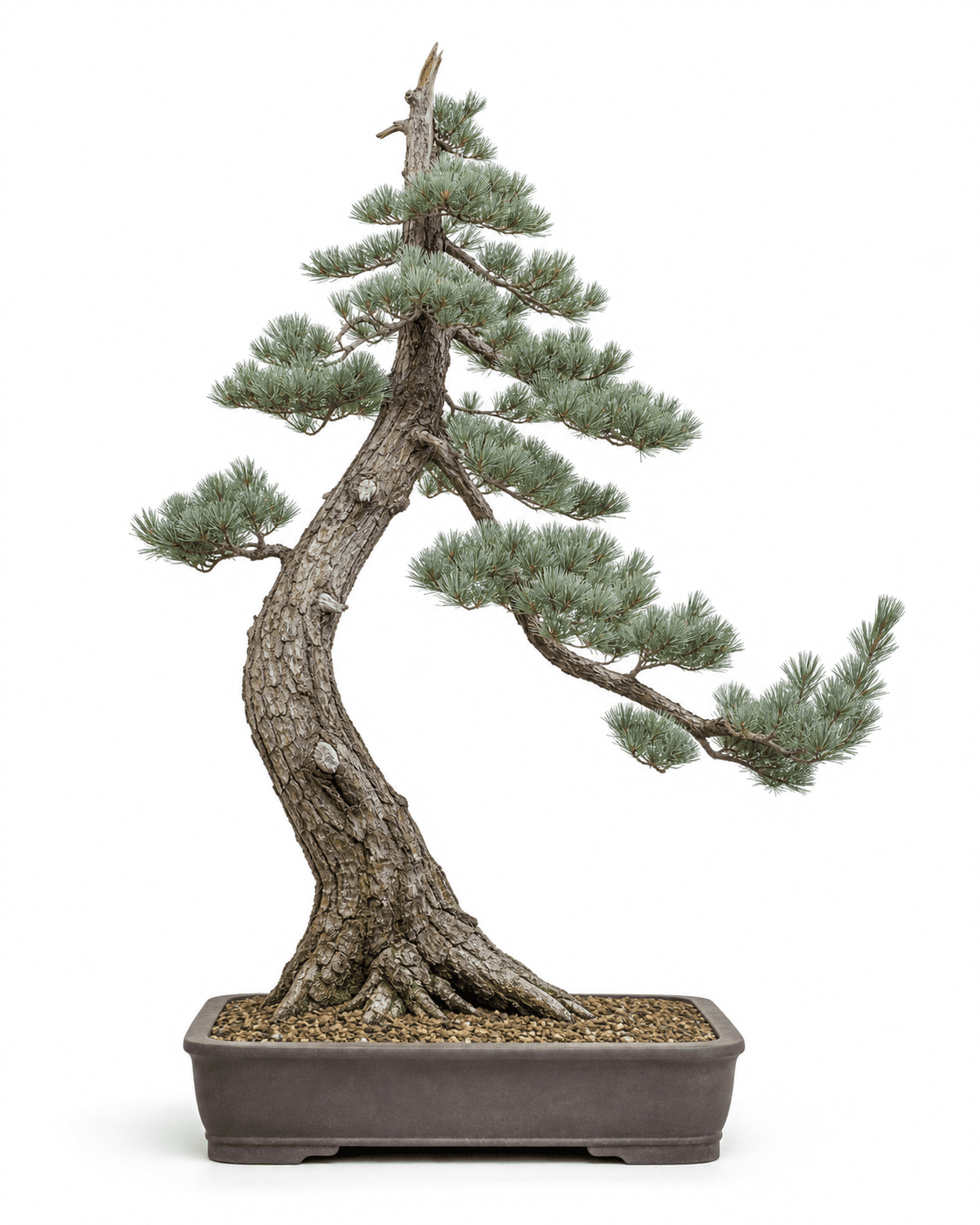
Western white pine is an outdoor, cold-dormant, five-needle pine from western North America. Treat confirmed Pinus monticola as Pine > Long-Needle Single-Flush: let spring candles extend, wait for sheath drop, prune conservatively, and keep enough needle mass to build roots and back buds.
This profile is grounded in Mirai files that name Western white pine directly in five-needle pine and outlier-classification work, plus Kew, RHS, NC State, Oregon State, Flora of North America, USDA, and UC IPM sources. The practical priorities are identity, oxygen-rich roots, cool montane climate adaptation, white pine blister rust, and medium-to-large design scale.
Updated June 7, 2026. Written by EntGrove Editorial. Last verified June 7, 2026.
Care fingerprint
Read the species through its shared care pattern.
Do not default to Japanese black pine decandling; manage vigor through timing, needle balance, light, and conservative pruning. Use this as the starting point before local conditions and tree strength refine the calendar.
Identify flush behavior
Single-flush, multiflush, white pine, and compact pine groups have different pruning windows and different risk levels.
Avoid default decandling
Japanese black pine methods do not transfer safely to every pine, especially slow, weak, collected, or five-needle trees.
Use needles as strength data
Needle length, color, age, and density help show where vigor is strong, weak, or becoming shaded.
Care cadence
The calendar starts with the tree's seasonal state.
Placement
Timing: Grow outdoors in full sun, with strong airflow, cold winter dormancy, and pot protection during deep freezes. In hotter regions, cool the container and avoid reflected heat.
Watch for: Indoor culture, warm winter storage, low light, hot dry wind, spring work followed by hard freeze, and assuming landscape Zone 3 hardiness protects exposed bonsai roots.
Oregon State Landscape PlantsBonsai Mirai LibraryWatering
Timing: Water through the whole rootball, then wait for the mix to regain air. Freshly repotted or newly collected trees need steadier moisture while new roots colonize the container.
Watch for: Wet organic cores, old field soil inside open bonsai soil, hydrophobic peat, drought after root work, and confusing moist forest habitat with tolerance for stale container soil.
Bonsai Mirai LibraryUSDA Forest Service FEISDevelopment feeding
Timing: Feed strongly while building trunk, root mass, and interior buds. Mirai five-needle pine method uses foliage mass and fall vascular thickening to create future buds.
Watch for: Starving a developmental tree for short needles, pruning all long shoots too early, and expecting back buds from cutting alone.
Bonsai Mirai LibraryRefinement feeding
Timing: Hold or moderate fertilizer during spring elongation on refined trees. Resume measured feeding after sheath drop when the new five-needle clusters have hardened.
Watch for: Spring fertilizer that lengthens needles, heavy feeding during heat, and weakening a still-developing tree by applying refinement restraint too early.
Bonsai Mirai LibrarySheath-drop pruning
Timing: Prune during the roughly 2 to 3 week window after papery sheaths drop from the five-needle clusters. Leave at least one new cluster at any cut site.
Watch for: Elongating-candle pinching, black-pine decandling, cutting behind all current-year needles, and pruning weak zones that need more growth.
Bonsai Mirai LibraryNeedle cleaning
Timing: At sheath drop, remove dead needles and only the old needles that release easily. Keep enough second-year foliage to feed roots, back buds, and branch strength.
Watch for: Needle plucking as strength balancing, tearing clusters backward, stripping the underside bare, and cleaning weak branches for a tidier short-term look.
Bonsai Mirai LibraryRepotting
Timing: Repot in early spring as buds begin to move, then protect from freezes. Convert old soil in stages when the root system has limited fine roots.
Watch for: Bare-rooting old material, combining major root work with heavy top work, loose tie-downs, and fertilizer before recovery growth is visible.
Bonsai Mirai LibraryWiring
Timing: Wire refined branches after sheath drop, or reserve heavier structural setting for early fall on a strong tree. Check wire often because smooth young bark marks quickly.
Watch for: Spring cambium slip, crotch tearing, tight wire under strong summer growth, and angular black-pine pad shapes that fight the softer white-pine line.
Bonsai Mirai LibraryBonsai Mirai / AsymmetryPests and disease
Timing: Inspect after purchase, during cool wet periods, when a single branch flags yellow or red, and when cones or leaders show pest damage.
Watch for: White pine blister rust, mountain pine beetle, ips beetles, needle cast, Armillaria, annosus root disease, pole blight, wind damage, and dwarf mistletoe on collected material.
USDA Forest Service FEISNC State ExtensionUC IPMSpecies guide
Apply the species profile before copying another tree's calendar.
At a glance
Western white pine is a five-needle native pine for patient outdoor growers.
Kew accepts Pinus monticola Douglas ex D.Don, and USDA FEIS gives Western white pine, mountain white pine, Idaho white pine, and silver pine as common labels. Oregon State and NC State both place it in Pinaceae. Kew POWOUSDA Forest Service FEISOregon State Landscape PlantsNC State Extension
For bonsai, place Western white pine in Pine > Long-Needle Single-Flush. Mirai names Pinus monticola directly and separates it from the outlier pines, so standard black-pine decandling and annual outlier-decandling logic should not be applied. Bonsai Mirai Library
The working spec is outdoor full sun, cold dormancy, complete watering followed by oxygen, mineral pine soil, spring root work, sheath-drop pruning, conservative needle cleaning, and enough scale for five-needle foliage. Bonsai Mirai LibraryOregon State Landscape Plants
Wild habitat
Its wild story is moist mountains, fog forests, dry summers, fire, and early-seral light.
FNA records Western white pine from Alberta and British Columbia south through the Pacific Northwest and northern California, with a 0 to 3000 m elevation range in montane moist forests and lowland fog forests. Flora of North America
USDA FEIS describes a dry-summer, winter-precipitation climate and sites ranging from river bottoms and lower slopes in the northern Rockies to poor gravelly soils near Puget Sound and bog edges on the Olympic Peninsula. USDA Forest Service FEIS
USDA FEIS also treats Western white pine as a seral species that uses disturbance to enter sites ahead of more shade-tolerant fir, spruce, and hemlock. In bonsai, that means sun and airflow should stay central even though the species often grows in moist forests. USDA Forest Service FEISBonsai Mirai Library
Care follows that ecology. Keep roots cool, airy, and evenly functional. Allow moisture without airlessness, use winter rest, and avoid warm indoor conditions that prevent the tree from completing a pine season. Bonsai Mirai LibraryUSDA Forest Service FEIS
Design should read as a western mountain white pine: open, soft, sinuous, and shaped by snow, wind, fire openings, or fog-edge light rather than dense stacked pads. Bonsai Mirai / AsymmetryUSDA Forest Service FEIS
Reading the tree
Read sheath drop, needle mass, branch age, roots, and disease history before cutting.
Sheath drop is the main refinement signal. Mirai five-needle pine files use the papery sheath falling from each cluster as proof that the new needles have hardened and will stop elongating. Bonsai Mirai Library
Development branches should carry more foliage than a finished silhouette needs. Mirai ties pine back budding to needle mass, fall vascular growth, and root strength, so long shoots are often the route to future options. Bonsai Mirai Library
A branch ready for refinement has current-year clusters, retained older needles, interior buds or secondaries, and enough vigor across the whole canopy. A few strong shoots on an otherwise weak tree are a warning to grow first. Bonsai Mirai Library
Roots and disease history are part of the read. A tree with blister-rust flagging, compact nursery soil, drought-suppressed roots, or few older needles should be stabilized before any aesthetic work. UC IPMBonsai Mirai Library
Pruning
Use sheath-drop pruning, light old-needle cleaning, and needle preservation.
Mirai five-needle pine guidance puts Western white pine in the long-needle single-flush group. Let candles extend and harden, then prune in the short sheath-drop window. Bonsai Mirai Library
Avoid spring candle pinching on standard Western white pine. Mirai states that pinching long-needle single-flush pines during elongation drives the remaining needles too long and weakens future refinement. Bonsai Mirai Library
Avoid decandling native Western white pine foliage. Mirai says long-needle single-flush pines lose major bud potential and spend years recovering when treated like annual two-flush black pine. Bonsai Mirai Library
After sheath drop, shorten strong shoots back to a selected current-year needle cluster and reduce three-shoot junctions to two only where the branch is already refined. Leave weak and developmental zones uncut. Bonsai Mirai Library
Clean needles with restraint. Third-year needles can release naturally, but second-year needles still feed the tree. Keep a full distribution around shoots instead of stripping the underside into a flat fan. Bonsai Mirai Library
For branch replacement, grow an interior bud until it becomes a real shoot with needle mass and diameter. Mirai uses about half the parent branch diameter as a practical threshold before cutting back to it. Bonsai Mirai Library
Roots
Repot in early spring and convert old root systems by stages.
Mirai spring fundamentals bases repotting on percolation, soil condition, root density, and design need. A healthy Western white pine that still drains can often wait another year. Bonsai Mirai Library
When root work is needed, repot in early spring as buds begin to move, then protect the tree from freezes. The goal is root recovery before summer heat and before sheath-drop pruning decisions. Bonsai Mirai Library
Old nursery or collected rootballs often contain different soil behavior inside the core. Remove the limiting core over multiple repots unless the tree has enough fine roots and strength for a larger conversion. Bonsai Mirai Library
Tie the tree firmly. Western white pine recovery depends on new root tips, and trunk movement after repotting tears the roots that should be colonizing fresh mineral soil. Bonsai Mirai Library
Do not stack major root work, heavy pruning, and structural styling into one recovery window. Grow the tree after repotting, then return to refinement when the next flush proves strong. Bonsai Mirai Library
Soil and pot
Use mineral oxygen, moderate moisture, and a pot that fits mountain-pine scale.
Mirai five-needle pine guidance uses 1:1:1 akadama:pumice:lava as a default and removes the 1/16 inch fine fraction for extra oxygen. That suits Western white pine roots better than waterlogged organic mixes. Bonsai Mirai Library
USDA FEIS reports a broad wild soil range, from deep porous coastal soils to poor sandy or gravelly sites. In a pot, that translates to drainage, air, and complete watering rather than a narrow native-soil imitation. USDA Forest Service FEISBonsai Mirai Library
Watch pH and water quality. Mirai white-pine guidance flags alkaline water or soil as a decline factor because iron availability and chlorophyll metabolism suffer above neutral conditions. Bonsai Mirai Library
Unglazed brown, gray, muted red, or weathered stoneware usually supports Western white pine better than glossy color. A slightly deeper oval, rectangle, or soft-cornered cascade-adjacent container can make the long foliage and open branches feel intentional. Bonsai Mirai / Asymmetry
Keep very small pots for established refined trees with reliable roots. Development trees need room to build needle mass, roots, and buds before container restriction can help reduce needle length. Bonsai Mirai Library
Climate
Adapt for cool western roots, dry summers, winter rest, and disease pressure.
Oregon State lists Zone 3 hardiness, and USDA Silvics says dormant Western white pine is among the more frost-tolerant northwestern species. Bonsai roots still need protection because pots freeze harder than ground soil. Oregon State Landscape PlantsUSDA Forest Service Silvics
In Pacific Northwest and northern Rocky Mountain climates, prioritize rust-aware spacing, airflow, and staged root conversion. Wet seasons favor disease, while dry summers demand careful full-depth watering. USDA Forest Service FEISUC IPM
In hotter inland climates, shade the pot during heat, keep foliage in full light where possible, and avoid black containers or benches that overheat the root zone. Bonsai Mirai Library
In mild-winter coastal or subtropical climates, the limiting factor is dormancy. Mirai five-needle pine guidance warns that warm winters are a poor fit for true five-needle white pines. Bonsai Mirai Library
Cold drying wind can desiccate needles when soil or trunks are frozen. USDA Silvics notes that dormant trees tolerate cold, while needle desiccation can happen when water cannot replace wind loss. USDA Forest Service Silvics
Pests and diseases
White pine blister rust is the disease that should shape sourcing and diagnosis.
UC IPM says white pine blister rust infects five-needle pines including Western white pine, with early yellow needle spots, branch flagging, cankers, orange spores, and eventual girdling. UC IPM
USDA FEIS calls blister rust the most serious damaging agent of Western white pine and reports major effects on western white pine forests and timber production. USDA Forest Service FEIS
NC State lists blister rust, pole blight, needle blight, root-system fungi, bark beetles, mountain pine beetle, red turpentine beetle, and wind damage as practical concerns. NC State Extension
USDA FEIS adds mountain pine beetle, ips beetles, Armillaria, annosus root disease, needle cast fungi, pole blight, and dwarf mistletoe. Collected material should be inspected for all of these before entering a bonsai collection. USDA Forest Service FEIS
Bonsai prevention starts with clean sourcing, airflow, avoiding overhead crowding, quarantine after purchase, strong roots, and local extension guidance before moving suspect infected material. UC IPMBonsai Mirai Library
Wiring
Wire for soft white-pine arcs and protect crotches, bark, and needles.
Mirai white-pine design guidance favors smooth, sinuous movement and soft five-needle tufts. Western white pine should look more like a mountain white pine than a rigid black-pine display tree. Bonsai Mirai / AsymmetryBonsai Mirai Library
Wire refined branches after sheath drop, when the new needles have hardened and attachment is stronger. Reserve heavier structural bending for early fall on a strong tree with a stable root system. Bonsai Mirai Library
Protect crotches. Mirai pine wiring files treat crotches as mechanical weak points, especially where wind or wire concentrates force at a fork. Bonsai Mirai Library
Check wire frequently on young smooth bark. NC State describes gray smooth bark on young material that becomes furrowed and rectangular with age, so younger trees mark before they look mature. NC State Extension
After wiring, keep the tree in strong light with moderate water and no extra pruning. Recovery growth should set the branch, not fight stacked stress. Bonsai Mirai Library
Propagation
Seed and nursery selection are the practical routes; grafting exists but should be documented.
NC State lists seed, grafting, root cutting, and stem cutting as propagation strategies. For bonsai, seedlings and nursery stock are the practical learning routes because roots and provenance can be tracked. NC State Extension
USDA Silvics says Western white pine grows rapidly to large size and has been regenerated as a forestry species. Seed-grown material can be developed over years with full sun, root work, and trunk-building restraint. USDA Forest Service SilvicsBonsai Mirai Library
USDA FEIS notes that Western white pine hybridizes with Balkan pine, blue pine, Eastern white pine, Southwestern white pine, and limber pine. Grafted or hybrid-labeled material should be documented before applying a precise care calendar. USDA Forest Service FEIS
Air layering should be treated as experimental for pines. Serious material usually comes from seed, nursery stock, documented grafts, or legally collected trees with a recovery plan. Bonsai Mirai Library
Collecting requires permission, disease inspection, retained fine roots, and multi-year aftercare. Old mountain material with poor roots should be stabilized before styling. Bonsai Mirai LibraryUSDA Forest Service FEIS
Sourcing
Buy confirmed Pinus monticola, clean roots, retained needles, and rust-aware provenance.
Good material has a confirmed Pinus monticola label, five needles per bundle, live older needles, strong terminal buds, no active cankers, and roots that can be moved into bonsai soil by stages. Flora of North AmericaOregon State Landscape PlantsBonsai Mirai Library
Oregon State and NC State list Nana and Pendula forms. Nana can help with scale, while Pendula can provide line, but cultivar names should never outweigh root quality, health, and usable branch placement. Oregon State Landscape PlantsNC State Extension
Avoid stock with branch flagging, swollen cankers, orange spores, heavy beetle evidence, compact wet cores, few old needles, recent collection shock, or unclear identity among white pines. UC IPMUSDA Forest Service FEISBonsai Mirai Library
Label confusion is common. Western white pine can be mixed up with Eastern white pine, Sugar pine, limber pine, whitebark pine, Japanese white pine, Korean white pine, and generic nursery white-pine labels. Oregon State Landscape PlantsFlora of North America
For collected material, favor legal documentation, intact fine roots, a recovery box, and enough foliage to power new roots. A dramatic trunk with few roots and little needle mass is a high-risk project. Bonsai Mirai Library
Troubleshooting
Most failures trace to wrong pine timing, airless roots, warm winters, or blister rust.
Symptom: needles become overly long after spring work. Likely cause: candles were pinched or pruned before sheath drop. Fix: grow the tree for strength and return to sheath-drop timing next year. Bonsai Mirai Library
Symptom: tips die after cutback. Likely cause: cuts removed all current-year needle clusters. Fix: leave at least one new five-needle cluster at every cut site and avoid cutting weak shoots. Bonsai Mirai Library
Symptom: no interior buds. Likely cause: too little needle mass, low light, weak roots, old bark, or repeated early pruning. Fix: feed and grow developmentally until interior shoots are real branches. Bonsai Mirai Library
Symptom: broad yellowing with wet soil. Likely cause: poor oxygen, old organic core, root disease, alkaline water, or recent overwork. Fix: stabilize water, improve drainage at the next safe repot, and defer pruning. Bonsai Mirai LibraryUSDA Forest Service FEIS
Symptom: one branch flags yellow to red, with swollen rough bark or orange spores. Likely cause: white pine blister rust. Fix: isolate, avoid moving infected material, and follow local plant-health guidance. UC IPM
Symptom: top or leader collapses with beetle signs. Likely cause: bark beetle, mountain pine beetle, ips beetle, or related stress. Fix: confirm the pest locally, quarantine the tree, and rebuild only from healthy growth. NC State ExtensionUSDA Forest Service FEIS
Design
Design from western mountain ecology, soft five-needle tufts, and open branch rhythm.
Oregon State describes a narrow, open, conical crown of horizontal branches. USDA Silvics records rapid growth to very large forest dimensions, including exceptional trees over 70 m tall. Oregon State Landscape PlantsUSDA Forest Service Silvics
Mirai places white pines such as limber, strobus, and western whites in a smoother aesthetic register: sinuous branch lines, soft billowy five-needle tufts, and rounded movement. Bonsai Mirai / Asymmetry
Medium and large bonsai scale suits standard Western white pine because the needles are commonly 5 to 10 cm or 2 to 4 inches long. Smaller trees need dwarf forms, tight internodes, or patient container restriction. Oregon State Landscape PlantsNC State ExtensionBonsai Mirai Library
Choose the defining branch from environment: a snow-loaded shoulder, wind-raised branch, ridge-line dead top, or open forest side branch. Keep the tree three-dimensional rather than flattening all foliage into a front plane. Bonsai Mirai / Asymmetry
Deadwood should be restrained and pine-specific. Western white pine can carry old stubs, broken tops, and weathered shari, but freshly sharpened juniper-style jin usually overstates the image. Bonsai Mirai LibraryBonsai Mirai / Asymmetry
Forms
Nana and Pendula are the common named forms to recognize first.
Oregon State lists Nana as a dwarf shrub, slow-growing to about 2 ft by 2 ft in 10 years, with short needles and irregular form. NC State also lists Nana as a slow-growing dwarf shrub. Oregon State Landscape PlantsNC State Extension
Oregon State lists Pendula as a tree with very pendulous branches and a bowed stem, about 5 to 10 ft in 10 years. NC State also records Pendula as a pendulous, bowed-stem form. Oregon State Landscape PlantsNC State Extension
Dwarf or weeping forms can help bonsai design, but every named form still needs white-pine timing, cold dormancy, root oxygen, and disease inspection. Bonsai Mirai LibraryNC State Extension
Kew and USDA FEIS both recognize Pinus monticola, while older synonym language includes Pinus strobus var. monticola and Strobus monticola. Confirm the current label before publishing or buying. Kew POWOUSDA Forest Service FEIS
History
Western white pine is Idaho forest history and a still-underused native bonsai subject.
USDA Silvics describes Western white pine as an important timber tree whose light, nonresinous, straight-grained wood was valuable for sash, frames, doors, paneling, construction, match wood, and toothpicks. USDA Forest Service Silvics
The species once dominated important northern Rocky Mountain forests, then white pine blister rust and fire exclusion reduced its role. USDA FEIS reports western white pine stocking in one context dropping from 44 percent in 1941 to 5 percent in 1979. USDA Forest Service FEIS
NC State records Native American uses of bark and pitch, and USDA FEIS notes seed, resin, bark, and cambium uses. That cultural history should be handled as context, not as styling decoration. NC State ExtensionUSDA Forest Service FEIS
The public bonsai record is thin compared with Japanese white pine, Ponderosa pine, Scots pine, and Japanese black pine. Western white pine therefore deserves transparent transferred technique, careful source labeling, and designs that read as western North American white pine. Bonsai Mirai LibraryBonsai Mirai / Asymmetry
Species questions
Answer the beginner questions before styling.
Can Western white pine be grown as bonsai?
Yes. Western white pine can be grown as outdoor bonsai when it has full sun, cold dormancy, oxygen-rich soil, careful watering, and five-needle single-flush timing.
Can Western white pine bonsai live indoors?
No. Keep Western white pine outdoors. It needs strong light, airflow, seasonal cold, and a real winter rest, with indoor display limited to brief viewing periods.
Is Western white pine an outlier pine?
EntGrove places Western white pine in Long-Needle Single-Flush Pines. Mirai explicitly says Pinus monticola is outside the outlier pine category.
Should I decandle Western white pine?
Avoid decandling Western white pine. Use sheath-drop pruning after the spring flush hardens and preserve enough needles to build buds and roots.
When should Western white pine be pruned?
Prune during the 2 to 3 week window after papery sheaths drop from the five-needle clusters, or defer heavier structural pruning to early fall on a strong tree.
Can I pinch Western white pine candles?
Avoid pinching elongating Western white pine candles. For long-needle single-flush pines, spring pinching causes the remaining needles to lengthen excessively.
What soil works for Western white pine bonsai?
Use an oxygen-rich pine mix such as akadama, pumice, and lava with very fine particles removed. Water thoroughly, then let air return to the root zone.
How cold hardy is Western white pine bonsai?
Oregon State lists landscape Western white pine as hardy to USDA Zone 3. Bonsai roots still need protection in severe freezes because pots expose roots more than the ground does.
Why is my Western white pine turning yellow?
Possible causes include old-needle aging, wet roots, poor oxygen, alkaline water, root disease, blister rust, beetles, needle cast, drought after root work, or recent over-pruning.
Is Western white pine good for small bonsai?
Standard Western white pine is usually better at medium and large scale because its needles are long. Dwarf forms such as Nana can help, but health and roots matter first.
Sources
Species advice needs source discipline.
Next decisions
Plan the operation before copying the calendar.
A good care note for Western white pine records the tree's stage, the work done, and the aftercare used. That record matters more than a month-name rule.
Related species
Compare nearby trees before transferring advice.
Ponderosa pine
Pinus ponderosa
Jeffrey pine
Pinus jeffreyi
Bishop pine
Pinus muricata
Sugar pine
Pinus lambertiana
Eastern white pine
Pinus strobus