
Species guide
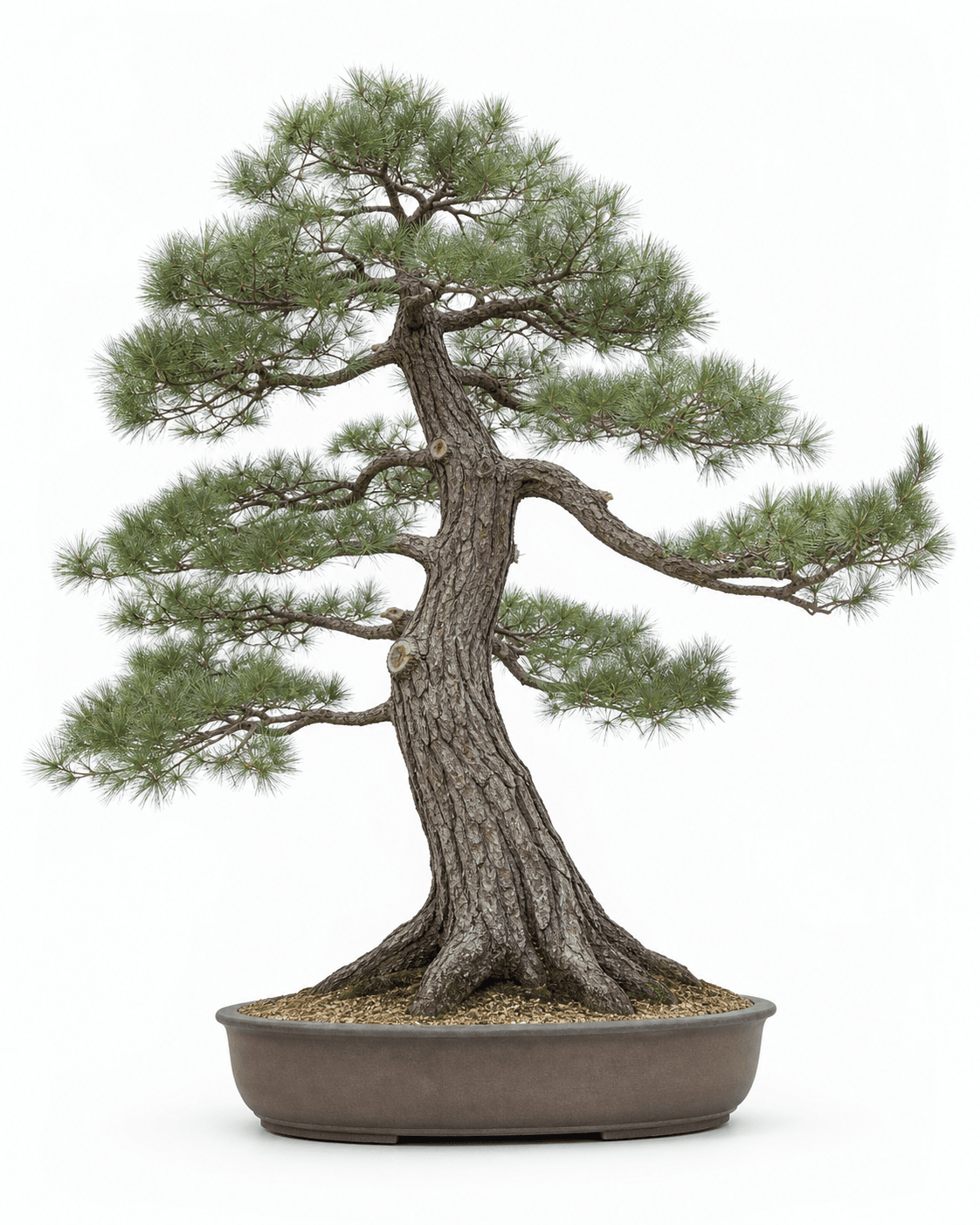
Eastern White Pine Bonsai Care
Pinus strobus
Eastern white pine is an outdoor, cold-dormant, five-needle North American pine that can make bonsai when the grower preserves needle mass, gives the roots oxygen, and avoids black-pine technique drift. Treat confirmed Pinus strobus as Pine > Long-Needle Single-Flush: no routine decandling, no spring candle pinching, and pruning only after the spring flush hardens.
This guide is grounded in Mirai five-needle pine files that name Pinus strobus directly, plus public sources from Kew, RHS, NC State, Oregon State, Flora of North America, USDA, UMN Extension, and Penn State. The practical focus is identity, sheath-drop timing, cool humid climate adaptation, white pine blister rust, white pine weevil, and sourcing material with enough roots and needles to recover.
Updated June 7, 2026. Written by EntGrove Editorial. Last verified June 7, 2026.
Care fingerprint
Read the species through its shared care pattern.
Do not default to Japanese black pine decandling; manage vigor through timing, needle balance, light, and conservative pruning. Use this as the starting point before local conditions and tree strength refine the calendar.
Identify flush behavior
Single-flush, multiflush, white pine, and compact pine groups have different pruning windows and different risk levels.
Avoid default decandling
Japanese black pine methods do not transfer safely to every pine, especially slow, weak, collected, or five-needle trees.
Use needles as strength data
Needle length, color, age, and density help show where vigor is strong, weak, or becoming shaded.
Care cadence
The calendar starts with the tree's seasonal state.
Placement
Timing: Grow outdoors in full sun with airflow and winter dormancy. In hot or alkaline regions, cool the pot, avoid reflected heat, and watch water quality.
Watch for: Indoor culture, shaded patios, warm winter storage, hot dry wind, alkaline water, air-pollution stress, and pots freezing solid after autumn work.
RHSNC State ExtensionOregon State Landscape PlantsWatering
Timing: Water through the entire root mass, then wait for the mix to regain oxygen before watering again. Freshly repotted trees are watered on demand until new roots work.
Watch for: Wet organic cores, hydrophobic nursery peat, soggy cold benches, chronic dryness after root work, and treating forest moisture preference as tolerance for airless soil.
Bonsai Mirai LibraryNC State ExtensionDevelopment feeding
Timing: Feed strongly while building trunk, roots, and interior buds. Mirai long-needle pine guidance uses needle mass and transpiration to create vascular tissue and future back buds.
Watch for: Cutting long extensions before the tree has interior shoots, starving a developmental tree for short needles, and pruning after repotting when growth is only moderate.
Bonsai Mirai LibraryRefinement feeding
Timing: Withhold or moderate fertilizer through spring elongation on refined trees. Once sheaths drop and needles harden, apply one measured feeding before sustained summer heat.
Watch for: Early spring fertilizer that lengthens needles, heavy feeding during 95 F heat, and underfeeding a tree that still needs back budding.
Bonsai Mirai LibrarySheath-drop pruning
Timing: Prune only after the papery sheath drops from the five-needle clusters. The best cutback window is roughly 2 to 3 weeks after sheath drop while buds can still form at retained needles.
Watch for: Spring candle pinching, black-pine decandling, cutting behind all current-year needles, and pruning weak developmental zones.
Bonsai Mirai LibraryNeedle cleaning
Timing: Clean dead needles and loose third-year needles at sheath-drop time. Keep second-year needles unless the branch is strong and the design needs light or separation.
Watch for: Needle plucking as strength balancing, stripping undersides bare, tearing clusters backward, and removing old needles from weak shoots.
Bonsai Mirai LibraryRepotting
Timing: Repot in early spring as buds begin to move, with freeze protection after work. Stage old soil conversion and tie the tree firmly so new roots are not torn.
Watch for: Bare-rooting old collected or nursery material, combining heavy root work with sheath-drop pruning, and fertilizing before healthy new growth returns.
Bonsai Mirai LibraryWiring
Timing: Wire after sheath drop for refined branch work or in early fall for heavier structural styling. Preserve the soft white-pine branch arc and check wire often.
Watch for: Spring cambium slip, wire bite on smooth bark, branches flipped out of their phototropic orientation, and severe bends after root work.
Bonsai Mirai LibraryBonsai Mirai / AsymmetryPests and disease
Timing: Inspect during cool humid disease periods, after nursery purchase, during spring leader growth, and whenever a branch flags yellow or red out of season.
Watch for: White pine blister rust, white pine weevil, pine bark adelgid, needle cast, Armillaria, root disease, deer browsing on landscape stock, and air-pollution stress.
USDA Forest Service SilvicsUniversity of Minnesota ExtensionPenn State ExtensionNC State ExtensionSpecies guide
Apply the species profile before copying another tree's calendar.
At a glance
Eastern white pine is a five-needle native pine for outdoor growers who can wait for the tree.
Kew accepts Pinus strobus L., first published by Linnaeus in 1753, and gives the native range as central and eastern Canada to north-central and eastern United States. NC State lists Eastern white pine, North American white pine, northern white pine, soft pine, and white pine as common names. Kew POWONC State Extension
For bonsai, place Eastern white pine in Pine > Long-Needle Single-Flush. Mirai names Pinus strobus directly with Japanese white pine and limber pine in the five-needle long-needle group, then states that Eastern and western white pine do not belong in the outlier category. Bonsai Mirai Library
The working spec is outdoor full sun, cool roots, complete watering followed by air, mineral soil with extra oxygen, spring root work, sheath-drop pruning, and enough foliage to keep the tree building roots and back buds. Bonsai Mirai LibraryOregon State Landscape Plants
Wild habitat
Its wild story is cool humidity, sandy drainage, old fields, lakes, ridges, and enormous forest scale.
USDA FEIS describes Eastern white pine across a broad moisture gradient: wet bogs, moist stream bottoms, xeric sand plains, rocky ridges, raised bogs, sand dunes, northerly Appalachian coves, stream bottoms, and lake edges. USDA Forest Service FEIS
NC State compresses that ecology into practical horticulture: cool humid climates, full sun, moist well-drained fertile sandy loams, and intolerance of salts, alkaline soils, sulfur dioxide, and ozone. NC State Extension
Oregon State adds useful container clues. Eastern white pine grows best on fertile moist well-drained soil, can occur on dry rocky ridges and wet sphagnum bogs, and drops needles that acidify soil below the tree to about pH 4.5. Oregon State Landscape Plants
Care follows those facts. Keep roots cool and acidic to neutral, never stale and alkaline. Water fully, preserve air space, and give sun and winter rest rather than attempting indoor or subtropical culture. Bonsai Mirai LibraryNC State ExtensionOregon State Landscape Plants
Design should respect forest scale. Eastern white pine is the tall, soft, horizontal-branch pine of eastern North America, with old trees rising above hardwoods, flattening with age, and carrying open layered limbs rather than dense black-pine shelves. USDA Forest Service FEISBonsai Mirai / Asymmetry
Reading the tree
Read sheath drop, needle age, interior buds, root oxygen, and branch youth before making cuts.
The decisive signal is sheath drop. Mirai five-needle pine guidance says the papery sheath falling from each five-needle cluster marks the point where needles have hardened and will no longer elongate from that flush. Bonsai Mirai Library
Development branches should look temporarily long and full. Mirai ties pine back budding to needle mass, transpiration, and fall vascular tissue production, so bare interiors need growth more than pruning. Bonsai Mirai Library
A branch ready for refinement has retained needles, working interior buds, and current shoots that can be shortened while leaving at least one new five-needle cluster at the cut site. Cutting behind all current needles leaves no reliable bud site. Bonsai Mirai Library
Roots are part of the reading. Moderate spring growth after repotting means the tree should be fed and grown, then refined the following year. Strong sheath-drop growth across the canopy gives more options. Bonsai Mirai Library
Pruning
Use sheath-drop pruning and needle preservation, not decandling.
Mirai five-needle post-flush guidance states that true five-needle pines, including Eastern white pine, respond alike in a bonsai container: wait for sheath drop, then work in the short post-flush window. Bonsai Mirai Library
Do not pinch elongating candles. Mirai pinching guidance names Pinus strobus among long-needle single-flush pines where spring pinching causes remaining needles to lengthen excessively. Bonsai Mirai Library
Do not decandle Eastern white pine. Mirai says decandling long-needle single-flush pines depletes the tree for years and aborts many buds rather than producing the reliable second flush expected from Japanese black pine. Bonsai Mirai Library
After sheath drop, shorten strong shoots back to a chosen new needle cluster and reduce clusters of three shoots to two. Leave weak shoots, recovering branches, and developmental areas alone. Bonsai Mirai Library
Clean lightly. Third-year needles can release at this time, but second-year needles still feed roots, buds, and branch strength. Needle distribution as a strength-balancing tool belongs to multi-flush pine work. Bonsai Mirai Library
For branch replacement, grow the interior bud until it becomes a real shoot with enough diameter and needle mass. Mirai guidance uses roughly half the diameter of the parent branch as a practical strength threshold before cutting back to it. Bonsai Mirai Library
Roots
Repot early, preserve the foliage battery, and stage old root systems.
Mirai spring fundamentals gives repotting decisions by percolation, soil decomposition, and aesthetic need. Calendar habit alone is a weak reason to disturb a five-needle pine root system. Bonsai Mirai Library
When the tree needs root work, repot in early spring as buds begin to move and protect from freezes after the operation. Pines initiate root growth at relatively cool temperatures, so early spring gives time to repair before heat. Bonsai Mirai Library
Stage old nursery or collected soil. A dense organic or clay core can stay wet while the outer bonsai soil dries, so remove the limiting section over multiple repots if the tree cannot tolerate a full conversion. Bonsai Mirai Library
Tie the tree firmly. New white pine roots are the recovery engine, and trunk movement after repotting tears the fine roots that should be colonizing fresh mineral soil. Bonsai Mirai Library
After root work, keep needles and current growth. Freshly repotted white pines with only moderate spring response should skip refinement pruning that year and rebuild with careful fertilizer, heat awareness, and fall support. Bonsai Mirai Library
Soil and pot
Give the roots oxygen, moderate acidity, and enough pot volume for the design stage.
Mirai five-needle pine guidance uses 1:1:1 akadama:pumice:lava as the default and removes the 1/16 inch fine fraction to increase oxygen. Internal particles around 1/8 to 1/4 inch suit long-needle five-needle pines. Bonsai Mirai Library
Public sources reinforce the drainage and chemistry. RHS lists well-drained loam or sand, NC State favors moist well-drained fertile sandy loam, and Oregon State notes strong growth in fertile moist well-drained soil with acidifying needle litter. RHSNC State ExtensionOregon State Landscape Plants
Watch alkalinity. Mirai five-needle post-flush guidance flags pH above 7 as a common white pine decline factor because iron availability and chlorophyll metabolism are disrupted. Bonsai Mirai Library
Pot size should follow stage. Development trees need volume for roots, needle mass, and back budding; refined trees can move smaller once branch replacement is established and roots are fine enough to support the reduced soil mass. Bonsai Mirai LibraryBonsai Mirai / Asymmetry
Use unglazed, quiet containers for old native-pine character: rectangles, soft rectangles, ovals, shallow forest trays, or literati containers that leave the soft needles and horizontal branch line as the focus. Bonsai Mirai / Asymmetry
Climate
Eastern white pine likes cold rest and cool humidity, while bonsai pots magnify heat, salt, and alkalinity.
Landscape hardiness is broad, with Oregon State giving Zone 3 and NC State giving Zones 3a to 8a. In bonsai, pot exposure means root protection is still needed during hard freezes and repeated freeze-thaw weather. Oregon State Landscape PlantsNC State Extension
Warm regions need caution. NC State says Eastern white pine prefers cool humid climates and is intolerant of salts, alkaline soils, sulfur dioxide, and ozone. These limits show up faster in shallow containers. NC State Extension
In hot summers, keep the root zone cool, water early enough for daytime transpiration, reduce fertilizer during sustained heat, and preserve foliage that cools the tree. Mirai post-growth guidance warns that fertilizer salts compete with heat-stressed roots for water. Bonsai Mirai Library
In cold northern gardens, wind and sun can desiccate potted roots and needles even when the species is hardy. Shelter the pot, keep the soil slightly moist, and avoid late root disturbance. Oregon State Landscape PlantsBonsai Mirai Library
In alkaline-water regions, track yellowing, weak needles, and stalled growth. Acidifying soil biology, rainwater capture, and local water testing may matter more for Eastern white pine than for tougher two-needle pines. Bonsai Mirai LibraryNC State Extension
Pests and disease
Blister rust, weevil, needle disease, adelgids, and root trouble deserve sourcing-level attention.
USDA Silvics identifies three major injury agents for white pine: white pine weevil, white pine blister rust, and Armillaria. It also notes hundreds of insects and disease organisms associated with white pine, though far fewer cause serious damage. USDA Forest Service Silvics
UMN Extension explains that white pine blister rust kills branches, tree tops, and whole Eastern white pine trees, and needs both a white pine and a currant or gooseberry host to complete its life cycle. University of Minnesota Extension
The bonsai signal is branch flagging: needles on one branch turn yellow, then rusty red, with a swollen cracked canker on the branch or trunk. Isolate suspect material and get local diagnosis before cutting broadly. University of Minnesota Extension
Penn State Extension calls white pine weevil the most destructive insect pest of Eastern white pine in North America. It attacks leaders, which matters in bonsai because a leader can be the entire apex plan. Penn State Extension
NC State lists pine bark adelgid, root disease, wind damage, and environmental intolerance, while Mirai spring fundamentals includes needle-cast prevention across conifers as new needles emerge before cuticles harden. NC State ExtensionBonsai Mirai Library
Prevention is cultural first: full sun, airflow, clean benches, disease-aware sourcing, water that moves through the pot, and no fertilizer on sick roots. Chemical work should follow local diagnosis and label guidance. Bonsai Mirai LibraryUSDA Forest Service Silvics
Wiring
Wire for soft arcs, open layers, and branch safety after the tree has hardened.
Five-needle pine design has a softer branch arc than black pine. Mirai five-needle nuance guidance says wiring should preserve the smooth curving line from primary branch to needle cluster rather than forcing rigid angular shelves. Bonsai Mirai LibraryBonsai Mirai / Asymmetry
For refined branch placement, sheath drop is a good starting signal because needles are attached strongly enough to handle. For major structure, early fall after needle mass has built is often safer. Bonsai Mirai Library
Spring wiring carries higher cambium-slip risk because water and mobilized reserves are moving hard. It can be done by skilled hands, but young bark and active candles demand light pressure. Bonsai Mirai Library
Do not flip branch orientation casually. Mirai notes that branch orientation sets while the spring shoot is soft; exposing the shaded underside after lignification can sunburn tissue and weaken the branch. Bonsai Mirai Library
Guy wires, padding, staged bends, and enough time for new vascular growth are better than a single heroic bend. Check wire often because vigorous Eastern white pine can thicken quickly after recovery feeding. Bonsai Mirai Library
Propagation
Seed is normal, grafting is possible, and collected material needs legality plus aftercare.
RHS lists seed propagation for Pinus strobus, and USDA Silvics says white pine has been regenerated by clearcutting, seed tree, shelterwood, and group selection methods in forestry. RHSUSDA Forest Service Silvics
Seedlings give the cleanest root start and allow early trunk movement, but the species can take a long time to develop convincing bark and branch scale. Large designs are often more realistic than small refined bonsai. Bonsai Mirai LibraryUSDA Forest Service Silvics
Grafting is botanically possible within white pines. USDA Silvics notes that Eastern white pine crosses readily with western white pine, Balkan pine, blue pine, Japanese white pine, and others, which signals close genetic compatibility in the white-pine group. USDA Forest Service Silvics
For bonsai propagation, record whether a tree is seed-grown, grafted, nursery-grown, or collected. Rootstock, disease resistance, cultivar habit, and needle length can change the practical care pace. Bonsai Mirai LibraryOregon State Landscape Plants
Air layering should be treated as experimental for pines. Serious material usually comes from seed, nursery stock, documented grafts, or legally collected trees with a multi-year recovery plan. Bonsai Mirai Library
Sourcing
Buy confirmed identity, disease history, roots, needles, and usable scale.
Good material has a confirmed Pinus strobus label, five soft needles per fascicle, a functioning rootball, retained older needles, active buds, and branch placement that can become an open native pine rather than a forced miniature black pine. Flora of North AmericaOregon State Landscape PlantsBonsai Mirai Library
Cultivars and dwarf forms can help with scale. Oregon State lists Alba, Fastigiata, Macopin, Nana, Pendula, Sea Urchin, Torulosa, and Verkade's Broom among named forms. NC State lists Alba, Fastigiata, Nana, Pendula, Sea Urchin, and Umbraculifera. Oregon State Landscape PlantsNC State Extension
Avoid stock with blister-rust cankers, red flagging branches, killed leaders from weevil, compact wet peat, alkaline irrigation history, severe root disease, few old needles, or recent landscape digging without recovery. University of Minnesota ExtensionPenn State ExtensionBonsai Mirai Library
Label confusion matters. White pine can mean Pinus strobus in eastern North America, Japanese white pine in bonsai trade, western white pine in the West, or Korean white pine in nursery catalogs. Confirm Latin name before applying technique. Kew POWORHSFlora of North America
Collected material requires permission and patience. Eastern white pine is common in parts of its range, but legal access, fine-root recovery, pathogen risk, and trunk scale should decide whether a collected tree is worth the aftercare. USDA Forest Service FEISBonsai Mirai Library
Troubleshooting
Most problems trace to wrong timing, wet or alkaline roots, disease pressure, or weak needle mass.
Symptom: needles lengthen after spring work. Likely cause: elongating candles were pinched or pruned before sheath drop. Fix: stop refinement for the season, rebuild strength, and wait for sheath-drop timing next year. Bonsai Mirai Library
Symptom: tip dies after cutback. Likely cause: the cut removed all current-year needle clusters. Fix: leave at least one new five-needle cluster at each cut site, or prune back to an existing strong secondary. Bonsai Mirai Library
Symptom: no back buds. Likely cause: too little needle mass, poor sun, weak roots, old corked bark, or pruning before the branch had enough vascular traffic. Fix: grow the branch, feed developmentally, and preserve foliage. Bonsai Mirai Library
Symptom: broad yellowing with wet soil. Likely cause: overwatering, stale organic core, poor oxygen, high pH water or soil, or root disease. Fix: improve drainage and oxygen, test water if needed, and avoid fertilizer until roots recover. Bonsai Mirai LibraryNC State Extension
Symptom: one branch turns yellow, then rusty red, with cracked swollen bark. Likely cause: white pine blister rust. Fix: isolate the tree, contact local extension or plant-health support, and do not move infected material. University of Minnesota Extension
Symptom: leader or apex collapses during spring. Likely cause: white pine weevil or other leader injury. Fix: confirm the pest, remove damaged tissue only as advised locally, and rebuild the apex from healthy lateral growth. Penn State ExtensionUSDA Forest Service Silvics
Design
Design from soft five-needle foliage, horizontal limbs, forest height, and eastern weather.
RHS describes a conical young tree that develops a rounded head with sparse horizontal and upturned branches. Oregon State describes a symmetrical young pyramid becoming an open older tree with horizontal and ascending branches. RHSOregon State Landscape Plants
That growth form favors readable trunk line, open branching, soft ascending tips, and enough void for the foliage to breathe. Designs should feel like old-field, lake-edge, or mixed-hardwood forest pines. Bonsai Mirai / AsymmetryUSDA Forest Service FEIS
Small bonsai are difficult because standard Pinus strobus needles are soft but long, often 5 to 15 cm depending on source and vigor. Medium and large scale let the five-needle foliage look intentional. RHSOregon State Landscape PlantsBonsai Mirai Library
Use the defining branch to explain environment: snow load, lake wind, old-field light, or a tall pine rising above hardwood competition. Avoid equal shelves that erase the native character. Bonsai Mirai / AsymmetryUSDA Forest Service FEIS
Deadwood should stay pine-credible: jagged broken stubs, weathered old branch bases, and subtle shari where a real limb failed. Bright, sharpened juniper-style jin usually conflicts with white pine bark and foliage. Bonsai Mirai Library
Forms
Dwarf and weeping forms can solve scale, but identity and health still decide the calendar.
Oregon State lists cultivar examples including Alba, Fastigiata, Macopin, Nana, Pendula, Sea Urchin, Torulosa, and Verkade's Broom. NC State also lists Alba, Fastigiata, Nana, Pendula, Sea Urchin, and Umbraculifera. Oregon State Landscape PlantsNC State Extension
Sea Urchin and Nana-type forms may offer compact growth, while Pendula and Fastigiata can offer unusual line. Judge root quality, graft status, needle length, bud distribution, and disease history before valuing the name. Oregon State Landscape PlantsNC State ExtensionBonsai Mirai Library
Kew accepts Pinus strobus and synonymizes several horticultural names back to it, including some old fastigiate, prostrate, umbraculifera, and glauca records. Modern nursery names need source verification. Kew POWO
USDA Silvics notes geographic variation in growth, air-pollution sensitivity, winter injury, flowering, and blister-rust susceptibility. Seed origin and cultivar history can matter as much as the species name. USDA Forest Service Silvics
History
Eastern white pine is a historic forest tree and an underused native bonsai subject.
USDA Silvics describes Eastern white pine as one of the most valuable trees in eastern North America and says virgin stands before European settlement contained an estimated 3.4 billion cubic meters, or 600 billion board feet, of lumber. USDA Forest Service Silvics
The same source says most vast stands were logged by the late 1800s, then the species became widely planted for reforestation, landscapes, and Christmas trees because it grows rapidly for a northern conifer. USDA Forest Service Silvics
FNA notes state and provincial symbolism: Eastern white pine is the provincial tree of Ontario and the state tree of Maine and Michigan. That cultural weight supports a native North American design vocabulary. Flora of North America
Mirai calls Eastern white pine underutilized as native bonsai material. Its value comes from a distinct North American five-needle pine image with soft foliage, vigor, and enough technical overlap with limber and Japanese white pine to be teachable. Bonsai Mirai LibraryBonsai Mirai / Asymmetry
Species questions
Answer the beginner questions before styling.
Can Eastern white pine be grown as bonsai?
Yes. Eastern white pine can be grown as outdoor bonsai when it has full sun, winter dormancy, oxygen-rich soil, careful water quality, and five-needle single-flush timing.
Can Eastern white pine bonsai live indoors?
No. Keep Eastern white pine outdoors. It needs full outdoor light, airflow, and cold seasonal rest, with indoor display limited to brief viewing periods.
Is Eastern white pine an outlier pine?
EntGrove now places Eastern white pine in Long-Needle Single-Flush Pines. Mirai classifies Pinus strobus outside the outlier pine group.
Should I decandle Eastern white pine?
Avoid decandling Eastern white pine. It is a long-needle single-flush pine, so use sheath-drop pruning after the spring flush hardens and preserve enough needles to form buds.
When should Eastern white pine be pruned?
Prune during the 2 to 3 week window after papery sheaths drop from the five-needle clusters, or defer heavier structural work to early fall on a strong tree.
Can I pinch Eastern white pine candles?
Do not pinch elongating Eastern white pine candles. Mirai places Pinus strobus with long-needle single-flush pines where spring pinching causes excessive needle elongation.
What soil works for Eastern white pine bonsai?
Use a fast, oxygen-rich pine mix such as akadama, pumice, and lava with very fine particles removed. Keep the root zone moist enough for growth and airy enough to avoid decline.
How cold hardy is Eastern white pine bonsai?
Landscape sources list roughly USDA Zone 3 to 8. Bonsai roots need protection in hard freezes because a shallow pot exposes roots more than the ground does.
Why is my Eastern white pine turning yellow?
Possible causes include normal old-needle aging, wet roots, alkaline water or soil, poor oxygen, white pine blister rust, needle disease, pests, or recent work. Branch flagging with cankers needs local diagnosis.
Is Eastern white pine good for small bonsai?
Usually it is better for medium and large bonsai. Standard Eastern white pine has soft but long needles, and larger designs make the foliage, open limbs, and native forest character easier to read.
Sources
Species advice needs source discipline.
Next decisions
Plan the operation before copying the calendar.
A good care note for Eastern white pine records the tree's stage, the work done, and the aftercare used. That record matters more than a month-name rule.
Related species
Compare nearby trees before transferring advice.
Ponderosa pine
Pinus ponderosa
Jeffrey pine
Pinus jeffreyi
Bishop pine
Pinus muricata
Sugar pine
Pinus lambertiana
Western white pine
Pinus monticola