
Species guide
Jeffrey Pine Bonsai Care
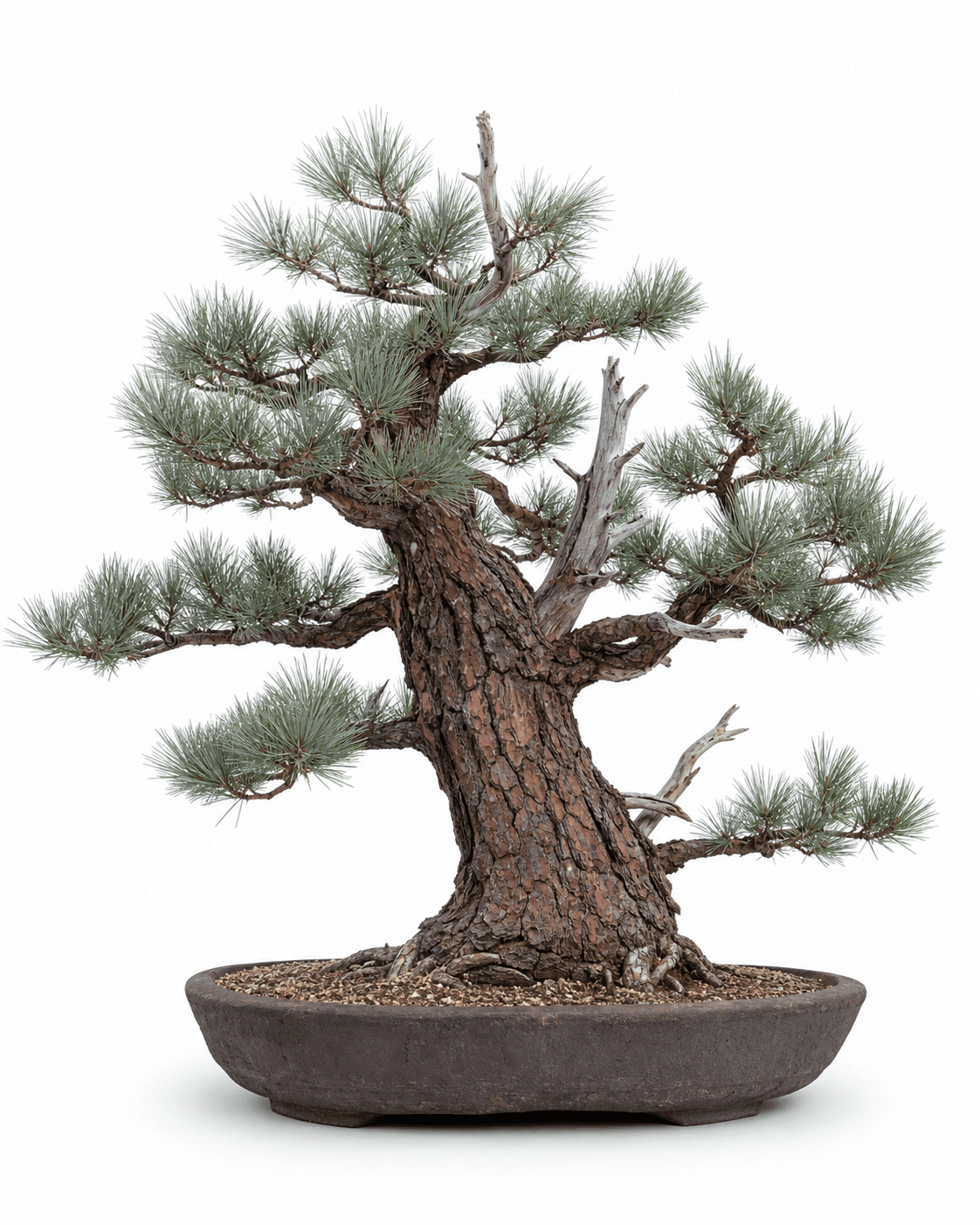
Pinus jeffreyi
Jeffrey pine is a long-needle, single-flush western pine that belongs outdoors in full sun, cold winter rest, and oxygen-rich mineral soil. Manage it through vigor, third-year needle-drop timing, restrained pruning, and staged root work rather than Japanese black pine decandling.
The local Mirai corpus has no dedicated Jeffrey pine file, so this profile is intentionally transparent: the bonsai method comes from Mirai long-needle single-flush pine and Ponderosa coverage that explicitly includes Jeffrey pine, while Kew, NC State, Oregon State, Virginia Tech, USDA, UC IPM, and Trees and Shrubs Online ground the species facts.
Updated June 6, 2026. Written by EntGrove Editorial. Last verified June 6, 2026.
Care fingerprint
Read the species through its shared care pattern.
Do not default to Japanese black pine decandling; manage vigor through timing, needle balance, light, and conservative pruning. Use this as the starting point before local conditions and tree strength refine the calendar.
Identify flush behavior
Single-flush, multiflush, white pine, and compact pine groups have different pruning windows and different risk levels.
Avoid default decandling
Japanese black pine methods do not transfer safely to every pine, especially slow, weak, collected, or five-needle trees.
Use needles as strength data
Needle length, color, age, and density help show where vigor is strong, weak, or becoming shaded.
Care cadence
The calendar starts with the tree's seasonal state.
Placement
Timing: Grow outdoors in full sun with moving air. Use root-zone cooling or afternoon protection only during extreme heat that would cook a shallow container.
Watch for: Indoor display, weak light, stagnant patios, reflected heat, warm winter storage, and labels that hide whether the tree is Jeffrey or Ponderosa.
NC State ExtensionOregon State Landscape PlantsBonsai Mirai LibraryWatering
Timing: Water completely through the root mass during active growth, then let air return. Strong growth and back-budding need water as well as oxygen.
Watch for: Old mountain soil that repels water, permanent wet cores, drought used as needle-shortening strategy, and dry pockets inside a collected rootball.
Bonsai Mirai LibraryUSDA Forest Service FEISDevelopment feeding
Timing: Feed strongly once the tree is clearly growing. Development feeding should build long needles, sugars, and transpiration before refinement asks for smaller foliage.
Watch for: Trying to miniaturize a weak tree, cutting fertilizer before back buds become shoots, and removing the foliage needed to generate interior buds.
Bonsai Mirai LibraryRefinement feeding
Timing: After the tree carries enough interior foliage, reduce spring strength and favor fall feeding around the old-needle color-shift window.
Watch for: Applying refinement feeding to a tree still building structure, or feeding a finished tree so hard that it returns to coarse long-needle growth.
Bonsai Mirai LibraryPruning and needle work
Timing: Use the late-season third-year needle-drop signal for pruning, shoot selection, and old-needle cleanup. Calendar dates can shift by climate and elevation.
Watch for: Spring candle pinching, native-foliage decandling, forced needle plucking, and pruning before old needles release easily.
Bonsai Mirai LibraryRepotting
Timing: Repot only after recovery is obvious. Stage old soil and large roots over multiple cycles rather than clearing the rootball in one operation.
Watch for: Bare-rooting, weak buds, loose tie-downs, stale native cores, and combining heavy styling with root reduction in the same season.
Bonsai Mirai LibraryWiring
Timing: Wire and bend during the same fall strength window used for other long-needle western pines, or use the final pre-push window for selected structural moves.
Watch for: Hidden tear signals under raffia, foliage rotated into sunburn, wire bite on thickening branches, and removing support before old wood holds position.
Bonsai Mirai LibraryPests and disease
Timing: Inspect during drought, after wounds, in humid needle-cast weather, and whenever a collected tree loses vigor.
Watch for: Jeffrey pine beetle pitch tubes or boring dust, Ips engravers, needle disease, dwarf mistletoe, root disease, wind damage, and heat stress.
USDA Forest Service SilvicsUSDA Forest Service FEISUC IPMNC State ExtensionWinter rest
Timing: Keep outside for cold dormancy. Protect the pot and roots during severe cold while preserving the seasonal signal.
Watch for: Warm-winter decline, frozen dry soil, wet frozen cores, hard freezes immediately after repotting, and moving the tree into a warm room for storage.
NC State ExtensionOregon State Landscape PlantsBonsai Mirai LibrarySpecies guide
Apply the species profile before copying another tree's calendar.
At a glance
Jeffrey pine is a western long-needle pine for outdoor growers with space.
Kew accepts Pinus jeffreyi in Pinaceae and gives the native range as southern Oregon to northern Baja California. NC State and Oregon State both flag the common-name overlap with black pine, yellow pine, western yellow pine, bull pine, and Ponderosa-like labels. Kew POWOKew POWO general informationNC State ExtensionOregon State Landscape Plants
For bonsai, EntGrove places Jeffrey pine in Pine > Long-Needle Single-Flush Pines. That means no native-foliage decandling, no spring candle pinching for length control, and no routine needle plucking as a strength-balancing habit. Bonsai Mirai Library
The page uses a transparent evidence hierarchy. Mirai has direct Jeffrey mention inside its Ponderosa maintenance corpus and transferable long-needle pine files, while public botanical and forestry sources provide the species-specific range, morphology, hardiness, habitat, pest, and identification facts. Bonsai Mirai LibraryKew POWONC State ExtensionUSDA Forest Service SilvicsUSDA Forest Service FEIS
Wild habitat
Its native image is Sierra, Klamath, Oregon, Nevada, and Baja dry mountain forest.
USDA Silvics describes Jeffrey pine as primarily Californian, ranging through the Klamath Mountains into southwestern Oregon, across the Sierra Nevada into western Nevada, and south through the Transverse and Peninsular Ranges into northern Baja California. USDA Forest Service Silvics
The site range is broad. NC State says Jeffrey pine can occupy edges of moist high mountain meadows and arid slopes bordering deserts, usually above 5000 ft. USDA FEIS adds very dry sites, serpentine soils, and mixed-conifer forests where recurrent fire keeps shade-tolerant conifers from taking over. NC State ExtensionUSDA Forest Service FEIS
Its roots explain the care translation. FEIS describes a deep taproot and strong extensive laterals, including roots found far from the trunk in shallow ultramafic soil. In a bonsai pot, that ecological drought strategy must become complete watering plus high root oxygen. USDA Forest Service FEISBonsai Mirai Library
The design translation is equally direct: open crown, blue-green long needles, cinnamon to red-brown plated bark, dry ridges, poor soil, and fire-influenced spacing. Jeffrey pine bonsai should read as a western mountain pine with room around the branches. Oregon State Landscape PlantsVirginia Tech DendrologyBonsai Mirai / Asymmetry
Reading the tree
Confirm identity first, then read vigor through candles, old needles, and buds.
Jeffrey pine is often confused with Ponderosa. Oregon State separates them by larger Jeffrey cones, inward-curving cone prickles, bluish-green needles, purplish or bluish young twigs, and a crushed-twig odor often described as vanilla, pineapple, or apple. Oregon State Landscape PlantsOregon State Landscape Plants
Trees and Shrubs Online adds a useful bud distinction: Jeffrey pine has buds that are only slightly resinous, while it differs from Ponderosa in resin chemistry, darker bark, young shoot color, usually larger cones, and recurved prickles. Trees and Shrubs Online
Once identity is clear, read the tree like a long-needle single-flush pine. Strong shoots carry both length and needle count. Weak shoots may extend with few needles, which limits their ability to bud back after pruning. Bonsai Mirai Library
The key seasonal signal is old-needle release. Mirai long-needle pine files use third-year needle drop as the indicator for energy-positive pruning, needle cleaning, shoot selection, and heavier bending. Bonsai Mirai Library
Pruning
Build back buds with strength, then prune to shoots that already work.
Mirai Ponderosa maintenance explicitly includes Jeffrey pine in the single-flush long-needle group. The method is to water and fertilize enough to create needle mass, then use the resulting photosynthesis and transpiration to stimulate adventitious buds. Bonsai Mirai Library
Spring candle pinching creates the wrong response on long-needle single-flush pines. The remaining needles elongate because stored root energy is distributed across fewer growing needles. Bonsai Mirai Library
Decandling native Jeffrey foliage is also off the table. Long-needle single-flush pines lack the high water mobility and second-flush capacity that make Japanese black pine decandling useful. Bonsai Mirai Library
The safe refinement move is cutback to interior buds that have already become needle-bearing shoots. If a back bud has not built enough diameter and foliage, leave the parent shoot to keep feeding it. Bonsai Mirai Library
Cone removal is practical energy management. Mirai Ponderosa maintenance advises removing cone primordia before they mature because fruiting draws heavily on reserves, and Jeffrey pine sources describe large seed cones that take two seasons to mature. Bonsai Mirai LibraryUSDA Forest Service FEIS
Roots
Treat collected Jeffrey roots as western pine roots: staged, braced, and never rushed.
The local corpus does not include a Jeffrey-specific repotting file, so EntGrove transfers only the western single-flush pine principles: wait for strong post-collection growth, keep a functioning root mass, and avoid bare-rooting. Bonsai Mirai Library
The reason is ecological. USDA FEIS describes Jeffrey pine as having a deep taproot and extensive lateral roots. Collected material may arrive with long structural roots and a native core that cannot be corrected in one safe operation. USDA Forest Service FEIS
Use the first major repot to solve the limiting root or container problem while preserving enough roots to keep the tree energy-positive. Replace the old core in later cycles after strong candles and buds prove recovery. Bonsai Mirai Library
Asymmetric yamadori need mechanical stability. Tie down along the root plane, block rotation with props when needed, and keep the trunk still so new roots are not sheared each time wind moves the crown. Bonsai Mirai Library
Soil and pot
Use mineral oxygen first, then tune moisture to your climate.
Oregon State lists sun and well-drained gravelly to sandy moist soil. NC State lists clay, loam, sand, and shallow rocky texture with good drainage and occasional dryness. The shared message is oxygen, not soggy storage. Oregon State Landscape PlantsNC State Extension
For long-needle western pine bonsai, Mirai repotting guidance favors akadama, pumice, and lava with small fines reduced to increase air space. In hot dry gardens, keep enough water-holding capacity to prevent root recession. Bonsai Mirai Library
Pot size is a needle-length lever. Oversized containers create root strength and coarse extension. Once the design has enough usable buds, a proportionate container helps divide energy across more growing points. Bonsai Mirai Library
Pot character should stay quiet: rugged rectangles, slab-like forms, unglazed ovals, and earth colors suit the red bark, blue-green long needles, and exposed mountain image better than ornate show pots. Bonsai Mirai / AsymmetryOregon State Landscape Plants
Climate
Jeffrey pine tolerates cold and drought, while shallow pots narrow both tolerances.
NC State lists USDA Zones 5a to 7b and says Jeffrey pine is tolerant of drought and cold weather. Oregon State lists Zone 6 and a native range centered on mountains from southern Oregon through California and Baja. NC State ExtensionOregon State Landscape Plants
In the Pacific Northwest and northern California, the main bonsai challenge is keeping collected roots oxygenated through winter rain while preserving full sun and airflow. Oregon State Landscape PlantsBonsai Mirai Library
In hot inland California, Nevada, and similar climates, protect shallow pots from extreme heat, water fully in the morning, and avoid heavy pruning or bending during heat events. USDA Forest Service FEISBonsai Mirai Library
In humid eastern regions, NC State warns that the species may do better in mountains than in Piedmont or coastal heat and humidity. Growers outside the native climate should be stricter about airflow, soil oxygen, and disease monitoring. NC State Extension
Pests and disease
Watch beetles, root stress, wind damage, and diseases that exploit weakness.
USDA Silvics calls Jeffrey pine beetle the single worst enemy of Jeffrey pine. UC IPM lists Jeffrey pine beetle on Jeffrey pine, with attacks on the midtrunk of large trees, long J-shaped galleries, and larvae overwintering in inner bark. USDA Forest Service SilvicsUC IPM
UC IPM also cautions that chemical treatment after beetles have already entered the bark offers no benefit. For bonsai, prevention means reducing stress, identifying pitch tubes or boring dust early, and avoiding unnecessary wounds during pest pressure. UC IPM
USDA FEIS and Silvics list additional pressure from dwarf mistletoe, root disease, heart rots, fir coneworm, Ips engravers, and other insects. Container trees reveal these problems first as weak candles, needle loss, branch dieback, or poor response after work. USDA Forest Service FEISUSDA Forest Service Silvics
NC State notes wind damage susceptibility. In bonsai terms, heavy crowns, fresh repots, and tall collected trunks need secure tie-downs and wind protection until new roots have anchored the tree. NC State ExtensionBonsai Mirai Library
Wiring
Wire old western pine wood slowly and keep the foliage oriented to light.
Mirai long-needle pine timing places heavy bending near the same third-year needle-drop strength window used for pruning and shoot selection, while some structural work can also fit the final pre-push window before new needles emerge. Bonsai Mirai Library
Use heavier wire, guy wires, and bracing when old branches resist movement. Collected pine wood can rebound for years, so support may need to stay longer than it would on young nursery material. Bonsai Mirai Library
Avoid hiding the branch under material that prevents you from seeing tear signals. On Ponderosa and similar western pines, visible whitening, opening bark, or sudden tissue lift is the cue to stop the bend. Bonsai Mirai Library
After a major bend, rotate needles and buds into light. Long-needle pines carry sparse foliage, so losing one productive tuft can remove the entire visual pad and the branch energy behind it. Bonsai Mirai Library
Propagation
Seed, grafting, and ethical collection are realistic paths.
NC State and USDA FEIS both support seed as the normal propagation path. FEIS notes that female cones mature two summers after pollination and that the species produces winged seeds. NC State ExtensionUSDA Forest Service FEIS
Seedlings are useful for forests, learning single-flush timing, and building young trunks, but they will not quickly create the bark, rugged movement, and sparse old branches that make native western pine bonsai compelling. Bonsai Mirai / AsymmetryUSDA Forest Service Silvics
Grafting belongs in advanced work. The Mirai pine corpus treats Ponderosa as a strong rootstock for other pine foliage types; Jeffrey should be approached with the same Pinus-grafting caution until grower evidence proves compatibility and vigor. Bonsai Mirai Library
Collected material requires legal permission, careful aftercare, and source documentation. Record whether the tree came from a serpentine ridge, Sierra dry slope, Oregon stand, nursery seedling, or uncertain yellow-pine label. USDA Forest Service FEISUSDA Forest Service Silvics
Sourcing
Buy verified identity, recovery, and usable scale.
A reliable Jeffrey pine candidate should have a Latin label, visible vigor, strong terminal buds, live old needles, enough branch options, and a root system that can be staged into a bonsai container. NC State ExtensionBonsai Mirai Library
Inspect cones, twigs, needles, bark scent, and bud resin when the tree is sold as Jeffrey. Oregon State and Trees and Shrubs Online both emphasize that Jeffrey and Ponderosa can be hard to separate when only one feature is visible. Oregon State Landscape PlantsTrees and Shrubs Online
Avoid recently collected trees with no recovery history, weak short candles, sour old soil, trunk instability, bark beetle evidence, severe wind damage, or a seller who collapses Jeffrey, Ponderosa, Austrian black pine, and generic black pine into one care plan. USDA Forest Service SilvicsUC IPMBonsai Mirai Library
Scale matters. The long needles and open branch rhythm suit medium and large bonsai more naturally than shohin. A small-tree plan usually needs grafting or a different pine species. Bonsai Mirai LibraryOregon State Landscape Plants
Troubleshooting
Trace symptoms back to roots, timing, identity, and the last major operation.
Symptom: old interior needles loosen in fall. Likely cause: normal third-year needle drop. Fix: clean only needles that release easily and use the timing signal for pruning decisions. Bonsai Mirai Library
Symptom: long coarse needles. Likely cause: development strength, too few growing points, oversized container, or spring foliage reduction. Fix: build back buds, let them become shoots, then refine feeding and pot strength. Bonsai Mirai Library
Symptom: no back buds after cutback. Likely cause: weak water and fertilizer cycle, insufficient light, old bark sealing latent sites, or pruning before the interior bud was ready. Fix: rebuild vigor and branch placement before more cuts. Bonsai Mirai Library
Symptom: pitch tubes, boring dust, or sudden top decline. Likely cause: Jeffrey pine beetle, Ips engravers, or wound-associated insects. Fix: diagnose early with local extension or IPM guidance and avoid chemical rescue after beetles are already under bark. UC IPMUSDA Forest Service Silvics
Symptom: weak response after repotting. Likely cause: too much root removal, a stale native core, poor tie-down, or roots kept cold and wet after cutting. Fix: stabilize, protect from extremes, and wait for strong candles before additional work. Bonsai Mirai Library
Symptom: decline in hot humid regions. Likely cause: climate mismatch, root oxygen loss, or disease pressure. Fix: increase airflow, use sharper drainage, cool the pot, and reconsider the species if winter and summer conditions cannot be met. NC State ExtensionBonsai Mirai Library
Design
Design for dry ridges, open crowns, blue needles, and red-brown bark.
Jeffrey pine has a quieter bonsai literature than Ponderosa, so design should start from ecology rather than imported pine formulas. The habitat says open light, exposed ridges, dry mountain air, poor soil, and fire-shaped spacing. USDA Forest Service FEISUSDA Forest Service SilvicsBonsai Mirai / Asymmetry
Oregon State and Virginia Tech describe thick furrowed bark, blue-green twisted needles, open spreading branches, and large cones. Those traits favor sparse pads, longer negative spaces, and broad old crowns rather than tight black-pine density. Oregon State Landscape PlantsVirginia Tech Dendrology
Mirai long-needle pine design asks each bud to carry more visual weight than a short-needle pine bud. A single healthy tuft may read as a complete pad, so branch placement and silhouette need restraint. Bonsai Mirai Library
Deadwood should stay pine-like. Use broken branches, dry stubs, weathered cylindrical jin, and aged bark transitions instead of highly torn juniper-style grain. Bonsai Mirai Library
Forms
Most bonsai decisions are about provenance, not named cultivars.
Kew accepts Pinus jeffreyi at species rank and lists older names such as Pinus ponderosa var. jeffreyi and Pinus peninsularis. FEIS also lists Pinus ponderosa subsp. jeffreyi as a synonym. Kew POWOUSDA Forest Service FEISTrees and Shrubs Online
FEIS notes hybridization with Ponderosa and Coulter pine where distributions overlap. In practice, buy or collect with enough cones, buds, twigs, and provenance to avoid building care around a guessed identity. USDA Forest Service FEISOregon State Landscape Plants
Trees from serpentine Oregon sites, Sierra east-side forests, Baja mountains, or nursery seed can differ in heat, cold, needle length, and vigor. Record the source because it may explain the tree better than a generic Jeffrey pine label. USDA Forest Service FEISUSDA Forest Service Silvics
Named ornamental cultivars are not central to the bonsai conversation today. Prioritize a healthy root system, suitable trunk scale, branch options, and legally documented origin over cultivar novelty. Bonsai Mirai Library
History
Jeffrey pine carries a strong botanical history and a thinner public bonsai record.
USDA Silvics records that Jeffrey pine was discovered in 1852 in the Shasta Valley of California by John Jeffrey, a Scottish botanical explorer. Oregon State also ties the name to John Jeffrey and his Oregon and California collecting work. USDA Forest Service SilvicsOregon State Landscape Plants
Trees and Shrubs Online explains why older references blurred it with Ponderosa: the two species were historically treated closely, but differences in resin chemistry, bark, buds, shoots, leaves, cones, and seeds support a distinct species concept. Trees and Shrubs Online
Public bonsai examples are much less documented than Ponderosa pine in the accessible sources reviewed for this page. That absence should make the page conservative: it treats Jeffrey as a serious native-material candidate with transferred long-needle pine method, not as a settled exhibition standard. Bonsai Mirai LibraryBonsai Mirai / Asymmetry
The notable-tree record outside bonsai is stronger. Trees and Shrubs Online lists long-cultivated British and Irish specimens, while USDA sources frame Jeffrey pine as an ecologically distinctive western forest tree tied to serpentine soils, dry slopes, and fire-shaped landscapes. Trees and Shrubs OnlineUSDA Forest Service FEISUSDA Forest Service Silvics
Species questions
Answer the beginner questions before styling.
Can Jeffrey pine be grown as bonsai?
Yes. Jeffrey pine can be grown as outdoor bonsai when it has full sun, cold dormancy, oxygen-rich soil, complete watering, and long-needle single-flush timing.
Can Jeffrey pine bonsai live indoors?
No. Jeffrey pine is an outdoor cold-dormant pine. Indoor display should be brief, then the tree should return to outdoor light and seasonal weather.
Should I decandle Jeffrey pine bonsai?
Do not decandle native Jeffrey pine foliage. Treat it as a long-needle single-flush pine and use fall timing, back-budding, and conservative cutback instead.
How do you reduce Jeffrey pine needle length?
Build health first: water, feed, and light the tree well enough to create more buds and more needle-bearing shoots. Once energy is divided across many growing points, individual needles can shorten.
When should Jeffrey pine be pruned?
Use the late-season third-year needle-drop signal. When old needles release easily, the tree is in a stronger window for shoot selection, pruning, needle cleanup, and heavier wiring.
How is Jeffrey pine different from Ponderosa pine?
Jeffrey pine often has larger cones with inward-curving prickles, bluish-green needles, purplish or bluish young twigs, sweet-fruity crushed twig scent, and less resinous buds. Use several traits, not one clue.
What soil works for Jeffrey pine bonsai?
Use a mineral pine mix that drains fast and holds air, often akadama, pumice, and lava adjusted to climate. Keep enough moisture for active roots without trapping a wet stale core.
How cold hardy is Jeffrey pine bonsai?
NC State lists USDA Zones 5a to 7b, and Oregon State lists Zone 6. Bonsai roots are less insulated than landscape roots, so protect the pot during severe cold while keeping the tree dormant.
Why is my Jeffrey pine dropping old needles?
Old third-year needle drop in fall is normal and useful as a timing signal. Widespread browning, banded needles, or sudden thinning outside that pattern should trigger root, water, pest, and disease checks.
Is Jeffrey pine good for small bonsai?
Usually it is better at medium and larger sizes because the needles are long and the natural branch rhythm is open. Very small bonsai usually need grafting or a different pine.
Sources
Species advice needs source discipline.
Next decisions
Plan the operation before copying the calendar.
A good care note for Jeffrey pine records the tree's stage, the work done, and the aftercare used. That record matters more than a month-name rule.
Related species
Compare nearby trees before transferring advice.
Ponderosa pine
Pinus ponderosa
Bishop pine
Pinus muricata
Sugar pine
Pinus lambertiana
Eastern white pine
Pinus strobus
Western white pine
Pinus monticola