
Species guide
Zelkova Bonsai Care
Zelkova serrata
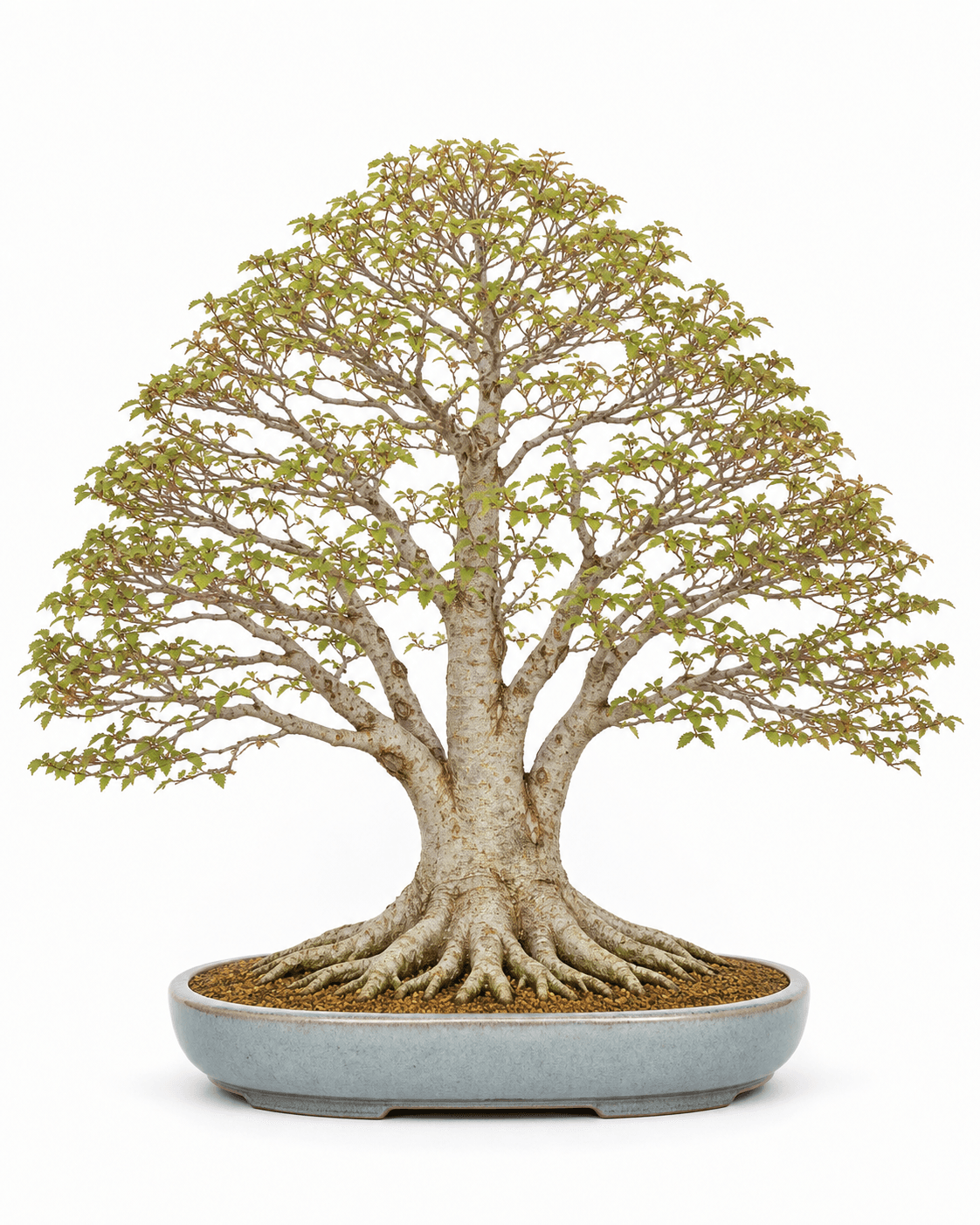
Zelkova serrata is the classic outdoor deciduous bonsai for broom style: a clean trunk, radial nebari, and a fan of fine twigging judged most clearly after leaf drop. It rewards attentive growers because it grows fast, back-buds readily, and can build ramification quickly when water, roots, and pruning are kept in balance.
Treat zelkova as Broadleaf > Deciduous in the EntGrove taxonomy. The work calendar is set by spring bud swell, first-flush hardening, midsummer heat, autumn leaf drop, and winter root protection, with repeated pruning used to hold energy evenly from the lower interior to the outer tips.
This is a good tree for an outdoor beginner who can check water daily in leaf and protect the pot in winter. It is a poor match for warm indoor shelves, skipped pruning, casual wire marks, and old nursery trunks with large scars that will never close cleanly.
Updated July 13, 2026. Written by EntGrove Editorial. Last verified July 13, 2026.
Care fingerprint
Read the species through its shared care pattern.
Repot and structural prune around dormant-to-active transitions; protect new leaves; time refinement work after growth hardens. Use this as the starting point before local conditions and tree strength refine the calendar.
Read the foliage first
Broadleaf stress usually shows in leaf color, leaf size, wilt, scorch, or delayed hardening before it becomes a branch problem.
Match work to dormancy
Deciduous, evergreen, tropical, succulent, and flowering broadleaf trees recover on different calendars.
Protect fine roots
Root work should preserve enough active fine roots for the tree to rehydrate quickly after the operation.
Care cadence
The calendar starts with the tree's seasonal state.
Placement
Timing: Grow outdoors through the seasons. Use morning sun and afternoon shade for two to eight weeks after hard canopy opening, then return strong trees to full sun.
Watch for: Warm indoor winter growth, thin distorted leaves, bark sunscald after heavy pruning, overheated shallow pots, and weak interior buds from excessive shade.
Bonsai Mirai LibraryNC State ExtensionWatering
Timing: Check daily while leafed out. Water in multiple gentle passes until the full root mass drains, then let air return before the next watering.
Watch for: Dry cores under a damp surface, runoff around old soil, stale wet lower roots, leaf-edge burn, and interior tip loss after drought.
Bonsai Mirai LibraryFertilizing
Timing: Feed according to stage. Development and recovery need stronger organic feeding; refined trees feed after the first flush hardens and strongly again in fall.
Watch for: Long internodes from overfeeding refinement, weak response after repeated cutbacks, fertilizer on ill roots, and salt stress during sustained 95 F heat.
Bonsai Mirai LibraryPruning
Timing: For refinement, cut extending shoots after the first flush hardens. On dieback-prone vigorous growth, repeat cutbacks to two internodes after shoots reach three to five internodes.
Watch for: Outer canopy takeover, vertical water sprouts, dog-leg branches, weak branches pruned before energy-positive status, and spring cuts that trigger coarse growth.
Bonsai Mirai LibraryPartial defoliation
Timing: Use only on healthy trees after the flush hardens. Reduce the largest outer leaves by roughly two-thirds or remove a measured portion to balance the canopy.
Watch for: Weak roots, recent repotting, insufficient feeding, hot afternoon exposure immediately after thinning, and removing the leaf mass needed for back-budding.
Bonsai Mirai LibraryRepotting
Timing: Repot at spring bud swell, or earlier only with reliable winter protection. Preserve the fine-root sheen and build a lateral root plate.
Watch for: Congested roots, poor percolation, broken-down akadama, summer dieback from a too-small reservoir, and upsizing after major root loss.
Bonsai Mirai LibraryWiring
Timing: Wire during fall leaf drop or after leaf fall when branches are visible and pliable. Use wire selectively; pruning carries most broom refinement.
Watch for: Wire getting tight, smooth-bark scars, excessive wiring on fine twigs, summer wiring during recovery, and ties left through spring swelling.
Bonsai Mirai LibraryFall structural work
Timing: Use the leaf-color to leaf-drop window for structural pruning on healthy fully deciduous trees; the useful window is roughly two weeks after peak color starts.
Watch for: Heavy work on weak trees, deciduous conifer timing copied by mistake, large wounds left unpasted, and pruning after the resource movement window has closed.
Bonsai Mirai LibraryWinter protection
Timing: Keep dormant and cold, with roots sheltered from hard freeze, dry wind, and rapid freeze-thaw swings. Small pots need protection near the low 20s F.
Watch for: Warm storage, fully dry akadama, rodent damage, wind on a leafless canopy, and fine twig loss after testing landscape hardiness in a bonsai pot.
Bonsai Mirai LibraryNC State ExtensionSpecies guide
Apply the species profile before copying another tree's calendar.
At a glance
Zelkova is a temperate deciduous broom-style tree with high vigor and little tolerance for neglect.
Kew accepts Zelkova serrata in Ulmaceae and places its native range from China to the southern Kuril Islands and temperate East Asia. NC State describes Japanese zelkova as a large deciduous East Asian tree, 50-80 ft tall and wide in the landscape, with full-sun preference, medium water demand, serrated leaves, green spring flowers, small drupes, variable fall color, and distinctive bark. Kew POWONC State Extension
In bonsai, those facts translate to an outdoor tree for real dormancy, strong light, steady water, and fast repeated growth. The Mirai corpus treats zelkova with elm as high-water-mobility material, which means vigor is useful but stress can quickly become branch dieback. Bonsai Mirai Library
The complete care specification is narrow: full outdoor culture, careful water and oxygen balance, spring bud-swell repotting, post-flush pruning, fall leaf-drop structural work, winter root protection, fine akadama for refinement, and a design language built around radial roots, low trunk division, and a leafless twig dome. Bonsai Mirai LibraryBonsai Mirai / Asymmetry
Wild habitat
Design from an East Asian canopy tree with vase-shaped winter architecture.
Kew describes Zelkova serrata as a temperate tree native from China to the southern Kuril Islands and temperate East Asia. NC State and Purdue describe the landscape tree as vase-shaped, full-sun adapted, deciduous, wind tolerant once established, and valued for textured foliage, bark, and autumn color. Kew POWONC State ExtensionPurdue Arboretum
For care, the wild signal is a vigorous canopy broadleaf that wants light, moisture, drainage, and a cold rest. It can tolerate dry or windy landscape conditions after establishment, but a bonsai pot removes deep soil, root insulation, and stored water, so the grower must provide the stability the landscape tree would normally get from volume. NC State ExtensionBonsai Mirai Library
For design, the useful image is the winter silhouette: a trunk that divides into an ascending fan, a canopy edge that domes outward, and progressively finer branch divisions at each order. Arnold Arboretum connects zelkova to elm-like street-tree form after Dutch elm disease changed American plantings; bonsai uses the same vase-to-broom language at miniature scale. Arnold ArboretumBonsai Mirai / Asymmetry
Reading the tree
Read stage, water flow, and energy distribution before choosing a cut.
Mirai divides deciduous work by stage: primary structure, secondary scaffolding, and tertiary ramification. A zelkova can be globally refined while individual branches remain in development, so each branch needs its own read before pruning, wiring, or feeding intensity is chosen. Bonsai Mirai Library
The most important species read is evenness. Mirai defines refinement as even energy distribution across the tree from top to bottom and from interior to exterior. On zelkova, that is survival logic, because unchecked outer growth concentrates water and hormones at the tips and starves the interior. Bonsai Mirai Library
Health is read through the fine-root sheen and the smallest twigs. The direct zelkova corpus warns that tertiary tips are the first parts to die when a refined broadleaf declines. Tip loss after heat, drought, stale soil, or rushed heavy cuts should trigger root and water review before another design pass. Bonsai Mirai Library
Pruning
Build the broom with repeated post-flush cutbacks and disciplined junction work.
The main refinement window opens after the first flush hardens and the tree returns to energy-positive status. Spring pre-bud-push cuts on high-mobility deciduous material can trigger coarse growth or bleeding, while post-flush cuts convert stored spring growth into controlled ramification. Bonsai Mirai Library
Start the cutback at the lowest branches because their length sets the reference for the canopy above. Reduce the upper crown more strongly than the lower fan when vigor has climbed, which redirects strength toward weaker lower and interior branches instead of preserving an increasingly top-heavy broom. Bonsai Mirai Library
For dieback-prone vigorous species such as zelkova, Mirai gives a repeated rhythm: when a shoot extends to three to five internodes, cut back to two internodes, then repeat through the season. Pair that with removal of vertical water sprouts and bottom shoots at every junction before they swell the shoulder into a knuckle. Bonsai Mirai Library
Partial defoliation belongs only on healthy trees after hardening. The corpus uses it to throttle strong exterior leaves, often by cutting oversized leaves down by about two-thirds, so interior buds receive light and the next flush can reduce leaf size and internode length. Bonsai Mirai Library
A broom also needs proportional taper. The direct zelkova corpus calls for smooth transition from trunk to primary, secondary, tertiary, and sub-tertiary branches, with internode length reducing at each level. Dog-leg branches, old single-stem chains, and coarse long-internode twigs usually need replacement rather than refinement in place. Bonsai Mirai Library
Repotting
Repot at bud swell to preserve water capacity and build a radial plate.
Spring bud swell is the standard repot window. Mirai beginner repotting method uses swollen buds before active growth as the safe window, and the direct zelkova fall cleanup corpus adds that vigorous refined deciduous trees in small pots often need root review about every two years because summer water capacity disappears quickly. Bonsai Mirai Library
The target is a shallow lateral root plate under the nebari, with pot depth chosen to keep the root zone stable. A refined zelkova depends on a fine-root sheen under the trunk flare, so root work should protect live fine roots, remove downward roots gradually, and keep the tree anchored so new root tips are not torn by wind or watering. Bonsai Mirai Library
After major root loss, avoid automatically moving to a larger pot. The corpus warns that reduced roots in excess soil can worsen water and oxygen balance. Recovery often works better in the original container size or in a wooden box that increases oxygen flow around the root pad. Bonsai Mirai Library
Soil and pot
Use akadama for refinement and a pot that frames the radial broom.
Fine akadama is the default refined zelkova substrate in the Mirai method because its clay particles fracture as roots expand, driving root ramification while binding nutrients for a tree with high water and feeding demand. Development trees can use a more oxygen-rich blend with pumice and lava, and recovery trees may move to a wooden box. Bonsai Mirai Library
The pot should support a wide, quiet deciduous image. A shallow oval or soft-cornered rectangle gives the root flare and twig dome visual space, while enough depth keeps the water and oxygen balance stable. Ultra-shallow exhibition pots should wait until the root pad is compact, vigorous, and predictable. Bonsai Mirai / AsymmetryBonsai Mirai Library
A glazed container is usually appropriate for a refined deciduous broom because the seasonal display is fall color and winter twigging rather than rugged bark or deadwood. Keep the container quiet: the clean trunk, radial nebari, and absence of wire scars should be the visual center. Bonsai Mirai / Asymmetry
Climate
Adjust around heat, winter root exposure, and container water capacity.
NC State lists landscape hardiness as Zones 5a-8b, but bonsai care must start with the container. A small pot loses ground insulation and water reserve, so protect roots before the species hardiness limit is tested. The Mirai fall cleanup corpus flags low-20s F nights as a practical protection threshold for small deciduous pots. NC State ExtensionBonsai Mirai Library
In hot or arid climates, full sun may still be correct in spring and fall, while the shallow pot needs shade, mulch, or afternoon relief in midsummer. After heavy cutback that exposes interior leaves and bark, Mirai recommends temporary morning sun with afternoon shade until new growth adapts. Bonsai Mirai Library
In cool humid climates, the risk shifts toward old wet substrate, leaf disease, and a dense canopy that never dries. Water early, open the interior, and repot before degraded akadama turns the lower root zone anaerobic. Bonsai Mirai LibraryNC State Extension
Indoor winter warmth breaks the seasonal contract. The zelkova corpus notes that low-light indoor winter leaves waste stored energy and develop distorted morphology. Keep the tree dormant in a protected cold space instead of asking it to grow in a room. Bonsai Mirai Library
Pests and diseases
Zelkova has low baseline pest pressure, while wounds and container stress create the serious problems.
NC State describes Japanese zelkova as usually disease-free and resistant to Dutch elm disease and elm leaf beetle, which explains its use as an American elm substitute. Leafrollers may occur, and NC State also records center-crown dieback and bark cracking under harsh urban conditions. NC State Extension
UF/IFAS also characterizes the species as normally disease-free, while warning that canker diseases can enter repeatedly wounded trunks. Oklahoma State identifies Japanese beetle and canker as susceptibilities. In a bonsai, inspect chewing damage and bark lesions early, then protect vigor and avoid adding fresh wounds while the tree is stressed. UF/IFAS ExtensionOklahoma State University Extension
Root rot is the serious potted-tree threat. Mirai watering and soil method ties anaerobic substrate to root failure, and zelkova responds to root failure by shedding fine tips and sometimes whole branch zones. Correct drainage, particle condition, and watering cycle before chasing symptoms with fertilizer. Bonsai Mirai Library
Wiring
Use wire to set structure, then let pruning maintain the image.
The Mirai deciduous wiring corpus favors selective wiring that preserves natural deciduous character. Zelkova is especially dependent on that restraint because the final image is a clean leafless network of twigs, and visible scars on smooth bark remain part of the tree for a long time. Bonsai Mirai LibraryBonsai Mirai / Asymmetry
Fall is the productive wiring window. Branches are visible, the tree is still moving resources, and incidental damage bleeds less. Use aluminum for thin young branches, paper-wrap copper if stronger holding power is unavoidable, and remove wire when it first gets tight rather than waiting for bite. Bonsai Mirai Library
Young broom branches may also be tied or loosely bundled to correct crooked growth and hold the fan. Remove ties before spring swelling. Fine twig placement should increasingly become clip-and-grow, with less wire each year as the canopy reaches tertiary refinement. Bonsai Mirai Library
Propagation
Start from cuttings or layers when radial roots matter more than trunk size.
NC State lists seed as a propagation strategy for the landscape tree. For bonsai, seed is useful for volume and selection, but the broom form makes root geometry the decisive issue. Sow and cull for radial roots, low trunk division, small leaves, and short internodes. NC State ExtensionBonsai Mirai Library
Cuttings give the most control over nebari. The Mirai method for zelkova uses cutting propagation on a flat tile or geodisc to force lateral roots early, which avoids many later grafting and root-repair problems. Bonsai Mirai Library
Air-layering is useful when an existing trunk section has the right line but poor roots. Root grafting can repair missing radial roots, with thread grafts preferred where visible approach-graft scars would ruin pale bark. Bonsai Mirai Library
Buying
Buy for nebari, clean trunk division, and small scars.
Good zelkova material shows an even 360-degree root flare, a low trunk division or a trunk that can be cut into one, active buds on the interior, no one-sided wilt, and branch angles that can become a fan without heavy twisting. Bonsai Mirai LibraryPurdue Arboretum
Landscape nursery stock is vigorous and affordable, but often has a high trunk, street-tree cultivars, buried roots, large pruning wounds, or branch structure too coarse for broom style. It is best for trunk development or long rebuilds, rather than instant refinement. NC State ExtensionPurdue ArboretumBonsai Mirai Library
Pre-bonsai and finished brooms cost more because the hard work has already been done: radial root plate, clean trunk split, and fine winter silhouette. On zelkova, that premium can be rational because large scars and wire marks remain hard to hide. Bonsai Mirai LibraryBonsai Mirai / Asymmetry
Reject material with active dieback, degraded old soil, permanent inverse taper at the division, major unhealed trunk chops, heavy wire scars, or only a vague elm label. NC State notes confusion with Ulmus parvifolia and other trees, so identify the plant before copying a Chinese elm calendar. NC State ExtensionKew POWO
Troubleshooting
Work backward from energy distribution, roots, and recent timing.
Zelkova troubleshooting is rarely about a single visual symptom. Ask whether vigor is concentrated at the tips, whether the root zone can hold both water and oxygen, whether the tree was worked in an energy-positive window, and whether the branch had enough live tissue behind the cut to compartmentalize. Bonsai Mirai Library
Design
The best zelkova is read as a clean winter broom.
Mirai design method starts with base, trunk line, defining branch, and apex. On zelkova, the base is the radial nebari, the trunk line is usually straight or gently upright, the defining branch is the widest reach of the fan, and the apex is the rounded high point of the dome. Bonsai Mirai / AsymmetryBonsai Mirai Library
Broom design asks for balance without stiffness. The trunk should split low enough to feel old, branch thickness should reduce at each order, internodes should shorten toward the tips, and negative space should appear inside the fan rather than as conifer-style pads. Bonsai Mirai LibraryBonsai Mirai / Asymmetry
Formal upright, informal upright, clump, and forest are possible when the material already suggests them. Deadwood styles should stay outside the main design vocabulary. Broadleaf deadwood decays differently, and the species value is bark, root flare, winter twigging, and fall color. Bonsai Mirai / AsymmetryArnold Arboretum
Cultivars
Cultivar labels explain form and color, while bonsai timing still follows Zelkova serrata.
NC State lists Autumn Glow, Fuiri Kevaki, Green Vase, Green Veil, Halka, Musashino, Spring Grove, Variegata, Village Green, and Wireless. These names may point to upright habit, fall color, variegation, or street-tree form, but most bonsai work still follows zelkova deciduous timing. NC State Extension
Purdue gives useful identity traits for ordinary Zelkova serrata: simple alternate sharply serrated leaves, often 1.3-2 inches or longer, offset leaf bases, reddish-brown young bark, and orange-brown inner bark exposed as mature bark exfoliates. Purdue Arboretum
For bonsai, cultivar selection should be practical. Musashino or Green Vase style upright habits may help a vertical image, while variegated or coarse growth can complicate refinement. Prioritize leaf size, internode length, radial root potential, and clean branching over a landscape marketing name. NC State ExtensionBonsai Mirai Library
History
Zelkova became famous through elm-like architecture and the Japanese broom ideal.
Arnold Arboretum places zelkova in the post-Dutch-elm-disease search for elm-like, disease-resistant alternatives, including its use along Boston Commonwealth Avenue beginning in the 1950s. NC State and Purdue also describe resistance to Dutch elm disease, which helps explain why the tree became familiar in landscapes. Arnold ArboretumNC State ExtensionPurdue Arboretum
In Japanese culture, keyaki is valued as an avenue and timber tree as well as a bonsai subject. In bonsai, its importance is tied less to individual named specimens and more to the exacting class of keyaki brooms, where radial root flare, trunk division, and winter ramification are judged leafless. Bonsai Mirai LibraryArnold Arboretum
The exhibition standard is severe because leaves hide flaws. A refined zelkova broom should read from across the room as a calm dome, then reward close inspection with even bifurcation, no swollen knuckles, no wire scars, clean wound management, and a pot that supports quiet deciduous form. Bonsai Mirai / AsymmetryBonsai Mirai Library
Wounds
Respect the shoulder, paste fresh cambium, and expect large scars to persist.
The direct zelkova corpus is strict: cut close to the branch shoulder but never past it. Flush cuts or cuts beyond the shoulder cause dieback. Leave a bud above old pruning junctions so the tree can direct response cleanly rather than pushing multiple shoots from a knuckle. Bonsai Mirai Library
For larger removals, leave the wound slightly concave relative to the trunk surface so the callus rolls inward. Use cut paste on fresh cambium. If a callus stalls, the deciduous wound corpus recommends slicing the inner callus edge toward the wound center and applying hormone-bearing paste to restart division. Bonsai Mirai Library
This is why buying matters. A massive old trunk chop on pale smooth bark can define the tree for decades. Choose cleaner starting material unless you are intentionally growing a hollow broadleaf image. Bonsai Mirai LibraryBonsai Mirai / Asymmetry
Species questions
Answer the beginner questions before styling.
Is zelkova a good beginner bonsai?
Yes for an outdoor beginner who can water carefully, prune repeatedly, and protect the pot in winter. It is a poor fit for warm indoor shelves or growers who want a once-a-year styling project.
Can zelkova bonsai live indoors?
Grow true Zelkova serrata outdoors with winter dormancy. Brief indoor display is fine after hardening, but warm low-light winter growth wastes stored energy and weakens spring response.
How often should I water zelkova bonsai?
Check daily in leaf. Water thoroughly when the surface and root zone are ready, then let oxygen return. In winter, keep the soil slightly damp rather than dry.
When should I repot zelkova bonsai?
Repot as buds swell in spring. Vigorous refined trees in small pots often need review about every two years, but drainage, root density, and summer water capacity decide.
When should I prune zelkova bonsai?
Refinement pruning belongs after the first flush hardens. For vigorous dieback-prone growth, cut shoots back to two internodes after they extend to three to five internodes, then repeat as needed.
Can I defoliate zelkova bonsai?
Use partial defoliation only on healthy trees after leaves harden. Reduce the strongest outer leaves to balance energy and light, then shade the tree during recovery if interior tissue was exposed.
When should I wire zelkova bonsai?
Wire during fall leaf drop or winter structure review when branches are visible. Remove wire when it first tightens, because smooth-bark deciduous scars can persist.
Is zelkova the same as Chinese elm?
No. Zelkova serrata and Ulmus parvifolia are separate genera in Ulmaceae. Retail labels can blur them, so confirm the plant before applying Chinese elm indoor or semi-indoor advice.
Why are my zelkova interior twigs dying?
The usual causes are unchecked outer vigor, root-zone water and oxygen problems, hard drought, stale soil, or heavy work during weak timing. Start by checking roots, watering, and energy distribution.
What soil is best for refined zelkova bonsai?
Fine akadama is the Mirai refinement standard because it supports fine root ramification and nutrient exchange. Development or recovery trees may need more oxygen through pumice, lava, or a wooden box.
Sources
Species advice needs source discipline.
Next decisions
Plan the operation before copying the calendar.
A good care note for Zelkova / Japanese gray-bark elm records the tree's stage, the work done, and the aftercare used. That record matters more than a month-name rule.
Related species
Compare nearby trees before transferring advice.
Japanese maple
Acer palmatum
Trident maple
Acer buergerianum
Amur maple
Acer tataricum subsp. ginnala
Field maple
Acer campestre
Korean hornbeam
Carpinus turczaninovii