
Species guide
American Elm Bonsai Care
Ulmus americana
American elm bonsai care starts with treating Ulmus americana as an outdoor temperate deciduous tree with a broad vase habit, spring seed, large leaves, and serious Dutch elm disease pressure. Give it sun, moisture with oxygen, spring bud-swell root work, repeated elm cutback, and native-elm disease monitoring.
The local Mirai corpus has direct American elm and broader elm coverage in field-grown deciduous styling, Chinese elm summer work, deciduous structural development, elm wiring, leaf-drop pruning, root-sheen, watering, soil, propagation, energy, and design files. Kew, USDA Forest Service Silvics, NC State, Iowa State, NDSU, Oklahoma State, University of Minnesota, and Illinois Extension ground taxonomy, range, hardiness, morphology, disease, and cultivar evidence.
The main failure points are warm indoor growing, confusing American elm with Chinese elm or other native elms, letting vigorous shoots create swelling, pruning dieback-prone wood without stub and seal logic, damaging the elm root sheen, using shallow dry pots before roots are ready, letting wire bite, and treating resistant cultivars as disease-proof.
Updated June 18, 2026. Written by EntGrove Editorial. Last verified June 18, 2026.
Care fingerprint
Read the species through its shared care pattern.
Repot and structural prune around dormant-to-active transitions; protect new leaves; time refinement work after growth hardens. Use this as the starting point before local conditions and tree strength refine the calendar.
Note: American elm has the classic vase-shaped North American elm image but high Dutch elm disease risk; disease-resistant cultivars help sourcing but do not make the tree disease-proof.
Read the foliage first
Broadleaf stress usually shows in leaf color, leaf size, wilt, scorch, or delayed hardening before it becomes a branch problem.
Match work to dormancy
Deciduous, evergreen, tropical, succulent, and flowering broadleaf trees recover on different calendars.
Protect fine roots
Root work should preserve enough active fine roots for the tree to rehydrate quickly after the operation.
Care cadence
The calendar starts with the tree's seasonal state.
Placement
Timing: Keep outdoors year-round with seasonal light, air movement, rain, and winter dormancy. Protect the container from extreme freeze, drying wind, and repeated freeze-thaw while keeping the tree cold.
Watch for: Long warm-room growth, delayed autumn shutdown, twig dieback after exposed freezes, and confusing landscape hardiness with unprotected pot hardiness.
Kew POWOIowa State ExtensionNDSU ExtensionBonsai Mirai LibraryLight requirement
Timing: Use full sun when the root ball can keep pace with water demand. In very hot or windy spells, temporary afternoon shade can protect the pot while the tree keeps enough light for compact growth.
Watch for: Long internodes, oversized leaves, weak interior buds, leaf flagging in hot wind, or a pot that dries faster than new roots can replace water.
NC State ExtensionIowa State ExtensionNDSU ExtensionWatering
Timing: Water thoroughly when the upper soil begins to dry and the lower root zone still has moisture. Check more often during spring extension, strong sun, wind, and after root work.
Watch for: A sour old core, routine wet feet, hydrophobic dry edges, leaf wilt in wind, or assuming bottomland tolerance means stale bonsai soil.
USDA Forest Service SilvicsNC State ExtensionBonsai Mirai LibraryFertilizer
Timing: Feed by stage once growth resumes. Push development trees after leaf-out, moderate trees in secondary building, refine lightly after the first flush hardens, and end deciduous feeding early enough for shoots to harden before winter.
Watch for: Runaway coarse extension, excess potassium patterns in elm, fertilizer during heat or root stress, weak yellowing caused by roots, and late soft growth.
Bonsai Mirai LibraryPruning
Timing: In development, let selected shoots extend enough to thicken, then thin crowded junctions before summer growth locks swelling in place. In refinement, prune hardened shoots back to viable buds and leave weaker areas with extra leaf mass.
Watch for: Four or more shoots at one point, unchecked elm dieback, a top that shades the lower tree, big cuts without sealing, and hedge-like pruning that erases the vase habit.
Bonsai Mirai LibraryUSDA Forest Service SilvicsUMN Extension resistant elmsWiring
Timing: Wire structural branches selectively while the tree is vigorous and the wood can still move. Check wire as soon as the first flush hardens, then use guy wires, branch weights, clip-and-grow, and directional pruning for older wood.
Watch for: Wire bite within a few months, bark scars, gray bark splitting to green phloem during a bend, cracked older branches, and conifer-pad styling on a deciduous elm.
Bonsai Mirai LibraryNC State ExtensionRepotting
Timing: Repot as buds swell and warmth returns. Preserve the root sheen under the base, open the surface, sides, and bottom for oxygen, correct heavy roots in stages, and anchor the tree firmly.
Watch for: Root binding, pot lift, slow drainage, branch weakening, a compacted nursery core, destroyed fine roots under the base, and repeat root work before the tree has recovered.
Bonsai Mirai LibraryUSDA Forest Service SilvicsDisease and pest checks
Timing: Inspect from late spring through the growing season, especially after stress, nearby elm removals, or bark beetle activity. Treat suspicious vascular wilt as a local-extension or arborist problem beyond ordinary bonsai leaf drop.
Watch for: Flagging, yellowing or browning on one branch, wilting upper branches, brown sapwood streaking, elm leaf beetle feeding, scale, leafhoppers, and dead elm wood nearby that can breed bark beetles.
Oklahoma State Extension Dutch elm diseaseIllinois Extension Dutch elm diseaseUSDA Forest Service SilvicsNC State ExtensionSeed and cultivar review
Timing: Watch spring flowers and samaras, then decide whether seed helps propagation or wastes energy. When buying, treat cultivar names as disease-resistance clues and still inspect roots, grafts, trunk line, and low buds.
Watch for: Unwanted seedlings, energy diverted from branch building, graft unions, long internodes, suspicious wilt symptoms, and resistance claims that sound like immunity.
USDA Forest Service SilvicsNC State ExtensionUMN Extension resistant elmsOklahoma State Extension Dutch elm diseaseSpecies guide
Apply the species profile before copying another tree's calendar.
At a glance
American elm is a broad native elm for outdoor bonsai.
The botanical name is Ulmus americana L. in Ulmaceae. Common labels include American elm, white elm, water elm, soft elm, Florida elm, common elm, and gray elm. Kew gives the native range as central and eastern Canada to northern Mexico. Kew POWOUSDA Forest Service SilvicsNC State Extension
Use it as an outdoor deciduous bonsai. Landscape sources place American elm around USDA Zones 2 to 9, with full sun to part shade, rapid growth, spring flowers before leaves, spring samaras, rough 3 to 6 inch leaves, and a mature vase form. A bonsai pot narrows that wide tolerance to sun, even moisture, oxygen, and winter root protection. Iowa State ExtensionNDSU ExtensionNC State ExtensionUSDA Forest Service Silvics
Best bonsai sizes are medium, large, broom, informal upright, clump, twin-trunk, multi-trunk, and naturalistic native deciduous designs. Difficulty is intermediate to advanced because the tree asks for repeated pruning, larger-leaf scale management, root-sheen preservation, careful wiring, and Dutch elm disease awareness. Bonsai Mirai LibraryBonsai Mirai / AsymmetryNC State ExtensionIllinois Extension Dutch elm disease
Wild habitat
The wild tree explains the vase image and the water discipline.
USDA Forest Service Silvics places American elm across eastern North America, from Nova Scotia and the Canadian interior south into Florida, Texas, and northern Mexico. It is common on wet flats, bottomlands, stream terraces, and rich loams, while also appearing on drier uplands where growth is more limited. USDA Forest Service SilvicsKew POWO
For care, the wild lesson is moisture with oxygen. USDA Silvics says American elm grows best on rich, well-drained loams and performs poorly on droughty sands or sites with a constantly high summer water table. In bonsai, bottomland tolerance becomes a reason to protect the root zone from hard dry-down and stale saturation at the same time. USDA Forest Service SilvicsBonsai Mirai Library
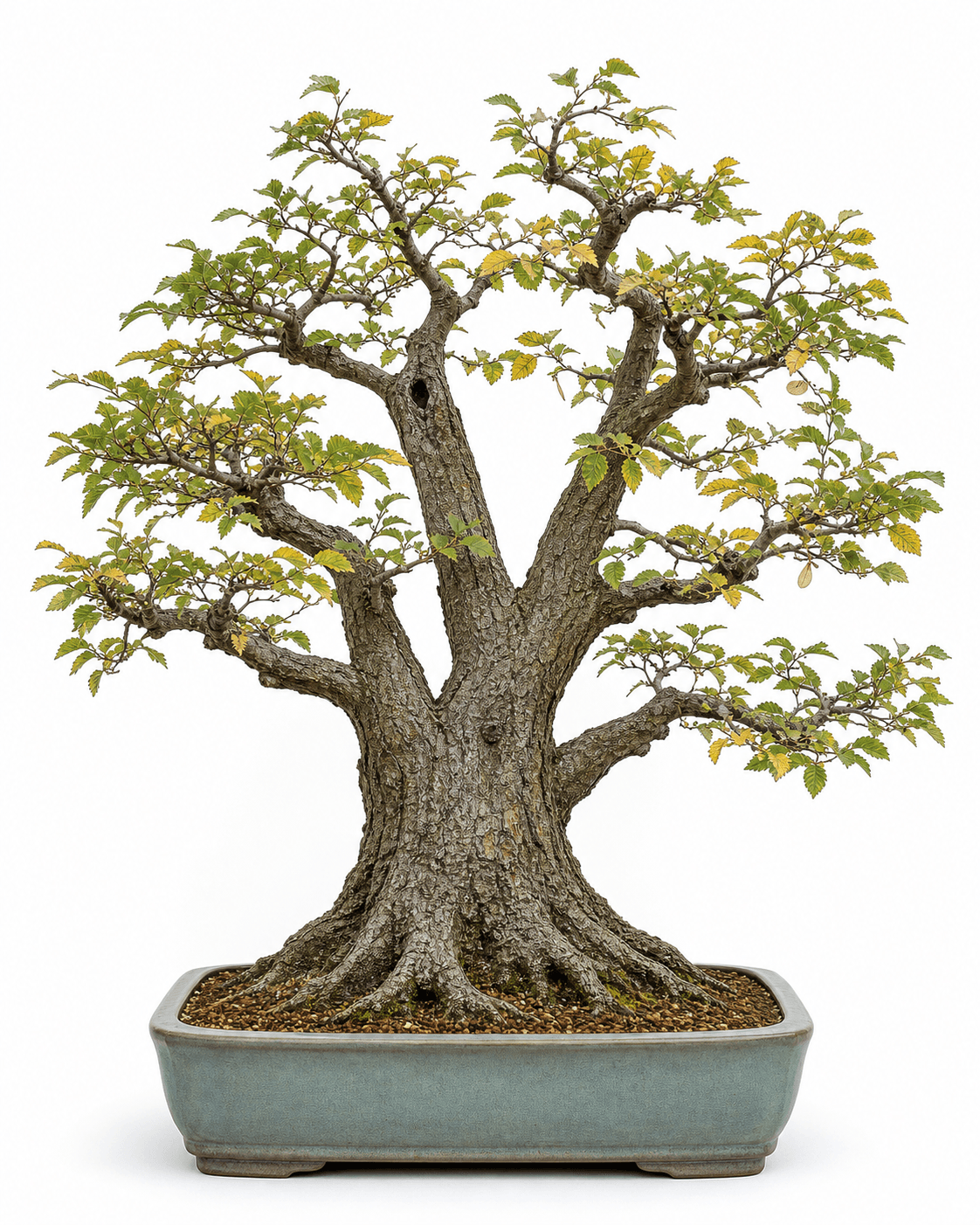
For design, read the tree from open-grown American elm: a broad base, widening trunk division, arching limbs, and a high vase canopy. Mirai deciduous design favors species-specific branch movement, so American elm should read as an elm crown with upward and outward structure, not as stacked conifer foliage. USDA Forest Service SilvicsBonsai Mirai LibraryBonsai Mirai / Asymmetry
Reading the tree
Read whether the tree is building structure or refining density.
Mirai separates development from refinement by the job the tree still needs to do. Development uses extension to build trunk, vascular tissue, wound closure, and primary branches. Refinement uses hardened flushes, viable buds, selective leaf reduction on larger leaves, and energy balancing to build twig density. Bonsai Mirai Library
American elm needs a shorter leash than easy back-budding retail elms. Mirai groups elm with dieback-prone deciduous trees that should be cut with stubs, sealed quickly, and managed so interior tissue keeps light and sap flow. Leaving four or more shoots at one elm junction creates swelling that later work cannot cleanly undo. Bonsai Mirai Library
Read health from the whole system: spring bud count, interior bud survival, leaf size, internode length, how quickly the pot dries, root smell, and whether dieback follows pruning or root stress. A disease-resistant cultivar still needs ordinary elm health before it can respond to bonsai work. Bonsai Mirai LibraryOklahoma State Extension Dutch elm diseaseUMN Extension resistant elms
Pruning
Prune American elm before vigor becomes swelling.
In structural development, let selected shoots extend to build the trunk and primary branch framework, then thin every busy junction before summer vascular growth locks the swelling in. Mirai advises reducing deciduous junctions to a main line plus one useful secondary, or to one leader where dominance is already clear. Bonsai Mirai Library
In refinement, wait for the spring flush to harden. Cut strong elongated shoots back to viable buds that can divide, and leave weak interior shoots longer so they can repay the branch with sugars. Because American elm leaves are large, selective partial leaf reduction in strong areas can help rebalance light and energy after the first flush hardens. Bonsai Mirai LibraryNC State Extension
Large cuts need elm dieback logic. Mirai recommends leaving a stub on dieback-prone deciduous material, sealing fresh cambium immediately, and returning later when natural recession shows the final cut line. On elm, some large summer removals are safer when the finishing cut waits until leaf drop. Bonsai Mirai Library
Spring seed can drain a refined tree and create seedlings where they are unwanted. Remove flower clusters or samaras when refinement, disease sanitation, or bench hygiene matters more than propagation. USDA Forest Service SilvicsNC State Extension
Roots
Treat American elm as a root-sheen deciduous tree.
Mirai places elm in the shin or root-sheen group with hornbeam and other broadleaf deciduous trees whose fine roots under the root flare govern health. Damage to that zone on a weak elm can show up as branch shedding, random dieback, and slow recovery after work. Bonsai Mirai Library
Repot as buds swell and warmth returns. Mirai says elms respond later than many deciduous trees because they need heat to break dormancy. Hydrate before work, mist roots if they dry, clean the surface, open the sides and bottom, and preserve the interior root column unless health forces deeper intervention. Bonsai Mirai Library
Correct heavy roots while the tree is vigorous. USDA Silvics says American elm root depth changes with soil: shallow widespread roots in heavy wet soils, deeper roots in drier medium-textured soils, and taproots in deep dry sands. Treat those roots like branches by cutting heavy sections back to finer secondary roots over staged repots. USDA Forest Service SilvicsBonsai Mirai Library
Anchor the tree firmly after root work. Mirai repeats a simple recovery rule: a tree that moves cannot grow new roots. Give bright protected light, steady moisture, wind reduction, and delayed fertilizer until new growth confirms root restart. Bonsai Mirai Library
Soil and pot
Use soil that keeps moisture moving through the root sheen.
A development mix should hold enough water for a large-leaf deciduous tree and enough oxygen for fine roots. Mirai soil guidance assigns akadama nutrient and fine-root value, pumice water buffering, and lava oxygen structure. USDA Silvics adds the species-level reminder: American elm grows best on rich, well-drained loams. Bonsai Mirai LibraryUSDA Forest Service Silvics
For refined deciduous trees, Mirai often uses solid akadama because deciduous repot cycles can refresh soil before breakdown becomes dangerous. Use that only when watering, winter protection, particle quality, and repot timing are reliable; recovering American elm can stay in a more structurally open aggregate mix. Bonsai Mirai Library
Pot depth should follow root stage. Mirai root-sheen guidance favors deeper containers for sheen-based deciduous trees because gravity helps pull water through the root zone and preserves oxygen. Move to a shallower display pot only after the root plate is flat, fine, and predictable. Bonsai Mirai Library
Pot pairing can be quiet and deciduous: deeper training containers first, then muted glazed or unglazed rectangles and ovals for mature broom, clump, and broad upright trees. Let the broad native crown, rough bark, and winter silhouette carry the design. Bonsai Mirai / AsymmetryBonsai Mirai Library
Climate
Adapt the pot, not the species identity.
Cold regions should preserve dormancy while protecting roots. Iowa State lists Zones 2 through 9, NDSU lists Zone 2, and NC State lists USDA Zones 3a through 9b. In a pot, mulch around the container, group trees low, block drying wind, or use an unheated cold frame when freeze-thaw and wind threaten fine roots. Iowa State ExtensionNDSU ExtensionNC State ExtensionBonsai Mirai Library
Hot regions should manage root temperature and water demand. NC State lists drought, heat, urban-condition, and compaction resistance, but Mirai watering guidance still makes foliar mass, soil reservoir, wind, humidity, and temperature the daily equation. Temporary afternoon shade can keep roots functional without turning the tree into shade culture. NC State ExtensionBonsai Mirai Library
Mild-winter regions should use tree signals over northern dates. Wait for bud swelling before root work, let hardened flushes guide pruning, and avoid late fertilizer that pushes soft autumn growth. If a warm autumn keeps the tree partially active, delay heavy work until a clean dormancy or spring recovery window appears. Bonsai Mirai LibraryUSDA Forest Service Silvics
Disease climate matters too. Dutch elm disease pressure, beetle timing, root-graft risk, and sanitation expectations vary by region. Nearby infected elms and dead elm wood should move this tree from ordinary maintenance into extension-guided disease management. Oklahoma State Extension Dutch elm diseaseIllinois Extension Dutch elm disease
Pests and diseases
Dutch elm disease is the defining risk.
Oklahoma State describes Dutch elm disease as an Ophiostoma wilt that invades xylem and blocks water movement, with early symptoms often appearing as wilting or flagging in upper branches. Illinois Extension describes yellowing, wilting, browning, and brown sapwood discoloration. Those symptoms deserve fast diagnosis, isolation, and local extension guidance. Oklahoma State Extension Dutch elm diseaseIllinois Extension Dutch elm disease
Beetle biology changes bench hygiene. Oklahoma State says elm bark beetles feed in twig crotches of healthy elms, breed in dying or dead elm trees and logs with intact bark, and move spores from infected wood. Keep dead elm wood, suspect branches, and nearby infected material away from the bench. Oklahoma State Extension Dutch elm disease
Resistance improves odds without removing risk. Oklahoma State says no elm species is immune and that American elm is among the most severely affected; University of Minnesota lists American elm selections such as Princeton, Prairie Expedition, New Harmony, St. Croix, and Valley Forge as resistant options that still require maintenance. Oklahoma State Extension Dutch elm diseaseUMN Extension resistant elms
NC State flags frequent disease and insect problems, including Dutch elm disease, phloem necrosis, wetwood, cankers, leaf spots, aphids, scale, borers, elm leaf beetle, caterpillars, leaf miners, mealybugs, spider mites, and leafhoppers. Strong light, root oxygen, sanitation, and airflow lower stress before a pest reaches treatment thresholds. NC State ExtensionBonsai Mirai Library
Powdery mildew and leaf problems often reflect culture. Mirai elm guidance treats powdery mildew as a poor-airflow and humidity signal that reduces photosynthesis. Open crowded growth, reduce wet foliage time, and restore root health before escalating controls. Bonsai Mirai LibraryNC State Extension
Wiring
Wire structure selectively and remove it early.
Mirai deciduous wiring is selective. Wire primary and secondary structure when it changes the design, then rely on pruning, clip-and-grow, guy wires, and branch weights for finer ramification. Wiring every small branch erases the informal deciduous character and adds avoidable scars. Bonsai Mirai LibraryBonsai Mirai / Asymmetry
American elm shoots can thicken quickly after leaf hardening. Mirai warns that elm wire can bite within three to four months in active growth, sometimes sooner on vigorous branches. Check wire often and remove before bark damage becomes part of the design. Bonsai Mirai LibraryNC State Extension
Bend with rotation across the branch. Mirai recommends rolling deciduous branches along the wire direction so fibers shear across a longer span. On elm, gray bark splitting and showing green phloem is the stop signal. Bonsai Mirai Library
Copper can be useful on rough-bark mature elm when fewer turns and stronger holding power matter. Aluminum, guying, and clip-and-grow are safer on young, thin, or brittle sections. Avoid running wire across mature trunk bark where a contact scar would draw the eye forever. Bonsai Mirai Library
Propagation
Seed is common, but bonsai roots still need curation.
Seed is the species default. USDA Silvics says American elm seedlings usually germinate soon after spring seed fall, although some seed can remain dormant until the following spring. For bonsai, move seedlings early enough to correct taproots, radial roots, and trunk bases while they are still flexible. USDA Forest Service SilvicsBonsai Mirai Library
Cuttings and layers borrow from elm method. Mirai notes that elm cuttings root readily under mist, bottom heat, and well-aerated media, with larger cuttings possible only under tightly managed warmth and humidity. Air layers can salvage an upper trunk or create better roots, but only after enough radial roots have formed. Bonsai Mirai Library
Stump sprouts and collected volunteers can be useful where collection is legal and disease context is clean. USDA Silvics notes that small American elm trees can produce vigorous stump sprouts. Keep only material with low buds, clean vascular tissue, a usable base, and no suspicious wilt or flagging. USDA Forest Service SilvicsIllinois Extension Dutch elm disease
Grafting is mainly a repair or cultivar tool: thread grafts and approach grafts can add branches or roots while the tree is vigorous. Disease-resistant cultivar grafts should be inspected for union quality, swelling, and whether the graft location helps or harms the bonsai design. Bonsai Mirai LibraryUMN Extension resistant elms
Sourcing
Buy roots, movement, and health before the American elm label.
Good material can come from disease-resistant nursery cultivars, seedlings, locally removed volunteers, or field-grown pre-bonsai. University of Minnesota says resistant elms are widely available, and USDA Silvics documents the species as a fast-growing native tree with spring germination and strong stump sprouting. UMN Extension resistant elmsUSDA Forest Service Silvics
Inspect from the soil line upward. Look for a broad base, correctable root spread, low buds, trunk movement, branch placement, short enough internodes, and no graft scar that interrupts the future front. NC State lists rapid growth, 3 to 6 inch leaves, braided ridged bark on old trees, and a vase habit, so the design needs room. NC State ExtensionBonsai Mirai / Asymmetry
Disease-resistant cultivars deserve attention and verification. UMN lists Princeton, Prairie Expedition, New Harmony, St. Croix, and Valley Forge among American elm selections; Oklahoma State names Valley Forge, Princeton, and New Harmony as high-resistance options. A weak root system, bad graft, or active wilt symptom still rejects the tree. UMN Extension resistant elmsOklahoma State Extension Dutch elm disease
Reject material with flagging, vascular staining, dead attached elm wood, severe root girdling, buried trunk defects, irreversible inverse taper, no low buds, or vague elm labels. Confirm whether the plant is Ulmus americana, Ulmus parvifolia, Ulmus pumila, Ulmus crassifolia, Ulmus alata, Ulmus rubra, or a hybrid before applying this page. Kew POWONC State ExtensionOklahoma State Extension Dutch elm disease
Troubleshooting
Start with disease signals, roots, and timing.
One-sided wilting, flagging, yellowing, browning, or brown sapwood streaking points toward Dutch elm disease diagnosis rather than ordinary bonsai stress. Isolate the tree, sanitize tools, remove dead elm wood nearby, and use local extension or arborist guidance quickly. Oklahoma State Extension Dutch elm diseaseIllinois Extension Dutch elm disease
Random twig or branch dieback can come from damaged root sheen, stale soil, unchecked extension starving the interior, a large cut chased too far, or vascular disease. Inspect drainage, root smell, branch distribution, wound history, and nearby elm disease pressure before adding fertilizer. Bonsai Mirai LibraryOklahoma State Extension Dutch elm disease
Large leaves and long internodes mean the tree is still in development, shaded, overfed for refinement, or missing repeated cutback. Give more light, prune after hardening, leave weak interiors longer, and move toward a medium or large design instead of forcing tiny scale. Bonsai Mirai LibraryNC State Extension
Wire scars mean checks were too slow or wire was used where pruning should have carried the design. Remove wire, let the branch grow if the scar needs swelling over, and use guy wires or clip-and-grow on the next round. Bonsai Mirai Library
Leaf chewing, skeletonizing, sticky shoots, or speckled foliage can point to elm leaf beetles, caterpillars, scale, aphids, leafhoppers, mites, or leaf miners. Improve vigor and airflow, remove manageable pests by hand, and follow regional extension guidance for controls. NC State Extension
Design
Design American elm as a broad old native tree.
Start with base, trunk line, defining branch, and apex. Mirai design methodology uses those anchors to decide what the tree already offers. American elm often offers a native vase image: a widening trunk, arching limbs, a broad crown, and a winter silhouette that shows branch hierarchy. Bonsai Mirai / AsymmetryBonsai Mirai LibraryUSDA Forest Service Silvics
Deciduous branch structure should move up and out, then subdivide into rounded terminal masses. Mirai describes mature broadleaf images as layered, asymmetrical, and broken into multiple foliage zones. Lower branches can stay smaller and more youthful while upper branches carry the broad elm canopy. Bonsai Mirai Library
Strong styles include broom, informal upright, clump, twin-trunk, multi-trunk, broad raft, and naturalistic collected-native forms. Use sacrifice growth for trunk and taper, then remove it before junctions swell beyond repair or shade kills the lower structure. Bonsai Mirai LibraryUSDA Forest Service Silvics
Deadwood should be restrained. Mirai broadleaf guidance treats deciduous deadwood as more temporary than conifer jin and shari. American elm should show age through bark, hollows, scars, branch hierarchy, and winter twig structure rather than preserved bleached deadwood as the main feature. Bonsai Mirai Library
Cultivars
Resistant cultivars are useful starting points with limits.
University of Minnesota lists American elm selections including Princeton, Prairie Expedition, New Harmony, St. Croix, and Valley Forge, with Zone and form comparisons for landscape use. Oklahoma State also names Valley Forge, Princeton, and New Harmony among commercially available high-resistance American elm cultivars. UMN Extension resistant elmsOklahoma State Extension Dutch elm disease
Cultivar form can help the bonsai image. UMN lists several American elm selections with vase or wide-vase form, and Oklahoma State describes Valley Forge, New Harmony, and Princeton with upright, arching, or broad vase habits. Those habits suit broom, informal upright, and broad native deciduous styling. UMN Extension resistant elmsOklahoma State Extension Dutch elm diseaseBonsai Mirai / Asymmetry
For bonsai, the individual tree decides. A named cultivar with a high graft, a bad root flare, coarse internodes, or no lower buds is poor stock. A seedling or volunteer with a clean base, movement, low buds, and healthy vascular tissue can be a better project. Bonsai Mirai LibraryUSDA Forest Service Silvics
Keep name boundaries clear. Red elm usually means Ulmus rubra, rock elm means Ulmus thomasii, Chinese elm in bonsai usually means Ulmus parvifolia, Siberian elm is Ulmus pumila, cedar elm is Ulmus crassifolia, and winged elm is Ulmus alata. American elm care should follow a confirmed Ulmus americana identity. Kew POWOUMN Extension resistant elms
History
American elm carries cultural weight and disease memory.
USDA Silvics describes American elm as once prominent in forests, shelterbelts, and urban areas before Dutch elm disease reduced its presence among large-diameter mixed-forest trees. That history is why this species still carries an emotional image for many North American growers. USDA Forest Service Silvics
The vase-shaped street-tree silhouette matters for bonsai. Iowa State lists large mature dimensions, and NC State lists arching, erect, spreading, and vase form. A convincing American elm bonsai should evoke that scale through broad branching and winter twig architecture rather than miniature conifer styling. Iowa State ExtensionNC State ExtensionBonsai Mirai / Asymmetry
There is no single famous American elm bonsai standard that beginners copy worldwide. The opportunity is local and long-term: build clean roots, protect health, select disease-aware material, and let native elm character guide the design over years of deciduous cutback. Bonsai Mirai LibraryBonsai Mirai / AsymmetryUMN Extension resistant elms
Identity
American elm belongs on its own elm care page.
Kew accepts Ulmus americana L. in Ulmaceae and lists the species as accepted. USDA Silvics lists American elm, white elm, water elm, soft elm, and Florida elm; NC State adds common elm and gray elm labels. Kew POWOUSDA Forest Service SilvicsNC State Extension
Identification starts with leaves, bark, flowers, and fruit timing. NC State describes rough, ovate-elliptic leaves with toothed margins, asymmetrical bases, and 3 to 6 inch length; Iowa State lists alternate, simple, double-toothed leaves with unequal bases; USDA Silvics says spring fruit ripens as leaves unfold or soon after. NC State ExtensionIowa State ExtensionUSDA Forest Service Silvics
Separate every vague elm tag. American elm has larger leaves, a broad vase habit, spring seed, and high Dutch elm disease consequence. Chinese elm, Siberian elm, cedar elm, winged elm, slippery elm, rock elm, and hybrid elms all need their own identity check before their care calendars are borrowed. NC State ExtensionOklahoma State Extension Dutch elm diseaseUMN Extension resistant elms
Species questions
Answer the beginner questions before styling.
Is American elm a good beginner bonsai?
American elm suits an outdoor grower who wants native deciduous material and can prune, water, protect roots, and monitor disease carefully. It asks more judgment than many retail elms because leaves are large, growth is vigorous, and Dutch elm disease matters.
Can American elm bonsai live indoors?
Keep American elm outdoors for long-term culture. It is a temperate deciduous tree that needs outdoor light, winter dormancy, airflow, and seasonal timing.
What other names refer to American elm?
EntGrove uses Ulmus americana L. Kew accepts that name in Ulmaceae; common labels include white elm, water elm, soft elm, Florida elm, common elm, and gray elm.
How much sun does American elm bonsai need?
Use full outdoor sun when water and roots are reliable. Temporary afternoon protection can help during severe heat, but permanent low light creates long internodes and weak interior growth.
How often should I water American elm bonsai?
Water when the upper soil starts to dry, then water thoroughly. Keep the root zone evenly moist and oxygenated rather than either dry or constantly saturated.
When should I prune American elm bonsai?
In development, thin crowded junctions before four or more shoots create swelling. In refinement, prune after the spring flush hardens, cutting strong shoots back to viable buds and leaving weak areas longer.
When should I repot American elm bonsai?
Repot in spring as buds swell and warmth returns. Preserve the fine-root sheen under the base, open the outer root shell for oxygen, correct heavy roots in stages, and anchor the tree firmly.
Are disease-resistant American elm cultivars safe from Dutch elm disease?
Disease-resistant cultivars such as Valley Forge, Princeton, New Harmony, Prairie Expedition, and St. Croix can improve odds. They still require monitoring, sanitation, and regional Dutch elm disease guidance.
What soil works best for American elm bonsai?
Use an aggregate deciduous mix that balances water retention with oxygen. Development trees can use akadama, pumice, and lava or comparable regional particles; refined trees can move toward akadama-forward soil when watering, pot depth, and repot timing are reliable.
Why is my American elm branch suddenly wilting?
One-sided wilting or flagging can indicate Dutch elm disease and should be treated as a diagnostic issue. Isolate the tree, sanitize tools, check for brown sapwood streaking, remove nearby dead elm wood, and contact local extension or an arborist.
Sources
Species advice needs source discipline.
Next decisions
Plan the operation before copying the calendar.
A good care note for American elm records the tree's stage, the work done, and the aftercare used. That record matters more than a month-name rule.
Related species
Compare nearby trees before transferring advice.
Japanese maple
Acer palmatum
Trident maple
Acer buergerianum
Amur maple
Acer tataricum subsp. ginnala
Field maple
Acer campestre
Korean hornbeam
Carpinus turczaninovii