
Species guide
Atlas Cedar Bonsai Care
Cedrus atlantica
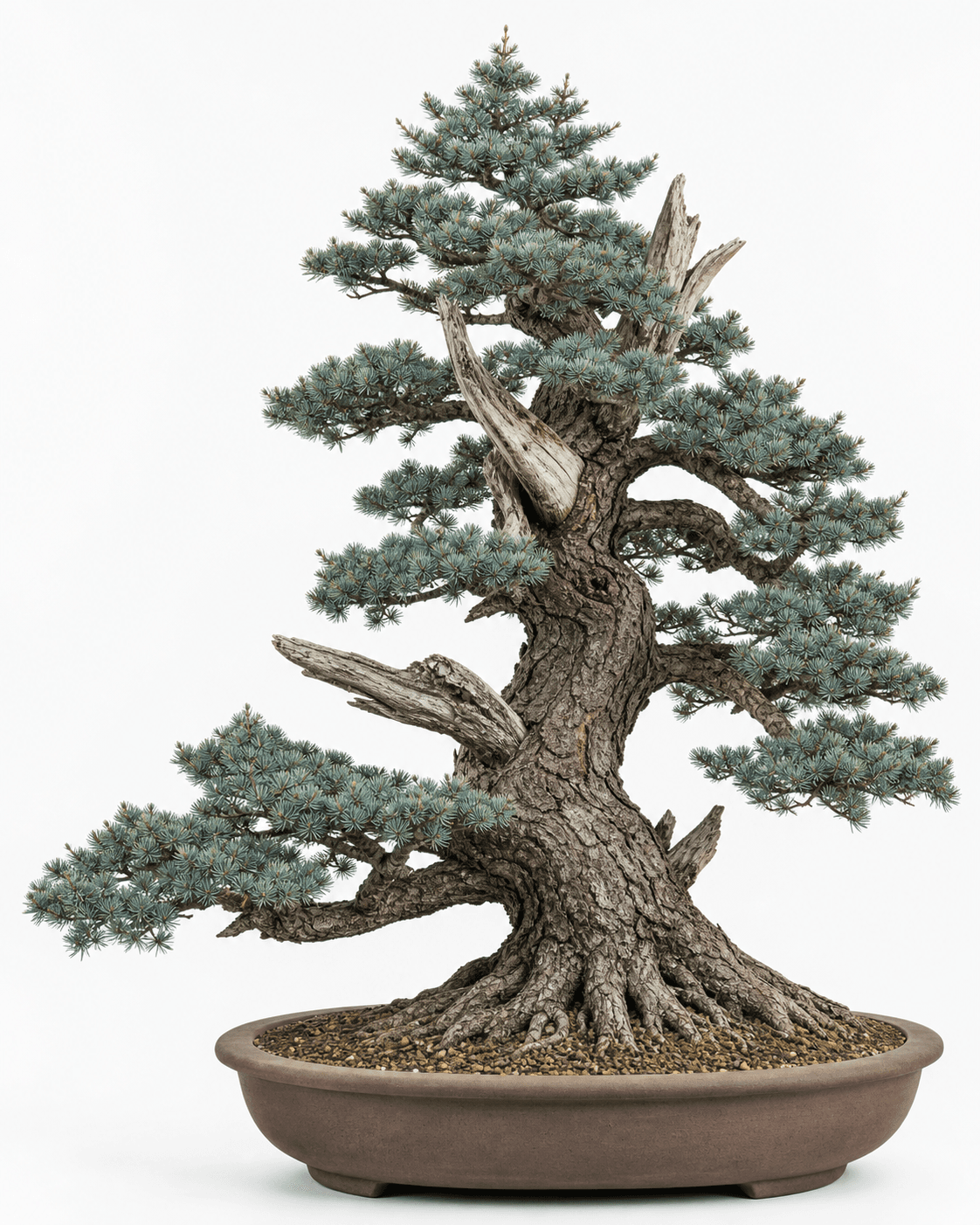
Atlas cedar bonsai is an outdoor true cedar for growers who can provide full sun, cold dormancy, wind protection, and careful timing around heat-driven root growth. Cedrus atlantica and its blue forms reward patient branch selection, clean needle handling, and designs that preserve the species upright, out-and-up branch character.
Treat Atlas cedar as a Cedrus elongating conifer: preserve foliage while correcting roots, repot late in the spring window as buds swell, pinch only soft refined shoots, prune hardened shoots back to visible buds, and keep heavy root work and heavy foliage work in separate seasons. The common failures are poor graft unions, inverse taper at whorls, crushed blue needles, over-bending brittle wood, drought in a shallow pot, and expecting old bare wood to back-bud.
This guide uses the local Bonsai Mirai Atlas cedar, Blue Atlas cedar nursery-stock, Blue Atlas cedar second-styling, Lebanese cedar, growth-management, pruning, wiring, watering, soil, energy, and design corpus first, then grounds taxonomy, hardiness, morphology, cultivars, propagation, and pest context in Kew, NC State Extension, and Oregon State.
Updated June 4, 2026. Written by EntGrove Editorial. Last verified June 4, 2026.
Care fingerprint
Read the species through its shared care pattern.
Strong light, cool-root management, conservative root work, and post-extension pruning dominate the care calendar. Use this as the starting point before local conditions and tree strength refine the calendar.
Note: Kew accepts Cedrus atlantica and places its native range from northern Morocco to northern Algeria. NC State and Oregon State sources use Atlas cedar, Blue Atlas cedar, Glauca, and Glauca Pendula labels; inspect graft quality, whorl swelling, and brittle blue needles before applying bonsai design assumptions.
Do not prune like a pine
Elongating conifers extend from buds and shoots, so candle-cutting assumptions can remove the exact growth the tree needs.
Preserve interior growth
Spruce, fir, hemlock, cedar, redwood, cypress, and larch all become harder to design when interior buds are shaded out.
Keep recovery cool and steady
Many elongating conifers respond best when roots stay evenly moist, oxygenated, and protected from hot dry swings.
Care cadence
The calendar starts with the tree's seasonal state.
Placement
Timing: Grow outdoors year-round. Give full sun where roots stay cool, then add afternoon shade, wind moderation, and pot cooling during dry heat or after major work.
Watch for: Hot black pots, reflected heat, strong sweeping wind, shaded interiors, sudden sun after styling, and winter protection that wakes buds early.
NC State ExtensionOregon State Landscape PlantsBonsai Mirai LibraryWatering
Timing: Water deeply through active elongation and hot weather. In warm dry conditions, a shallow established pot may need water more than once daily, but the next watering should still follow root-zone oxygen.
Watch for: Needle dulling, limp new tips, runoff around a dry core, sour wet soil, constant saturation after repotting, and assuming landscape drought tolerance applies to a pot.
Bonsai Mirai LibraryFertilizer
Timing: Feed development trees through active growth and fall to build vascular reserves. Refined trees can receive lighter spring feeding until pinching and needle-size goals are clear.
Watch for: Coarse spring runners, weak interior buds from underfeeding, salt in shallow pots, fertilizer on a tree with poor uptake, and late soft growth before cold.
Bonsai Mirai LibrarySpring pinching
Timing: Pinch only refined soft shoots that extend beyond the intended silhouette. Stop when the stem hardens and visible needle separation shows the shoot has moved into the post-harden pruning stage.
Watch for: Pinching development branches, removing the whole shoot, breaking blue needles, pinching after root work, and creating dense round balls when a thinner naturalistic pad is intended.
Bonsai Mirai LibraryPost-harden pruning
Timing: After elongating shoots harden, prune back to a visible bud in a needle axil, spur, or useful bifurcation. Every retained cut point needs live growth behind it.
Watch for: Cutting mid-internode, cutting through needles, reducing old bare wood, keeping bar branches, and leaving all ramification only at branch tips.
Bonsai Mirai LibraryStructural work
Timing: Heavy branch selection and primary wiring are strongest in spring before bud push or after the first flush hardens. Early fall is useful for structural work when heat has passed.
Watch for: Combining major styling with repotting, over-bending brittle branches, hidden wire bite in fall, and removing foliage needed for root recovery.
Bonsai Mirai LibraryRepotting
Timing: Repot late in the spring window as buds swell or begin to open and warmth can support new root growth. Hydrate first, preserve useful root mass, and secure the tree firmly.
Watch for: Early cold repots, bare-rooting, weak tie-downs, root reduction after heavy styling, deep grafted nursery cores, and prolonged shade that starves recovery.
Bonsai Mirai LibraryNeedle cleaning
Timing: Clean only the lower pad line, dead needles, and older needles blocking bud lines. Retain a full skirt of live needles around useful buds and spurs.
Watch for: Wholesale stripping, pulling resistant live needles, crushed blue needles under wire, empty interiors, and over-cleaning weak branches.
Bonsai Mirai LibraryPest and disease inspection
Timing: Inspect during spring growth, dry summer heat, and fall. NC State flags tip blight, Phytophthora, root rot, sooty mold, and conifer pests as practical problems.
Watch for: Tip browning, blackened tips, honeydew, sooty film, scale, mite stippling, root sourness, heavy-snow breakage, and decline after repeated drought.
NC State ExtensionNC State Extension conifer pestsBonsai Mirai LibraryWinter protection
Timing: Keep dormant and cold. Protect container roots from severe freeze-thaw and drying wind, especially in Zone 6 edges or after late-season styling.
Watch for: Warm indoor storage, dry frozen soil, newly wired branches under snow load, winter wind, and unremoved wire hidden by needle clusters.
Oregon State Landscape PlantsBonsai Mirai LibrarySpecies guide
Apply the species profile before copying another tree's calendar.
At a glance
Atlas cedar is a true cedar with alpine-Mediterranean timing and blue-needle handling demands.
Cedrus atlantica is accepted by Kew as a Pinaceae species native to northern Morocco and northern Algeria. Bonsai and nursery trade often preserve Atlas cedar, blue Atlas cedar, Glauca, and older Cedrus libani subsp. atlantica labels. Kew POWONC State ExtensionOregon State Landscape Plants
As bonsai, it is an elongating conifer with two useful shoot types: long runners and compact spur clusters. Long runners build strength and future options; spurs carry compact foliage and latent buds that can become new elongating shoots after pruning. Bonsai Mirai Library
The practical care pattern is bright outdoor placement, high active-season water with oxygen, late-spring repotting, conservative needle cleaning, and branch selection that prevents whorl swelling before it becomes inverse taper. Bonsai Mirai LibraryNC State Extension
Wild range
Read Atlas cedar from high mountains, snow pressure, drought, and open light.
Kew places Cedrus atlantica from northern and north-central Morocco to northern Algeria, and Oregon State ties the tree to the Atlas Mountains. NC State describes mountain forests in the native habitat. Kew POWOOregon State Landscape PlantsNC State Extension
Mirai reads the wild tree through snow loading, Mediterranean dry periods, strong light, and branch loss. Those pressures explain why Atlas cedar designs can carry out-and-up branches, broad old crowns, negative space, and large deadwood remnants. Bonsai Mirai Library
The care implication is direct. A bonsai pot removes the deep root run that makes a mountain cedar drought-adapted, so container trees need more reliable water than landscape descriptions suggest while still needing air at the roots. Bonsai Mirai LibraryNC State Extension
The design implication is equally direct. A young tree can be narrow and upright, while an older image can broaden at the apex, expose trunk, and show lost branches. Both images should keep Cedrus branch tips moving outward and upward rather than flattening into pine shelves. Bonsai Mirai / AsymmetryBonsai Mirai Library
Reading
Separate root correction, development, refinement, and age image before work.
Start with the base. Many blue Atlas cedars enter bonsai as grafted landscape stock, and Mirai notes that Atlas cedar is commonly grafted onto Cedrus deodara for nursery speed. A clean graft can be hidden over time; a bulbous or straight graft should lower the tree value. Bonsai Mirai Library
Read whorls early. Cedrus commonly throws opposing branches or several branches at one node, and those junctions thicken uniformly. Keep useful foliage during development, then remove the weaker or downward member before swelling becomes permanent. Bonsai Mirai Library
Read branch phase separately. A lower branch may need extension to thicken, a middle branch may need prune-back to interior buds, and a refined upper branch may need soft-tip pinching. One timing rule cannot be applied evenly across every branch. Bonsai Mirai Library
Read age honestly. Smooth bark on young Atlas cedar is normal, and Mirai notes that textured bark requires long timelines. A young tree can be elegant and tall before it earns the deadwood and broad crown of an ancient image. Bonsai Mirai LibraryOregon State Landscape Plants
Spring growth
Pinch only refined soft tips, then prune hardened shoots to visible buds.
Pinching Atlas cedar is a refinement tool for strong shoots that extend beyond the silhouette. Removing the soft tip shifts stored energy into weaker and interior buds, which helps balance a refined canopy. Bonsai Mirai Library
Development branches should usually extend first. Cedrus uses extension to build vascular tissue and reserves, and cutting every new shoot too early can leave the tree dense at the edge and weak inside. Bonsai Mirai Library
After shoots harden, prune to a visible bud in a needle axil, to an active spur, or to an existing bifurcation. A cut made below live buds or spurs can die back because Cedrus does not regenerate like a deciduous broadleaf. Bonsai Mirai Library
Needle work should be precise. Remove bottom-facing needles that muddy the lower pad line and older needles blocking bud lines, then keep live needles around useful buds so the branch can continue feeding itself. Bonsai Mirai Library
Use Cedrus pinching and post-harden pruning instead of pine decandling. Atlas cedar produces elongating shoots and spurs, so pine candle-removal timing does not describe its physiology. Bonsai Mirai Library
Roots
Repot late in spring and leave enough foliage to rebuild roots.
Mirai places Cedrus at the tail end of the spring repotting window, as buds swell or begin to open. The species responds better when warmth can drive new root regeneration after the operation. Bonsai Mirai Library
Keep root work and major foliage work in separate seasons. If Atlas cedar receives a heavy styling, let it recover before the next major root operation; if it is repotted hard, preserve foliage so photosynthesis can rebuild the root system. Bonsai Mirai Library
Nursery stock should be converted in stages. Expose the root flare from the top, reduce circling or diving roots cleanly, keep part of the functioning root ball, and replace old nursery media over multiple cycles rather than tearing the whole core away. Bonsai Mirai LibraryNC State Extension
Aftercare should be bright, protected, and stable. Water thoroughly, secure the tree so roots cannot move, shield from hard wind and extreme sun, and resume stronger work only after buds and water uptake confirm recovery. Bonsai Mirai Library
Soil and pot
Use a water-holding conifer mix and choose containers that support the cedar image.
Mirai gives Cedrus a resource-rich conifer mix, including 2 parts akadama, 1 part lava, and 1 part humus. The logic is water and nutrient availability for an elongating species with high vascular storage. Bonsai Mirai Library
Adjust the mix to climate. In maritime or rainy regions, reduce the organic fraction and increase aggregate structure; in hot dry regions, protect the pot and preserve enough water retention to keep active roots from cycling dry. Bonsai Mirai LibraryNC State Extension
Young tall material belongs first in a training container that stabilizes the root system and lets the trunk line evolve. A finished pot should follow the age image: narrower and quieter for tall literati, wider and shallower for an ancient spreading cedar. Bonsai Mirai / AsymmetryBonsai Mirai Library
For broad old cedar designs, Mirai favors wide shallow containers with softened corners or gentler geometry. A sharp heavy rectangle can fight the tree if the design is meant to feel weathered and old. Bonsai Mirai Library
Climate
Atlas cedar wants outdoor sun, mild-to-cold winters, and protected roots in extremes.
NC State lists full sun to partial shade, good drainage, heat tolerance, and USDA Zones 6a-9b. Oregon State lists Zone 6 hardiness and recommends protection from sweeping winds. NC State ExtensionOregon State Landscape Plants
In cool coastal or maritime climates, Atlas cedar can take strong sun and frequent active-season watering. Watch for constantly wet roots, salt buildup, and wind that dehydrates needle clusters faster than the roots can replace water. Bonsai Mirai LibraryOregon State Landscape Plants
In hot inland climates, the pot becomes the vulnerable organ. Use morning sun, afternoon shade, larger training containers during development, light-colored pot protection, and careful water checks during active elongation. Bonsai Mirai LibraryNC State Extension
In Zone 6 or colder bonsai culture, protect the root mass from deep freeze and drying wind. The tree needs dormancy, so winter storage should stay cold rather than warm and indoor. Oregon State Landscape PlantsBonsai Mirai Library
Pests
Scout for tip blight, root rot, scale, mites, and snow or wind damage.
NC State lists tip blight, Phytophthora, root rot, sooty mold, heavy-snow breakage, and conifer pest issues for Cedrus atlantica. Bonsai growers should translate those into frequent checks on tips, roots, sap-feeding insects, and branch structure. NC State Extension
Tip blight or tip dieback often appears first as browning at new growth or branch ends. Before treating, check recent water stress, root oxygen, heat exposure, wire damage, and whether the affected tips were cut below viable buds. NC State ExtensionBonsai Mirai Library
Root rot and Phytophthora risk rise when organic nursery cores stay wet, containers sit cold and saturated, or the tree is watered heavily after roots have stopped active uptake. NC State ExtensionBonsai Mirai Library
Scale, mites, aphids, honeydew, and sooty mold should be handled through diagnosis first. Identify the pest, improve light and airflow, reduce stress, and use locally labeled treatment only when active pressure is confirmed. NC State Extension conifer pestsNC State Extension
Wiring
Wire with enough support, gentle bends, and respect for brittle needles.
Atlas cedar can be wired, and the Mirai Blue Atlas cedar files use structural wiring as a core technique. Branch selection should come first so wire does not have to pass through unusable congestion. Bonsai Mirai Library
Young Cedrus wood can feel flexible and then snap cleanly. Use bends that match the branch, support both sides of every movement, and avoid acute forced angles that exceed the wood capacity. Bonsai Mirai Library
Needles are brittle and discolor when broken. Clean the underside and wiring path first, keep wire from crushing live needle clusters, and rotate branches so needle surfaces remain visually useful. Bonsai Mirai Library
Wire bite accelerates in fall as Cedrus lays down vascular tissue. Inspect existing wire late in the season and remove or reset it before scars become part of the trunk and branch story. Bonsai Mirai Library
Propagation
Seed and grafting dominate, while air layers are specialized rescue tools.
NC State lists seed and grafting as recommended propagation strategies. Seed can give cleaner roots and natural flare, while grafted blue forms preserve ornamental foliage color and weeping or selected habits. NC State ExtensionOregon State Landscape Plants
Blue Atlas cedar and Glauca Pendula nursery stock should be checked for graft quality before bonsai planning. A low angled graft can sometimes disappear visually over time; a high swollen graft may define the whole design problem. Bonsai Mirai LibraryNC State Extension
Mirai notes that Cedrus can be air-layered while bark is still smooth and fleshy, before mature thick bark develops. Use layering as a correction tool for young vigorous material, not as a routine beginner propagation plan. Bonsai Mirai Library
Cuttings are less central than seed or grafting in the public extension sources used here. For most growers, selecting better nursery stock will be faster and more reliable than propagating a new Atlas cedar for bonsai. NC State ExtensionBonsai Mirai Library
Buying
Buy for graft quality, base, branch spacing, and interior buds.
Good Atlas cedar starter material has a visible or discoverable base, a graft that can be hidden or incorporated, branch spacing without severe whorl swelling, and interior buds or spurs close enough to build ramification. Bonsai Mirai Library
Reject material where every usable branch emerges from one swollen junction, the graft sits high and bulbous, the trunk is too slender for a chopped image, or all live foliage is far from the trunk. Bonsai Mirai Library
Blue Atlas cedar nursery material often tempts buyers with color first. Foliage color matters less than the root base, trunk line, branch shoulder, and ability to convert the nursery root system into a bonsai container. Bonsai Mirai LibraryOregon State Landscape Plants
Collected or field-grown Cedrus should be approached conservatively. Preserve foliage after root disturbance, wait for active vascular signs such as callus and strong buds, and delay refinement until the root system is clearly established. Bonsai Mirai Library
Troubleshooting
Most Atlas cedar failures trace to timing, roots, broken needles, weak buds, or grafted material.
Symptom: branch tips brown after pruning. Likely cause: cuts were made below visible buds, through needles, or into weak old wood. Fix: prune only to live buds, spurs, or bifurcations, and rebuild vigor before deeper reductions. Bonsai Mirai Library
Symptom: blue needles turn pink, red, or brown after styling. Likely cause: broken needles, crushed foliage under wire, heat after work, or repeated handling. Fix: reduce handling, clean wiring paths first, and protect from hard sun during recovery. Bonsai Mirai Library
Symptom: yellowing or dull needles after repotting. Likely cause: root work happened too early, the tree moved in the pot, old nursery soil stayed wet, or too much foliage was removed. Fix: stabilize aftercare and delay further styling. Bonsai Mirai Library
Symptom: swelling at branch whorls. Likely cause: opposing or clustered branches kept too long. Fix: reduce same-node branches over staged work, favor one clean shoulder, and avoid pruning that leaves a bulge with no design purpose. Bonsai Mirai Library
Symptom: no back-budding on old wood. Likely cause: cuts were made into mature bare wood that lacks usable buds. Fix: design with existing interior shoots, preserve spurs, and use long-term energy building before reducing farther. Bonsai Mirai Library
Symptom: sticky foliage, black film, or fine stippling. Likely cause: sap-feeding insects, sooty mold, mites, or drought stress. Fix: identify the pest, improve airflow and water consistency, and treat according to local labels only after confirmation. NC State ExtensionNC State Extension conifer pests
Design
Keep Cedrus character: upright strength, out-and-up branch tips, and credible old wood.
Start with base, trunk line, defining branch, and apex. On tall young stock, preserving height can be more honest than chopping to force an old compact image before the trunk has enough girth. Bonsai Mirai / AsymmetryBonsai Mirai Library
Cedrus branch tips naturally move outward and upward. Refinement should keep that lift, with globular cloud-like foliar masses or thinner naturalistic pads depending on whether the design is bonsai-conventional or ecology-led. Bonsai Mirai Library
Ancient Atlas cedar designs can broaden at the top, show negative space, and retain large structural deadwood. Mirai cautions that fine twiggy deadwood will not persist convincingly on Cedrus, so large remnants are more credible. Bonsai Mirai Library
Use bar-branch removal as design evolution, not as reflex cleanup. Sometimes a branch should remain temporarily to feed the trunk and roots, then be removed once the tree has enough strength and another branch can carry the image. Bonsai Mirai Library
Cultivars
Glauca, Glauca Pendula, Fastigiata, Argentea, and Aurea change the design brief.
Oregon State notes that blue forms such as Glauca are often selected from seedling populations, and NC State lists Argentea, Aurea, Fastigiata, Glauca, and Glauca Pendula among common cultivars or varieties. Oregon State Landscape PlantsNC State Extension
Glauca and other blue forms are popular because the foliage color gives instant visual identity. In bonsai, the color also reveals damage quickly because broken needles discolor and stand out against the blue canopy. Bonsai Mirai LibraryOregon State Landscape Plants
Glauca Pendula and other weeping forms can make dramatic literati or cascade-adjacent material, but they need a convincing trunk line and branch structure. A weeping cultivar without a good base remains landscape material. NC State ExtensionBonsai Mirai / Asymmetry
Fastigiata and narrow forms suit upright images, while gold or silver foliage forms can distract from age if color becomes the main feature. Evaluate each plant by root quality, graft, internodes, and bud placement. NC State ExtensionBonsai Mirai Library
History
Atlas cedar bridges North African mountain forests, landscape specimens, and modern nursery-stock bonsai.
Kew and extension sources anchor Atlas cedar in North African mountain geography. NC State also notes human pressure from wood harvest and firewood use in its native forests, with reforestation campaigns in some regions. Kew POWONC State Extension
In landscapes, Atlas cedar became a specimen tree valued for blue foliage, broad horizontal branches, and picturesque age. Oregon State notes that Glauca and Glauca Pendula remain common ornamental selections. Oregon State Landscape PlantsNC State Extension
In contemporary bonsai, Mirai treats Blue Atlas cedar as a strong nursery-stock teaching species because the material forces decisions about grafts, slender trunks, bar branches, brittle needles, and cumulative multi-cycle design. Bonsai Mirai Library
A credible exhibition Atlas cedar should show clean lower pad lines, preserved interior buds, controlled whorls, careful wire scars, species-appropriate branch lift, and an age image that fits the bark, trunk, and deadwood actually present. Bonsai Mirai / AsymmetryBonsai Mirai Library
Species questions
Answer the beginner questions before styling.
Can Atlas cedar be grown as bonsai?
Yes. Atlas cedar can be grown as bonsai outdoors when it receives full sun, cold dormancy, oxygenated soil, careful watering, and Cedrus-specific pruning around soft growth and post-harden shoots.
Can Atlas cedar bonsai live indoors?
Atlas cedar is an outdoor conifer. It needs outdoor light, moving air, winter dormancy, and seasonal temperature change for long-term health.
When should I repot Atlas cedar bonsai?
Repot late in the spring window as buds swell or begin to open. Hydrate first, preserve useful roots, secure the tree firmly, and avoid heavy foliage reduction in the same season.
Should I pinch Atlas cedar?
Pinch only healthy refined shoots while the new tips are soft and extending beyond the silhouette. Development branches should usually extend first and be pruned after hardening.
Can Atlas cedar be decandled?
Use Cedrus pinching and post-harden pruning instead of decandling. Decandling belongs to multiflush pines, while Atlas cedar grows through elongating shoots and spur clusters.
Why is my Blue Atlas cedar turning brown after wiring?
Common causes include broken needles, crushed foliage under wire, over-bending brittle wood, wire bite, heat after styling, or root weakness. Protect the tree and avoid more work until new growth confirms recovery.
What soil mix works for Atlas cedar bonsai?
A Mirai-derived Cedrus baseline is 2 parts akadama, 1 part lava, and 1 part humus-rich organic component. Adjust for local rainfall, heat, pot depth, and whether old nursery soil remains.
Is blue Atlas cedar the same as Atlas cedar?
Blue Atlas cedar usually refers to blue-foliaged selections of Cedrus atlantica, especially Glauca forms. The care is Cedrus atlantica care, with extra attention to needle damage and graft quality.
Does Atlas cedar back-bud on old wood?
Atlas cedar can activate buds on younger fleshy stem tissue and spur clusters, but old bare wood is unreliable. Keep live interior buds and design with existing shoots rather than expecting deciduous-style regeneration.
What styles suit Atlas cedar bonsai?
Tall literati, informal upright, formal upright, slanting, broad ancient cedar, and weeping blue Atlas forms all suit the species when the design preserves Cedrus branch lift and credible old-wood features.
Sources
Species advice needs source discipline.
Next decisions
Plan the operation before copying the calendar.
A good care note for Atlas cedar records the tree's stage, the work done, and the aftercare used. That record matters more than a month-name rule.
Related species
Compare nearby trees before transferring advice.
Subalpine fir
Abies lasiocarpa
Balsam fir
Abies balsamea
White fir
Abies concolor
Noble fir
Abies procera
Mountain hemlock
Tsuga mertensiana