
Species guide
Lebanon Cedar Bonsai Care
Cedrus libani
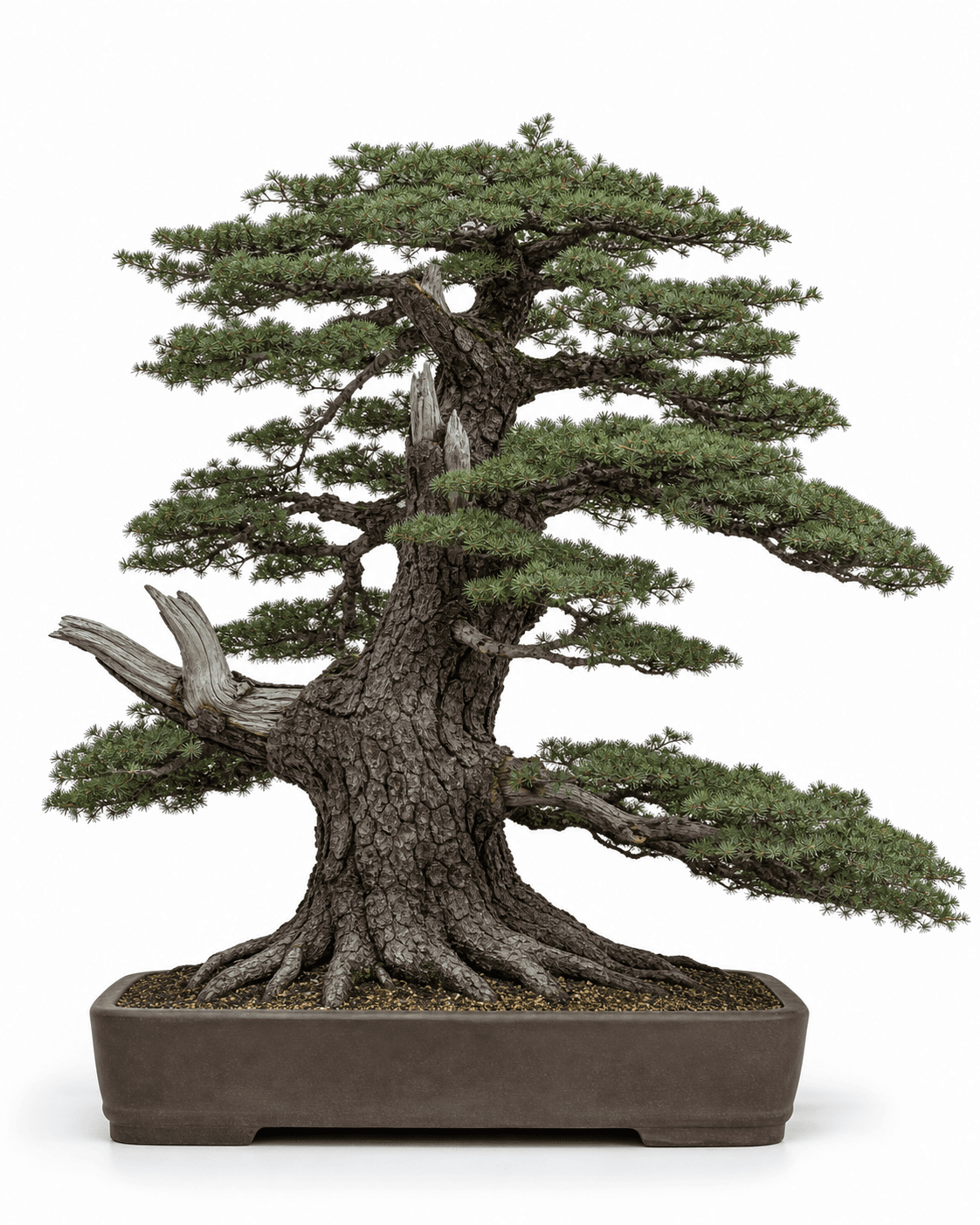
Lebanon cedar bonsai is an outdoor true cedar for growers who can provide full sun, cold dormancy, oxygen-rich soil, and patient multi-season styling. Cedrus libani is famous for broad, tiered, flat-topped old trees, so the best bonsai designs usually preserve horizontal strength, lifted branch tips, negative space, and a wider ancient crown.
Treat Lebanon cedar as a Cedrus elongating conifer: repot late in spring as buds swell, let development shoots extend, prune hardened growth only to visible buds or active spurs, and protect needles during wiring. The most common failures are cutting below live buds, over-cleaning foliage, dry wind in a shallow pot, wet root cores, whorl swelling, and expecting old bare wood to refill with buds.
This guide uses the local Bonsai Mirai Lebanon cedar and Cedrus corpus first, especially maximizing-design-lebanese-cedar, Atlas cedar design, Blue Atlas cedar nursery-stock and second-styling files, and foundational watering, soil, wiring, pruning, and energy files. Taxonomy, hardiness, morphology, cultivar, and historic-site context are grounded with Kew, NC State Extension, Oregon State, RHS, Cornell, and UNESCO sources.
Updated June 4, 2026. Written by EntGrove Editorial. Last verified June 4, 2026.
Care fingerprint
Read the species through its shared care pattern.
Strong light, cool-root management, conservative root work, and post-extension pruning dominate the care calendar. Use this as the starting point before local conditions and tree strength refine the calendar.
Note: Kew accepts Cedrus libani and places its native range from southern Turkey to Lebanon. NC State lists Zones 5a-7b, Oregon State lists Zone (5) 6, and RHS rates it H6. Mirai has dedicated Lebanon cedar and broader Cedrus method coverage; apply late-spring root timing, visible-bud pruning, whorl control, and broad ancient-crown design framing.
Do not prune like a pine
Elongating conifers extend from buds and shoots, so candle-cutting assumptions can remove the exact growth the tree needs.
Preserve interior growth
Spruce, fir, hemlock, cedar, redwood, cypress, and larch all become harder to design when interior buds are shaded out.
Keep recovery cool and steady
Many elongating conifers respond best when roots stay evenly moist, oxygenated, and protected from hot dry swings.
Care cadence
The calendar starts with the tree's seasonal state.
Placement
Timing: Grow outdoors year-round in full sun, with pot cooling and wind moderation during dry heat or after major work. Keep winter protection cold enough to maintain dormancy.
Watch for: Shade, reflected paving heat, hot black pots, dry wind, winter sun on frozen roots, and storage that wakes buds before roots can support them.
NC State ExtensionRHSBonsai Mirai LibraryWatering
Timing: Water deeply during active elongation and hot weather. In shallow active pots, more than one watering per day can be normal, but each cycle should restore oxygen.
Watch for: Dull needles, limp soft tips, runoff around a dry core, sour wet nursery soil, constant saturation after repotting, and drought assumptions copied from landscape trees.
Bonsai Mirai LibraryFertilizer
Timing: Feed development trees through active growth and fall to build vascular reserves. Refined trees can be fed lighter once density and needle scale are already strong.
Watch for: Coarse first flush, weak interior buds from underfeeding, salt in shallow pots, fertilizer before root uptake returns, and late soft growth before cold.
Bonsai Mirai LibrarySpring pinching
Timing: Pinch only strong refined shoots while tips are soft and extending beyond the intended silhouette. Use it to redistribute vigor, not to build primary branches.
Watch for: Pinching weak branches, pinching every shoot evenly, forcing dense round pads when a thinner natural image is intended, and pinching after root work.
Bonsai Mirai LibraryPost-harden pruning
Timing: After shoots harden, prune back to visible buds in needle axils, active spurs, or useful bifurcations. Cuts below live buds can die back.
Watch for: Cutting mid-internode, cutting through needles, removing all interior foliage, reducing old bare wood, and leaving all ramification at branch tips.
Bonsai Mirai LibraryStructural work
Timing: Make major branch-selection and structural-wiring decisions in spring before bud push or after the first flush hardens. Early fall can work when heat has passed and the tree remains active.
Watch for: Combining heavy styling with repotting, removing foliage needed for root recovery, over-bending brittle wood, and missing fall wire bite.
Bonsai Mirai LibraryRepotting
Timing: Repot late in the spring window as buds swell or begin to open. Hydrate first, preserve useful root mass, correct old soil in stages, and tie the tree firmly.
Watch for: Early cold repots, bare-rooting, weak tie-downs, heavy foliage work in the same season, and wet organic cores that stay hidden under free-draining surface soil.
Bonsai Mirai LibraryNeedle cleaning
Timing: Clean dead needles, downward needles that block the lower pad line, and needles hiding bud lines. Keep a full live needle skirt around useful buds and spurs.
Watch for: Wholesale stripping, pulling resistant live needles, crushed foliage under wire, empty interiors, and over-cleaning old branches that must stay photosynthetic.
Bonsai Mirai LibraryPest and disease inspection
Timing: Inspect during spring growth, hot dry spells, fall, and after wet winter periods. NC State flags root rot and tip blight, while RHS notes conifer aphid and honey fungus susceptibility.
Watch for: Sticky foliage, sooty film, aphids, mite stippling, tip browning, sour roots, poor drainage, honey fungus signs, and decline after drought followed by overwatering.
NC State ExtensionRHSNC State Extension conifer pestsWinter protection
Timing: Keep dormant and cold, with container roots protected from severe freeze-thaw and drying wind. Extra protection is useful near Zone 5 edges, after repotting, or after fall wiring.
Watch for: Warm indoor storage, dry frozen soil, newly wired branches under snow load, windward needle burn, and cultivars with less proven local hardiness.
NC State ExtensionOregon State Landscape PlantsRHSSpecies guide
Apply the species profile before copying another tree's calendar.
At a glance
Lebanon cedar is a true cedar with slow power, late-spring roots, and broad ancient character.
Cedrus libani is accepted by Kew as an eastern Mediterranean Pinaceae species. In horticulture, the same tree is commonly labeled cedar of Lebanon, Lebanon cedar, and Lebanese cedar. Kew POWONC State ExtensionRHS
As bonsai, it behaves like other Cedrus: it makes elongating runners, compact spur clusters, and latent buds in needle axils. Growth can be guided through extension, soft-tip pinching, and post-harden pruning, but every cut needs live buds or active spurs behind it. Bonsai Mirai Library
The practical care pattern is full outdoor sun, reliable active-season water with oxygen, late-spring repotting, conservative needle cleaning, and design decisions that create an old broad cedar rather than a generic conifer triangle. Bonsai Mirai LibraryNC State ExtensionOregon State Landscape Plants
Wild range
Read Lebanon cedar from eastern Mediterranean mountains, old sacred groves, and flat-topped age.
Kew places Cedrus libani from southern Turkey to Lebanon. RHS lists Syria, Lebanon, and Turkey, and NC State includes Cyprus in its origin field, reflecting the broader eastern Mediterranean horticultural framing. Kew POWORHSNC State Extension
UNESCO describes the Forest of the Cedars of God near Qadisha Valley as a remnant of ancient cedar forests, located on Mount Makmel at about 1900-2050 m. That altitude explains why cold, snow, wind, sun, and drainage matter in the species image. UNESCO World Heritage Centre
The care implication is controlled exposure. Lebanon cedar wants sun and air, yet a bonsai pot removes the deep soil volume that supports old mountain trees through drought and heat, so container trees need consistent water and root-zone oxygen. Bonsai Mirai LibraryOregon State Landscape Plants
The design implication is broad age. Young trees can be pyramidal, while old trees develop horizontal branches and a wider, flatter crown. A convincing bonsai should use branch planes, negative space, and crown width to show that age sequence. NC State ExtensionRHSBonsai Mirai / Asymmetry
Reading
First decide whether the cedar is building strength, correcting roots, or entering refinement.
Read the root system before the silhouette. Lebanon cedar can be difficult to transplant in landscape use, and Cedrus bonsai roots are heat-activated. A tree with old dense nursery soil needs staged conversion before it is asked to carry refined foliage. NC State ExtensionBonsai Mirai Library
Read the branch junctions next. Mirai repeatedly flags Cedrus whorls and bar branches because several branches at one node thicken evenly and create swelling. Keep needed foliage during development, then simplify same-node branches before the bulge becomes the design. Bonsai Mirai Library
Read shoot phase branch by branch. A lower branch may need a long extension to thicken and feed roots; an upper refined branch may need soft-tip pinching; a hardened runner may need a cut back to a visible interior bud. Bonsai Mirai Library
Read age honestly. A young Lebanon cedar can be tall, upright, and elegant. An ancient image needs the trunk, bark, branch girth, and negative space to justify a flat top and large structural remnants. Bonsai Mirai / AsymmetryNC State Extension
Spring growth
Use extension for strength, soft pinching for refinement, and post-harden pruning for structure.
Lebanon cedar first flush often extends with longer internodes from stored reserves, then later growth can become tighter as those reserves are distributed. That rhythm lets the grower choose between development extension and refinement control. Bonsai Mirai Library
Soft-tip pinching redirects energy into latent buds and can create dense, ball-like ramification. Use it on strong refined shoots extending beyond the silhouette, and avoid using it on branches that still need length, thickness, or next-year interior buds. Bonsai Mirai Library
Post-harden pruning is the better tool for thinner naturalistic pads. After a runner hardens, cut back to a bud in a needle axil, a spur, or a useful bifurcation. A cut with no live bud behind it can die back. Bonsai Mirai Library
Needle work should support bud function. Remove dead or downward needles that clog the lower silhouette, but keep live needles around buds and spurs. Broken Cedrus needles brown and reduce the branch energy budget. Bonsai Mirai Library
Use Cedrus pinching and post-harden pruning instead of pine decandling. Lebanon cedar does not follow the candle-removal calendar of multiflush pines. Bonsai Mirai Library
Roots
Repot late in spring, correct old soil in stages, and separate root work from heavy styling.
Mirai places Cedrus root work at the tail end of spring repotting, as buds swell or begin to open. The reason is physiological: Cedrus roots need warmth and active metabolism to regenerate after disturbance. Bonsai Mirai Library
Hydrate the tree before repotting, preserve functional roots, and anchor the trunk so new root tips are not torn by movement. On old nursery or field material, remove compacted organic cores in stages rather than trying to fix the whole root system at once. Bonsai Mirai LibraryNC State Extension
Do not pair heavy root reduction with heavy foliage reduction. Mirai treats root recovery and foliage recovery as competing uses of finite stored resources, so the same season should have one main insult. Bonsai Mirai Library
After repotting, protect from hard wind, keep water consistent, and wait for new growth to confirm uptake before styling. A delay in bud push after well-timed root work can be normal while resources move to root repair. Bonsai Mirai Library
Soil and pot
Use an open water-retentive mix and a pot that reinforces old cedar breadth.
A Cedrus baseline from Mirai is 2 parts akadama, 1 part lava, and 1 part humus-rich organic component. The akadama supports ramification and needle scale, while lava and organic material balance air and water. Bonsai Mirai Library
Adjust the mix to your climate. Use less organic material or a faster pot in wet winter regions, and use more water retention or deeper containers where dry wind and heat empty shallow pots too quickly. Bonsai Mirai LibraryRHS
Extension sources agree that Lebanon cedar prefers well-drained soil and tolerates a broad pH range. In bonsai, drainage is only half the point; the mix also has to hold enough water to support active spring and summer elongation. NC State ExtensionRHSOregon State Landscape Plants
For an ancient cedar image, Mirai favors wider shallow containers that reinforce breadth. Rectangles can work if the corners are visually softened; dwarf cultivars can use smaller ovals or soft rectangles when the branch scale is compact. Bonsai Mirai LibraryCornell Woody Plants Database
Climate
Lebanon cedar is hardy, but container roots and dry wind set the real limits.
In cold regions, treat the landscape hardiness numbers as a starting point. NC State lists Zones 5a-7b and Oregon State lists Zone (5) 6, but a bonsai pot exposes roots to deeper freeze and faster drying than in-ground soil. NC State ExtensionOregon State Landscape Plants
In maritime or mild winter regions, the main risks are wet roots, weak dormancy, and early spring movement followed by cold snaps. Use open soil, rain management, and a cold but protected overwintering position. Bonsai Mirai LibraryRHS
In hot inland regions, keep the tree in full morning sun and protect the pot from reflected heat. Lebanon cedar can handle dry soil in landscapes, but bonsai roots need reliable moisture during active elongation. NC State ExtensionBonsai Mirai Library
Dwarf and specialty cultivars should be tested locally. Stenocoma and Purdue Hardy language often signals cold-hardiness selection, while compact forms such as Green Prince may need more careful watering because root and foliage volume are smaller. Oregon State Landscape PlantsOregon State Landscape Plants: Green PrinceCornell Woody Plants Database
Pests
Most pest and disease problems follow weak roots, wet soil, or stressed foliage.
NC State says Lebanon cedar has no serious insect or disease issues in landscape use, but it may incur root rot or tip blight. In bonsai, shallow pots, old soil, and repeated styling can make those issues more consequential. NC State Extension
RHS notes possible conifer aphid and honey fungus susceptibility. Sticky needles, black sooty film, honeydew, or active insects should be identified before treatment, especially on a styled tree with reduced foliage reserves. RHSNC State Extension conifer pests
Mites and sap-feeding insects can flare during dry stress, dusty benches, or poor airflow. Improve water consistency and environment first, then use locally labeled controls only after the pest is confirmed. NC State Extension conifer pestsBonsai Mirai Library
Root rot prevention is mostly horticultural: open soil, firm tie-down, staged nursery-core conversion, no standing water, and a watering rhythm that restores oxygen after deep watering. Bonsai Mirai LibraryNC State Extension
Wiring
Wire for lifted cedar character and protect brittle wood and needles.
Cedrus wood can feel flexible and then snap abruptly. Use enough wire to move the branch once, support outside curves, and avoid acute bends that ask old wood to behave like young deciduous material. Bonsai Mirai Library
Clean the path before wiring. Remove only needles that block placement, then set wire so it does not crush live clusters. Broken needles brown, especially on long-needled Lebanon and Deodar cedar. Bonsai Mirai Library
Set branch planes with the species in mind. Lebanon cedar branches can be horizontal and tiered, but the tips should still feel alive and slightly lifted rather than ironed into flat pine shelves. Bonsai Mirai / AsymmetryBonsai Mirai Library
Check wire in fall. Mirai warns that Cedrus lays down vascular tissue before winter, so wire that looked safe in summer can bite quickly as reserves move into branches. Bonsai Mirai Library
Propagation
Seed, selected cultivars, and occasional young-material air layers serve different goals.
NC State lists seed as the recommended propagation strategy, and RHS lists seed or semi-hardwood cuttings. Seedlings can give cleaner roots and natural flare, though growth rate and needle character will vary. NC State ExtensionRHS
Named cultivars are selected for size, color, habit, or hardiness and are commonly propagated to preserve those traits. Green Prince, for example, is documented by Oregon State as dwarf, slow-growing, and highly prized in bonsai. Oregon State Landscape Plants: Green PrinceCornell Woody Plants Database
Mirai notes that Cedrus can be air-layered while bark is still smooth and fleshy. For Lebanon cedar, use layering as a young-material correction tool for a bad root base or trunk line rather than a routine beginner plan. Bonsai Mirai Library
For most growers, buying better starter material is faster than propagating from scratch. The best young plants already show a usable base, interior buds, and branch spacing that does not require severe early surgery. Bonsai Mirai LibraryOregon State Landscape Plants: Green Prince
Buying
Buy for base, branch spacing, interior buds, and cultivar scale.
Good Lebanon cedar starter material has a visible or discoverable root base, horizontal branch options at different heights, interior buds or active spur clusters, and no severe same-node swelling near the future trunk front. Bonsai Mirai Library
Reject material where all live foliage is far from the trunk, several major branches leave one swollen whorl, the trunk is too straight for the intended style, or old nursery soil fills a deep wet core. Bonsai Mirai Library
Green Prince deserves special attention for bonsai because Oregon State calls it highly prized in bonsai and American horticultural references describe a dwarf compact habit. Still, inspect roots and branch placement before paying for the name. Oregon State Landscape Plants: Green PrinceCornell Woody Plants Database
Large landscape stock can work when the trunk line, first branches, and root history are already useful. Chopping a slow old cedar hard can remove the species character and leave a tree that takes many years to rebuild. Bonsai Mirai / AsymmetryBonsai Mirai Library
Troubleshooting
Lebanon cedar problems usually point to cuts, roots, water, wind, or old branch structure.
Symptom: tips brown after pruning. Likely cause: cuts were made below visible buds, through needles, or into weak old wood. Fix: prune only to buds, active spurs, or bifurcations, then rebuild vigor before deeper reduction. Bonsai Mirai Library
Symptom: yellowing or dull foliage after repotting. Likely cause: root work happened too early, the tree moved in the pot, a wet nursery core remained, or too much foliage was removed. Fix: stabilize aftercare and delay more work. Bonsai Mirai Library
Symptom: weak interior buds. Likely cause: branches were pinched too early, shaded by exterior growth, or underfed in development. Fix: allow selected shoots to extend, feed appropriately, and prune hardened growth back to useful buds. Bonsai Mirai Library
Symptom: swelling at a node. Likely cause: bar branches or multiple whorl branches were kept too long. Fix: reduce same-node branches in staged work and leave one clean shoulder with enough foliage to support recovery. Bonsai Mirai Library
Symptom: sticky needles, black film, or fine stippling. Likely cause: aphids, scale-like conifer pests, mites, honeydew, or drought stress. Fix: identify the pest, improve airflow and water consistency, then treat according to local labels. RHSNC State Extension conifer pests
Symptom: roots smell sour or tips decline after wet weather. Likely cause: root rot pressure, compacted old soil, or repeated watering without oxygen recovery. Fix: improve drainage, reduce standing wetness, and repot only at the next safe late-spring window if the tree is strong enough. NC State ExtensionBonsai Mirai Library
Design
Style Lebanon cedar as a broad old cedar, not as a compressed generic conifer.
Start with base, trunk line, defining branch, and apex width. Matching branch lengths, centered planes, and a narrow pointed crown read young; asymmetry, negative space, lost branches, and a broader crown read older. Bonsai Mirai / AsymmetryBonsai Mirai Library
Use the ancient Lebanon cedar image carefully. UNESCO and Mirai both point toward old sacred groves, broad crowns, rugged remnants, and horizontal architecture, but the bonsai still has to match the actual age, bark, and trunk quality in front of you. UNESCO World Heritage CentreBonsai Mirai Library
Deadwood should be structural and credible. Mirai cautions that fine twiggy Cedrus deadwood ages poorly, so leave larger remnants when the design calls for them and age new work to match existing deadwood. Bonsai Mirai Library
A long straight young trunk may become a better literati or tall upright than a chopped compact tree. Slender trunks need visible line, branch variation, and negative space; thick trunks can carry more compression and foliage mass. Bonsai Mirai / AsymmetryBonsai Mirai Library
Cultivars
Green Prince, Stenocoma, Nana, Sargentii, and blue or weeping forms change the scale.
Oregon State lists Cedrus libani subsp. brevifolia, Green Prince, and Stenocoma as available forms, and describes Green Prince as an irregular dwarf with stiff small gray-green needles that is highly prized in bonsai. Oregon State Landscape PlantsOregon State Landscape Plants: Green Prince
Cornell lists cultivar names including Beacon Hill, Blue Angel, Green Knight, Green Prince, Home Park, Kenwith, Nana, var. stenocoma, Sargentii, and Hedgehog. These names affect size, color, hardiness, and whether the plant wants to spread, weep, mound, or stay upright. Cornell Woody Plants Database
Green Prince is especially useful for smaller bonsai because compact growth reduces the fight against long internodes. The tradeoff is slower development, so root quality and first branch placement matter more at purchase. Oregon State Landscape Plants: Green PrinceBonsai Mirai Library
Stenocoma and hardy selections can widen the climate range, while blue, dwarf, and pendulous forms can become design features. Evaluate each plant by base, branch architecture, and local hardiness rather than cultivar novelty. Oregon State Landscape PlantsCornell Woody Plants DatabaseRHS
History
Lebanon cedar carries unusual cultural weight, which raises the design standard.
UNESCO describes the Forest of the Cedars of God near Qadisha Valley as a remnant of ancient cedar forests and one of the rare sites where Cedrus libani still grows, tied to construction materials highly valued in antiquity. UNESCO World Heritage Centre
The species became a cultural symbol because old Lebanon cedar forests were associated with sacred landscapes, religious building, and long-lived mountain trees. A bonsai can respect that gravity through restraint, broad age, and credible structure. UNESCO World Heritage CentreBonsai Mirai / Asymmetry
In public gardens and landscapes, Lebanon cedar is valued for a massive trunk, horizontal branches, tiered structure, and flat-topped age. Those same signals translate directly into bonsai styling decisions. NC State ExtensionRHSOregon State Landscape Plants
A credible exhibition Lebanon cedar should show controlled whorls, preserved interior buds, clean lower silhouettes, branch tips that still feel alive, broad old-crown logic, and deadwood that reads as a durable remnant rather than decoration. Bonsai Mirai LibraryBonsai Mirai / Asymmetry
Species questions
Answer the beginner questions before styling.
Can Lebanon cedar be grown as bonsai?
Yes. Lebanon cedar can be grown as bonsai outdoors when it receives full sun, cold dormancy, oxygenated soil, careful watering, and Cedrus-specific pruning around soft growth and hardened shoots.
Can Lebanon cedar bonsai live indoors?
Lebanon cedar is an outdoor conifer. It needs outdoor light, moving air, seasonal temperature change, and winter dormancy for long-term health.
When should I repot Lebanon cedar bonsai?
Repot late in the spring window as buds swell or begin to open. Preserve useful roots, secure the tree firmly, and avoid heavy foliage reduction in the same season.
Should I pinch Lebanon cedar?
Pinch only strong refined shoots while the new tips are soft and extending beyond the silhouette. Let development shoots extend first, then prune hardened growth back to visible buds.
Can Lebanon cedar be decandled?
Use Cedrus pinching and post-harden pruning instead of decandling. Lebanon cedar grows through elongating shoots and spur clusters, while decandling belongs to multiflush pine technique.
What soil mix works for Lebanon cedar bonsai?
A Mirai-derived Cedrus baseline is 2 parts akadama, 1 part lava, and 1 part humus-rich organic component. Adjust the mix for local rain, heat, pot depth, and old nursery soil.
Is Green Prince Lebanon cedar good for bonsai?
Green Prince is one of the more bonsai-relevant Lebanon cedar cultivars because it is dwarf and compact. Still inspect the root base, branch placement, and interior buds before buying.
Does Lebanon cedar back-bud on old wood?
Lebanon cedar can activate buds on younger fleshy stem tissue and active spur clusters, but mature bare wood is unreliable. Keep live interior buds and design with existing shoots.
Why is my Lebanon cedar turning brown after pruning?
Common causes include cuts below live buds, severed needles, weak roots, water stress, or heavy work done at the wrong time. Stop pruning and rebuild vigor before deeper reduction.
What styles suit Lebanon cedar bonsai?
Formal upright, informal upright, literati, slanting, broad ancient cedar, flat-topped old tree, twin-trunk, and dwarf-cultivar small bonsai all suit the species when the design preserves broad tiered character.
Sources
Species advice needs source discipline.
Next decisions
Plan the operation before copying the calendar.
A good care note for Lebanon cedar records the tree's stage, the work done, and the aftercare used. That record matters more than a month-name rule.
Related species
Compare nearby trees before transferring advice.
Subalpine fir
Abies lasiocarpa
Balsam fir
Abies balsamea
White fir
Abies concolor
Noble fir
Abies procera
Mountain hemlock
Tsuga mertensiana