
Species guide
Bahama Berry Bonsai Care
Nashia inaguensis
Bahama berry bonsai care starts with identity, warmth, and water discipline. Nashia inaguensis is a tiny-leaved Caribbean Verbenaceae shrub from seasonally dry tropical habitat, yet a bonsai pot can dry so quickly that even brief drought can collapse fine growth.
Treat Bahama berry as Broadleaf > Tropical in EntGrove. Give bright warm light, steady humidity, fast drainage with moisture retention, warm active-growth pruning, and frost-free winter protection.
The local Mirai corpus has no dedicated Nashia or Bahama berry file. This guide transfers Mirai tropical, small-leaf broadleaf, watering, soil, repotting, wiring, propagation, energy, and design method transparently, while Kew, GBIF, IPNI, Leon Levy Native Plant Preserve, Cornell Botanic Gardens, and TopTropicals ground taxonomy, range, morphology, and cultivation limits.
Updated June 14, 2026. Written by EntGrove Editorial. Last verified June 14, 2026.
Care fingerprint
Read the species through its shared care pattern.
Treat indoor culture as a light-management problem first; prune and repot when the tree is actively growing and warm enough to recover. Use this as the starting point before local conditions and tree strength refine the calendar.
Note: Kew accepts Nashia inaguensis and lists Lippia inaguensis as the homotypic synonym; verify against Neea, Fukien tea, Serissa, Premna, and generic tropical boxwood labels.
Read the foliage first
Broadleaf stress usually shows in leaf color, leaf size, wilt, scorch, or delayed hardening before it becomes a branch problem.
Match work to dormancy
Deciduous, evergreen, tropical, succulent, and flowering broadleaf trees recover on different calendars.
Protect fine roots
Root work should preserve enough active fine roots for the tree to rehydrate quickly after the operation.
Care cadence
The calendar starts with the tree's seasonal state.
Placement
Timing: Place in bright warmth after cold risk passes, then protect before chilly nights. Acclimate any indoor-held tree gradually when moving outside.
Watch for: Leaf scorch after abrupt sun, wind-dried pots, weak indoor extension, cold windows, and dark winter rooms without supplemental light.
Bonsai Mirai LibraryTopTropicals: Nashia inaguensisWatering
Timing: Water before the fine root zone dries hard. Let drainage clear and oxygen return after each watering.
Watch for: Crisping tips, wilt, hard dry substrate, sour wet soil, algae crust, and tiny pots drying faster than the daily routine expects.
TopTropicals: Nashia inaguensisBonsai Mirai LibraryHumidity
Timing: Maintain higher humidity during warm growth, cuttings, and indoor winter protection while preserving airflow around the canopy.
Watch for: Dry heated rooms, closed stagnant cases, fungal surface growth, mites, and humidity trays that leave roots standing in water.
TopTropicals: Nashia inaguensisBonsai Mirai LibraryFeeding
Timing: Feed lightly to moderately during active warm growth after roots are working. Reduce feed during weak indoor winter holding.
Watch for: Oversized leaves, long soft internodes, salt buildup, fertilizer on dry roots, and heavy feeding before post-repot recovery growth.
Bonsai Mirai LibraryPruning
Timing: Let shoots extend enough to feed the branch, then cut back in warmth after the growth firms. Use repeated small corrections.
Watch for: Hedging the outside, stripping all fine leaves, cutting hard in winter, and letting the dense canopy shade out interior buds.
Bonsai Mirai LibraryBonsai Mirai / AsymmetryLeaf work
Timing: Use selective leaf reduction on strong refined trees only. Let root maturity, bright light, and short internodes do most of the scale work.
Watch for: Full defoliation on weak or newly repotted trees, leaf cutting to compensate for poor light, and removing the humidity buffer on hot days.
Bonsai Mirai LibraryRepotting
Timing: Repot in warm active growth, with enough remaining warmth for new roots to harden before the tree returns indoors or slows down.
Watch for: Bare-rooting, combining hard root reduction with hard top pruning, burying the crown, and old peat cores that stay wet inside.
Bonsai Mirai LibraryWiring
Timing: Wire young flexible shoots early, then refine with pruning, leader changes, and light guying as wood hardens.
Watch for: Wire bite hidden by tiny leaves, brittle older twigs, scarred bark, and forcing a formal line onto a naturally spreading shrub.
Bonsai Mirai / AsymmetryBonsai Mirai LibraryPropagation
Timing: Root cuttings in spring or early summer during warm nights, using humidity, oxygen-rich media, reduced sun, and patient aftercare.
Watch for: Dry cuttings, saturated media, direct sun before roots form, unlabeled batches, and separating weak material too early.
TopTropicals: Nashia inaguensisBonsai Mirai LibraryWinter protection
Timing: Move to bright frost-free protection before cool nights. Slow watering only as growth slows, and preserve enough humidity for fine leaves.
Watch for: Cold root balls, dry heater air, low light, pests, stale wet soil, and major styling while tropical metabolism is weak.
Bonsai Mirai LibraryTopTropicals: Nashia inaguensisSpecies guide
Apply the species profile before copying another tree's calendar.
At a glance
Bahama berry is a tiny-leaved Caribbean tropical with a narrow care margin.
Use this page for Nashia inaguensis, the accepted species Kew lists in Verbenaceae. The main old synonym is Lippia inaguensis. Kew POWO: Nashia inaguensisGBIF: Nashia inaguensisIPNI: Nashia inaguensis
Common labels include Bahama berry, Bahamas berry, Moujean tea, Mounjean tea, pineapple verbena, Nashia, and el tuque. Verify the plant before applying generic tropical-boxwood or Fukien-tea advice. Cornell Botanic Gardens: Moujean TeaTopTropicals: Nashia inaguensisGBIF: Nashia inaguensis
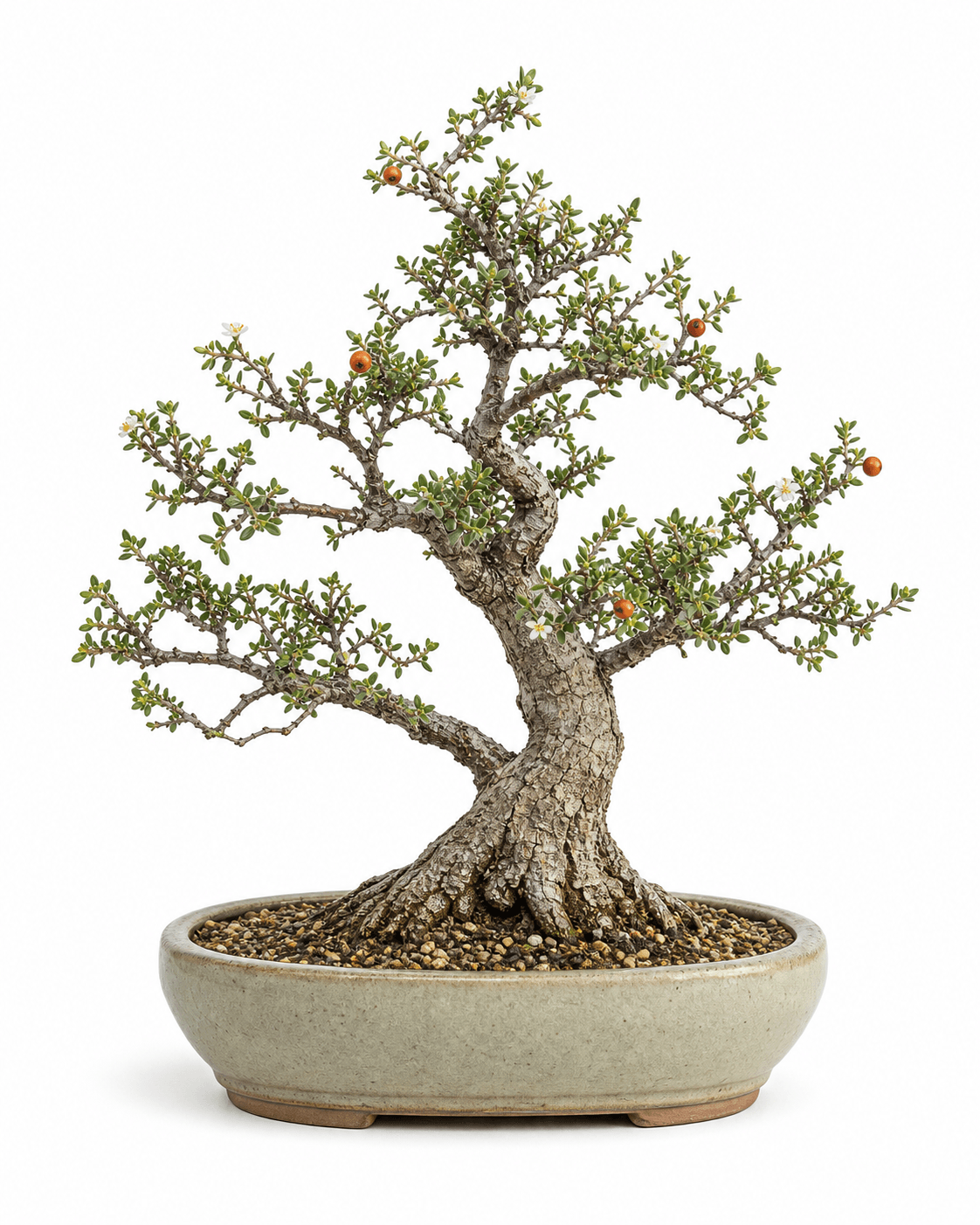
The attraction is obvious: tiny aromatic leaves, small white flowers, orange to reddish fruit, and a loose spreading shrub habit that can read well at shohin scale. Cornell Botanic Gardens: Moujean TeaLeon Levy Native Plant Preserve: Nashia inaguensisTopTropicals: Nashia inaguensis
The care constraint is just as important. The local Mirai corpus has no dedicated Nashia file, and public horticultural sources describe a plant that wants warmth, humidity, and steady moisture while still needing clean drainage. Bonsai Mirai LibraryTopTropicals: Nashia inaguensis
Habitat
Its native signal is dry tropical shrubland with small leaves, wind, and bright light.
Kew gives the native range as Bahamas (Great Inagua), southern Puerto Rico, and the Virgin Islands, and places the species in the seasonally dry tropical biome. Kew POWO: Nashia inaguensis
Leon Levy Native Plant Preserve describes Nashia inaguensis in dry broadleaf evergreen shrubland or dwarf shrubland, occurring in the southern Lucayan Archipelago as well as Puerto Rico and the Virgin Islands. Leon Levy Native Plant Preserve: Nashia inaguensis
Cornell describes a loose spreading evergreen shrub up to 2 m high with mature trunks of 5-10 cm, aromatic opposite leaves, and tiny white flowers attractive to pollinators. Cornell Botanic Gardens: Moujean Tea
Design should use that ecology plainly: a compact bright-climate shrub with aromatic small leaves, light branch rhythm, and fruiting detail. Bonsai Mirai / AsymmetryCornell Botanic Gardens: Moujean Tea
Reading
Read Bahama berry by leaf firmness, internode length, humidity response, and root moisture.
A strong tree has firm small leaves, short active shoots, visible interior buds, quick recovery after watering, clean drainage, and enough growth to replace pruned tips. Bonsai Mirai LibraryTopTropicals: Nashia inaguensis
A stressed tree shows crisping tips, wilt, stalled branchlets, sudden leaf drop, sour soil, pale weak extension, mites in dry rooms, or dieback after cold nights. Bonsai Mirai LibraryTopTropicals: Nashia inaguensis
Development means building roots, base, trunk line, and low branches before chasing a tiny finished canopy. Refinement means shorter internodes, controlled extensions, and enough interior foliage to keep the shrub alive inside. Bonsai Mirai LibraryBonsai Mirai / Asymmetry
The tiny natural leaf gives a head start. Use that gift by improving light, roots, and pruning cadence before attempting aggressive leaf work. Bonsai Mirai LibraryCornell Botanic Gardens: Moujean Tea
Pruning
Prune in warmth with small repeated cuts that preserve interior life.
Let shoots extend long enough to create energy, then cut back to a useful side bud or branch after the growth firms. This keeps the tree productive while shortening the next growth cycle. Bonsai Mirai Library
A dense tropical shrub can become a clipped shell quickly. Open windows inside the canopy so the trunk, defining branch, and secondary structure remain visible. Bonsai Mirai / Asymmetry
Selective leaf work belongs on strong refined trees in warm active growth. Keep enough leaves to maintain transpiration and recovery after pruning. Bonsai Mirai Library
Skip heavy winter pruning in cold regions. Tropical broadleaf trees need temperature, light, and root activity to seal wounds and replace lost foliage. Bonsai Mirai Library
Repotting
Repot only when warm roots can rebuild quickly.
Mirai tropical method places major root work in warm active growth, with enough heat remaining for new roots to harden before cool weather or indoor holding. Bonsai Mirai Library
Bahama berry has a small-leaf, moisture-sensitive canopy. Preserve enough root mass and foliage to keep water moving, especially when reducing old nursery soil. Bonsai Mirai LibraryTopTropicals: Nashia inaguensis
Use chopsticks, water, and staged reduction to remove compacted old media. Tie the tree firmly because new tropical roots tear easily when a shallow pot rocks. Bonsai Mirai Library
After repotting, keep humidity stable, light bright but gentle, and fertilizer low until new extension proves that roots are functioning. Bonsai Mirai Library
Soil and pot
Use a moist, oxygen-rich tropical mix and size the pot for water stability.
A practical bonsai mix starts with akadama, pumice, lava, or comparable particles, then adjusts water retention for climate, pot size, and daily observation. Bonsai Mirai Library
The wild habitat is seasonally dry, but TopTropicals warns against even brief dryness in cultivation. In a bonsai pot, the aim is steady available moisture without stagnant roots. Kew POWO: Nashia inaguensisTopTropicals: Nashia inaguensisBonsai Mirai Library
Avoid jumping too quickly into a very shallow show pot. A slightly deeper training pot gives more moisture buffer while trunk, roots, and primary branches develop. Bonsai Mirai LibraryBonsai Mirai / Asymmetry
Pot pairing should stay understated: small ovals, soft rectangles, or quiet glazed containers that let tiny leaves, pale flowers, orange fruit, and branch rhythm read first. Bonsai Mirai / Asymmetry
Climate
Grow it as a tropical in temperate collections and as a moisture-watch tree in hot regions.
In tropical and subtropical climates, Bahama berry can grow outdoors with bright light, high humidity, and frequent water checks. Small pots still need protection from wind-driven drying. Kew POWO: Nashia inaguensisTopTropicals: Nashia inaguensis
In dry summer regions, use morning sun, wind moderation, and a mix that does not hard-dry between waterings. Acclimate the plant slowly when changing exposure. Bonsai Mirai LibraryTopTropicals: Nashia inaguensis
In cold-winter regions, bring the tree into a greenhouse, warm room under lights, or other frost-free protected space before cold nights. Water use slows with growth, while the drought margin remains narrow. Bonsai Mirai LibraryTopTropicals: Nashia inaguensis
Very hot indoor windows can dry a tiny pot while the room itself remains too dim. Track root-zone moisture and leaf temperature instead of judging only by room comfort. Bonsai Mirai Library
Pests and diseases
Most problems trace back to drought shock, stale wet roots, or indoor pest buildup.
No detailed extension pest profile surfaced for bonsai-grown Nashia, so use tropical-broadleaf inspection discipline: check mites, aphids, mealybugs, and scale on new growth, leaf undersides, and dense forks. Bonsai Mirai Library
Dry indoor air favors mites and leaf crisping. Stagnant humidity favors fungal surface issues. The right middle is humid air with airflow and a root zone that drains cleanly. Bonsai Mirai LibraryTopTropicals: Nashia inaguensis
Root rot shows as yellowing, sour soil, black roots, and wilt despite wet media. Stop styling while drainage, warmth, and watering are corrected. Bonsai Mirai Library
Quarantine rare tropicals. Imported or mail-order material may arrive with pests, old peat, or stress from shipping, and Bahama berry has little drought margin in a small pot. TopTropicals: Nashia inaguensisBonsai Mirai Library
Wiring
Set young structure lightly, then let pruning do most of the refinement.
Wire young flexible shoots after they firm enough to hold a line, using small gauges and frequent checks. Tiny leaves can hide wire bite until scars are already set. Bonsai Mirai / AsymmetryBonsai Mirai Library
The natural habit is loose and spreading. Use wire to organize primary branch direction, then build finer ramification through extension, cutback, and branch selection. Cornell Botanic Gardens: Moujean TeaBonsai Mirai / Asymmetry
Avoid severe bends on older twigs unless the branch can be replaced. A compact tropical shrub image is strongest with grown-looking branch rhythm and gentle direction changes. Bonsai Mirai / Asymmetry
Remove wire early during warm growth. Better to rewire lightly than to leave permanent scars on a shohin-scale trunk or branch. Bonsai Mirai Library
Propagation
Cuttings are the practical route, with warmth and humidity doing the work.
TopTropicals lists cuttings as the propagation method, preferably in spring and early summer during warm nights. TopTropicals: Nashia inaguensis
Use clean semi-ripe cuttings, small leaves reduced only as needed to limit water loss, and a free-draining propagation medium that stays humid without turning anaerobic. Bonsai Mirai Library
Keep cuttings out of direct harsh sun until roots form. Provide humidity, bottom warmth if needed, and patient aftercare before moving to full bonsai culture. Bonsai Mirai LibraryTopTropicals: Nashia inaguensis
Air layering is plausible on vigorous tropical broadleaf material, but source evidence for Nashia layers is thin. Use it only on strong material where the branch is worth preserving. Bonsai Mirai Library
Buying
Buy for verified identity, small healthy leaves, and no drought history.
Look for Nashia inaguensis, Bahama berry, Bahamas berry, Moujean tea, Mounjean tea, pineapple verbena, el tuque, or Lippia inaguensis on labels and invoices. Kew POWO: Nashia inaguensisGBIF: Nashia inaguensisCornell Botanic Gardens: Moujean Tea
Good material has firm aromatic leaves, short internodes, visible low branches, a trunk base with movement, clean bark at the soil line, and a potting mix that accepts water immediately. Cornell Botanic Gardens: Moujean TeaLeon Levy Native Plant Preserve: Nashia inaguensisBonsai Mirai / Asymmetry
Avoid wilted or recently dried material, hard peat cores, branch tips with crispy dieback, plants shipped bare in heat, and trees with no lower branch options. TopTropicals: Nashia inaguensisBonsai Mirai Library
Separate Bahama berry from Neea, Fukien tea, Serissa, Premna, buttonwood, dwarf black olive, and generic tropical boxwood before applying species advice. GBIF: Nashia inaguensisGBIF: Neea buxifoliaBonsai Mirai Library
Troubleshooting
Correct water, humidity, warmth, and identity before adding technique.
Leaves crisp or tips die: check missed watering, wind, hot glass, dry indoor air, and root-zone dryness before pruning. TopTropicals: Nashia inaguensisBonsai Mirai Library
Leaves yellow while soil stays wet: warm the roots, improve drainage, pause fertilizer, and let oxygen return between waterings. Bonsai Mirai Library
Long soft shoots and larger leaves: increase light gradually, reduce excess nitrogen, and prune after growth firms. Bonsai Mirai Library
No interior buds: open the canopy, improve light, let shoots extend longer before cutback, and avoid stripping the tree during weak indoor periods. Bonsai Mirai LibraryBonsai Mirai / Asymmetry
Fruit weakens the tree: reduce fruit load on developing or recently repotted material and prioritize branch structure until the tree is strong. Bonsai Mirai LibraryLeon Levy Native Plant Preserve: Nashia inaguensis
Identity is unclear: verify Nashia inaguensis against Lippia inaguensis, Neea buxifolia, Ehretia microphylla, Serissa japonica, Premna, and tropical boxwood labels. Kew POWO: Nashia inaguensisGBIF: Nashia inaguensisGBIF: Neea buxifolia
Design
Style Bahama berry as a fragrant, fine-leaved tropical shrub.
Start with the base, trunk line, defining branch, and apex. The foliage is small enough to support mame and shohin designs, but a convincing trunk still takes development time. Bonsai Mirai / AsymmetryCornell Botanic Gardens: Moujean Tea
A low spreading shrub image fits the ecology. Informal upright, clump, broom, and small fruiting broadleaf designs usually serve the species better than conifer pad geometry. Leon Levy Native Plant Preserve: Nashia inaguensisBonsai Mirai / Asymmetry
Flowers and fruit are best used as seasonal punctuation on a healthy refined tree. Structure, root health, and branch rhythm should come first. Leon Levy Native Plant Preserve: Nashia inaguensisBonsai Mirai Library
Deadwood should stay minor. The species gives stronger visual identity through tiny aromatic leaves, orange drupes, and fine twigging. Bonsai Mirai / AsymmetryCornell Botanic Gardens: Moujean Tea
Forms
Keep the page species-first and label-driven.
No well-sourced bonsai cultivar set surfaced for Nashia inaguensis. Treat named material as one species until a reliable nursery or botanical source proves a distinct clone. Kew POWO: Nashia inaguensisGBIF: Nashia inaguensis
The useful label distinctions are common names and synonyms: Bahama berry, Bahamas berry, Moujean tea, pineapple verbena, el tuque, and Lippia inaguensis. GBIF: Nashia inaguensisCornell Botanic Gardens: Moujean TeaIPNI: Nashia inaguensis
Select by observable bonsai traits: shortest internodes, smallest firm leaves, flexible young branches, clean roots, visible low structure, and no sign of prior drought collapse. Bonsai Mirai / AsymmetryTopTropicals: Nashia inaguensis
History
Bahama berry is a rare tropical bonsai subject rooted in Inagua.
IPNI records Nashia inaguensis Millsp. as published in 1906 in Publications of the Field Columbian Museum, Botanical Series, with Bahamas type distribution. IPNI: Nashia inaguensis
Kew accepts the species and cites West Indies seed-plant catalogue work plus the 2016 revision of Caribbean endemics formerly placed in Nashia. Kew POWO: Nashia inaguensis
Cornell and TopTropicals preserve the horticultural story: aromatic foliage used for tea, small white flowers, orange fruit, and common bonsai use because of miniature features. Cornell Botanic Gardens: Moujean TeaTopTropicals: Nashia inaguensis
A named exhibition canon for Bahama berry is thin. EntGrove treats the species as a niche tropical with excellent scale and a narrow horticultural margin, making source honesty part of the advice. Bonsai Mirai / AsymmetryBonsai Mirai Library
Species questions
Answer the beginner questions before styling.
Can Bahama berry be grown as bonsai?
Yes. Nashia inaguensis is used as bonsai because its leaves, flowers, fruit, and branch scale are naturally small. It needs warm, bright, humid, frost-free care.
Is Bahama berry the same as Moujean tea?
Yes. Bahama berry, Bahamas berry, Moujean tea, Mounjean tea, pineapple verbena, and el tuque are common labels for Nashia inaguensis.
Is Bahama berry an indoor bonsai?
It can be wintered indoors under strong light and humidity, but it develops best with warm outdoor light when weather allows. Indoors should provide horticultural protection, strong light, airflow, and humidity.
How often should I water Bahama berry bonsai?
Water before the fine root zone dries hard, then let the pot drain cleanly. The plant has little drought margin, yet stale wet soil still damages roots.
How much light does Bahama berry need?
Use bright warm light with careful acclimation. Morning sun, bright filtered light, and wind protection are safer than abrupt exposure in a tiny pot.
When should I repot Bahama berry bonsai?
Repot in warm active growth with enough heat ahead for new roots to rebuild. Preserve part of the root mass and avoid combining hard root work with hard top pruning.
Can Bahama berry bonsai dry out?
No. Avoid hard dryness. TopTropicals warns that even brief dryness can kill the plant, so use a moisture-retentive but fast-draining mix and observe small pots closely.
Can I wire Bahama berry?
Wire young flexible shoots lightly and check often. Use pruning, leader changes, and branch selection for most refinement.
How do I propagate Bahama berry?
Cuttings are the practical route. Take them in spring or early summer during warm nights, then provide humidity, oxygen-rich media, and gentle light until roots form.
How do I tell Bahama berry from Neea or Fukien tea?
Check the botanical label first. Bahama berry is Nashia inaguensis in Verbenaceae, Neea is Neea buxifolia in Nyctaginaceae, and Fukien tea is Ehretia microphylla in Boraginaceae.
Sources
Species advice needs source discipline.
Next decisions
Plan the operation before copying the calendar.
A good care note for Bahama berry records the tree's stage, the work done, and the aftercare used. That record matters more than a month-name rule.
Related species
Compare nearby trees before transferring advice.
Ficus retusa / Indian laurel
Ficus microcarpa
Tigerbark ficus
Ficus microcarpa 'Tigerbark'
Willow-leaf ficus
Ficus salicaria
Benjamin fig
Ficus benjamina
Ginseng ficus
Ficus microcarpa 'Ginseng'