
Species guide
Gardenia Bonsai Care
Gardenia jasminoides
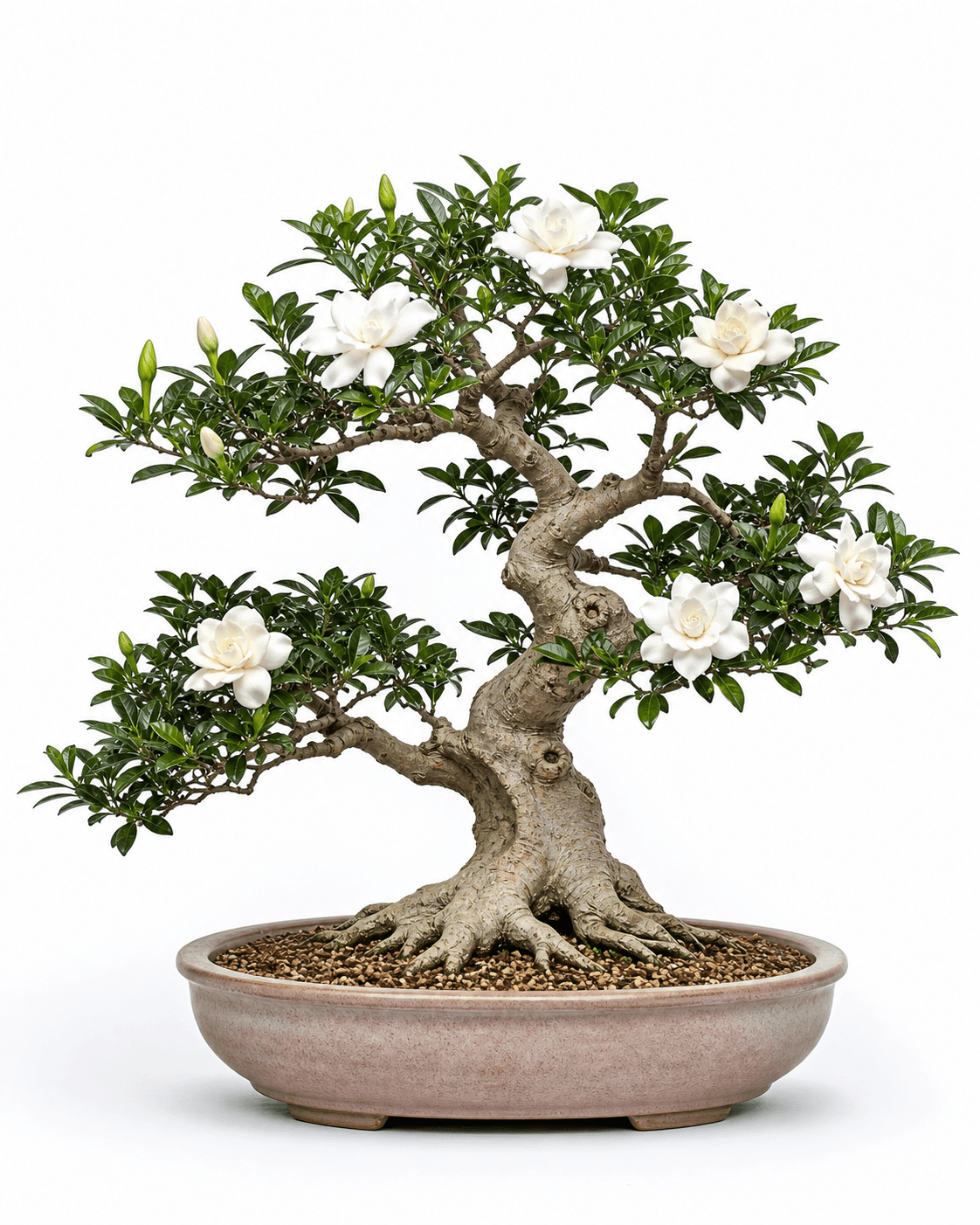
Gardenia bonsai, Gardenia jasminoides, is a fragrant subtropical broadleaf evergreen that rewards precise culture and punishes casual indoor handling. Grow it bright, warm, acidic, evenly moist, and airy, then prune after flowering so the next bloom cycle has time to form.
A June 2026 local corpus scan found Gardenia only in species-list and context mentions rather than a dedicated Gardenia claim set. This guide therefore applies Mirai tropical, broadleaf-evergreen, watering, soil, repotting, wiring, propagation, and design method transparently, then grounds Gardenia identity, acidity, hardiness, pests, diseases, bud drop, and cultivar facts in Kew, NC State, and Clemson Extension records.
The practical bonsai lesson is consistency. Gardenia drops buds, yellows leaves, and invites whiteflies or scale when light, water, soil pH, temperature, or root oxygen swing too far from its narrow comfort range.
Updated June 20, 2026. Written by EntGrove Editorial. Last verified June 20, 2026.
Care fingerprint
Read the species through its shared care pattern.
Treat indoor culture as a light-management problem first; prune and repot when the tree is actively growing and warm enough to recover. Use this as the starting point before local conditions and tree strength refine the calendar.
Note: Gardenia jasminoides is the accepted target. Older synonym and trade labels appear around cape jasmine, cape jessamine, Kuchinashi, Gardenia florida, Gardenia grandiflora, and Gardenia radicans; verify the exact plant before applying cultivar or hardiness claims.
Read the foliage first
Broadleaf stress usually shows in leaf color, leaf size, wilt, scorch, or delayed hardening before it becomes a branch problem.
Match work to dormancy
Deciduous, evergreen, tropical, succulent, and flowering broadleaf trees recover on different calendars.
Protect fine roots
Root work should preserve enough active fine roots for the tree to rehydrate quickly after the operation.
Care cadence
The calendar starts with the tree's seasonal state.
Placement
Timing: Give bright protected light, morning sun where climate allows, and steady air movement. Move outdoors after nights are reliably warm, then protect before cold drafts or near-freeze roots become likely.
Watch for: Bud drop after a move, leaf scorch in hot direct sun, weak pale growth in low light, cold glass, heating vents, and stagnant indoor air.
Clemson ExtensionNC State ExtensionBonsai Mirai LibraryWatering
Timing: Water when the upper soil begins to dry but before the root ball dries hard. Use rain water or low-alkalinity water when possible, then let the pot drain cleanly.
Watch for: Yellow new leaves from alkaline conditions, stale wet soil, hydrophobic nursery peat, salt buildup, and roots sitting in a tray of water.
Clemson ExtensionClemson Extension diseasesBonsai Mirai LibraryFertilizer
Timing: Feed during active growth with an acid-loving plant fertilizer. Reduce or stop feeding as autumn growth slows, especially where winter cold can damage tender late shoots.
Watch for: Chlorosis, coarse growth in weak light, fertilizer on cold roots, and fall feeding that pushes tender growth before winter.
Clemson ExtensionBonsai Mirai LibraryPruning
Timing: Prune after flowering in summer or after the main bloom flush. Shorten leggy shoots, remove spent flowers when fruit is being skipped, and keep interior light open.
Watch for: Cutting off the next bloom cycle, hedge-shearing a hollow shell, pinching weak shoots, and hard pruning during cold protection.
Clemson ExtensionBonsai Mirai LibraryLeaf work
Timing: Use selective leaf removal only to reveal pests, let light reach useful interior buds, or balance a vigorous refined tree. Avoid routine full defoliation on Gardenia.
Watch for: Defoliation used to solve large leaves caused by weak light, a recently repotted tree stripped of its energy source, and leaf removal before a bloom display.
Bonsai Mirai LibraryFlowering
Timing: Protect flower buds from sudden moves, cold drafts, dry heat, overwatering, underwatering, and pest pressure. Stop pruning display branches before the target bloom window.
Watch for: Bud drop, flower thrips, brown petals from handling, weak light, rapid temperature drops, and heavy fertilizer that favors foliage over bloom quality.
Clemson Extension diseasesClemson Extension insectsClemson ExtensionRepotting
Timing: Repot in spring or stable warm active growth when drainage, root fill, or poor nursery soil requires it. Keep root reduction gentle and aftercare quiet.
Watch for: Bare-rooting, alkaline soil, cold wet aftercare, root disturbance during bud set, and pairing major root work with heavy pruning.
Bonsai Mirai LibraryClemson ExtensionWiring
Timing: Wire young flexible branches in warm growth, then check often. Use pruning and guying for older wood and flowering branch placement.
Watch for: Wire bite on smooth bark, buds knocked off during styling, brittle older wood, and bends attempted while the tree is cold or dehydrated.
Bonsai Mirai LibraryBonsai Mirai / AsymmetryPests
Timing: Inspect new growth, buds, branch crotches, and leaf undersides through warm growth and during indoor or greenhouse protection.
Watch for: Whiteflies, scale, aphids, thrips, mealybugs, spider mites, honeydew, sooty mold, stippled leaves, curled shoots, and ants tracking sap-feeding pests.
Clemson Extension insectsNC State ExtensionClemson Extension diseasesWinter protection
Timing: Keep protected plants bright, airy, and above cold-draft stress. Reduce water to actual use while maintaining enough humidity and light for evergreen leaves.
Watch for: Leaf drop from cold roots, soggy soil, dry heated air, spider mites, whiteflies, and the temptation to prune hard while recovery speed is low.
Bonsai Mirai LibraryClemson Extension diseasesClemson ExtensionSpecies guide
Apply the species profile before copying another tree's calendar.
At a glance
Gardenia is a fragrant acid-loving evergreen with a narrow care lane.
The accepted botanical target is Gardenia jasminoides J.Ellis in Rubiaceae. Kew documents the accepted name, Asian native range, and a long synonym list; NC State lists gardenia, cape jasmine, cape jasmine gardenia, and cape jessamine as common names. Kew POWONC State Extension
The bonsai target is a compact flowering broadleaf evergreen with glossy dark leaves, white fragrant flowers, and enough branch structure to remain interesting between bloom cycles. The common retail image is a gift bonsai with flowers; the stronger long-term image is a warm-protected flowering shrub built patiently. Clemson ExtensionNC State ExtensionBonsai Mirai / Asymmetry
The source caveat matters. A June 2026 scan found Gardenia only as species-list or context mentions in soils, Pieris, azalea, cork oak, and 2021 National Show files. The local corpus lacks a dedicated Gardenia primer, so species facts here rely on public botanical and extension records. Bonsai Mirai LibraryKew POWOClemson Extension
Wild habitat
Its wild and garden history points to warmth, acidity, humidity, and filtered light.
Kew places Gardenia jasminoides across warm Asian regions including China, Japan, Taiwan, Thailand, Vietnam, Laos, Cambodia, Hainan, and the East Himalaya. NC State summarizes the origin as southern China, Taiwan, Japan, and Vietnam. Kew POWONC State Extension
That range supports the bonsai reading: this is a warm broadleaf evergreen that expects active roots, moisture, and an acidic root environment. Treat winter as protected evergreen culture, with lower water use but foliage that still needs light and roots kept above damaging cold. Bonsai Mirai LibraryClemson ExtensionNC State Extension
Clemson says gardenias have been grown in China for more than a thousand years and in South Carolina since the eighteenth century. The plant was valued first for fragrance and glossy foliage, which should remain the design premise for bonsai. Clemson Extension
For care, translate habitat into bright protected light, acid water and soil, even moisture, and warm recovery windows. For design, translate it into a flowering evergreen shrub image with open branch layers rather than a clipped green shell. Bonsai Mirai / AsymmetryClemson ExtensionNC State Extension
Reading
Read Gardenia through buds, leaf color, pest signs, and root oxygen.
Buds are the first diagnostic. Clemson lists bud drop as a stress response tied to thrips or aphids, nematodes, too much fertilizer, overwatering, underwatering, poor drainage, low light, cool weather, rapid temperature drops, and hot dry weather. Clemson Extension diseases
Leaf color is the second diagnostic. Clemson notes that yellow new foliage can reflect iron deficiency when gardenias are limed or planted near concrete, and NC State warns that nearby concrete can make soil too alkaline for good growth. Clemson ExtensionNC State Extension
Pest signs often show as honeydew, sooty mold, curled growth, stippling, or insects on the undersides of leaves. Clemson names whiteflies, scales, aphids, thrips, mealybugs, spider mites, and caterpillars as Gardenia problems. Clemson Extension insectsNC State Extension
Root oxygen decides whether the top symptoms can improve. Mirai soil and watering methods frame roots as a water and oxygen system; Gardenia adds the extra constraint of acidity and sensitivity to disturbance. Bonsai Mirai LibraryClemson ExtensionClemson Extension diseases
Pruning
Prune after bloom and protect the next flower cycle.
Clemson recommends pruning shrubs after they finish flowering in summer to remove straggly branches and faded flowers. In bonsai, that same post-bloom window is the best time to correct structure without sacrificing the display cycle. Clemson ExtensionBonsai Mirai / Asymmetry
Use that window to solve structure: shorten long shoots, remove duplicate junctions, open crowded interiors, and select the branches that will carry the next silhouette. Avoid repeated outer clipping that shades the center. Bonsai Mirai LibraryBonsai Mirai / Asymmetry
If flowers are the display goal, stop pruning the target branch tips before buds set. If structure is the goal, remove flowers or fruit from weak development material so energy returns to leaves, roots, and branch extension. Clemson ExtensionBonsai Mirai Library
Gardenia is sensitive during bud and flower stages because bud drop can follow pest pressure, water swings, low light, cold weather, rapid temperature drops, hot dry weather, and excess fertilizer. Detailed styling belongs outside the display moment. Clemson Extension diseases
Repotting
Repot gently in spring warmth and keep the root core alive.
Use an inspection rhythm rather than a fixed calendar. Check drainage, root fill, soil quality, and tree vigor each spring; act when the pot no longer drains, when nursery soil is failing, or when roots have filled the container. Bonsai Mirai LibraryClemson Extension
Clemson says gardenias resent root disturbance, which is important in a bonsai pot. Preserve enough fine roots and avoid dramatic bare-root work unless failing soil leaves no safer option. Clemson ExtensionBonsai Mirai Library
Mirai tropical method places major tropical work in active warmth, when the tree can replace roots and heal. A protected Gardenia that is cold, pest stressed, or carrying buds should wait unless the root problem is urgent. Bonsai Mirai Library
After repotting, secure the tree, water thoroughly, keep light bright but gentle, and reduce variables. A wobbly trunk, dry fine roots, alkaline water, or cold wet aftercare can undo an otherwise careful repot. Bonsai Mirai LibraryClemson Extension
Soil and pot
Use an acidic aggregate mix that drains like bonsai soil.
Clemson gives the gardenia soil target as acidic, pH below 6.0, moist, and well drained. In a bonsai pot, the same target has to be expressed through aggregate structure so the roots get both water and oxygen. Clemson ExtensionBonsai Mirai Library
A practical protected-culture starting mix is kanuma-led with pumice and a durable aggregate such as akadama or lava, adjusted to your water quality and winter storage. More kanuma increases acidity and water retention; more pumice and lava increase air and durability. Bonsai Empire Gardenia guideBonsai Mirai Library
Avoid dense peat cores, lime-heavy media, hard-water salt buildup, and trays that keep the pot sitting in water. Clemson connects Gardenia health to acidic conditions, and Mirai watering method keeps oxygen central. Clemson ExtensionBonsai Mirai LibraryClemson Extension diseases
Pot choice should support flower display and root moderation. Cream, muted green, warm gray, or quiet unglazed containers can frame white flowers and dark leaves without turning the pot into the dominant feature. Bonsai Mirai / AsymmetryClemson Extension
Climate
Outdoor warm-climate Gardenia and indoor-protected Gardenia need different calendars.
In Zone 8 and warmer landscape climates, Gardenia may spend much of the year outdoors with protection from harsh sun, drought, and severe cold. In a bonsai pot, protect roots earlier than the ground-grown shrub because container soil loses heat quickly. Clemson ExtensionBonsai Mirai Library
In colder regions, treat indoor time as winter protection. Mirai tropical method reserves major work for warm active conditions, and NC State recommends sheltering Gardenia from cold and strong winds to prevent winter burn. Bonsai Mirai LibraryNC State Extension
In hot dry regions, afternoon shade and steady water matter more than forcing all-day sun. Clemson prefers morning sun and afternoon shade, and bud drop can follow very hot dry weather. Clemson ExtensionClemson Extension diseases
In humid regions or greenhouses, airflow and pest inspection become the limiting factors. Dense leaves, whiteflies, scale, and sooty mold can build before the tree looks weak from the front. Clemson Extension insectsClemson Extension diseases
Pests
Sap-feeding insects and stress diseases are Gardenia routine work.
Clemson lists whiteflies, scales, aphids, thrips, mealybugs, spider mites, and caterpillars among Gardenia insect problems. NC State also flags whiteflies, aphids, scales, thrips, mealybugs, spider mites, and caterpillars. Clemson Extension insectsNC State Extension
Scales and whiteflies matter because they produce honeydew that supports sooty mold. Clemson explains that sooty mold grows on honeydew from sap-sucking insects and can reduce vigor when severe by blocking light. Clemson Extension insectsClemson Extension diseases
Disease and stress work starts with culture. Clemson lists canker, nematodes, sooty mold, bud drop, and yellowing leaves among Gardenia problems, with water, drainage, light, temperature, nutrition, and pest pressure repeatedly tied to symptoms. Clemson Extension diseases
On a bonsai, isolate new purchases, inspect undersides with magnification, wash or prune minor pest sites early, and follow local extension guidance before using pesticides on a flowering plant. Clemson Extension insectsBonsai Mirai Library
Wiring
Wire young shoots in warmth and let pruning do most refinement.
Wire young branches in warm active growth, when recovery is available and bark is less brittle. Cold storage is the wrong moment for bends that need callus, sap flow, and follow-up growth. Bonsai Mirai LibraryBonsai Mirai / Asymmetry
Use wire for young primary placement, then rely on pruning, directional buds, and guying for much of the branch structure. Older Gardenia wood and flower-bearing shoots are poor candidates for forceful bends. Bonsai Mirai / Asymmetry
Avoid wiring through a display bud set. Buds can drop from stress, handling, pests, or temperature swings, and a styling session can add several of those triggers at once. Clemson Extension diseases
Check wire often during warm feeding. Smooth evergreen bark can mark quickly, and Gardenia flower display is strongest when scars do not compete with foliage and bloom. Bonsai Mirai LibraryBonsai Mirai / Asymmetry
Propagation
Cuttings, layering, seed, and grafting are possible, but cuttings are the useful bonsai route.
NC State lists grafting, layering, seed, and stem cutting as recommended propagation strategies for Gardenia jasminoides. For bonsai, stem cuttings and layers are the most useful routes because they preserve known leaf, flower, and internode traits. NC State ExtensionBonsai Mirai / Asymmetry
For bonsai, cuttings preserve a compact leaf form, branch habit, or cultivar trait. Seed gives variation but takes longer to reveal whether the plant has workable internodes and flower scale. Bonsai Mirai / AsymmetryNC State Extension
Air layering is useful when an existing branch already has a better trunk line than any nursery start. Keep the layer warm, shaded from harsh dry wind, and free of flower load while roots form. NC State ExtensionBonsai Mirai Library
Keep labels with propagated material. Gardenia jasminoides, Gardenia radicans, cape jasmine, and dwarf cultivar names can matter for leaf size, cold tolerance, flower size, and future sourcing decisions. Kew POWOClemson Extension
Buying
Buy for roots, compact foliage, and climate tolerance before flowers.
Retail Gardenia often arrives in a shallow container, a humidity tray, and a bloom-heavy top. Inspect the root ball, drainage, label, pest status, and branch structure before assuming it is ready for display care. Clemson Extension insectsClemson Extension diseasesBonsai Mirai / Asymmetry
Good source material has a clear Gardenia jasminoides or cultivar label, compact leaves, active interior buds, a visible root base, flexible young branches, and soil that can be transitioned without destroying all fine roots. Clemson ExtensionNC State ExtensionBonsai Mirai / Asymmetry
Reject or quarantine plants with sticky leaves, whiteflies, scale bumps, mite stippling, flower thrips, sour soil, yellow new leaves near alkaline water, heavy root disturbance, or a weak plant forced into bloom for sale. Clemson Extension insectsClemson Extension diseasesClemson Extension
Choose cultivar size deliberately. A small-leaf or dwarf form is more useful for small bonsai, while large-flowered landscape cultivars may need medium or larger designs so the flowers fit the image. Clemson ExtensionNC State ExtensionBonsai Mirai / Asymmetry
Troubleshooting
Most Gardenia failures trace to pH, water, light, temperature, or pests.
Symptom: buds drop before opening. Likely causes: thrips or aphids, nematodes, excess fertilizer, overwatering, underwatering, poor drainage, insufficient light, cool weather, rapid temperature drops, or hot dry weather. Fix: stabilize the bench first, then inspect pests and roots. Clemson Extension diseases
Symptom: new leaves yellow with green veins. Likely causes: alkaline water or soil, concrete exposure, iron unavailability, or stressed roots. Fix: review water source, use acidic soil, and avoid stronger fertilizer until roots and pH are corrected. Clemson ExtensionNC State Extension
Symptom: sticky leaves or black coating. Likely causes: whiteflies, scales, aphids, mealybugs, or nearby honeydew dripping onto the tree. Fix: identify the insect, clean foliage, increase airflow, and follow local IPM guidance. Clemson Extension insectsClemson Extension diseases
Symptom: leaves droop while the soil is wet. Likely causes: cold roots, oxygen-starved soil, root rot, recent root disturbance, or a dense nursery core. Fix: improve warmth and airflow, reduce watering to actual use, and plan staged soil correction in the proper window. Bonsai Mirai LibraryClemson Extension diseases
Symptom: no flowers. Likely causes: weak light, pruning at the wrong time, immature material, too much nitrogen, winter stress, or repeated position changes. Fix: strengthen the tree, prune after bloom, and set a steady light and temperature pattern before the next bud cycle. Clemson ExtensionClemson Extension diseasesBonsai Mirai Library
Symptom: repeated indoor decline. Likely causes: low light, dry heated air, cold drafts, hard water, pest buildup, and wet soil. Fix: use stronger light, better airflow, acidic water, warmer roots, and outdoor recovery when nights are safe. Bonsai Mirai LibraryClemson Extension insectsClemson Extension diseases
Design
Style Gardenia as a fragrant flowering evergreen, with negative space around the bloom.
Begin with root base, trunk line, defining branch, and apex. Flowers should support those decisions, not hide a weak structure behind a temporary display. Bonsai Mirai / Asymmetry
Gardenia lends itself to compact shrub images: informal upright, slanting, twin trunk, clump, exposed-root, and semi-cascade when the trunk line already suggests it. Clean branch forks and interior light matter more than a perfectly rounded hedge outline. Bonsai Mirai / AsymmetryClemson Extension
Use contrast as the design engine. Dark glossy leaves make white flowers visually strong, so the tree needs quiet branch spacing, a restrained pot, and enough foliage mass to make the bloom feel earned. Clemson ExtensionBonsai Mirai / Asymmetry
Deadwood is rarely the defining Gardenia feature. Keep scars small, wounds clean, and the image alive, fragrant, and well hydrated rather than forcing aged conifer language onto a flowering evergreen shrub. Bonsai Mirai / Asymmetry
Cultivars
Cultivar choice changes leaf scale, flower size, and cold risk.
Clemson lists many landscape cultivars and notes differences in size, bloom form, reblooming, and cold tolerance. Mystery, August Beauty, First Love, Frost Proof, Summer Snow, Kleim's Hardy, Pinwheel, Jubilation, Heaven Scent, and Scent Amazing all point to different plant sizes and flower traits. Clemson Extension
For bonsai, dwarf and compact forms are often more useful than the showiest flowers. Clemson warns that dwarf cultivars can be more cold sensitive, so a smaller leaf does not remove the need for winter planning. Clemson ExtensionBonsai Mirai / Asymmetry
Kew lists Gardenia radicans and Gardenia jasminoides var. radicans among synonym records, and the trade may use radicans for compact gardenia material. Keep the nursery label and observe the actual leaf, branch, and flower scale before committing to shohin design. Kew POWOClemson Extension
Large double-flowered cultivars can be beautiful on medium bonsai, but the branch structure must support the visual weight. A tiny trunk under a 4-inch flower reads as florist stock, not mature bonsai. Clemson ExtensionBonsai Mirai / Asymmetry
History
Gardenia brings cultural weight, fragrance, and exhibition risk.
Clemson records more than a thousand years of Chinese cultivation and South Carolina garden use since the eighteenth century. It also notes that the genus name honors Alexander Garden, the Scottish naturalist associated with colonial South Carolina. Clemson Extension
Mirai lists Gardenia as Kuchinashi in a National Show reflection file, which confirms that the species appears in serious exhibition conversations even though the local corpus does not provide a dedicated care primer. Bonsai Mirai Library
Gardenia fruit has its own cultural story. NC State notes yellow dye extracted from the fruit for food and clothing and use in Chinese herbal medicine; Clemson calls the orange fruit Gardenia hips. NC State ExtensionClemson Extension
The exhibition standard is unforgiving because flowers reveal every handling error. A Gardenia bonsai should arrive with clean leaves, no honeydew, no pest distortion, stable buds, well-spaced branches, and a pot that lets fragrance and foliage carry the display. Clemson Extension insectsClemson Extension diseasesBonsai Mirai / Asymmetry
Species questions
Answer the beginner questions before styling.
Is Gardenia a good bonsai species?
Yes, for a grower who can manage bright protected light, acidic water and soil, warm roots, pests, and stable flowering conditions. It is less forgiving than ficus.
Can Gardenia bonsai live indoors?
Indoor protection can work with strong light, airflow, humidity, acidic water, and warm roots. Ordinary dim rooms usually lead to bud drop, yellow leaves, pests, and wet soil problems.
What is the accepted botanical name for Gardenia bonsai?
Use Gardenia jasminoides J.Ellis. Older or trade labels may include cape jasmine, cape jessamine, Gardenia florida, Gardenia grandiflora, or Gardenia radicans.
How much sun does Gardenia bonsai need?
Use bright light, often morning sun with afternoon shade in hot climates. Avoid weak indoor light and harsh direct heat that dries buds and roots too quickly.
What water is best for Gardenia bonsai?
Rain water or low-alkalinity water is best. Gardenia is acid-loving, and hard alkaline water can contribute to chlorosis and poor root function.
When should I prune Gardenia bonsai?
Prune after flowering, usually after the main summer bloom flush. Pruning too late or too often can remove the branch tips needed for flowers.
When should I repot Gardenia bonsai?
Repot in spring or stable warm active growth, commonly on a 2-3 year inspection rhythm. Use gentle root work and acidic, well-drained soil.
Why is my Gardenia bonsai dropping buds?
Common causes include pests, too much fertilizer, overwatering, underwatering, poor drainage, low light, cool weather, temperature swings, and hot dry conditions.
Why are Gardenia bonsai leaves turning yellow?
Yellowing can come from normal old-leaf shed, alkaline water or soil, iron unavailability, poor drainage, cold roots, pests, nematodes, or weak nutrition.
What pests attack Gardenia bonsai?
Whiteflies, scales, aphids, thrips, mealybugs, spider mites, caterpillars, and root-knot nematodes are common Gardenia problems. Honeydew and sooty mold often point to sap-feeding insects.
Sources
Species advice needs source discipline.
Next decisions
Plan the operation before copying the calendar.
A good care note for Gardenia records the tree's stage, the work done, and the aftercare used. That record matters more than a month-name rule.
Related species
Compare nearby trees before transferring advice.
Ficus retusa / Indian laurel
Ficus microcarpa
Tigerbark ficus
Ficus microcarpa 'Tigerbark'
Willow-leaf ficus
Ficus salicaria
Benjamin fig
Ficus benjamina
Ginseng ficus
Ficus microcarpa 'Ginseng'