
Species guide
Pacific Yew Bonsai Care
Taxus brevifolia
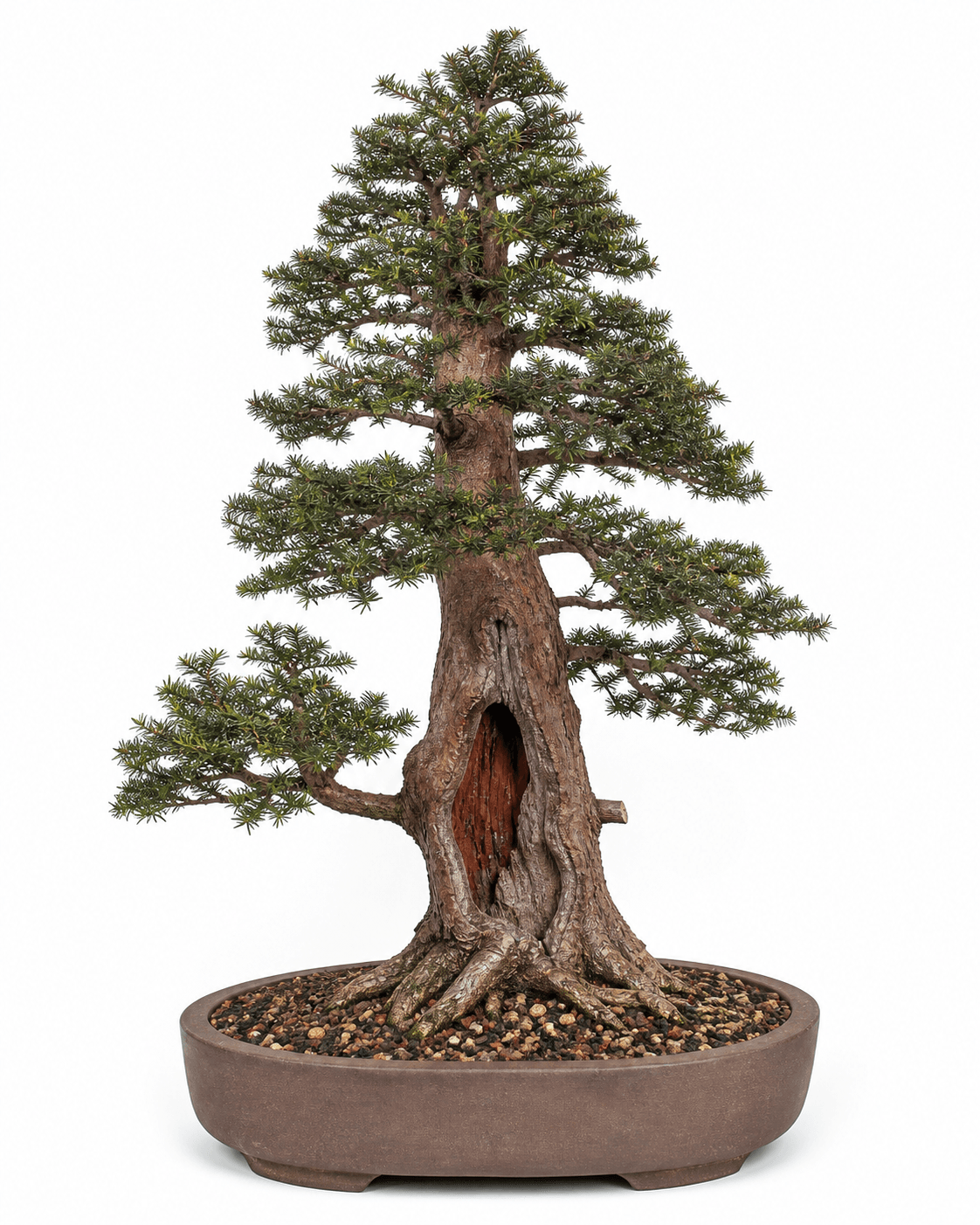
Pacific yew bonsai are outdoor, shade-tolerant Taxus conifers from western North America. They need cool roots, bright filtered light, oxygenated soil, careful spring repotting, and patient pruning that builds interior buds before any large reduction.
The local Mirai corpus has broad Taxus method and one Pacific-yew-specific habit comparison rather than a dedicated Pacific yew program. Treat the species as a columnar western yew with Taxus roots and back-budding behavior, then ground climate and sourcing decisions in its native understory ecology.
Updated June 4, 2026. Written by EntGrove Editorial. Last verified June 4, 2026.
Care fingerprint
Read the species through its shared care pattern.
Strong light, cool-root management, conservative root work, and post-extension pruning dominate the care calendar. Use this as the starting point before local conditions and tree strength refine the calendar.
Note: Kew accepts Taxus brevifolia and places it in western North America. Oregon State lists Zone 6 and western yew / California yew / Oregon yew labels; USDA Silvics and FEIS ground the western North American understory ecology. Mirai has broad Taxus method plus one brevifolia habit comparison, so apply Taxus roots, back-budding, and pruning timing transparently rather than claiming dedicated Pacific yew coverage.
Do not prune like a pine
Elongating conifers extend from buds and shoots, so candle-cutting assumptions can remove the exact growth the tree needs.
Preserve interior growth
Spruce, fir, hemlock, cedar, redwood, cypress, and larch all become harder to design when interior buds are shaded out.
Keep recovery cool and steady
Many elongating conifers respond best when roots stay evenly moist, oxygenated, and protected from hot dry swings.
Care cadence
The calendar starts with the tree's seasonal state.
Watering
Timing: Check daily in active growth and heat; water when the surface begins to dry while the root mass remains faintly moist.
Watch for: Needle dulling, root-zone heat, old organic soil, and sour drainage all matter more than a fixed calendar.
Bonsai Mirai LibraryPacific Northwest Plant Disease Management HandbookRepotting
Timing: Spring bud swell, before new needles visibly open. Established bonsai often tolerate a 3 to 5 year rhythm.
Watch for: White or swelling terminal buds, live root tips, a firm tie-down plan, and enough foliage retained to power recovery.
Bonsai Mirai LibraryDevelopment pruning
Timing: Let selected shoots extend through the growing season, then reduce once the tree has stored energy.
Watch for: Interior buds, branch thickness, and stored vigor. Repeated small pinching can weaken a slow Pacific yew.
Bonsai Mirai LibraryBack-budding cutback
Timing: After the first hard freeze on a prepared tree, followed by frost protection for the rest of dormancy.
Watch for: Only use this on strong trees that were fed, allowed to extend, and kept healthy through the season.
Bonsai Mirai LibraryRefinement pruning
Timing: Late spring to early summer after the spring flush has elongated and hardened.
Watch for: Cut strong shoots back to interior buds and preserve weaker interior growth that will become the next pad layer.
Bonsai Mirai LibraryWiring
Timing: Late spring after growth hardens, or early fall on strong trees with winter protection available.
Watch for: Thin bark, slow scar healing, and brittle old wood. Remove or adjust wire before swelling marks the trunk.
Bonsai Mirai LibrarySummer protection
Timing: Provide shade through the hottest part of summer, especially in dry inland regions and after root work.
Watch for: Hot pots, dry wind, and full afternoon sun can outpace the species even when landscape plants tolerate shade.
Bonsai Mirai LibraryUSDA Forest Service SilvicsFeeding
Timing: Feed steadily in development after growth starts, then taper before deep winter cold.
Watch for: A tree being prepared for major back-budding cuts needs extension and reserves more than constant silhouette control.
Bonsai Mirai LibrarySpecies guide
Apply the species profile before copying another tree's calendar.
At A Glance
Pacific yew is a slow western Taxus that asks for cool roots and patient pruning.
Pacific yew is Taxus brevifolia, a Taxaceae conifer native to western North America. Kew accepts the name, while USDA and Oregon State sources use the Pacific yew, western yew, Oregon yew, and California yew labels. Kew POWOOregon State Landscape PlantsUSDA Forest Service Silvics
For bonsai, treat it as an outdoor elongating conifer with Taxus roots and Taxus back-budding behavior. It is slower and less commonly available than English or Japanese yew, but the small needles, shade tolerance, red heartwood, and columnar habit give it a distinct western character. Bonsai Mirai LibraryUSDA Forest Service Silvics
The safest first-year plan is simple: verify the label, keep the tree outdoors in bright filtered light, water for oxygen rather than saturation, avoid major root and foliage work in the same season, and let shoots extend until you can see where interior buds are forming. Bonsai Mirai LibraryPacific Northwest Plant Disease Management Handbook
Wild Habitat
Its native forest explains the care: shade tolerance, cool moisture, and slow stored strength.
USDA describes Pacific yew as a western North American understory tree, distributed from southeastern Alaska and British Columbia south through Washington, Oregon, California, Idaho, Montana, and adjacent interior mountain regions. It often appears scattered rather than dominant. USDA Forest Service SilvicsUSDA Forest Service FEIS
In the wild it occupies moist forest, ravines, stream-adjacent slopes, and shaded mixed-conifer settings. That ecology does not mean a bonsai should be kept dark. It means the pot should stay cool and evenly moist while the foliage receives enough light to build interior buds. USDA Forest Service SilvicsUSDA Forest Service FEISBonsai Mirai Library
The design lesson is vertical restraint. Mirai notes that brevifolia tends toward an upright columnar form that can be pulled into a rounded silhouette. Start from that natural habit rather than forcing it into a pine triangle or a flattened juniper pad image. Bonsai Mirai LibraryBonsai Mirai / Asymmetry
The care implication is root temperature. A Pacific yew in a shallow pot has less forest duff, less soil depth, and less evaporative buffering than the wild tree. Summer shade, wind moderation, and an akadama-heavy but aerated mix protect the root system that drives back budding later. Bonsai Mirai LibraryUSDA Forest Service Silvics
Reading The Tree
Read Pacific yew by stored strength, bud position, and branch thickness.
Taxus stores usable strength in vascular tissue through the trunk and branches. That is why prepared yews can respond to hard pruning with dense back budding, and why weak yews that have been clipped all season often answer with sparse, cautious growth. Bonsai Mirai Library
Development trees need extension. Let selected shoots run, feed after growth begins, and preserve enough foliage to thicken branches. A Pacific yew that has no interior buds is still being built, even if the outline already looks tidy. Bonsai Mirai Library
Refinement begins when interior buds, shorter shoots, and a stable root system are already present. Then pruning can replace wire as the main tool: cut strong growth back to usable buds, protect weaker interior growth, and let new tufts mature into the next layer of the pad. Bonsai Mirai Library
The source caveat matters. Mirai has deep Taxus method, direct English and Japanese yew material, and one Pacific yew habit comparison. This page therefore applies genus-level Taxus physiology cautiously and uses public western North American sources for ecology, range, and hardiness. Bonsai Mirai LibraryKew POWOUSDA Forest Service Silvics
Pruning
Use pruning to build interior buds before asking for a finished silhouette.
Do not keep a developing Pacific yew in a constant hedge clip. Mirai Taxus method favors extension first, then deliberate reduction. Repeated pinching of every shoot removes the foliage that would have fed the vascular system and root pad. Bonsai Mirai Library
For refinement, pinch only the strongest soft shoots that exceed the silhouette and leave a portion of new growth intact. After the flush hardens, cut long or vertical shoots back to interior buds while preserving weaker buds that will form compact ramification. Bonsai Mirai Library
For back budding on older wood, prepare for a full season. Allow extension, feed, protect roots, and avoid major stress. After the first hard freeze moves reserves inward, a strong Taxus can be pruned back while retaining some old foliage on each branch. Bonsai Mirai Library
That post-freeze cutback requires aftercare. Once the tree begins reallocating cold-hardiness reserves into bud production, shelter it from deeper freezing for the rest of dormancy. This is an advanced move for strong material, not routine annual maintenance. Bonsai Mirai Library
Repotting
Repot at bud swell and preserve the fleshy Taxus root system.
The high-tolerance root window is spring bud swell, when terminal buds are swelling and beginning to show white before opening. Once the new needles are visibly shaped, Mirai treats the Taxus repotting window as closed. Bonsai Mirai Library
Pacific yew roots should be handled like Taxus roots: soft, fine, fleshy, and easily damaged by tearing. Secure the tree firmly, work roots in stages, and preserve an untouched zone rather than bare-rooting the whole conifer. Bonsai Mirai Library
Avoid balancing a heavy root reduction with heavy foliage reduction. Mirai repotting method for elongating conifers preserves one side of the energy system while the other side recovers. Roots and foliage should not both be drastically reduced in the same season. Bonsai Mirai Library
Collected or field-dug yew needs even more patience. Prepare by reducing foliage while the tree is still established, let interior buds rebuild, then move the root system in a later operation. Freshly collected roots are preserved and arranged rather than pruned aggressively. Bonsai Mirai Library
Soil And Pot
Use an akadama-heavy mix and a pot that keeps the root zone cool.
A Mirai-derived Taxus baseline is 3 parts akadama, 1 part pumice, and 1 part lava in moisture-rich climates. In drier climates, the akadama portion can rise toward 4 parts while pumice and lava preserve oxygen. Bonsai Mirai Library
The goal is a root pad with moisture, nutrition holding, and air. Akadama supports fine root development and nutrient exchange; pumice and lava prevent the dense wet core that invites root disease when a yew is overpotted or underlit. Bonsai Mirai LibraryPacific Northwest Plant Disease Management Handbook
Pot choice should match the western-yew character. A deeper oval, soft rectangle, drum, forest slab, or quiet unglazed pot usually fits better than a very shallow show pot during development. Move shallower only after the root pad is compact and reliable. Bonsai Mirai / AsymmetryBonsai Mirai Library
Because Pacific yew is often slower than common nursery yews, potting decisions should favor horticulture first. A slightly deeper, cooler pot that keeps roots active is more valuable than a dramatic container that bakes in summer. Bonsai Mirai LibraryOregon State Landscape Plants
Climate
Pacific yew adapts best to cool outdoor growing, with summer heat as the main container risk.
Oregon State lists Pacific yew for USDA Zone 6 and describes it as a western North American plant. USDA sources show the broader ecological truth: it lives across maritime forests and interior mountain sites, often as a scattered understory tree. Oregon State Landscape PlantsUSDA Forest Service SilvicsUSDA Forest Service FEIS
In cool maritime climates, give morning sun or bright open shade and protect from prolonged drying wind. In dry inland climates, raise shade and humidity, mulch the pot surface lightly, and place the container where afternoon sun will not cook the root ball. Bonsai Mirai LibraryUSDA Forest Service Silvics
In cold regions, protect the pot rather than the foliage first. The species needs dormancy, but container roots freeze harder and thaw faster than forest roots. Use a cold frame, mulch bed, or sheltered ground placement to limit root desiccation and freeze-thaw cycling. Bonsai Mirai LibraryOregon State Landscape Plants
Indoor culture is not a durable plan. Pacific yew needs outdoor light, air movement, winter rest, and cool nights. A few weeks of display indoors can be tolerated only when the tree is otherwise healthy and returned outside promptly. Bonsai Mirai LibraryOregon State Landscape Plants
Pests
Most Pacific yew bonsai problems begin with roots, dense shade, or stagnant foliage.
USDA FEIS describes Pacific yew as generally resistant to many insects and diseases in the wild, but bonsai containers change the risk profile. Heat, compacted soil, and overwatering can turn a naturally durable understory tree into a root-stressed plant. USDA Forest Service FEISPacific Northwest Plant Disease Management Handbook
Root rot is the first disease concern to rule out. The Pacific Northwest Plant Disease Management Handbook covers yew root rot for Taxus species, with wet soil, susceptible roots, and infected nursery or landscape soil as practical risk factors. Pacific Northwest Plant Disease Management Handbook
Dense pads can hide scale, mealybugs, mites, and honeydew-related sooty film. Open the interior enough for inspection, improve airflow, and identify the pest before using a locally labeled treatment. NC State Extension conifer pestsBonsai Mirai Library
Toxicity is a handling issue, not a pest. Yew leaves, wood, bark, and seeds are poisonous, while the red aril tissue is the only fleshy part often described separately. Keep clippings, carving dust, and seeds away from pets, children, livestock, wildlife, and compost piles. Oregon State Landscape PlantsUSDA Forest Service Silvics
Wiring
Wire after pruning decisions, then watch scars closely.
Mirai Taxus method is pruning-led. Set the primary branch choices first, remove unusable downward shoots, then wire branches that are thick enough to hold a useful line. Wiring every weak twig slows the work and increases scar risk. Bonsai Mirai Library
Late spring after growth hardens is the best bending window. Early fall can also work on strong trees if winter protection is available. Old yew wood and live tissue can separate under heavy force, so large bends need guy wires, staged pressure, and a backup design. Bonsai Mirai Library
Wire scars matter because Taxus wound healing is slow. Thin bark can hold marks for years until swelling absorbs them. Check frequently during active growth, especially on strong vertical shoots and young branches near the trunk. Bonsai Mirai Library
For fine pads, wire secondaries into flat or slightly rising fans, then let later elongation create depth. Pacific yew naturally starts more columnar than many yews, so a rounded old crown should be built over cycles rather than forced in one styling. Bonsai Mirai LibraryBonsai Mirai / Asymmetry
Propagation
Cuttings preserve the plant, while seed and collection raise legal and ethical questions.
USDA Silvics describes Pacific yew reproduction through seed, arils, animal dispersal, and vegetative layering or sprouting under some conditions. Seedlings are slow, variable, and often sex-unknown for a long time. USDA Forest Service SilvicsUSDA Forest Service FEIS
Cuttings are the practical nursery route when you want the same needle scale and growth habit. Treat them as slow conifer cuttings: semi-ripe material, clean medium, bottom warmth if appropriate, high humidity, and patience. USDA Forest Service SilvicsBonsai Mirai Library
Mirai treats Taxus air layering as difficult. A layer is more realistic when a living branch remains below the layer point as a sap-flow safety net. Without that branch, success is poor and the upper section may fail before roots form. Bonsai Mirai Library
Wild collection requires permission, ecological judgment, and restraint. Pacific yew has a history of medicinal bark harvest pressure, and old understory trees are slow to replace. Use legal nursery, salvage, or field-grown stock before considering wild material. USDA Forest Service SilvicsUSDA Forest Service FEIS
Buying
Buy for label confidence, root health, trunk character, and interior buds.
Good Pacific yew starter material has a verified Taxus brevifolia label, a visible base, healthy dark green needles, interior buds, branch options near the trunk, and a root system that can be moved into bonsai soil without removing all strength at once. Kew POWOBonsai Mirai Library
Inspect nursery stock for buried root flares, compacted peat, circling roots, dead inner branches, heavy shearing, and straight columnar trunks with no usable branch placement. Columnar habit can become a design asset only when the base and branch options are already present. Bonsai Mirai LibraryOregon State Landscape Plants
Separate Pacific yew from English yew, Japanese yew, hybrid yew, Cephalotaxus, and Podocarpus before applying a schedule. Mirai notes baccata as finer and slightly lower in vigor, cuspidata as coarser and stronger, and brevifolia as more upright or columnar. Bonsai Mirai Library
Avoid freshly dug old yew with no new roots, no interior buds, or recent styling scars. A slow species can sit green on stored reserves while the root system is failing, so demand evidence of recovery before paying for collected age. Bonsai Mirai Library
Troubleshooting
Diagnose Pacific yew through roots, reserves, exposure, and timing.
Symptom: weak growth after repotting. Likely cause: root work after needles opened, torn fleshy roots, tree movement in the pot, or simultaneous foliage reduction. Fix: stabilize shade, wind protection, watering, and tie-down; delay further work. Bonsai Mirai Library
Symptom: brown tips after summer heat. Likely cause: hot container roots, dry wind, full afternoon sun, or a root pad that cannot rehydrate evenly. Fix: move to bright shade, cool the pot, water thoroughly, and avoid fertilizer until recovery is visible. Bonsai Mirai LibraryUSDA Forest Service Silvics
Symptom: yellowing, sour smell, or branch dieback in wet soil. Likely cause: root rot pressure or a compacted organic core. Fix: correct watering and drainage, then repot at the next bud-swell window only if the tree is strong enough. Pacific Northwest Plant Disease Management HandbookBonsai Mirai Library
Symptom: no interior buds after cutback. Likely cause: the tree was weak, shaded too deeply, pinched repeatedly, or cut back before reserves were built. Fix: give brighter filtered light, feed, let shoots extend, and postpone heavy reduction. Bonsai Mirai Library
Symptom: wire marks that linger. Likely cause: thin bark and slow Taxus wound closure. Fix: remove wire earlier, use guy wires where possible, and allow swelling time rather than recutting the scarred area repeatedly. Bonsai Mirai Library
Symptom: sticky foliage or black film. Likely cause: scale, mealybug, aphids, or another honeydew-producing pest hidden in dense foliage. Fix: thin for airflow, identify the pest, wash or treat with a labeled product, and monitor the interior. NC State Extension conifer pests
Design
Style Pacific yew as a quiet western understory tree with hollow age.
The defining Taxus design feature is hollow, inside-out aging. Mirai Taxus files describe deadwood that rots from the core while a harder exterior shell remains. Carving should reveal interior shadow, foreground, and background instead of drawing unrelated grooves on the surface. Bonsai Mirai LibraryBonsai Mirai / Asymmetry
Pacific yew adds a western forest voice to that Taxus language. A narrow trunk, dark foliage, shaded understory origin, and columnar habit can support informal upright, clump, raft, forest, hollow trunk, or rounded old-crown designs. Bonsai Mirai LibraryUSDA Forest Service Silvics
Build pads flat first. Mirai lays Taxus primary branches flat, turns secondary growth into the primary line at acute angles, then relies on repeated extension and pruning to build depth. This is especially useful on Pacific yew because growth is too slow to waste on decorative wiring. Bonsai Mirai Library
Old Pacific yew designs should stay restrained. The best image is often a weathered small tree from a dim conifer forest: strong base, few meaningful branches, hollow or red heartwood where appropriate, dark negative space, and a crown that rounds out through time. Bonsai Mirai / AsymmetryUSDA Forest Service FEIS
Forms
Pacific yew is usually species material, not a cultivar-shopping tree.
Unlike English and Japanese yew, Pacific yew does not appear in bonsai commerce with a large stable list of named cultivars. Most useful material is species stock, local nursery material, field-grown plants, legal salvage, or carefully sourced native-plant nursery stock. Oregon State Landscape PlantsUSDA Forest Service Silvics
Common names are the main label issue. Pacific yew, western yew, Oregon yew, and California yew can all point to Taxus brevifolia. Hybrid yew, Japanese yew, English yew, plum yew, and Buddhist pine point elsewhere and need separate care assumptions. Oregon State Landscape PlantsKew POWOBonsai Mirai Library
When two Pacific yew plants are available, choose by bonsai structure rather than name novelty: compact needles, low branches, visible root flare, useful trunk movement, and interior buds outrank height or dense retail foliage. Bonsai Mirai Library
Female plants can make red arils, which are visually useful but require cleanup and toxic-seed handling. Seed-bearing display should be managed so children, pets, wildlife, and livestock cannot access fallen material. Oregon State Landscape PlantsUSDA Forest Service Silvics
History
Pacific yew carries a medicinal and ecological history that should shape sourcing ethics.
Pacific yew became widely known beyond forestry because its bark was associated with taxane cancer-drug development. USDA sources document the species and its forest context, which is why ethical sourcing matters when old bark and wild populations are part of the story. USDA Forest Service SilvicsUSDA Forest Service FEIS
As bonsai material, Pacific yew is less documented in the public record than English or Japanese yew. That scarcity should raise the editorial bar. Describe what can be sourced, name the limits of Mirai coverage, and avoid inventing a Japanese exhibition lineage for a western native tree. Bonsai Mirai LibraryBonsai Mirai / Asymmetry
The notable design opportunity is North American character. A strong Pacific yew bonsai can read as a shadowed western understory tree rather than a borrowed European churchyard yew or Japanese garden cultivar. USDA Forest Service SilvicsBonsai Mirai / Asymmetry
A credible exhibition Pacific yew should show an old root base, quiet branch selection, compact dark foliage, restrained carving, protected hollow deadwood, and a crown that respects the species tendency toward upright columnar growth rounded by pruning cycles. Bonsai Mirai Library
Species questions
Answer the beginner questions before styling.
Can Pacific yew be grown as bonsai?
Yes. Pacific yew can be grown as bonsai outdoors when it receives cool roots, bright filtered light, oxygenated soil, cold dormancy, and patient Taxus-style pruning.
Can Pacific yew bonsai live indoors?
Pacific yew belongs outdoors. It needs natural light, air movement, seasonal dormancy, and cool nights for long-term health.
When should I repot Pacific yew bonsai?
Repot in spring when terminal buds swell and begin to show white, before new needles open. Preserve fleshy roots and avoid heavy foliage reduction that year.
Does Pacific yew back-bud on old wood?
Pacific yew should be treated like Taxus: it can back-bud strongly when prepared with extension, feeding, and health, but weak trees cut hard may respond poorly.
How is Pacific yew different from English and Japanese yew?
The Mirai corpus describes English yew as finer and slightly lower in vigor, Japanese yew as coarser and stronger, and Pacific yew as more upright or columnar.
What soil mix works for Pacific yew bonsai?
Use an akadama-heavy Taxus mix such as 3 parts akadama, 1 part pumice, and 1 part lava. Increase water-holding slightly in dry climates while preserving drainage.
Is Pacific yew poisonous?
Yes. Yew leaves, bark, wood, seeds, and many clippings are poisonous. Keep pruning waste, carving dust, and seeds away from people, pets, livestock, wildlife, and compost.
Should I pinch Pacific yew?
Pinch only the strongest refined shoots that break the silhouette. Developing Pacific yew needs extension first so it can build vascular reserves and interior buds.
Why is my Pacific yew turning brown?
Common causes include wet roots, hot container roots, dry wind, root work after the safe spring window, hidden scale or mites, and cutback before reserves were built.
What styles suit Pacific yew bonsai?
Informal upright, forest, clump, raft, hollow trunk, collected naturalistic, and rounded old-crown designs suit Pacific yew when the design respects its columnar western character.
Sources
Species advice needs source discipline.
Next decisions
Plan the operation before copying the calendar.
A good care note for Pacific yew records the tree's stage, the work done, and the aftercare used. That record matters more than a month-name rule.
Related species
Compare nearby trees before transferring advice.
Subalpine fir
Abies lasiocarpa
Balsam fir
Abies balsamea
White fir
Abies concolor
Noble fir
Abies procera
Mountain hemlock
Tsuga mertensiana