
Species guide
Cork Oak Bonsai Care
Quercus suber
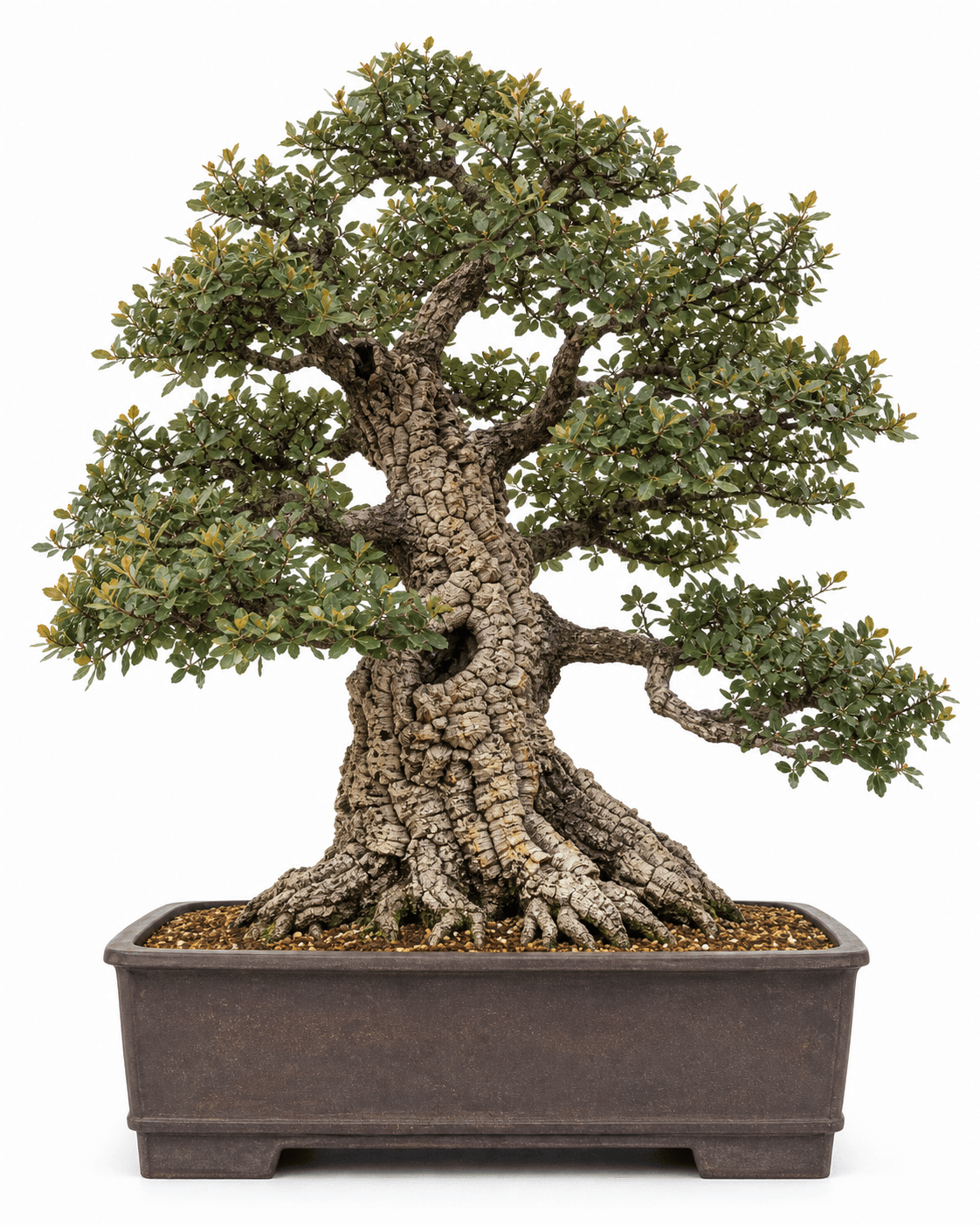
Cork oak bonsai is best grown outside as a Mediterranean broadleaf evergreen with bright sun, careful winter protection, full wet-dry watering cycles, and conservative root work. Its value comes from thick cork bark, broad old-oak structure, and a billowy evergreen canopy, so the grower protects bark and vascular flow before chasing tiny leaves.
Kew accepts Quercus suber L. in Fagaceae and places its native range in the western and central Mediterranean. EntGrove currently parks cork oak in Broadleaf > Deciduous with the other oak pages, but the care calendar is evergreen and Mediterranean, with winter or early spring work windows depending on climate and protection.
The beginner fit is narrow. Cork oak suits a patient outdoor grower in a warm or protected climate; it fails quickly in heated indoor culture, hard freezes, stale wet winter soil, and one-session styling that strips bark, removes too much foliage, or reduces old roots too aggressively.
Updated July 13, 2026. Written by EntGrove Editorial. Last verified July 13, 2026.
Care fingerprint
Read the species through its shared care pattern.
Repot and structural prune around dormant-to-active transitions; protect new leaves; time refinement work after growth hardens. Use this as the starting point before local conditions and tree strength refine the calendar.
Note: Cork oak is botanically a broadleaf evergreen Mediterranean oak; it stays in the deciduous oak group until the oak cluster is split, so follow the species page before copying English-oak timing.
Read the foliage first
Broadleaf stress usually shows in leaf color, leaf size, wilt, scorch, or delayed hardening before it becomes a branch problem.
Match work to dormancy
Deciduous, evergreen, tropical, succulent, and flowering broadleaf trees recover on different calendars.
Protect fine roots
Root work should preserve enough active fine roots for the tree to rehydrate quickly after the operation.
Care cadence
The calendar starts with the tree's seasonal state.
Placement
Timing: Grow outside in bright light and moving air. In true Mediterranean or mild coastal climates, winter can be active; in colder regions, use a cold frame, greenhouse, or insulated protection before container roots face sustained freezing.
Watch for: Warm indoor storage, stale humid corners, cold wind on small pots, exposed frozen roots, and applying a fully deciduous oak calendar to an evergreen Mediterranean oak.
Oregon State Landscape PlantsNC State ExtensionBonsai Mirai LibraryLight
Timing: Use full sun once the root system can keep up. Shift to temporary afternoon protection after repotting, after air-layer separation, or during hot dry wind in a small container.
Watch for: Weak interior buds, long coarse extensions from shade, scorched recovery growth after a sudden move, and lower branches losing light under a dense apex.
NC State ExtensionOregon State Landscape PlantsBonsai Mirai LibraryWatering
Timing: Water thoroughly until runoff, then allow the top dressing and visible soil on both sunny and shaded sides of the pot to dry back before the next full watering.
Watch for: Frequent light sprinkling, overspray from nearby trees, stale nursery peat, cold wet winter soil, hydrophobic dry cores, and confusing landscape drought tolerance with bonsai neglect.
Bonsai Mirai LibraryOregon State Landscape PlantsFeeding
Timing: Feed strongly only when building trunks and branches. After root work, wait until strong growth appears, then begin lightly and build through the season if development remains the goal.
Watch for: Salt on new roots, oversized leaves in refinement, soft late growth before winter protection, and fertilizer used to hide a water, soil, or light problem.
Bonsai Mirai LibraryStructural pruning
Timing: Use the protected Mediterranean winter window or spring bud-swell window for major selection, depending on climate. Keep live nodes below cuts, reduce whorls to two useful lines, and avoid stacking major pruning on recent repotting.
Watch for: Cuts beyond the last live node, trunk suckers stealing strength, clustered branches causing swelling, removing lower foliage, and old-wood chops in climates where recovery is slow.
Bonsai Mirai LibraryShoot pruning and leaf work
Timing: Let the first flush harden, then prune overlong shoots in the June to July broadleaf evergreen window. After July, preserve foliage so fall and winter storage can rebuild roots and vascular tissue.
Watch for: Routine full defoliation, cutting cork oak leaves in half without local evidence, apex dominance, weak lower branches, and late-season foliage removal.
Bonsai Mirai LibraryWiring
Timing: Wire and bend before strong spring water movement or after the first flush hardens. Use copper or guy wires for holding power, and protect or bridge through corked bark rather than crushing it.
Watch for: Bark plates opening, deep wire indentation, hidden wire bite under cork ridges, rigid old branches, and detailed conifer-style wiring on every fine twig.
Bonsai Mirai LibraryVirginia Tech DendrologyRepotting
Timing: In Mediterranean or protected greenhouse culture, evergreen oaks can be repotted after winter solstice through January or early February. In colder regions, spring bud swell is the safer default. Repot only part of the root system at a time.
Watch for: Bare-rooting, removing the old core in one pass, repotting a first-year collected tree, poor tie-down, premature fertilizer, and missing the post-repot dry-back rhythm.
Bonsai Mirai LibraryPest and disease checks
Timing: Inspect during warm active growth, after wet still weather, after import or nursery purchase, and any time roots or bark have been injured.
Watch for: Scale, aphids, caterpillars, leaf miners, lace bugs, borers, gall insects, powdery mildew, anthracnose, leaf spots, cankers, root rot, oak wilt, and sudden oak death rules in regulated regions.
NC State ExtensionUC IPMBonsai Mirai LibrarySpecies guide
Apply the species profile before copying another tree's calendar.
At a glance
Cork oak is an outdoor evergreen oak for warm-climate, bark-first bonsai work.
Quercus suber is the cork oak used for cork-bark oak bonsai. Kew accepts the name in Fagaceae, and NC State, Oregon State, and Virginia Tech all describe an evergreen oak with thick cork-forming bark, leathery toothed leaves, flowers in catkins, and acorns. Kew POWONC State ExtensionOregon State Landscape PlantsVirginia Tech Dendrology
The bonsai spec is specific: outdoor sun, a protected cool winter, wet-dry watering that restores oxygen, acidic or pH-aware soil, staged root work, bark-safe wiring, and broad old-oak design. The tree is warm-climate friendly and frost-sensitive in a pot. Bonsai Mirai LibraryNC State ExtensionOregon State Landscape Plants
The species suits medium to large trees, although seed-grown material can be trained smaller. Informal upright, slanting, twin-trunk, clump, and broad naturalistic forms let the cork bark, branch shoulders, and evergreen canopy read as an aged Mediterranean oak. Bonsai Mirai LibraryBonsai Mirai / Asymmetry
Wild habitat
Its wild pattern is western Mediterranean: acidic soils, dry summers, winter moisture, fire, and cork bark.
Kew places Quercus suber in the western and central Mediterranean and notes its association with open woodland and acidic soils. EUFORGEN frames cork oak as a characteristic west-Mediterranean tree, historically managed in cork-producing landscapes. Kew POWOEUFORGEN
Mirai reads that ecology as a care pattern. Mediterranean broadleaf evergreens hold thick cuticle-rich leaves through winter, tolerate sun and drought better than thin-leaved deciduous species, and often move strongly with winter moisture or short winter day length. Bonsai Mirai Library
Care follows the place. Keep the tree outside, give roots oxygen between waterings, shelter it from hard freezes, and protect foliage after the summer working window because those leaves drive fall and winter vascular rebuilding. Bonsai Mirai LibraryOregon State Landscape Plants
Design follows the place as well. Cork oak should read as a broad Mediterranean oak with upward branch shoulders, outward sweep, soft foliage billows, and rugged bark, rather than a stack of tight conifer shelves. Bonsai Mirai LibraryBonsai Mirai / Asymmetry
Reading the tree
Read cork oak by climate, stage, bark, and water movement.
Mirai places cork oak in the broadleaf evergreen oak logic: moderate water mobility, slow redistribution after hard work, strong dependence on retained foliage, and a narrower pruning window than deciduous broadleaf trees. Bonsai Mirai Library
Stage comes before technique. A tree still building trunk and primary branches needs strong shoots, heavier feeding, and larger containers. A tree moving into secondary structure needs selective pruning and branch positioning. A refined tree needs measured feeding, shorter internodes, and protection from coarse apex dominance. Bonsai Mirai Library
Bark is both asset and risk. Mirai notes that cork bark develops quickly, can hide superficial scars, and can also conceal water-conducting damage below a wire indent. Protect the bark because it is the visual reason many growers choose the species. Bonsai Mirai LibraryVirginia Tech Dendrology
Recovery signals should be visible before the next big move. Buds on older wood, strong new shoots, stable leaf color, and percolating soil all matter more than a calendar interval after collection, repotting, or heavy pruning. Bonsai Mirai Library
Pruning
Prune for retained foliage, live nodes, and a broad evergreen canopy.
The heavy-work window depends on climate. Mirai describes winter through early winter as a productive Mediterranean-oak window when winter moisture is active and aftercare can keep the tree above damaging cold. In colder continental regions, spring bud swell or just-before-bud-swell timing is safer. Bonsai Mirai Library
During structural cleanup, remove trunk suckers early, reduce three- and four-branch junctions to two usable lines, eliminate inverse-taper offenders, and avoid building a canopy from many shoots that all emerge from one swelling. Keep live nodes below cuts so water flow continues. Bonsai Mirai Library
Post-flush pruning belongs in the broadleaf evergreen summer window. Mirai puts broadleaf evergreen pruning later than deciduous pruning, commonly mid-June through July in northern temperate climates, then closes foliage reduction after July so leaves can fund vascular and root storage. Bonsai Mirai Library
Cork oak should not be treated as a routine defoliation species. The direct Mirai cork-oak file calls full and partial defoliation unreliable for Quercus suber. For most growers, branch selection, shoot cutback, light, and feeding are the refinement tools. Bonsai Mirai Library
The apex can easily steal the tree. Shorten or redirect the strongest top growth, preserve lower foliage, and use strong lower shoots to thicken the design before refining them. A cork oak with all vigor in the crown becomes old-looking bark with young-looking branch logic. Bonsai Mirai Library
Roots
Repot cork oak in the evergreen-oak window and reduce old roots in stages.
Mirai evergreen-oak repotting guidance places Quercus suber with Mediterranean broadleaf evergreens that can move after winter solstice, often January through early February in protected practice. That timing is tied to short winter day length and early root activity, not to warm spring weather alone. Bonsai Mirai Library
Climate changes the default. In colder regions without reliable greenhouse aftercare, spring bud-swell repotting is more conservative. The point is to repot when the tree can callus, start roots, and avoid hard freeze injury during recovery. Bonsai Mirai LibraryOregon State Landscape Plants
Root reduction should be progressive. Mirai warns that broadleaf evergreens should be partially repotted rather than bare-rooted, and that long-established root masses should have decomposed interior soil reduced across multiple repots rather than one dramatic pass. Bonsai Mirai Library
After repotting, stability and oxygen decide the recovery. Tie the tree firmly, integrate soil around roots with appropriately sized chopsticks, water fully, then honor the dry-back interval before watering again. Fertilizer waits for a strong growth response. Bonsai Mirai Library
A newly collected or newly reduced cork oak can look healthy while its root system remains immature. Mirai warns that first-year foliage does not prove the root system has rebuilt; major follow-up root work before roughly two years can create decline that appears years later. Bonsai Mirai Library
Soil and pot
Use oxygen-rich soil, acidic awareness, and a pot that respects bark and canopy mass.
Cork oak wants drainage and oxygen first. Oregon State says established landscape trees are drought resistant and prefer good drainage, while Mirai watering guidance for cork oak, olive, boxwood, and coast live oak lets the top dressing dry back more than it would on many deciduous broadleaf trees. Oregon State Landscape PlantsBonsai Mirai Library
The pH nuance is real. Kew places cork oak on acidic soils, NC State lists acid to neutral soil reaction, and Mirai oak work reports European cork oaks recovering more reliably once an acidic component such as kanuma corrected a nutrient-availability problem. Kew POWONC State ExtensionBonsai Mirai Library
Development soil and refinement soil can be different. Mirai uses coarser, more organic development mixes when thickening and healing matter, then moves broadleaf evergreens toward akadama-led or even solid akadama refinement soil when root bifurcation, leaf scale, and twig density become the goal. Bonsai Mirai Library
Repot because the tree needs it. Mirai lists three valid reasons: percolation has failed, soil has decomposed, or the container choice needs to change. A cork oak with good drainage, strong color, and stable growth may wait longer than a young tree in a decaying nursery core. Bonsai Mirai Library
Pot choice should give enough depth for watering control and enough visual strength for rugged bark. Mirai cork-oak design leans toward rectangles or straight-walled ovals with strong feet, especially while the tree is still building canopy breadth. Bonsai Mirai LibraryBonsai Mirai / Asymmetry
Climate
Match the calendar to your winter, not just to the species label.
Landscape hardiness is only the outer boundary. Oregon State lists USDA Zone 7 and NC State lists Zones 8a-10b, but Mirai broadleaf-evergreen guidance treats bonsai containers as dependent systems because limited soil mass freezes and dries faster than ground roots. Oregon State Landscape PlantsNC State ExtensionBonsai Mirai Library
In Mediterranean or mild coastal regions, late fall through winter can be the productive season because rain and short days activate root and vascular growth. Work done in that window still needs shelter from damaging cold after pruning, wiring, or repotting. Bonsai Mirai Library
In colder inland regions, spring bud swell is safer for root and structural work because the tree is about to move and aftercare can avoid the deepest freezes. Protect from cold rain if the local winter is wet enough to keep the root zone airless. Bonsai Mirai Library
Summer is a water-balance test. The tree tolerates heat when roots are healthy, but small pots and coarse bark do not prevent hydraulic stress. Water thoroughly, watch both sides of the pot, and use shade cloth or afternoon protection only when the root system cannot keep up. Bonsai Mirai LibraryOregon State Landscape Plants
Regional disease rules matter. UC IPM includes oak wilt and sudden oak death in oak problem lists, and local extension rules may restrict movement, pruning, disposal, or treatment in affected regions. Keep suspect oak material inside local regulatory boundaries. UC IPMNC State Extension
Pests and disease
Most cork oak pest problems become serious after stress, wet roots, or poor airflow.
NC State lists common oak pests and diseases for Quercus suber, including scale, leaf miners, galls, lace bugs, borers, caterpillars, nut weevils, root rot, anthracnose, leaf blister, cankers, leaf spots, powdery mildew, and oak wilt. NC State Extension
Bonsai prevention starts culturally. Sun, airflow, dry-back, free percolation, and moderate feeding reduce the conditions that make scale, mildew, canker, and root rot more damaging on a small tree. Bonsai Mirai LibraryNC State Extension
Borer holes, soft bark, sour soil smell, progressive branch dieback, and root-zone collapse deserve faster diagnosis than ordinary leaf spotting. A potted evergreen oak has less reserve than a landscape oak and can carry damage invisibly for months. NC State ExtensionBonsai Mirai Library
Regulated oak diseases need regional judgment. UC IPM includes sudden oak death and oak wilt among oak problems; if symptoms match local warnings, pause pruning, isolate tools, and use extension or IPM guidance before moving material. UC IPMNC State Extension
A few leaf galls or minor chewing marks on a vigorous tree are often less important than the root system. Treat the cause of stress first, especially stale soil, poor tie-down, underwatering after hard dry-down, and cold wet winter roots. Bonsai Mirai LibraryNC State Extension
Wiring
Wire cork oak for structure and use guy wires where corked branches resist coils.
Mirai cork-oak guidance is explicit: heavy bending and wiring should happen before strong spring water movement, because bark can wrinkle or slough when the tree is fully active. Another workable window is after the first flush hardens, when the branch has regained strength. Bonsai Mirai Library
Cork bark changes the technique. On heavily corked branches, Mirai favors guy wires over coiling the branch because the rigid cork fails on the tension side. A bridge through bark crevices can anchor tension without wrapping over soft cork ridges. Bonsai Mirai LibraryVirginia Tech Dendrology
Use enough holding power. Mirai recommends copper for stiff oak branches and sometimes one gauge heavier on brittle material, because elegant wire that cannot set the bend only scars the tree without changing the line. Bonsai Mirai Library
Inspect for functional damage alongside cosmetic scars. Mirai notes that cork may grow over visible marks, but a deep indent can still reduce water conductivity to that branch. Remove only wire sections that are biting when the rest of the wiring still needs time to set. Bonsai Mirai Library
Development wiring should focus on the first inches of primary and secondary branches. Broadleaf evergreen oaks can refine later through shoot selection, so detail-wiring every fine twig early often creates risk without adding lasting structure. Bonsai Mirai Library
Propagation
Fresh seed is the cleanest route; air layers are possible but require oxygen discipline.
Kew describes cork oak propagation from fresh acorns and notes that viability declines quickly. NC State lists seed and stem cuttings, while Mirai oak guidance treats Quercus cuttings as generally difficult compared with higher-water-mobility broadleaf species. Kew POWONC State ExtensionBonsai Mirai Library
For bonsai, seed gives the best chance to correct roots early. Work young roots in stages so the future nebari forms close to the trunk instead of preserving a long primary root that only feeds far from the base. Bonsai Mirai Library
Air layering can work on cork oak in warm Mediterranean-like conditions. Mirai notes that a June air layer may show roots by mid-to-late fall, and that broadleaf evergreen layers should usually be separated at the onset of spring growth so the new root system receives the tree's first push. Bonsai Mirai Library
Air-layer failure usually comes from water-oxygen imbalance in the sphagnum or rooting medium. A vigorous canopy above the layer is helpful because it feeds callus and root initiation, but constant saturation can produce callus without roots. Bonsai Mirai Library
Grafting is mainly a repair or cultivar tool rather than the normal path for cork oak bonsai. Any grafted material should be judged by bark transition, root flare, trunk continuity, and whether the union can ever disappear into the design. Bonsai Mirai Library
Sourcing
Buy confirmed Quercus suber with usable bark, roots, and low structure.
Species certainty comes first. Use this page for confirmed Quercus suber, not cork-bark elm, English oak, coast live oak, holm oak, Turkish oak, corky-barked pine, or a nursery tag that only says oak. Kew POWONC State ExtensionOregon State Landscape Plants
Good material has a visible base, usable low branches or buds, healthy evergreen foliage, well attached bark, and roots that can be corrected without one violent reduction. A fat corky trunk with no low structure may take longer to solve than a younger tree with better branch options. Bonsai Mirai LibraryVirginia Tech Dendrology
Ground-grown material can be excellent in warm Mediterranean-like regions because Mirai notes that cork oak can back-bud after chopping and build trunks quickly there. Outside that climate, the same chop can recover so slowly that a staged pre-bonsai path is more sensible. Bonsai Mirai Library
Reject material with soft or rotting cork, wire hidden under bark ridges, fresh frost injury, weak interior foliage, a buried graft, pest holes, a deep peat core, or evidence that the roots have never been worked toward a container. Bonsai Mirai LibraryNC State Extension
Collected material requires permission and a recovery plan. A first-year push can be powered by stored energy and old roots; the durable root system often takes longer to prove itself. Bonsai Mirai Library
Troubleshooting
Diagnose cork oak through roots, bark, foliage retention, and the last operation.
Symptom: yellowing older leaves after a heavy repot. Likely cause: normal broadleaf evergreen adjustment if the tree otherwise stays turgid and buds remain viable. Fix: keep the tree stable, water with dry-back, delay fertilizer, and wait for a clear growth response. Bonsai Mirai Library
Symptom: gradual pale foliage, weak push, and wet soil. Likely cause: airless roots or a decomposed nursery core. Fix: improve drying, protect from cold wet exposure, and plan staged repotting when the correct window returns. Bonsai Mirai LibraryOregon State Landscape Plants
Symptom: a branch weakens below a wire scar hidden in cork. Likely cause: wire indentation reduced conductivity under the bark. Fix: remove biting wire sections, reduce stress on the branch, and avoid coiling heavily corked branches in the next styling cycle. Bonsai Mirai Library
Symptom: lower branches weaken while the apex stays strong. Likely cause: apex dominance and poor light distribution. Fix: shorten or redirect strong top shoots, open the canopy, and preserve lower foliage until it regains strength. Bonsai Mirai Library
Symptom: dieback after a large pruning cut. Likely cause: cutting past the last functioning node or removing too much foliage from a moderate-water-mobility tree. Fix: retain live nodes, stage structural cuts, and let recovery shoots run before the next reduction. Bonsai Mirai Library
Symptom: blackened tips or root decline after winter. Likely cause: container-root freezing, cold wet soil, or a hard freeze after work. Fix: shelter future winter work, protect roots above damaging cold, and avoid repotting or pruning without aftercare. Bonsai Mirai LibraryOregon State Landscape PlantsNC State Extension
Symptom: scale, sticky residue, mildew, cankers, borers, or leaf spots. Likely cause: ordinary oak pest or disease pressure amplified by stress. Fix: improve sun and airflow, correct roots and watering, isolate severe cases, and use local extension guidance for regulated oak diseases. NC State ExtensionUC IPM
Design
Style cork oak as a rugged Mediterranean oak, with bark first and canopy breadth second.
Start with the base, trunk line, and strongest bark feature, then decide the defining branch and apex. Mirai design fundamentals use those elements to choose harmony, tension, or a more dynamic composition from the material already present. Bonsai Mirai LibraryBonsai Mirai / Asymmetry
Cork oak branches should often rise from the shoulder, move outward, then settle. Mirai Mediterranean-oak design describes soft foliage billows with broad transitions, matching the species better than compact conifer pads. Bonsai Mirai Library
A powerful trunk can carry a compressed broad apex, while a taller trunk needs a smaller apex that can widen through ramification over time. Negative space near the trunk can make a straight section read with more movement. Bonsai Mirai LibraryBonsai Mirai / Asymmetry
Deadwood should be secondary. Mirai warns that deadwood on cork oak and other Quercus often hollows and deteriorates, so living bark, plated cork, and attached live vein should carry the main image. Bonsai Mirai Library
The most convincing pot is usually unglazed, quiet, and strong. Rugged rectangles, straight-walled ovals, and deeper development containers support the bark-first character while the canopy gains width. Bonsai Mirai LibraryBonsai Mirai / Asymmetry
Cultivars and forms
Most bonsai material is seed-grown cork oak; confirm the species before trusting form names.
Cork oak bonsai usually moves through seed-grown, field-grown, nursery, or collected material rather than a stable list of named bonsai cultivars. The practical form differences often come from local origin, ground-growing, trunk chop history, and how early roots were corrected. Bonsai Mirai LibraryEUFORGEN
Kew and NC State both record older or alternate Quercus suber names, but those taxonomy notes should not be treated as separate bonsai care calendars. Confirm the accepted species, then adapt timing to climate and aftercare. Kew POWONC State Extension
Separate cork oak from nearby search confusions. English oak is a temperate deciduous Quercus robur page, coast live oak is California Quercus agrifolia, holm oak is a different Mediterranean evergreen oak, and cork-bark elm is an Ulmus label. Kew POWOOregon State Landscape PlantsBonsai Mirai Library
A local or regional cork oak can behave differently from imported material because Mediterranean microclimates vary strongly in winter rain, summer heat, soil reaction, and hybrid background. Keep records by the actual tree, not by the broad label alone. Bonsai Mirai LibraryEUFORGEN
History
The species carries a cork landscape history, so the bonsai should feel accumulated.
Cork oak is culturally important because its bark can be harvested while the tree remains alive. Kew and NC State both describe cork harvest cycles, with first commercial harvest only after decades and repeated harvests on roughly decade-length cycles. Kew POWONC State Extension
That history is useful for bonsai design. A good cork oak should feel like a tree that accumulated protection, fire response, browsing pressure, pruning history, and weather over time, rather than a smooth young tree dressed up with pads. Bonsai Mirai LibraryBonsai Mirai / Asymmetry
Long life is part of the species image. Mirai cork-oak work rejects the idea that cork oak is short-lived and notes trees can live for hundreds of years; the bonsai version should be developed with the same long horizon. Bonsai Mirai LibraryEUFORGEN
For exhibition, protect the bark story. Visible wire, crushed cork, moss creeping over the trunk, and a pot that is too dainty all distract from the aged Mediterranean-oak image. Bonsai Mirai LibraryBonsai Mirai / Asymmetry
Species questions
Answer the beginner questions before styling.
Is cork oak a good beginner bonsai?
Cork oak can be a good beginner project for a patient outdoor grower in a warm or protected climate. It is demanding for anyone relying on indoor culture, exposed hard-freeze storage, or fast one-season styling.
Can cork oak bonsai live indoors?
Long-term indoor culture fails because cork oak needs outdoor sun, airflow, seasonal change, and a cool protected winter rest. Brief indoor display is different from cultivation.
Is cork oak evergreen or deciduous?
Cork oak is evergreen. EntGrove currently groups it with deciduous broadleaf oaks only because the oak subcluster has not been split into an evergreen Mediterranean oak hub.
How much sun does cork oak bonsai need?
Use full outdoor sun when roots are healthy and water is reliable. Temporary afternoon protection is useful after root work, during hot dry wind, or in very small pots.
How often should I water cork oak bonsai?
Water thoroughly to runoff, then let the top dressing and visible soil dry back before watering again. The goal is full saturation followed by enough oxygen return for Mediterranean evergreen roots.
When should I prune cork oak bonsai?
Use protected winter or spring bud-swell timing for structural work, depending on climate, then use the June to July broadleaf evergreen window for post-flush shoot pruning. Preserve foliage after that window.
When should I repot cork oak bonsai?
In protected Mediterranean practice, evergreen oaks can be repotted after winter solstice through January or early February. In colder regions, spring bud swell is safer. Repot for percolation, soil decay, root correction, or container change.
Should I defoliate cork oak bonsai?
Do not make defoliation routine on cork oak. The direct Mirai cork-oak guidance treats Quercus suber leaf removal as unreliable, so most growers should use shoot selection, pruning, light, and feeding instead.
Should I strip cork bark on cork oak bonsai?
Do not strip cork bark as routine bonsai maintenance. Commercial cork harvest is a specialized mature-tree practice, while bonsai bark should be protected from wire, scraping, rot, and moss pressure.
Why is my cork oak dropping yellow leaves after repotting?
Some older-leaf shedding after heavy root work can be a normal broadleaf evergreen recovery signal. Check that the tree is stable, the soil percolates, watering includes dry-back, and fertilizer waits until strong growth appears.
What is cork oak often confused with?
Cork oak is Quercus suber. It is commonly confused with cork-bark elm, English oak, coast live oak, holm oak, other Mediterranean oaks, and corky-barked pines sold under unrelated names.
Sources
Species advice needs source discipline.
Next decisions
Plan the operation before copying the calendar.
A good care note for Cork oak records the tree's stage, the work done, and the aftercare used. That record matters more than a month-name rule.
Related species
Compare nearby trees before transferring advice.
Japanese maple
Acer palmatum
Trident maple
Acer buergerianum
Amur maple
Acer tataricum subsp. ginnala
Field maple
Acer campestre
Korean hornbeam
Carpinus turczaninovii