
Species guide
English Oak Bonsai Care
Quercus robur
English oak bonsai should be grown outside as a temperate deciduous Quercus, with real dormancy, strong sun, moving air, and patient root work. The species rewards growers who want bark, weight, acorns, and a broad old-oak silhouette more than tiny leaves in the first few years.
Quercus robur is best treated as a medium to large bonsai. Its leaves are naturally broad, its root system can be taproot-heavy, and its refinement depends on repeated seasonal cycles of extension, selected cutback, wiring, and recovery.
Use this page for English oak, pedunculate oak, common oak, European oak, truffle oak, and confirmed Quercus robur material. Cork oak, coast live oak, holm oak, white oak, live oak, and unidentified native seedlings need their own timing records.
Updated June 18, 2026. Written by EntGrove Editorial. Last verified June 18, 2026.
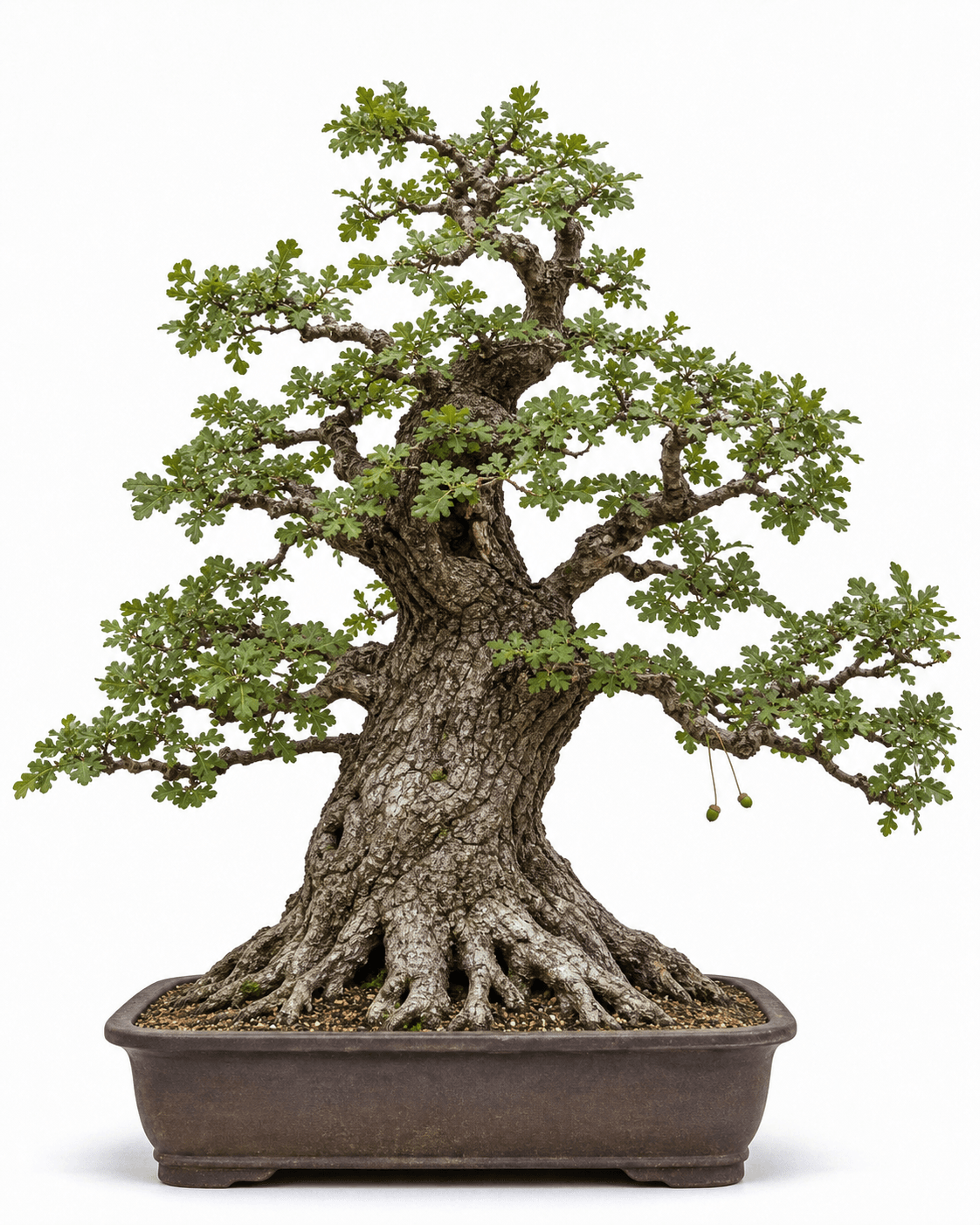
Care fingerprint
Read the species through its shared care pattern.
Repot and structural prune around dormant-to-active transitions; protect new leaves; time refinement work after growth hardens. Use this as the starting point before local conditions and tree strength refine the calendar.
Note: English oak is a temperate deciduous outdoor oak with large leaves, strong terminal buds, and meaningful root-work sensitivity; keep it separate from cork oak, coast live oak, and North American white-oak labels before applying care.
Read the foliage first
Broadleaf stress usually shows in leaf color, leaf size, wilt, scorch, or delayed hardening before it becomes a branch problem.
Match work to dormancy
Deciduous, evergreen, tropical, succulent, and flowering broadleaf trees recover on different calendars.
Protect fine roots
Root work should preserve enough active fine roots for the tree to rehydrate quickly after the operation.
Care cadence
The calendar starts with the tree's seasonal state.
Placement
Timing: Grow outside year-round. Use a sunny, airy bench during active growth and cold, protected outdoor storage when container roots face hard freezes.
Watch for: Warm indoor storage, stale humid corners, drying winter wind, roots frozen in a shallow pot, and tags that only say oak.
Oregon State Landscape PlantsMorton ArboretumBonsai Mirai LibraryLight
Timing: Use full sun after the root system can keep up. Temporary afternoon shade is useful after repotting, during heat stress, or in a very small pot.
Watch for: Long internodes, shaded lower branches, weak interior buds, mildew-prone still air, and a top canopy that steals light from the future structure.
NC State ExtensionMorton ArboretumBonsai Mirai LibraryWatering
Timing: Water thoroughly, then let the surface move toward dry before watering again. After root work, honor the dry-back interval because new roots form best in oxygenated soil.
Watch for: Hydrophobic dry cores, sour wet nursery soil, overspray from neighboring trees, wilt after root work, and assuming ground-grown drought tolerance transfers to a pot.
Bonsai Mirai LibraryNC State ExtensionMorton ArboretumFeeding
Timing: Feed strongly in development after growth is active. After repotting, wait for a clear push before feeding lightly, then build strength through the season.
Watch for: Salt on new roots, soft late growth before winter, oversized leaves in refinement, weak lower branches, and fertilizer used to mask a root or light problem.
Bonsai Mirai LibraryStructural pruning
Timing: Use late-fall leaf drop for even spring response in refinement and bud-swell spring pruning when development needs strong local push. Avoid deep-winter wounds.
Watch for: Cuts past the last live node, flush cuts without surrounding ramification, summer wounds in oak-wilt regions, and unchecked terminal tips.
Bonsai Mirai LibraryMorton ArboretumShoot pruning and leaf work
Timing: Let shoots extend enough to build strength, then select the best line and cut back to usable buds. Use selective large-leaf removal only on strong trees.
Watch for: Full defoliation on weak trees, leaving whorls, cutting all interior shoots, and starving branches that need foliage to thicken.
Bonsai Mirai LibraryWiring
Timing: Wire structural lines while branches can still move, using copper where holding power matters. Check scars early on smooth young bark and on heavy bends.
Watch for: Wire returning into old scars, branch crossing over the trunk, crushed leaves, bark-plate separation during clamp bends, and visible guy wires on finished trees.
Bonsai Mirai LibraryRepotting
Timing: For temperate deciduous English oak, favor spring as buds swell or a carefully timed post-leaf-drop window when local aftercare is reliable. Repot for percolation, soil decay, root correction, or aesthetics.
Watch for: Taproot-heavy seedlings, long root stubs, airless cores, poor tie-down, root work stacked with heavy branch work, and fertilizing before recovery growth.
Bonsai Mirai LibraryCornell Woody Plants DatabasePest and disease checks
Timing: Inspect through active growth and after humid weather, root stress, pruning, or imported nursery purchases. Keep the canopy open enough for light and air.
Watch for: Powdery mildew, anthracnose, oak wilt, sudden oak death in regulated regions, galls, aphids, lace bugs, borers, caterpillars, leaf miners, scale, and root rot.
NC State ExtensionMorton ArboretumUC IPMSpecies guide
Apply the species profile before copying another tree's calendar.
At a glance
English oak is an outdoor deciduous oak for patient, scale-aware bonsai work.
Kew accepts Quercus robur L. in Fagaceae, and the common search labels converge on English oak, pedunculate oak, common oak, European oak, and truffle oak. The page is written for that confirmed species rather than every Quercus sold in a nursery pot. Kew POWONC State ExtensionOregon State Landscape PlantsCornell Woody Plants Database
The bonsai spec is clear: outdoor dormancy, six or more hours of sun when the tree is strong, evenly moist and oxygenated soil, staged root correction, medium to large scale, and a design that uses heavy branches and a spreading crown. NC State ExtensionMorton ArboretumBonsai Mirai Library
The beginner fit is conditional. English oak is hardy and recognizable, but the leaf scale, taproot tendency, mildew pressure, and slow refinement make it better as a deliberate outdoor project than a quick first-display tree. Oregon State Landscape PlantsMorton ArboretumBonsai Mirai Library
Wild habitat
Its wild image is broad woodland, open pasture, deep roots, acorns, and old bark.
Kew gives Quercus robur a broad European and western Asian range, while Woodland Trust frames English oak as common in southern and central Britain. The natural image is a large deciduous tree that can build a broad crown and massive limbs over a long life. Kew POWOWoodland Trust
Identification rests on short leaf stalks and stalked acorns. Oregon State gives 5-15 cm lobed leaves with very short petioles and acorns on longer stalks; Woodland Trust describes the same short leaf stalk and long-stalked acorn contrast with sessile oak. Oregon State Landscape PlantsWoodland Trust
Care follows the place. A tree from open woodland or pasture needs light on lower branches, water in the root zone, and enough oxygen to keep fine roots functioning. The bonsai version has no deep field root to buffer mistakes, so watering and soil structure replace the ground. NC State ExtensionMorton ArboretumBonsai Mirai Library
Design should also follow the place. Mirai oak work repeatedly returns to oak movement: branches rise from the shoulder, roll outward, and settle down into a broad canopy. That is the opposite of forcing every branch into a tight conifer shelf. Bonsai Mirai LibraryBonsai Mirai / Asymmetry
Reading the tree
Read the tree by stage: trunk, primary branches, secondary structure, then refinement.
Mirai oak method describes a deciduous development sequence: structural pruning, secondary push-out and wiring, tertiary refinement, then clip-and-grow maintenance once twigs hold their positions. A young English oak in a nursery pot usually belongs in the first two stages. Bonsai Mirai Library
Energy is assigned through foliage. Leaves on branches you want to thicken should be retained because photosynthesis and transpiration drive cambial growth. Interior shoots should stay shorter so they remain useful rather than becoming coarse extensions. Bonsai Mirai Library
Watch the lower tree first. If the apex and outer shell are strong while lower branches weaken, the design is spending energy in the wrong place. Light, pruning, and selective shoot length should protect the branches that create age and breadth. Bonsai Mirai Library
A confirmed recovery signal matters after heavy work. Mirai root-work guidance treats buds on old wood and strong new pushes as evidence that the tree has returned to positive energy before the next major operation. Bonsai Mirai Library
Pruning
Use fall for even refinement response and spring for development push.
For deciduous oaks, Mirai separates the pruning windows by goal. Leaf-drop pruning within the short window after natural autumn resource withdrawal tends to produce a more even spring push. Spring pruning near bud swell can create a strong local response, which is useful during coarse development. Bonsai Mirai Library
Cut logic is node logic. Mirai oak work keeps a live node or surrounding ramification below a cut so water flow continues. Cutting past the last useful node invites dieback into the cylinder of wood you wanted to keep. Bonsai Mirai Library
During branch building, leave stubs where a hard flush cut would strand vascular flow. Once ramification surrounds the site, a cleaner cut can be made with less recession. Use cut paste on fresh structural cuts when the wound would otherwise dry or recede. Bonsai Mirai Library
Leaf work should be selective. English oak leaves are large enough that removing the worst offenders can help light and scale, but wholesale defoliation on a weak tree reduces the foliage that drives roots, branch thickening, and recovery. Oregon State Landscape PlantsBonsai Mirai Library
Roots
Make the roots the long project: correct taproots and old cores in stages.
Quercus is sensitive to root tampering outside the proper window. The Mirai oak corpus treats dormant or bud-swell timing as a survival factor, and Cornell notes that English oak is moderately difficult bare-root and is generally transplanted in spring. Bonsai Mirai LibraryCornell Woody Plants Database
Seedlings and field-grown material often begin with a taproot or long root stubs. Mirai collected-oak guidance favors cutting problem roots short enough that new fine roots are forced closer to the trunk, rather than preserving long roots that only produce feeders far away. Bonsai Mirai Library
A survival container can be different from a refinement container. For first work on rough or collected oak material, Mirai describes straight pumice as a recovery substrate; after stabilization, the tree can move toward a more refinement-oriented soil. Bonsai Mirai Library
After repotting, immobilize the trunk and soil column. Mirai repotting guidance is blunt: new roots establish only in still soil. Tie-downs, props, and careful chopsticking are horticultural details. Bonsai Mirai Library
Post-repot watering should fully hydrate the root mass, then let the surface dry enough for oxygen to return before the next full watering. Fertilizer waits until the tree produces strong growth, because salts on newly emerging roots can set recovery back. Bonsai Mirai Library
Soil and pot
Use development soil for growth, akadama-led soil for refinement, and an oak-appropriate pot.
NC State, Oregon State, and Morton all point toward moist, well-drained soil in landscape culture. In bonsai, translate that into a granular column that can hold water long enough for active growth and still breathe after every watering. NC State ExtensionOregon State Landscape PlantsMorton Arboretum
For primary development, Mirai repotting method allows a coarser, more organic mix around 70 percent aggregate and 30 percent organic material when thickening, healing, and vascular expansion matter. Pure akadama is a refinement tool because it scales roots and branch growth down. Bonsai Mirai Library
Akadama becomes more attractive once the tree has branches, roots, and water control. Mirai oak and deciduous soil guidance values akadama for refinement because roots fracture it, particles scale down, and fertilizer exchange supports steady availability. Bonsai Mirai Library
The pot should reinforce age and weight. Mirai oak design favors unglazed, earth-tone, rugged containers for oak display because the species carries bark, acorns, and structural mass rather than the floral color that asks for a glazed pot. Bonsai Mirai LibraryBonsai Mirai / Asymmetry
Climate
Treat hardiness as two numbers: the landscape tree and the bonsai pot.
Landscape English oak is cold-hardy, with Oregon State and Morton listing USDA Zone 4 and NC State listing Zones 5a-8b. A shallow bonsai container is less forgiving because roots are exposed to cold, dry wind, and rapid temperature swings. Oregon State Landscape PlantsMorton ArboretumNC State Extension
Refinement lowers the safety margin. Mirai deciduous guidance notes that as trees lose tissue mass and storage capacity, cold tolerance can decline. Protect finished trees from the kind of root-zone freeze that field trees survive without injury. Bonsai Mirai Library
In hot regions, the issue is water movement and leaf surface. Full sun is still the design baseline, but a recently repotted tree, a small pot, or a dry wind event may need afternoon protection until the root system catches up. NC State ExtensionMorton ArboretumBonsai Mirai Library
Regional pest pressure changes timing. Morton recommends dormant-season oak pruning to reduce oak-wilt risk, and UC IPM ties many oak problems to stress, wounds, drought, and pathogen exposure. Local extension advice should shape wound timing when regional oak disease is active. Morton ArboretumUC IPM
Pests and disease
Manage the ordinary oak problems before they become bonsai-scale failures.
Powdery mildew is the routine English oak warning. NC State, Morton, and Cornell all flag mildew or anthracnose pressure. Bonsai prevention is simple but strict: sun, airflow, moderate nitrogen, prompt removal of badly affected leaves, and no crowded humid corner. NC State ExtensionMorton ArboretumCornell Woody Plants Database
Oak wilt and sudden oak death require regional judgment. Morton recommends pruning oaks in dormancy where oak wilt beetles are a concern, and UC IPM lists sudden oak death among oak problems in affected regions. Keep suspect material inside regulated boundaries. Morton ArboretumUC IPM
Galls, lace bugs, caterpillars, leaf miners, skeletonizers, borers, scale, nut weevils, cankers, leaf spots, and root rot all appear in extension lists for oak. A strong landscape oak can absorb some damage, while a stressed potted oak may lose a season. NC State Extension
Treat galls with context. Woodland Trust uses oak galls as a normal identification-gallery feature, and NC State lists galls among possible pests. A few galls on a strong bonsai are usually a monitoring issue; widespread decline calls for local diagnosis. Woodland TrustNC State Extension
Root rot is usually cultural first. Stale organic cores, cold wet winter soil, and poor tie-down after repotting reduce oxygen. Fix the water and soil system before adding products to a failing root zone. NC State ExtensionBonsai Mirai Library
Wiring
Wire for oak movement, then remove before scars become the design.
Mirai oak wiring guidance favors copper on rugged or rough-bark deciduous species because it holds heavy bends against strong spring growth. Use enough gauge to set the line in one application, then inspect often. Bonsai Mirai Library
Young English oak bark is smooth enough that scars can remain visible for years. Mirai oak work gives a practical scar window of roughly three to five years on young oaks before thick bark hides the mark, so remove wire early when the bark is still plain. Bonsai Mirai Library
Branch origin matters. Mirai structural design rejects crossing a branch over the trunk to fix a short-term gap, because the line becomes worse as the branch thickens. Use the branch on the side where it begins. Bonsai Mirai Library
Heavy bends need sound feedback and visual feedback. Mirai clamp-bending guidance watches for creaks, pops, tearing, and pale openings between bark plates. Stop before a structural bend turns into a failed branch. Bonsai Mirai Library
Wire only the part that matters in development. On a young branch, the first few inches at the point of origin may be the only portion kept in the final design. Detailed wiring all the way to a disposable tip wastes time and increases scar risk. Bonsai Mirai Library
Propagation
Seed is the normal path; early root correction decides whether a seedling becomes bonsai material.
Kew says oaks are mostly propagated from fresh acorns because the seed does not store well, and NC State lists seed as the recommended propagation strategy. For bonsai, that points toward fresh autumn acorns and early attention to the primary root. Kew POWONC State Extension
Seedlings should be grown for root architecture, trunk, and branch options before refinement. Let the tree extend enough to build a base, then correct downward roots and taproot dominance in staged root work rather than forcing a shallow pot too early. Bonsai Mirai Library
Cuttings and air layers are less predictable as the main plan for ordinary English oak material. Grafting appears mostly as a cultivar or repair tool, and any graft should be judged by root flare, trunk continuity, and the eventual bonsai image. NC State ExtensionCornell Woody Plants DatabaseBonsai Mirai Library
Acorns and oak leaves contain tannins and can be hazardous to livestock when eaten in quantity. For a backyard grower, the practical point is to keep acorns away from pets or animals that might browse the bench. Kew POWO
Sourcing
Buy species certainty, root promise, low branches, and clean health before age claims.
Most English oak bonsai projects start as seedlings, volunteers, field-grown trunks, pre-bonsai, or landscape nursery stock. The best material has a base worth developing, low buds or branches, clear Quercus robur identity, and roots that can be corrected in stages. Kew POWONC State ExtensionBonsai Mirai Library
Avoid a trunk that already solved itself into a problem: a buried graft, a broom of high branches with no lower structure, active mildew, borer holes, wilt symptoms, a sour root core, or roots that can never fit a bonsai container without a dangerous one-session reduction. NC State ExtensionMorton ArboretumBonsai Mirai Library
Collecting native or naturalized oaks requires permission and a recovery plan. Mirai Quercus guidance treats collection season and first-root work as survival factors, and severe root reduction often causes canopy dieback that must be grown through before styling. Bonsai Mirai Library
Separate the label before borrowing timing. Cork oak and coast live oak are evergreen or semi-evergreen Mediterranean-pattern oaks, while white oak, bur oak, southern live oak, holm oak, and unidentified local seedlings carry different hardiness, pest, leaf, and root assumptions. Kew POWOOregon State Landscape PlantsBonsai Mirai Library
Troubleshooting
Diagnose English oak by leaves, roots, branch position, and the last operation.
Symptom: white powder on leaves, weak foliage, and repeated summer decline. Likely cause: powdery mildew supported by humidity, shade, or lush soft growth. Fix: increase sun and airflow, thin crowded shoots, reduce late nitrogen, and confirm treatment with local extension if infection is severe. NC State ExtensionMorton ArboretumCornell Woody Plants Database
Symptom: lower branches weaken while the top extends. Likely cause: light and energy captured by the outer crown. Fix: shorten strong tips, keep interior shoots short but alive, and open the canopy so the lower structure receives sun. Bonsai Mirai Library
Symptom: dieback below a pruning cut. Likely cause: cutting beyond the last functioning node or flush-cutting before ramification could draw water through the section. Fix: leave safer stubs during development and clean wounds later after surrounding growth is active. Bonsai Mirai Library
Symptom: weak or delayed push after repotting. Likely cause: too much root reduction, mobile soil, premature fertilizer, or water without dry-back. Fix: secure the tree, water deeply with oxygen-return intervals, hold fertilizer until growth appears, and delay styling. Bonsai Mirai Library
Symptom: leaf browning, branch death, or dark vascular symptoms after pruning in a high-risk region. Likely cause: oak wilt or another regional oak disease. Fix: stop pruning, isolate tools, consult local extension, and follow regional sanitation and disposal rules. Morton ArboretumNC State ExtensionUC IPM
Symptom: round galls or odd swellings on leaves and twigs. Likely cause: oak gall insects. Fix: monitor the tree, maintain vigor, and treat only when local diagnosis shows the pest is causing meaningful decline. Woodland TrustNC State Extension
Symptom: long internodes and large leaves despite pruning. Likely cause: too much root power, too few growing points, shade, or development-stage feeding. Fix: build more branch density first, then shift toward refinement soil, measured feeding, and selective leaf reduction. Oregon State Landscape PlantsBonsai Mirai Library
Design
Style English oak as an old broadleaf tree with weight and breadth.
Start with the base, then the trunk line, then the features that add value. Mirai Quercus design uses that order before deciding branch placement, because the oak image depends on mass, direction, bark, and the first few branch origins. Bonsai Mirai LibraryBonsai Mirai / Asymmetry
Oak branch movement has a signature: up from the shoulder, rolling out, then settling down with age. That creates staggered, broad, powerful tiers rather than tight flat pads. A believable English oak should feel like a reduced veteran tree. Bonsai Mirai Library
The broad crown should be asymmetric enough to feel lived in. Ancient-oak logic supports informal upright, slanting, twin-trunk, clump, and group plantings, with negative space under heavy lower limbs and room for the crown to spread. Woodland TrustBonsai Mirai Library
Deadwood should be secondary on nursery-grown English oak unless the material already has convincing character. Mirai oak guidance warns that nursery-propagated oak deadwood can rot quickly, so plated bark and living structure usually carry the image better. Bonsai Mirai Library
Acorns can be a display detail on a refined tree, but heavy fruiting spends energy. In development, branch and root building have priority. Woodland TrustBonsai Mirai Library
Cultivars and forms
Cultivars can help, but the graft and root system matter more than the name.
NC State lists Attention, Fastigiata, and Variegata for Quercus robur. Cornell lists a wider set, including Fastigiata, Skyrocket, Filicifolia, Salicifolia, Pendula, Variegata, and several colored or globe forms. NC State ExtensionCornell Woody Plants Database
Columnar forms such as Fastigiata and Skyrocket can supply upright character, but their inherited habit may fight a spreading old-oak image. Cut-leaf and variegated forms can be visually interesting while still needing the same outdoor dormancy and root discipline. NC State ExtensionCornell Woody Plants DatabaseBonsai Mirai Library
Many landscape cultivars are grafted. Inspect the union, bark transition, swelling, root flare, and branch placement before buying, because an awkward graft stays visible in a bonsai trunk. Cornell Woody Plants DatabaseBonsai Mirai Library
Seedling English oak remains the most flexible starting point for forests, clumps, root-over-rock experiments, and long trunk projects. The tradeoff is time: bark, branch weight, and convincing age need years of unrestricted development cycles. Kew POWOBonsai Mirai Library
History
The cultural image is ancient, broad, and habitat-rich.
Woodland Trust calls English oak one of Britain's iconic trees and notes that it supports more life than any other native UK tree species. That matters for bonsai because the species image is already tied to age, shelter, acorns, galls, bark, and wildlife. Woodland Trust
Kew emphasizes Quercus robur as a long-lived species of woodland ecology, cultivation from fresh seed, and biodiversity value. The bonsai version should borrow that vocabulary: a tree that looks accumulated rather than manufactured. Kew POWO
Mirai exhibition guidance also matters once the tree is refined. A finished deciduous oak should hold its structure without visible guy wires, and the pot should support the heavy broadleaf image without becoming the loudest object on the display table. Bonsai Mirai LibraryBonsai Mirai / Asymmetry
Species questions
Answer the beginner questions before styling.
Is English oak a good beginner bonsai?
English oak can be a good outdoor learning tree for a patient grower who wants a medium or large deciduous bonsai. It is a demanding first tree because leaf scale, root timing, mildew, and slow refinement all matter.
Can English oak bonsai live indoors?
Long-term indoor culture fails because English oak needs outdoor light, seasonal change, and winter dormancy. Brief display indoors is different from cultivation.
How much sun does English oak bonsai need?
Use full outdoor sun when roots are healthy and water is reliable. Temporary partial shade is useful after repotting, during heat stress, or in very small containers.
How often should I water English oak bonsai?
Water when the upper soil begins to dry, then soak thoroughly. Keep the root zone moist and oxygenated, with dry-back between waterings rather than constant saturation.
When should I prune English oak bonsai?
Use late-fall leaf drop for even refinement response, spring bud swell for development push, and dormant-season timing where oak-wilt risk shapes local pruning rules.
Should I defoliate English oak bonsai?
Use selective large-leaf removal only on strong trees. Full defoliation can remove the foliage the tree needs for roots, branch thickening, and post-work recovery.
When should I repot English oak bonsai?
Repot when percolation, soil decay, root correction, or the container choice requires it. Spring bud swell is the conservative temperate window; advanced growers may use post-leaf-drop timing when aftercare is reliable.
What names mean English oak?
English oak, pedunculate oak, common oak, European oak, truffle oak, and Quercus robur are the labels this page is written for.
Why are my English oak leaves so large?
Large leaves usually come from natural species scale, too much root power, too few growing points, shade, or development-stage feeding. Build branch density before expecting refined leaf scale.
Are oak galls dangerous on bonsai?
A few galls are usually a monitoring issue on a strong tree. Widespread galling, weak growth, or branch decline should be diagnosed locally because small bonsai have less reserve than landscape oaks.
Sources
Species advice needs source discipline.
Next decisions
Plan the operation before copying the calendar.
A good care note for English oak records the tree's stage, the work done, and the aftercare used. That record matters more than a month-name rule.
Related species
Compare nearby trees before transferring advice.
Japanese maple
Acer palmatum
Trident maple
Acer buergerianum
Amur maple
Acer tataricum subsp. ginnala
Field maple
Acer campestre
Korean hornbeam
Carpinus turczaninovii