
Species guide
Dwarf Alberta Spruce Bonsai Care
Picea glauca 'Conica'
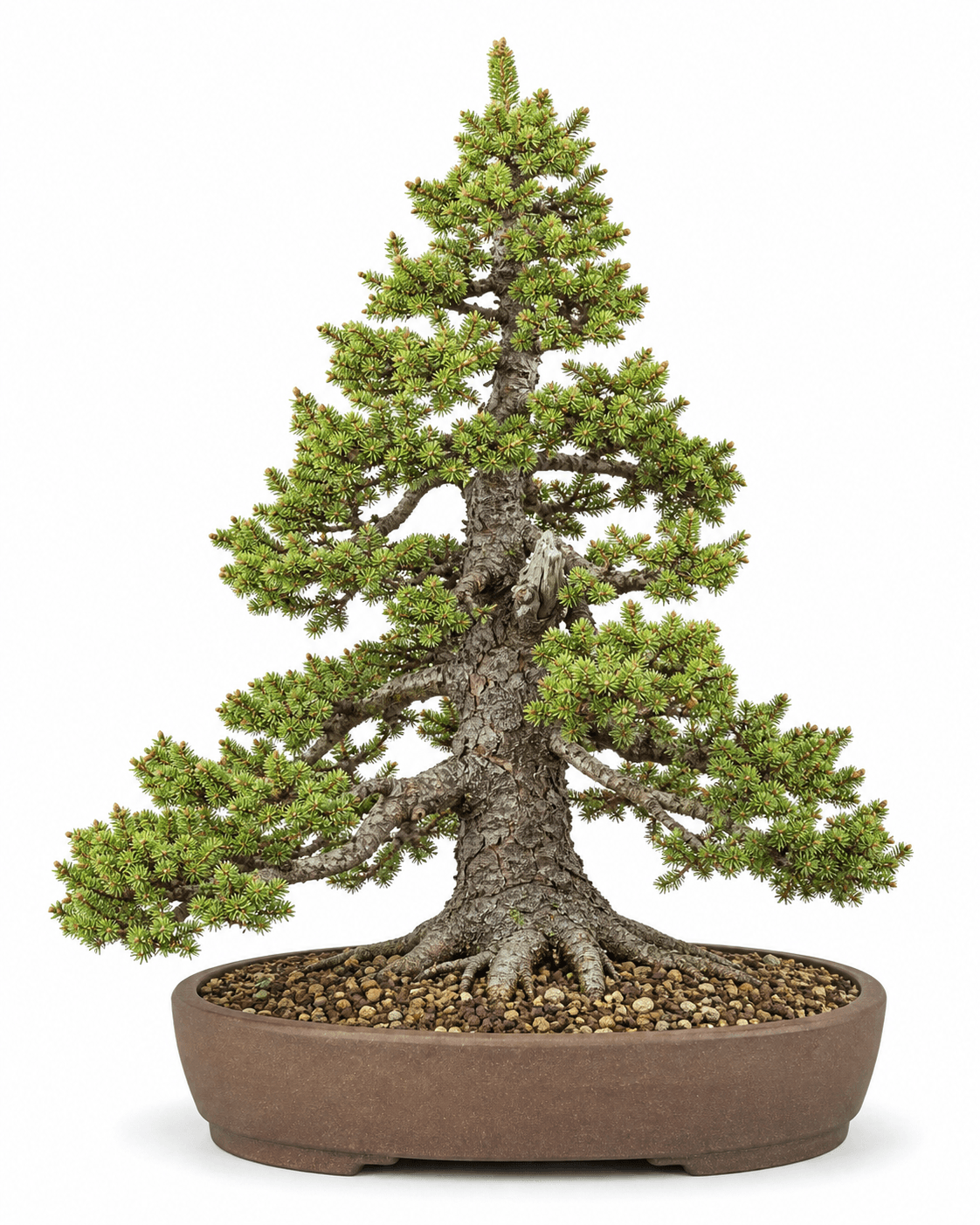
Dwarf Alberta spruce bonsai is a compact white spruce cultivar for outdoor growers who can provide cold dormancy, cool roots, bright light, and careful timing. Picea glauca Conica is appealing because its short needles, tight internodes, and narrow conical habit give small bonsai and forest plantings believable scale from nursery stock.
Treat it as a fine-needled Picea: build strength first, pinch only refined soft shoots, prune after the flush hardens, and keep heavy root work separate from heavy foliage work. The common failures are stale nursery peat, dry heat, spider mites, crushed needles under wire, inverse taper at congested junctions, and reverted shoots that grow faster and coarser than the dwarf form.
This guide uses the local Bonsai Mirai dwarf Alberta spruce, Alberta spruce forest, spruce pinching, post-harden pruning, rootbound nursery-stock, wiring, energy, watering, soil, and design corpus first, then grounds taxonomy, hardiness, cultivar behavior, morphology, and disease context in Kew, Oregon State, NC State, USDA, and University of Minnesota sources.
Updated June 4, 2026. Written by EntGrove Editorial. Last verified June 4, 2026.
Care fingerprint
Read the species through its shared care pattern.
Strong light, cool-root management, conservative root work, and post-extension pruning dominate the care calendar. Use this as the starting point before local conditions and tree strength refine the calendar.
Note: Standalone cultivar page justified by direct Mirai dwarf Alberta spruce corpus coverage and beginner search demand. Kew currently accepts Picea laxa for the white spruce complex and lists Picea glauca f. conica in synonymy; Oregon State documents Conica as dwarf Alberta spruce / dwarf white spruce with short 6-12 mm needles, Zone 2 hardiness, dry-heat mite risk, and reversion behavior.
Do not prune like a pine
Elongating conifers extend from buds and shoots, so candle-cutting assumptions can remove the exact growth the tree needs.
Preserve interior growth
Spruce, fir, hemlock, cedar, redwood, cypress, and larch all become harder to design when interior buds are shaded out.
Keep recovery cool and steady
Many elongating conifers respond best when roots stay evenly moist, oxygenated, and protected from hot dry swings.
Care cadence
The calendar starts with the tree's seasonal state.
Placement
Timing: Grow outdoors year-round. Give full sun in cool seasons and cool climates, then protect from hot wind, strong reflected light, and dry heat.
Watch for: Spider mites in dry heat, soft spring needles after protection, hot nursery containers, shaded interiors, and sudden exposure after heavy styling.
Oregon State Landscape PlantsBonsai Mirai LibraryWatering
Timing: Water deeply when the upper root zone begins to dry and confirm that water enters the old nursery core. After repotting, water thoroughly once, then let oxygen return before watering again.
Watch for: Runoff around a dry peat plug, sour wet core, gray mite-stressed foliage, dry slab edges, and constant saturation after root work.
Bonsai Mirai LibraryFertilizer
Timing: Feed development and post-styling trees through active growth and fall. In refinement, hold heavy spring fertilizer until pinching goals are clear, then feed conservatively.
Watch for: Coarse reverted shoots, junction swelling, weak fall buds, salt buildup in shallow pots, and fertilizer used to push a tree with poor water uptake.
Bonsai Mirai LibraryOregon State Landscape PlantsSpring pinching
Timing: Pinch only healthy refined shoots while the soft tip is still green and flexible. Work in two or three passes about 7-10 days apart when strong and weak zones open at different speeds.
Watch for: Removing the whole new shoot, pinching development branches, using scissors on folded needles, pinching after repotting, and letting soft needles burn in direct hot sun.
Bonsai Mirai LibraryPost-flush pruning
Timing: After new growth hardens, reduce coarse tips to visible buds or ramification, thin same-point clusters, and keep each retained shoot in its own light.
Watch for: Cutting mid-internode, keeping three or more shoots in one junction, cutting below viable buds, and stripping weak zones that still need needle mass.
Bonsai Mirai LibraryStructural work
Timing: Do heavy pruning and primary wiring in spring before bud push or in early fall after heat. Keep root reduction and heavy foliage reduction in separate seasons.
Watch for: Crushed needles, branch inversion that exposes needle undersides, under-gauged wire, fall wire bite, and old nursery stock styled before the root core is stable.
Bonsai Mirai LibraryRepotting
Timing: Repot as buds swell and freezing can be excluded during aftercare. Preserve part of the original root ball, reduce depth cleanly, and secure the tree firmly.
Watch for: Bare-rooting, torn roots, unstable tie-downs, deep peat under the trunk, over-reduction of foliage, and heavy shade that lasts beyond recovery.
Bonsai Mirai LibraryNeedle cleaning
Timing: Clean dead needles and older third- or fourth-year needles only when they release with light rubbing. Leave current and second-year needles in place.
Watch for: Pulling resistant needles, wiring over crushed foliage, removing all old needles from weak branches, and cleaning before back buds become usable shoots.
Bonsai Mirai LibraryPest and disease inspection
Timing: Inspect spring, dry late summer, and fall. Dwarf Alberta spruce needs frequent checks for spider mites, eastern spruce gall adelgid, aphids, sawflies, Rhizosphaera-like needle cast, and root rot.
Watch for: Gray stippling, webbing, pineapple-like galls, purple older needles, black fruiting bodies, sudden thinning, and browning from the inside out.
Oregon State Landscape PlantsNC State Extension conifer pestsUniversity of Minnesota ExtensionWinter protection
Timing: Keep dormant and cold. Protect container roots from severe freeze-thaw, dry wind, and exposed slab conditions while avoiding warm indoor storage.
Watch for: Dry frozen soil, newly styled sparse foliage, unremoved wire under dense needles, and warm protection that wakes buds before outdoor conditions are stable.
Oregon State Landscape PlantsBonsai Mirai LibrarySpecies guide
Apply the species profile before copying another tree's calendar.
At a glance
Dwarf Alberta spruce is compact, useful, and less forgiving than its availability suggests.
Dwarf Alberta spruce is the common bonsai and nursery name for Picea glauca Conica, a compact white spruce form. Kew now anchors the broader white spruce complex under Picea laxa, while public horticulture and bonsai sources still use Picea glauca for this cultivar. Kew POWOKew POWO: Picea glaucaOregon State Landscape Plants
The bonsai value is scale. Short needles, tight internodes, and a narrow silhouette let a young nursery tree read like a larger spruce in miniature, especially in forests and formal upright designs. Bonsai Mirai LibraryOregon State Landscape Plants
The horticultural risk is also scale. Dense foliage holds moisture and mites, tight junctions swell quickly, and small roots in nursery peat can swing between dry and anaerobic in one hot week. Bonsai Mirai LibraryOregon State Landscape Plants
Origin
Read the cultivar from white spruce ecology and from its dwarf mutation.
Oregon State describes Conica as a natural dwarf found in Alberta, Canada, in 1904. The parent white spruce complex is a northern North American conifer, with Kew and USDA sources placing it across Alaska, Canada, the Great Lakes, New England, and northern mountain pockets. Oregon State Landscape PlantsKew POWOUSDA Forest Service FEIS
That ecology gives the care baseline: cold dormancy, bright cool light, even moisture, and roots that receive water without losing oxygen. A bonsai pot removes the insulating snowpack and deep soil, so root temperature becomes the grower responsibility. USDA Forest Service FEISBonsai Mirai Library
The dwarf mutation changes the design baseline. A natural cone can become static unless the grower creates asymmetry through front choice, branch selection, spacing, and small variations in height, trunk line, and pad density. Bonsai Mirai / AsymmetryBonsai Mirai Library
In a forest or slab, the cultivar reads convincingly because many small, narrow trees can suggest altitude, snow, and distance. The composition needs varied trunk sizes and spacing so the group avoids looking like landscape shrubs set in a row. Bonsai Mirai Library
Reading
Separate nursery stock, development, refinement, and reversion before choosing work.
A new nursery dwarf Alberta spruce should be read from the base upward. Find the real flare, inspect the old soil core, identify branch clusters, and decide whether the first major operation should be styling, root correction, or simple recovery. Bonsai Mirai Library
Development relies on foliage. Let useful branches elongate enough to build vascular tissue, then use post-flush pruning to redirect strength toward interior buds and finer ramification. Bonsai Mirai Library
Refinement begins only after back buds have become actual needle mass. Before then, needle cleaning and pinching can remove the resources needed to create the next layer of branches. Bonsai Mirai Library
Reversion is a cultivar-specific read. A reverted shoot is longer, looser, and more species-type than the surrounding dwarf growth. Remove those shoots early before they thicken the junction and overwhelm the miniature scale. Oregon State Landscape PlantsBonsai Mirai Library
Technique
Pinch refined soft tips, prune hardened shoots, and protect needle mass.
Pinching is a refinement technique. Remove only the soft tip while supporting the shoot, leaving enough new-growth tissue near the base to form the next bud whorl. Bonsai Mirai Library
Development branches should usually extend first. Dwarf Alberta spruce already has short internodes, so premature pinching often weakens the tree without solving a design problem. Bonsai Mirai Library
After the flush hardens, prune back to visible buds or existing ramification. Same-point clusters should be reduced before they make hard knuckles, and dwarf Alberta spruce can swell aggressively where several shoots emerge together. Bonsai Mirai Library
Needle work is conservative. Remove dead needles and old needles that release easily, but leave resistant needles because the branch still uses them for photosynthesis and vascular support. Bonsai Mirai Library
Decandling has no role in this single-flush calendar. Manage dwarf Alberta spruce with soft-tip pinching in refinement or later prune-back to viable buds after hardening. Bonsai Mirai Library
Roots
Convert the nursery core slowly and avoid bare-rooting.
Repot in spring as buds swell, when the tree is hydrated and freezing can be excluded during aftercare. This is also the safest time to reduce a deep nursery root mass into a shallower training container. Bonsai Mirai Library
Start at the surface. Nursery soil and adventitious roots can hide the true base, and the widest flare should set the future front and planting height. Bonsai Mirai Library
Conifers should retain part of the original root ball. Replace peat or field soil over two to three repots, using clean cuts on circling roots and a firm tie-down so new roots are not torn. Bonsai Mirai Library
Keep foliage and root reductions separated. Spruce can tolerate heavy foliage reduction with roots intact, or meaningful root work with foliage intact, because stored strength sits in vascular tissue. Combining both cuts sharply raises risk. Bonsai Mirai Library
Soil and pot
Use oxygenated aggregate and containers that support a small spruce image.
An established-tree baseline is 3 parts akadama, 1 part lava, and 1 part pumice, adjusted for local heat, wind, pot depth, and the amount of old nursery core still present. Bonsai Mirai Library
During development, a flat or shallow training container can push roots laterally and improve oxygen exchange. The pot should be stable enough to support future wiring and carving without root movement. Bonsai Mirai Library
Finished trees usually read best in restrained unglazed conifer pots, narrow ovals, rectangles, slabs, or forest containers. The pot should reinforce cold-site spruce character rather than making the young nursery material look decorative. Bonsai Mirai / AsymmetryBonsai Mirai Library
Slab plantings dry faster and freeze harder than deeper pots. Use them when aftercare can provide secure tie-downs, moss edge management, careful watering, and winter buffering. Bonsai Mirai Library
Climate
Cold is easy for the species; heat, dry air, and warm roots are the harder problems.
Landscape hardiness is strong. Oregon State lists Zone 2, but a bonsai container exposes fine roots to freeze-thaw, drying wind, and warm winter swings that a landscape root system would not experience. Oregon State Landscape PlantsBonsai Mirai Library
In cool northern climates, give full sun and steady moisture. In hot inland or southern climates, use morning sun, afternoon shade, pot insulation, and clean airflow once heat starts to stress soft needles or mites appear. Oregon State Landscape PlantsBonsai Mirai Library
Dry heat is the pressure point. Oregon State flags red spider mites as a common problem in dry heat, and the bonsai version adds shallow soil, reflected heat, and dense foliage that can hide damage until the color dulls. Oregon State Landscape PlantsNC State Extension conifer pests
Winter storage should keep the tree dormant. Use a cold frame, mulch bed, snow cover, or ground contact where needed, and avoid warm indoor rooms that break dormancy while light remains too weak. Bonsai Mirai LibraryOregon State Landscape Plants
Pests
Spider mites, gall adelgid, needle cast, and stale roots are the routine checks.
Spider mites are the signature dwarf Alberta problem in dry heat. Look for gray stippling, dusty color, fine webbing, and a canopy that loses vibrancy before whole shoots brown. Oregon State Landscape PlantsNC State Extension conifer pests
Eastern spruce gall adelgid favors Norway and white spruce and forms pineapple-like galls near new growth. Bonsai trees should be inspected at bud break because early crawler timing matters more than late removal of old galls. NC State Extension conifer pests
Rhizosphaera-like needle cast shows as older needles turning brown or purple, black fruiting bodies in rows, and thinning from the interior or lower canopy. UMN notes that diagnosis matters because several fungi can look similar. University of Minnesota Extension
Root disorders often look like needle disease. A wet peat plug inside dry aggregate, poor tie-down, or constant saturation can cause yellowing and dieback after repotting without a pathogen being the primary driver. Bonsai Mirai Library
Wiring
Dwarf Alberta spruce can be wired, but needles and junctions punish rough work.
The Mirai corpus treats dwarf Alberta spruce as workable material when timing and aftercare are correct. Primary wiring is strongest in spring before push or early fall after heat. Bonsai Mirai Library
Clean before wiring. Remove dead needles, weak unbudded growth where strength allows, and redundant cluster shoots so wire can contact wood without crushing live needles. Bonsai Mirai Library
Wire should cradle needle-bearing sections in a loose tube and hold woody shoulders with real contact. Crushed needles die, while loose wire on wood fails because spruce tissue is phototropic and rebounds toward light. Bonsai Mirai Library
Watch wire closely after spring and fall work. The cultivar swells quickly at junctions, and dense needles hide bite until scars have already formed. Bonsai Mirai Library
Propagation
Most bonsai start as purchased nursery stock, not home propagation.
Conica is a named dwarf selection, so seed from a white spruce does not reliably produce the same compact habit. For bonsai, buying nursery stock or pre-bonsai is the practical route. Oregon State Landscape PlantsBonsai Mirai Library
NC State lists cultivars related to the white spruce complex, including Conica, Jean's Dilly, Laurin, Pixie, and Rainbow's End. Those names are sourcing clues, not guarantees of root quality or bonsai suitability. NC State Extension
Cuttings, grafts, and nursery propagation can preserve compact selections, but the bonsai buyer still has to inspect for graft unions, reverse taper, circling roots, and interior buds. Bonsai Mirai LibraryNC State Extension
Air layering spruce is not a dependable beginner route. If attempted experimentally, preserve foliage, choose young vigorous tissue, and expect slower response than with many broadleaf species. Bonsai Mirai Library
Buying
Buy the base, buds, and root convertibility before the perfect cone.
Good starter material has a discoverable trunk flare, usable interior buds, live lower branches, manageable shoot clusters, and a root core that can be converted over time. Bonsai Mirai Library
Reject perfect holiday-cone material when every branch starts from congested whorls and all live growth is on the exterior. A clean landscape outline can hide years of bonsai correction. Bonsai Mirai Library
Inspect for reverted shoots, dry-heat mite damage, brown interior thatch, branch junction swelling, and a peat column under the trunk. These are the common problems that decide whether an inexpensive tree is worth the years. Oregon State Landscape PlantsBonsai Mirai Library
For forests, buy varied sizes instead of identical cones. The tallest and thickest tree should anchor the group, while smaller trees build depth and age variation around it. Bonsai Mirai Library
Troubleshooting
Most failures trace to heat, mites, peat cores, crushed needles, or reversion.
Symptom: gray, dusty needles and slow browning. Likely cause: spider mites, dry heat, or dust stress. Fix: inspect with magnification, rinse when appropriate, improve airflow, and use locally labeled treatment only after confirming active mites. Oregon State Landscape PlantsNC State Extension conifer pests
Symptom: older interior needles turn purple or brown and drop. Likely cause: natural old-needle shed, Rhizosphaera-like needle cast, shaded interiors, or root stress. Fix: check needle age, look for black fruiting bodies, improve light and air, and use lab diagnosis where disease is suspected. University of Minnesota ExtensionBonsai Mirai Library
Symptom: yellowing after repotting. Likely cause: old nursery peat stayed wet, fresh aggregate dried around it, roots moved under weak tie-down, or foliage was reduced too hard. Fix: stabilize aftercare and delay further styling. Bonsai Mirai Library
Symptom: one shoot grows long, loose, and coarse. Likely cause: cultivar reversion. Fix: remove the reverted shoot early and reduce excess vigor at that junction before it creates inverse taper. Oregon State Landscape PlantsBonsai Mirai Library
Symptom: browning after wiring. Likely cause: crushed needles, branch inversion, repeated bending, wire bite, or direct sun after heavy work. Fix: remove pressure, protect from heat, and use cleaner shoulder contact next time. Bonsai Mirai Library
Symptom: fat knuckles at branch ends. Likely cause: repeated pinching without post-flush cluster reduction. Fix: after hardening, reduce same-point groups to useful pairs or finer ramification. Bonsai Mirai Library
Design
Use the cultivar for scale, then add asymmetry and age deliberately.
Start with base, trunk line, defining branch, and apex. The natural cone supplies instant spruce identity, but bonsai design needs one side to lead, one side to recede, and enough voids to avoid a clipped landscape-shrub feeling. Bonsai Mirai / AsymmetryBonsai Mirai Library
Formal upright and forest are the most natural first reads. A young single tree can suggest a middle-aged mountain spruce, while a forest can use repeated narrow trunks to create depth and scale. Bonsai Mirai Library
Apex work should stay peaked and spruce-like. Rounded domes weaken the species character, while a narrow top with small directional pads suggests a conifer reacting to light and snow. Bonsai Mirai Library
Deadwood should be modest. Use broken tips, small jin, or an aged apex feature where biologically credible, and avoid large manufactured shari on young nursery bark. Bonsai Mirai Library
Cultivars
Conica is the target, but related dwarf white spruce labels need inspection.
Oregon State uses Picea glauca Conica, dwarf Alberta spruce, and dwarf white spruce labels for the target plant. The same source notes short dense needles, slow growth, Zone 2 hardiness, mite risk in dry heat, and occasional reversion. Oregon State Landscape Plants
NC State lists related white spruce cultivars including Jean's Dilly, Laurin, Pixie, Rainbow's End, Sander's Blue, and others. Some may be better for small bonsai because of shorter needles or slower growth, but each plant still needs root and graft inspection. NC State Extension
Alberta white spruce and Black Hills spruce labels can refer to regional white spruce forms or trade selections. Keep the exact plant tag in records and compare habit, needle length, bud density, and heat response before applying a cultivar-specific plan. USDA Forest Service SilvicsUSDA NRCS Plant GuideNC State Extension
For EntGrove, dwarf Alberta spruce receives its own page because beginner searches, nursery availability, and Mirai corpus coverage are strong enough to justify cultivar-specific guidance. Bonsai Mirai LibraryOregon State Landscape Plants
History
A common landscape shrub became useful bonsai material through better technique.
Oregon State traces Conica to a natural dwarf found in Alberta in 1904, with later cultivars such as Laurin and Elegans Compacta derived from it. That history explains why the plant is common in nurseries but still behaves as a white spruce. Oregon State Landscape Plants
In bonsai, dwarf Alberta spruce has often carried a reputation for weakness. The Mirai corpus reframes the problem as technique and aftercare: timing, needle protection, root-core conversion, and heat management decide the outcome. Bonsai Mirai Library
Forest and slab plantings are the cultivar strongest historical opportunity in contemporary bonsai. Inexpensive nursery trees can become coherent groups when varied in size, planted securely, and refined over multiple cycles. Bonsai Mirai Library
A credible exhibition dwarf Alberta spruce should show clean old-needle work, protected interiors, controlled wire, no uncontrolled reverted shoots, and a design that reads like a spruce rather than clipped patio material. Bonsai Mirai / AsymmetryBonsai Mirai Library
Species questions
Answer the beginner questions before styling.
Can dwarf Alberta spruce be grown as bonsai?
Yes. Dwarf Alberta spruce can be grown as bonsai outdoors when it receives cold dormancy, bright cool light, oxygenated soil, careful watering, and pruning timed around spruce growth stages.
Can dwarf Alberta spruce bonsai live indoors?
No. It needs outdoor light, moving air, winter dormancy, and seasonal temperature change. Indoor rooms are too warm and dim for long-term health.
When should I repot dwarf Alberta spruce bonsai?
Repot in spring as buds swell. Hydrate first, keep part of the original root ball intact, secure the tree firmly, and protect it from freezing, wind, and hard sun afterward.
Should I pinch dwarf Alberta spruce?
Pinch only healthy refined shoots while the new tips are soft. Development branches, weak trees, and recently repotted trees should usually extend first and be pruned after hardening.
Can dwarf Alberta spruce be decandled?
No. Decandling belongs to multiflush pines. Dwarf Alberta spruce is managed with soft-tip pinching, post-flush pruning, needle cleaning, and staged wiring.
Why is my dwarf Alberta spruce turning brown inside?
Common causes include spider mites, natural old-needle shed, shaded interior growth, Rhizosphaera-like needle cast, stale nursery soil, heat stress, or root weakness after repotting.
What soil mix works for dwarf Alberta spruce bonsai?
A practical established-tree mix is 3 parts akadama, 1 part lava, and 1 part pumice. Nursery peat should be converted gradually over multiple repots.
What is a reverted shoot on dwarf Alberta spruce?
A reverted shoot is a longer, looser, faster-growing species-type shoot that breaks the compact Conica habit. Remove it early before it swells the junction and changes the tree scale.
Is dwarf Alberta spruce the same as white spruce?
It is a compact white spruce form commonly sold as Picea glauca Conica. EntGrove keeps it separate because its nursery availability, short needles, reversion behavior, and beginner search demand justify specific guidance.
What styles suit dwarf Alberta spruce bonsai?
Formal upright, informal upright, forest, slab forest, twin-trunk, and small alpine spruce images suit dwarf Alberta spruce best, especially when the design adds asymmetry to the natural cone.
Sources
Species advice needs source discipline.
Next decisions
Plan the operation before copying the calendar.
A good care note for Dwarf Alberta spruce records the tree's stage, the work done, and the aftercare used. That record matters more than a month-name rule.
Related species
Compare nearby trees before transferring advice.
Subalpine fir
Abies lasiocarpa
Balsam fir
Abies balsamea
White fir
Abies concolor
Noble fir
Abies procera
Mountain hemlock
Tsuga mertensiana