
Species guide
Norway Spruce Bonsai Care
Picea abies
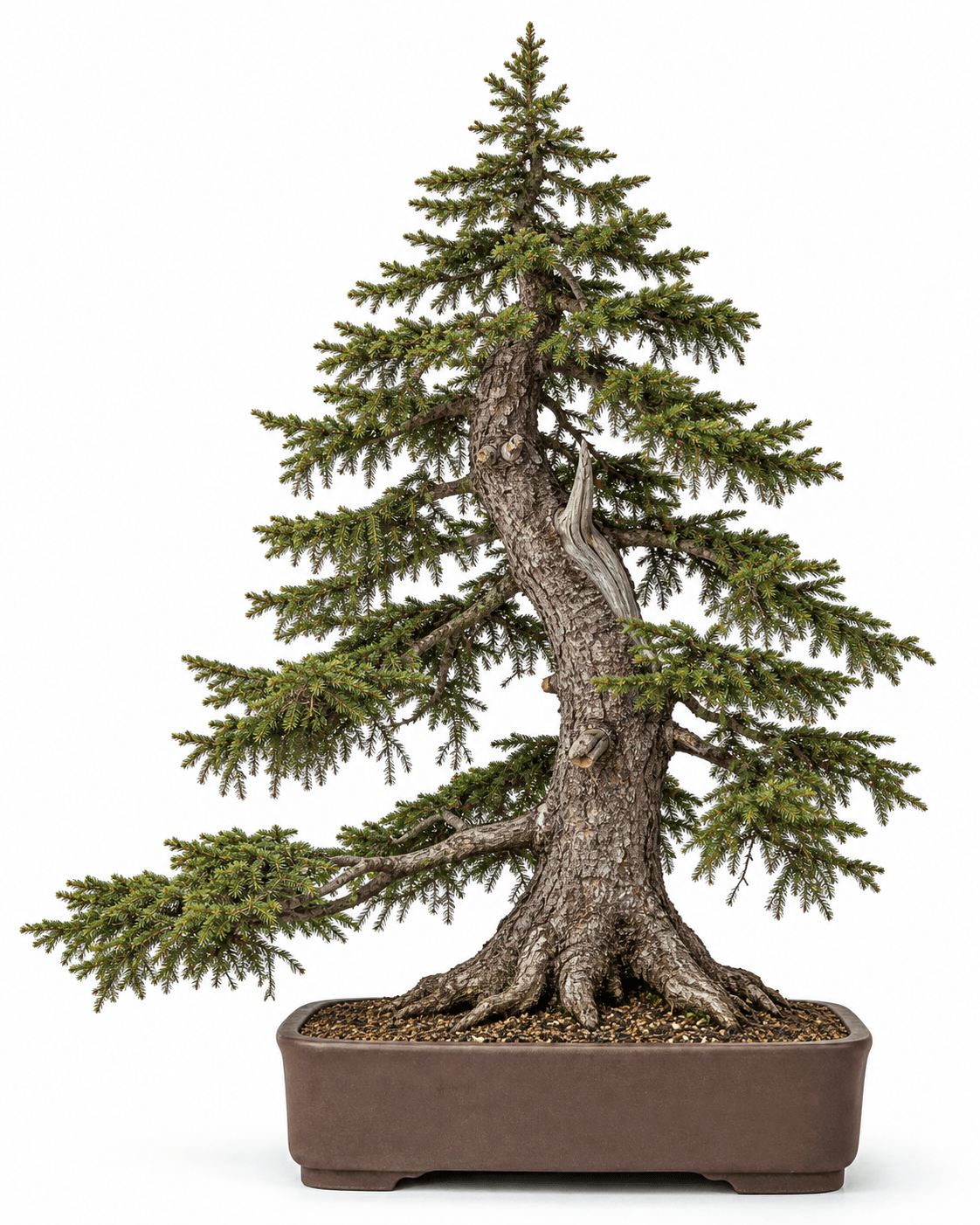
Norway spruce bonsai is an outdoor, cold-dormant Picea for growers who can provide cool roots, bright light, even moisture, and disciplined spring and early-summer timing. Picea abies is more common in nursery trade than most spruces, and dwarf forms such as bird's nest spruce can give bonsai growers short internodes and usable scale from the start.
Treat Norway spruce as an elongating conifer: build vascular strength first, pinch only healthy refined soft tips, prune after the flush hardens, and reserve heavy structural work for spring bud swell or early fall. The practical pattern is full sun in cool climates, afternoon protection in heat, staged nursery-core conversion, no bare-rooting, careful needle cleaning, frequent mite checks, and branch selection that uses the species natural conical or pendulous character.
This guide uses the local Bonsai Mirai Picea abies, bird's nest spruce, spruce pinching, post-harden pruning, refinement-transition, rootbound nursery-stock, watering, soil, wiring, and design corpus first, then grounds taxonomy, range, hardiness, morphology, cultivar, and disease context in Kew, Oregon State, NC State, USDA FEIS, Iowa State, and University of Minnesota sources.
Updated June 4, 2026. Written by EntGrove Editorial. Last verified June 4, 2026.
Care fingerprint
Read the species through its shared care pattern.
Strong light, cool-root management, conservative root work, and post-extension pruning dominate the care calendar. Use this as the starting point before local conditions and tree strength refine the calendar.
Note: Kew accepts Picea abies and places its native range in Europe. Oregon State and NC State sources use Norway spruce, European spruce, common spruce, Baltic whitewood, bird's nest spruce for Nidiformis, and weeping Norway spruce labels; verify cultivar habit and root system before applying scale or styling assumptions.
Do not prune like a pine
Elongating conifers extend from buds and shoots, so candle-cutting assumptions can remove the exact growth the tree needs.
Preserve interior growth
Spruce, fir, hemlock, cedar, redwood, cypress, and larch all become harder to design when interior buds are shaded out.
Keep recovery cool and steady
Many elongating conifers respond best when roots stay evenly moist, oxygenated, and protected from hot dry swings.
Care cadence
The calendar starts with the tree's seasonal state.
Placement
Timing: Grow outdoors year-round. Give full sun in cool weather and cool climates, then protect the pot and soft growth from hot afternoon sun, reflected heat, and drying wind.
Watch for: Warm southern Zone 7 conditions, hot dry summers, soft spring needles after greenhouse protection, mite-prone dry air, and compact cultivars overheating in shallow pots.
NC State ExtensionBonsai Mirai LibraryWatering
Timing: Water deeply when the upper root zone begins to dry. After repotting, water thoroughly once, then let air return before the next deep watering.
Watch for: Wet peat under the trunk, dry aggregate around a wet core, water bypassing rootbound nursery soil, stale odor, and watering by calendar.
Bonsai Mirai LibraryNC State ExtensionFertilizer
Timing: Feed development trees strongly through active growth and fall to build vascular tissue and back buds. Refined trees can receive lighter spring feeding until pinching goals are clear.
Watch for: Coarse junctions, excessive dwarf-cultivar swelling, salt accumulation, weak fall buds from underfeeding, and fertilizer used to push a weak root system.
Bonsai Mirai LibrarySpring pinching
Timing: Pinch only healthy refined shoots while the new growth is soft and mint green. Work in two or three passes about 7-10 days apart when strong, medium, and weak shoots move at different speeds.
Watch for: Removing the whole shoot, pinching development branches, tearing hardened stems, using scissors on folded needles, and letting soft foliage burn near 75 F.
Bonsai Mirai LibraryPost-flush pruning
Timing: After the flush hardens and new needles firm up, reduce coarse tips to viable buds or ramification, thin same-point whorls, and open light to interiors.
Watch for: Cutting mid-internode, reducing below the last bud, keeping five to eight shoots in one cluster, overworking during heat, and removing more foliage than the tree can support.
Bonsai Mirai LibraryStructural work
Timing: Do heavy branch removal and primary wiring in spring before bud push or in early fall after peak heat. Keep heavy root work and heavy foliage work in separate seasons.
Watch for: Fall wire bite, under-gauged wire, wire hidden by needles, hollow or weak old branches, and summer bending that interrupts water delivery.
Bonsai Mirai LibraryRepotting
Timing: Repot in spring as buds swell, while the tree is well hydrated and freezing can be excluded during aftercare. Convert old nursery soil over two to three repots.
Watch for: Bare-rooting, torn roots, poor tie-down, over-reduction of top and roots together, constant saturation, and missed root flare under nursery soil.
Bonsai Mirai LibraryNeedle cleaning
Timing: Clean dead needles and older needles only when they release with light rubbing. Third- and fourth-year needles can be removed on strong refined trees to improve air, light, and wiring access.
Watch for: Tearing live needles, plucking first- or second-year needles, crushing needles under wire, and stripping weak branches that still need photosynthetic mass.
Bonsai Mirai LibraryPest and disease inspection
Timing: Inspect spring and fall for spruce spider mites, then check wet or stressed seasons for needle cast, cytospora canker, aphids, bagworms, budworms, borers, rust, and wood decay.
Watch for: Gray stippling, webbing, purple or brown older needles, black fruiting bodies, resinous cankers, random branch death, and branch decline after drought or winter injury.
NC State ExtensionNC State Extension conifer pestsUniversity of Minnesota Extension: Cytospora cankerUniversity of Minnesota Extension: Rhizosphaera needle castWinter protection
Timing: Keep dormant and cold. Protect container roots from hard freeze-thaw, dry wind, and exposed slab conditions, especially after heavy styling or root work.
Watch for: Indoor storage, dry frozen soil, sparse post-styling foliage, late nitrogen, and warm protection that breaks dormancy early.
Oregon State Landscape PlantsBonsai Mirai LibrarySpecies guide
Apply the species profile before copying another tree's calendar.
At a glance
Norway spruce is a vigorous European spruce with useful dwarf and weeping forms.
Picea abies is an evergreen Pinaceae species native to Europe. Public sources use Norway spruce, European spruce, common spruce, Baltic whitewood, and several cultivar names, while Kew accepts Picea abies as the current species name. Kew POWONC State ExtensionUSDA Forest Service FEIS
As bonsai, it belongs with alpine elongating conifers. The working calendar is spring bud swell for root work and heavy setup, soft spring growth for refined pinching, post-flush hardening for prune-back, early fall for structural work, and winter for protected dormancy. Bonsai Mirai Library
The species is more available than many native alpine spruces because it is widely planted in nurseries. That availability matters: growers can select for a good root base, short internodes, pendulous branches, or dwarf habit instead of starting from oversized landscape material. Oregon State Landscape PlantsBonsai Mirai Library
Wild range
Read care from cool European forests, mountain air, and moist soil.
Kew gives the native range as Europe. USDA FEIS describes the species across the European Alps, Balkan mountains, Carpathians, Scandinavia, and northern Russia, with later introduction across the British Isles and North America. Kew POWOUSDA Forest Service FEIS
NC State translates that ecology into horticulture: full sun, moderately moist well-drained sandy acidic soil, cool summers, and sensitivity to heat, wet feet, and hot dry summers. In a bonsai container, the same tree needs more precise water and root-temperature management. NC State ExtensionBonsai Mirai Library
Wild and old landscape Norway spruce often show a strong central leader with drooping secondary branchlets. Bonsai design can use that habit for formal upright, forest, weeping, or old European mountain images without forcing broad pine-like pads. Oregon State Landscape PlantsBonsai Mirai / Asymmetry
Dwarf cultivar habitat is artificial but still useful to read. Bird's nest spruce is a dense mounding mutation, so its care should manage congested whorls, interior light, and mite-prone dry foliage while using its naturally small scale. Oregon State Landscape PlantsOregon State Landscape Plants: NidiformisBonsai Mirai Library
Reading
Decide whether each branch is building strength or ready for refinement.
A developing Norway spruce needs extension, needle mass, and vascular expansion before refinement. Mirai elongating-species method treats foliar mass as the engine that creates back buds and future prune-back points. Bonsai Mirai Library
A branch is ready for refinement only after back buds have matured into actual needles. Before that point, heavy cleaning or pinching removes the resources that would have turned those buds into usable branch structure. Bonsai Mirai Library
Read each branch separately. A single tree can hold a refined upper branch, a developing lower branch, and a weak interior shoot at the same time, so the correct technique can vary branch by branch. Bonsai Mirai Library
Nursery material has extra diagnostic work. Find the true root flare, check whether interior buds exist, identify bar-branch whorls, and decide whether the plant is upright Norway spruce, bird's nest spruce, weeping Norway spruce, or a different Picea label. Oregon State Landscape PlantsBonsai Mirai Library
Spring growth
Pinch soft refined tips and prune hardened shoots back to visible buds.
Pinching is a refinement technique. Remove only the soft tip while supporting the shoot, and leave enough new-growth tissue at the base to form the next bud whorl. Bonsai Mirai Library
The pinching window is visual and brief. Work when the shoot is still soft and green; stop when the central stem stiffens, turns pale, and tears instead of breaking cleanly. Bonsai Mirai Library
Post-flush pruning is the main structural refinement tool. Once new needles firm and harden, cut back to identifiable buds, reduce same-point whorls, remove downward and crotch growth, and organize branch fans with light reaching each retained shoot. Bonsai Mirai Library
Norway spruce should never be decandled like Japanese black pine. It is a single-flush elongating conifer, so spring technique is soft-tip pinching on refined zones or later prune-back to viable buds. Bonsai Mirai Library
Roots
Protect the conifer root core and convert nursery soil over time.
Repot Norway spruce in spring as buds swell. The tree should be well hydrated before work, and aftercare should exclude freezing while roots callus and begin to grow. Bonsai Mirai Library
Avoid bare-rooting. Mirai nursery-stock and slab-planting work repeats the conifer rule: keep some original root mass intact, then replace nursery soil or field soil over two to three repotting cycles. Bonsai Mirai Library
Rootbound nursery spruce often hides the real base under organic matter and adventitious roots. Expose the trunk flare from the top first, reduce bottom depth next, and cut circling roots back to finer laterals rather than tearing them out. Bonsai Mirai Library
Keep top work and root work balanced across seasons. Spruce can tolerate heavy root reduction when foliage is preserved, or heavy foliage reduction when roots are preserved, but combining both reductions raises the failure risk sharply. Bonsai Mirai Library
Soil and pot
Use water-retentive aggregate, then choose a pot that supports the tree story.
A reliable established-spruce mix is 3 parts akadama, 1 part pumice, and 1 part lava. Adjust particle size, akadama fraction, and watering frequency for heat, wind, pot depth, and whether old nursery soil remains in the core. Bonsai Mirai Library
Fresh repots need one thorough watering followed by oxygen re-entry. Chronic wet feet are a known landscape weakness for Norway spruce, and the same problem intensifies in shallow containers. NC State ExtensionBonsai Mirai Library
Unglazed earthen pots suit older upright or rugged conifer images. Deep ovals, rectangles, rounds, slabs, and forest trays can all work when depth and tie-down match the root system. Bonsai Mirai / AsymmetryBonsai Mirai Library
Dwarf mounding material may look better in shallow ovals or slabs once roots are established. Weeping forms often need enough pot mass to balance a falling line and enough depth to keep the root zone cool. Oregon State Landscape Plants: NidiformisOregon State Landscape PlantsBonsai Mirai / Asymmetry
Climate
Cool northern climates are easiest, while heat changes the whole calendar.
Norway spruce is cold hardy, but bonsai roots need earlier protection than landscape roots. Mulch beds, snow cover, cold frames, or ground contact help shallow containers avoid freeze-thaw damage and dry frozen soil. Oregon State Landscape PlantsBonsai Mirai Library
Warm climates require stronger restraint. NC State warns that Norway spruce performs poorly in the southern United States Zone 7 because it prefers cool summers, and Iowa State notes that Zone 8 survival does not mean good adaptation. NC State ExtensionIowa State Extension
During heat, shift from maximum sun to root protection: morning sun, afternoon shade, airy benches, wind moderation, and reduced post-pruning exposure. Freshly thinned spruce has less transpirational cooling capacity than a full tree. Bonsai Mirai Library
Locally adapted nursery stock matters in marginal regions. The Mirai spruce corpus explicitly favors nursery-adapted Norway or bird's nest spruce for hot-region experiments over moving cool-region collected spruce into heat. Bonsai Mirai Library
Pests
Watch mites first, then diagnose needle cast and canker carefully.
NC State lists aphids, bagworms, budworms, borers, red spider mites, cytospora canker, wood decay, needle cast, and rust as potential Norway spruce problems. In bonsai, dense pads and dry benches make mite scouting especially important. NC State ExtensionNC State Extension conifer pests
Spruce spider mites are cool-weather mites. NC State conifer pest guidance notes that they feed on spruce and other conifers, yellow or brown needles, and can cause premature needle drop and webbing in serious infestations. NC State Extension conifer pests
Cytospora canker usually follows stress. University of Minnesota Extension describes random branch death, purple-brown needles, and resin-coated cankers, with drought, winter injury, and other stress acting as common triggers. University of Minnesota Extension: Cytospora canker
Rhizosphaera needle cast is less aggressive on Norway spruce than on Colorado blue spruce, but stress can still allow infection. Look for older needles turning brown to purple, black fruiting bodies in rows, and late-summer to fall needle drop. University of Minnesota Extension: Rhizosphaera needle castBonsai Mirai Library
Wiring
Wire before growth moves, then watch fall and spring swelling.
Primary wiring is safest in spring before bud push or early fall after heat. Spruce branches have memory, so use enough gauge, anchor well, and expect position to need more than one wiring cycle. Bonsai Mirai Library
When wiring through needle mass, pre-form the wire into a loose tube around needles so it does not crush them. Along bare woody sections, the wire needs firm shoulder contact to hold the bend. Bonsai Mirai Library
Check wire frequently in spring and fall because spruce vascular tissue expands strongly. Wire that looked fine in winter can bite quickly once the tree begins storing and moving energy. Bonsai Mirai Library
Avoid twisting fine branches repeatedly. Use one decisive bend, guy wires where useful, and branch selection when the existing shoot structure can solve the design with less stress. Bonsai Mirai Library
Propagation
Seed gives clean roots, while cultivars usually come from nursery propagation.
NC State lists seed propagation, and Iowa State notes that Norway spruce is widely planted in the United States for ornamental and windbreak use. Seedlings give the cleanest root system but need years of development. NC State ExtensionIowa State Extension
Cultivars are usually purchased rather than created by the bonsai grower. Dwarf, bird's nest, columnar, golden, and weeping selections start with different habits that can either solve or create bonsai design problems. Oregon State Landscape PlantsOregon State Landscape Plants: Nidiformis
Cuttings and grafted nursery forms should be judged by root quality and graft union, not just foliage scale. A compact top on a poor root system can still require years of root correction. Bonsai Mirai Library
Collected material is less common than nursery material for Norway spruce in North America. If collected legally in suitable regions, protect roots, preserve foliage, and delay styling until buds and water uptake show recovery. Bonsai Mirai LibraryUSDA Forest Service FEIS
Buying
Buy for base, buds, cultivar habit, and root convertibility.
Good Norway spruce nursery material has a visible or discoverable trunk flare, interior buds, branches that are not all in one coarse whorl, and a root core that can be converted without bare-rooting. Bonsai Mirai Library
Bird's nest spruce can be valuable because its dense, flattened habit and shorter needles fit smaller compositions. Inspect for spider mites, dead interior thatch, congested junctions, and a root pad that has not turned into solid peat. Oregon State Landscape Plants: NidiformisNC State Extension conifer pestsBonsai Mirai Library
Weeping Norway spruce and pendulous forms can make strong literati, cascade, or dramatic upright material, but they still need a coherent trunk line and branch structure. A weeping habit alone does not make a bonsai. Oregon State Landscape PlantsBonsai Mirai / Asymmetry
Ask how long pre-bonsai has been in its current soil, whether it has been repotted or styled recently, what cultivar it is, and whether mites or needle disease have appeared in the last two seasons. Bonsai Mirai LibraryNC State Extension
Troubleshooting
Most failures trace to heat, stale roots, mites, overwork, or disease stress.
Symptom: gray, dusty, stippled needles. Likely cause: spruce spider mites, dry air, dust, or water stress. Fix: inspect with magnification, rinse when appropriate, improve humidity and airflow, and treat only after confirming active mites. NC State Extension conifer pestsBonsai Mirai Library
Symptom: older interior needles turn purple or brown and drop. Likely cause: natural older-needle shed, Rhizosphaera-like needle cast, shade, or root stress. Fix: check needle age, look for black fruiting bodies, improve light and air, and use local lab diagnosis for disease. University of Minnesota Extension: Rhizosphaera needle castBonsai Mirai Library
Symptom: random branch death with resin near the trunk. Likely cause: cytospora canker after drought, winter injury, or other stress. Fix: prune infected branches during dry weather, reduce stress, and avoid wounding healthy branches. University of Minnesota Extension: Cytospora canker
Symptom: yellowing after a first nursery repot. Likely cause: old peat stays wet, new aggregate dries around it, roots moved under weak tie-down, or too much foliage was removed. Fix: stabilize aftercare and plan staged core conversion later. Bonsai Mirai Library
Symptom: coarse knuckles at every branch end. Likely cause: repeated pinching without post-flush whorl reduction. Fix: after hardening, reduce same-point clusters to useful pairs or finer ramification. Bonsai Mirai Library
Symptom: browning after wiring. Likely cause: crushed needles, repeated twisting, wire bite, branch inversion, or heat exposure after styling. Fix: remove pressure, shade and cool the tree, and use cleaner branch selection next cycle. Bonsai Mirai Library
Design
Use conical apices, pendant branchlets, and cultivar habit honestly.
Start with base, trunk line, defining branch, and apex. Norway spruce can support a formal upright forest image, an informal old European tree, a weeping literati, or a compact mounded dwarf, but each image needs its own branch rhythm. Bonsai Mirai / AsymmetryOregon State Landscape Plants
Spruce apices read best when they stay conical or peaked. A rounded dome weakens the species character, while a narrow apex with small directional pads feels closer to spruce ecology. Bonsai Mirai Library
Pendant secondary branchlets are a Norway spruce signature. Use wiring and pruning to separate branch planes, then let selected tips hang or sweep where the design calls for age, snow load, or weeping cultivar identity. Oregon State Landscape PlantsBonsai Mirai Library
Deadwood should be restrained. Spruce wood is softer than juniper wood, so natural jin, broken stubs, and aged dead branch remnants are more credible than large carved shari. Bonsai Mirai Library
Cultivars
Nidiformis, Pendula, Cupressina, and other forms change the starting point.
Oregon State notes that more than 150 Norway spruce cultivars have originated from mutations, with dwarf forms often coming from witches' broom growth. That cultivar diversity is one reason Norway spruce is practical nursery material. Oregon State Landscape Plants
Picea abies Nidiformis, bird's nest spruce, is a dense spreading dwarf with a flattened globe form and short 7-10 mm needles in the Oregon State profile. It is useful for small trees, clumps, mounds, and forest components when the interior is kept alive. Oregon State Landscape Plants: Nidiformis
Pendula and other weeping forms supply dramatic movement, but they often need staking or careful structural wiring to establish a convincing trunk. Cupressina offers narrow upright habit, while Gold Drift supplies color that may distract from bonsai age. Oregon State Landscape Plants
Pumila and related dwarf nursery labels should be evaluated plant by plant. Needle scale, internode length, root flare, graft quality, interior buds, and cultivar stability matter more than the printed label. Bonsai Mirai LibraryOregon State Landscape Plants
History
Norway spruce links European forestry, Christmas trees, and nursery bonsai material.
USDA FEIS describes Norway spruce as one of Europe and Scandinavia major conifer species, widely used for construction, pulp, furniture, and musical instruments, and intensively studied in forest genetics. USDA Forest Service FEIS
Oregon State notes its role as the typical Christmas tree in Britain, while Iowa State describes wide planting in the United States for ornamental and windbreak purposes. Oregon State Landscape PlantsIowa State Extension
For bonsai, the important history is nursery availability. Many growers meet Norway spruce as bird's nest spruce, weeping Norway spruce, or inexpensive landscape stock, then learn that the species rewards timing more than quick styling. Bonsai Mirai LibraryOregon State Landscape Plants: Nidiformis
A credible exhibition Norway spruce should show clean needle generations, interior buds, controlled whorls, a cool-rooted container strategy, and a design that reads as spruce from the first glance. Bonsai Mirai / AsymmetryBonsai Mirai Library
Species questions
Answer the beginner questions before styling.
Can Norway spruce be grown as bonsai?
Yes. Norway spruce can be grown as bonsai outdoors when it receives cold dormancy, cool roots, bright light, oxygenated soil, and pruning timed around spring growth and post-flush hardening.
Can Norway spruce bonsai live indoors?
No. Norway spruce needs outdoor sun, moving air, cold dormancy, and seasonal temperature change. Indoor rooms are too warm and dim for long-term health.
When should I repot Norway spruce bonsai?
Repot in spring as buds swell. Hydrate first, keep part of the original root ball intact, tie the tree firmly, and protect it from freezing, wind, and hard sun afterward.
Should I pinch Norway spruce?
Pinch only healthy refined shoots while the new tips are soft. Development branches, weak trees, and recently repotted trees should usually extend first and be pruned after hardening.
Can Norway spruce be decandled?
No. Decandling is for multiflush pines such as Japanese black pine. Norway spruce is managed through soft-tip pinching, post-flush pruning, needle cleaning, and staged wiring.
What soil mix works for Norway spruce bonsai?
A practical established-tree mix is 3 parts akadama, 1 part pumice, and 1 part lava. Nursery peat or field soil should be converted gradually over multiple repots.
Is bird's nest spruce the same as Norway spruce?
Bird's nest spruce is Picea abies Nidiformis, a dwarf Norway spruce form with dense spreading growth and shorter needles. It follows Norway spruce care but needs extra interior light and mite scouting.
Why is my Norway spruce turning brown inside?
Common causes include natural old-needle shed, shaded interior growth, spruce spider mites, needle cast, stale nursery soil, heat stress, or root weakness after repotting. Inspect needles, roots, and water movement before treating.
How much sun does Norway spruce bonsai need?
Give full sun in cool climates and cool seasons. In hot climates or during soft spring growth, use morning sun, afternoon shade, and pot cooling.
What styles suit Norway spruce bonsai?
Formal upright, informal upright, forest, slab, literati, cascade, semi-cascade, weeping, and compact mounding styles suit Norway spruce when they preserve a conical spruce apex and species-appropriate branch rhythm.
Sources
Species advice needs source discipline.
Next decisions
Plan the operation before copying the calendar.
A good care note for Norway spruce records the tree's stage, the work done, and the aftercare used. That record matters more than a month-name rule.
Related species
Compare nearby trees before transferring advice.
Subalpine fir
Abies lasiocarpa
Balsam fir
Abies balsamea
White fir
Abies concolor
Noble fir
Abies procera
Mountain hemlock
Tsuga mertensiana