
Species guide
Dwarf Black Olive Bonsai Care
Terminalia molinetii
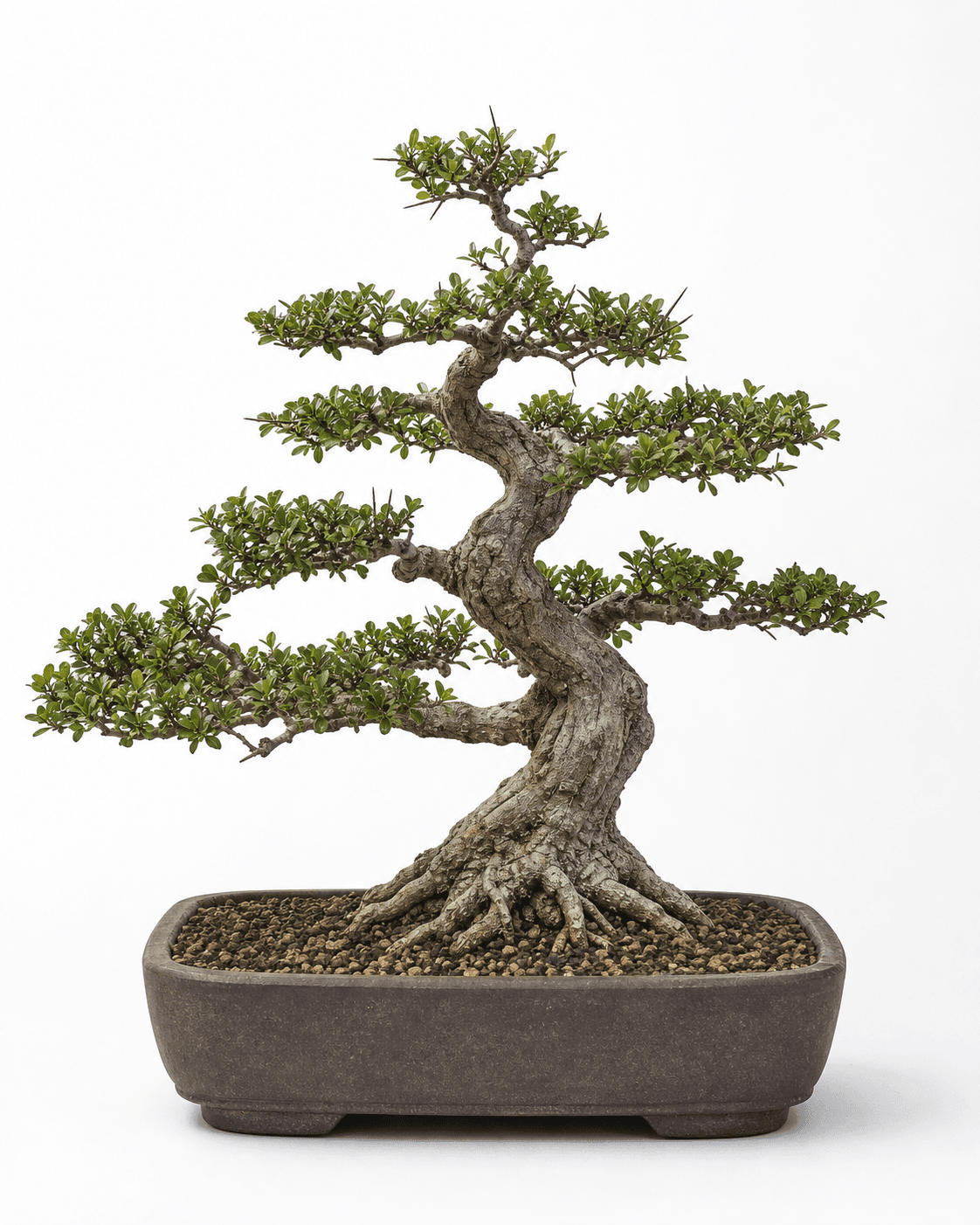
Dwarf black olive bonsai is a slow tropical broadleaf grown for tiny leaves, thorny zigzag branching, horizontal branch planes, and a naturally architectural silhouette. The current accepted name is Terminalia molinetii, while bonsai trade and the Bonsai Mirai corpus commonly use Bucida spinosa.
The main care rule is warmth before work. Do pruning, wiring, repotting, and propagation attempts only during reliable tropical growth, ideally after nights are above 60-65 F / 16-18 C, and protect the tree when nights approach 40-45 F / 4-7 C.
This is a patient tree. Trunk character comes from age, collected material, or long training rather than fast thickening. Clip-and-grow, careful wound sealing, seed propagation, and branch-plane design suit the species better than forcing curves into mature hard wood.
Updated June 19, 2026. Written by EntGrove Editorial. Last verified June 19, 2026.
Care fingerprint
Read the species through its shared care pattern.
Treat indoor culture as a light-management problem first; prune and repot when the tree is actively growing and warm enough to recover. Use this as the starting point before local conditions and tree strength refine the calendar.
Note: Current Kew taxonomy accepts Terminalia molinetii; Bucida spinosa remains the common bonsai trade label. Keep separate from Terminalia buceras, the larger black olive / oxhorn bucida / Shady Lady tree.
Read the foliage first
Broadleaf stress usually shows in leaf color, leaf size, wilt, scorch, or delayed hardening before it becomes a branch problem.
Match work to dormancy
Deciduous, evergreen, tropical, succulent, and flowering broadleaf trees recover on different calendars.
Protect fine roots
Root work should preserve enough active fine roots for the tree to rehydrate quickly after the operation.
Care cadence
The calendar starts with the tree's seasonal state.
Placement
Timing: Grow outside in warmth when nights are reliably above 60-65 F / 16-18 C. Move into protected bright quarters as nights approach 40-45 F / 4-7 C.
Watch for: Cold nights, dull indoor leaves, long internodes from weak light, stalled extension, and leaf drop after a move from protection to sun.
Bonsai Mirai LibraryWatering
Timing: Water thoroughly during warm active growth when the upper soil is drying. In cool protection, let the substrate approach dryness before watering again.
Watch for: Soft new leaves during heat, stale wet soil in winter, dry inner root cores, and yellowing leaves when oxygen has not returned to the pot.
Bonsai Mirai LibraryFertilizer
Timing: Feed during active warm growth after the tree is extending. Resume lightly after repotting only once new robust growth proves root recovery.
Watch for: Salt stress during high heat, weak growth after root work, and coarse extension on a refined small tree.
Bonsai Mirai LibraryPruning
Timing: Use clip-and-grow during peak growth. Seal significant cuts immediately because unsealed wounds can rot inward and interrupt vascular flow.
Watch for: Hard pencil-thick branches, old wounds, branch dieback behind unsealed cuts, and repeated clipping before enough extension has drawn energy through the branch.
Bonsai Mirai LibraryWiring
Timing: Wire young shoots while they are flexible. Use mature branch wire mainly to set branch planes and direction, then check often as growth resumes.
Watch for: Hard wood that refuses a bend, wire bite on slow-healing bark, flat planes pulled into generic curves, and branches set at the same height.
Bonsai Mirai LibraryRepotting
Timing: Repot only after warmth is stable, ideally near the strongest part of the local tropical growing season. Preserve part of the root mass and avoid heavy top reduction in the same session.
Watch for: Slow drainage, decomposed soil, weak anchoring, cold aftercare, and root work performed before nights are warm enough for recovery.
Bonsai Mirai LibraryPropagation
Timing: Plan seed as the primary route. Mirai reports poor cutting and air-layer success; air layers can need 12-15 months and only about one third may produce enough roots.
Watch for: Dry seed trays, windy mother-tree sites, early layer separation, and expecting fast trunk character from seedlings.
Bonsai Mirai LibraryWinter protection
Timing: Protect before cold arrives, then keep the tree bright, warm, and drier than in summer. Avoid major work while it is below its active photosynthetic range.
Watch for: Cold wet roots, blackened leaf patches, bare indoor rooms, and heavy pruning before spring warmth returns.
Bonsai Mirai LibrarySpecies guide
Apply the species profile before copying another tree's calendar.
At a glance
Treat the bonsai trade tree as Terminalia molinetii, with Bucida spinosa as the searchable label.
Kew accepts Terminalia molinetii M.Gomez in Combretaceae and gives the native range as southern Mexico to Belize, southeast Florida, Cuba to southern Hispaniola, and St. Croix. Flora of North America lists Bucida molinetii and B. spinosa as synonyms and gives the common names spiny black olive and dwarf geometry tree. Kew POWOFlora of North America
The Bonsai Mirai distilled corpus uses Bucida spinosa and dwarf black olive, which matches common bonsai trade language. This page uses Terminalia molinetii for taxonomy and keeps Bucida spinosa in the title ecosystem so growers can find the right care. Bonsai Mirai LibraryFlora of North America
Keep the care group simple: Broadleaf > Tropical. Work when nights are warm, protect before cold, maintain root oxygen, and build the design through clip-and-grow and young-shoot wiring rather than heavy bends on old wood. Bonsai Mirai Library
Wild habitat
Its natural image is low, coastal, thorny, and horizontally layered.
FNA places Terminalia molinetii in low hammocks and pineland margins at 0-10 m elevation. Leon Levy describes wet coastal dry broadleaf evergreen formations, coppice, wet savannas, and a shrub or small-tree habit up to 8 m. Flora of North AmericaLeon Levy Native Plant Preserve
That habitat explains the bonsai character. The plant carries small persistent leaves, slender thorns, and horizontally flattened zigzag branches. The design should read as tropical coastal scrub or dry broadleaf woodland, not as a temperate maple or pine. Flora of North AmericaLeon Levy Native Plant PreserveBonsai Mirai / Asymmetry
Care follows the same ecology. Give strong light, warmth, airflow, and a root zone that drains well while holding enough water for active tropical growth. In cold regions, winter protection is a substitute for habitat, so it must include light and root warmth rather than only shelter from frost. Bonsai Mirai Library
Design from the plant that exists. The zigzag branching and flat blade-like pads are species character. A good tree can be sparse, angular, and graphic while still feeling mature. Bonsai Mirai LibraryBonsai Mirai / Asymmetry
Reading the tree
Separate development, structure, and refinement before cutting.
A young or weak dwarf black olive in development needs extension. Mirai uses the general tropical rule that running shoots build energy, roots, branch strength, and future back-budding zones before refinement cuts make sense. Bonsai Mirai Library
Once the trunk and primary structure are chosen, set the major planes and let growth harden. Fine secondary and tertiary wiring can wait until the tree has enough branch density to justify it. Bonsai Mirai Library
A refined tree is managed by cutting back to useful junctions, preserving enough foliage to power recovery, and protecting the old horizontal line. The presence of small secondary and tertiary growth tells you refinement has started; a few long branches still mean development. Bonsai Mirai Library
Leaf change can be normal. Mirai notes that once old leaves begin dropping, natural leaf transition can complete in roughly two weeks. Leave yellowing old leaves during a flush unless they are clearly dead or diseased because they still help the new flush establish. Bonsai Mirai Library
Pruning
Clip-and-grow is the main refinement tool.
Dwarf black olive grows with angular zigzag shoots that extend more readily than they thicken. Mirai treats clip-and-grow as the dominant method, with wiring reserved for juvenile shoots that still need directional placement. Bonsai Mirai Library
Let a shoot extend past the zone where you want back budding, then cut back when it has drawn enough energy through the branch. Cutting too early leaves no surplus to activate interior buds. Bonsai Mirai Library
Seal significant cuts. Mirai calls wound seal standard on this species because unsealed cuts can rot inward and starve a branch of vascular flow. Use bonsai paste, add a water-shedding outer layer on exposed cuts, and clean old damaged wounds with a razor before resealing, especially before bending nearby tissue. Bonsai Mirai Library
Use leaf work with restraint. Root maturation, strong light, and tip management produce the durable leaf scale on tropical bonsai. Full defoliation spends stored energy on replacement leaves and is rarely the first answer for dwarf black olive. Bonsai Mirai Library
Roots
Repot in real warmth, then leave the canopy to help recovery.
Repot only after temperatures are consistently tropical. Mirai gives the general tropical threshold as above 60 F / 16 C, and the dwarf black olive primer pushes annual work toward nights above 60-65 F / 16-18 C. Bonsai Mirai Library
Use purpose rather than habit. Repot because drainage has slowed, the substrate has broken down, the root system needs correction, or the design requires a changed angle or container. Bonsai Mirai Library
Do not bare-root a leafy tropical. Preserve part of the root mass so hydration continues, and avoid heavy pruning or defoliation in the same operation. A tree recovering roots needs leaves to pull water and produce sugars. Bonsai Mirai Library
Anchor carefully. The tree is slow to replace lost structure, so firm tie-downs, complete chopsticking, and a quiet recovery window matter more than speed. Return to full sun only after new growth confirms recovery. Bonsai Mirai Library
Soil and pot
Use mineral structure and a pot that supports the horizontal branch image.
A reliable starting mix is equal parts akadama, pumice, and lava. Akadama supports finer broadleaf roots, pumice buffers water, and lava keeps oxygen moving. In humid, rainy, or indoor-protected conditions, increase pumice or lava. Bonsai Mirai Library
Avoid a dense nursery core surrounded by coarse bonsai soil. Two different moisture zones make watering harder and can keep the center wet while the outside looks dry. Bonsai Mirai Library
Use a shallow or medium-depth pot only after the root system can support it. Development material belongs in a larger training container because tropical refinement depends on mature roots and sustained growth. Bonsai Mirai Library
Pot pairing should respect the tree: low, quiet, and slightly graphic. Warm unglazed clay, muted green, gray, or soft earth glazes work when they leave attention on the tiny leaves, zigzag branch planes, and old trunk texture. Bonsai Mirai / Asymmetry
Climate
The calendar changes with how tropical your growing season really is.
In south Florida, the Caribbean, and comparable frost-free climates, dwarf black olive can stay outdoors most of the year and may receive multiple careful work sessions across a long warm season. Bonsai Mirai LibraryFlora of North America
In Central Florida and northward, Mirai expects roughly four months of protection. Keep the tree bright, warm, and drier during that protected period because it uses less water outside its active temperature range. Skip structural pruning, wiring, repotting, and propagation checks until nights return above 60-65 F / 16-18 C. Bonsai Mirai Library
In cool maritime or indoor-heavy regions, compress the serious work into the warmest reliable window. Repotting, hard pruning, wiring, and air-layer checks all need enough remaining warmth for recovery. Bonsai Mirai Library
Heat is useful only when roots and water can keep up. If a protected tree moves into full sun too quickly, acclimate it over several days and watch leaf response before adding pruning or fertilizer. Bonsai Mirai Library
Pests
Hard mature tissue is resistant, while soft new growth is vulnerable.
Mirai describes few major pests on mature dwarf black olive because hardened tissue resists penetration. The vulnerable moment is the brief flush of soft new growth before the cuticle sets. Bonsai Mirai Library
Watch for aphids and other small sucking insects on soft shoots. Check the underside of new leaves and the congested interior rather than waiting for sticky leaves or distorted tips. Bonsai Mirai Library
Root decline is the bigger disease risk in bonsai culture. Cold wet soil, decomposed substrate, and heavy work in weak light can look like a foliage problem because the canopy drops after the roots fail. Bonsai Mirai Library
Wound rot is a species-specific concern. Seal cuts carefully, avoid leaving ragged tissue, and revisit old injuries before bending because disrupted vascular flow can kill a branch beyond the cut. Bonsai Mirai Library
Wiring
Set direction early, then let clip-and-grow do the rest.
Wire young shoots while they still bend. Once branches reach pencil thickness, Mirai describes the wood as dense, hard, and minimally flexible. Older growth should be cut back or replaced rather than forced. Bonsai Mirai Library
The wiring goal is branch plane and direction. The species naturally elongates in flat blade-like patterns, so wiring should organize that structure rather than impose soft curves from another tree style. Bonsai Mirai Library
Use standard wiring discipline: even coils, continuous contact, branch support while bending, and frequent checks after warm growth resumes. Slow-growing bark can still mark, and old wood can break suddenly. Bonsai Mirai Library
Place primary branches at differentiated heights. Mirai stresses that equal-height branches weaken the design, especially on material where the flat planes already make the image graphic. Bonsai Mirai Library
Propagation
Seed is the realistic route; layers are slow and uncertain.
Mirai reports that dwarf black olive propagates poorly from cuttings and air layers, with seed as the most reliable method. That makes good starting material valuable because replacement takes time. Bonsai Mirai Library
For seed, Mirai suggests placing a shallow tray of organic, peat-heavy, free-draining soil under a mother tree sheltered from wind so small seeds can drop and self-sow. Bonsai Mirai Library
Air layers require patience. The local corpus reports 12-15 months to produce enough roots for separation and roughly one third success, so a layer should be planned as a long project rather than a quick correction. Bonsai Mirai Library
Grafting is a specialist route for branch placement or root correction. For most growers, source better material, grow seedlings patiently, or keep backup branches until the design proves itself. Bonsai Mirai Library
Buying
Buy the identity, the base, and the branch pattern.
Confirm the label first. Dwarf black olive bonsai usually means Terminalia molinetii under older Bucida spinosa trade labels. Terminalia buceras is the larger black olive or oxhorn bucida, and FNA also notes hybrids with T. buceras. Flora of North AmericaUF/IFAS Extension
Good material has a stable base, tiny leaves, usable low branches, natural zigzag movement, short internodes, and living tips close enough to build a canopy. Because the species is slow, existing character matters. Bonsai Mirai Library
Inspect wounds. Old unsealed cuts, rot pockets, blackened branch ends, and dead strips below a bend are red flags because this species needs clean vascular flow and deliberate wound protection. Bonsai Mirai Library
Avoid buying only for rarity. A rare tropical with no low structure, weak roots, or oversized greenhouse growth will take longer to become a convincing bonsai than a plain seedling with a better base. Bonsai Mirai LibraryBonsai Mirai / Asymmetry
Troubleshooting
Read symptoms through warmth, roots, wounds, and timing.
Symptom: leaves yellow and drop in winter protection. Likely causes: cool temperatures, low light, wet soil, or normal leaf transition. Fix: raise light and warmth, reduce watering, and wait for active growth before heavy work. Bonsai Mirai Library
Symptom: soft tips twist or carry insects. Likely causes: aphids or similar pests attacking the brief tender-growth window. Fix: inspect early, clean the canopy, improve airflow, and treat the identified pest before tissue hardens. Bonsai Mirai Library
Symptom: branch dies behind a cut. Likely causes: unsealed wound, inward rot, or disrupted vascular flow. Fix: clean the wound edge, seal properly, protect from water entry, and rebuild from a healthy lower shoot if needed. Bonsai Mirai Library
Symptom: branch snaps while styling. Likely causes: old hard wood, a bend concentrated in one point, or wire used to force a curve. Fix: stop bending old wood, cut back to younger growth, and wire new shoots earlier. Bonsai Mirai Library
Symptom: no back budding after cutback. Likely causes: insufficient extension before pruning, weak light, cold roots, or a branch still in development. Fix: let growth run, feed during warmth, and cut after the shoot has strengthened the zone behind it. Bonsai Mirai Library
Symptom: decline after repotting. Likely causes: root work before stable heat, too much root and top reduction together, weak anchoring, or full sun before recovery. Fix: stabilize, give bright protection, manage water carefully, and wait for new growth. Bonsai Mirai Library
Design
Use the angular line instead of smoothing it away.
Dwarf black olive has a built-in design language: small leaves, thorns, flat branch planes, hard wood, and angular zigzag extension. Mirai emphasizes incorporating that pattern rather than masking it. Bonsai Mirai Library
Start with the base, trunk line, defining branch, and apex. A smooth lower primary branch can preview the older softened image, but the rest of the design should still honor the species habit. Bonsai Mirai LibraryBonsai Mirai / Asymmetry
Flat blade-like pads are legitimate. The species does not need stacked conifer pads to look finished. Let negative space show between planes, especially on smaller trees. Bonsai Mirai Library
Literati and sparse tropical images can work when interpreted regionally. The tree resists soft Japanese literati lines, so use angular austerity, movement, and asymmetry instead of trying to make it resemble a pine. Bonsai Mirai LibraryBonsai Mirai / Asymmetry
Forms
Keep dwarf black olive separate from black olive and Shady Lady.
Dwarf black olive, spiny black olive, Bucida spinosa, Bucida molinetii, and Terminalia molinetii should resolve to this care page. Those labels point to the small thorny tree with fine leaves and geometric branching. Kew POWOFlora of North AmericaLeon Levy Native Plant Preserve
Black olive, oxhorn bucida, and Shady Lady commonly point to Terminalia buceras, a larger evergreen tree. UF/IFAS describes that tree as 40-50 feet tall with 2-4 inch leaves and black fruit that can stain surfaces. UF/IFAS Extension
FNA notes hybrids with T. buceras in coastal ornamental use. If the leaves are larger, the canopy is dense, or the plant lacks the fine thorny geometry, verify the exact plant before applying this dwarf black olive guide. Flora of North AmericaUF/IFAS Extension
Named bonsai cultivars are less important than material quality. Choose by root base, branch plane, internode length, leaf scale, wound history, and verified identity. Bonsai Mirai Library
History
Its bonsai history is tied to Caribbean and Florida tropical material.
Kew lists Terminalia molinetii as first published in 1914, while FNA cites the species treatment under M. Gomez and records the Bucida synonyms that still persist in trade. Kew POWOFlora of North America
Leon Levy records cultural and economic use in horticulture for its unique branching pattern. That is the same trait bonsai growers value: the tree naturally suggests miniature architecture. Leon Levy Native Plant Preserve
In bonsai, the notable standard is patience. The best trees show age in the base, restraint in the branch planes, clean sealed wounds, and a canopy that accepts the species angular growth. Bonsai Mirai LibraryBonsai Mirai / Asymmetry
For EntGrove, the species is also a taxonomy lesson. Search demand often says black olive, bonsai trade says Bucida spinosa, and current plant taxonomy says Terminalia molinetii. A canonical guide should make that bridge explicit. Kew POWOFlora of North AmericaUF/IFAS Extension
Species questions
Answer the beginner questions before styling.
Is dwarf black olive the same as Bucida spinosa?
Yes in bonsai trade. Current Kew taxonomy accepts Terminalia molinetii, while Flora of North America lists Bucida spinosa and Bucida molinetii as synonyms.
Is dwarf black olive the same as black olive or Shady Lady?
Usually no. Black olive and Shady Lady often refer to Terminalia buceras, a larger tree. Dwarf black olive bonsai usually refers to the smaller spiny Terminalia molinetii trade group.
Can dwarf black olive bonsai grow indoors?
It can be winter-protected indoors under strong light, root warmth, and airflow, but it is best treated as an outdoor or greenhouse tropical bonsai.
How cold can dwarf black olive bonsai tolerate?
Protect it before nights approach 40-45 F / 4-7 C. Serious pruning, wiring, repotting, and propagation work should wait until nights are consistently above 60-65 F / 16-18 C.
When should I repot dwarf black olive bonsai?
Repot during stable tropical warmth, usually the strongest part of the growing season in non-tropical climates. Repot for drainage, soil condition, root health, or design rather than on a fixed calendar.
What soil is best for dwarf black olive bonsai?
Use a fast-draining mineral tropical mix. Equal parts akadama, pumice, and lava are a useful starting point, with more pumice or lava in humid, rainy, or protected settings.
Can I propagate dwarf black olive from cuttings?
Cuttings are unreliable according to the Mirai corpus. Seed is the most reliable route, and air layers can take 12-15 months with limited success.
How should I prune dwarf black olive bonsai?
Use clip-and-grow. Let shoots extend enough to draw energy through the branch, then cut back to useful structure and seal meaningful cuts immediately.
Can I wire dwarf black olive bonsai?
Yes, but wire young flexible growth. Mature branches become hard and bend poorly, so wiring should set branch planes and direction rather than force curves.
Why is my dwarf black olive dropping leaves?
Likely causes include cold, weak light, wet soil during protection, normal leaf transition, or root stress after work. Fix warmth, light, water balance, and timing before cutting more.
Sources
Species advice needs source discipline.
Next decisions
Plan the operation before copying the calendar.
A good care note for Dwarf black olive records the tree's stage, the work done, and the aftercare used. That record matters more than a month-name rule.
Related species
Compare nearby trees before transferring advice.
Ficus retusa / Indian laurel
Ficus microcarpa
Tigerbark ficus
Ficus microcarpa 'Tigerbark'
Willow-leaf ficus
Ficus salicaria
Benjamin fig
Ficus benjamina
Ginseng ficus
Ficus microcarpa 'Ginseng'