
Species guide
Buttonwood Bonsai Care
Conocarpus erectus
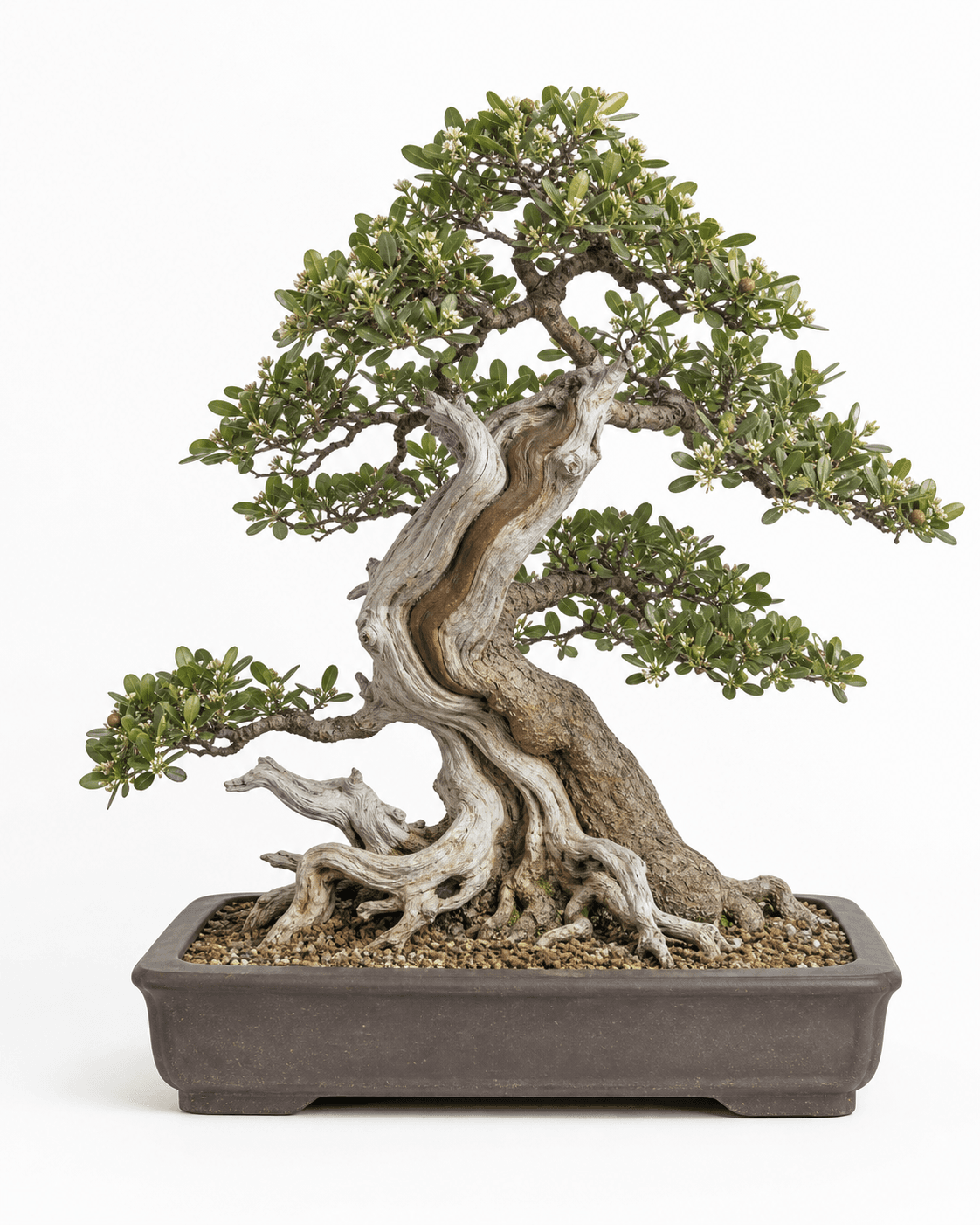
Buttonwood bonsai, Conocarpus erectus, is a tropical coastal broadleaf grown for twisted trunks, pale natural deadwood, small evergreen leaves, and rugged Florida-Caribbean character. It is best treated as an outdoor tropical or greenhouse tree: full sun, warmth, mineral soil, careful watering, and no freeze exposure.
Kew accepts Conocarpus erectus L. in Combretaceae and places its native range from south Florida through tropical America plus western tropical Africa, primarily in wet tropical habitat. UF/IFAS lists Buttonwood for USDA Zones 10B through 11, full sun, high drought tolerance, high aerosol salt tolerance, small leaves, cone-like fruits, and bonsai use.
The main bonsai caution is root handling. Bonsai Mirai describes Buttonwood roots as fragile, tolerant of staged repotting, and dangerous to pair with heavy defoliation in the same operation. Strong trees back bud well, root cuttings readily, and recover best from styling with one to two weeks of partial shade before returning to full sun.
Updated June 19, 2026. Written by EntGrove Editorial. Last verified June 19, 2026.
Care fingerprint
Read the species through its shared care pattern.
Treat indoor culture as a light-management problem first; prune and repot when the tree is actively growing and warm enough to recover. Use this as the starting point before local conditions and tree strength refine the calendar.
Note: Florida guidance treats green and silver buttonwood within Conocarpus erectus; choose bonsai material by root health, leaf scale, and trunk quality rather than color alone.
Read the foliage first
Broadleaf stress usually shows in leaf color, leaf size, wilt, scorch, or delayed hardening before it becomes a branch problem.
Match work to dormancy
Deciduous, evergreen, tropical, succulent, and flowering broadleaf trees recover on different calendars.
Protect fine roots
Root work should preserve enough active fine roots for the tree to rehydrate quickly after the operation.
Care cadence
The calendar starts with the tree's seasonal state.
Placement
Timing: Grow in full sun during warm active growth. After heavy styling without root work, give partial shade for 1-2 weeks, then return to full sun.
Watch for: Cold nights below about 45 F / 7 C, weak indoor light, stagnant winter rooms, sudden sun after shelter, and long internodes from shaded growth.
Bonsai Mirai LibraryUF/IFAS ExtensionWatering
Timing: Water thoroughly when the root ball is drying but before new growth flags. Let the pot breathe between waterings, especially after defoliation, pruning, or indoor winter protection.
Watch for: A sour smell, constantly wet soil, leaves wilting in full sun, runoff that bypasses a dry root core, and slow drying after foliage reduction.
Bonsai Mirai LibraryUF/IFAS ExtensionFertilizer
Timing: Feed through warm active growth. After a styling session, resume stronger feeding around two weeks later, once the tree is returning to full sun and new response is visible.
Watch for: Fertilizer on cold roots, coarse unchecked extensions in refinement, and feeding hard while the tree is still shaded for recovery.
Bonsai Mirai LibraryPruning
Timing: Prune during warm active growth on established trees. Leave useful terminal growth on branches you need to keep alive, then cut back after the branch has fed the interior.
Watch for: Hard cutback on a weak root system, pruning all tips from a branch, and combining hard pruning with heavy root work.
Bonsai Mirai LibraryLeaf work
Timing: Use selective leaf cutting or partial defoliation on vigorous trees. Cut the blade at the base and leave the petiole attached when reducing leaves.
Watch for: Full defoliation paired with repotting, weak trees, cold nights after leaf removal, and source material with naturally large leaves.
Bonsai Mirai LibraryRepotting
Timing: Repot in the warm season, after nights are safely tropical and several weeks of heat remain. Stage invasive root correction if the root ball is dense or fragile.
Watch for: Roots snapping during combing, bare-rooting old collected material, saturated aftercare, and removing foliage and roots in the same session.
Bonsai Mirai LibraryWiring
Timing: Wire flexible growth during warm active growth, often from the outer secondary and terminal branches inward. Anchor on deadwood where possible.
Watch for: Oversized wire crushing cambium, long forced curves, wire bite in fast growth, and bends that ignore movement already present in the tree.
Bonsai Mirai LibraryPest checks
Timing: Inspect during warm humid growth and during indoor winter protection. Check shaded interiors, leaf undersides, and sticky or blackened foliage.
Watch for: Sucking insects, sooty mold inland from salt air, mites in dry shelter, and pests that build in dense clipped canopies.
UF/IFAS ExtensionUF/IFAS Gardening SolutionsBonsai Mirai LibrarySpecies guide
Apply the species profile before copying another tree's calendar.
At a glance
Buttonwood is a coastal tropical tree with roots that demand respect.
Conocarpus erectus is an evergreen Combretaceae shrub or tree used in bonsai for coastal character, naturally pale deadwood, compact foliage, strong wood, and twisting movement. Kew accepts the species name, and UF/IFAS explicitly lists bonsai among its landscape uses. Kew POWOUF/IFAS Extension
The practical profile is warm, bright, and oxygenated. Give Buttonwood full sun after acclimation, a mineral root zone, careful wet-to-breathing watering, and frost-free protection before nights fall below about 45 F / 7 C. UF/IFAS ExtensionBonsai Mirai Library
Its hardest rule is operation stacking. Mirai warns that heavy defoliation plus significant root work can kill Buttonwood because the tree spends stored reserves before regrowth can rebuild them. Bonsai Mirai Library
Wild habit
Coastal sun, limestone, salt, and storm damage shape the image.
Kew places Buttonwood in wet tropical habitat from south Florida through tropical America and western tropical Africa. UF/IFAS describes it as a Florida native well suited to seaside plantings, full sun, sandy soils, salty conditions, brackish areas, alkaline soils, and wet hammock soils. Kew POWOUF/IFAS Extension
Mirai explains the bonsai character through that ecology. Intense sun can kill tender tips and force directional back budding, storm surge can expose roots that become dramatic deadwood, and limestone cracks can create notched, twisting trunks. Bonsai Mirai Library
For care, this means strong light and oxygen around the roots rather than a soft houseplant routine. For design, let the tree read as a coastal survivor: low, asymmetric, scarred, sun-bleached, and shaped by wind, salt, and broken substrate. Bonsai Mirai LibraryBonsai Mirai / Asymmetry
Reading the tree
Separate development vigor from refinement control.
A developing Buttonwood needs roots, heat, foliage mass, and branch options. Strong established trees back bud reliably enough for decisive pruning, but the root base must be present before the canopy is asked to recover. Bonsai Mirai Library
A refining Buttonwood asks for restraint. Leaf reduction is inconsistent and temporary, so select source material with naturally small leaves and compact petioles, then use pruning and partial leaf work to distribute energy rather than chase a permanent miniaturization trick. Bonsai Mirai Library
Read response after work. New buds, firm leaves, and regular drying say the tree is rebuilding. Wet soil, dull leaves, branch-tip dieback, or no extension after styling mean the next operation should wait. Bonsai Mirai Library
Use neighboring tropical species as comparisons, then return to Buttonwood identity. Ficus is the more indoor-tolerant aerial-root comparison, Brazilian rain tree is a legume with compound leaves and folding foliage, and dwarf black olive is the closer Caribbean deadwood comparison. Buttonwood centers on coastal salt, limestone, pale weathered deadwood, fragile roots, and warm full-sun recovery. Bonsai Mirai LibraryBonsai Mirai / Asymmetry
Pruning
Use cutback for back budding, then leaf work only on strong trees.
Buttonwood can take fairly extensive pruning when the root base is established. When reducing a branch, leave useful tip growth where survival matters so the branch keeps an energy path while interior buds are stimulated. Bonsai Mirai Library
Clip-and-grow is one of the most productive Buttonwood refinement tools. Let a shoot extend enough to feed the branch, cut back to a useful bud or kink, and repeat until taper and fine branch division match the image. Bonsai Mirai Library
For leaf trimming, Mirai recommends cutting at the base of the blade and leaving the petiole attached, which acts as a closing gate against pathogens entering the branch. Use this selectively, especially on strong areas. Bonsai Mirai Library
Do not stack full canopy removal with invasive root work. A Buttonwood can look tough above ground while the root system is too fragile to support that combined demand. Bonsai Mirai Library
Roots
Stage root work because Buttonwood roots snap easily.
Mirai describes Buttonwood roots as extremely fragile, with heavy combing able to remove a damaging volume of roots before the grower notices. That one fact should govern every repot. Bonsai Mirai Library
Work in a warm active-growth window, secure the tree firmly, and preserve enough root mass to keep the canopy hydrated. On collected or old container material, staged repotting across multiple sessions is a valid Buttonwood-specific strategy. Bonsai Mirai Library
After repotting, use bright warmth and controlled moisture rather than a cold wet recovery. Mirai tropical repot guidance returns trees to full sun only as new growth confirms recovery. Bonsai Mirai Library
A weak or newly repotted Buttonwood should keep enough leaves to regulate water movement. Removing both absorbing roots and transpiring foliage at the same time strips away both sides of recovery. Bonsai Mirai Library
Soil and pot
Give coastal toughness a controlled, oxygen-rich container.
UF/IFAS lists Buttonwood as tolerant of clay, sand, loam, acidic soil, alkaline soil, wet sites, well-drained sites, drought, and salt spray. A bonsai pot compresses those tolerances into a shallow root zone, so drainage and oxygen matter more than proving how much abuse the species can survive. UF/IFAS Extension
Start with a granular tropical broadleaf mix, such as akadama, pumice, and lava, then tune for climate. In rainy or humid settings, add more pumice or lava. In very hot full sun, retain enough water that leaves do not flag between checks. Bonsai Mirai Library
Use containers that support the design origin. Rough unglazed clay, shallow ovals, rugged rectangles, and textured tropical pots can all work. Avoid a pot so shallow that summer water management becomes the central feature of the tree. Bonsai Mirai / AsymmetryBonsai Mirai Library
Raised roots and deadwood bases often need careful anchoring. If the tree rocks, new roots tear before they can colonize the new soil. Bonsai Mirai Library
Climate
Treat it as a frost-free tropical even if the landscape plant is tough.
UF/IFAS lists Buttonwood for USDA Zones 10B through 11. Mirai adds the bonsai-level threshold: tropicals should be protected before freezing, and Buttonwood can suffer serious damage below about 45 F / 7 C. UF/IFAS ExtensionBonsai Mirai Library
In south Florida, the Caribbean, and comparable tropical climates, Buttonwood can grow outdoors year-round with full sun and strong airflow. The main adjustments are hurricane exposure, salt, rainfall volume, and how quickly the pot dries. UF/IFAS ExtensionBonsai Mirai Library
In temperate regions, make a two-season plan: full sun outdoors in warm months, then bright protected winter quarters before cold nights arrive. Reduce watering indoors because foliage, heat, wind, and sun are all reduced. Bonsai Mirai Library
In hot dry interiors, full sun may still be right, but water demand and leaf temperature rise fast. Acclimate in stages, protect after major work, and avoid letting a fresh repot dry hard in wind. Bonsai Mirai LibraryUF/IFAS Extension
Pests
Most problems begin with sucking insects, sooty mold, or weak culture.
UF/IFAS lists Buttonwood as free of serious pests and diseases, but notes that sucking insect secretions can lead to sooty mold on trees inland from the coast. The silver form is also described as vulnerable to sooty mold in less ventilated inland sites. UF/IFAS ExtensionUF/IFAS Gardening Solutions
In bonsai, inspect for scale, aphids, mealybugs, mites, and sticky honeydew on shaded interior growth. Dense clipped canopies, weak light, and indoor winter rooms make these problems harder to see early. UF/IFAS ExtensionBonsai Mirai Library
Treat the cultural cause first: more light, airflow, correct watering, and less shaded congestion. Then identify the pest before using oil, soap, or a labeled pesticide, because tropical foliage can react when treated in heat or sun. Bonsai Mirai Library
Root decline is the larger bonsai disease risk. Constantly saturated soil, cold aftercare, and broken roots can look like a foliage disease because the canopy dulls or drops after the roots fail. Bonsai Mirai Library
Wiring
Wire from the outside in and bend with the tree already in front of you.
Mirai wires Buttonwood by setting outer terminals and secondary branches first, then working inward toward primary branches. This avoids forcing heavy wire through the trunk and lets branch placement answer the existing design. Bonsai Mirai Library
Match wire to the branch. Oversized wire can crush cambium and create a dead strip instead of a bend. In rainy climates, slightly stronger aluminum may be needed because repeated rain weight can loosen fine wire. Bonsai Mirai Library
Anchor on deadwood where possible so live bark is not scarred. On branches, make short incremental bends rather than long smooth arcs. A pinch-turn-pinch rhythm distributes force and avoids snap fractures. Bonsai Mirai Library
Avoid generic curves. Mirai stresses copying movement that already exists somewhere on the tree, so the styled branch belongs to the trunk rather than looking imposed. Bonsai Mirai LibraryBonsai Mirai / Asymmetry
Propagation
Cuttings are unusually useful for small Buttonwood bonsai.
Mirai reports that Buttonwood cuttings can root readily in plain water, even when deadwood remains attached, making styling offcuts useful for shohin and mame starts. Bonsai Mirai Library
For bonsai, choose cuttings with small leaves, compact internodes, and natural movement. Treat them as training material first: build roots, then trunk, then branch structure. Bonsai Mirai Library
Seed is possible because Buttonwood flowers and fruits, but it is a slower route to character. UF/IFAS describes small green flowers and cone-like fruits, while Mirai notes that Buttonwood reproduces by seed rather than floating mangrove pods. UF/IFAS ExtensionBonsai Mirai Library
Air-layering and grafting belong to special cases, such as rescuing a better trunk section or adding a missing branch. Most growers should source naturally useful material or propagate cuttings from good genetics. Bonsai Mirai Library
Buying
Buy the trunk, deadwood, leaf scale, and root health.
Good Buttonwood material has a firm base, compact leaves, visible live veins, useful deadwood, flexible secondary branches, and a root ball that drains without smelling sour. Naturally small leaves matter because leaf reduction is inconsistent. Bonsai Mirai Library
Collected coastal material can have spectacular deadwood and root character, but it also carries the highest root-risk. Ask when it was collected, how long it has been stable in a container, and whether it has pushed new growth since collection. Bonsai Mirai Library
Nursery green or silver Buttonwood can be safer for beginners in warm climates. UF/IFAS notes green Buttonwood grows larger than silver Buttonwood, while silver forms are often shrubby and prized for foliage color. UF/IFAS ExtensionUF/IFAS Gardening Solutions
Avoid weak material with large leaves, blackened sticky foliage, wire scars through live veins, dry dead roots, or recently collected trunks sold before recovery. A dramatic deadwood trunk without active roots is a long rehabilitation project. Bonsai Mirai LibraryUF/IFAS Gardening Solutions
Troubleshooting
Diagnose roots, cold, water, and stacked work first.
Symptom: leaves wilt after repotting. Likely causes: snapped fragile roots, too much root reduction, poor anchoring, or full sun before recovery. Fix: stabilize the tree, move to bright partial shade, control water, and wait for new growth before feeding hard. Bonsai Mirai Library
Symptom: black film on leaves. Likely causes: sooty mold growing on honeydew from sucking insects, especially in still inland or protected conditions. Fix: identify the insect, clean the foliage, open the canopy, and improve airflow. UF/IFAS ExtensionUF/IFAS Gardening Solutions
Symptom: branch dieback after pruning. Likely causes: all terminal growth removed from a weak branch, root weakness, or a cut made before the branch had enough energy. Fix: leave terminal support during future cutback and rebuild vigor before more pruning. Bonsai Mirai Library
Symptom: yellowing and wet soil. Likely causes: saturated substrate, cool protection, too little foliage, or watering as if the tree were in full tropical sun. Fix: let oxygen return, increase warmth and light, and repot into better soil during the next safe warm window. Bonsai Mirai Library
Symptom: large leaves after repeated trimming. Likely causes: genetics, shade, heavy feeding, or chasing permanent leaf reduction through technique. Fix: improve light, reduce coarse vigor, and source smaller-leaf material for refined small trees. Bonsai Mirai Library
Symptom: cold damage or sudden decline after winter shelter. Likely causes: nights below about 45 F / 7 C, freezing exposure, cold wet roots, or dim indoor storage. Fix: protect earlier, keep winter quarters bright and warm, and water less while the tree is using less. Bonsai Mirai LibraryUF/IFAS Extension
Design
Design from storm, sun, limestone, and salt.
The strongest Buttonwood bonsai show the place the species comes from. Mirai connects the best deadwood and trunk movement to UV pruning, storm surge, exposed roots, and limestone cracks, so the design should feel coastal rather than mountain-temperate. Bonsai Mirai LibraryBonsai Mirai / Asymmetry
Start with the live vein and deadwood relationship. Preserve natural gray patina where possible; Mirai notes that UV-bleached Buttonwood deadwood does not need lime sulfur, and chemical whitening cannot reproduce the same age. Bonsai Mirai Library
Build branches to frame the trunk, not hide it. A defining branch can sweep with the wind, while secondary branches create small planes of foliage that leave deadwood and live veins visible. Bonsai Mirai LibraryBonsai Mirai / Asymmetry
Literati, slanting, semi-cascade, and rugged informal upright designs can all work when the movement already exists. Small cutting-grown trees often read better as compact coastal shrubs or shohin with one clear trunk gesture. Bonsai Mirai Library
Forms
Green and silver Buttonwood share the species name in current Florida guidance.
UF/IFAS Gardening Solutions notes that some sources separate silver and green Buttonwood names, but the Atlas of Florida Plants and other trusted sources recognize Conocarpus erectus as one species with a wide range of leaf fuzziness. UF/IFAS Gardening Solutions
Green Buttonwood is the larger common form in many landscape references. UF/IFAS describes Buttonwood as capable of 30-45 feet in height and 20-30 feet of spread, with smooth dark green leaves. UF/IFAS Extension
Silver Buttonwood is often lower, shrubbier, and prized for silvery pubescent foliage. In bonsai, the foliage color can be beautiful, but it should not outweigh root quality, leaf scale, and the trunk line. UF/IFAS Gardening SolutionsBonsai Mirai Library
UF/IFAS also notes the cultivar 'Mombo', a smaller dense-crowned form. Treat cultivar labels as secondary until the tree proves it has bonsai-useful roots, branches, and leaf scale. UF/IFAS Extension
History
Buttonwood is a regional deadwood species with a Florida-Caribbean center of gravity.
Kew records Conocarpus erectus as first published by Linnaeus in Species Plantarum in 1753. Its broad tropical range and coastal tolerance made it a practical wood and landscape tree before it became a regional bonsai subject. Kew POWOUF/IFAS Extension
UF/IFAS notes that Buttonwood wood was formerly used for firewood, cabinetwork, charcoal, and smoking meats or fish. That durable wood is part of why old Buttonwood deadwood can carry a bonsai image convincingly. UF/IFAS Extension
In bonsai, the species is especially tied to Florida and Caribbean collected material. Its appeal comes from tropical deadwood, live-vein contrast, exposed roots, and weather-shaped movement rather than from Japanese mountain-conifer conventions. Bonsai Mirai LibraryBonsai Mirai / Asymmetry
The exhibition standard is source honesty: natural movement, protected live veins, aged gray deadwood, convincing foliage scale, and horticulture stable enough that the tree can keep improving after display. Bonsai Mirai Library
Species questions
Answer the beginner questions before styling.
Is Buttonwood a good bonsai species?
Yes, especially in warm climates or greenhouse culture. It has strong coastal character, small evergreen leaves, dramatic deadwood potential, and reliable back budding on established roots.
Can Buttonwood bonsai grow indoors?
It can be winter-protected indoors under strong light, but long-term indoor culture is difficult. Buttonwood wants full sun, warmth, airflow, and careful watering.
How cold can Buttonwood bonsai tolerate?
UF/IFAS lists Buttonwood for USDA Zones 10B through 11. As a bonsai, protect it before nights drop below about 45 F / 7 C and never allow freezing.
When should I repot Buttonwood bonsai?
Repot during warm active growth after nights are safely tropical. Inspect every 2-3 years, then repot only when drainage, soil condition, roots, or design make it necessary.
Why is Buttonwood repotting risky?
Mirai describes Buttonwood roots as extremely fragile. Heavy combing can break many roots quickly, so staged root work and firm anchoring are safer than aggressive bare-rooting.
Can I defoliate Buttonwood?
Use partial leaf work only on vigorous trees in warm bright conditions. Avoid combining heavy defoliation with major root work because that pairing can exhaust the tree.
What soil is best for Buttonwood bonsai?
Use a fast-draining mineral tropical mix. Akadama, pumice, and lava are a good starting point, with more pumice or lava in rainy, humid, or protected settings.
Does Buttonwood need full sun?
Yes, after acclimation. UF/IFAS lists full sun, and Mirai returns styled Buttonwoods to full sun after a short partial-shade recovery period.
Is silver Buttonwood different from green Buttonwood?
Florida guidance treats green and silver Buttonwood within Conocarpus erectus, with silver forms showing fuzzier, silvery foliage. For bonsai, choose by root health, leaf scale, and trunk quality.
Can Buttonwood deadwood be treated with lime sulfur?
Mirai recommends preserving natural UV-bleached gray deadwood where possible. Chemical whitening does not reproduce the same coastal patina, so use deadwood treatments conservatively.
Sources
Species advice needs source discipline.
Next decisions
Plan the operation before copying the calendar.
A good care note for Buttonwood records the tree's stage, the work done, and the aftercare used. That record matters more than a month-name rule.
Related species
Compare nearby trees before transferring advice.
Ficus retusa / Indian laurel
Ficus microcarpa
Tigerbark ficus
Ficus microcarpa 'Tigerbark'
Willow-leaf ficus
Ficus salicaria
Benjamin fig
Ficus benjamina
Ginseng ficus
Ficus microcarpa 'Ginseng'