
Species guide
Western Redcedar Bonsai Care
Thuja plicata
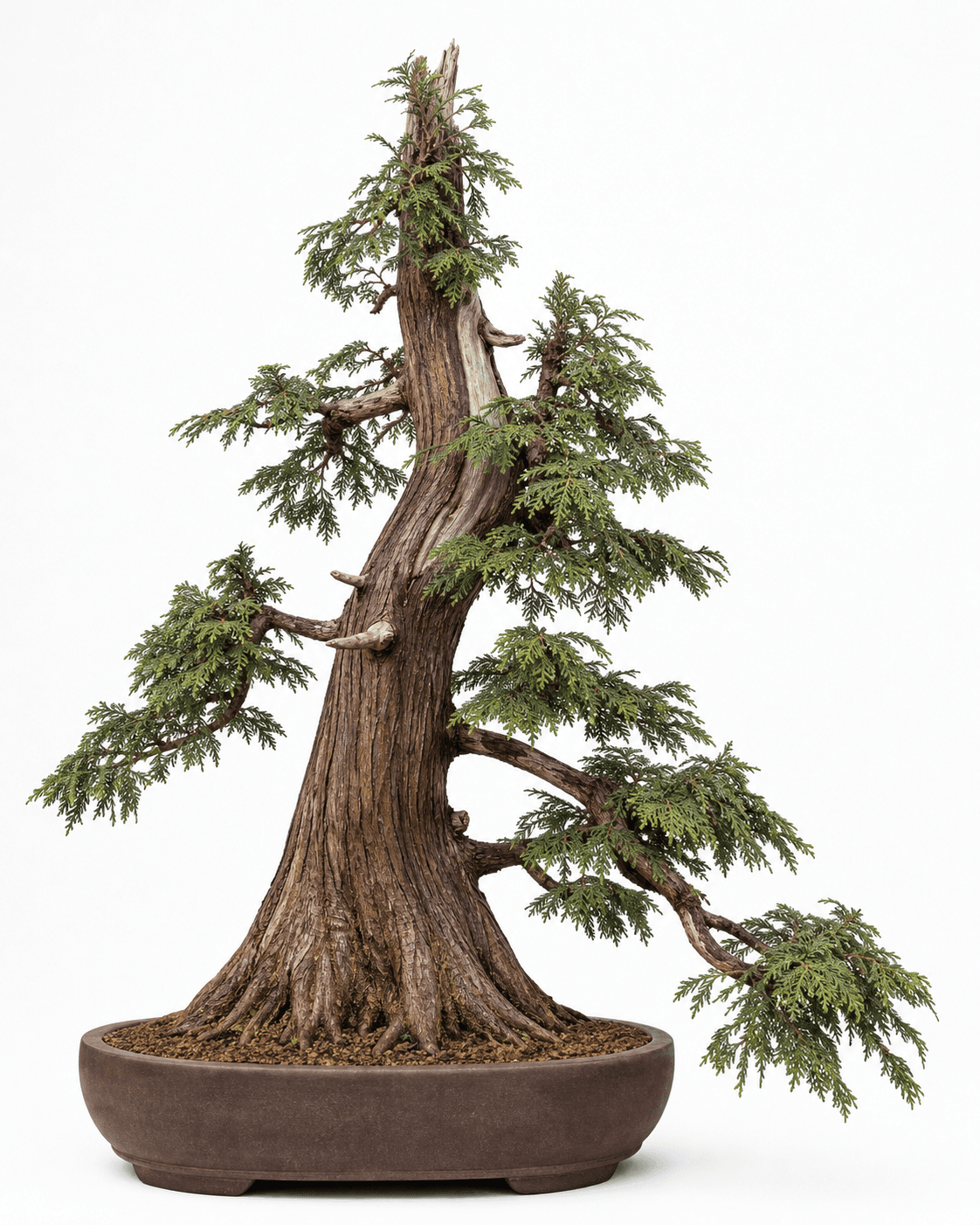
Western redcedar, Thuja plicata, is an outdoor Pacific Northwest conifer with flat scale-foliage fans, strong apical dominance, high moisture demand, and a natural habit of arching branches with drooping fronds. In bonsai, it needs full sun for compact growth, cool moist roots, and directional pruning that preserves living fronds.
Mirai has direct Thuja plicata coverage for initial styling, summer refinement, frond orientation, soil, wiring, and deadwood. This profile grounds the bonsai method in that corpus, then uses Kew, Oregon State, NC State, USDA Silvics, USDA FEIS, USDA NRCS, and regional forest-health sources for taxonomy, hardiness, habitat, cultivars, propagation, dieback, and leaf blight.
Updated June 5, 2026. Written by EntGrove Editorial. Last verified June 5, 2026.
Care fingerprint
Read the species through its shared care pattern.
Avoid dry-wind stress, preserve interior growth, and distinguish cypress-style pad work from juniper refinement. Use this as the starting point before local conditions and tree strength refine the calendar.
Note: Kew accepts Thuja plicata and places it from southern Alaska to northern California. Mirai has direct Thuja plicata styling and summer-pruning coverage plus genus-level Thuja method; the species page grounds western redcedar labels, Zone 5 to 7b context, cool moist habitat, full-sun bonsai cultivation, cultivars, propagation, dieback, leaf blight, and forest ecology in Kew, Oregon State, NC State, USDA Forest Service / NRCS, British Columbia forest-health, and Pacific Northwest Pest Management Handbook sources.
Do not prune like a pine
Elongating conifers extend from buds and shoots, so candle-cutting assumptions can remove the exact growth the tree needs.
Preserve interior growth
Spruce, fir, hemlock, cedar, redwood, cypress, and larch all become harder to design when interior buds are shaded out.
Keep recovery cool and steady
Many elongating conifers respond best when roots stay evenly moist, oxygenated, and protected from hot dry swings.
Care cadence
The calendar starts with the tree's seasonal state.
Repotting
Timing: Spring around bud swell or first visible movement
Watch for: Matted roots, compacted organic pockets, slow drainage, sour smell, weak surface roots, and the temptation to combine root work with major foliage removal.
Bonsai Mirai LibraryStructural pruning
Timing: Just before spring bud swell, or after the first flush hardens on vigorous trees
Watch for: Nubs, same-plane pairs, inner-curve branches, heavy verticals, inverse-taper risk, and cold-hardiness loss after dormant heavy work.
Bonsai Mirai LibraryRefinement pruning
Timing: Midsummer, before late-summer interior foliage shed
Watch for: Rope-like vertical shoots, weak fronds that detach easily, brown pruning margins, wire bite, and cuts that need to finish at living ramified fronds.
Bonsai Mirai LibraryWatering
Timing: Check daily in warm weather and after wind
Watch for: Dry top dressing, hot pot walls, dull yellow-green foliage, tip burn, stale wet soil, and oxygen loss after repeated shallow watering.
Bonsai Mirai LibraryUSDA Forest Service Western redcedar diebackWiring
Timing: After spring growth firms, then monitor through rapid vascular thickening
Watch for: Wire bite, stripped bark, rolled fronds, soft tip damage, and fine frond wire that may kill those tips months later.
Bonsai Mirai LibraryWinter protection
Timing: Before hard freezes, especially after repotting or heavy styling
Watch for: Frozen shallow pots, dry winter wind, foliage bronzing, recent large cuts, and trees that have not reloaded after late work.
Bonsai Mirai LibraryNC State ExtensionSpecies guide
Apply the species profile before copying another tree's calendar.
At a glance
Treat Western redcedar as a full-sun, moisture-loving outdoor Thuja.
Thuja plicata is the accepted name. Kew places the species from southern Alaska to northern California, while USDA NRCS describes a coastal Coast Range and Cascade segment plus an inland Rocky Mountain segment extending into British Columbia, Alberta, Idaho, and Montana. Kew POWOUSDA NRCS Plant Guide
The common-name field is crowded. Western redcedar, western red cedar, western red-cedar, Pacific redcedar, giant arborvitae, western arborvitae, canoe cedar, and shinglewood can all point to Thuja plicata. Eastern red cedar is Juniperus virginiana and needs juniper handling. USDA Forest Service SilvicsBonsai Mirai Library
For bonsai, the care fingerprint is bright outdoor light, steady moisture, aerated soil, strong apical and vertical dominance, flat fronds that burn when rolled upside down, and branch design built around arching limbs with pendulous fans. Bonsai Mirai Library
Wild habitat
Its wild character comes from wet forests, riverbanks, hummocks, and old-growth shade.
Oregon State describes Western redcedar in moist flats, slopes, and river banks. USDA NRCS expands that to swamps, wet ravines, poorly drained depressions, rocky slopes, mixed conifer forests, and elevations from sea level to roughly 1,500 m, occasionally higher. Oregon State Landscape PlantsUSDA NRCS Plant Guide
Wild shade tolerance should be read as forest strategy, not container advice. The tree can survive in shade because it holds branches low and grows patiently in moist understory conditions, but Mirai emphasizes full sun in cultivation when compact bonsai growth is the goal. USDA NRCS Plant GuideBonsai Mirai Library
Old trees often show buttressed bases, fluted trunks, drooping branches, fibrous reddish bark, many leaders, dead spike tops, and fan-shaped sprays. Those traits should guide bonsai design more than a generic conifer outline. USDA Forest Service SilvicsUSDA NRCS Plant Guide
Care follows ecology: do not let the root zone bake dry, do not suffocate roots in sour organic sludge, and do not mistake shade tolerance for a shaded bonsai bench. Aim for cool moisture, moving air, and enough sun to keep internodes and fronds compact. Bonsai Mirai LibraryUSDA Forest Service Western redcedar dieback
Design follows ecology too. Western redcedar can carry Northwest forest stories: nurse-log roots, bog-stunted old trunks, multiple apices, broad low limbs, hanging fronds, smooth cylindrical deadwood, and the feeling of a tree that grew with water and shade rather than drought and wind. Bonsai Mirai / AsymmetryUSDA NRCS Plant Guide
Reading the tree
Read vigor through fronds, vascular swelling, and root history.
Mirai treats Thuja as an elongating conifer whose stored strength sits largely in the trunk and branch vascular system. That explains why the species can tolerate substantial root work or substantial foliage work, but combining both in the same window creates avoidable risk. Bonsai Mirai Library
Thuja plicata differs from Thuja occidentalis in frond structure: secondary growth can emerge from both the top and bottom faces of the branch, changing how the foliage should be oriented and reduced. Bonsai Mirai Library
The tree is strongly apically dominant. Upright shoots gather strength quickly, suppress lateral growth, thicken disproportionately, and can pull energy away from lower branches unless they are redirected or removed at the right time. Bonsai Mirai Library
Do a pressure test before cutting. A frond that falls with almost no pressure is spent; a frond that resists light pressure and still has active tips can be pruned back and kept in the design. Bonsai Mirai Library
Back budding can happen on older Thuja wood, but Mirai treats it as sparse and weak. Build design from existing live interiors, then use cultivation, light, and directional pruning to strengthen any adventitious shoots that appear. Bonsai Mirai Library
Pruning
Prune to live lateral fronds and keep the natural pendulous habit.
For larger Western redcedar, Mirai favors scissor pruning back to interior lateral fronds. This keeps the drooping, airy frond presentation that makes the species distinct and avoids turning the tree into a dense hedge shell. Bonsai Mirai Library
The main refinement window is midsummer. It is late enough to avoid forcing a strong second push, but early enough to act before late-summer and early-fall interior foliage shed removes useful live tissue. Bonsai Mirai Library
Cut along the line of the frond and reduce to a live lateral or ramified interior tip. Perpendicular cuts and repeated handling leave visible brown margins, so each cut should have a clear purpose. Bonsai Mirai Library
Remove rope-like vertical shoots that have abandoned ramification, upward-pointing sub-fronds after a junction cut, and three- or four-shoot junctions that need to become two. Keep strong interior crotch shoots when they are the best route to a smaller silhouette. Bonsai Mirai Library
Pinching has a narrow use. Small shohin or kifu Thuja can be pinched to activate dense compact pads, but on larger Western redcedar pinching usually erases the pendulous frond character and creates tight vertical balls of foliage. Bonsai Mirai Library
Keep the dark upper surface of the foliage facing the sun. Rolled fronds expose the pale underside, sunburn more easily, and often need replacement by newly oriented growth. Bonsai Mirai LibraryNC State Extension
Repotting
Work roots in spring and keep foliage intact while the tree reloads.
Use the same physiological rule as other elongating conifers: root work is safest around spring bud swell or early movement, before the flush is demanding peak water. Strong collected or nursery material can also accept staged container transfers when roots are already vigorous. Bonsai Mirai Library
Separate heavy operations. If a tree has just been styled, wait at least one full growing season before repotting. If the tree has just been repotted hard, leave the new foliage push intact so it can rebuild roots through the season. Bonsai Mirai Library
For a well-rooted Thuja moving into a new bonsai pot, Mirai describes a conservative transfer: break up matted roots minimally, set the tree securely, and preserve momentum rather than bare-rooting the whole mass. Bonsai Mirai Library
Collected bog or wet-site material often carries acidic organic soil, slender old trunks, and roots that survived on hummocks where oxygen was barely available. Convert that soil in stages, refill cavities completely, and avoid leaving wet pockets that collapse after watering. Bonsai Mirai LibraryUSDA NRCS Plant Guide
After repotting, tie the tree firmly, water thoroughly, protect from drying wind and hard freezes, and delay heavy feeding until extension confirms recovery. The pot should stay moist, but the evening root zone still needs oxygen. Bonsai Mirai Library
Soil and pot
Use a moist, nutrient-retentive, aerated conifer mix.
Oregon State describes Western redcedar as preferring moist, well-drained, fertile soils. NC State adds consistently moist, well-drained soil high in organic matter with acidic to neutral pH, plus intolerance of drought and dry winds. Oregon State Landscape PlantsNC State Extension
For bonsai, Mirai gives Thuja a moisture-retentive but aerated substrate. Use 2 parts akadama, 1 part pumice, and 1 part lava during conversion, or 3 parts akadama, 1 part pumice, and 1 part lava when roots are strong and old soil is gone. Bonsai Mirai Library
A solid-akadama approach appears in direct Thuja plicata styling discussion because of the species high nutrition demand, but Mirai later qualifies genus-level Thuja culture toward 2:1:1 or 3:1:1 for evergreen elongating conifers that need more aeration than deciduous trees. Bonsai Mirai Library
Choose particle size by scale and climate. Small refined trees need enough fine akadama to stay evenly moist; large developing trees or hot inland benches need enough pumice and lava to prevent stale saturation after heavy watering. Bonsai Mirai Library
Pot choice should reinforce the forest image. Quiet rectangles, deep ovals, forest slabs, and understated unglazed containers suit multi-apex and old-growth designs; tiny shallow pots should wait until roots are dense and the tree can stay hydrated. Bonsai Mirai / Asymmetry
Climate
Cool maritime gardens are straightforward; hot dry sites need root-zone discipline.
In coastal Pacific Northwest conditions, Western redcedar can take full sun, rain, cool nights, and outdoor winter. The main bonsai job is to keep the container evenly moist without allowing old organic soil to stay sour. Oregon State Landscape PlantsBonsai Mirai Library
In inland or southern climates, full sun may still be needed for compact growth, but the pot may need afternoon shade, mulch around the container, wind protection, and closer watering. NC State warns that Western redcedar suffers in hot humid climates and does not tolerate drought or dry wind. NC State ExtensionBonsai Mirai Library
USDA Forest Service dieback work documents elevated Western redcedar dieback concern after the 2015 to 2018 hot-drought period in the Pacific Northwest. For bonsai, that supports conservative heat management: cool the pot before foliage shows crisis symptoms. USDA Forest Service Western redcedar dieback
Winter care depends on recent work. Unworked, established trees are hardy outdoor conifers, but recent root work, large cuts, or late-season styling justify heel-in protection, wind shelter, and avoidance of repeated freeze-thaw swings around the root ball. Bonsai Mirai LibraryNC State Extension
In wet winter climates, lift pots off saturated ground, keep drainage holes open, and avoid constant overhead watering during cool humid disease weather. The tree loves moisture, but foliage and roots still need air movement. Pacific Northwest Pest Management HandbookBonsai Mirai Library
Pests and diseases
Most problems start with wet foliage, hot drought, old soil, or weak roots.
Cedar leaf blight is the most species-specific disease to know. British Columbia identifies Didymascella thujina as the cause across Western redcedar range there, and the Pacific Northwest Pest Management Handbook notes warm-moist coastal conditions, leaf spots, apothecia, and fall foliage drop. British Columbia cedar leaf blightPacific Northwest Pest Management Handbook
For bonsai prevention, prioritize fast-drying foliage, spacing, morning watering, removal of fallen infected debris, and local extension diagnosis before fungicides. PNW guidance emphasizes disease-free stock, spacing, and irrigation timing for nursery control. Pacific Northwest Pest Management Handbook
Root and trunk rots are more important than casual pest lists. USDA FEIS notes more than 200 fungi on Western redcedar and highlights root, butt, and trunk rots as important fungi, while wet bonsai soil can create the small-container version of that risk. USDA Forest Service FEISBonsai Mirai Library
Watch for mites, scale, bagworms, aphids, borers, and bark beetle stress in weak or heat-stressed material. NC State and USDA FEIS both describe insect and wildlife pressure, and bonsai growers should respond with diagnosis rather than routine spraying. NC State ExtensionUSDA Forest Service FEIS
Physiological decline deserves equal attention. Hot drought, dry wind, compacted roots, sudden full-sun exposure after shade culture, and large root-to-foliage imbalance can look like disease long before a pathogen is confirmed. USDA Forest Service Western redcedar diebackBonsai Mirai Library
Wiring
Wire structure, protect shoulders, and leave the finest fronds alone.
Western redcedar wiring starts with mechanics at the branch shoulder. Mirai emphasizes pressing the wire against the shoulder during turns so force transfers into the bend without tearing soft green-stage tissue. Bonsai Mirai Library
Avoid wiring the finest frond tips. Mirai notes that detailed wire on Thuja tips can kill those pieces months later through subtle vascular damage. Set primary and secondary lines, then use pruning to finish the frond outline. Bonsai Mirai Library
A slight wire bite can be acceptable on vigorous Thuja because the bark thickens and scars heal quickly, but that is different from letting wire cut through active tissue. Check wired trees often during spring and summer thickening. Bonsai Mirai Library
Bring fronds into their natural orientation rather than flattening every spray into a display pad. Branches often drop, then prop upward again into the next frond, which creates the stacked Western redcedar rhythm. Bonsai Mirai Library
On rough or flaky bark, keep supporting fingers between wire and bark during application. On heavy split-prone crotches, mechanical braces or staged guying may be more appropriate than forcing a tight coil. Bonsai Mirai Library
Propagation
Seed, cuttings, layering, and selected cultivar stock all have roles.
NC State lists propagation by seed and stem cuttings. USDA NRCS notes that cone production begins in open-grown trees around 10 to 20 years, peaks after 70 to 80 years, and good seed crops occur every 2 to 3 years. NC State ExtensionUSDA NRCS Plant Guide
Seedlings are useful for forests, clumps, exposed-root experiments, and long-term trunk building. They also let the grower observe the species from the beginning, including its strong vertical habit and moisture response. USDA NRCS Plant GuideBonsai Mirai Library
Cuttings are the practical route for cultivar forms. Keep the cultivar label with the plant because foliage scale, color, habit, and vigor vary widely between Atrovirens, Excelsa, Hogan, Virescens, Stoneham Gold, and other forms. Oregon State Landscape PlantsNC State Extension
Natural vegetative reproduction is part of the species ecology. USDA NRCS describes layering, rooting of fallen branches, and branch development on fallen trees in mature stands, which makes raft and nurse-log inspired bonsai designs botanically credible. USDA NRCS Plant Guide
Air layering is less central in the public forestry literature than seed, cuttings, and natural layering. Use it as an experimental technique on vigorous garden material, keep plenty of foliage above the layer, and avoid layering weak heat-stressed trees. Bonsai Mirai LibraryUSDA NRCS Plant Guide
Buying
Buy roots, interior foliage, and species identity before silhouette.
Good Western redcedar bonsai material has a clear Thuja plicata label, a visible root flare or recoverable base, live interior fronds, flexible branch choices, clean drainage, and foliage that has not been rolled, sheared, or dried into a shell. Bonsai Mirai LibraryNC State Extension
Nursery hedging stock can work when roots are not trapped in a dense peat cylinder. Reject plants with dead brown interiors, stale wet root smell, severe circling roots, heat-scorched tips, mite stippling, or a trunk that only offers a green screen outline. Bonsai Mirai LibraryPacific Northwest Pest Management Handbook
Cultivar material can be useful, especially narrow, compact, gold, or variegated forms, but every cultivar needs the same bonsai questions: root quality, branch placement, actual frond scale, graft or cutting origin, and long-term vigor. Oregon State Landscape PlantsBonsai Mirai / Asymmetry
Collected material should be legal, ethical, and slow. Mirai describes old bog-collected Thuja plicata with strong natural form, while USDA sources emphasize the species ecological, cultural, wildlife, and timber importance across its range. Bonsai Mirai LibraryUSDA NRCS Plant GuideUSDA Forest Service Silvics
Separate look-alikes before buying. Nootka cypress, Lawson cypress, incense cedar, eastern white cedar, eastern red cedar, Leyland cypress, and true Cedrus all carry different pruning, root, or disease assumptions. Bonsai Mirai LibraryOregon State Landscape Plants
Troubleshooting
Start with water, heat, frond viability, and recent work.
Symptom: dull yellow-green foliage or tip burn in summer. Likely cause: root-zone heat, dry wind, drought stress, or a pot that dries faster than the canopy can tolerate. Fix: cool the container, water thoroughly when the surface dries, protect from hot wind, and review soil condition. NC State ExtensionUSDA Forest Service Western redcedar dieback
Symptom: brown interior fronds in late summer or fall. Likely cause: normal shedding mixed with shaded interior weakness. Fix: pressure-test fronds, remove spent pieces during midsummer refinement, and redirect strong tips before they abandon the interior. Bonsai Mirai Library
Symptom: tan leaf spots, black fruiting bodies, shot-hole pits, or lower foliage that looks scorched. Likely cause: cedar leaf blight. Fix: improve spacing and drying, avoid unnecessary wet foliage, remove debris, and get local diagnosis before chemical control. British Columbia cedar leaf blightPacific Northwest Pest Management Handbook
Symptom: the tree weakens while soil stays wet. Likely cause: compacted organic soil, root rot, poor oxygen, or foliage loss that reduced transpiration. Fix: stop constant saturation, improve airflow, protect from heat, and plan staged spring root conversion. Bonsai Mirai LibraryUSDA Forest Service FEIS
Symptom: fronds brown after wiring. Likely cause: fine-tip vascular damage or rolled underside exposure. Fix: remove wire from delicate tips, reorient live sprays, and rely on branch wiring plus directional pruning for future refinement. Bonsai Mirai Library
Symptom: swelling knobs and inverse taper at branch junctions. Likely cause: same-plane branches, nubs, and unchecked verticals on a fast-thickening elongating conifer. Fix: reduce structural flaws early, keep two-branch junctions clean, and monitor wire through the vascular thickening season. Bonsai Mirai Library
Design
Style for arching branches, drooping fronds, multiple apices, and wet-forest age.
Begin with species character. Mirai identifies old Thuja through compound movement: arching branches, reverse-arching fronds, foliage that often hangs below the branch, and multiple vertical apices rather than one orthodox compact crown. Bonsai Mirai / AsymmetryBonsai Mirai Library
Use the trunk line and defining branch to choose between old-growth forest, bog survivor, raft, group, riverbank, or formalized cultivated material. A tree with natural yamadori character should represent that form before conventional bonsai proportion. Bonsai Mirai Library
Branch movement should drop, then prop back into the frond. This creates levels and keeps the foliage reading as Thuja, while still allowing negative space and branch hierarchy. Bonsai Mirai Library
Deadwood should stay smooth, bark-stripped, and broadly cylindrical. Mirai warns against splitting, tearing, or sandblasting Thuja deadwood into arid juniper texture because wet-climate Thuja deadwood weathers in a different language. Bonsai Mirai Library
For large material, multiple smaller apical regions can reference old coastal conifers better than a single swollen top. Start the apex compact at first styling because ramification will add volume over time. Bonsai Mirai Library
Respect branch hierarchy. A branch emerging higher on the trunk should remain visually higher than branches below it, and low branches that survive in shaded forest conditions can become powerful design anchors when they receive enough light in a bonsai pot. Bonsai Mirai Library
Cultivars
Hedging, compact, narrow, gold, and variegated forms are common in trade.
Oregon State lists Atrovirens, Can Can, Excelsa, Fastigiata, Grune Kugel, Hogan, Stoneham Gold, Sunshine, Virescens, and Zebrina among available Thuja plicata cultivars. Oregon State Landscape Plants
Atrovirens and Excelsa are common hedging or narrow landscape forms. They can provide strong evergreen density, but bonsai conversion requires interior foliage and root conversion rather than repeated shearing. Oregon State Landscape PlantsBonsai Mirai Library
Compact or dwarf forms such as Can Can, Grune Kugel, and Stoneham Gold may fit small bonsai or accent-scale experiments, though color and density should never outrank health and branch usability. Oregon State Landscape Plants
Hogan and Virescens are regionally important narrow forms in Pacific Northwest horticulture. Check labels carefully because Oregon State notes that Fastigiata has been misapplied to Hogan. Oregon State Landscape Plants
Zebrina and other variegated or gold forms need extra scrutiny. Variegation can be visually useful, but reduced green tissue, graft history, sun response, and vigor determine whether the plant belongs in bonsai training. Oregon State Landscape PlantsBonsai Mirai / Asymmetry
History
Western redcedar is a Northwest cultural and ecological landmark.
USDA Silvics calls Western redcedar the only Thuja native to western North America and lists Pacific redcedar, giant-cedar, arborvitae, canoe-cedar, and shinglewood as common names. USDA Forest Service Silvics
USDA NRCS records Western redcedar as central to Northwest Coast cultural life, with wood and bark used for house planks, posts, roof boards, boxes, canoes, clothing, baskets, rope, mats, and medicine. USDA NRCS Plant Guide
Oregon State repeats the cultural importance and notes that Thuja plicata is the provincial tree of British Columbia. The same page explains plicata as Latin for pleated, referring to folded scale leaves. Oregon State Landscape Plants
USDA NRCS notes that age determination is complicated by buttressing and complex growth, but ring counts from Washington and British Columbia show some trees living at least 1,460 years. USDA NRCS Plant Guide
For bonsai, that history raises the standard. Old Western redcedar designs should feel culturally and ecologically specific: quiet, wet, useful, long-lived, and deeply connected to Pacific Northwest forest structure. Bonsai Mirai / AsymmetryUSDA NRCS Plant Guide
Species questions
Answer the beginner questions before styling.
Can Western redcedar be grown as bonsai?
Yes. Western redcedar can be grown as outdoor bonsai when it receives bright light, steady moisture, aerated soil, careful frond orientation, and pruning that preserves live lateral fans.
Can Western redcedar bonsai live indoors?
Grow Western redcedar outdoors. It needs outdoor light, moving air, seasonal rhythm, and cool root conditions. A short indoor display is fine when the tree returns outside quickly.
How much sun does Western redcedar bonsai need?
Use full sun in cool maritime climates for compact growth. In hot inland conditions, keep morning sun or filtered afternoon protection while still avoiding deep shade.
When should I repot Western redcedar bonsai?
Repot around spring bud swell or early movement. Keep the repot staged when old soil remains, and do not combine major root reduction with major foliage reduction.
What soil is best for Western redcedar bonsai?
Use a moist but aerated inorganic mix. Start around 2 parts akadama, 1 part pumice, and 1 part lava during conversion, then use 3:1:1 when roots are strong and old soil is gone.
Should Western redcedar be pinched or pruned?
Use directional scissor pruning for most trees. Pinching can compact very small Thuja, but larger Western redcedar usually looks better when its drooping fronds stay airy and layered.
Why is my Western redcedar bonsai turning brown?
Common causes include dry wind, hot roots, drought, cedar leaf blight, spent interior fronds, compacted wet soil, root rot, or fine frond damage after wiring. Check roots, recent weather, and foliage viability first.
Is Western redcedar the same as eastern red cedar?
Western redcedar is Thuja plicata, a Thuja with fan-like scale foliage. Eastern red cedar is Juniperus virginiana and follows juniper care assumptions.
What cultivars of Western redcedar work for bonsai?
Atrovirens, Excelsa, Hogan, Virescens, Can Can, Grune Kugel, Stoneham Gold, Sunshine, and Zebrina can all be considered. Choose by roots, interior foliage, branch placement, and vigor before color or hedge density.
What styles suit Western redcedar bonsai?
Informal upright, forest, group, raft, multi-apex old-growth, slanting, literati, bog survivor, and riverbank forms suit the species when they show arching branches and pendulous fronds.
Sources
Species advice needs source discipline.
Next decisions
Plan the operation before copying the calendar.
A good care note for Western redcedar records the tree's stage, the work done, and the aftercare used. That record matters more than a month-name rule.
Related species
Compare nearby trees before transferring advice.
Coast redwood
Sequoia sempervirens
Sitka spruce
Picea sitchensis
Western hemlock
Tsuga heterophylla
Coastal Douglas-fir
Pseudotsuga menziesii var. menziesii
Monterey cypress
Hesperocyparis macrocarpa