
Species guide
English Yew Bonsai Care
Taxus baccata
English yew bonsai are outdoor evergreen conifers that reward patient, pruning-led development. The species back-buds readily when it has been allowed to build reserves, but its fleshy roots, thin bark, toxic tissues, and slow wound closure make timing and restraint more important than force.
Treat Taxus baccata as an elongating conifer: repot at spring bud swell before needles open, let selected shoots extend to build energy, prune back to usable interior buds, and design deadwood around the hollow inside-out rot pattern that makes old yew look ancient.
Updated June 4, 2026. Written by EntGrove Editorial. Last verified June 4, 2026.
Care fingerprint
Read the species through its shared care pattern.
Strong light, cool-root management, conservative root work, and post-extension pruning dominate the care calendar. Use this as the starting point before local conditions and tree strength refine the calendar.
Note: Kew accepts Taxus baccata and places its native range across the Azores, much of Europe, northwestern Africa, western Asia, Transcaucasia, Turkey, and Iran. Mirai has direct Taxus baccata, Taxus structure, spring work, and repotting coverage; apply fine-needle, slightly lower-vigor English yew assumptions only after separating it from Japanese yew, Pacific yew, and Taxus x media trade labels.
Do not prune like a pine
Elongating conifers extend from buds and shoots, so candle-cutting assumptions can remove the exact growth the tree needs.
Preserve interior growth
Spruce, fir, hemlock, cedar, redwood, cypress, and larch all become harder to design when interior buds are shaded out.
Keep recovery cool and steady
Many elongating conifers respond best when roots stay evenly moist, oxygenated, and protected from hot dry swings.
Care cadence
The calendar starts with the tree's seasonal state.
Placement
Timing: Keep outdoors year-round with bright light, air movement, and winter dormancy.
Watch for: Summer root heat, dry wind, weak interior buds from deep shade, and winter burn on exposed benches.
NC State ExtensionRHSBonsai Mirai LibraryWatering
Timing: Water deeply when the akadama surface starts to dry, then allow oxygen to return before the next watering.
Watch for: Yellowing tips, sour soil smell, stagnant organic cores, and sudden decline after long wet periods.
Bonsai Mirai LibraryEuropean Atlas of Forest Tree SpeciesRepotting
Timing: Repot in spring as terminal buds swell and show white, before the new needle shape is visible.
Watch for: Fine fleshy roots that tear easily, old field soil, weak anchoring, and foliage reduction in the same season.
Bonsai Mirai LibraryEnergy building
Timing: Let selected shoots elongate through the growing season when interior buds or future cutback points are needed.
Watch for: Over-pinching, which can stall moderate shoots and reduce the reserves needed for back-budding.
Bonsai Mirai LibraryRefinement pruning
Timing: Use spring reductive pruning on strong trees, then pinch only the dominant spring extensions that outrun the silhouette.
Watch for: Three-way junctions, inward-facing buds, vertical shoots that overpower pads, and wire scars.
Bonsai Mirai LibraryHard cutback
Timing: For prepared trees in temperate climates, heavy back-budding cuts can be made after the first hard freeze, followed by protection.
Watch for: Trees that were not fertilized, allowed to extend, or kept strong enough during the growing season.
Bonsai Mirai LibraryWiring
Timing: Wire lignified branches after pruning has reduced the branch to useful structure; major bends are safest after spring growth hardens.
Watch for: Thin bark, old scars, soft green shoots, and live tissue separating from deadwood during heavy bends.
Bonsai Mirai LibraryFertilizer
Timing: Feed development trees steadily through active growth, then stop as freezing weather begins.
Watch for: Weak late-season tissue, unchecked coarse growth in refined pads, or heavy feeding after winter cutback.
Bonsai Mirai LibrarySpecies guide
Apply the species profile before copying another tree's calendar.
Care profile
English yew is a slow, long-lived, poisonous evergreen built for outdoor bonsai discipline.
Taxus baccata is the common or English yew, a Taxaceae conifer native across the Azores, Europe, northwestern Africa, western Asia, Turkey, Transcaucasia, and Iran. Kew lists the species as accepted, and both Kew and NC State describe it as a densely branching evergreen with dark linear leaves and red arils on female plants. Kew POWORoyal Botanic Gardens, KewNC State Extension
For bonsai, the useful traits are fine needles, short internodes, flexible young branches, dependable back-budding, and old trunks that can carry hollows. The liabilities are slow thickening, fleshy roots, poor scar blending, poisonous tissue, and a tendency to suffer when root work, branch work, and heat stress stack together. Bonsai Mirai LibraryOregon State Landscape PlantsNC State Extension
English yew belongs outdoors. It can tolerate shade better than many conifers, yet bonsai refinement still needs enough light to sustain interior buds, enough cold to complete dormancy, and enough summer root protection to keep containerized roots from overheating. European Atlas of Forest Tree SpeciesBonsai Mirai LibraryRHS
Native ecology
Wild yew reads as an ancient understory survivor, often hollow, shade-tolerant, and slow.
The European Atlas describes yew as a non-resinous conifer with broad environmental tolerance, high shade tolerance, slow growth, and sensitivity to waterlogging. It often grows as individuals or small groups in the mid to lower forest tier, especially where drainage is adequate. European Atlas of Forest Tree Species
Kew places yew in woodlands and churchyards on chalk or limestone soils and notes its deep cultural association with old churchyard trees. For care, that ecology argues for cool roots, oxygenated soil, steady but measured water, and protection from prolonged saturated conditions. Royal Botanic Gardens, KewEuropean Atlas of Forest Tree Species
For design, wild yew points toward survival rather than speed. Hollow cores, wide bases, dark foliage masses, modest height, and age in the trunk matter more than dramatic young branch movement. Mirai translates that into designs that expose interior voids and build dense pads over time. Bonsai Mirai LibraryBonsai Mirai / AsymmetryRoyal Botanic Gardens, Kew
Reading
Read yew by reserves, buds, branch phase, and the age of the wood.
Mirai treats Taxus as an elongating conifer that stores much of its strength in vascular tissue. A strong tree shows firm foliage, useful interior buds, healthy fine roots, and the ability to push new buds from older lignified stems after energy has been built. Bonsai Mirai Library
Development trees need extension. Let selected shoots run when a branch needs thickness, interior buds, or future cutback points. Refinement trees use shorter cycles: prune to useful buds, pinch dominant shoots, and keep the pad compact without stripping away the engine. Bonsai Mirai Library
Read old wood differently from young shoots. Young yew branches are flexible and can be placed widely during first styling; old trunks and old branch shoulders carry thin bark, slow scar absorption, hollow centers, and live tissue that can separate during aggressive bends. Bonsai Mirai Library
Pruning
Use pruning as the main refinement tool and reserve pinching for dominant shoots.
Taxus is one of the conifers where pruning can do more long-term refinement work than wire. Mirai uses reductive pruning to remove structural flaws, shorten overlong stems, select usable buds, and concentrate energy into alternating right-left bud patterns toward the pad tip. Bonsai Mirai Library
Spring work is strongest after the tree has rebuilt vigor. Remove inward-facing buds, reduce junctions with three or four shoots to two, shorten vertical shoots rather than eliminating every one, and preserve dormant white bud sites that may push later. Bonsai Mirai Library
Pinch only the aggressive elongating shoots that extend beyond the silhouette. Moderate shoots may stall if pinched too early, and development branches should be allowed to lengthen before they are cut back. Bonsai Mirai Library
For heavy back-budding, the tree must be prepared first. Mirai describes hard cuts after the first hard freeze on vigorous trees that were fertilized, allowed to elongate, and kept strong through the growing season. Retain some old foliage on the cut branch and protect the tree from further freezes afterward. Bonsai Mirai Library
Roots
Repot at bud swell, preserve fleshy roots, and separate major root work from major foliage work.
The best Taxus repotting window in the Mirai corpus is spring, when terminal buds swell and begin to show white. Once the new needles are visibly opening, the most tolerant window for severe root work has passed. Bonsai Mirai Library
Taxus roots are fine, fleshy, and easily damaged. Preserve viable roots on raw collected material, avoid bare-rooting conifers, and transition old field or nursery soil in stages unless the tree is strong and the root system is already domesticated. Bonsai Mirai Library
Do one major insult per year. Mirai repeatedly warns that reducing roots and foliage together drains both sides of the stored-energy system and can make survival unpredictable, especially on collected yew. Bonsai Mirai Library
After repotting, tie the tree firmly, shelter it from wind and intense sun, water thoroughly, and wait for growth to confirm recovery before styling. Heavy old yew often needs careful anchoring because the root pad and deadwood mass can work against each other. Bonsai Mirai Library
Soil and pot
Use akadama-heavy soil and a container that supports age, mass, and root oxygen.
Mirai gives Taxus a mineral mix biased toward akadama, often about 3 parts akadama, 1 part pumice, and 1 part lava. In drier climates, the akadama share can increase to hold more water while still preserving oxygen. Bonsai Mirai Library
The horticultural sources agree on well-drained soil. NC State says English yew prefers moist fertile sandy or loamy soil with neutral pH, RHS says it grows in any well-drained soil, and UF/IFAS lists clay, loam, sand, acid, slightly alkaline, and well-drained soil tolerance. NC State ExtensionRHSUF/IFAS Extension
For bonsai, translate that tolerance into an oxygen-first root zone. Avoid compacted organic cores, standing water, and shallow pots that dry so fast the fine roots repeatedly crash between waterings. Bonsai Mirai LibraryEuropean Atlas of Forest Tree Species
Pot choice should match the image. Old hollow yew can carry deep ovals, soft rectangles, or understated containers with enough visual weight for the trunk. Compact cultivars such as Repandens or Fastigiata-derived material can use smaller pots when the root mass and branch scale support it. Bonsai Mirai LibraryOregon State Landscape PlantsRHS
Climate
English yew likes cool roots, real dormancy, and protection from waterlogged extremes.
Hardiness sources differ by region and use case. NC State lists Zones 6a to 7b for English yew in the southeastern United States, while RHS gives common yew the very hardy H7 rating. A bonsai pot narrows that tolerance because roots freeze and dry faster than in-ground roots. NC State ExtensionRHS
In cold regions, overwinter in a protected outdoor place where the tree stays dormant and roots are buffered from repeated freeze-thaw and dry wind. Avoid warm indoor storage that breaks dormancy. Bonsai Mirai LibraryNC State Extension
In hot or dry regions, use morning sun, afternoon shade, and pot protection. Mirai notes that containerized Taxus cannot tolerate full summer sun in some temperate maritime conditions and may need about 20 percent shade cloth there, with more protection in hotter climates. Bonsai Mirai Library
In wet winter regions, drainage and bench placement matter. The European Atlas flags long-term poor drainage as a weakness, and bonsai containers amplify that risk when old soil, moss mats, and winter rain reduce oxygen. European Atlas of Forest Tree SpeciesBonsai Mirai Library
Pests
Most yew failures start with roots, toxins, or sap-feeding pests that hide in dense foliage.
NC State lists root rot, winter burn, twig and needle blights, mealybugs, scale, pine needle scale, black vine weevils, and other conifer pests as possible issues. RHS adds tortrix moth, vine weevil, gall mites, scale insects, Phytophthora root diseases, and rare honey fungus. NC State ExtensionRHS
UF/IFAS specifically notes Taxus mealybug, black vine weevil, Taxus scale, and yew gall midge. In bonsai, scout the interior pads and branch crotches because dense yew foliage can hide the first visible symptoms. UF/IFAS Extension
Root disease prevention is mainly cultural: open soil, careful watering, firm tie-down, no old wet core, and repotting only in the spring bud-swell window when the tree can make new roots. Bonsai Mirai LibraryEuropean Atlas of Forest Tree Species
Every pruning, repotting, and disposal plan should account for toxicity. Kew, NC State, and Oregon State all flag poisonous leaves, bark, stems, and seeds. Do not compost yew cuttings into vegetable beds or leave clippings where animals can eat them. Royal Botanic Gardens, KewNC State ExtensionOregon State Landscape Plants
Wiring
Wire after pruning has chosen the structure, and stay off soft green growth.
Taxus branches can be highly flexible while young, which makes the first styling powerful. Mirai still treats later refinement as pruning-led because compact, back-budded structure reduces the need to wire every twig. Bonsai Mirai Library
After reductive pruning, wire paired branchlets and use enough gauge to control short, thick lignified pieces. Mirai warns that relying on very fine wire at this stage usually means the tree was under-pruned or the wired pieces are too small for the intended reset. Bonsai Mirai Library
Keep wire on woody portions and off soft fleshy growth. Finish secondary and tertiary wire over the top of the foliar mass to push phototropic yew growth down, then watch the thin bark because scars remain visible for years. Bonsai Mirai Library
Major bends are best after spring growth hardens. Heavy late-fall bends require protected storage afterward. For old hollow trunks, live-vein thinning and raffia are advanced work, and a backup design option should remain intact before riskier movement. Bonsai Mirai Library
Propagation
Use cuttings for cultivars, seed for variation, and air layers only with a live safety branch.
NC State lists seed and stem cuttings, and notes that seed may need cold-warm stratification for 120 to 365 days. RHS also lists seed and semi-hardwood cuttings, while UF/IFAS lists seed, cuttings, and grafting. NC State ExtensionRHSUF/IFAS Extension
Cuttings are the practical path for named forms because they preserve compact, columnar, spreading, or golden traits. Seedlings may give better trunk-base options, but sex, vigor, needle scale, and growth habit will vary. NC State ExtensionOregon State Landscape Plants
Mirai treats Taxus air layering as difficult. It is only realistic when a viable branch remains below the layer point as a sap-flow safety net. Without that safety, the odds are poor. Bonsai Mirai Library
For collected or field material, staged preparation is safer than instant extraction. Mirai recommends hard-pruning while the tree is still in the ground so interior buds form before later root reduction. Bonsai Mirai Library
Buying
Buy yew for trunk character, interior buds, root history, and cultivar fit.
Good English yew starter material has a visible base, active interior buds, dark healthy needles, branch options near the trunk, and roots that can be transitioned into a shallow container without removing all strength at once. Bonsai Mirai Library
Landscape hedging stock can be useful because yew tolerates trimming and back-buds well, but old hedge material often hides straight trunks, reverse taper, dead interiors, compacted organic roots, and branch scars that will never fully disappear. RHSBonsai Mirai Library
Collected European yew can be extraordinary, especially when it has natural hollows and deadwood. Treat it as a long recovery project: inspect legal collection status, preserve roots, reduce work cycles, and expect multi-year stalls before visible growth proves recovery. Bonsai Mirai LibraryEuropean Atlas of Forest Tree Species
Keep labels clean. Common yew, English yew, European yew, Irish yew, Taxus media hybrids, Japanese yew, and Pacific yew are often mixed in garden trade conversation. Verify Taxus baccata before applying the finest-needle and lower-vigor English yew assumptions. Oregon State Landscape PlantsNC State ExtensionBonsai Mirai Library
Troubleshooting
Diagnose English yew by roots, timing, branch energy, and hidden pests.
Symptom: new growth opens weakly after repotting. Likely cause: the work happened after the bud-swell window, roots were torn, the tree moved in the pot, or foliage was reduced at the same time. Fix: stabilize aftercare and delay further work. Bonsai Mirai Library
Symptom: interior buds fail to strengthen. Likely cause: deep shade, repeated pinching of moderate shoots, weak feeding, or no extension phase. Fix: let selected shoots run, feed in development, and prune back later. Bonsai Mirai LibraryEuropean Atlas of Forest Tree Species
Symptom: brown or yellow tips after wet weather. Likely cause: low oxygen, old organic soil, waterlogging, or root disease pressure. Fix: improve drainage and water rhythm, then repot only in the next safe spring window if the tree is strong enough. European Atlas of Forest Tree SpeciesRHSBonsai Mirai Library
Symptom: sticky needles, white residue, stippling, or black film. Likely cause: scale, mealybug, mites, or honeydew-producing pests. Fix: open the pads, identify the pest, improve airflow, and treat with locally labeled controls. NC State ExtensionUF/IFAS ExtensionRHS
Symptom: large scars stay obvious. Likely cause: Taxus has thin bark and poor wound blending. Fix: avoid unnecessary branch removal, design with the scar or hollow, and let trunk swelling work over years. Bonsai Mirai Library
Symptom: a wired branch rises back toward the sun. Likely cause: phototropic growth and under-supported wiring. Fix: prune to compact structure, pair wire branchlets, and reset lignified portions instead of chasing every soft shoot. Bonsai Mirai Library
Design
Make yew design about hollows, dense pads, and old survival character.
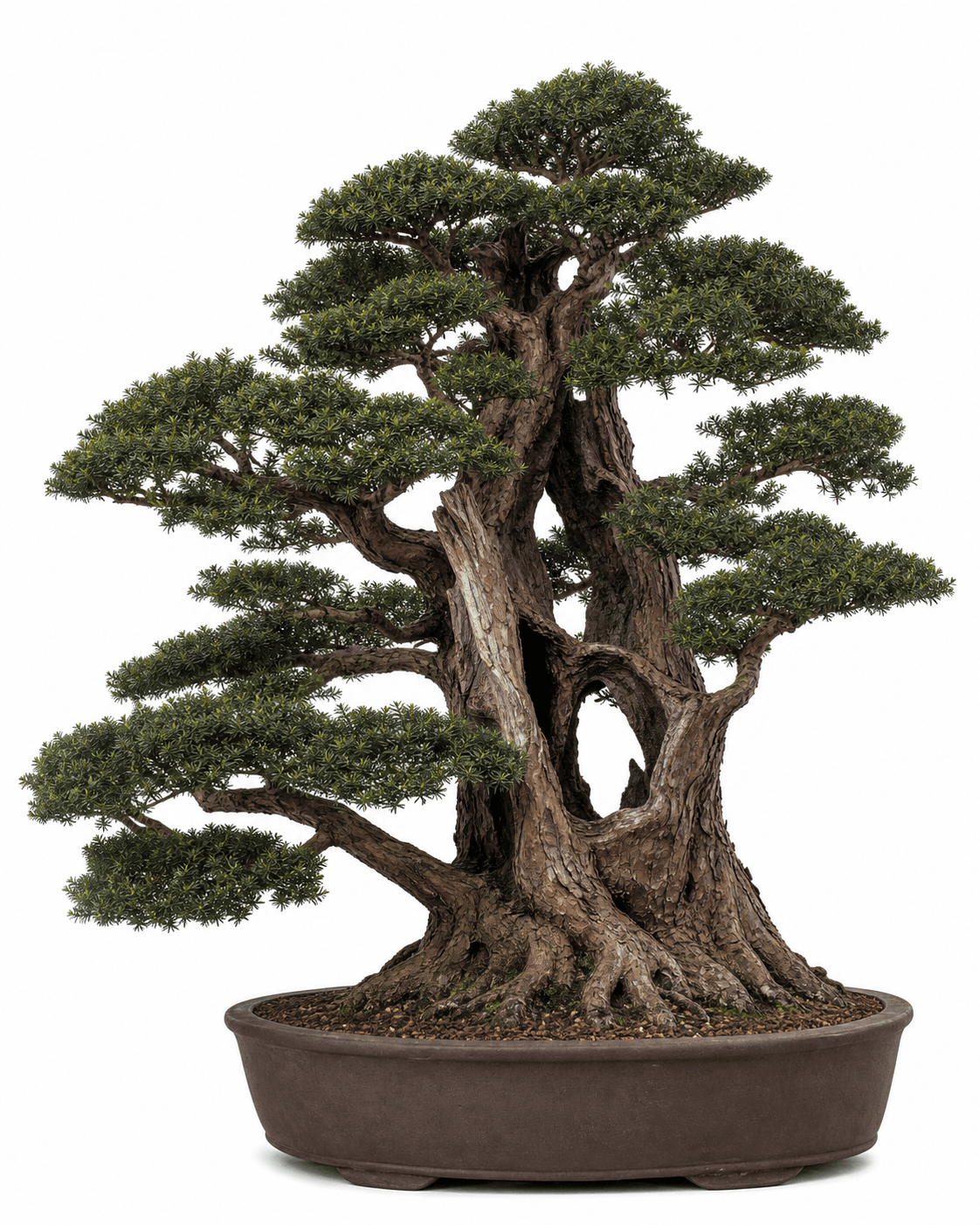
The defining design fact is inside-out decay. Mirai describes Taxus deadwood as hollowing from the pithy interior beneath a harder shell, so carving should open windows, create foreground and background, and follow the grain rather than impose a generic shari pattern. Bonsai Mirai Library
Initial Taxus pads are set flat. Over years, extension and pruning build the elevated, settled, cloud-like pad form. The early job is clean primary structure, broad fan-shaped pads, varied pad sizes, and enough branch length to fill negative spaces around the trunk features. Bonsai Mirai Library
Choose the apex and defining branch in three dimensions. Photos flatten the hollow trunk, base, and branch planes; Mirai emphasizes handling and rotating the tree before locking in a front or planting angle. Bonsai Mirai LibraryBonsai Mirai / Asymmetry
A credible English yew bonsai can be quiet. Dark foliage, restrained pads, an ancient hollow, low visual speed, and a container with gravity often read truer than dramatic movement on a tree whose wild identity is endurance. Royal Botanic Gardens, KewEuropean Atlas of Forest Tree SpeciesBonsai Mirai / Asymmetry
Cultivars
Fastigiata, Repandens, Standishii, and hybrid labels change the starting material.
Oregon State lists Fastigiata as Irish yew with rigid upright branches, Repandens as a dwarf wide-spreading form, Repandens Aurea as a variegated spreading form, and Standishii as compact and columnar with golden-yellow foliage. Oregon State Landscape Plants
NC State lists Amersfoort, Fastigiata, Repandens, Repandens Aurea, and Standishii as cultivars or varieties. These names affect branch habit, needle color, size, and how much early correction the grower has to do. NC State Extension
Fastigiata material often starts too vertical for natural old-tree design but can suit formal, clump, or compressed upright work. Repandens and compact forms may be better for smaller bonsai because they already carry short scale and spreading habit. Oregon State Landscape PlantsBonsai Mirai Library
Taxus x media, Japanese yew, and Pacific yew deserve separate handling. Mirai notes that baccata has the finest needles and slightly lower vigor, cuspidata is coarser and stronger, and brevifolia tends toward upright columnar habit. Bonsai Mirai LibraryOregon State Landscape Plants
History
English yew carries ancient-tree and churchyard associations that suit bonsai restraint.
Kew describes yew as deeply tied to mythology and folklore, with some European trees thought to be more than 2000 years old. The same page connects ancient yews with churchyards, death, rebirth, longbows, carving, and medical taxane compounds. Royal Botanic Gardens, Kew
The European Atlas says very old yews are difficult to age because hollow centers make ring counts unreliable, and it records reports of specimens up to 5000 years old while noting disagreement over exact ages. European Atlas of Forest Tree Species
That history raises the bar for bonsai styling. An English yew should avoid decorative deadwood that fights the species story. Hollow trunks, dense dark masses, slow branch refinement, and quiet containers make the tree feel older than theatrical curves. Bonsai Mirai LibraryBonsai Mirai / AsymmetryRoyal Botanic Gardens, Kew
Exhibition-quality Taxus usually comes from time: field or collected trunks, patient root transition, repeated pruning cycles, clean pad layering, and deadwood refined over multiple sessions rather than completed in one carving pass. Bonsai Mirai Library
Species questions
Answer the beginner questions before styling.
Can English yew be grown as bonsai?
Yes. English yew is a strong bonsai species when grown outdoors with cold dormancy, bright light, cool roots, oxygenated soil, and pruning-led refinement.
Can English yew bonsai live indoors?
English yew belongs outdoors. It needs outdoor light, moving air, seasonal temperature change, and winter dormancy for long-term health.
When should I repot English yew bonsai?
Repot in spring when terminal buds swell and begin to show white, before the new needle shape is visible. Preserve fine fleshy roots and avoid heavy foliage reduction in the same season.
Does English yew back-bud on old wood?
English yew can back-bud strongly from older lignified wood when it has built reserves through extension, feeding, and strong health. Heavy cutback on weak trees is unreliable.
Should I pinch English yew?
Pinch only the strongest refined shoots that extend beyond the silhouette. Development shoots and moderate shoots usually need to extend first so the tree can build energy and interior buds.
What soil mix works for English yew bonsai?
A Mirai-derived baseline is about 3 parts akadama, 1 part pumice, and 1 part lava. Increase water retention in dry climates and avoid compacted organic cores.
Is English yew poisonous?
Yes. Leaves, bark, stems, and seeds are highly poisonous. Keep clippings away from children, pets, livestock, and vegetable-garden compost.
Can English yew be heavily pruned?
Yes, on strong prepared trees. Mirai describes heavy post-freeze pruning for back-budding after the tree has been allowed to extend, feed, and load reserves through the growing season.
Why is my English yew turning brown?
Common causes include wet roots, old compacted soil, root work after the safe window, winter burn, hidden scale or mealybugs, and weak trees that were pinched or pruned too often.
What styles suit English yew bonsai?
Informal upright, ancient hollow trunk, literati, clump, raft, forest, deadwood-heavy collected image, and compact cultivar bonsai all suit English yew when the design respects dark foliage and slow old-tree character.
Sources
Species advice needs source discipline.
Next decisions
Plan the operation before copying the calendar.
A good care note for English yew records the tree's stage, the work done, and the aftercare used. That record matters more than a month-name rule.
Related species
Compare nearby trees before transferring advice.
Subalpine fir
Abies lasiocarpa
Balsam fir
Abies balsamea
White fir
Abies concolor
Noble fir
Abies procera
Mountain hemlock
Tsuga mertensiana