
Species guide
Limber Pine Bonsai Care
Pinus flexilis
Limber pine bonsai is outdoor, cold-dormant, slow to recover, and best handled as a five-needle long-needle single-flush pine. The practical rule is simple: preserve needle mass, wait for sheath drop before refinement pruning, keep roots oxygen-rich, and never copy annual Japanese black pine decandling onto Pinus flexilis.
This guide has strong direct Mirai coverage from Limber pine design, ancient Limber pine creation, second-working, natural restyling, five-needle pine pruning, Rocky Mountains field studies, and pine deadwood files. Kew, Flora of North America, USDA Forest Service, National Park Service, NC State, Oregon State, Utah State, and UC IPM ground the accepted name, range, elevation, hardiness, morphology, and pest risks.
Updated June 7, 2026. Written by EntGrove Editorial. Last verified June 7, 2026.
Care fingerprint
Read the species through its shared care pattern.
Do not default to Japanese black pine decandling; manage vigor through timing, needle balance, light, and conservative pruning. Use this as the starting point before local conditions and tree strength refine the calendar.
Identify flush behavior
Single-flush, multiflush, white pine, and compact pine groups have different pruning windows and different risk levels.
Avoid default decandling
Japanese black pine methods do not transfer safely to every pine, especially slow, weak, collected, or five-needle trees.
Use needles as strength data
Needle length, color, age, and density help show where vigor is strong, weak, or becoming shaded.
Care cadence
The calendar starts with the tree's seasonal state.
Placement
Timing: Grow outdoors in sun, airflow, and real winter dormancy. Use afternoon shade only when container heat rises into stress conditions after recent work.
Watch for: Warm indoor winters, humid stagnant benches, shaded weak growth, black pots on paving, and protection that removes the cold season entirely.
Bonsai Mirai LibraryNC State ExtensionUtah State University ExtensionWatering
Timing: Water the whole root mass, then wait until the soil has dried enough for oxygen to return. Adjust after foliage reduction because fewer needles pull less water through the pot.
Watch for: Wet native cores, dry outer mix around wet inner soil, algae, sour organic pockets, and watering by calendar during rainy periods.
Bonsai Mirai LibraryUtah State University ExtensionDevelopment feeding
Timing: Feed strongly through development after roots are functioning. Mirai five-needle pine method uses needle mass and fertilizer to build vascular tissue, roots, and back buds.
Watch for: Refinement feeding during spring needle elongation, starving collected trees after recovery, and pushing fertilizer into cold or damaged roots.
Bonsai Mirai LibraryRefinement feeding
Timing: On refined trees, hold spring fertilizer until sheath drop, then apply a measured dose before summer heat. In development, keep feeding and growing instead of pruning early.
Watch for: Long needles from spring feeding, weak interior buds from underfeeding, and fertilizer before the tree has recovered from root work.
Bonsai Mirai LibrarySheath-drop pruning
Timing: Work five-needle foliage when the papery sheaths fall and needles harden. The reliable cutback window is roughly two to three weeks after sheath drop.
Watch for: Spring candle pinching, late cuts into hardened yellow shoots, cutting behind all new needles, and bud selection on branches still in development.
Bonsai Mirai LibraryRoot work
Timing: Repot around spring bud movement with freeze protection, or follow proven protected Mirai timing when aftercare is controlled. Preserve functioning roots and anchor the tree tightly.
Watch for: Bare-rooting, replacing the entire native core at once, loose tie-downs, heavy styling in the same season, and freezing freshly cut roots.
Bonsai Mirai LibraryWiring and bending
Timing: Wire strong trees after growth hardens or in early fall. For heavy bends, keep branches and raffia dry, test flex lightly, and accept that older wood can snap suddenly.
Watch for: Wet raffia, cold wet branches, repeated incremental bending within the same season, branch-crotch shear, and cantilevered weight on hollow old trunks.
Bonsai Mirai LibraryPests and disease
Timing: Inspect in spring, after collection, after drought or wet winters, and whenever one branch flags. Five-needle white pines need specific rust and beetle awareness.
Watch for: White pine blister rust, mountain pine beetle, dwarf mistletoe, root disease, needle disease, scale, mites, and stress from alkaline water or chronic wet roots.
USDA Forest Service FEISUC IPMBonsai Mirai LibrarySpecies guide
Apply the species profile before copying another tree's calendar.
At a glance
Limber pine is a five-needle western mountain pine that rewards restraint.
Pinus flexilis is the accepted name for limber pine. It is a western North American five-needle pine in Pinaceae, with native populations across the Rockies, Great Basin, parts of California and Oregon, the Dakotas, Nebraska, Arizona, New Mexico, Alberta, and British Columbia. Kew POWOFlora of North AmericaUSDA Forest Service FEIS
For bonsai, treat it as Pine > Long-Needle Single-Flush. Mirai five-needle pine files repeatedly group limber pine with Japanese white pine, Eastern white pine, and Western white pine for sheath-drop pruning, no spring candle pinching, and no routine decandling. Bonsai Mirai Library
The care target is bright outdoor growth, a dry-cycle watering rhythm, oxygen-rich mineral soil, and enough needle mass to keep roots active. Container culture should preserve strength first, then ask for refinement. Bonsai Mirai LibraryUtah State University Extension
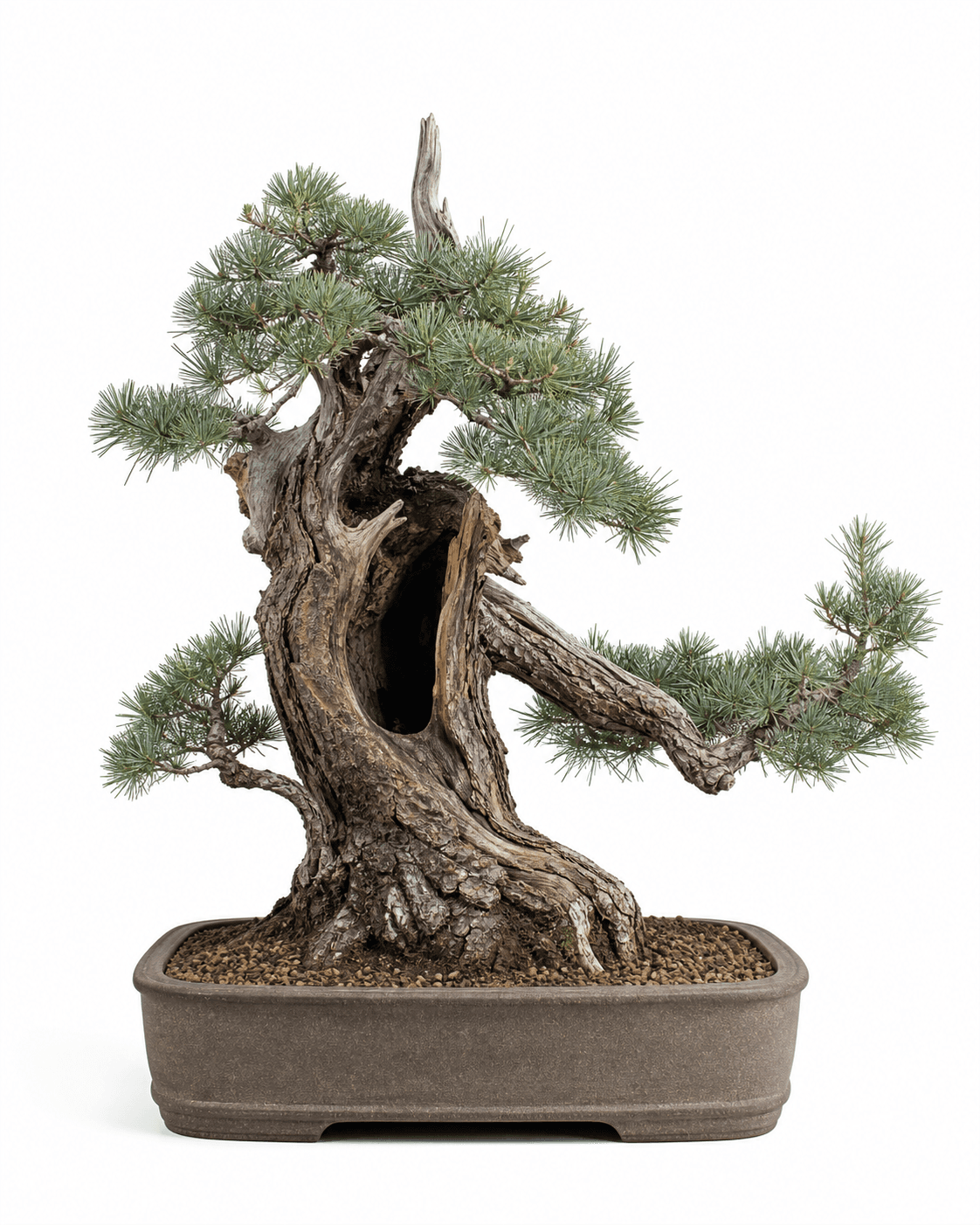
The design target is a sparse mountain pine with soft five-needle foliage, hollowing old wood, wind-readable live veins, and broad negative space. Dense black-pine pads make old limber material look younger and less species-faithful. Bonsai Mirai / AsymmetryBonsai Mirai Library
Wild habitat
Its wild model is exposed rock, wind, cold, drought, and animal-cached seed.
FNA places limber pine in high montane forests, often at timberline, from 1000 to 3600 m. NPS describes it near Bryce Canyon from 5000 to 12000 ft, often on cliff edges, talus pockets, and harsh southwest-facing slopes where more competitive conifers fail. Flora of North AmericaNational Park Service
Mirai Rocky Mountains field studies explain the pattern: limber pine seedlings establish in rock pockets, then emerge into exposed wind and sun after deeper roots are set. Seed-caching animals concentrate seed on ridges and outcroppings that remain accessible through winter. Bonsai Mirai Library
That habitat does not mean the bonsai wants neglect. In a pot, drought tolerance becomes high oxygen plus complete watering. A healthy limber pine uses substantial water during growth, then declines when roots sit in stagnant wet soil. Bonsai Mirai LibraryUtah State University Extension
Design follows the same ecology. Windward deadwood, protected leeward live tissue, old hollow trunks, clustered survival, and sparse foliage should guide trunk line, branch shoulder, apex, and negative space. Bonsai Mirai / AsymmetryBonsai Mirai Library
Reading the tree
Read needle mass, sheath drop, root recovery, and old wood before choosing work.
A strong limber pine carries firm blue-green five-needle clusters, older needles that release only when ready, multiple active buds, and roots that dry and rehydrate predictably. Weak trees show scattered strong shoots, soft color, wet cores, or branch-by-branch dieback. Bonsai Mirai LibraryFlora of North America
Mirai ties five-needle pine refinement to sheath drop. When papery sheaths fall, the needles have hardened and elongation has stopped. That is the timing signal for cutback, needle cleanup, wiring, and branch layout on strong refined areas. Bonsai Mirai Library
Development branches and refinement branches can exist on the same tree. Development zones keep needle mass and fertilizer to build vascular tissue. Refined zones can be shortened after sheath drop when there are enough interior buds to carry the branch. Bonsai Mirai Library
Old limber pine wood deserves a separate read. Mirai notes that mature trees often hollow from the inside because resin and active resources concentrate toward exterior tissue. The older and thicker the wood, the more conservative the bending plan should be. Bonsai Mirai Library
Pruning
Use sheath-drop pruning, not spring pinching or routine decandling.
Do not pinch elongating spring candles on limber pine. Mirai five-needle pine guidance warns that spring pinching on long-needle single-flush pines pushes the remaining needles longer and weakens the design signal. Bonsai Mirai Library
Do not decandle limber pine as an annual technique. It has one main flush, low water mobility, and slow bud response. Use post-flush pruning and needle preservation as the normal refinement path. Bonsai Mirai Library
After sheath drop, shorten a refined shoot by cutting in front of retained five-needle clusters. Buds form from the retained clusters; cutting behind all current-year needles leaves no useful bud site. Bonsai Mirai Library
Balance strength by shortening stronger shoots and preserving weaker zones. Needle plucking as a primary strength-balancing tool belongs to multiflush pine systems; limber pine depends on needle mass to move water and build roots. Bonsai Mirai Library
Roots
Repot for function, and keep the old root system alive while new roots form.
Limber pine roots behave like other low-water-mobility five-needle pines: slow, fragile, and easy to overwork. Mirai rock-planting guidance warns against bare-rooting and against losing large portions of the root mass in one operation. Bonsai Mirai Library
Freshly collected material should stay quiet for years. Mirai uses about three undisturbed years before a first repot on yamadori five-needle pines, with styling delayed until recovery is visible. Bonsai Mirai Library
Established trees should be repotted when the soil stops percolating, decomposes into waterlogging, or needs an angle or container correction. Older collected material may need long intervals because root growth has already slowed. Bonsai Mirai Library
Spring bud movement is the practical outdoor window when freeze protection is available. After root work, tie the tree firmly, protect from drying wind, hold heavy styling, and water by root response rather than habit. Bonsai Mirai Library
Soil and pot
Use mineral oxygen, then choose a pot that respects mountain-pine scale.
Mirai gives limber pine a 1:1:1 akadama:pumice:lava mix with the 1/16 inch fraction screened out. The point is oxygen. Fine particles hold too much moisture around a species whose roots recover slowly. Bonsai Mirai Library
Do not copy the native rock pocket literally. A pot cannot supply a deep root run, wind-cleaned soil, and alpine drainage. The bonsai mix must hydrate completely, then restore air quickly. Bonsai Mirai LibraryUtah State University Extension
Collected trees with long linear roots often need wide shallow containers, trays, or slab setups before they fit a refined pot. Solve root geometry in stages instead of cutting every anchor root to hit a design size. Bonsai Mirai Library
Pot pairing should be quiet and austere: unglazed stoneware, subdued gray, warm brown, iron, or rock slabs. Use enough visual mass to hold a hollow old trunk and enough negative space to keep the mountain story legible. Bonsai Mirai / Asymmetry
Climate
Cold dormancy is required, while hot lowland winters are a slow failure pattern.
NC State lists Zones 4a to 7b, Oregon State lists Zone 4, and Utah State lists Zones 4 to 7. In bonsai pots, protect roots during hard freeze events even when the species is landscape-hardy. NC State ExtensionOregon State Landscape PlantsUtah State University Extension
Mirai specifically warns that limber pine needs extended cold dormancy and is unlikely to thrive in low-elevation climates with only brief freezing. Warm-winter regions should choose a different pine or grow limber pine only with serious climate strategy. Bonsai Mirai Library
Hot summer regions can grow limber pine only when root heat is controlled. Use sun for foliage strength, then protect the container from reflected heat, black-pot overheating, and dry wind after work. Bonsai Mirai Library
High-rainfall regions need the most soil discipline. A wet maritime winter around a native core can suffocate roots even while the foliage still looks dry and durable. Bonsai Mirai LibraryUtah State University Extension
Pests and disease
Treat it as a five-needle white pine with rust, beetle, mistletoe, and root risks.
USDA FEIS identifies Pinus flexilis as a five-needle white pine in subgenus Strobus. UC IPM notes that white pine blister rust can infect native California five-needle white pines, including limber pine. USDA Forest Service FEISUC IPM
White pine blister rust deserves sourcing caution. Avoid suspect material, learn local quarantine rules, and ask regional extension guidance before moving infected or high-risk white pine material. UC IPMUSDA Forest Service FEIS
USDA FEIS grounds broader wild-tree risks including mountain pine beetle, dwarf mistletoe, fire injury, and regeneration challenges. In bonsai, stress from drought, wet roots, and recent collection raises the stakes of these problems. USDA Forest Service FEIS
Common bonsai trouble also includes scale, spider mites, needle diseases, bark injury, and alkaline-water chlorosis. The first prevention step is cultural: full sun, airflow, high-oxygen soil, clean tools, and no stacked major work. Bonsai Mirai LibraryNC State Extension
Wiring
The name says limber, but old bonsai wood can be brittle and unforgiving.
Young shoots can flex dramatically, which is where the common name comes from. Mirai warns that older structural wood behaves differently because the resin-poor core dries, hollows, and snaps with little warning. Bonsai Mirai LibraryOregon State Landscape Plants
Wire only dry branches. Several Mirai limber pine files warn that wet branches and wet raffia increase breakage risk. Let tissue dry before heavy bending, then use dry protection if needed. Bonsai Mirai Library
Distribute bends over the whole wired length, twist with the bend, and stop when small bark fractures or sap show that the branch is at threshold. Additional movement often needs two to four years of new vascular growth. Bonsai Mirai Library
After heavy bending, minimize cantilevered weight. Hollow old trunks continue to settle, rotate, and sag as seasons change, so designs need compact structural logic rather than long unsupported reaches. Bonsai Mirai Library
Propagation
Seed is normal; grafting is possible; collected material carries the longest recovery tail.
FNA records cones maturing in two years and shedding large wingless or nearly wingless seeds. Wild establishment is tied to animal caching, while bonsai propagation usually starts from seed or nursery liners. Flora of North AmericaBonsai Mirai Library
Seed-grown trees give the cleanest root-to-trunk continuity and avoid graft-union questions. They also demand patience because limber pine is slow, especially when grown for convincing bark and branch age. USDA Forest Service SilvicsUtah State University Extension
Named landscape forms are often grafted. Inspect graft union height, bark match, rootstock vigor, and whether the scion habit suits bonsai scale before buying a cultivar for serious work. Oregon State Landscape PlantsBonsai Mirai Library
Collected material can be exceptional when legal and well recovered. The first bonsai task is aftercare: stabilize roots, maintain needle mass, and wait for multiple seasons of growth before refinement. Bonsai Mirai Library
Buying
Buy verified Pinus flexilis with roots, needle mass, and a believable recovery story.
Good nursery material has a confirmed Pinus flexilis label, five needles per fascicle, blue-green foliage, flexible young shoots, a visible base, and roots that can be converted without removing the entire core. Flora of North AmericaNC State ExtensionBonsai Mirai Library
Good collected material has documentation, firm anchoring, several years of recovery, active buds, retained older needles, and a seller who can explain the native soil, collection date, and aftercare. Bonsai Mirai Library
Red flags include recent collection plus first styling, loose trunks, wet native cores, white pine blister rust symptoms, bark beetle galleries, single-branch flagging, old wire scars, and labels that blur limber pine with whitebark or Southwestern white pine. UC IPMUSDA Forest Service FEISUtah State University Extension
Cultivars such as Vanderwolf's Pyramid, Cessarini Blue, Extra Blue, Glauca, and Glauca Pendula can be useful, but they should be evaluated as grafted landscape material first and bonsai material second. Oregon State Landscape Plants
Troubleshooting
Diagnose by roots, needle age, branch history, and the last work window.
Needles yellowing across the tree usually points to wet roots, poor oxygen, decomposed soil, alkaline water, recent overwork, or cold roots that are no longer moving water well.
Sudden old-needle drop after repotting points to root loss or water imbalance. Stabilize the tree, protect from wind and freeze, avoid fertilizer spikes, and stop styling.
One branch turning brown can mean branch-crotch tearing, wire injury, a borer or beetle issue, rust canker, root loss on that side, or a live vein interrupted during styling.
Long coarse needles after heavy pruning mean too much stored energy was pushed through too few growing tips. Rebuild interior buds before chasing small needles again.
Weak interior buds usually mean insufficient needle mass, shade, premature cutback, poor feeding in development, or a root system that has not recovered.
A branch snapping during wiring means the bend exceeded the old core. Seal damage, reduce leverage, support the remaining live path, and postpone further heavy movement for years.
White or orange blister rust symptoms need local extension guidance and movement caution. Do not treat rust-risk white pines as casual nursery traffic.
Design
Style limber pine as a soft five-needle mountain survivor with hollow old wood.
Mirai design sources describe limber pine as soft, curvaceous, ancient, and environment-driven. Its foliage often reads as chunky flat breaks with long wispy extensions rather than tight two-needle pine pads. Bonsai Mirai / AsymmetryBonsai Mirai Library
Start with the trunk line and hollowing. Old limber pine often rots from the inside, and a hollow trunk can be an age signal. Preserve that signal instead of carving it into generic juniper-style torn deadwood. Bonsai Mirai Library
Choose the defining branch from the story the tree already tells: windward survival, leeward live tissue, a rock-pocket origin, a dead top, a clump that endured together, or a trunk that settled against stone. Bonsai Mirai / AsymmetryBonsai Mirai Library
Use compact apexes and reduced outward reach on old hollow trees. The branch placement should lower leverage, hold asymmetry, and let negative space do as much work as foliage mass. Bonsai Mirai Library
Forms
Landscape forms can help scale, but identity and graft quality still control care.
Oregon State lists Vanderwolf's Pyramid as a popular upright blue-green form and also notes Cessarini Blue, Extra Blue, Glauca, and Glauca Pendula. These are landscape selections, so inspect them as grafted stock. Oregon State Landscape Plants
Dwarf or blue forms can give shorter internodes, compact foliage, and better container scale. The tradeoff is possible graft swelling, rootstock mismatch, and branch placement built for garden habit rather than bonsai design. Oregon State Landscape PlantsBonsai Mirai Library
Southwestern white pine can be confused with limber pine. Utah State notes that some treatments have considered it a variety of limber pine and points to cone-scale differences. Verify the actual species before assigning care or hardiness. Utah State University Extension
Whitebark pine, bristlecone pine, western white pine, and lodgepole pine can appear near similar habitats or in similar nursery language. Use fascicle count, cones, bark, range, and label history before relying on a care page. Flora of North AmericaUSDA Forest Service FEIS
History
Limber pine is a western old-tree species with a distinct bonsai design language.
USDA Silvics describes limber pine as a long-lived, slow-growing small to medium tree, and Mirai Rocky Mountains field studies treat ancient limber pine as one of the signature North American mountain-pine design references. USDA Forest Service SilvicsBonsai Mirai Library
Mirai field observations connect old limber pine to wind, drought, UV, deep cold, rock pockets, animal seed caching, hollow trunks, clustered survival, and live tissue protected on the leeward side. Bonsai Mirai Library
NPS uses limber pine at Bryce Canyon to explain edge habitats where other conifers cannot compete. That ecological role is exactly what makes the species compelling in bonsai: it records hardship through shape. National Park Service
As a bonsai subject, limber pine belongs to the North American yamadori and native-conifer conversation rather than the older Japanese black pine refinement canon. Its authority comes from species-faithful restraint. Bonsai Mirai / AsymmetryBonsai Mirai Library
Species questions
Answer the beginner questions before styling.
Can limber pine be grown as bonsai?
Yes. Limber pine can be grown as outdoor bonsai, especially from verified nursery stock or legally collected material, but it is best for experienced growers who can manage five-needle pine timing and slow recovery.
Can limber pine bonsai live indoors?
No. Limber pine needs full sun, airflow, seasonal change, and winter dormancy. Indoor display should be brief and occasional.
Is limber pine a white pine?
Yes. USDA FEIS places Pinus flexilis in subgenus Strobus, and it has five needles per fascicle. Common labels include limber pine, white pine, and Rocky Mountain white pine.
Should I decandle limber pine?
Avoid routine decandling. Limber pine is a long-needle single-flush five-needle pine, so the normal refinement method is sheath-drop pruning and needle preservation.
When do I prune limber pine?
Prune refined shoots after the papery sheaths drop and the needles harden. The reliable cutback window is roughly two to three weeks after sheath drop.
Can I pinch limber pine candles in spring?
Skip spring candle pinching. Mirai five-needle pine guidance warns that pinching elongating candles on long-needle single-flush pines causes coarse needle length and weakens the tree.
What soil works for limber pine bonsai?
Use a high-oxygen pine mix. Mirai gives limber pine one part akadama, one part pumice, and one part lava, with the 1/16 inch fraction screened out.
Why did my limber pine branch snap while wiring?
Older limber pine wood can be brittle even though young shoots are flexible. Work dry branches, distribute bends, stop at sap or bark-fracture signals, and avoid repeated heavy bending in the same season.
How is limber pine different from lodgepole pine?
Limber pine has five needles per fascicle and often blue-green softer foliage. Lodgepole pine usually has paired needles and belongs to a different pine method group.
What should I inspect before buying limber pine bonsai stock?
Confirm the Pinus flexilis label, check for five-needle foliage, inspect roots and graft unions, avoid rust or beetle symptoms, and be cautious with recently collected trees that already have heavy styling.
Sources
Species advice needs source discipline.
Next decisions
Plan the operation before copying the calendar.
A good care note for Limber pine records the tree's stage, the work done, and the aftercare used. That record matters more than a month-name rule.
Related species
Compare nearby trees before transferring advice.
Ponderosa pine
Pinus ponderosa
Jeffrey pine
Pinus jeffreyi
Bishop pine
Pinus muricata
Sugar pine
Pinus lambertiana
Eastern white pine
Pinus strobus