
Species guide
Ginkgo Bonsai Care
Ginkgo biloba
Ginkgo bonsai is an outdoor temperate tree for patient growers who want golden fall color, an upright flame-shaped image, and a species that rewards restraint. Warm indoor culture exhausts it because the tree needs full outdoor light, autumn shutdown, and winter dormancy.
Botanically, Ginkgo biloba is a gymnosperm and the only living species in its ancient lineage. In EntGrove care timing, it sits in Broadleaf > Deciduous because the bonsai calendar follows spring bud swell, a single growth flush, leaf hardening, autumn color, and leaf drop.
The defining care rule is small work before large correction. Mirai treats ginkgo as a weak compartmentalizer with low water mobility, soft bark, fragile buds, and a vulnerable apex, so the best trees are built from early choices, protected wounds, 100 percent akadama, and carefully padded aluminum or guy-wire work.
Updated July 13, 2026. Written by EntGrove Editorial. Last verified July 13, 2026.
Care fingerprint
Read the species through its shared care pattern.
Repot and structural prune around dormant-to-active transitions; protect new leaves; time refinement work after growth hardens. Use this as the starting point before local conditions and tree strength refine the calendar.
Read the foliage first
Broadleaf stress usually shows in leaf color, leaf size, wilt, scorch, or delayed hardening before it becomes a branch problem.
Match work to dormancy
Deciduous, evergreen, tropical, succulent, and flowering broadleaf trees recover on different calendars.
Protect fine roots
Root work should preserve enough active fine roots for the tree to rehydrate quickly after the operation.
Care cadence
The calendar starts with the tree's seasonal state.
Placement
Timing: Grow outdoors through the seasons. Use full sun for established trees until heat rises above roughly 85-90 F, then use shade cloth or afternoon relief.
Watch for: Warm indoor winter growth, shade-enlarged leaves, long internodes, tender post-repot foliage, late frost after bud push, and hot benches that dry a shallow pot.
Bonsai Mirai LibraryNC State ExtensionMorton ArboretumWatering
Timing: Water thoroughly while leaves are active, then let air return through the akadama before the next pass. Keep dormant roots lightly moist, with clean drainage before freezes.
Watch for: Dry interior root cores, runoff around old nursery soil, wet frozen pots, leaf scorch after drought, and apex weakness after repeated water stress.
Bonsai Mirai LibraryFertilizer
Timing: Feed organic pellets during active growth according to stage. Refined trees need measured nutrition; developing trees can use stronger feeding to build trunk and branch options.
Watch for: Starved branch building, coarse late growth, salt buildup in 100 percent akadama, calcium additions when source water is already hard, and fertilizer left after leaf drop.
Bonsai Mirai LibraryPruning
Timing: In spring refinement, let shoots extend three to five leaves, then cut back to the two-leaf mark. Use fall leaf-drop pruning for refined structure and early spring for heavy development cuts.
Watch for: Large visible wounds, incomplete collars, fragile buds knocked off by tools, basal suckers stealing apex strength, and trying to force a second ramification flush.
Bonsai Mirai LibraryWiring
Timing: Use aluminum for second styling and refinement. Check wire every four to eight weeks as growth resumes, then about every two weeks once active thickening starts.
Watch for: Soft bark scars, copper abrasion, underpadded guy wires, buds snapped from small attachments, and heavy bends on old rigid wood.
Bonsai Mirai LibraryRepotting
Timing: Repot as buds swell in spring. Established trees may go about four years, sometimes five, when the root system colonizes slowly and water still percolates evenly.
Watch for: Broken-down akadama, stale nursery cores, root reduction paired with major canopy work on old trees, missing the bud-swell window, and removing the basal root sheen on lower-water-mobility material.
Bonsai Mirai LibraryPests, disease, and seed safety
Timing: Inspect during watering, but reserve treatment for evidence. Prefer male or nonfruiting cultivars when seed mess, odor, or skin irritation matters.
Watch for: Seed pulp contact dermatitis, children or pets around fallen seeds, rare pests on stressed trees, and female identity appearing only after maturity.
Kew POWONC State ExtensionOregon State Landscape PlantsMorton ArboretumWinter protection
Timing: Let the tree go fully dormant, then protect the pot from hard freeze, dry wind, and rapid freeze-thaw cycles. Keep storage cold and bright enough for normal dormancy, not warm.
Watch for: Frozen dry akadama, wet frozen roots, rodents, early bud push in warm storage, and assuming landscape Zone 3 hardiness applies directly to a shallow pot.
NC State ExtensionOregon State Landscape PlantsBonsai Mirai LibrarySpecies guide
Apply the species profile before copying another tree's calendar.
At a glance
Ginkgo is a deciduous gymnosperm bonsai with simple care and unforgiving design consequences.
Kew accepts Ginkgo biloba L. in Ginkgoaceae and gives the native range as China (Zhejiang). Kew also describes the tree as the only living member of an ancient lineage, which explains why ordinary broadleaf language can be botanically imprecise even when the bonsai calendar behaves deciduously. Kew POWO
For a grower, the complete specification is clear: outdoor culture, full sun until hot weather needs shade cloth, steady water in leaf, spring bud-swell repotting, measured organic feeding, 100 percent akadama for refinement, careful winter root protection, and almost no tolerance for casual large wounds. Bonsai Mirai LibraryNC State ExtensionOregon State Landscape Plants
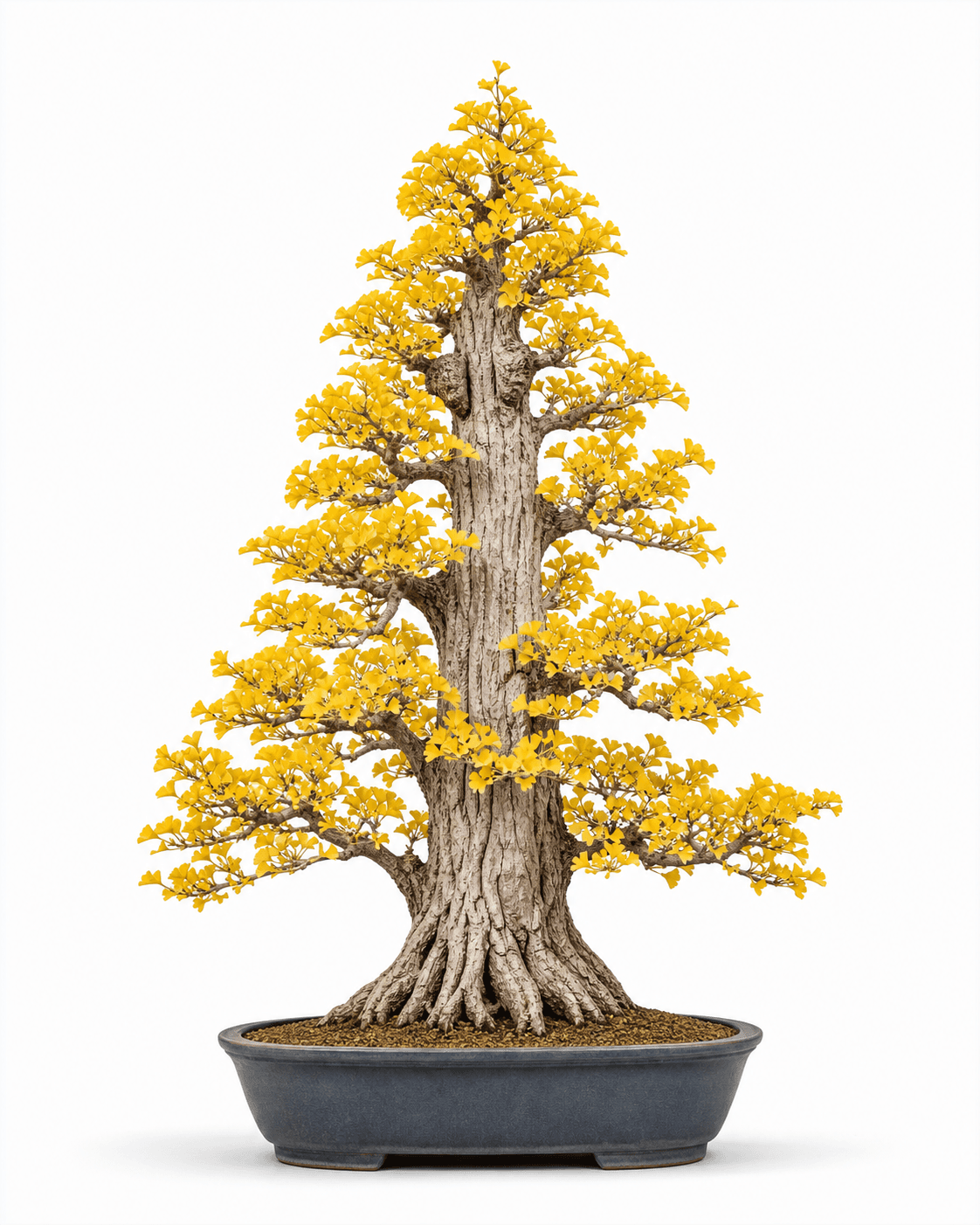
The bonsai image is equally specific. Mature ginkgo reads as an upright flame: a rooted base, a protected apex, branches that step inward and outward, and golden fan-shaped leaves that drop after a short autumn display. The species can be healthy for beginners, while canonical styling asks for intermediate judgment. Bonsai Mirai / AsymmetryBonsai Mirai LibraryKew POWO
Wild habit
The wild story points to moist, sunny, deep-rooted temperate care.
Kew places Ginkgo biloba in a temperate biome and describes its geography around China, with survival in truly wild sites uncertain. Its species profile names broadleaved forests, moist deep sandy soils, and full sunlight as ecological context. Kew POWO
Landscape sources reinforce that translation. NC State says ginkgo needs full sun and good drainage to thrive, while Oregon State says it prefers sandy, deep, moderately moist soil and grows in many difficult sites. In a bonsai pot, the useful overlap is moisture retention plus oxygen, not dryness. NC State ExtensionOregon State Landscape Plants
Design should also come from the mature tree rather than from generic deciduous pad work. Mirai points to old ginkgo with a flame silhouette, stronger upper structure, and lower branches that can be thinner because they emerge adventitiously later in life. That mature habit is the styling target. Bonsai Mirai / AsymmetryBonsai Mirai Library
Reading the tree
Read apex strength, collars, basal suckers, and water flow before cutting.
Mirai treats ginkgo as a low-water-mobility, weak-compartmentalizing tree. Xylem health is central: damage, repeated drought, and aggressive apical reduction can reduce water movement to the top and start the slow apex collapse that ruins old ginkgo bonsai. Bonsai Mirai Library
Every pruning decision should ask whether a full collar exists. Mirai warns that reducing a ginkgo branch before a complete 360-degree shoulder has formed can cause dieback beyond the intended cut. This is why development work belongs early, before branches become too thick to remove cleanly. Bonsai Mirai Library
Basal suckers deserve stage-aware handling. They can fill lower silhouette in a clump or multi-trunk design, yet Mirai also warns that uncontrolled basal growth can pull strength away from older structural branches and the apex. Keep the useful ones, shorten or remove the rest. Bonsai Mirai Library
Interior branches need the same active protection. The direct ginkgo corpus notes that interior growth can weaken before exterior growth because its vascular path to the roots is less direct. Preserve light and viable buds inside the silhouette, and avoid treating an exterior-heavy canopy as proof that the whole branch system is strong. Bonsai Mirai Library
Pruning
Ginkgo gives one real ramification chance per year.
NC State and Oregon State describe long shoots and short spur shoots, with leaves clustered on spurs and reproductive structures forming there. Mirai turns that anatomy into technique: in spring refinement, let a shoot extend three to five leaves, then cut back to the two-leaf mark while the first internodes are still tight. NC State ExtensionOregon State Landscape PlantsBonsai Mirai Library
Unlike many high-vigor deciduous species, ginkgo should not be planned around repeated flushes in one growing season. Mirai says the tree supports one ramification flush, so missed timing produces a year of coarser growth rather than an easy second correction. Bonsai Mirai Library
Use fall leaf drop for refined pruning when the tree has moved resources into buds and the branch structure is visible. Use early spring, just before the push, for heavier development cuts because stored energy can drive new buds along the trunk. In both cases, seal cuts and leave the shoulder intact. Bonsai Mirai Library
If the early spring structural window has passed, wait until the tree is energy-positive in mid-to-late spring and reduce to actively growing secondary shoots. Do not use routine partial or full defoliation to manufacture another cycle. Ginkgo produces one useful ramification flush, and the direct corpus treats defoliation as an exceptional experiment for unusually vigorous material. Bonsai Mirai Library
Seedling and nursery development has a narrow window. Mirai recommends setting low tight internodes early, using sacrifice growth deliberately, and making trunk chops before branches or trunks exceed roughly thumb thickness. After that, scars and dieback become permanent design constraints. Bonsai Mirai Library
Roots
Repot at bud swell and preserve the root sheen that supports water balance.
Mirai places ginkgo in the ordinary deciduous repot window: spring as buds swell. The species can tolerate longer intervals than many high-vigor deciduous trees because it colonizes soil more slowly, with four years and sometimes five being reasonable on established refined material if drainage and vigor stay strong. Bonsai Mirai Library
Young vigorous nursery stock can handle more aggressive root correction than an old refined tree, but age and containerization change the risk. Once a ginkgo has lived in a bonsai pot for years, separate heavy root work from heavy canopy reduction unless the tree is strong and the aftercare is controlled. Bonsai Mirai Library
The root base has its own species rule. In the Korean hornbeam repotting corpus, Mirai groups ginkgo with hornbeam and elm as lower-to-moderate water-mobility deciduous material that tolerates smaller containers and stone plantings because it relies on the basal root sheen. Preserve that sheen instead of stripping it flat like a high-water-mobility maple. Bonsai Mirai Library
After repotting, protect from drying wind, hot sun, and late frost until the first leaves harden. A 100 percent akadama profile holds water well, so the grower must water by actual percolation and root demand rather than by calendar habit. Bonsai Mirai Library
Soil and pot
Refined ginkgo wants fine akadama and an oval pot that reinforces the flame.
The direct Mirai recommendation is unusually specific: 100 percent akadama at 1/16-1/4 inch particle size. The reason is water balance and surface area. Ginkgo responds to a retentive fine-root environment, while too much pumice or lava can raise oxygen and reduce the moisture profile the tree prefers. Bonsai Mirai Library
Development material can use transitional choices when old nursery soil, field soil, or weak roots need staged conversion. The endpoint for refined ginkgo remains a clean, percolating, moisture-retentive akadama root system rather than a dry conifer mix. Bonsai Mirai Library
Pot choice should support the upright design. Mirai favors oval containers for single-trunk ginkgo because they carry vertical movement without implying lateral drift. Cream, orange, blue, or indigo glazes can complement the yellow fall display if the tree is otherwise quiet enough for color. Bonsai Mirai / AsymmetryBonsai Mirai Library
Clumps and forests need broader pot thinking. Use asymmetrical trunk spacing, enough front-to-back depth for roots, and a container that keeps the flame-like grove rising from one visual root plane. Bonsai Mirai / AsymmetryBonsai Mirai Library
Climate
Adapt by heat, winter root risk, and the length of the growing season.
Cold regions can grow ginkgo well, but a bonsai pot is more exposed than an in-ground root system. Use mulch beds, cold frames, unheated sheds, or similar cold protection that keeps the tree dormant while shielding roots from wind and severe freeze-thaw swings. NC State ExtensionOregon State Landscape PlantsBonsai Mirai Library
Hot-summer regions need light without leaf inflation. Mirai uses full sun until roughly 85-90 F, then shade cloth. Strong shade for too long gives larger leaves and longer internodes, so move between exposure levels with the season. Bonsai Mirai Library
Humid climates still need drainage and airflow because 100 percent akadama can stay wet after repeated rain. Dry climates need wind moderation and careful multi-pass watering so the entire root mass rehydrates instead of shedding water around a dry core. Bonsai Mirai LibraryOregon State Landscape Plants
Short-season growers should prioritize spring bud-swell repotting, early first-flush pruning, and fall work as leaf drop begins. Avoid late nitrogen that keeps soft growth active as nights cool. Bonsai Mirai Library
Pests and diseases
Ginkgo is pest-resistant, but seed pulp and cultural stress still matter.
Mirai describes ginkgo as highly resistant to routine pest and disease issues, and Morton reports no serious pest problems in landscape culture. Continue inspecting during watering, with roots, light, pruning injury, and aftercare at the top of the diagnostic list. Bonsai Mirai LibraryMorton Arboretum
NC State lists contact dermatitis, malodorous seed coverings, messy seed drop, and low-severity poison characteristics. The irritating parts are associated with the seed pulp, so older female material needs handling discipline around fallen seeds. NC State Extension
Kew identifies ginkgotoxin in the seed and warns that it can cause poisoning unless the seed is thoroughly cooked. NC State separately identifies ginkgolic acid in the seed pulp as a skin irritant. Treat cleanup as a safety task, use gloves, and keep fallen seeds away from children and pets. Kew POWONC State Extension
Root problems show first as weak extension, yellowing outside normal autumn color, poor water uptake, or apex decline. Correct watering, percolation, winter storage, and timing before reaching for pesticide or fertilizer. Bonsai Mirai Library
Wiring
Wire with aluminum, protect the bark, and protect every bud.
Mirai is direct: use aluminum rather than copper for second styling and refinement because ginkgo bark is thin, soft, and slow to outgrow scars. Paper-wrapped copper belongs only to exceptional initial moves, and even then the risk must be justified. Bonsai Mirai Library
The wood can be rigid, so structural bends may require heavy aluminum or guy wires. Use oversized rubber padding under guy wires, and watch contact points more closely than the bend itself because scars persist for years. Bonsai Mirai Library
Buds are fragile. Mirai notes that ginkgo buds attach at a small point and do not reliably regenerate if knocked off. Wire routing, pruning, and hand placement should preserve every viable bud on a branch that matters. Bonsai Mirai Library
Before pruning a wired branch, remove the wire first. Mirai calls out the combined wire-and-branch cut as a way to leave a sloppy wound on a species that already struggles to close cuts. Bonsai Mirai Library
Propagation
Seed and grafting are the dependable routes; cuttings are difficult.
Kew describes seed handling for cultivated ginkgo: remove the fleshy coating, stratify in cold storage, and sow into gritty compost in spring. Germination is measured in weeks, while landscape maturity and sex expression can take decades. Kew POWO
Mirai propagation guidance says ginkgo is very difficult from cuttings because its primitive and often hollow vascular structure resists hardwood propagation. Softwood cuttings taken as leaves begin to harden are the most plausible cutting route, with seed generally preferred. Bonsai Mirai Library
Grafting is common for dwarf and male cultivars. Mirai notes grafting as a viable route for very small-leaved dwarf cultivars, while NC State lists grafting as the propagation method in landscape culture. Bonsai Mirai LibraryNC State Extension
Air layering older ginkgo is unreliable. Mirai attributes that to slow callus formation, the same wound biology that makes late trunk chops and old branch removals poor bets. Bonsai Mirai Library
Buying
Buy trunk character, sex certainty, and clean wounds before tiny leaves.
Good ginkgo material already has the bones: an upright or clump base, usable low buds, no fatal inverse swelling, no large front-facing wounds, and an apex that can stay strong. A pencil-thin trunk can be healthy and still be decades away from a convincing flame image. Bonsai Mirai / AsymmetryBonsai Mirai Library
Nursery stock can be excellent if the graft is low and clean, the branch junctions have not swollen, and the future trunk line avoids a huge chop. Mirai warns that early inverse swelling at branch junctions should be handled quickly because late correction is much harder. Bonsai Mirai Library
Male or nonfruiting cultivars reduce seed mess. Kew says male trees are usually selected for cultivation, Oregon State lists commercial male selections, and Morton recommends buying male trees because female seed coverings are messy and odorous. Kew POWOOregon State Landscape PlantsMorton Arboretum
Avoid old collected or landscape-dug material with large fresh cuts, damaged roots, uncertain aftercare, or no plan for the top. Ginkgo can live through rough work, but it records the mistake for a very long time. Bonsai Mirai Library
Troubleshooting
Most Ginkgo problems trace to timing, wounds, roots, or apex management.
Apex weakens or dies back: reduce basal sucker competition, check xylem injury, improve water consistency, and stop aggressive apical cutback until bud density and water flow rebuild. Bonsai Mirai Library
Large wound stalls or dies back: wait for a complete collar before final reduction, refine the cut edge, seal every wound, and design around scars that will stay visible. Bonsai Mirai Library
Leaves are large and internodes stretch: increase light outside hot extremes, avoid long shade exposure, reduce excess nitrogen, and cut the first flush back on time next spring. Bonsai Mirai Library
Wire marks appear: remove wire immediately, switch to aluminum or padding, and accept that scar recovery will be slow. Use pruning and lightly staged guy-wire work to redirect future growth. Bonsai Mirai Library
Water runs around the root ball: suspect old nursery soil, dry akadama core, or broken-down media. Rehydrate carefully now and schedule bud-swell repotting if percolation remains uneven. Bonsai Mirai Library
Messy odorous seed coverings appear: identify the tree as female, clean with gloves, keep children and pets away from fallen seeds, and consider whether a male cultivar is a better long-term bonsai subject. Kew POWONC State ExtensionMorton Arboretum
Design
Style ginkgo as an old flame-form tree, not as a generic deciduous pad tree.
Mirai repeatedly frames mature ginkgo as upright and flame-shaped. The apex should come back over the base, with branch lengths stepping down and movement traveling in toward the trunk and back out at acute angles. Bonsai Mirai / AsymmetryBonsai Mirai Library
The usual deciduous rule of largest lowest branch can mislead here. Mirai notes that mature ginkgo often has thinner lower branches because they emerge adventitiously after the tree has aged. Protect the upper strength rather than forcing pine-style branch hierarchy. Bonsai Mirai Library
Single trunk, formal upright, informal upright, clump, and forest all fit the species. Clump designs need asymmetric trunk spacing, one close gap and one wider gap, so the grove feels grown rather than arranged. Bonsai Mirai / AsymmetryBonsai Mirai Library
Deadwood should be rare and contextual. Ginkgo wood and bark do not carry deadwood like juniper or pine, and poor compartmentalization means many scars remain wounds rather than refined features. Use existing scars honestly, then prevent new ones. Bonsai Mirai Library
Cultivars
Dwarf and male cultivars solve scale and seed problems, not design judgment.
Oregon State lists male selections such as Autumn Gold, Lakeview, Magyar, Mariken, and Princeton Sentry, with Mariken described as a dwarf slow-growing male selection around 2 ft by 2 ft in 10 years. Oregon State Landscape Plants
Morton lists nonfruiting male cultivars including Autumn Gold, Emperor, Golden Colonade, Jade Butterfly, Magyar, Mariken, Presidential Gold, and Princeton Sentry. Jade Butterfly is described as a nonfruiting male dwarf with dense leaf clusters. Morton Arboretum
Mirai notes that grafting is standard for dwarf cultivars with very small leaves. Inspect graft unions carefully. A dwarf crown above an ugly graft can be less useful than ordinary seedling material with a clean trunk and better root base. Bonsai Mirai LibraryNC State Extension
Chichi ginkgo forms are valuable for age character when the design can support them. The International Biological Flora review describes aerial and basal chichi as vegetative structures that can produce shoots and adventitious roots, with basal chichi linked to stress and regeneration. Chichi signals form and maturity; determine sex from reproductive structures or known clonal provenance. Journal of Ecology: International Biological FloraBonsai Mirai Library
History
The species has cultural weight, botanical age, and a small bonsai vocabulary.
Kew calls ginkgo a living fossil and says fossils are common in Jurassic and Cretaceous rocks, while Ginkgo biloba remains the sole living species in its lineage. Kew also records extremely long-lived individuals and a long history in East Asian cultivation. Kew POWO
Kew notes the species has been planted in temple gardens in Japan and China, introduced to Europe in the 1700s, and represented at Kew by historic trees including the Old Lion, dating to at least 1762. Kew POWO
That history matters for bonsai because the design target is ancient-tree character. Mirai recommends referencing very old ginkgo, not young street-tree silhouettes, when deciding branch proportion, top strength, and flame shape. Bonsai Mirai / AsymmetryBonsai Mirai Library
A named exhibition canon for ginkgo is smaller than for pines, junipers, maples, and azaleas, but the species earns its place through age, simplicity, autumn color, and the discipline required to avoid visible mistakes. Bonsai Mirai / AsymmetryKew POWO
Species questions
Answer the beginner questions before styling.
Is ginkgo a good beginner bonsai?
Yes, for an outdoor grower with patience. Ginkgo is hardy and pest-resistant, but branch building is slow and large wounds stay visible, so the styling bar is higher than the survival bar.
Can ginkgo bonsai live indoors?
Use outdoor culture. Ginkgo needs full seasonal light, autumn shutdown, and winter dormancy. Indoor time should be brief display, with cold protected winter storage when needed.
How much sun does ginkgo bonsai need?
Established trees use full sun until summer heat rises above roughly 85-90 F. At that point, shade cloth or afternoon shade protects foliage while avoiding the larger leaves caused by long-term shade.
How often should I water ginkgo bonsai?
Water by root condition. While leafed out, water thoroughly and let oxygen return through the akadama. In dormancy, keep roots lightly moist and protect them from wet hard freezes.
When should I repot ginkgo bonsai?
Repot as buds swell in spring. Older refined trees can often go about four years, sometimes five, if drainage, water uptake, and vigor remain good.
When should I prune ginkgo bonsai?
For refinement, let spring shoots extend three to five leaves and cut back to two leaves. Use fall leaf drop for refined structural pruning and early spring for heavier development cuts.
Can I wire a ginkgo bonsai?
Yes. Use aluminum, pad guy wires, protect buds, and inspect frequently. Ginkgo bark marks easily, and scars persist because the tree heals slowly.
Do ginkgo bonsai produce smelly fruit?
Female ginkgo can produce fleshy seed coverings that smell strong, make a mess, and irritate some skin. Male or nonfruiting cultivars are usually better bonsai choices when sex is known.
What soil is best for ginkgo bonsai?
For refined ginkgo, Mirai recommends 100 percent akadama in 1/16-1/4 inch particles. Development trees may need staged transitions, but the refined target is moisture-retentive, clean-draining akadama.
Why did my ginkgo apex weaken?
Common causes include aggressive apical cutback, unchecked basal suckers, xylem damage, drought stress, and root problems. Rebuild water flow and bud density before reducing the top again.
Sources
Species advice needs source discipline.
Next decisions
Plan the operation before copying the calendar.
A good care note for Ginkgo records the tree's stage, the work done, and the aftercare used. That record matters more than a month-name rule.
Related species
Compare nearby trees before transferring advice.
Japanese maple
Acer palmatum
Trident maple
Acer buergerianum
Amur maple
Acer tataricum subsp. ginnala
Field maple
Acer campestre
Korean hornbeam
Carpinus turczaninovii