
Species guide
Hawthorn Bonsai Care
Crataegus monogyna, Crataegus laevigata
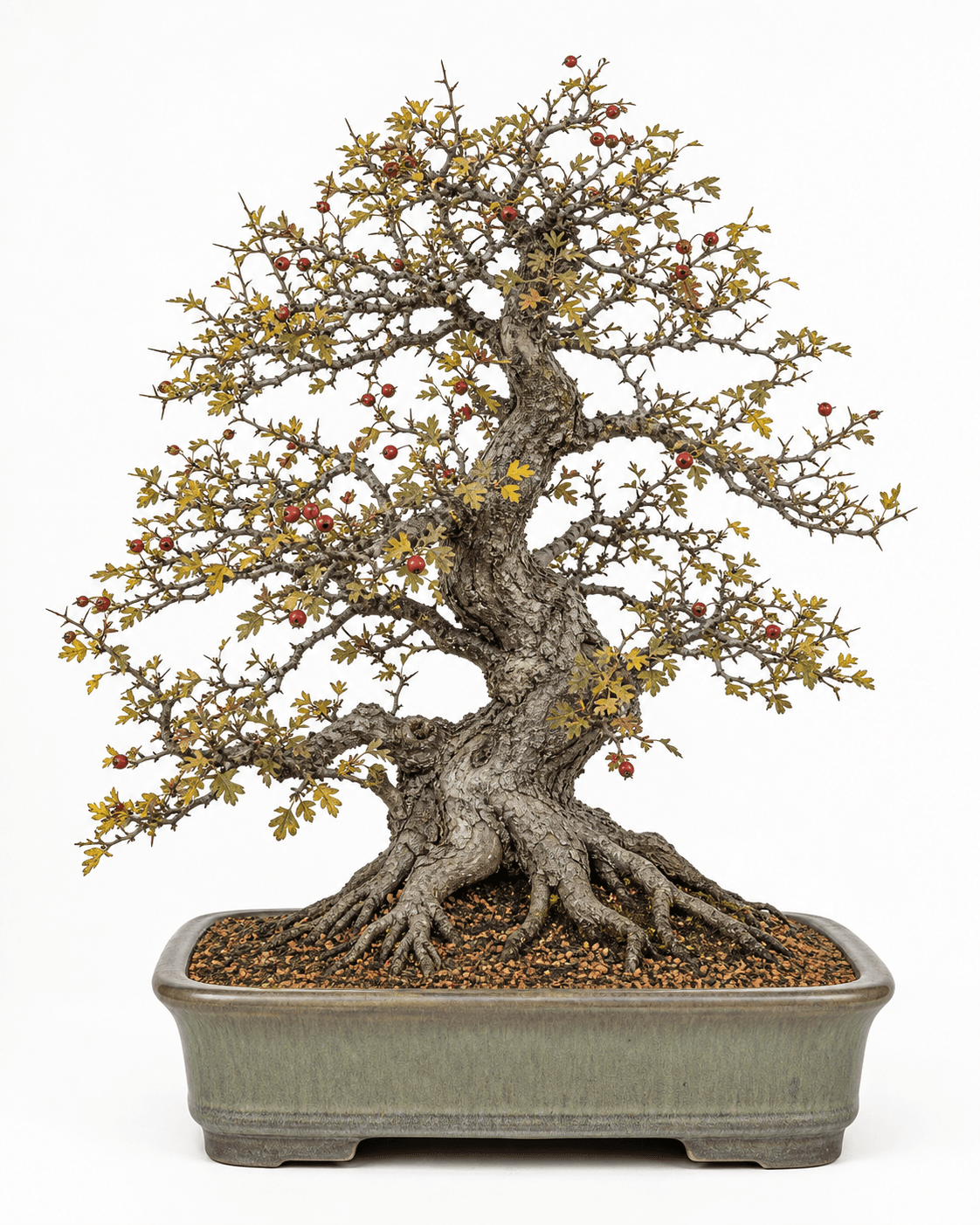
Hawthorn bonsai is a full-sun outdoor deciduous tree grown for rugged bark, thorny branch character, spring flowers, red autumn haws, and a strong winter silhouette. It succeeds when the grower gives it dormancy, moving air, a well-oxygenated root system, and pruning that preserves flowering wood.
Most bonsai material sold as hawthorn belongs in Crataegus, especially common hawthorn, Crataegus monogyna, and midland hawthorn, Crataegus laevigata. Treat it as Broadleaf > Deciduous in the EntGrove taxonomy and verify nursery labels because local invasive status, cultivar flower form, thorniness, and disease susceptibility differ.
The core method is tree first, display second. Build primary and secondary structure before asking for heavy flower or fruit, then manage rust, fire blight, fruit load, and old-wood brittleness as part of annual care.
Updated June 15, 2026. Written by EntGrove Editorial. Last verified June 15, 2026.
Care fingerprint
Read the species through its shared care pattern.
Repot and structural prune around dormant-to-active transitions; protect new leaves; time refinement work after growth hardens. Use this as the starting point before local conditions and tree strength refine the calendar.
Note: Common hawthorn and midland hawthorn overlap in bonsai care, but local invasive status, cultivar identity, thorniness, and flower form should be verified before species-specific advice.
Read the foliage first
Broadleaf stress usually shows in leaf color, leaf size, wilt, scorch, or delayed hardening before it becomes a branch problem.
Match work to dormancy
Deciduous, evergreen, tropical, succulent, and flowering broadleaf trees recover on different calendars.
Protect fine roots
Root work should preserve enough active fine roots for the tree to rehydrate quickly after the operation.
Care cadence
The calendar starts with the tree's seasonal state.
Placement
Timing: Grow outside year-round. Use full sun and strong air movement through the growing season, with afternoon relief only for small pots, heat waves, or fresh root work.
Watch for: Weak shaded shoots, poor flowering, stagnant wet foliage, overheated small containers, and indoor culture that prevents dormancy.
Oregon State Landscape Plants: Crataegus monogynaOregon State Landscape Plants: Crataegus laevigata Paul's ScarletBonsai Mirai LibraryWatering
Timing: Check demand from spring bud push through fruit set and summer heat. Water thoroughly in multiple passes when akadama or top dressing reads dry, then let oxygen return.
Watch for: Wilt in wind, dry fruiting shoots, sour wet soil, leaf-edge stress after root work, and misting routines that spread fungal spores.
Bonsai Mirai LibraryFertilizer
Timing: Feed for the development goal. Use stronger organic feeding while building primary and secondary growth, moderate feeding while balancing bloom, and lighter feeding in refinement after the first flush hardens.
Watch for: Excessive nitrogen before display, weak trees asked to carry fruit, late-season feeding that drives tender fall growth, and fertilizer on stressed roots.
Bonsai Mirai LibraryPruning and flowering
Timing: Let shoots extend enough to feed and thicken, then prune after the first flush hardens or after bloom depending on the goal. Avoid fall pruning on wood that carries next year's flowers.
Watch for: Neat foliage with no flowers, overlong thorny shoots, fruit exhausting weak branches, and repeated cuts that leave no paired buds for ramification.
Bonsai Mirai LibraryRepotting
Timing: Repot around spring bud swell when the tree can recover, or earlier only with winter protection. Work the surface, sides, and bottom while preserving the central shin on established deciduous root systems.
Watch for: Slow percolation, decomposed soil, upper-branch dieback from a stale shin, severe root reduction before a full fruit load, and slip-pot interfaces.
Bonsai Mirai LibraryWiring
Timing: Wire young and vigorous shoots when they are hydrated and flexible. Use aluminum for most thin deciduous work, paper-wrapped copper only for heavier initial structure, and check early.
Watch for: Old thorny wood cracking, hidden wire under leaves, scarring on smooth young bark, and branch movement attempted without a clear design purpose.
Bonsai Mirai LibraryFlower and fruit load
Timing: Let a refined, strong tree carry a restrained display. Remove fruit on young, weak, recovering, recently repotted, or structurally developing trees.
Watch for: Short-term display choices that slow branch building, haws on weak ramification, and old branches that decline after carrying too much crop.
Bonsai Mirai LibraryWinter
Timing: Keep the tree cold and dormant. When hard freezes threaten the root zone, set containers on the ground, mulch the pot, or use an unheated cold frame.
Watch for: Fine ramification loss, root freeze in shallow containers, winter drying wind, and warm indoor storage that breaks dormancy.
Oregon State Landscape Plants: Crataegus monogynaOregon State Landscape Plants: Crataegus laevigata Paul's ScarletBonsai Mirai LibraryPests and disease
Timing: Inspect from bud break through leaf drop, especially in wet spring weather and where junipers are nearby. Remove infected leaves, twigs, fruit, and fallen debris promptly.
Watch for: Orange rust spots, fire-blight shoot hooks, leaf spot, scab, powdery mildew, canker, aphids, scale, mites, borers, and rust galls on nearby junipers.
Connecticut Agricultural Experiment StationUMN Extension cedar-apple and hawthorn rustBonsai Mirai LibrarySpecies guide
Apply the species profile before copying another tree's calendar.
At a glance
Hawthorn is a thorny flowering deciduous bonsai with real outdoor requirements.
Botanically, hawthorn belongs to Crataegus in Rosaceae. Kew accepts Crataegus monogyna and Crataegus laevigata, and Oregon State separates common hawthorn from Paul's Scarlet midland hawthorn while noting the frequent confusion among C. laevigata, C. monogyna, and hybrid forms. Kew POWO: Crataegus monogynaKew POWO: Crataegus laevigataOregon State Landscape Plants: Crataegus monogynaOregon State Landscape Plants: Crataegus laevigata Paul's Scarlet
In the EntGrove care model, hawthorn sits in Broadleaf > Deciduous. It needs outdoor sun, deciduous dormancy, winter root protection in a container, full airflow, and pruning that respects the balance between structural building and flower or fruit display. Oregon State Landscape Plants: Crataegus monogynaOregon State Landscape Plants: Crataegus laevigata Paul's ScarletBonsai Mirai Library
Best use is medium to large outdoor bonsai where a rugged base, thorny branch texture, small leaves, spring blossom, autumn fruit, and winter silhouette all matter. The difficulty is moderate because the tree is tough, but rust, fire blight, invasive-region seed control, brittle old branches, and fruit-load decisions are part of the work. Connecticut Agricultural Experiment StationUMN Extension cedar-apple and hawthorn rustBonsai Mirai Library
Wild habitat
The hedgerow origin explains the light, thorn, and design logic.
Oregon State describes common hawthorn as a dense, rounded broadleaf tree native to Europe, northern Africa, and western Asia, with thorny shoots, lobed leaves, white clustered flowers, and red single-stoned fruit. Its familiar visual language is hedgerow density, rough bark, protected interior branching, and seasonal crop. Oregon State Landscape Plants: Crataegus monogyna
Common hawthorn is also a prolific seed producer in parts of the Pacific Northwest, where Oregon State flags invasive behavior and hybridization risk with native hawthorns. A bonsai grower should keep fruit contained where this species is regulated or naturalizing, and should avoid distributing seedlings without local context. Oregon State Landscape Plants: Crataegus monogyna
The care implication is straightforward: give hawthorn the sun and air of an outdoor small tree, then protect the bonsai container from extremes the ground would buffer. The design implication is equally clear: bark, thorns, branch angles, flowers, fruit, and winter twigging should read as a rugged deciduous shrub or small tree with its own character. Oregon State Landscape Plants: Crataegus monogynaBonsai Mirai / Asymmetry
Reading the tree
Separate development years from display years.
Mirai flowering and fruiting guidance is strict about sequence. During primary and secondary development, elongation, thickening, wound healing, foliar expansion, back-budding, and root regeneration matter more than flowers or fruit. The display becomes worthwhile once the tree has enough tertiary structure to carry it. Bonsai Mirai Library
Read hawthorn branch by branch. A coarse lower branch may still need extension, an upper branch may need restraint, and a refined spur can carry flower or fruit only if the rest of the tree has enough stored energy. Fruit is especially expensive, so a recovering tree should be stripped clean after flowering. Bonsai Mirai Library
Hawthorn also rewards patience with replacement shoots. Old thorny branches can be brittle, and deciduous wood becomes harder to bend as it thickens. Let strong younger growth create new structure before asking old wood for movement it cannot give. Bonsai Mirai Library
Pruning
Prune for structure first, then protect the flowering wood.
The broad deciduous rule is to let shoots extend when the tree is developing, then cut back later to interior buds, paired buds, or useful direction changes. Mirai describes this as the two-steps-forward, one-step-back rhythm that creates taper, movement, and ramification. Bonsai Mirai Library
Hawthorn needs a flowering exception. Mirai flags hawthorn among species where fall pruning can remove wood responsible for the next display. Use fall timing cautiously, reserve refinement cuts for after flowering or after the first flush hardens, and keep notes on which short shoots bloom on your own tree. Bonsai Mirai Library
For young material, prioritize the base, trunk line, primary branch placement, and wound closure. For refined material, shorten strong extension to useful buds, vary branch lengths, open dense thorny interiors for light and air, and thin fruit so branch work remains stronger than crop production. Bonsai Mirai Library
Repotting
Protect the shin and repot for oxygen and root renewal.
Use the standard deciduous spring window: repot as buds swell and before active leaves demand more water than the reduced root system can supply. With reliable winter protection, deciduous repotting can begin earlier, but spring bud movement is the safer public recommendation. Bonsai Mirai Library
Treat hawthorn as a shin-based deciduous root system unless your actual root work proves otherwise. Work the surface, sides, and bottom of the root mass to break compacted outer scale and restore oxygen, while preserving the central column under the trunk. Avoid bare-rooting an established bonsai just to make the root pad look clean. Bonsai Mirai Library
Repot when water no longer penetrates, soil particles have broken down, the tree needs a new planting angle or container, or upper random dieback suggests the shin has gone stale. Use drainage, spring push, and root density to decide whether the tree can wait. Bonsai Mirai Library
Soil and pot
Use deciduous soil for refinement and pot color for the autumn moment.
Mirai soil method favors 100 percent solid akadama for refined deciduous bonsai because active root scaling produces finer roots, shorter internodes, and smaller leaves. For hawthorn in early development, a coarser nursery or development mix can be acceptable while trunk, base, and primary branches are still being built. Bonsai Mirai Library
A mature flowering and fruiting hawthorn usually benefits from a pot with enough depth to keep the shin aerobic and enough volume to support bloom and fruit without daily crisis watering. Shallow exhibition containers should come after the root system is already reconciled and responsive. Bonsai Mirai Library
Pot pairing can honor the seasonal peak. Mirai ceramic discussion specifically calls out English hawthorn as a tree whose autumn yellow foliage and red berries can guide glaze color. Choose restrained glazed, wood-fired, or earthy surfaces that serve bark, thorns, flowers, and haws rather than competing with them. Bonsai Mirai LibraryBonsai Mirai / Asymmetry
Climate
Hawthorn is hardy in the ground and still exposed in a bonsai pot.
Oregon State gives both common hawthorn and Paul's Scarlet midland hawthorn a USDA Zone 4 landscape hardiness baseline. In bonsai, winter work is about root-zone buffering: place the pot on the ground, mulch the container, or use an unheated cold frame before the root mass freezes hard and repeatedly thaws. Oregon State Landscape Plants: Crataegus monogynaOregon State Landscape Plants: Crataegus laevigata Paul's ScarletBonsai Mirai Library
Hot-summer regions need water and sun management. Keep the tree outside, protect recently reduced roots from afternoon heat, keep the soil oxygenated, and move small containers out of heat-reflective corners when daytime heat stays severe. Bonsai Mirai Library
Regional disease and invasiveness also change care. Where common hawthorn seeds into natural areas, remove or contain fruit. Where spring is wet and junipers are nearby, run a tighter sanitation and spacing program before rust spots appear. Oregon State Landscape Plants: Crataegus monogynaConnecticut Agricultural Experiment StationUMN Extension cedar-apple and hawthorn rust
Pests and diseases
Rust and fire blight shape hawthorn bench placement.
CAES lists hawthorn leaf spot, leaf rust, stem rust, powdery mildew, fire blight, aphids, cankerworms, and scale among relevant problems. In bonsai, those issues intensify when a dense thorny canopy traps moisture or fallen leaves and fruit remain under the bench. Connecticut Agricultural Experiment Station
Rust deserves special handling because the cycle links junipers and Rosaceae hosts. Mirai describes rust moving between Cupressaceae and Rosaceae, and UMN advises inspecting nearby junipers in late winter or early spring and removing woody galls before orange spring structures appear. Bonsai Mirai LibraryUMN Extension cedar-apple and hawthorn rust
Fire blight management is equally practical. CAES describes scorched blackish-brown shoot symptoms and recommends cutting infected wood well below visible damage, cleaning tools between cuts, and avoiding excessive nitrogen-driven vigor. Connecticut Agricultural Experiment Station
Routine prevention is cultural first: full sun, open branch structure, clean leaf drop, restrained nitrogen, prompt fruit cleanup, and local extension guidance before ornamental chemical use. Home fungicide decisions vary by region and whether fruit might be handled or eaten. Connecticut Agricultural Experiment StationUMN Extension cedar-apple and hawthorn rustBonsai Mirai Library
Wiring
Wire young hawthorn, and let old wood keep its authority.
Mirai wiring method starts with intent: wire only the trunk and branches that must move for the design. Use a consistent 55 to 60 degree coil angle, even spacing, and no gaps, then bend with support so force spreads through the branch instead of concentrating at one brittle point. Bonsai Mirai Library
For hawthorn, the safest candidates are vigorous young branches before they harden into final caliper. Aluminum is the everyday choice for thin deciduous growth; paper-wrapped copper can hold heavier initial structure when bark and branch strength justify the risk. Bonsai Mirai Library
Use pruning, guy wires, replacement shoots, and gradual clip-and-grow for old thorny branches. Thicker deciduous wood is inherently more brittle than conifer wood, and Mirai cautions that severe movement must be added while branches are still young. Bonsai Mirai Library
Propagation
Propagate for future trunks and delayed flowers.
Seed can produce useful long-term hawthorn material, but it is slow and variable. For bonsai, seed-grown plants are best treated as a root-base and trunk project from the beginning, with early root selection and movement while the stems are still young. Bonsai Mirai Library
Cuttings, air layers, and grafts follow the broader deciduous rules. Take cuttings by lignification stage, use clean razor cuts, control transpiration, and avoid wet propagation media. Air layer after the first flush hardens, when sugars can accumulate above the ring and drive root initiation. Bonsai Mirai Library
Root grafting and branch grafting are advanced options for established deciduous trees. Mirai places root grafting in the early bud-swell window and emphasizes precise design intent, cambial contact, immobilization, and at least one full growing season before separation decisions. Bonsai Mirai Library
Buying and sourcing
Buy the base, then inspect the disease and seed risks.
Good hawthorn material starts with a believable base, low movement, usable taper, an existing branch option near the lower trunk, and bark character that can age into a rugged deciduous tree. Avoid material that needs a huge trunk wound to become plausible unless the rest of the tree is exceptional. Bonsai Mirai Library
Nursery and hedge stock can be valuable, but tags are often broad. Verify Crataegus identity, cultivar name, graft status, flower form, thorniness, and whether the species is invasive or discouraged in your region. Oregon State specifically flags common hawthorn as a Pacific Northwest invasive concern. Oregon State Landscape Plants: Crataegus monogynaOregon State Landscape Plants: Crataegus laevigata Paul's Scarlet
Collected hawthorn needs legal permission, a recoverable fine-root mass, and time in a training container before full bonsai work. Mirai field-collection guidance favors rebuilding roots first, then moving toward bonsai scale once the tree is producing reliable growth. Bonsai Mirai Library
Troubleshooting
Most hawthorn problems start with timing, water, fruit load, or disease.
No flowers usually points to low sun, repeated pruning of flowering wood, young material, excessive vegetative feeding, weak roots, or a tree kept in development mode. Restore full outdoor light, review pruning dates, and reduce crop expectations until the structure is stronger. Bonsai Mirai Library
Orange leaf spots point toward rust pressure, especially when junipers or red cedars are nearby. Remove infected Rosaceae leaves as spots appear, inspect junipers before orange fruiting structures form, and improve spacing and airflow. Bonsai Mirai LibraryUMN Extension cedar-apple and hawthorn rustConnecticut Agricultural Experiment Station
Blackened hooked shoots suggest fire blight. Cut below visible damage, disinfect tools between cuts, remove infected material from the site, and pull back on nitrogen that pushes soft susceptible growth. Connecticut Agricultural Experiment Station
Random upper twig dieback often means the root system cannot balance water and oxygen. Check drainage, decomposed soil, a stale shin, winter root damage, or a recent fruit load that exceeded stored energy. Bonsai Mirai Library
Design
Design hawthorn around rugged asymmetry and seasonal restraint.
Mirai design fundamentals read every tree through base, trunk line, defining branch, and apex. Hawthorn often has a strong base and rough branch texture, so the design can lean into an old hedgerow or small pasture-tree feeling with asymmetry, broken negative space, and a rounded but irregular crown. Bonsai Mirai LibraryBonsai Mirai / Asymmetry
A flower-and-fruit tree can become visually lazy if long branches are kept only for bloom count. Mirai flowering-bonsai method values a fully structured tree that also carries flowers or fruit, so choose pruning that keeps taper, movement, and ramification visible after the display ends. Bonsai Mirai Library
Deadwood should be incidental and restrained. Mirai deciduous design treats deadwood as short-lived compared with conifers, so preserve living branch health and use natural hollows, scars, bark, and thorny silhouette as the main age signals. Bonsai Mirai Library
Cultivars and forms
Common and midland hawthorn overlap, but labels matter.
Common hawthorn, Crataegus monogyna, is the classic single-seeded hedgerow hawthorn. Oregon State lists common names including singleseed hawthorn, common hawthorn, and English hawthorn, and notes the contorted Flexuosa form. Oregon State Landscape Plants: Crataegus monogyna
Midland hawthorn, Crataegus laevigata, appears in ornamental forms such as Paul's Scarlet. Oregon State describes Paul's Scarlet as a double scarlet-flowered form with dense thorny branching and high susceptibility to rust, leaf spot, and blight in its local record. Oregon State Landscape Plants: Crataegus laevigata Paul's Scarlet
In practice, choose hawthorn forms for leaf scale, internode length, bark, flower size, fruit size, disease behavior, and graft quality. A spectacular double flower can be less useful than a plain white-flowered tree with a better base and healthier branch structure. Oregon State Landscape Plants: Crataegus laevigata Paul's ScarletBonsai Mirai Library
History
Hawthorn bonsai borrows strength from hedges, flowers, fruit, and pot culture.
Common hawthorn is deeply tied to European hedgerows, and Oregon State describes it as common in the English countryside as a roadside hedge. That history matters in bonsai because the species reads naturally as dense, thorn-protected, weathered, and seasonal. Oregon State Landscape Plants: Crataegus monogyna
Paul's Scarlet adds a cultivated ornamental thread. Oregon State notes it arose as a branch sport in about 1858 on a double light-pink form and entered trade through William Paul of Waltham Cross, England, in 1866. Oregon State Landscape Plants: Crataegus laevigata Paul's Scarlet
The Mirai ceramic corpus uses English hawthorn as an example of species-specific pot pairing: autumn yellow foliage and red berries can drive the glaze choice. That framing is a useful standard for hawthorn bonsai generally: the best presentation supports the tree through several seasonal states instead of chasing one bloom moment. Bonsai Mirai LibraryBonsai Mirai / Asymmetry
Species questions
Answer the beginner questions before styling.
Is hawthorn a good beginner bonsai?
Yes, for an outdoor beginner who can provide full sun, winter dormancy, air movement, regular watering, and disease checks. It is a poor fit for indoor shelves.
Can hawthorn bonsai live indoors?
Hawthorn should be grown outdoors. It needs seasonal light, leaf drop, cold dormancy, fresh air, and container-root protection during hard freezes.
How often should I water hawthorn bonsai?
Water by demand rather than by schedule. Check more often during spring flush, bloom, fruit set, summer wind, and heat, then water thoroughly when the surface and top dressing read dry.
When should I repot hawthorn bonsai?
Repot around spring bud swell when root density, poor drainage, decomposed soil, or a required planting-angle change calls for it. Established trees are usually managed by condition rather than an annual calendar.
When should I prune hawthorn bonsai?
Let shoots extend when building structure, then cut back after the first flush hardens or after flowering depending on the goal. Avoid casual fall pruning on wood that carries next year's flowers.
Why did my hawthorn bonsai stop flowering?
Common causes include low sun, pruning away flowering wood, excessive vegetative growth, weak roots, too much fruit the prior season, young material, or a tree still being pushed through development.
Should I let hawthorn bonsai fruit?
Let a strong refined tree carry a modest fruit display. Remove fruit on young, weak, recently repotted, recovering, or structurally developing trees so energy returns to roots and branches.
Can I wire hawthorn branches?
Yes, but young flexible growth is the best candidate. Use aluminum for most fine deciduous work, monitor wire early, and use pruning, guy wires, or replacement shoots for brittle old branches.
What diseases should hawthorn bonsai growers watch?
Watch for hawthorn rust, cedar-hawthorn rust, fire blight, leaf spot, scab, powdery mildew, canker, aphids, scale, mites, borers, and disease pressure from nearby junipers.
Is common hawthorn invasive?
It can be invasive in some regions. Oregon State flags Crataegus monogyna as a Pacific Northwest concern, so growers should contain fruit and check local guidance before collecting or distributing seedlings.
Sources
Species advice needs source discipline.
Next decisions
Plan the operation before copying the calendar.
A good care note for Hawthorn records the tree's stage, the work done, and the aftercare used. That record matters more than a month-name rule.
Related species
Compare nearby trees before transferring advice.
Japanese maple
Acer palmatum
Trident maple
Acer buergerianum
Amur maple
Acer tataricum subsp. ginnala
Field maple
Acer campestre
Korean hornbeam
Carpinus turczaninovii