
Species guide
Crabapple Bonsai Care
Malus spp. (often M. halliana, M. sylvestris, M. x floribunda, M. baccata, M. x zumi)
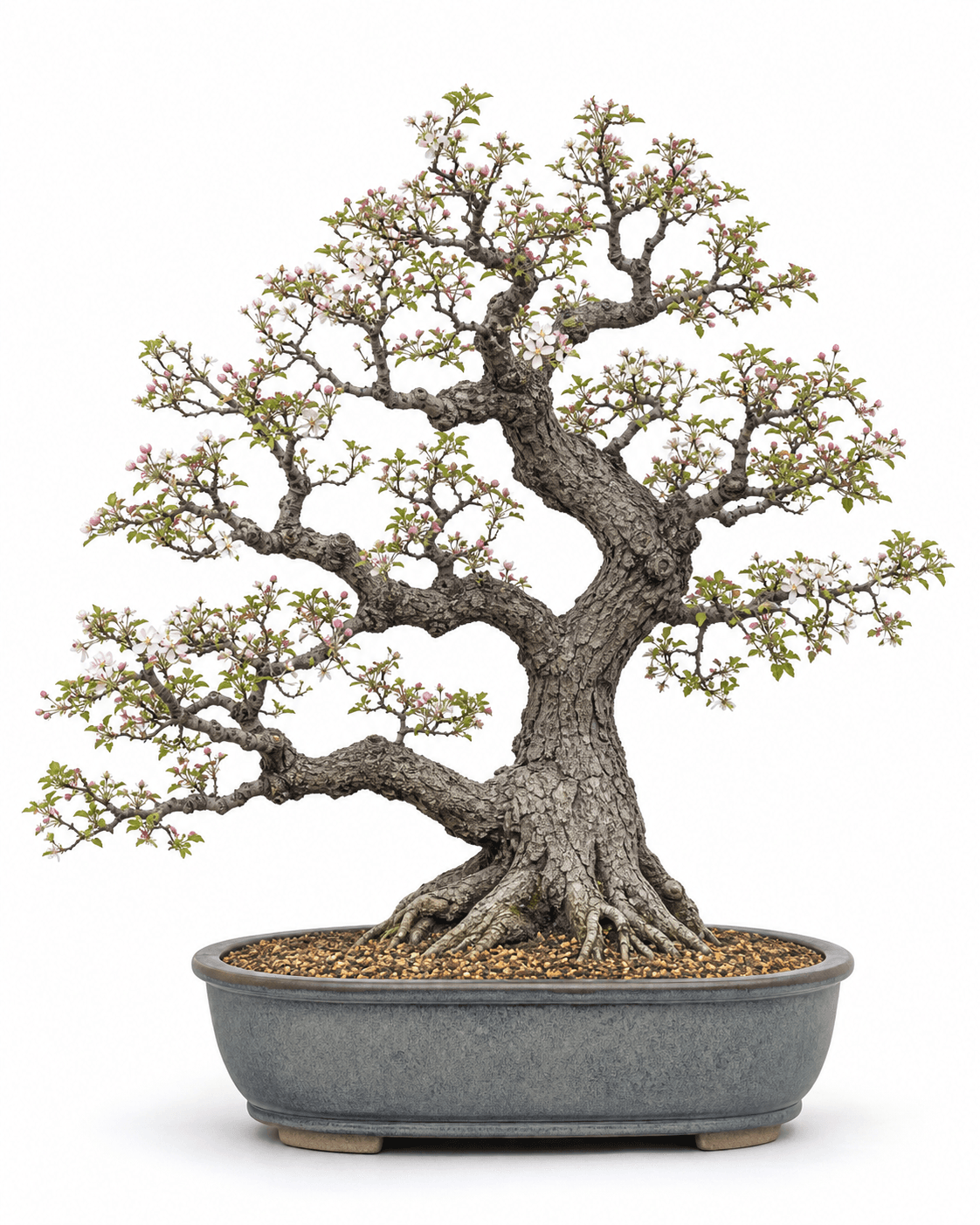
Crabapple bonsai belongs outdoors in sun, air, seasonal dormancy, and a container that can support heavy water movement during bloom and fruit. The reward is a tree with spring flowers, small autumn pomes, fall color, and a winter branch structure that still reads after the display is gone.
Treat crabapple as a Malus-group guide within Broadleaf > Deciduous. Common bonsai labels include Hall crabapple, Zumi crabapple, Siberian crabapple, Toringo, Nagasaki, Cerasifera, Pacific crabapple, and apple bonsai, so exact source identity matters before making hardiness or fruit-scale promises.
The core technique is restraint: build coarse angular structure first, preserve young flowering spurs once refinement begins, thin fruit on weak trees, keep rust and scab pressure out of the collection, and repot with the shin protected while the outer root shell is renewed.
Updated June 15, 2026. Written by EntGrove Editorial. Last verified June 15, 2026.
Care fingerprint
Read the species through its shared care pattern.
Repot and structural prune around dormant-to-active transitions; protect new leaves; time refinement work after growth hardens. Use this as the starting point before local conditions and tree strength refine the calendar.
Note: Bonsai trade labels can be loose; treat Nagasaki/Cerasifera labels as nursery identifiers to verify against current Malus taxonomy before publishing cultivar-specific claims.
Read the foliage first
Broadleaf stress usually shows in leaf color, leaf size, wilt, scorch, or delayed hardening before it becomes a branch problem.
Match work to dormancy
Deciduous, evergreen, tropical, succulent, and flowering broadleaf trees recover on different calendars.
Protect fine roots
Root work should preserve enough active fine roots for the tree to rehydrate quickly after the operation.
Care cadence
The calendar starts with the tree's seasonal state.
Placement
Timing: Grow outdoors in full sun and moving air through active growth. Shift recently worked or heat-stressed trees to morning sun and afternoon shade until water uptake recovers.
Watch for: Long shaded internodes, mildew-prone still air, overheated shallow pots, rust pressure near junipers, and cold exposure after root work.
Bonsai Mirai LibraryNC State Extension: Hall crabappleClemson Extension apple and crabapple diseasesWatering
Timing: Water by root demand, with extra attention during bloom, fruit swelling, hot wind, and the first weeks after repotting. Keep winter roots slightly moist and aerobic.
Watch for: Flower or fruit drop after drought, wilt in a shallow display pot, sour wet soil after leaf drop, and dry akadama hidden under moss.
Bonsai Mirai LibraryFertilizing
Timing: Feed development trees strongly enough to grow, thicken, heal, and rebuild roots. Flowering and fruiting refinement still needs nutrition, especially iron and zinc timing when bloom is weak.
Watch for: Excess fruit on a weak tree, alkaline-water chlorosis, overly soft nitrogen growth, and starving a tree because it is already in a small pot.
Bonsai Mirai LibraryPruning
Timing: Use fall leaf drop for balanced structural pruning and wiring. Use post-flush hardening in late May to early June when development matters more than that year's flowers or fruit.
Watch for: Removing young spurs on refined trees, overlong vertical shoots that will not fruit well, coarse callus at forks, and cuts made far from a viable bud.
Bonsai Mirai LibraryFlowers and fruit
Timing: Let flowers and a restrained fruit set remain on strong refined trees. Remove or thin fruit on young, weak, recently repotted, or structurally developing trees.
Watch for: Fruit load bending branches, old spent spurs, weak two-year wood, depleted root growth, and a display year replacing needed structural work.
Bonsai Mirai LibraryPartial defoliation
Timing: After the spring flush hardens on a vigorous refined canopy, prune shoots back to two leaves and reduce large remaining leaves by about two-thirds.
Watch for: Working weak interior shoots, applying refinement technique to a mostly developing tree, and full defoliation when partial leaf reduction would do the job.
Bonsai Mirai LibraryWiring
Timing: Wire structural branches at fall leaf drop while broadleaf deciduous wood is most flexible. Use paper-wrapped heavy wire for initial structural work, then aluminum or guy wires later.
Watch for: Thin bark scars, branch cracks on second bends, wiring against the rotational direction, and spring swelling before wire removal.
Bonsai Mirai LibraryRepotting
Timing: Repot before bud movement or at the local deciduous repot window, preserving the shin while reducing the outer shell, sides, and bottom of the root mass.
Watch for: Random upper-canopy dieback, slow percolation, compacted organic debris under the trunk, slip-pot interfaces, and heavy fruiting after root work.
Bonsai Mirai LibraryPests and disease
Timing: Scout from bud break through summer and clean leaves after fall. Rust, scab, fire blight, powdery mildew, aphids, scale, mites, and fruit mummies all matter in small pots.
Watch for: Orange rust spots, juniper galls nearby, apple scab lesions, fire-blight shoot hooks, powdery residue, cankers, ants farming aphids, and fallen diseased leaves.
Bonsai Mirai LibraryClemson Extension apple and crabapple diseasesUMN Extension apple scabUMN Extension fire blightSpecies guide
Apply the species profile before copying another tree's calendar.
At a glance
Crabapple is a deciduous Malus-group bonsai built around structure first and display second.
Crabapple bonsai is a group label for small-fruited Malus across several species and hybrids. Kew accepts common bonsai candidates such as Malus halliana, Malus sylvestris, Malus x floribunda, Malus baccata, and Malus x zumi, while the Mirai corpus works directly from Pacific crabapple and wider Malus technique. Kew POWO: Malus hallianaKew POWO: Malus sylvestrisKew POWO: Malus x floribundaKew POWO: Malus baccataKew POWO: Malus x zumiBonsai Mirai Library
The practical specification is outdoor deciduous culture, 6 or more hours of direct sun where heat allows, strong air movement, careful water during flower and fruit, oxygenated akadama-heavy soil in refinement, root-zone winter protection, and disease-aware cultivar selection. NC State Extension: Hall crabappleClemson Extension apple and crabapple diseasesBonsai Mirai Library
The best beginner fit is a grower with a patio, bench, balcony, or cold frame who wants seasonal display and accepts leaf drop. Indoor shelves, warm winter rooms, and fruit-heavy display on weak material create the usual failure pattern. Bonsai Mirai LibraryNC State Extension: Hall crabapple
Wild habitat
Design from small-fruited forest, edge, orchard, and thicket trees with a coarse Malus vocabulary.
The group covers several origins. Kew places Hall crabapple from central and southern China to southwest Korea, common crabapple from Europe to Turkiye, Siberian crabapple from Siberia through northern Japan and the Himalaya, floribunda crabapple in Korea, and Zumi crabapple in Japan. Kew POWO: Malus hallianaKew POWO: Malus sylvestrisKew POWO: Malus x floribundaKew POWO: Malus baccataKew POWO: Malus x zumi
For care, those origins point to a seasonal deciduous rhythm with cool rest, active spring growth, summer water movement, and autumn nutrient withdrawal before work. A bonsai container narrows the margin, so sun and air need to be paired with root-zone moisture and oxygen. Bonsai Mirai LibraryNC State Extension: Hall crabapple
For design, Mirai treats Malus as coarse flowering and fruiting tissue, with brittle branch behavior and powerful callus. The image should carry rugged angularity, open branch planes, selected fruit, and coarse deciduous line. Bonsai Mirai / AsymmetryBonsai Mirai Library
Ecology also limits style choice. Mirai notes Malus has limited capacity for extreme cascade or windswept forms because the source image is a high-resource flowering and fruiting broadleaf, often believable as an old edge, orchard, or forest understory tree. Bonsai Mirai / AsymmetryBonsai Mirai Library
Reading the tree
Read development stage, spur age, root condition, and disease pressure before choosing work.
The first read is stage. During primary and secondary development, Mirai prioritizes elongation, thickening, wound healing, foliar expansion, back-budding, and root regeneration. Flowers and fruit are earned after the tree has structure that can carry them. Bonsai Mirai Library
The second read is spur age. Malus flowers and fruits mainly on first-year shoots and two-year-old spurs. Spurs that reach three years or more decline, so a refined tree needs renewal cuts instead of preserving every old flowering point indefinitely. Bonsai Mirai Library
The third read is branch direction. Vigorous vertical shoots produce fewer flowers and fruit than moderate lateral shoots, while overly long display shoots steal scale from the tree. Choose between growing a structural shoot and preserving a fruiting spur before cutting. Bonsai Mirai Library
The fourth read is health. Apple scab, fire blight, cedar-apple rust, and powdery mildew are common apple and crabapple disease pressures, and Mirai rust guidance adds the collection-level issue: Rosaceae hosts and junipers complete the rust cycle together. Clemson Extension apple and crabapple diseasesUMN Extension apple scabUMN Extension fire blightBonsai Mirai Library
Pruning
Prune Malus for angular renewal, then protect young flowering wood once the structure is earned.
Fall leaf-drop pruning works for Malus because flowers form in late spring and early summer on new growth and on second-year wood that fall cuts can leave intact. Wait for natural color change and pigment reabsorption before major work so stored energy has returned to the tree. Bonsai Mirai Library
The development window is post-flush hardening in late May to early June. Mirai uses that timing to force a strong second flush and angular structural regrowth, accepting that current-year flowers and fruit will be sacrificed. Bonsai Mirai Library
Malus responds to branch thickness at the cut. Thin young wood creates smoother transitions, while thicker stock produces wider, near-90-degree breaks. Use that trait deliberately when the design needs rugged, weathered, old-orchard angularity. Bonsai Mirai / AsymmetryBonsai Mirai Library
In refinement, remove exhausted older spurs and keep enough young lateral growth to replace them. Letting every flower become fruit depletes the tree; thinning fruit or removing all fruit on weak trees sends energy back to roots, wounds, and future ramification. Bonsai Mirai Library
Repotting
Treat crabapple as a shin-based deciduous tree with a protected center and worked perimeter.
Mirai places apple and crabapple with shin-based deciduous species. The active root zone under the trunk must stay aerobic, but it should not be bare-rooted or washed clean like a plate-based maple. Work the surface, sides, and bottom while preserving the interior column. Bonsai Mirai Library
The repot trigger is the water and oxygen balance: slow percolation, decomposed organic debris, random upper-canopy dieback, or a root mass that has scaled around the container walls. Hydrate the tree before root work so cuts can callus and new roots can form. Bonsai Mirai Library
After a meaningful repot, avoid another full root intervention for about two years unless the tree is failing. New callus forms in roughly 10 to 14 days, with new roots emerging another 2 to 3 weeks later, so early bud movement is still powered by roots that survived the operation. Bonsai Mirai Library
Collected or field-grown Malus gets one major root correction at the moment of collection or first transition. Later reductions should be conservative because the coarse root system and sparse structural roots need depth and continuity to sustain flowers and fruit. Bonsai Mirai Library
Soil and pot
Use water-retentive mineral soil, a deeper container, and a display pot that supports fruiting broadleaf character.
Mirai soil method favors akadama for refined temperate deciduous trees because roots fracture the particles over time, creating smaller oxygen spaces, finer roots, shorter internodes, and restrained swelling. For Malus, the mix must still preserve fast water movement and oxygen. Bonsai Mirai Library
A practical refinement mix can be akadama-heavy, with particle size matched to the tree and climate. In wetter climates, keep more oxygen. In hot or windy climates, use a container depth and top-dressing strategy that prevents the root ball from drying during flower and fruit demand. Bonsai Mirai Library
Mirai specifically notes coarse fruiting species such as Malus need deeper containers than fine-rooted maples because their roots stay coarser and sparser. A shallow show pot may look elegant and still fail the water movement that fruiting requires. Bonsai Mirai Library
Pot color should support the season of display: quiet earth tones for bark and winter branch line, restrained glazes that echo pink or white flowers, or muted autumn colors for red, yellow, or orange fruit. The tree should remain the dominant signal. Bonsai Mirai / AsymmetryBonsai Mirai Library
Climate
Adapt sun, water, and winter storage to the region while keeping dormancy intact.
In temperate climates, grow crabapple outdoors through the seasons and protect the container before roots freeze hard. Hall crabapple has a broad landscape range, but a bonsai pot is shallower, colder, and more exposed than garden soil. NC State Extension: Hall crabappleBonsai Mirai Library
In humid regions, disease resistance and airflow become part of placement. Clemson and UMN both emphasize apple-family disease pressure, and Mirai rust guidance explains why juniper proximity can sustain cedar-apple rust cycles across a bonsai collection. Clemson Extension apple and crabapple diseasesUMN Extension apple scabBonsai Mirai Library
In hot inland regions, use full sun as the goal while protecting recently worked trees and shallow pots from afternoon heat until roots can keep pace. A full fruiting canopy can draw water faster than a nonfruiting training tree. Bonsai Mirai Library
In subtropical climates, Mirai notes Malus flowering and fruiting can become unsustainable without chilling. If cold storage is used for very small deciduous trees, keep humidity around 70 to 80 percent and maintain airflow so stored tissue does not desiccate or age unnaturally. Bonsai Mirai Library
Pests and diseases
Manage crabapple as a Rosaceae disease host in a mixed bonsai collection.
Clemson lists apple scab, cedar-apple rust, fire blight, and powdery mildew as major apple and crabapple problems. In bonsai, prevention starts with cultivar choice, full sun, moving air, clean tools, leaf cleanup, and avoiding dense wet canopies. Clemson Extension apple and crabapple diseasesUMN Extension apple scabUMN Extension fire blight
Mirai rust method is especially relevant where junipers and Rosaceae sit in the same garden. Rust needs a Cupressaceae host and a Rosaceae host, with spring spores moving from juniper galls to emerging Malus leaves and summer spores returning to bark crevices on junipers. Bonsai Mirai Library
Remove infected Rosaceae leaves when orange spots appear and remove juniper galls before gelatinous orange spore structures release. Even good garden hygiene cannot stop airborne spores from outside the yard, so cultivar resistance and spacing still matter. Bonsai Mirai LibraryClemson Extension apple and crabapple diseases
Watch also for aphids, scale, mites, caterpillars, canker, fruit mummies, and root aphids. A pest outbreak often exposes a culture problem first: low light, stagnant air, overwet soil, fruit overload, or a tree weakened by stacked work. Clemson Extension apple and crabapple diseasesUMN Extension apple scabBonsai Mirai Library
Wiring
Wire crabapple for initial structure, then let pruning and renewal carry refinement.
Malus wood is brittle because flowering and fruiting tissue is coarse, fibrous, and built for high water movement. Mirai uses fall leaf drop for structural wiring because broadleaf deciduous branches are most flexible then and less likely to tear than in spring hydration. Bonsai Mirai Library
Use paper-wrapped copper for the first heavy structural wiring when the branch needs holding power and bark protection. Mirai specifically calls out heavy gauges such as 4, 6, and 8 on thin-barked Malus, then recommends lighter aluminum for later secondary and tertiary work. Bonsai Mirai Library
Bend with rotation and a supported fulcrum. Work with the direction of the wire, set a fulcrum thumb at the bend point, and move branches into a believable plane from their point of origin. Re-bent tissue tears more easily at old wire pressure points. Bonsai Mirai Library
For older brittle branches, use guy wires, props, or replacement shoots. A branch can only move so far before the structure looks false or the vascular path breaks, so refinement increasingly depends on clip-and-grow renewal. Bonsai Mirai / AsymmetryBonsai Mirai Library
Propagation
Use grafting, air layers, and selected seedlings with realistic root expectations.
Seed can produce useful trunks, but seedling Malus varies in fruit size, disease resistance, flower color, and growth habit. For bonsai display, cultivar identity and observed fruit scale matter more than a romantic label. Kew POWO: Malus hallianaKew POWO: Malus baccataNC State Extension: Malus domestica
Grafting is common in apple culture, and Mirai taxonomy guidance notes Malus can graft within the genus. Inspect graft unions carefully because a poor union, incompatible vigor, or awkward swelling can dominate a small bonsai forever. Bonsai Mirai LibraryNC State Extension: Malus domestica
Air layering is possible, with a Malus-specific caveat. Mirai recommends stripping bark, phloem, and cambium, letting the exposed site dry for 3 to 4 days, then wrapping with moisture and oxygen; rooting hormone is helpful because Malus often makes only one or two coarse roots. Bonsai Mirai Library
Layered or collected material should be judged by root distribution, not only by whether roots appear. A radial, well-distributed nebari from Malus is a meaningful achievement because the species tends toward sparse coarse roots. Bonsai Mirai Library
Buying
Buy the base, small fruit, disease resistance, and branch potential before buying flowers.
Good starter material has a useful base, visible trunk age, short internodes, small fruit, clean young lateral growth, and enough root quality to tolerate a transition into bonsai soil. A nursery tree loaded with bloom can still be a poor bonsai if the base and branch lines are unusable. Bonsai Mirai / AsymmetryBonsai Mirai Library
Ask for the cultivar or species label, then treat it as a starting clue. Kew validates several Malus species and hybrids used around crabapple bonsai, while trade labels such as Nagasaki and Cerasifera often need nursery-level confirmation. Kew POWO: Malus hallianaKew POWO: Malus sylvestrisKew POWO: Malus x floribundaKew POWO: Malus baccataKew POWO: Malus x zumi
In humid or rust-prone regions, disease resistance deserves real weight. Clemson lists disease-resistant crabapple cultivars for landscape use, and UMN explains why scab-resistant crabapple choices reduce annual sanitation and fungicide pressure. Clemson Extension apple and crabapple diseasesUMN Extension apple scab
Avoid material with large orchard fruit, swollen graft unions in the display zone, severe fire-blight history, trunk cankers, dense old nursery soil under the trunk, or a root system that would need repeated severe reductions. NC State Extension: Malus domesticaClemson Extension apple and crabapple diseasesBonsai Mirai Library
Troubleshooting
Diagnose crabapple problems by symptom, cause, and the next correction.
Flowers appear, then drop: the root ball likely dried during bloom, the tree was recently worked, or the tree lacked stored strength. Stabilize watering, skip fruit that year, and rebuild roots and foliage before display pressure returns. Bonsai Mirai Library
Long upright shoots with few flowers: the tree is in vegetative development, has excess nitrogen, lacks sun, or was pruned at the wrong stage. Use laterals for future spurs and reserve hard post-flush pruning for structural years. Bonsai Mirai Library
Orange leaf spots: suspect cedar-apple rust or related rusts. Remove infected leaves early, inspect nearby junipers for galls, and improve spacing and air movement while checking local extension guidance. Bonsai Mirai LibraryClemson Extension apple and crabapple diseases
Olive-green or dark leaf lesions and early leaf drop: suspect apple scab. Clean fallen leaves, open the canopy, select resistant cultivars for future material, and avoid overhead conditions that keep foliage wet. UMN Extension apple scabClemson Extension apple and crabapple diseases
Shoot tips blacken in a hook: suspect fire blight. Prune infected tissue with sanitized tools according to extension guidance, avoid forcing lush susceptible growth, and quarantine suspicious material from the bench. UMN Extension fire blightClemson Extension apple and crabapple diseases
Random upper dieback with slow drainage: suspect shin oxygen failure or decomposed soil. Refresh the surface if a full repot is out of season, then schedule a proper shin-based repot when the tree can recover. Bonsai Mirai Library
Design
Style crabapple as a rugged flowering and fruiting broadleaf with coarse angular character.
Start with the base, trunk line, primary movement, and first defining branch. Mirai warns that Malus cannot deliver the fine twig elegance of maple or beech, so the strongest image is aged angularity with flowers and fruit as seasonal accents. Bonsai Mirai / AsymmetryBonsai Mirai Library
Let the coarse tissue become a strength. Branches can dogleg, open into wider crotches, and show a weathered fruiting-tree rhythm. Avoid closed loops, repeating curves, and branch lines that cross back through the same visual plane. Bonsai Mirai / AsymmetryBonsai Mirai Library
A first show-presentable tree from prepared raw Malus stock can take about five years, with world-class character closer to ten years and exceptional quality often fifteen to twenty years or more. That clock assumes structure comes before crop display. Bonsai Mirai Library
Deadwood is usually subordinate on Malus. Wounds, hollows, or rugged bark can support age when the material supplies them, but flowers, fruit, branch renewal, and clean callus management carry most of the design language. Bonsai Mirai / AsymmetryBonsai Mirai Library
Cultivars
Small fruit, clean labels, and disease resistance decide whether a crabapple can scale down.
Useful bonsai forms usually have small fruit, compact internodes, abundant but restrained bloom, and a disease profile that fits the local climate. Large-fruited orchard apple material can be trained, but the fruit may dominate the tree instead of completing it. Bonsai Mirai LibraryNC State Extension: Malus domestica
Common bonsai taxa and labels include Malus halliana, Malus sylvestris, Malus x floribunda, Malus baccata, Malus x zumi, Pacific crabapple, Toringo, Nagasaki, and Cerasifera. Kew anchors several names, while nursery trade labels still need verification. Kew POWO: Malus hallianaKew POWO: Malus sylvestrisKew POWO: Malus x floribundaKew POWO: Malus baccataKew POWO: Malus x zumiBonsai Mirai Library
Clemson lists disease-resistant crabapple cultivars such as Adams, Mary Potter, Professor Sprenger, Red Baron, and Indian Magic in its regional disease guidance. UMN also lists scab-resistant crabapples, including species and named cultivars such as Prairifire and Sargent. Clemson Extension apple and crabapple diseasesUMN Extension apple scab
Ornamental landscape disease resistance is only one filter. For bonsai, also inspect root base, graft union, fruit size, branch angle, bark age, internode length, and whether the tree can be rebuilt without huge scars. Bonsai Mirai LibraryNC State Extension: Malus domestica
History
Crabapple bonsai earns its place through old-tree structure plus restrained seasonal display.
Malus has a long horticultural history as edible apple, ornamental crabapple, and small-fruited flowering tree. In bonsai, the group is valued because flowers, fruit, fall color, and winter silhouette can appear on one compact deciduous frame. NC State Extension: Malus domesticaNC State Extension: Hall crabappleBonsai Mirai / Asymmetry
Mirai uses Pacific crabapple as a major structural case study because it exposes the central problem of the genus: coarse tissue, brittle bending, fast callus, and the tension between tree building and seasonal crop display. Bonsai Mirai LibraryBonsai Mirai / Asymmetry
The highest expression of flowering or fruiting bonsai is a fully structured tree that also carries flowers or fruit. Growing long branches only for bloom count creates the display quickly and leaves the bonsai visually weak after flowering ends. Bonsai Mirai Library
Named public canon is thinner than for pines, junipers, maples, and azaleas, but strong crabapple bonsai are memorable because the grower has balanced contradictory demands: crop, disease resistance, old wood, young spurs, and a believable small tree. Bonsai Mirai / AsymmetryBonsai Mirai Library
Species questions
Answer the beginner questions before styling.
Is crabapple a good beginner bonsai?
Yes, for an outdoor grower with full sun, reliable watering, winter protection, and patience around disease. It is a poor first tree for indoor shelves or growers who want constant evergreen appearance.
Can crabapple bonsai live indoors?
Use outdoor seasonal culture. Crabapple needs sun, moving air, leaf drop, winter rest, and cold protection for the pot through winter.
How much sun does crabapple bonsai need?
Aim for full sun, about 6 or more hours of direct sun, unless heat, recent root work, or a shallow pot calls for morning sun and afternoon shade during recovery.
How often should I water crabapple bonsai?
Water by demand. Active trees with flowers, fruit, summer heat, or a full canopy may need careful daily checks, while winter leafless trees need only enough water to keep roots slightly moist and aerobic.
When should I repot crabapple bonsai?
Repot around the deciduous spring window before bud movement, then avoid repeating major root work for about two years when possible. Preserve the shin and work the surface, sides, and bottom of the root mass.
When should I prune crabapple bonsai?
Use fall leaf drop for balanced structural work and post-flush hardening in late May to early June for development cuts that create a second flush. Refined trees need young spur preservation and fruit-load restraint.
Should I let my crabapple bonsai fruit?
Let a modest fruit set remain only on strong refined trees. Remove or thin fruit on young, weak, recently repotted, recovering, or structurally developing trees so energy returns to roots and branch work.
Can I wire crabapple bonsai?
Yes. Wire at fall leaf drop, protect thin bark with paper-wrapped heavy wire for structural work, and shift to aluminum, guy wires, or pruning as branches age and become more brittle.
Why did my crabapple bonsai stop flowering?
Common causes include pruning away young flowering wood, too much vertical vegetative growth, weak stored energy, low sun, alkaline-water nutrient lockup, disease stress, or asking the tree to recover from heavy root work and fruit at the same time.
What diseases should crabapple bonsai growers watch for?
Watch for apple scab, fire blight, cedar-apple rust, powdery mildew, canker, aphids, scale, mites, caterpillars, and fruit mummies. Airflow, sanitation, resistant cultivars, and juniper-aware rust management matter.
Sources
Species advice needs source discipline.
Next decisions
Plan the operation before copying the calendar.
A good care note for Crabapple records the tree's stage, the work done, and the aftercare used. That record matters more than a month-name rule.
Related species
Compare nearby trees before transferring advice.
Japanese maple
Acer palmatum
Trident maple
Acer buergerianum
Amur maple
Acer tataricum subsp. ginnala
Field maple
Acer campestre
Korean hornbeam
Carpinus turczaninovii