
Species guide
Incense Cedar Bonsai Care
Calocedrus decurrens
Incense cedar, Calocedrus decurrens, is an outdoor evergreen Cupressaceae conifer with aromatic fan-like sprays, thick reddish bark, strong drought adaptation in the ground, and a slower, deliberate bonsai rhythm. In a pot, it should be grown bright, cool-rooted, evenly watered, and pruned to live lateral fans.
The local Mirai corpus has only a scattered direct incense cedar mention, so this guide states that limitation and transfers method from Mirai cypress, Thuja, Hinoki, coastal conifer, and elongating-species files. Kew, Oregon State, NC State, USDA, Oregon Encyclopedia, and Purdue sources ground the taxonomy, native range, hardiness, morphology, propagation, pests, and history.
Updated June 5, 2026. Written by EntGrove Editorial. Last verified June 5, 2026.
Care fingerprint
Read the species through its shared care pattern.
Avoid dry-wind stress, preserve interior growth, and distinguish cypress-style pad work from juniper refinement. Use this as the starting point before local conditions and tree strength refine the calendar.
Note: Kew accepts Calocedrus decurrens and places it from western Oregon to northern Baja California. Mirai direct incense cedar coverage is limited to a scattered mention, so the species page transparently transfers cypress, Thuja, false-cypress, coastal-conifer, and elongating-species method, then grounds identity, hardiness, dry-summer ecology, propagation, and disease context in Kew, Oregon State, NC State, USDA, Oregon Encyclopedia, and Purdue sources.
Do not prune like a pine
Elongating conifers extend from buds and shoots, so candle-cutting assumptions can remove the exact growth the tree needs.
Preserve interior growth
Spruce, fir, hemlock, cedar, redwood, cypress, and larch all become harder to design when interior buds are shaded out.
Keep recovery cool and steady
Many elongating conifers respond best when roots stay evenly moist, oxygenated, and protected from hot dry swings.
Care cadence
The calendar starts with the tree's seasonal state.
Watering
Timing: Check daily in warm wind, shallow pots, and the first season after repotting. Let the upper surface approach dry, then water through the full root mass.
Watch for: Dull foliage, brittle tips, dry old nursery pockets, overheated black pots, slow drainage, and a root ball that stays wet because foliage was reduced too hard.
Oregon State Landscape PlantsBonsai Mirai LibraryRepotting
Timing: Use spring bud swell or the earliest visible spring movement for significant root work. Routine transfers can be lighter when roots are already healthy.
Watch for: Do not bare-root old field or nursery cores in one pass. Convert dense organic soil gradually and refill every cavity so water and oxygen move evenly.
Bonsai Mirai LibraryPruning
Timing: Use directional pruning after the first flush firms, with a second light pass in late summer or early fall only on vigorous trees.
Watch for: Cut to living lateral fans or ramified tips. Avoid hedge shearing, cuts behind live foliage, and repeated handling of the same delicate fan.
Bonsai Mirai LibraryStructural work
Timing: Major branch selection is safest around spring bud swell on established roots, or at the front edge of the fall vascular phase after summer heat.
Watch for: Protect newly exposed interior foliage from hot sun, and give a heavily styled tree winter protection if work happened late.
Bonsai Mirai LibraryWiring checks
Timing: Inspect wire through late spring, early summer, and fall vascular thickening.
Watch for: Hidden bite under rough bark, branch-shoulder tears, rolled fan undersides, tight guy wires, and contact points swelling faster than expected.
Bonsai Mirai LibraryFertilizing
Timing: Feed established developing trees from active growth through fall. Use lighter feeding after a severe repot or on refined trees where compact growth matters.
Watch for: Skip fertilizer when roots are stale, saturated, drought-stressed, or recently cut hard. Fix water and oxygen first.
Bonsai Mirai LibraryPest and disease inspection
Timing: Inspect during spring growth, summer heat, and autumn cleanup, especially on collected or landscape material with old bark and fire scars.
Watch for: Cutworms on seedlings, root rot, pocket dry rot in old trunk wood, incense-cedar rust, mistletoe, mites, scale, and drought or heat stress that mimics pests.
USDA Forest Service SilvicsUSDA Forest Service FEISUSDA NRCS Plant GuideWinter protection
Timing: Keep the tree dormant outdoors, but protect the bonsai root ball from hard freezes, dry wind, and freeze-thaw swings after recent work.
Watch for: Landscape Zone 5 hardiness does not make a shallow freshly worked pot equally hardy.
Oregon State Landscape PlantsNC State ExtensionBonsai Mirai LibrarySpecies guide
Apply the species profile before copying another tree's calendar.
At a glance
Incense cedar is a rugged Calocedrus with fan foliage and dry-summer tolerance.
Kew accepts Calocedrus decurrens and places it in Cupressaceae, native from western Oregon to northern Baja California. Older Libocedrus decurrens labels remain common in forestry and nursery references, so keep both names in the tree record. Kew POWOUSDA Forest Service Silvics
Oregon State describes a conifer with flattened fan-like sprays, dark green aromatic foliage, light to reddish-brown bark, small yellow male cones, and distinctive 2 to 2.5 cm female cones. NC State adds that the foliage holds its color in winter and lists Zones 5a to 8b. Oregon State Landscape PlantsNC State Extension
The bonsai method needs transparency. The Mirai distilled corpus contains only a scattered direct incense cedar mention, so this page transfers technique from Cupressus repotting, Thuja fan-foliage pruning, Hinoki directional false-cypress work, coastal-conifer styling, and elongating-species timing. Bonsai Mirai LibraryBonsai Mirai / Asymmetry
That transfer fits the horticultural pattern: evergreen Cupressaceae foliage, scale-like sprays, strong vascular thickening, drought adaptation in the ground, and a need for live foliage to rebuild roots after work. The page avoids species-specific claims where direct evidence is thin. Oregon State Landscape PlantsUSDA Forest Service FEISBonsai Mirai Library
Wild habitat
Wild incense cedar bridges moist roots, dry summers, and mixed-conifer fire history.
USDA Silvics describes incense cedar as a long-lived, slow-growing tree of western mixed-conifer forests, generally on western slopes where summer conditions are dry. FEIS places it with ponderosa pine, Jeffrey pine, sugar pine, white fir, Douglas-fir, oaks, and giant sequoia groves, rarely in pure stands. USDA Forest Service SilvicsUSDA Forest Service FEIS
Oregon Encyclopedia notes that the tree can grow stream-side or in other high-moisture settings, yet it is more common on dry sites and is especially drought tolerant. It also tolerates substrates from serpentine to granitic soils. Oregon Encyclopedia
For bonsai care, read drought tolerance as mature-root adaptation. A shallow pot cannot duplicate a deep lateral and downward root system, so the practical bench recipe is bright light, good drainage, regular watering, cool roots, and enough air movement to prevent stale wet soil. USDA Forest Service FEISBonsai Mirai Library
For design, the wild image is dry mixed-conifer age: columnar youth, thicker bark with age, fire scars, dead tops, dense lower understory seedlings, and association with pines, firs, oaks, and sequoias. That image gives incense cedar a more rugged western character than a clipped landscape hedge. Oregon EncyclopediaUSDA Forest Service FEISBonsai Mirai / Asymmetry
Reading the tree
Read root history, live fans, bark age, and nursery habit before styling.
Start at the root ball. Nursery incense cedar may arrive in dense organic soil, and older collected or landscape material may carry deep pockets that cannot be cleaned in one operation. Mirai repotting method treats unknown roots as exploratory work, with angle, front, and stability decided before extraction. Bonsai Mirai Library
Read foliage by viability, not by outline. Fans that remain dark green, flexible, and attached can support reduction to lateral tips. Brown interiors, brittle tips, and cut-back gaps tell you the tree needs recovery or redesign before refinement. Bonsai Mirai LibraryNC State Extension
Read development versus refinement through growth behavior. Developing trees need extension to build vascular tissue and interior strength; refined trees can be reduced back to existing ramification after the first flush firms. Bonsai Mirai Library
Read bark as a design asset and a handling warning. USDA and Oregon sources describe thick, fibrous, reddish to cinnamon bark on older trees. That bark can carry age, but wire, guy wires, and branch manipulation still need support at the shoulder so the living tissue beneath is not torn. USDA Forest Service FEISOregon EncyclopediaBonsai Mirai Library
Pruning
Prune to live fan laterals and keep enough foliage to feed roots.
Use directional scissor pruning as the default. Mirai fan-foliage method on Thuja and Chamaecyparis reduces to live lateral fronds, removes vertical shoots that take over, and avoids exterior shearing that leaves a hollow shell. Bonsai Mirai Library
After the first flush firms, shorten runaway tips to ramified lateral fans. If a tip has no live lateral or bud-like target behind it, leave it to grow until the tree creates a better reduction point. Bonsai Mirai Library
Keep interior foliage where it receives light. Mirai elongating-species method builds future options by allowing foliage to expand, harden, and load the vascular system before reduction. Pruning too deep into bare wood asks the tree to respond from tissue that may have no usable buds. Bonsai Mirai Library
Pinching has a narrow role on very small refined material. For most incense cedar bonsai, repeated pinching or hedge clipping creates dense exterior tufts and removes the airy fan and trunk character that make the species interesting. Bonsai Mirai Library
After major styling, leave the tree alone for a growing season unless there is a horticultural reason to intervene. The foliage you leave is the engine that rebuilds roots and seals wounds. Bonsai Mirai Library
Repotting
Repot in spring, convert old cores gradually, and anchor the tree hard.
Use spring bud swell or early spring movement as the main window. Mirai beginner and elongating-conifer repotting method uses spring stored energy for recovery, then leaves the new foliage push intact after significant root work. Bonsai Mirai Library
Separate heavy operations. If the tree has just had a major initial styling, wait at least one full growing season before severe root work. If the tree has just had a major repot, postpone structural reduction while roots rebuild. Bonsai Mirai Library
USDA FEIS describes a well-developed root system with widespread lateral roots and downward-growing roots that branch heavily. In a bonsai pot, that translates into careful combing, clean cuts, and staged reduction of coarse or circling roots. USDA Forest Service FEISBonsai Mirai Library
Do not excavate a pocket you cannot refill. Mirai cypress repotting method warns that unreachable cavities under the trunk become rot origins. It is better to leave some old soil for the next repot than to create hidden air and water pockets. Bonsai Mirai Library
After potting, tie the tree firmly, bulk-fill first, detail-chopstick second, and water through several passes until the soil column is fully seated. Recovery aftercare should protect from hot wind, hard freeze, and unnecessary fertilizer until growth confirms root activity. Bonsai Mirai Library
Soil and pot
Use aerated conifer soil with enough akadama to buffer dry-summer benches.
Oregon State says incense cedar prefers moist, well-drained, fertile soils while adapting to different soil types. NC State lists good drainage, moist soil, occasional wetness, neutral pH, full sun, and partial shade. Oregon State Landscape PlantsNC State Extension
For bonsai, start with an inorganic conifer mix. During nursery-core conversion, 2 parts akadama, 1 part pumice, and 1 part lava keeps moisture available while preserving oxygen. Once old soil is gone and roots are strong, 3:1:1 can support finer roots and nutrient retention. Bonsai Mirai Library
Avoid heavy organic potting soil in a shallow bonsai container. Mirai soil method frames the core problem as water and oxygen balance: particles must hold water and nutrients while preserving air space after repeated watering. Bonsai Mirai Library
Choose a pot that respects western conifer character. Quiet unglazed rectangles, soft rectangles, deeper ovals, and forest containers suit rugged upright trees; very shallow pots should wait until roots are dense and watering is predictable. Bonsai Mirai / Asymmetry
A taller or slightly deeper container is often more practical during development. The species can tolerate dry summers in the ground because roots explore volume; bonsai pots need enough reservoir to bridge hot afternoons without sour saturation. USDA Forest Service FEISBonsai Mirai Library
Climate
Cool western gardens are easiest; hot inland benches need root-zone control.
In Pacific Northwest, Sierra foothill, and other cool to moderate western climates, incense cedar can take bright sun, outdoor winter, and regular watering. The main bonsai task is preventing old organic soil from swinging between bone dry and stale wet. Oregon State Landscape PlantsBonsai Mirai Library
In hot inland climates, provide morning sun or filtered afternoon protection when the pot overheats, but keep enough light for compact fan growth. NC State lists heat and drought resistance, yet container roots still need attentive watering. NC State ExtensionBonsai Mirai Library
In humid eastern climates, prioritize airflow, drainage, and winter protection from repeated freeze-thaw. USDA Silvics notes the species is cultivated in the eastern United States as far north as Massachusetts, but bonsai pots remove much of the landscape buffer. USDA Forest Service SilvicsBonsai Mirai Library
After late-summer or fall structural work, protect the tree from early hard freezes. Mirai fall fundamentals allow significant conifer work in early fall when recovery time remains, but winter hardiness drops when large reductions happen too close to freezing weather. Bonsai Mirai Library
Pests and diseases
Most problems trace back to roots, dry heat, or old damaged wood.
USDA Silvics reports that cutworms can destroy young seedlings and that root rot can damage seedling tap roots. For bonsai, that supports protecting young starts, avoiding stale saturated soil, and checking weak seedlings before assuming a styling problem. USDA Forest Service Silvics
Older incense cedar can carry pocket dry rot, especially in fire-scarred wood. Oregon Encyclopedia describes large old trees with fire scars and pocket dry rot, while USDA NRCS notes mature trunks in native forests are often affected by dry rot of the heartwood. Oregon EncyclopediaUSDA NRCS Plant Guide
Incense-cedar rust and mistletoe are species-relevant concerns in native-range material. Treat unknown swelling, orange spores, witches-broom growth, or parasitic shoots as diagnosis problems, then use local extension guidance rather than guessing from a bonsai forum. USDA Forest Service FEIS
In containers, spider mites, scale, drought stress, hot wind, and sour roots are practical bench problems even when they are not dramatic forest pests. Inspect with a hand lens before spraying, then correct water, heat, and airflow as part of treatment. Bonsai Mirai LibraryNC State Extension
Good prevention is simple and strict: vigorous roots, clean tools, aerated soil, no chronic wet foliage in humid weather, no missed watering in dry heat, and no deep cuts on weak trees that cannot seal. Bonsai Mirai Library
Wiring
Wire the structure, protect rough bark, and leave the finest fans alone.
Use structural wire to set trunk and primary branch movement, then rely on directional pruning for most fan refinement. Mirai Thuja method warns that wiring the finest fan tips can cause subtle vascular damage and later dieback. Bonsai Mirai Library
Protect branch shoulders. When raising or lowering a branch, route wire or guy-wire force so it supports the shoulder mechanically, and use padding where contact pressure could bruise bark. Bonsai Mirai Library
On rough or flaky bark, keep the supporting fingers between wire and bark as each coil is applied. The wire should sit in full contact without being cranked tight enough to crush growing tissue. Bonsai Mirai Library
Check wire often during active thickening. Mirai coastal-conifer and fall work repeatedly flag May to June and fall vascular production as moments when wire and guy-wire contact points can bite quickly. Bonsai Mirai Library
Fan orientation matters. Keep the natural upper surface toward light and avoid twisting the spray into a position where the pale or shaded underside takes direct sun. Replace a wrong fan with new growth rather than forcing it. Bonsai Mirai LibraryOregon State Landscape Plants
Propagation
Seed is normal in nature; cuttings and grafts belong to deliberate nursery work.
USDA FEIS describes incense cedar as a prolific seeder in mixed-conifer stands, with field germination commonly far lower than controlled conditions. Seedlings can establish in shade, heavy litter, brush cover, mineral soil, and half-shade openings. USDA Forest Service FEIS
USDA NRCS gives practical seed handling: cones ripen in early autumn, seed can be sown in a cold frame, and young plants are grown under protection before planting out in late spring or early summer. USDA NRCS Plant Guide
USDA Silvics states natural vegetative reproduction is absent, while greenhouse conditions can stimulate vegetative propagation. Treat cuttings as possible, slower nursery work rather than the easy default. USDA Forest Service Silvics
For bonsai, seedlings are useful for forests and long-term upright material. Cuttings or grafted cultivars are useful when you need a specific color, compactness, or branchlet scale, but the root system and graft union still matter more than the label. Purdue Arboretum ExplorerBonsai Mirai / Asymmetry
Buying
Buy roots, bark, and live interior fans before buying a green column.
Good incense cedar bonsai material has a visible base, live interior fans, an honest label, healthy dark green foliage, flexible branchlets, usable bark, and a root ball that can be converted in stages. Oregon State Landscape PlantsBonsai Mirai Library
Avoid nursery columns with dead brown interiors, circling root mats, compacted peat that sheds water, weak seedlings, recent severe drought burn, old trunk cavities with active decay, and unlabeled material sold only as cedar. Bonsai Mirai LibraryUSDA NRCS Plant Guide
Separate cedar-name look-alikes. Incense cedar is Calocedrus decurrens; Western redcedar is Thuja plicata; Port-Orford-cedar is Chamaecyparis lawsoniana; Alaska cedar is Callitropsis nootkatensis; true cedars are Cedrus in Pinaceae; eastern red cedar is a Juniperus. Kew POWOKew POWOKew POWOKew POWO
Collected material requires legal permission, ecological restraint, and slow aftercare. Oregon Encyclopedia and USDA sources frame the species as a western forest tree with cultural, wildlife, timber, fire-history, and mixed-conifer ecological roles. Oregon EncyclopediaUSDA Forest Service FEIS
Cultivar material can solve scale or color, but it can also hide poor roots. Inspect the actual branchlet size, lower trunk, graft if present, interior fans, and year-round color before valuing a compact or gold form. Oregon State Landscape PlantsPurdue Arboretum ExplorerBonsai Mirai / Asymmetry
Troubleshooting
Diagnose from water, roots, live fans, and recent work.
Symptom: dull foliage and crispy tips in summer. Likely cause: dry root pockets, hot pot walls, wind, or missed watering. Fix: water thoroughly, cool the container, shelter from hot wind, and inspect whether old soil is shedding water. Oregon State Landscape PlantsBonsai Mirai Library
Symptom: yellowing while soil stays wet. Likely cause: compacted organic soil, poor oxygen, or root rot. Fix: stop keeping the root ball saturated, improve airflow and drainage, and plan a staged spring root conversion if roots are strong enough. Bonsai Mirai LibraryUSDA Forest Service Silvics
Symptom: brown interior after years of clipping. Likely cause: exterior hedge shearing, low interior light, and no directional reduction. Fix: stop shearing, reduce only to live laterals, and redesign around foliage that still has strength. Bonsai Mirai Library
Symptom: a wired branch turns mustard yellow months after bending. Likely cause: branch-shoulder vascular damage or rolled fan tissue. Fix: remove pressure, protect the remaining foliage, and use padding, guy wires, or less fine-tip wire next time. Bonsai Mirai Library
Symptom: orange, swollen, or abnormal growth on foliage. Likely cause: rust or another pathogen. Fix: isolate if needed, remove clearly dead material, keep foliage dry overnight, and get local extension diagnosis before choosing treatment. USDA Forest Service FEISBonsai Mirai Library
Symptom: trunk cavities, soft old wood, or crumbly fire-scar tissue. Likely cause: pocket dry rot or old decay. Fix: preserve safe deadwood only where structurally sound, keep water from sitting in cavities, and make design decisions around what the live vein can support. Oregon EncyclopediaUSDA NRCS Plant Guide
Design
Style for western mixed-conifer age, bark, and vertical quiet.
Start with the trunk line, defining branch, and apex. Mirai design method asks what the material can express. For incense cedar, the strongest cues are upright western conifer character, aromatic fan foliage, rugged bark, dry-summer endurance, and old mixed-forest history. Bonsai Mirai / AsymmetryOregon Encyclopedia
Young material often wants a tall narrow image. Oregon State describes stiff or narrowly columnar youth with regular outline; that can become formal upright, informal upright, group, or forest rather than a compact pine-like triangle. Oregon State Landscape PlantsBonsai Mirai / Asymmetry
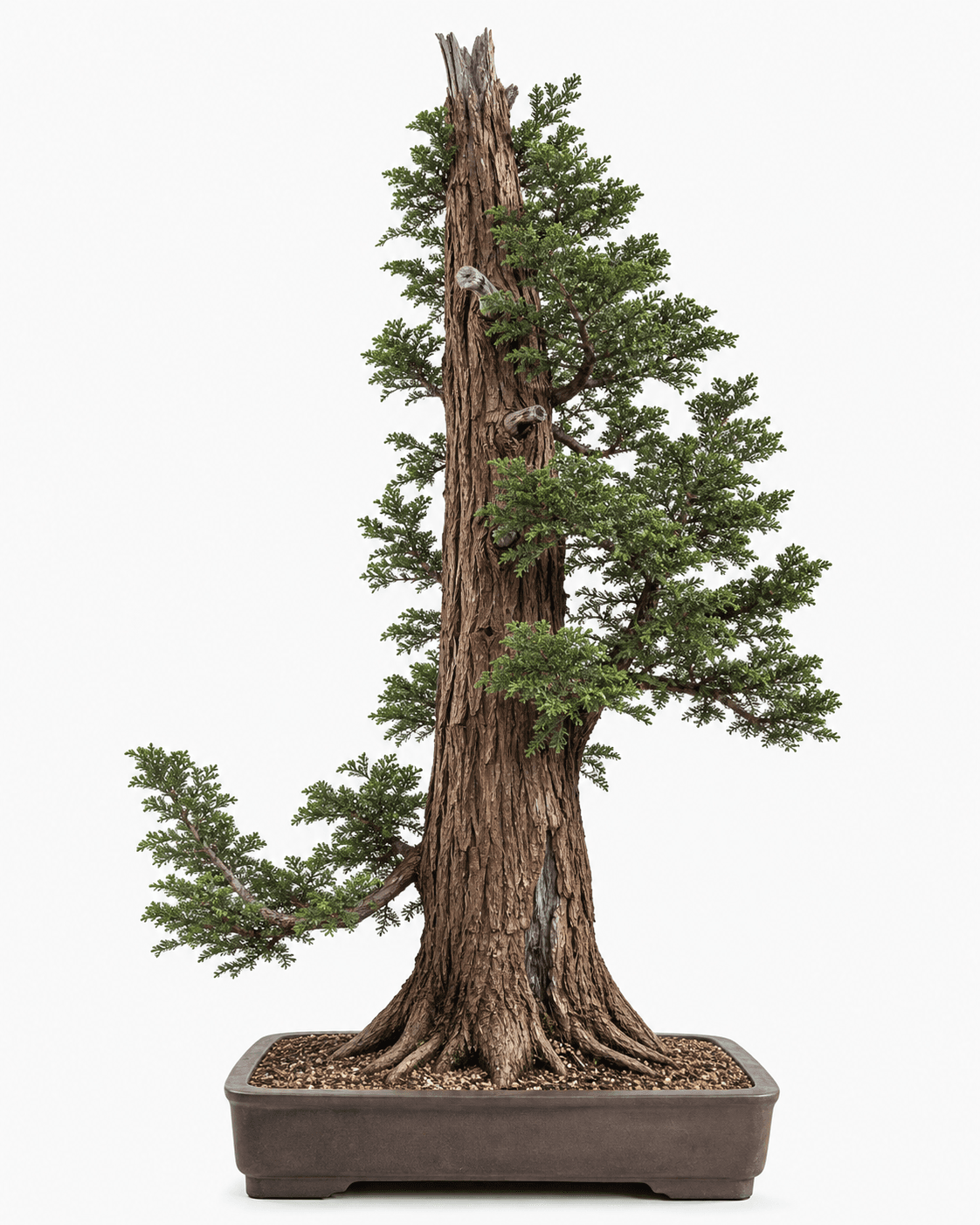
Older material can carry fire scars, rugged bark, broken tops, or dry mixed-conifer association. Keep deadwood restrained and believable, with the design reading as old western forest character rather than arid juniper drama. USDA Forest Service FEISBonsai Mirai / Asymmetry
Branch design should show fan orientation and level changes. Drop a branch where the trunk asks for weight, then let the fan turn up to light. Use negative space so the foliage reads as individual sprays. Bonsai Mirai Library
Forests and groups are especially credible from seedlings or young nursery stock. The species natural role as a mixed-conifer associate lets a planting feel like a Sierra or southwest Oregon stand without needing a single dramatic trunk. USDA Forest Service FEISBonsai Mirai / Asymmetry
Cultivars
Cultivar evidence is modest, but color and compact forms exist.
Oregon State lists Maupin Glow with yellow and green foliage. Kew lists several older Libocedrus decurrens form names, including aureovariegata, compacta, and glauca synonym entries. Oregon State Landscape PlantsKew POWO
Purdue Arboretum treats California incensecedar as columnar, slow growing, drought tolerant, heat tolerant, and suitable for hedge, screen, and specimen use. Those landscape traits can help source material, but bonsai still needs roots and interior foliage. Purdue Arboretum ExplorerBonsai Mirai Library
For bonsai, compact, gold, or blue-leaning material should be judged by vigor first. A color form with weak roots, coarse straight trunk, or no interior fans is less useful than a plain green seedling with a good base and branch options. Bonsai Mirai / Asymmetry
Keep cultivar names in the plant record, but do not build separate care calendars around them yet. Most incense cedar forms share the same outdoor, bright, aerated-root, fan-pruning method until a specific cultivar proves otherwise. Bonsai Mirai Library
History
Incense cedar carries pencil wood, Native uses, fire history, and old western forests.
Oregon Encyclopedia explains that the former Libocedrus decurrens name changed after cone anatomy studies, while Calocedrus comes from Greek roots meaning beautiful cedar. It also notes that Oregon incense cedar is the only North American Calocedrus. Oregon Encyclopedia
USDA NRCS records Native uses including leaf decoctions, bark steam for colds, bark for baskets, twigs for brooms, and other cultural uses. Oregon Encyclopedia adds food spice, filters, friction fire-making, and fuel. USDA NRCS Plant GuideOregon Encyclopedia
The wood history is unusually specific. USDA Silvics says much top-grade lumber was used for pencils because the wood is soft, straight-grained, and easy to whittle; Oregon Encyclopedia notes the same pencil association and durable aromatic wood uses. USDA Forest Service SilvicsOregon Encyclopedia
Old-tree scale can be enormous. Oregon Encyclopedia cites the Marble Mountain Wilderness champion at 469 inches in circumference and 165 ft high, the Oregon champion at 374 inches and 150 ft high, and the Tannen Lake Titan at 486 inches circumference and 137 ft high. Oregon Encyclopedia
There is no widely recognized incense cedar bonsai canon comparable to Japanese black pine or Shimpaku. A strong exhibition tree should therefore make the species readable through bark, fan foliage, western forest ecology, and restrained design rather than relying on species fame. Bonsai Mirai / AsymmetryOregon Encyclopedia
Species questions
Answer the beginner questions before styling.
Can incense cedar be grown as bonsai?
Yes. Incense cedar can be grown as outdoor bonsai when it receives bright light, aerated soil, regular watering, staged root work, and directional pruning to live fan foliage.
Can incense cedar bonsai live indoors?
No. Grow it outdoors with seasonal change, moving air, and dormancy. Brief indoor display is fine when the tree returns outside quickly.
When should I repot incense cedar bonsai?
Repot at spring bud swell or the earliest spring movement. Inspect every 2 to 4 years, and keep severe root work separate from severe foliage reduction.
What soil works for incense cedar bonsai?
Use an aerated inorganic conifer mix. During conversion, start around 2 parts akadama, 1 part pumice, and 1 part lava; established trees can use 3:1:1 when roots are strong.
How much sun does incense cedar bonsai need?
Use full sun in cool climates for compact growth. In hot inland gardens, use afternoon protection or pot cooling when heat and dry wind outpace water uptake.
Should incense cedar be pinched?
Use directional pruning as the default. Pinching is only a narrow refinement tool for very small trees, because repeated pinching can create dense exterior tufts.
Why is my incense cedar bonsai turning brown?
Common causes include dry root pockets, hot wind, missed watering, compacted wet soil, root rot, exterior shearing, mite or scale pressure, rust, or old damaged wood.
Is incense cedar the same as Western redcedar?
No. Incense cedar is Calocedrus decurrens. Western redcedar is Thuja plicata. Both have fan-like scale foliage, but their ecology, labels, and source evidence differ.
Is incense cedar drought tolerant as bonsai?
Established landscape trees are drought tolerant, but a bonsai pot has far less root volume. Treat it as drought aware, not drought proof: water thoroughly and keep roots oxygenated.
What styles suit incense cedar bonsai?
Formal upright, informal upright, slanting, forest, group, dry mixed-conifer, rugged old-bark, and tall narrow western conifer images suit the species best.
Sources
Species advice needs source discipline.
Next decisions
Plan the operation before copying the calendar.
A good care note for Incense cedar records the tree's stage, the work done, and the aftercare used. That record matters more than a month-name rule.
Related species
Compare nearby trees before transferring advice.
Coast redwood
Sequoia sempervirens
Sitka spruce
Picea sitchensis
Western hemlock
Tsuga heterophylla
Coastal Douglas-fir
Pseudotsuga menziesii var. menziesii
Monterey cypress
Hesperocyparis macrocarpa