
Species guide
Jaboticaba Bonsai Care
Plinia cauliflora
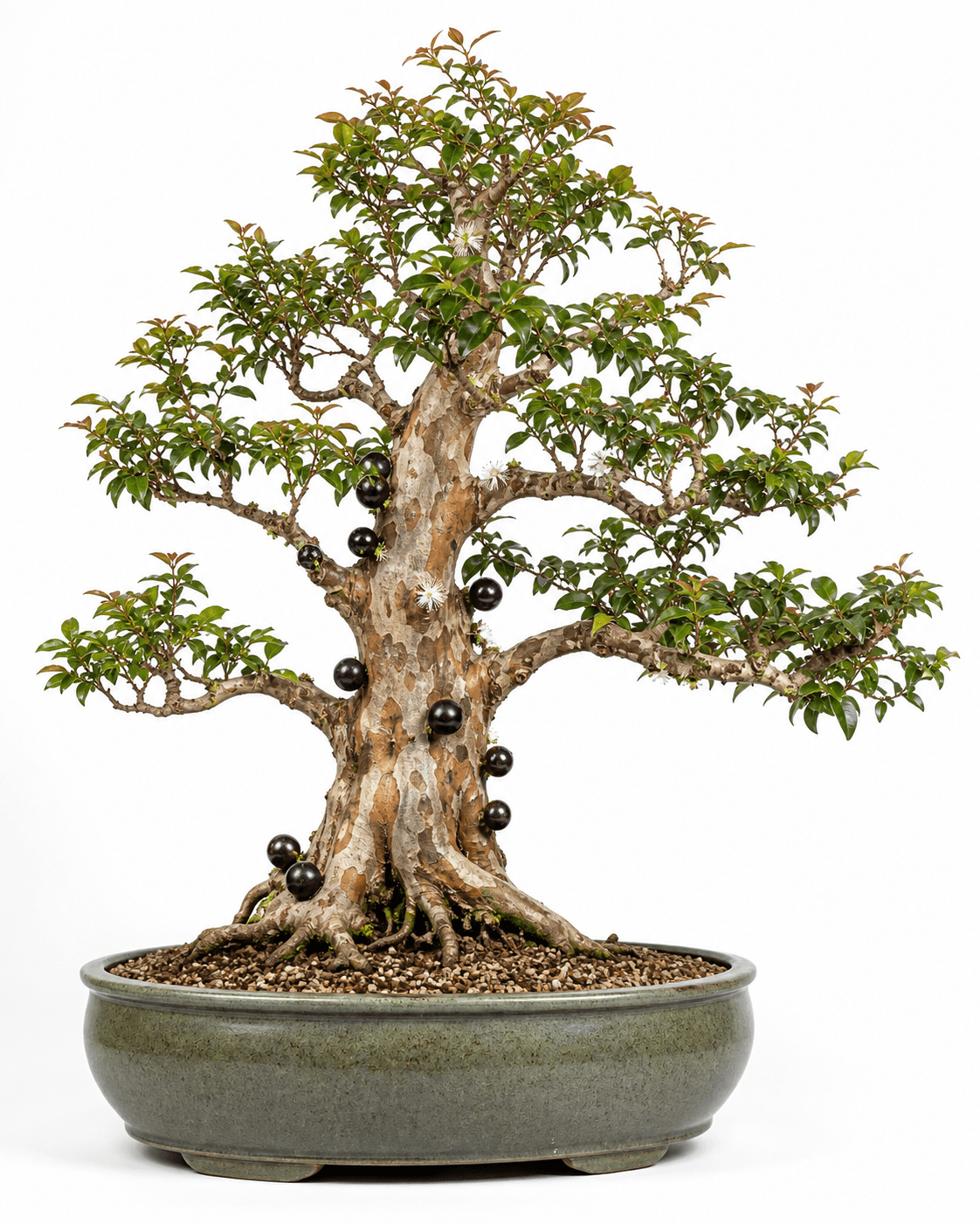
Jaboticaba bonsai care starts with a simple truth: Plinia cauliflora is a slow tropical Myrtaceae fruit tree, so roots, warmth, water discipline, and patience matter more than aggressive technique. It is grown for small evergreen leaves, exfoliating bark, and fruit that forms directly on the trunk and older branches.
Treat Jaboticaba as Broadleaf > Tropical in EntGrove. Give it outdoor light whenever weather allows, steady moisture without stagnant soil, warm active-growth repotting, conservative pruning, and frost-free winter protection in a container.
The local Mirai corpus has no dedicated Jaboticaba file. This guide transfers Mirai tropical, small-leaf Myrtaceae, fruiting broadleaf, propagation, watering, soil, repotting, wiring, energy, and design method transparently, while University of Hawaii CTAHR, California Rare Fruit Growers, Kew, GBIF, and public summaries ground taxonomy, labels, range, fruiting, propagation, and culture.
Updated June 14, 2026. Written by EntGrove Editorial. Last verified June 14, 2026.
Care fingerprint
Read the species through its shared care pattern.
Treat indoor culture as a light-management problem first; prune and repot when the tree is actively growing and warm enough to recover. Use this as the starting point before local conditions and tree strength refine the calendar.
Read the foliage first
Broadleaf stress usually shows in leaf color, leaf size, wilt, scorch, or delayed hardening before it becomes a branch problem.
Match work to dormancy
Deciduous, evergreen, tropical, succulent, and flowering broadleaf trees recover on different calendars.
Protect fine roots
Root work should preserve enough active fine roots for the tree to rehydrate quickly after the operation.
Care cadence
The calendar starts with the tree's seasonal state.
Placement
Timing: Grow outdoors in full sun to light shade during warm weather, then protect before cold nights stall tropical roots. Acclimate greenhouse or indoor-held trees gradually.
Watch for: Large thin leaves, stalled shoots, sun scorch after abrupt exposure, cold drafts, and winter rooms with weak light or stale air.
California Rare Fruit Growers: JaboticabaBonsai Mirai LibraryWatering
Timing: Water deeply when the upper root zone is ready, especially in active growth and fruit swelling. Keep moisture steady, but avoid flooding or sour organic soil.
Watch for: Wilt during fruit set, dry pockets in old root cores, yellowing in wet soil, algae crusts, and calendar watering indoors.
University of Hawaii CTAHR: JaboticabaCalifornia Rare Fruit Growers: JaboticabaBonsai Mirai LibraryFeeding
Timing: Feed during warm active growth after roots are working. Use lighter feeding after repotting, in weak light, or during winter protection.
Watch for: Coarse extension from heavy nitrogen, pale leaves from weak nutrition or alkaline water, and fertilizer applied before recovery growth appears.
Bonsai Mirai LibraryCalifornia Rare Fruit Growers: JaboticabaPruning
Timing: Let shoots extend, then cut back after the flush hardens. Keep trunk and older branch fruiting sites visible, and avoid pruning solely into a smooth hedge outline.
Watch for: Removing all interior fruiting wood, cutting every strong shoot from a weak tree, and losing the cauliflorous character under dense foliage.
Bonsai Mirai LibraryCalifornia Rare Fruit Growers: JaboticabaLeaf work
Timing: Use selective leaf reduction only on strong refined trees in warm active growth. Root maturity and tip control should do most of the leaf-size work.
Watch for: Full defoliation on slow material, leaf cutting after repotting, and expecting defoliation to compensate for weak light.
Bonsai Mirai LibraryRepotting
Timing: Repot once nights are consistently above about 60 F / 16 C. Reduce old soil in stages and preserve enough root mass to support evergreen foliage.
Watch for: Bare-rooting a leafed tree, combining heavy root work with heavy top work, burying the crown, and ignoring old anaerobic nursery soil.
Bonsai Mirai LibraryFruiting
Timing: Let mature, strong trees carry fruit when energy and water are adequate. Remove fruit on weak, recently repotted, or still-developing trees.
Watch for: Fruit set after stress, shriveled fruit from uneven moisture, branch weakening under crop load, and prioritizing fruit over structure too early.
Bonsai Mirai LibraryUniversity of Hawaii CTAHR: JaboticabaWiring
Timing: Set young structure while shoots are flexible, then rely heavily on pruning for secondary and tertiary refinement. Check wire often during warm growth.
Watch for: Wire bite on smooth bark, brittle older branches, wire crossing fruiting sites, and forcing straight branches into sharp bends.
Bonsai Mirai LibraryBonsai Mirai / AsymmetryWinter protection
Timing: Move into bright frost-free protection before cold nights. Water more slowly indoors and keep air moving around dense evergreen foliage.
Watch for: Routine summer watering indoors, mites or scale, fungal spots, leaf drop after cold roots, and pruning during low-light holding.
Bonsai Mirai LibraryCalifornia Rare Fruit Growers: JaboticabaPest and disease inspection
Timing: Inspect during flowering, fruiting, humid weather, winter protection, and after import or greenhouse moves.
Watch for: Rust on flowers or fruit in wet periods, scale, mites, mealybug, aphids, fungal spots, fruit rot, canker, and root rot from stale soil.
California Rare Fruit Growers: JaboticabaPublic species summary: JaboticabaBonsai Mirai LibrarySpecies guide
Apply the species profile before copying another tree's calendar.
At a glance
Jaboticaba is a slow tropical Myrtaceae tree grown for bark, tiny leaves, and trunk fruit.
Use this page for Plinia cauliflora, commonly sold as Jaboticaba, Jabuticaba, Brazilian grape tree, Brazil grape tree, Sabara, guapuru, guaperu, hivapuru, and ybapuru. Older bonsai and fruit references often use Myrciaria cauliflora. Kew POWO search: Plinia caulifloraGBIF species search: Plinia caulifloraUniversity of Hawaii CTAHR: JaboticabaCalifornia Rare Fruit Growers: Jaboticaba
Jaboticaba belongs to Myrtaceae and behaves in bonsai as a warm evergreen broadleaf. EntGrove places it in Broadleaf > Tropical because root warmth, light, moisture, and winter protection drive the calendar. University of Hawaii CTAHR: JaboticabaBonsai Mirai Library
The tree is slow, densely branched, and naturally ornamental. Its white flowers and dark fruits appear on the trunk and older branches, so refinement should keep those older structures visible. University of Hawaii CTAHR: JaboticabaCalifornia Rare Fruit Growers: Jaboticaba
The source-depth caveat is explicit. The local Mirai corpus has no dedicated Jaboticaba file, so this guide transfers only relevant tropical, Myrtaceae, fruiting broadleaf, propagation, water, root, wiring, energy, and design method. Bonsai Mirai LibraryUniversity of Hawaii CTAHR: Jaboticaba
Habitat
Jaboticaba comes from warm South American fruit-tree culture with dependable moisture.
University of Hawaii CTAHR describes Jaboticaba under the Myrciaria cauliflora label as native to southern Brazil and parts of Bolivia, Paraguay, and Argentina. CRFG adds Minas Gerais and wider Brazilian cultivation context for related jaboticaba species. University of Hawaii CTAHR: JaboticabaCalifornia Rare Fruit Growers: Jaboticaba
The tree has a dense rounded crown, exfoliating bark, opposite evergreen leaves, and fruit borne from trunk and main branches. In container design, those traits are the visual reason to grow the species. University of Hawaii CTAHR: JaboticabaCalifornia Rare Fruit Growers: Jaboticaba
Care should copy the habitat pattern without turning the pot into a swamp: warmth, water access, a deep oxygenated root zone, mild acidity, and protection from salt, frost, and stale wet soil. California Rare Fruit Growers: JaboticabaBonsai Mirai Library
Design should show the trunk. Jaboticaba loses much of its identity when all old wood is hidden by foliage because the bark, trunk fruit, and low branching are the tree's own strongest signals. Bonsai Mirai / AsymmetryUniversity of Hawaii CTAHR: Jaboticaba
Reading
Read Jaboticaba by root moisture, leaf scale, shoot pace, and older-wood visibility.
A strong Jaboticaba shows firm glossy leaves, steady warm-season extension, quick response after watering, visible buds behind recent growth, and a root ball that stays moist while still breathing. Bonsai Mirai LibraryCalifornia Rare Fruit Growers: Jaboticaba
A weak tree shows soft oversized leaves, stalled extension, yellowing in wet soil, wilting during fruit swell, pest buildup indoors, or dieback after root and canopy work are combined. Bonsai Mirai LibraryUniversity of Hawaii CTAHR: Jaboticaba
Development means growing roots, trunk, low branches, and bark character in a generous container. Refinement means shorter shoots, selected branch forks, controlled leaf scale, and careful exposure of trunk fruiting sites. Bonsai Mirai LibraryBonsai Mirai / Asymmetry
Myrtaceae method matters. Mirai small-leaf Myrtaceae guidance favors pruning-led structure, controlled ramification, and restraint with old brittle wood rather than wiring every fine branch. Bonsai Mirai Library
Pruning
Prune for structure first, then let mature trees carry fruit as a seasonal accent.
Let warm-season shoots extend enough to feed roots and thicken useful branches, then cut back after the flush hardens. Choose cuts that create taper, light access, and older-wood visibility. Bonsai Mirai Library
Because flowers and fruit form on trunks and larger branches, keep the interior readable. Remove congested shoots that shade the bark, but preserve older branch structure that can carry the species signature display. University of Hawaii CTAHR: JaboticabaCalifornia Rare Fruit Growers: Jaboticaba
Fruit is expensive. Mirai fruiting-broadleaf method supports removing fruit from weak or developing trees so stored energy can build roots, callus, and branch structure. Bonsai Mirai Library
A mature refined tree can carry some fruit when water, light, and roots are strong. Thin fruit if the crop weakens shoots, hides structure, or creates a maintenance burden during warm weather. Bonsai Mirai LibraryUniversity of Hawaii CTAHR: Jaboticaba
Repotting
Repot Jaboticaba in warmth and keep the shallow fibrous root system oxygenated.
Repot after nights are consistently above about 60 F / 16 C and the tree is ready to grow. Warm roots are the recovery engine for tropical bonsai. Bonsai Mirai Library
Avoid bare-rooting a leafed Jaboticaba. Preserve part of the root ball, reduce old soil in stages, and leave foliage to maintain water movement while new roots form. Bonsai Mirai Library
CRFG describes Jaboticaba as having a somewhat shallow root system, and CTAHR emphasizes deep well-drained soil for best growth. In bonsai, that means moisture retention must be paired with air space. California Rare Fruit Growers: JaboticabaUniversity of Hawaii CTAHR: Jaboticaba
Set crown roots slightly proud rather than burying the trunk base. Mirai tropical repotting method warns that buried bark at the wet soil line can invite crown rot. Bonsai Mirai Library
Soil and pot
Use a deep moisture-retentive mineral mix and a pot that keeps trunk fruit visible.
A development mix can start with akadama, pumice, lava, and a modest organic or bark fraction, adjusted by heat, humidity, and watering access. The target is even moisture with predictable oxygen return. Bonsai Mirai LibraryCalifornia Rare Fruit Growers: Jaboticaba
CRFG gives pH 5.5 to 6.5 as a strong fruit-culture range and notes sensitivity to salt and poor drainage. In bonsai, alkaline water can also contribute to micronutrient lockout and weak flowering or fruiting. California Rare Fruit Growers: JaboticabaBonsai Mirai Library
Use a deeper or slightly roomier container until the root system is mature. Slow tropicals refine poorly when a shallow pot removes too much water buffer too early. Bonsai Mirai Library
Pot pairing can be quiet: unglazed brown, warm gray, muted green, or a restrained dark glaze. Let the exfoliating bark, glossy leaves, and trunk fruit provide the visual interest. Bonsai Mirai / AsymmetryUniversity of Hawaii CTAHR: Jaboticaba
Climate
Jaboticaba changes most between frost-free outdoor culture and indoor winter holding.
In tropical and warm subtropical climates, Jaboticaba can remain outdoors with careful water management, light, and airflow. CTAHR notes that rain or irrigation can promote flowering and that Hawaiian trees may produce one to six crops per year. University of Hawaii CTAHR: Jaboticaba
In Mediterranean or dry-summer regions, protect young trees from abrupt hot exposure, water deeply, and avoid salty coastal wind. CRFG reports full sun or some shade tolerance, with small young trees benefiting from protection. California Rare Fruit Growers: Jaboticaba
In cold-winter regions, treat Jaboticaba as a warm-season outdoor tree with frost-free indoor or greenhouse protection. Indoors, reduce watering pace, increase light, and inspect for pests. Bonsai Mirai LibraryCalifornia Rare Fruit Growers: Jaboticaba
A brief landscape frost report is weaker evidence than container safety. Protect bonsai roots before frost, because a small pot cools quickly and recovers more slowly than the ground. California Rare Fruit Growers: JaboticabaBonsai Mirai Library
Pests and diseases
Prevent rust, root rot, and protected-room pests through air, light, and root balance.
CRFG notes that some Jaboticaba varieties can suffer fruit and flower rust during wet periods. Keep flowering trees airy, avoid stale humidity, and remove diseased fruit or flower remains. California Rare Fruit Growers: Jaboticaba
Public species summaries also list rust, canker, dieback, and fruit rot as disease concerns. In bonsai, these problems become more likely when foliage is dense, air is stagnant, or the root ball stays wet and cool. Public species summary: JaboticabaBonsai Mirai Library
Scale, mites, mealybug, and aphids can build on protected tropicals. Inspect leaf undersides, trunk crevices, branch forks, and fruiting sites before a small infestation becomes a winter-storage problem. Bonsai Mirai Library
Root rot is the cultural disease to prevent. Sour soil, black roots, persistent wetness, limp leaves, or a soft trunk base should stop styling work until warmth, drainage, and watering are corrected. Bonsai Mirai Library
Wiring
Wire young flexible lines, then refine Jaboticaba mostly with pruning.
Set the trunk line and primary branches while the wood is young enough to bend. Older Myrtaceae wood can be hard and brittle, so severe bends belong early and should be incremental. Bonsai Mirai Library
Small-leaf Myrtaceae often develop density through pruning. Use wire to set essential structure, then use cutback, leader changes, and light management to build the canopy. Bonsai Mirai Library
Check wire frequently during warm growth. Smooth bark and swelling tropical branches can mark quickly, especially where wire crosses a branch that later needs to display fruit. Bonsai Mirai LibraryUniversity of Hawaii CTAHR: Jaboticaba
Use guy wires or subtle angle changes when a hard bend would fracture older wood. The final tree should read as an old fruiting evergreen, not as a wired conifer silhouette. Bonsai Mirai / Asymmetry
Propagation
Seed is common, but grafting and layering matter when fruiting age and cultivar identity matter.
CTAHR recommends planting seeds as soon as possible after harvest and notes about 2 months to germination. It also describes polyembryonic seeds that can produce multiple plants. University of Hawaii CTAHR: Jaboticaba
CRFG reports that grafted plants can fruit much earlier than seedlings, while seedlings may take many years to reach fruiting age. For bonsai, that difference matters if trunk fruit is part of the goal. California Rare Fruit Growers: Jaboticaba
Inarching, air layering, grafting, cuttings, and tissue culture are all described as possible by CTAHR, with limited success depending on method. Approach grafting and side or veneer grafting are the more practical bonsai-adjacent tools. University of Hawaii CTAHR: JaboticabaCalifornia Rare Fruit Growers: JaboticabaBonsai Mirai Library
Mirai propagation method supports warmth, reduced light, oxygen-rich perlite, restrained foliage, no fertilizer before roots establish, and patient aftercare for cuttings and newly separated layers. Bonsai Mirai Library
Buying
Buy Jaboticaba for verified identity, trunk texture, roots, and future fruiting sites.
Look for labels such as Plinia cauliflora, Myrciaria cauliflora, Jaboticaba, Jabuticaba, Brazilian grape tree, Brazil grape tree, Sabara, guapuru, guaperu, hivapuru, or ybapuru. University of Hawaii CTAHR: JaboticabaCalifornia Rare Fruit Growers: JaboticabaGBIF species search: Plinia cauliflora
Good bonsai material has a firm base, exfoliating bark, low branching, compact leaves, healthy roots, and visible older wood that can carry flowers and fruit later. Bonsai Mirai / AsymmetryUniversity of Hawaii CTAHR: Jaboticaba
Ask whether the plant is seed-grown, grafted, layered, or a named cultivar such as Sabara, Paulista, Rajada, Ponhema, Branca, or Roxa. The answer affects fruit timing, vigor, and identity confidence. University of Hawaii CTAHR: JaboticabaCalifornia Rare Fruit Growers: Jaboticaba
Avoid material with sour soil, buried crown roots, weak indoor growth, leaf pests, swollen graft defects, or no visible trunk line. Foliage volume alone is a poor measure of future bonsai quality. Bonsai Mirai LibraryBonsai Mirai / Asymmetry
Troubleshooting
Most Jaboticaba problems trace back to light, root oxygen, water rhythm, or cold protection.
Leaves are large and shoots are long: increase light gradually, reduce excess nitrogen, and let the root system mature before relying on leaf reduction. Bonsai Mirai Library
Leaves wilt during fruiting: check water timing, root density, heat exposure, and whether the tree is carrying more fruit than the root system can support. University of Hawaii CTAHR: JaboticabaBonsai Mirai Library
Leaves yellow while soil stays wet: warm the root zone, improve drainage, pause fertilizer, and wait for consistent drying before pruning more. Bonsai Mirai LibraryCalifornia Rare Fruit Growers: Jaboticaba
Flowers or fruit rust in wet weather: increase airflow, remove infected fruit or flower debris, and avoid dense foliage around trunk fruiting sites. California Rare Fruit Growers: Jaboticaba
Wire marks appear: remove wire immediately, switch to pruning or guy wires, and inspect faster during active warm growth. Bonsai Mirai Library
Identity is unclear: compare Plinia cauliflora, Myrciaria cauliflora, Myrciaria jaboticaba, Sabara, yellow jaboticaba, camu-camu, guava, Surinam cherry, and brush cherry before applying cultivar or hardiness assumptions. University of Hawaii CTAHR: JaboticabaCalifornia Rare Fruit Growers: JaboticabaGBIF species search: Plinia cauliflora
Design
Style Jaboticaba as a fruiting evergreen with trunk-first character.
Start with the base, trunk movement, and low branch rhythm. The most convincing Jaboticaba bonsai read as compact old fruit trees with exfoliating bark and visible older wood. Bonsai Mirai / AsymmetryUniversity of Hawaii CTAHR: Jaboticaba
Choose a defining branch that opens the front instead of hiding it. The fruiting sites live on trunk and older branches, so dense foliage needs windows. Bonsai Mirai / AsymmetryCalifornia Rare Fruit Growers: Jaboticaba
Use the apex to complete a rounded or asymmetric broadleaf crown. Flat pad architecture usually fights the species fruit-tree character. Bonsai Mirai / Asymmetry
Deadwood should stay minor if used at all. The species offers bark, flowers, and fruit as stronger identity signals than carved drama. Bonsai Mirai / Asymmetry
Forms
Jaboticaba labels cover several species and cultivars, so verify the plant before refining care.
CTAHR lists cultivars and forms including Paulista, Rajada, Roxa, Ponhema, Mineira, Branca, Sabara, precoce, hibrida, Ascuda, pingo de mel, younghans, and J1. University of Hawaii CTAHR: Jaboticaba
CRFG treats jaboticaba as a broader fruit-group label and lists Myrciaria cauliflora, M. jaboticaba, M. tenella, and M. trunciflora among species historically carried under the common name. California Rare Fruit Growers: Jaboticaba
For EntGrove, Plinia cauliflora is the current species-page target. Other jaboticaba relatives can be discussed here until search demand or care differences justify separate pages. Kew POWO search: Plinia caulifloraCalifornia Rare Fruit Growers: Jaboticaba
Choose forms by leaf scale, bark quality, root health, fruiting age, trunk movement, and reliable label provenance rather than fruit size alone. Bonsai Mirai / AsymmetryUniversity of Hawaii CTAHR: Jaboticaba
History
Jaboticaba has deep Brazilian fruit culture and a small but real container-bonsai tradition.
CTAHR records that Jaboticaba was mentioned by Dutch observers in 1658, reached California around 1904, reached Florida around 1908, and appeared in Hawaiian plantings by the early 1900s. University of Hawaii CTAHR: Jaboticaba
The fruit is culturally important in Brazil and commercially meaningful there because it is distinctive, perishable, and tied to local fresh use. Its trunk fruiting also makes the tree memorable to non-specialists. University of Hawaii CTAHR: JaboticabaPublic species summary: Jaboticaba
In bonsai, Jaboticaba belongs with slow tropical fruit trees where the grower earns the display through root maturity, trunk visibility, careful water, and years of structural pruning. Bonsai Mirai LibraryBonsai Mirai / Asymmetry
Species questions
Answer the beginner questions before styling.
Can Jaboticaba be grown as bonsai?
Yes. Jaboticaba can be grown as bonsai when it receives bright warm placement, steady moisture, oxygenated soil, careful pruning, and frost-free winter protection.
Is Jaboticaba an indoor bonsai?
Jaboticaba should grow outdoors in warm bright weather whenever possible. Indoor culture is mainly winter protection and needs strong supplemental light, warmth, airflow, and slower watering.
When should Jaboticaba be repotted?
Repot Jaboticaba only in reliable warmth, usually when nights stay above about 60 F / 16 C. Preserve part of the root ball and avoid pairing heavy root work with heavy pruning.
How often should I water Jaboticaba bonsai?
Water deeply during active growth when the root zone is ready, then let oxygen return. Keep moisture steadier during flowering and fruit swelling, and water much less in cool indoor protection.
Does Jaboticaba need acidic soil?
Jaboticaba grows and fruits best in mildly acidic soil. CRFG gives pH 5.5 to 6.5 as a fruit-culture target, with salt and poor drainage as larger container risks.
Should I let a Jaboticaba bonsai carry fruit?
Let only strong mature trees carry fruit. Remove fruit on weak, recently repotted, or developing trees so energy can go to roots, callus, and branch structure.
Why is my Jaboticaba bonsai growing so slowly?
Jaboticaba is naturally slow. Weak light, cool roots, stale soil, salt buildup, or an undersized container can make that slow pace worse.
What soil works for Jaboticaba bonsai?
Use a granular tropical broadleaf mix that holds moisture while staying aerated. Akadama, pumice, lava, and a modest organic or bark fraction can be tuned by climate and pot size.
Is Jaboticaba the same as Brazilian grape tree?
Brazilian grape tree is one common English label for Jaboticaba. Verify the botanical label because several Plinia and Myrciaria species are sold under similar jaboticaba names.
Why are Jaboticaba flowers or fruit failing?
Check light, warmth, moisture consistency, root health, and fruit load. Wet humid flowering periods can also bring rust, while dry cycles can reduce flowering and fruit size.
Sources
Species advice needs source discipline.
Next decisions
Plan the operation before copying the calendar.
A good care note for Jaboticaba records the tree's stage, the work done, and the aftercare used. That record matters more than a month-name rule.
Related species
Compare nearby trees before transferring advice.
Ficus retusa / Indian laurel
Ficus microcarpa
Tigerbark ficus
Ficus microcarpa 'Tigerbark'
Willow-leaf ficus
Ficus salicaria
Benjamin fig
Ficus benjamina
Ginseng ficus
Ficus microcarpa 'Ginseng'