
Species guide
Surinam Cherry Bonsai Care
Eugenia uniflora
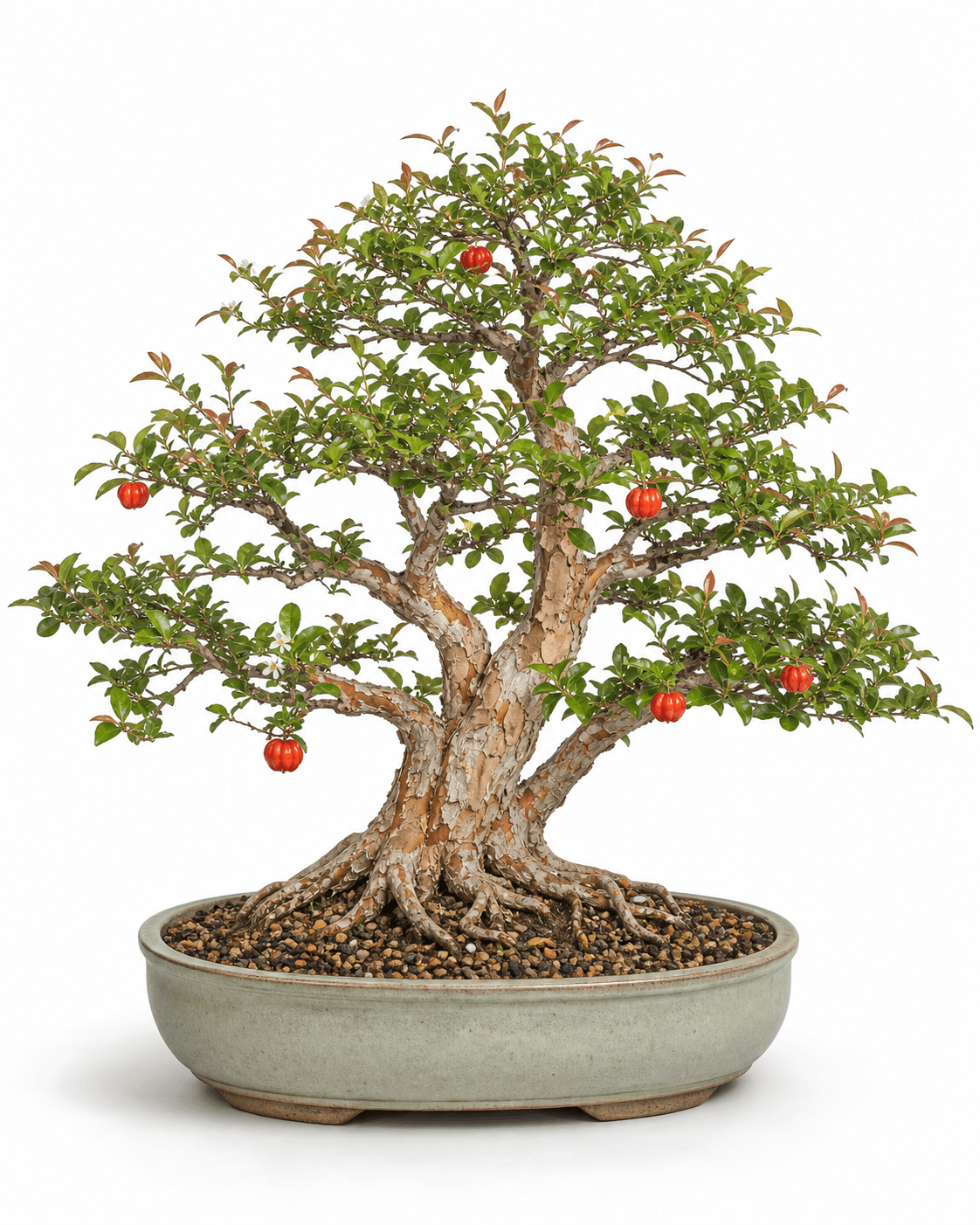
Surinam cherry bonsai, Eugenia uniflora, is a frost-tender tropical broadleaf grown for glossy aromatic foliage, red new growth, fragrant white flowers, ribbed fruit, and peeling tan bark. It belongs in Broadleaf > Tropical care: warmth, high light, mineral drainage, measured water, and work only while the tree is actively growing.
This page keeps a thin Mirai coverage caveat. A June 2026 local corpus scan did not surface a dedicated Surinam cherry file, so the bonsai method here comes from Mirai tropical-broadleaf, broadleaf evergreen, watering, soil, wiring, energy, and design principles, while species facts come from Kew, UF/IFAS, and NTBG.
Regional responsibility matters with this species. UF/IFAS lists Surinam cherry as invasive in south Florida and a species of caution elsewhere in Florida, so bonsai growers in warm climates should control seed, remove fruit when needed, and follow local invasive-plant guidance.
Updated June 20, 2026. Written by EntGrove Editorial. Last verified June 20, 2026.
Care fingerprint
Read the species through its shared care pattern.
Treat indoor culture as a light-management problem first; prune and repot when the tree is actively growing and warm enough to recover. Use this as the starting point before local conditions and tree strength refine the calendar.
Note: Use this page for Eugenia uniflora labels only. Florida guidance lists the species as invasive in south Florida, so seed control and local rules matter for warm-climate growers.
Read the foliage first
Broadleaf stress usually shows in leaf color, leaf size, wilt, scorch, or delayed hardening before it becomes a branch problem.
Match work to dormancy
Deciduous, evergreen, tropical, succulent, and flowering broadleaf trees recover on different calendars.
Protect fine roots
Root work should preserve enough active fine roots for the tree to rehydrate quickly after the operation.
Care cadence
The calendar starts with the tree's seasonal state.
Placement
Timing: Grow outside in strong light once nights are consistently above 60 F / 16 C. Protect before frost risk and before container roots cool below the tree active range.
Watch for: Weak indoor extension, oversized leaves, stalled buds, hot wind after a protected winter, and fruiting branches drying faster than foliage-only branches.
UF/IFAS ExtensionBonsai Mirai LibraryWatering
Timing: During warm active growth, water thoroughly when the upper soil is drying and the pot is using water. In cool protection, reduce frequency and wait for oxygen to return.
Watch for: Sour soil smell, yellowing foliage, limp new shoots, a dense nursery core, and a fruiting canopy that changes water demand quickly.
Bonsai Mirai LibraryFertilizer
Timing: Feed while the tree is extending. Use stronger feeding for trunk and branch development, then reduce to maintenance once short internodes, flower buds, and leaf scale matter.
Watch for: Coarse hedge-like shoots, long internodes, weak post-repot roots, salt stress in heat, and fertilizer left active while the tree is cool and slow.
Bonsai Mirai LibraryPruning
Timing: Let developmental shoots extend, then cut back during warm growth to a useful side shoot or bud. Refined trees can be clipped more often after each flush hardens.
Watch for: Repeated shearing that creates a flat hedge surface, equal-height branches, inverse taper from clustered shoots, and fruit set on weak branches.
UF/IFAS ExtensionBonsai Mirai LibraryLeaf work
Timing: Use partial leaf reduction only on vigorous refined trees in active growth. Preserve foliage after repotting, during cold protection, and on trees still building primary structure.
Watch for: Full defoliation on a developing tropical, large leaves from low light, weak interior shoots, and leaf drop after environmental changes.
Bonsai Mirai LibraryFlowers and fruit
Timing: Allow flowering and fruit only on healthy refined trees. Remove fruit on developing, recently repotted, or regionally restricted trees before birds or mammals spread seed.
Watch for: Fruit load draining small branches, seed escape in warm climates, bird dispersal, and flower buds sacrificed by poorly timed pruning.
UF/IFAS Center for Aquatic and Invasive PlantsBonsai Mirai LibraryWiring
Timing: Wire young flexible shoots during warm growth and check frequently. Use clip-and-grow for most secondary structure once the bark begins to harden.
Watch for: Thin aromatic bark, quick swelling after rain and fertilizer, bends placed too close to flower or fruit spurs, and branch tips forced below their natural light-seeking angle.
UF/IFAS ExtensionBonsai Mirai LibraryRepotting
Timing: Repot in stable warmth after nights are above 60 F / 16 C. Preserve part of the root mass and return to brighter sun only after new extension confirms recovery.
Watch for: Bare-rooting a leafy tropical, buried crowns, decomposed organic soil, poor anchoring, and pairing heavy root work with pruning or fruiting.
Bonsai Mirai LibraryPropagation
Timing: UF/IFAS lists seed and cuttings. For bonsai, seed gives clumps and forests, while cuttings preserve a known small-leaf or dark-fruited selection.
Watch for: Seedlings from invasive regions, fruit left to birds, cuttings taken outside warm active growth, and young plants rushed into shallow pots.
UF/IFAS ExtensionUF/IFAS Center for Aquatic and Invasive PlantsBonsai Mirai LibraryWinter protection
Timing: In non-tropical climates, move to bright protection before cold nights arrive. Keep roots warmer, airflow moving, and water frequency lower than the summer schedule.
Watch for: Cold wet soil, low-light leaf drop, scale indoors, spider mites in still air, and styling while the tree cannot grow through the response.
Bonsai Mirai LibraryUF/IFAS ExtensionSpecies guide
Apply the species profile before copying another tree's calendar.
At a glance
Surinam cherry is a tropical fruiting shrub that rewards light, heat, and controlled vigor.
Eugenia uniflora L. is the accepted botanical target for Surinam cherry bonsai. UF/IFAS lists Myrtaceae, USDA Zones 9B through 11, moderate growth, dense oval habit, small aromatic leaves, fragrant white spring flowers, and ribbed edible fruit. Kew POWOUF/IFAS Extension
The bonsai translation is a warm-climate broadleaf evergreen with fruiting potential. Grow it in high light, use a mineral soil that drains quickly, water by root-zone demand, and reserve serious work for active tropical growth. UF/IFAS ExtensionBonsai Mirai Library
This profile is intentionally transparent about source depth. The Mirai corpus gives strong tropical and broadleaf evergreen method, while Kew, UF/IFAS, and NTBG supply the verified plant facts and regional cautions. Bonsai Mirai LibraryKew POWOUF/IFAS ExtensionNational Tropical Botanical Garden
Wild habitat
Its natural image is a glossy subtropical shrub or small tree with fruit carried near the foliage.
Kew places Eugenia uniflora from eastern and southern Brazil to southern South America and says it grows primarily in the subtropical biome. NTBG describes a native range from the Guianas to southern Brazil and Uruguay. Kew POWONational Tropical Botanical Garden
UF/IFAS gives the practical landscape translation: part sun to part shade tolerance, best growth in full sun with rapidly draining soil, moderate drought tolerance, poor aerosol salt tolerance, and a dense multi-stem habit. UF/IFAS Extension
For care, that means bright outdoor light, warmth, and drainage first. The tree can tolerate some dryness in the ground, but a shallow pot needs more precise water and oxygen balance. UF/IFAS ExtensionBonsai Mirai Library
For design, the wild habit points toward a clipped shrub becoming a small tree: multiple stems, peeling bark, small glossy leaves, red new growth, white flowers, and ribbed fruit as seasonal punctuation. UF/IFAS ExtensionNational Tropical Botanical GardenBonsai Mirai / Asymmetry
Reading the tree
Read strength through extension, leaf size, fruit load, and root response.
In development, let selected shoots run. Mirai tropical guidance treats extension as the engine for roots, trunk thickening, branch strength, wound closure, and future back-budding. Bonsai Mirai Library
In refinement, the signs change: shorter internodes, smaller leaves, repeated bifurcation, interior buds, and controlled flowering on branches that can carry fruit without weakening. Bonsai Mirai Library
UF/IFAS notes that young foliage is red to purple and current-year stems are reddish and thin. That makes shoot age readable: soft red growth is for extension and young wiring, while hardened green growth is safer for cutback. UF/IFAS Extension
Fruit changes the energy budget. Flowering costs less than maturing fruit, so developing trees should spend most seasons building roots and branching before the grower asks them to hold a display crop. UF/IFAS ExtensionBonsai Mirai Library
Pruning
Use hedge tolerance for ramification, then keep the tree from becoming a hedge.
UF/IFAS describes Surinam cherry as easy to shear into a dense hedge. Bonsai can use that response, but refinement should be directional pruning to structure rather than repeated flat clipping. UF/IFAS Extension
In development, choose sacrifice shoots, let them extend, then cut back to side growth that continues the trunk or branch line. Remove competing trunk-origin shoots before they thicken and create swelling. Bonsai Mirai Library
In refinement, prune after a flush hardens and simplify crowded junctions to two useful branchlets. Preserve weak interior shoots until they strengthen, especially after partial leaf reduction. Bonsai Mirai Library
Use partial defoliation as a balancing tool on vigorous refined trees. Full defoliation spends energy on replacement leaves and is poorly matched to young, fruiting, recently repotted, or winter-protected tropicals. Bonsai Mirai Library
Roots
Repot in warmth and keep a working root system attached.
Mirai tropical repotting guidance opens the safe window once ambient warmth is consistent, with nights above 60 F / 16 C as the practical threshold. Surinam cherry should be handled inside that tropical window. Bonsai Mirai Library
Repot because drainage has slowed, the soil has decomposed, roots need correction, or the design requires a new angle or container. A healthy tree in durable mineral soil can wait longer than a tree in heavy nursery mix. Bonsai Mirai Library
Keep part of the root mass intact because the tree carries leaves year-round. A leafy tropical depends on active hydration, and heavy root removal paired with heavy pruning removes both sides of recovery. Bonsai Mirai Library
Set the root crown at the soil surface and anchor firmly. Mirai warns that burying tropical crowns can invite rot, and a loose tree cannot rebuild fine roots efficiently. Bonsai Mirai Library
Soil and pot
Drainage and oxygen matter more in a bonsai pot than landscape tolerance suggests.
UF/IFAS lists Surinam cherry as tolerant of acidic, alkaline, clay, sand, and loam soils, with best growth in rapidly draining soil. In a bonsai pot, that broad landscape tolerance narrows to one priority: a root zone that can hold water and breathe. UF/IFAS ExtensionBonsai Mirai Library
A reliable starting mix is equal parts akadama, pumice, and lava for temperate growers protecting tropicals part of the year. Increase pumice or lava in humid, rainy, or indoor-protected conditions. Bonsai Mirai Library
Move hedge or fruit nursery material out of dense organic soil gradually. A hidden wet core surrounded by coarse bonsai soil creates two watering zones and can make the tree look dry outside while roots decline inside. Bonsai Mirai Library
Pot pairing can be warm and quiet. Muted earth glazes, shallow ovals for refined clumps, and slightly deeper training pots for fruiting material keep attention on bark, leaves, flowers, and red fruit. Bonsai Mirai / Asymmetry
Climate
The calendar depends on whether your climate is truly tropical or only seasonally warm.
In frost-free tropical and subtropical climates, Surinam cherry can grow outdoors much of the year and may respond to multiple cutback cycles. Full sun is useful when water and roots are managed well. UF/IFAS ExtensionBonsai Mirai Library
In warm temperate regions, use the outdoor season for development, pruning, wiring, repotting, and propagation. Winter protection becomes a holding period with bright light, lower water use, and minimal stress work. Bonsai Mirai Library
UF/IFAS lists the species for USDA Zones 9B through 11, but a bonsai pot is more vulnerable than a landscape root system. Protect earlier than the landscape hardiness line suggests. UF/IFAS ExtensionBonsai Mirai Library
In Florida and other warm regions where the species can spread, seed control is part of care. UF/IFAS says birds and mammals disperse fruit, and the Florida invasive-plant directory discourages planting it in the landscape. UF/IFAS Center for Aquatic and Invasive Plants
Pests
Scale, caterpillars, fruit pests, and root imbalance are the main watch points.
UF/IFAS lists scale and caterpillars as Surinam cherry pests and says no major diseases are normally a concern in the landscape profile. Bonsai conditions can still magnify stress. UF/IFAS Extension
Check soft red growth, aromatic leaf undersides, branch crotches, fruiting twigs, and indoor winter foliage for scale, aphids, mealybugs, spider mites, and whitefly. Correct light and airflow while treating the identified pest. Bonsai Mirai Library
Fruit can attract birds and mammals outdoors. In invasive regions, remove fruit before it ripens or bag developing fruit only when seed containment is assured. UF/IFAS Center for Aquatic and Invasive Plants
Root-zone imbalance is the bonsai disease pattern to watch. Yellowing leaves, stalled shoots, sour soil, and persistent wetness point to low oxygen, cool wet roots, or decomposed substrate before they point to a rare pathogen. Bonsai Mirai Library
Wiring
Wire young red shoots early and let pruning create most fine structure.
UF/IFAS describes current-year stems as thin and reddish. That is the wiring window: young shoots are flexible enough to place before they harden into the dense shrub structure. UF/IFAS Extension
Use standard wiring discipline: even coils, continuous contact, a suitable gauge, and bends distributed across a length of tissue. Check often because warm tropical growth can swell quickly. Bonsai Mirai Library
Set primary angle, branch spread, and movement with wire. Use cutback for secondary and tertiary ramification so the canopy reads as a broadleaf cloud instead of a wired conifer pad. Bonsai Mirai LibraryBonsai Mirai / Asymmetry
Avoid wiring immediately after repotting, during fruit load, or while the tree is in winter protection. The tree needs warmth and active growth to respond to bend stress. Bonsai Mirai Library
Propagation
Seed and cuttings both work, but seed responsibility comes first.
UF/IFAS lists propagation by seed or cuttings. For bonsai, seed is useful for forests, clumps, and long development projects, while cuttings preserve a known leaf size, fruit color, or compact habit. UF/IFAS Extension
In regions where Surinam cherry spreads, seed propagation should be deliberate and contained. UF/IFAS notes bird and mammal dispersal, dense thicket formation, and displacement of native plants in Florida natural areas. UF/IFAS Center for Aquatic and Invasive Plants
Take cuttings during reliable warm growth and keep them bright, humid, and oxygenated. Move rooted cuttings through training containers before asking them to live in a shallow bonsai pot. UF/IFAS ExtensionBonsai Mirai Library
Air-layering is possible in principle for tropical broadleaf material, but no Surinam-specific Mirai success note surfaced. Use it only during stable warmth, and treat the layer as a recovery project after separation. Bonsai Mirai Library
Buying
Buy identity, base quality, and local legality before fruit color.
Confirm the plant is Eugenia uniflora. Pitanga, Brazilian cherry, Cayenne cherry, and Florida cherry may point here, while Barbados cherry usually points to Malpighia and brush cherry often points to Syzygium paniculatum. Kew POWONational Tropical Botanical Garden
Good bonsai material has low movement, a visible root flare, small leaves, branch options close to the trunk, peeling bark, and a root system that can be corrected without removing all working roots. UF/IFAS ExtensionBonsai Mirai / Asymmetry
Hedge material can be useful if it has a strong base and low shoots. Avoid straight clipped sticks, buried crowns, circling roots, old pest colonies, and fruiting shrubs growing in sour organic soil. UF/IFAS ExtensionBonsai Mirai Library
Check regional guidance before buying outdoor material in warm climates. UF/IFAS provides the page for identification and discourages purchase in Florida because of invasive risk. UF/IFAS ExtensionUF/IFAS Center for Aquatic and Invasive Plants
Troubleshooting
Most failures trace to cold, weak light, wet roots, or fruit load.
Symptom: leaves yellow and drop in winter protection. Likely causes: weak light, cool roots, wet soil, low airflow, or normal adjustment after moving indoors. Fix: raise light and warmth, reduce watering, and wait for active growth before pruning. Bonsai Mirai Library
Symptom: new shoots are long, pale, and sparse. Likely causes: low light, excess nitrogen in protection, or a tree kept too wet. Fix: increase light, move outside in safe warmth, and moderate fertilizer. Bonsai Mirai Library
Symptom: the tree wilts after repotting. Likely causes: too much root reduction, poor anchoring, full sun before recovery, or repotting before stable warmth. Fix: stabilize, give bright protection, and manage water carefully. Bonsai Mirai Library
Symptom: fruit develops while branch strength declines. Likely causes: fruit load on a small, young, or recently stressed tree. Fix: remove fruit and rebuild vegetative strength before the next display season. UF/IFAS ExtensionBonsai Mirai Library
Symptom: sticky leaves or distorted red shoots. Likely causes: scale, aphids, mealybugs, or other pests on tender growth. Fix: identify the pest, clean the canopy, improve airflow, and treat early. UF/IFAS ExtensionBonsai Mirai Library
Symptom: seedlings appear around the bench or garden. Likely causes: fruit dropped or carried by birds and mammals. Fix: remove fruit before ripening and follow local invasive-plant rules. UF/IFAS Center for Aquatic and Invasive Plants
Design
Style it as a subtropical fruiting shrub becoming a small old tree.
Start with base, trunk line, defining branch, and apex. Mirai design fundamentals use those elements to decide whether a tree reads as harmonious, tense, or dynamic. Bonsai Mirai / AsymmetryBonsai Mirai Library
Surinam cherry often suits a soft harmonious or lightly tense design because the species already has visual interest from red new leaves, fragrant flowers, ribbed fruit, and peeling bark. UF/IFAS ExtensionBonsai Mirai / Asymmetry
The natural habit is dense, multi-stemmed, oval, and hedge-capable. Use that as a starting point, then create negative space, branch hierarchy, and a crown that feels like a small subtropical tree rather than a clipped landscape shrub. UF/IFAS ExtensionBonsai Mirai Library
Fruit should support the image. A few ripe ribbed fruits can make a mature tree memorable, while a heavy crop on a small bonsai can flatten branch movement and drain energy. UF/IFAS ExtensionBonsai Mirai Library
Forms
Search labels and fruit forms belong on one parent page for now.
Kew accepts Eugenia uniflora L. and records many botanical synonyms. Bonsai and fruit trade labels usually stay with common names such as Surinam cherry, pitanga, Brazilian cherry, Cayenne cherry, and red Brazil cherry. Kew POWONational Tropical Botanical Garden
Fruit selections may vary in color, flavor, and vigor, including darker red or nearly black fruit forms. Bonsai selection should still prioritize trunk base, internode length, leaf scale, branch placement, and root health. National Tropical Botanical GardenBonsai Mirai / Asymmetry
Keep common-name confusions separate. Barbados cherry belongs to Malpighia in the EntGrove taxonomy, and brush cherry belongs to Syzygium paniculatum, even though older horticultural labels sometimes used Eugenia for brush cherry. Kew POWO
For EntGrove routing, Surinam cherry, pitanga, Brazilian cherry, Cayenne cherry, Florida cherry, red Brazil cherry, and Eugenia uniflora should resolve to this page until search demand justifies cultivar pages. Kew POWOUF/IFAS Extension
History
Its bonsai story starts with tropical fruit, hedge culture, and responsible containment.
Kew records Eugenia uniflora as first published in Species Plantarum in 1753. The species has since moved widely through the tropics and subtropics as a fruiting ornamental and hedge plant. Kew POWOUF/IFAS Extension
NTBG records food, medicinal, and cultural uses, plus the direct note that Surinam cherry is used for bonsai and landscaping as hedges. That dual identity explains why bonsai material often begins as clipped shrub stock. National Tropical Botanical GardenUF/IFAS Extension
There is less codified exhibition history for Surinam cherry than for ficus, Brazilian rain tree, buttonwood, or dwarf black olive. Its strongest bonsai identity is a small subtropical fruiting tree with glossy foliage and visible seasonal change. Bonsai Mirai / AsymmetryUF/IFAS Extension
A responsible canonical guide should hold both truths together: the species can make charming bonsai, and it can spread aggressively in suitable climates when fruit is allowed to seed into natural areas. UF/IFAS Center for Aquatic and Invasive PlantsBonsai Mirai Library
Species questions
Answer the beginner questions before styling.
Can Surinam cherry be grown as bonsai?
Yes. Eugenia uniflora can be grown as tropical broadleaf bonsai, especially when trained from compact material with a good base, small leaves, and low branch options.
Can Surinam cherry bonsai grow indoors?
It can be winter-protected indoors with strong light, warmth, airflow, and careful watering. It is healthier as an outdoor or greenhouse tropical during warm weather.
How cold can Surinam cherry bonsai tolerate?
UF/IFAS lists Surinam cherry for USDA Zones 9B through 11. In bonsai pots, protect before frost and before container roots experience prolonged cold.
When should I repot Surinam cherry bonsai?
Repot during stable warm growth after nights are consistently above 60 F / 16 C. Repot for drainage, soil condition, root health, or a design change.
What soil is best for Surinam cherry bonsai?
Use a fast-draining mineral tropical mix. Equal parts akadama, pumice, and lava are a useful starting point, with extra pumice or lava in humid, rainy, or indoor-protected settings.
How often should I water Surinam cherry bonsai?
Water thoroughly during warm growth when the upper soil is drying and the tree is using water. In cool protection, reduce frequency and let oxygen return to the root zone.
Should Surinam cherry bonsai be allowed to fruit?
Allow fruit only on strong refined trees. Remove fruit from young, weak, recently repotted, or regionally restricted trees because fruit drains energy and can spread seed.
Is Surinam cherry invasive?
UF/IFAS lists Surinam cherry as invasive in south Florida and a species of caution in central and north Florida. Check local rules and control seed in warm climates.
Can I grow Surinam cherry bonsai from seed or cuttings?
Yes. UF/IFAS lists propagation by seed or cuttings. Cuttings are useful when preserving a known compact or dark-fruited selection.
Why are my Surinam cherry leaves yellowing indoors?
Likely causes include weak light, cool roots, wet soil, low airflow, pests, or adjustment after moving inside. Correct the environment before pruning more foliage.
Sources
Species advice needs source discipline.
Next decisions
Plan the operation before copying the calendar.
A good care note for Surinam cherry records the tree's stage, the work done, and the aftercare used. That record matters more than a month-name rule.
Related species
Compare nearby trees before transferring advice.
Ficus retusa / Indian laurel
Ficus microcarpa
Tigerbark ficus
Ficus microcarpa 'Tigerbark'
Willow-leaf ficus
Ficus salicaria
Benjamin fig
Ficus benjamina
Ginseng ficus
Ficus microcarpa 'Ginseng'