
Species guide
Brush Cherry Bonsai Care
Syzygium paniculatum
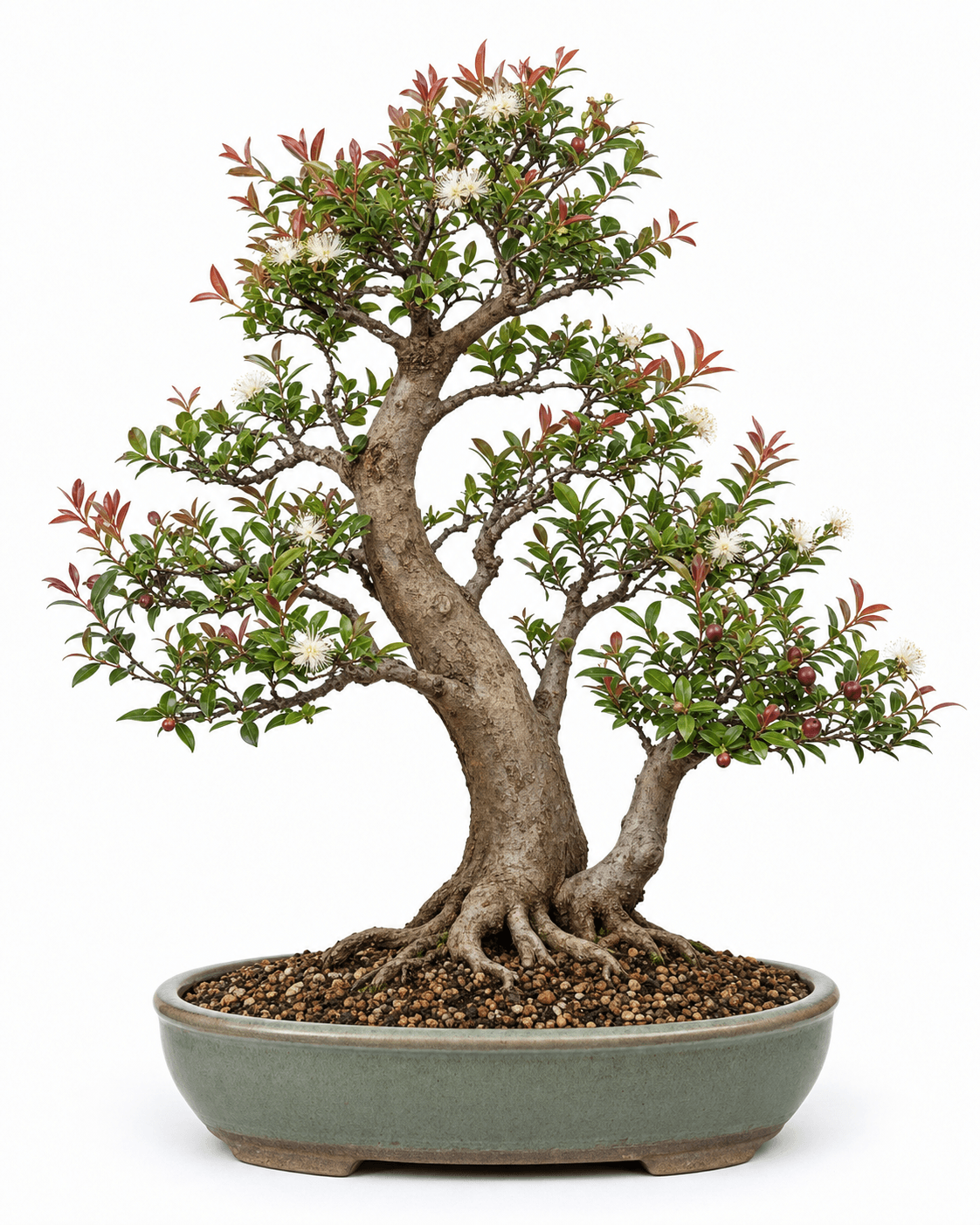
Brush cherry bonsai, Syzygium paniculatum, is a tropical to subtropical Myrtaceae tree grown for glossy small leaves, red new growth, white flowers, magenta to dark fruit, and a compact hedge-like response to pruning. Treat it as Broadleaf > Tropical material: bright light, warm roots, a draining mineral mix, active-growth pruning, and careful winter protection.
A June 2026 local corpus scan found brush cherry listed in Live Q&A 129 but no dedicated Syzygium file or brush-cherry-specific claim set. This guide therefore applies Mirai tropical, broadleaf-evergreen, fruiting-broadleaf, watering, soil, repotting, wiring, propagation, and design method transparently, then grounds identity, hardiness, pests, and native habitat in Kew, UF/IFAS, UC IPM, Australian Plants Society NSW, and Brooklyn Botanic Garden records.
The practical bonsai lesson is restraint. Brush cherry can back bud, flower, fruit, and clip well, but weak light, cold wet soil, pest pressure, and hedge-shearing without interior light quickly turn a dense canopy into a hollow shell.
Updated June 20, 2026. Written by EntGrove Editorial. Last verified June 20, 2026.
Care fingerprint
Read the species through its shared care pattern.
Treat indoor culture as a light-management problem first; prune and repot when the tree is actively growing and warm enough to recover. Use this as the starting point before local conditions and tree strength refine the calendar.
Note: Current accepted name is Syzygium paniculatum. Eugenia paniculata is a formal synonym, Eugenia myrtifolia appears in trade, and lilly pilly / brush cherry labels need exact-species verification.
Read the foliage first
Broadleaf stress usually shows in leaf color, leaf size, wilt, scorch, or delayed hardening before it becomes a branch problem.
Match work to dormancy
Deciduous, evergreen, tropical, succulent, and flowering broadleaf trees recover on different calendars.
Protect fine roots
Root work should preserve enough active fine roots for the tree to rehydrate quickly after the operation.
Care cadence
The calendar starts with the tree's seasonal state.
Placement
Timing: Grow in full sun to part shade after acclimation. Move outside only after nights are consistently warm, and reserve major work for periods above roughly 60 F / 16 C.
Watch for: Large pale leaves, long internodes, sparse interior growth, cold glass, abrupt sunburn after winter protection, and weak shoots after low-light storage.
UC IPMAustralian Plants Society NSWBonsai Mirai LibraryWatering
Timing: Water deeply during warm growth when the upper soil is drying and the tree is using water. In cool protection, water less often and keep oxygen in the lower pot.
Watch for: Wet lower soil, dry hydrophobic nursery peat, sour smell, leaf droop after cold nights, and pots that stay wet for days indoors.
UC IPMUF/IFAS ExtensionBonsai Mirai LibraryFertilizer
Timing: Feed during warm active extension. Use stronger feeding while building trunks and branches, then reduce once internode length, flower placement, and leaf scale matter.
Watch for: Coarse shoots in weak light, salt buildup in a protected pot, fertilizer on cold roots, and starving a tree that is being clipped repeatedly.
Bonsai Mirai LibraryPruning
Timing: Let selected shoots extend enough to strengthen a branch, then cut back after the growth hardens. Use repeated small pruning cycles to keep interior buds alive.
Watch for: Hedge-sheared outer shells, shaded interiors, three or more shoots from one junction, fruiting tips removed by accident, and old pruning stubs.
Bonsai Mirai LibraryUF/IFAS ExtensionAustralian Plants Society NSWLeaf work
Timing: Use selective leaf reduction only on vigorous trees in active growth when light access or pest inspection requires it. Avoid routine full defoliation on weak or indoor trees.
Watch for: Defoliation used to compensate for weak light, a recently repotted tree stripped of transpiring leaves, and repeated leaf work without root recovery.
Bonsai Mirai LibraryFlowers and fruit
Timing: Allow flowers and fruit on strong refined trees. Remove excess fruit on young, recently repotted, weak, or regionally risky trees so energy returns to leaves and roots.
Watch for: Birds spreading seed, fruit pulling branches down, flowers pruned off by hedge clipping, and reproductive load before structural work.
UF/IFAS ExtensionAustralian Plants Society NSWBonsai Mirai LibraryRepotting
Timing: Repot during stable warm growth, usually after the tree has resumed active extension and nights are reliably above roughly 60 F / 16 C. Keep a working root mass attached and correct nursery soil in stages when necessary.
Watch for: Cold wet aftercare, bare-rooting a leafy tropical, buried crowns, weak anchoring, and combining major root work with heavy canopy reduction.
Bonsai Mirai LibraryWiring
Timing: Wire young flexible shoots during active growth, then check often. Use clip-and-grow for much of the finer branch architecture.
Watch for: Wire bite on smooth bark, brittle older wood, uniform bends that ignore natural shrub movement, and branches wired while the tree is cold or pest-stressed.
Bonsai Mirai LibraryBrooklyn Botanic GardenPests
Timing: Inspect tender shoots, new red leaves, flower clusters, and leaf undersides through warm growth and winter protection.
Watch for: Psyllids, scales, mites, giant whitefly, glassy-winged sharpshooter, woolly whitefly, honeydew, distorted leaves, and nutrient or water-management disorders.
UC IPMAustralian Plants Society NSWUF/IFAS ExtensionWinter protection
Timing: Protect before nights approach the mid-30s F / 1-3 C in a bonsai pot, and give bright airflow and warmer roots through winter storage.
Watch for: Frost burn, leaf drop after cold wet soil, pest buildup under glass, and treating a cold-protected tree as if it were still in summer growth.
UC IPMBonsai Mirai LibrarySpecies guide
Apply the species profile before copying another tree's calendar.
At a glance
Brush cherry is a warm-climate myrtle that becomes bonsai through light, clipping, and root oxygen.
The accepted botanical target is Syzygium paniculatum in Myrtaceae. Kew places it in the subtropical biome of eastern Australia, and UF/IFAS notes that older trade catalogues may still label it Eugenia myrtifolia. Kew POWOUF/IFAS Extension
The bonsai target is a small-leaved, evergreen tropical broadleaf with red new growth, white flowers, fruit, and natural compactness. Those traits make it workable from nursery hedging, topiary, and pre-bonsai material. UF/IFAS ExtensionAustralian Plants Society NSWBrooklyn Botanic Garden
The source caveat is important. A June 2026 scan found brush cherry in the Live Q&A 129 species list, but no dedicated brush cherry file and no species-specific Mirai claim set. This page therefore uses species-specific public horticulture sources for plant facts and Mirai for transferable tropical bonsai timing. Bonsai Mirai LibraryKew POWOUC IPM
Wild habitat
Its native habitat explains the bonsai need for warmth, drainage, and layered light.
Kew gives the native range as New South Wales and Queensland. Australian Plants Society NSW describes it on coastal New South Wales sites in subtropical and littoral rainforest and on sand dunes behind the beach. Kew POWOAustralian Plants Society NSW
That habitat suggests a plant accustomed to warm growth, filtered to open light, air movement, and soil that drains after rain. In bonsai, the pot compresses those conditions into a shallow root column, so drainage and oxygen matter more than the tree landscape drought reputation. Australian Plants Society NSWUF/IFAS ExtensionBonsai Mirai Library
For care, grow it bright and warm, water thoroughly, and avoid cold wet stagnation. For design, read it as a coastal rainforest edge shrub or small tree with multiple stems, glossy foliage, white flowers, and fruit rather than as a rigid conifer outline. UF/IFAS ExtensionAustralian Plants Society NSWBonsai Mirai / Asymmetry
Australian Plants Society NSW also notes that it can become weedy where planted away from its local native range. Warm-climate bonsai growers should remove unwanted fruit and check local guidance before composting seed-bearing material. Australian Plants Society NSW
Reading
Read brush cherry through new growth color, interior light, fruit load, and pest pressure.
Healthy brush cherry pushes reddish new leaves that mature glossy dark green. If new growth is long, pale, and sparse, the first suspect is light, followed by cold roots, pest pressure, or fertilizer that exceeds the tree light budget. UF/IFAS ExtensionUC IPMBonsai Mirai Library
Interior light is the refinement signal. A clipped outer wall can look dense from the front while inner branches lose leaves and buds. Open windows in the canopy, keep useful interior leaves, and prune branch by branch. Bonsai Mirai LibraryUF/IFAS Extension
Fruit load is a stage signal. In development, flowers and fruit are usually secondary to roots, trunk, and branch placement. In refinement, fruit can complete the image if the tree is strong enough to carry it. UF/IFAS ExtensionAustralian Plants Society NSWBonsai Mirai / Asymmetry
Pests are part of the read. UC IPM lists psyllids, scales, whiteflies, and related disorders, while Australian Plants Society NSW calls out psyllid damage on leaves. Distorted new leaves should trigger inspection before more pruning. UC IPMAustralian Plants Society NSW
Pruning
Prune as a bonsai branch system, not as a hedge.
Brush cherry tolerates clipping, which is why it is common as a hedge, screen, topiary, and patio container plant. Bonsai pruning should be more selective: identify the branch line, preserve interior buds, then cut back after extension has hardened enough to feed the branch. UF/IFAS ExtensionBonsai Mirai Library
On development material, let sacrifice shoots run where they build trunk or primary branch girth. Cut them back before swelling creates inverse taper or a congested junction that will be hard to hide. Bonsai Mirai LibraryBonsai Mirai / Asymmetry
On refined material, use repeated small cuts and selective thinning. Remove strong upward shoots, crossing shoots, and crowded opposite forks before they thicken, and keep leaves where they still feed weak interiors. Bonsai Mirai Library
Flowers appear in warm months in the UF/IFAS profile, and Australian Plants Society NSW notes heavier flower and fruit production after pruning. If fruit display matters, stop trimming the target branch tips before the flower cycle. UF/IFAS ExtensionAustralian Plants Society NSW
Repotting
Repot in warmth and preserve enough roots to keep evergreen foliage hydrated.
Use the Mirai tropical rule: root work belongs in active warmth, when the tree can replace fine roots. Avoid repotting during cold protection or during the first days after a hard top reduction. Bonsai Mirai Library
Never treat a leafy tropical like a dormant deciduous tree. Keep part of the root mass working, reduce nursery soil in stages when needed, and avoid pairing major root disturbance with heavy defoliation. Bonsai Mirai Library
Brush cherry sold as topiary or hedge material may arrive in peat-heavy or water-repellent nursery soil. The first bonsai repot should prioritize drainage, root orientation, anchoring, and an honest trunk angle rather than an immediate shallow show pot. UF/IFAS ExtensionBonsai Mirai Library
After root work, return the tree to bright protected warmth, secure the trunk, and watch water use. A pot that feels wet for days after repotting is telling you that oxygen and root activity are below target. Bonsai Mirai LibraryUC IPM
Soil and pot
Build the soil around oxygen first, then tune water retention by climate.
UF/IFAS lists broad soil tolerance in landscapes, including acidic, alkaline, sand, loam, and clay, and UC IPM says well-drained soils are desirable. Bonsai culture narrows that to a durable aggregate mix because the container is shallow. UF/IFAS ExtensionUC IPM
A reliable starting point is a mostly mineral mix built from pumice, lava, and a water-holding component matched to climate. Akadama can help refinement in temperate protection, but Mirai tropical soil method warns that humid tropical heat breaks it down quickly and can leave high-metabolism growth underfed if used alone. Bonsai Mirai Library
Training containers should support roots and recovery. Use deeper or wider containers while building trunk and low branches, then move into shallower ovals, rounds, or soft rectangles once root density and watering rhythm are stable. Bonsai Mirai / AsymmetryBonsai Mirai Library
Pot pairing can lean quiet and warm: muted green, cream, brown, or restrained glazed containers work with red new growth and magenta fruit. The foliage and fruit should carry the color before the pot does. Bonsai Mirai / AsymmetryBrooklyn Botanic Garden
Climate
Warm regions get outdoor vigor; cooler regions need bright protected culture.
UF/IFAS lists Zones 10 through 11 for landscape culture. UC IPM says plants can be damaged where temperatures fall below 25 F / -4 C and are frost sensitive. A bonsai pot has less thermal buffer than the ground, so protect earlier. UF/IFAS ExtensionUC IPM
In south Florida, coastal California, and similar mild climates, brush cherry can spend much of the year outside. The main adaptations are airflow, pest monitoring, fruit cleanup, and avoiding saturated soil after storms. UF/IFAS ExtensionUC IPMAustralian Plants Society NSW
In temperate climates, winter protection must be bright enough to keep leaves useful. A dim room with warm air and wet soil encourages weak shoots and pests before spring recovery begins. Bonsai Mirai LibraryUC IPM
In dry heat, increase water attention and protect freshly repotted trees from harsh afternoon exposure until roots recover. In humid heat, keep the canopy open so pests and fungal problems are easier to see. Bonsai Mirai LibraryUC IPM
Pests
Psyllids, scale, whiteflies, mites, and water disorders are the routine watch list.
UC IPM lists giant whitefly, glassy-winged sharpshooter, psyllids, scales, and whiteflies on Australian brush cherry, plus frost, mineral problems, and water-management disorders. UF/IFAS lists scales and mites. UC IPMUF/IFAS Extension
Australian Plants Society NSW specifically warns that psyllids can cause pimple-like wounds and distorted leaf growth. On a bonsai, that distortion can ruin a refined canopy faster than minor chewing damage. Australian Plants Society NSW
Start pest response with culture. Increase light and airflow, remove dead leaves and old fruit, isolate new purchases, and inspect leaf undersides and branch crotches before spraying. Bonsai Mirai LibraryUC IPM
Use local extension guidance for chemical controls, especially on a flowering or fruiting plant. Avoid treatment during heat stress, drought stress, or immediately after major root work unless the pest pressure itself is the greater risk. UC IPMBonsai Mirai Library
Wiring
Wire young wood for placement, then use pruning to build the canopy.
Brush cherry can be trained into formal and informal upright bonsai, as Brooklyn Botanic Garden records in its collection. The branch work still needs to respect tropical broadleaf recovery and smooth bark. Brooklyn Botanic GardenBonsai Mirai / Asymmetry
Wire young flexible shoots during warm active growth. Older branches are better repositioned with gradual guying, directional pruning, or by growing a new branch than by forcing a hard bend. Bonsai Mirai Library
Check wire frequently during warm feeding because swelling can mark bark quickly. Remove or reset wire before the mark becomes part of the design. Bonsai Mirai Library
Use wiring to establish trunk movement, primary branch angle, and negative space. Let clip-and-grow create most of the secondary and tertiary branching so the canopy does not become a wired hedge shell. Bonsai Mirai / AsymmetryBonsai Mirai Library
Propagation
Seed and softwood cuttings are the practical routes, with label records kept from day one.
Australian Plants Society NSW lists propagation from seed or softwood cuttings. UF/IFAS describes fleshy fruit suited for human consumption and attractive to birds, which also explains why seed cleanup matters in warm regions. Australian Plants Society NSWUF/IFAS Extension
For softwood cuttings, use warmth before technique. Mirai propagation method favors sustained nights above 60 F / 16 C, reduced foliage so transpiration stays in balance, and a loose medium that lets new roots find oxygen. Bonsai Mirai LibraryAustralian Plants Society NSW
For bonsai, cuttings are useful when a plant has compact foliage, good color, or a short-internode habit worth preserving. Seed gives variation but may produce coarser leaves or weaker branch placement. Bonsai Mirai / AsymmetryAustralian Plants Society NSW
Air layering is plausible on vigorous tropical broadleaf material, but this profile has no brush-cherry-specific Mirai or extension benchmark for timing. Use it only when the target branch already solves a design problem. Bonsai Mirai Library
Keep the original label with every propagated plant. Brush cherry, lilly pilly, Eugenia, Syzygium, and magenta cherry labels can point to different species with different cold tolerance and pest behavior. Kew POWOUF/IFAS ExtensionAustralian Plants Society NSW
Buying
Buy compact material with a label, visible roots, and interior branch options.
Brush cherry often appears as hedge, patio, screen, topiary, or container material. UF/IFAS notes its small leaves, year-round growth, compact habit, container suitability, and multiple-trunk potential, all useful traits for bonsai selection. UF/IFAS Extension
Good pre-bonsai material has a verified Syzygium paniculatum label, a trunk or clump line worth keeping, low branches, active interior buds, fine glossy leaves, and a root base that can be improved without burying the crown. UF/IFAS ExtensionBonsai Mirai / Asymmetry
Reject or quarantine material with distorted new leaves, sticky honeydew, scale bumps, whiteflies, mite webbing, sour soil, a pot that never dries, or a topiary shell with no live interior growth. UC IPMAustralian Plants Society NSWBonsai Mirai Library
Ask how the plant was grown. A south Florida hedge liner, a California patio topiary, and a greenhouse tropical each need a different transition into your light, winter protection, and watering routine. UF/IFAS ExtensionUC IPM
Troubleshooting
Diagnose by light, root oxygen, cold history, pest signs, and canopy density.
Symptom: long internodes and large pale leaves. Likely causes: weak light, warm indoor air without enough sun, or fertilizer exceeding available light. Fix: increase light gradually, delay refinement, and feed only with active strong growth. Bonsai Mirai LibraryUC IPM
Symptom: leaf drop after winter storage. Likely causes: cold roots, wet soil, low light, or pests under protection. Fix: move to bright warm shelter, reduce water to actual demand, inspect undersides, and wait for new growth before styling. UC IPMBonsai Mirai Library
Symptom: distorted new leaves. Likely causes: psyllids, mites, nutrient imbalance, or water-management stress. Fix: inspect with magnification, improve airflow and watering, and follow local IPM guidance before pruning more foliage. UC IPMAustralian Plants Society NSW
Symptom: dense green outside, dead interior. Likely causes: hedge shearing, low light, no thinning, or repeated outer clipping. Fix: open windows, prune branch by branch, and preserve leaves on weak useful interior branches. Bonsai Mirai LibraryUF/IFAS Extension
Symptom: no flowers or fruit. Likely causes: pruning off branch tips, weak light, immature material, or prioritizing structure over display. Fix: choose a display cycle and stop trimming the target tips before bloom. UF/IFAS ExtensionAustralian Plants Society NSW
Symptom: soil stays wet and leaves dull. Likely causes: decomposed nursery soil, cold protection, oversized pot, or blocked drain holes. Fix: improve aftercare now and plan a warm-season staged transition into aggregate soil. Bonsai Mirai LibraryUC IPM
Design
Style it as a compact tropical myrtle with flowers, fruit, bark, and negative space.
Start with the root base, trunk line, defining branch, and apex. Brush cherry often has multiple stems from low on the plant, which can support clump, twin-trunk, or informal upright designs when the base is coherent. UF/IFAS ExtensionBonsai Mirai / Asymmetry
Use the natural character. Red new leaves, white flowers, magenta fruit, thin twigs, and showy bark on older trunks are enough visual information without forcing deadwood or conifer pad language. UF/IFAS ExtensionAustralian Plants Society NSW
Refinement should create layered openings rather than a solid hedge outline. A readable brush cherry bonsai has a live interior, visible trunk sections, short internodes, and flower or fruit placement that supports the front. Bonsai Mirai / AsymmetryBonsai Mirai Library
Brooklyn Botanic Garden records Syzygium paniculatum bonsai in formal and informal upright styles, including trees shaped by Kazuo Fujii in 1986. That public collection evidence supports the species as legitimate bonsai material when the structure is disciplined. Brooklyn Botanic Garden
Forms
Treat cultivar labels cautiously because brush cherry names are often messy.
UC IPM notes compact and dwarf forms are available, and UF/IFAS notes that the plant is often clipped into hedges and topiary. Those traits are valuable for bonsai, but the label still needs verification. UC IPMUF/IFAS Extension
Kew lists Eugenia paniculata as a synonym of Syzygium paniculatum, while UF/IFAS reports Eugenia myrtifolia in catalogue use. Australian Plants Society NSW says the species is similar to S. oleosum, S. australe, and S. crebrinerve. Kew POWOUF/IFAS ExtensionAustralian Plants Society NSW
For bonsai, form value is practical: smaller leaves, short internodes, low branch options, active back budding, clean bark, and root quality. A cultivar name alone is less useful than those visible traits. Bonsai Mirai / AsymmetryUC IPM
History
Brush cherry has public bonsai evidence, plus a broader Australian plant story.
Australian Plants Society NSW calls Syzygium paniculatum magenta lilly pilly or magenta cherry and notes that it is threatened in its natural habitat while also capable of establishing where planted outside local range. Australian Plants Society NSW
Brooklyn Botanic Garden lists Syzygium paniculatum in its bonsai collection, including formal and informal upright trees, with two trees shaped by Kazuo Fujii in 1986. That gives this species a concrete public bonsai record. Brooklyn Botanic Garden
The exhibition standard should be horticultural clarity rather than novelty: clean roots, an open interior, compact leaves, controlled fruit, pest-free new growth, and a design that reads as a tropical myrtle instead of generic mall-bonsai styling. Bonsai Mirai / AsymmetryBonsai Mirai Library
Species questions
Answer the beginner questions before styling.
Is brush cherry a good bonsai species?
Yes, if the grower can provide warm bright conditions and pest monitoring. Syzygium paniculatum has small evergreen leaves, red new growth, white flowers, fruit, and a compact pruning response.
Is brush cherry Syzygium paniculatum or Eugenia myrtifolia?
Use Syzygium paniculatum as the current accepted name. UF/IFAS notes that Eugenia myrtifolia still appears in some catalogues, and Kew lists Eugenia paniculata as a formal synonym.
Can brush cherry bonsai grow indoors?
It can be winter-protected indoors with strong light, warmth, airflow, and reduced watering. It is healthier outdoors or in a greenhouse during warm weather.
How cold can brush cherry bonsai tolerate?
UF/IFAS lists Zones 10 through 11, and UC IPM says plants can be damaged below 25 F / -4 C. Protect bonsai earlier because container roots chill faster.
When should I repot brush cherry bonsai?
Repot during stable warm active growth, usually after the tree has resumed extension. Inspect every 2-3 years, or sooner if drainage slows or nursery soil is failing.
What soil is best for brush cherry bonsai?
Use a fast-draining tropical aggregate mix with enough retention for warm active growth. Pumice, lava, and a water-holding component can be adjusted by climate, with less reliance on akadama alone in humid tropical heat.
How should I prune brush cherry bonsai?
Let useful shoots extend enough to feed the branch, then cut back after hardening. Avoid hedge-shearing the outer shell while the interior loses light.
Why are my brush cherry leaves distorted?
Likely causes include psyllids, mites, nutrient stress, or water-management problems. UC IPM and Australian Plants Society NSW both flag psyllid pressure on this species.
Can brush cherry bonsai flower and fruit?
Yes. UF/IFAS describes white warm-season flowers and red to black fruit, and Australian Plants Society NSW describes magenta fruit. Let only strong refined trees carry a full crop.
Is brush cherry the same as Surinam cherry or Barbados cherry?
They are separate plants. Brush cherry is Syzygium paniculatum, Surinam cherry is Eugenia uniflora, Barbados cherry belongs to Malpighia, Water jasmine is Wrightia religiosa, and Gardenia is Gardenia jasminoides in the EntGrove taxonomy.
Sources
Species advice needs source discipline.
Next decisions
Plan the operation before copying the calendar.
A good care note for Brush cherry records the tree's stage, the work done, and the aftercare used. That record matters more than a month-name rule.
Related species
Compare nearby trees before transferring advice.
Ficus retusa / Indian laurel
Ficus microcarpa
Tigerbark ficus
Ficus microcarpa 'Tigerbark'
Willow-leaf ficus
Ficus salicaria
Benjamin fig
Ficus benjamina
Ginseng ficus
Ficus microcarpa 'Ginseng'