
Species guide
Barbados Cherry Bonsai Care
Malpighia emarginata, Malpighia glabra
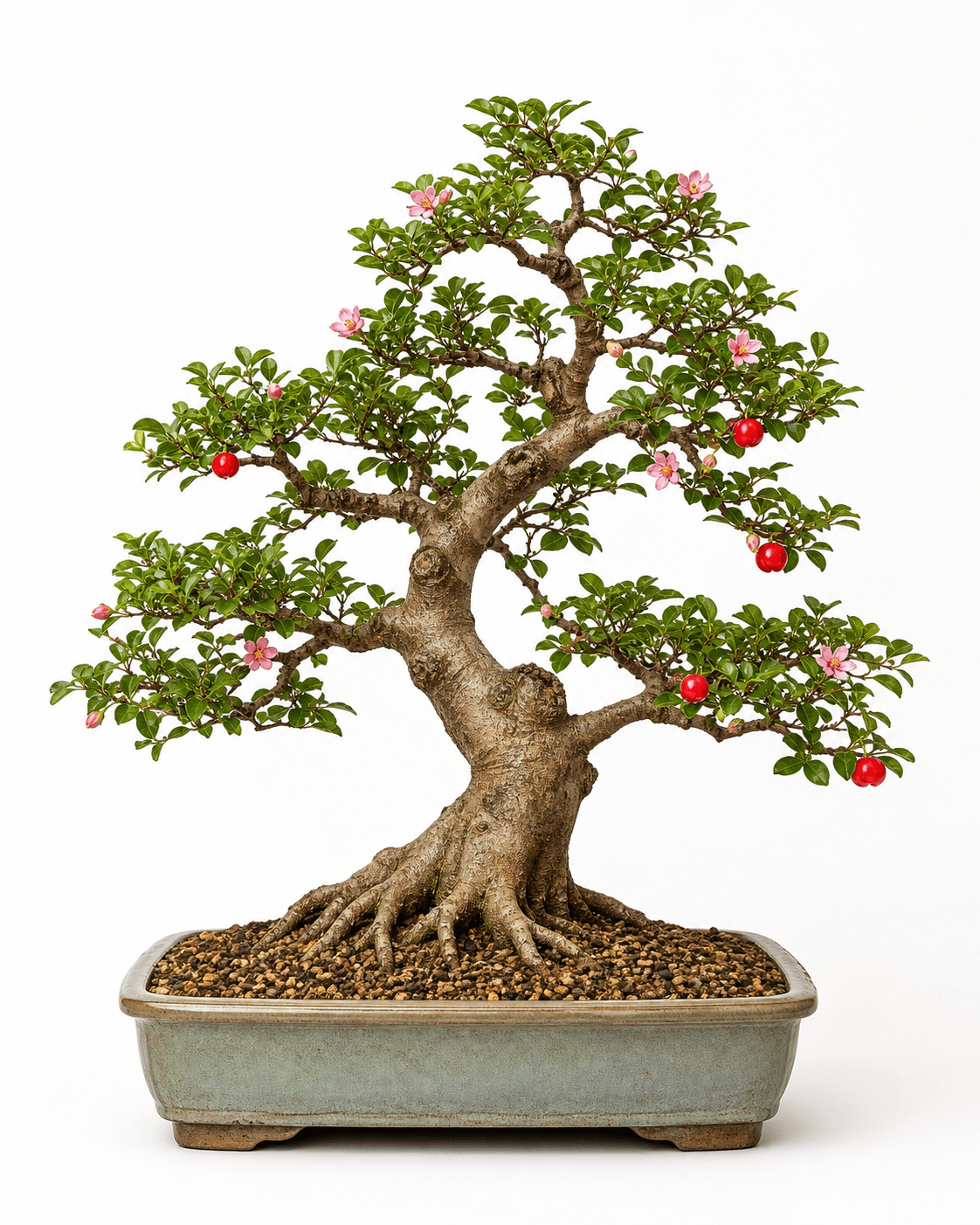
Barbados cherry bonsai are tropical Malpighia shrubs or small trees grown for pink flowers, red acerola-type fruit, opposite leaves, and fast warm-season response. Give them high light, warmth, an oxygen-rich root zone, and pruning that uses their paired buds instead of stripping foliage reflexively.
The name needs care. Bonsai and nursery labels may use Malpighia emarginata, M. glabra, or the older M. punicifolia label, and Flora of North America notes that many plants sold as M. glabra are actually M. emarginata.
This page treats Barbados cherry as Broadleaf > Tropical in the EntGrove taxonomy. It was rechecked on June 20, 2026 against dedicated Mirai Malpighia coverage, plus Kew, Flora of North America, UF/IFAS, Plant Pono, NTBG, and NParks for taxonomy, climate, pest, fruit, and propagation facts.
Updated June 20, 2026. Written by EntGrove Editorial. Last verified June 20, 2026.
Care fingerprint
Read the species through its shared care pattern.
Treat indoor culture as a light-management problem first; prune and repot when the tree is actively growing and warm enough to recover. Use this as the starting point before local conditions and tree strength refine the calendar.
Note: Parent page for practical Barbados cherry bonsai labels. Kew accepts M. emarginata and M. glabra separately; older M. punicifolia labels are treated under M. glabra, and FNA warns that many plants sold as M. glabra are actually M. emarginata.
Read the foliage first
Broadleaf stress usually shows in leaf color, leaf size, wilt, scorch, or delayed hardening before it becomes a branch problem.
Match work to dormancy
Deciduous, evergreen, tropical, succulent, and flowering broadleaf trees recover on different calendars.
Protect fine roots
Root work should preserve enough active fine roots for the tree to rehydrate quickly after the operation.
Care cadence
The calendar starts with the tree's seasonal state.
Placement
Timing: Grow outside in full sun during warm weather after acclimation. In cold climates, use the brightest protected winter space available and move outside only after stable warm nights.
Watch for: Large leaves, weak flowering, long internodes, cold drafts, abrupt sun scorch after indoor storage, or a tree kept too shaded for fruiting growth.
UF/IFAS Extension St. Lucie CountyBonsai Mirai LibraryWatering
Timing: Water thoroughly when the root zone begins to dry, then let the mix breathe. Increase checks during heat, fruit load, and rapid extension.
Watch for: Slow drainage, wet lower soil under a dry surface, leaf wilt after recent watering, nematode-stressed roots, or fruit drop during dry spells.
Bonsai Mirai LibraryUF/IFAS Extension St. Lucie CountyPruning
Timing: In development, let spring shoots extend to thicken selected branches, then cut back to the first couple of leaves. In refinement, remove the shoot tip as soon as the first leaf set hardens.
Watch for: Long thin branches that never thicken, paired buds swelling into bars, pruning that removes all fruiting tips, or repeated cutting without enough light and feeding.
Bonsai Mirai LibraryLeaf work
Timing: Remove whole leaves when you need bud activation on Malpighia. Cut leaves in half only to weaken an overly strong section without forcing new shoots.
Watch for: Confusing Malpighia with Buttonwood leaf response, fully defoliating weak trees, or leaf cutting before the current flush has hardened.
Bonsai Mirai LibraryFertilizer
Timing: Feed during warm active growth. Use stronger feeding for development and fruiting, then taper for refinement when internodes and leaf scale matter.
Watch for: Yellow leaves from underfeeding, coarse growth from overfeeding in low light, or crop load draining reserves before major work.
Bonsai Mirai LibraryUF/IFAS Extension St. Lucie CountyRepotting
Timing: Repot in warm active growth after nights are consistently tropical. Choose the interval from root density, drainage, substrate condition, and design need.
Watch for: Bare-rooting a leafy tree, combining heavy root work with heavy top reduction, burying the root crown, or leaving decomposed organic soil in the core.
Bonsai Mirai LibraryWiring
Timing: Wire young pliable growth during active growth and inspect often. Use pruning and directional cutback for most refined branch building.
Watch for: Wire bite on fast-swelling shoots, bending stiff old wood, wiring across fruiting twigs, or leaving unsupported long extension in wind.
Bonsai Mirai LibraryBonsai Mirai / AsymmetryPropagation
Timing: Use cuttings, air layers, or layering when warmth and humidity are steady. Seed is possible, but clone-based propagation preserves known fruit, leaf, and growth traits.
Watch for: Cold propagation media, seedling variability, air layers placed without improving the parent design, or cuttings kept saturated.
UF/IFAS Extension: Malpighia glabraUF/IFAS Extension St. Lucie CountyPlant Pono: Malpighia emarginataNParks Flora & Fauna WebWinter protection
Timing: Protect before cold nights push the tree below tropical metabolism. Avoid major work during winter storage and reduce water as growth slows.
Watch for: Leaf damage below 30 F / -1 C, wet cold roots, low-light leaf enlargement, and moving from protection to full sun without acclimation.
UF/IFAS Extension St. Lucie CountyBonsai Mirai LibraryPests and disorders
Timing: Inspect roots and tender growth through the warm season. Protected trees still need checks for whiteflies, scale, aphids, mites, and fruit pests.
Watch for: Nematode weakness in sandy soils, deformed fruit, honeydew, scale on twigs, leaf spot under humid crowded canopies, or birds stripping ripe fruit.
UF/IFAS Extension: Malpighia glabraUF/IFAS Extension St. Lucie CountySpecies guide
Apply the species profile before copying another tree's calendar.
At a glance
Barbados cherry is a fast tropical fruiting broadleaf with a naming problem.
The practical bonsai subject is Malpighia grown under Barbados cherry, acerola, West Indian cherry, wild crapemyrtle, and sometimes M. punicifolia labels. Kew accepts both M. emarginata and M. glabra, and FNA cautions that many plants sold as M. glabra are actually M. emarginata. Kew POWO: Malpighia emarginataKew POWO: Malpighia glabraFlora of North America
For care, treat it as a warm tropical flowering and fruiting broadleaf. It wants strong light, active roots, a freely draining pot, and enough feeding to support repeated pruning, flowers, and fruit. Bonsai Mirai LibraryUF/IFAS Extension St. Lucie County
The bonsai advantage is the paired-bud response. Mirai describes Malpighia as opposite-leaved, so removing a shoot tip can signal the paired dormant buds below to break and form two new branches. Bonsai Mirai Library
Wild habit
Its ecology points to heat, sun, drought tolerance, and seasonal growth pulses.
Kew places M. emarginata in the seasonally dry tropical biome from Mexico to northern Colombia, with several Caribbean and tropical introductions. Kew places M. glabra from southern Texas through tropical America and the Caribbean. Kew POWO: Malpighia emarginataKew POWO: Malpighia glabra
NTBG describes Barbados cherry as a bushy shrub or small tree with erect, spreading, or drooping branches, glossy evergreen leaves, pink flowers, and bright red fruit. UF/IFAS describes M. glabra as a rounded, fairly delicate-canopied shrub or small tree in south Florida nursery use. National Tropical Botanical GardenUF/IFAS Extension: Malpighia glabra
That ecology informs care. Barbados cherry can handle heat and some drought in the ground, but a bonsai pot removes soil volume and thermal buffering. The goal is full light and strong metabolism with root oxygen protected after every watering. Bonsai Mirai LibraryUF/IFAS Extension St. Lucie County
The design implication is a tropical fruiting shrub image, often with rounded crown movement, sinewy multi-trunk potential, light-catching branch tips, flowers, and small fruit. It should read as a warm-climate tree rather than as a temperate deciduous silhouette. UF/IFAS Extension: Malpighia glabraBonsai Mirai / Asymmetry
Reading
Read Barbados cherry through paired buds, leaf size, fruit load, and root pace.
Opposite leaves make the branch-building logic clear. When the apical meristem is removed, the paired dormant buds below can push together. That is useful for ramification, but repeated opposite-bud forks can also create swelling if the grower never simplifies junctions. Bonsai Mirai Library
Leaf size is a light and root-maturity signal. Mirai tropical guidance says insufficient light causes tropical leaves to enlarge while extension stalls, and root maturation is the larger engine of refinement and leaf-size control. Bonsai Mirai Library
Flowers and fruit are energy events. Mirai notes that fruiting and flowering trees need enough nutrition because display costs stored energy, and UF/IFAS notes that fruit can ripen within weeks after bloom. Bonsai Mirai LibraryUF/IFAS Extension St. Lucie County
Root speed changes the calendar. In warm climates, Mirai notes that tropical roots grow vigorously through the growing season and development trees can need annual root pruning. In cooler climates, the work window is shorter and intervals stretch. Bonsai Mirai Library
Use the species signals before borrowing generic tropical advice. Compared with Water jasmine, Surinam cherry, brush cherry, and Gardenia, Barbados cherry is defined by Malpighia label work, opposite-bud pruning, whole-leaf activation, and acerola fruit load. Bonsai Mirai LibraryFlora of North AmericaUF/IFAS Extension St. Lucie County
Pruning
Use whole-leaf removal for bud activation and half-leaf cuts for energy balance.
During development, let selected spring shoots extend freely so they thicken. Then cut back to the first couple of leaves once the branch has contributed useful girth and direction. Bonsai Mirai Library
For refinement, Mirai recommends removing the shoot tip as soon as the first set of leaves hardens. Two flushes can emerge from the lateral meristems, and the cycle can be repeated through summer on a vigorous tree. Bonsai Mirai Library
Leaf work on Malpighia is species-specific. Mirai says cutting a leaf in half does not trigger new shoot production on Malpighia. Remove the whole leaf when the goal is a new bud response. Bonsai Mirai Library
Half-leaf cuts still have a role. They can weaken an overly strong section without asking it to push new growth, which helps balance a finished canopy before the next pruning cycle. Bonsai Mirai Library
Prune around flower and fruit goals. UF/IFAS says Barbados cherry flowers from spring through fall in Florida, with fruit ripening 3-4 weeks after bloom. Heavy cutting right before a desired crop trades display for structure. UF/IFAS Extension St. Lucie CountyBonsai Mirai Library
Repotting
Repot during warm active growth and keep part of the root mass functioning.
Mirai tropical repotting guidance uses consistent warmth as the trigger. Once nights are reliably above about 60 F / 16 C, tropicals have enough metabolic speed for repotting, pruning, and recovery. Bonsai Mirai Library
Avoid bare-rooting a leafy tropical. Mirai warns against bare-rooting trees that carry leaves or needles because a complete interruption of root function can outpace the foliage mass. Bonsai Mirai Library
Use root evidence for the interval. In hot regions, Mirai describes tropical repotting every 2-3 years as common, with development-stage root pruning sometimes needed annually. Cooler temperate culture can stretch intervals when growth is slower. Bonsai Mirai Library
Protect the root crown. Mirai cautions that burying the crown deeper on tropicals can promote rot because moisture stays active around the bark-to-soil transition. Show the root flare as the high point of the soil surface. Bonsai Mirai Library
Soil and pot
Build the pot around oxygen, fruiting demand, and local rainfall.
Mirai states that akadama is effective for Malpighia where it is available. A practical starting point is akadama, pumice, and lava, adjusted for heat, rain, indoor protection, and how quickly the root ball dries. Bonsai Mirai Library
UF/IFAS says Barbados cherry needs fertile, nematode-free soil, tolerates several soil textures, and grows best in well-drained conditions. In a bonsai pot, fertility and drainage must both be designed into the mix. UF/IFAS Extension: Malpighia glabraUF/IFAS Extension St. Lucie County
High-rainfall tropical culture may need a freer-draining or more durable aggregate. Mirai notes that akadama can break down quickly where rain is constant and the pot never gets a drying interval. Bonsai Mirai Library
Pot choice should fit the design stage. Use larger training containers for trunk and primary growth, then move to a shallower glazed oval, round, or soft rectangle once the structure can support finer root restriction and display. Bonsai Mirai LibraryBonsai Mirai / Asymmetry
For color, let the display feature lead. Mirai tropical repotting guidance recommends choosing flowering tropical containers by the flower or fruit color, which makes soft green, cream, blue-green, or muted red-brown glazes plausible depending on the tree. Bonsai Mirai Library
Climate
Warm regions can grow hard; cold regions need a shorter, cleaner work calendar.
UF/IFAS lists M. glabra for USDA Zones 9B through 11 and says M. emarginata performs best in Zones 9-11, with young plants sensitive to cold and damage possible below 30 F / -1 C. UF/IFAS Extension: Malpighia glabraUF/IFAS Extension St. Lucie County
In Florida-style warmth, the tree can flower and fruit repeatedly. UF/IFAS reports three to five crops annually in Florida, which means pruning, feeding, and watering need to account for repeated reproductive demand. UF/IFAS Extension St. Lucie County
In cool temperate culture, move the tree outside after stable warm nights and bring it under protection before cold stalls tropical metabolism. Mirai tropical guidance places major work in the warm active window, then recommends reduced winter watering and little aggressive work. Bonsai Mirai Library
Regional risk also matters. Plant Pono rates M. emarginata low risk in Hawaii but notes naturalization in parts of the Caribbean and bird-dispersed seed. Warm-climate growers should clean unwanted fruit and follow local guidance. Plant Pono: Malpighia emarginata
Pests
Nematodes and sap-feeding insects deserve routine checks.
UF/IFAS lists nematodes, whiteflies, scale, and plant bugs for M. glabra, and says fruit can be deformed by pest attack. The St. Lucie County extension note adds aphids, whiteflies, scales, nematodes, occasional leaf spots, birds on ripe fruit, and irritating leaf hairs. UF/IFAS Extension: Malpighia glabraUF/IFAS Extension St. Lucie County
In bonsai, nematode damage can look like weak growth, leaf drop, poor water response, or malnutrition. Sandy warm soils raise the risk, so inspect root health when a tree declines despite correct light and watering. UF/IFAS Extension St. Lucie CountyUF/IFAS Extension: Malpighia glabra
Protected winter culture changes the pest mix. Check tender shoots and leaf undersides for whiteflies, scale, aphids, and mites, especially where airflow is poor and leaves stay soft. UF/IFAS Extension St. Lucie CountyBonsai Mirai Library
Treat culture first. Improve light, root oxygen, airflow, and temperature, then use labeled horticultural oil, soap, or local extension guidance only when the tree is hydrated and out of heat stress. Bonsai Mirai LibraryUF/IFAS Extension St. Lucie County
Wiring
Wire young shoots, then let pruning create most of the ramification.
Barbados cherry can build branch structure quickly through cutback because paired buds respond predictably. Use wire to place a selected branch or establish movement, then rely on pruning cycles for finer forks. Bonsai Mirai Library
Wire during warm active growth when shoots are pliable and capable of recovery. Avoid bending old stiff wood hard enough to split bark or interrupt a fruiting branch that is serving a display purpose. Bonsai Mirai LibraryBonsai Mirai / Asymmetry
Inspect frequently. Tropical growth can swell quickly when heat, water, and fertilizer align, and wire marks on smooth young bark can become permanent design distractions. Bonsai Mirai Library
Long extension used for sacrifice growth may need support. If a branch is being grown for girth, stake or guy it before wind or fruit weight tears the junction. Bonsai Mirai / Asymmetry
Propagation
Cuttings, air layers, and grafting are more predictable than seed.
UF/IFAS says M. glabra is propagated by layering or cuttings, and the St. Lucie County extension note says cuttings or air layering are preferred for M. emarginata to preserve fruit quality and faster bearing. UF/IFAS Extension: Malpighia glabraUF/IFAS Extension St. Lucie County
Plant Pono says reproduction is mostly by air layer and seeds are not often viable. NParks lists seed, grafting, and air-layering for its M. glabra record. Plant Pono: Malpighia emarginataNParks Flora & Fauna Web
For bonsai, choose propagation method by design goal. Air layer a branch that already has taper or movement, take cuttings from compact short-internode material, and use grafting when a known fruiting or leaf form is worth preserving. Bonsai Mirai LibraryUF/IFAS Extension St. Lucie County
Seed has a place for variation, but it is less predictable for a canonical bonsai page. If the label is uncertain between M. emarginata and M. glabra, keep source records with the plant from the start. Flora of North AmericaKew POWO: Malpighia emarginataKew POWO: Malpighia glabra
Buying
Buy the roots and label first, then the flowers and fruit.
Start by checking the label. Barbados cherry, acerola, wild crapemyrtle, West Indian cherry, M. glabra, M. emarginata, and M. punicifolia may all appear in trade, and FNA confirms a real nursery-label confusion between M. glabra and M. emarginata. Flora of North AmericaKew POWO: Malpighia glabraKew POWO: Malpighia emarginata
Good bonsai material has compact leaves, short internodes, visible low branch options, a root base that can be improved, and a pot that drains fast after a full watering. A heavy fruit set is secondary. Bonsai Mirai LibraryUF/IFAS Extension St. Lucie County
Inspect for pests before buying. Whiteflies, scale, aphids, plant bugs, and nematode-weakened roots are all more expensive than they look on a flowering bench. UF/IFAS Extension: Malpighia glabraUF/IFAS Extension St. Lucie County
For colder regions, ask how the tree was wintered. A tree grown in steady Florida or greenhouse warmth needs a careful transition into indoor protection, supplemental light, and reduced winter water. Bonsai Mirai LibraryUF/IFAS Extension St. Lucie County
Troubleshooting
Diagnose Barbados cherry by light, roots, paired buds, fruit load, and cold history.
Symptom: large leaves and stalled extension. Likely causes: low light, immature roots, or too much water in cool protection. Fix: increase light gradually, improve drainage, and wait for warm extension before pruning hard. Bonsai Mirai Library
Symptom: no new shoots after leaf cutting. Likely causes: leaves were cut in half rather than removed whole, or the tree lacked strength. Fix: use whole-leaf removal only on vigorous sections when bud activation is the goal. Bonsai Mirai Library
Symptom: weak foliage despite watering. Likely causes: nematode pressure, decomposed soil, poor root oxygen, or cold root function. Fix: inspect roots at the next warm window and correct the substrate rather than adding more water. UF/IFAS Extension: Malpighia glabraUF/IFAS Extension St. Lucie CountyBonsai Mirai Library
Symptom: flowers or fruit disappear after pruning. Likely causes: branch tips or flowering shoots were removed, or the crop load was traded for structure. Fix: decide whether the next cycle is display, branch building, or recovery before cutting. UF/IFAS Extension St. Lucie CountyBonsai Mirai Library
Symptom: fruit is deformed or messy. Likely causes: plant bugs, whiteflies, birds, or overly heavy fruit load. Fix: inspect regularly, remove unwanted fruit, and use local extension guidance for edible-fruit pest controls. UF/IFAS Extension: Malpighia glabraUF/IFAS Extension St. Lucie County
Symptom: leaf burn or drop after cold. Likely causes: temperatures near or below tropical tolerance, cold wet roots, or abrupt relocation. Fix: move to bright protected warmth, reduce water to actual demand, and wait for active growth. UF/IFAS Extension St. Lucie CountyBonsai Mirai Library
Design
Style it as a tropical fruiting shrub with movement, paired forks, and seasonal color.
Begin with trunk line, root base, defining branch, and apex. Barbados cherry often suits informal upright, slanting, clump, twin-trunk, exposed-root, broom-adjacent, and small fruiting shrub images. Bonsai Mirai / AsymmetryUF/IFAS Extension: Malpighia glabra
The paired-bud habit is both tool and risk. Use it to build quick bifurcation, then thin congested junctions before opposite shoots thicken into knobs. Bonsai Mirai Library
A fruiting design needs open structure. Let light reach the interior, keep branch ends where flowers and fruit can be seen, and avoid building flat conifer pads that hide the plant character. Bonsai Mirai LibraryBonsai Mirai / Asymmetry
Mirai notes that planting-angle changes can help solve a problem trunk on Barbados cherry when root anchorage is adequate. Rotate and tilt before choosing a front, then make root work serve that decision. Bonsai Mirai Library
Forms
Keep Barbados cherry forms together until care differences are proven.
This page covers the practical Barbados cherry bonsai group rather than splitting every taxon or cultivar. Kew accepts M. emarginata and M. glabra separately, and Kew places M. punicifolia under M. glabra. Kew POWO: Malpighia emarginataKew POWO: Malpighia glabra
UF/IFAS recommends improved M. emarginata cultivars such as Florida Sweet and B-17 for home fruit quality. For bonsai, cultivar value depends on compact leaves, short internodes, branch response, flower rhythm, and root performance in a pot. UF/IFAS Extension St. Lucie County
NParks records Barbados cherry, wild crapemyrtle, acerola, and manzanita labels under M. glabra. NTBG records acerola and Barbados cherry under M. emarginata. Keep exact source records when buying or propagating. NParks Flora & Fauna WebNational Tropical Botanical Garden
History
Its bonsai value comes from tropical practice and fruit culture more than named exhibition lineages.
Barbados cherry is widely known as acerola because of its vitamin C rich fruit. Plant Pono notes Hawaii commercial-crop history for ascorbic acid production, while UF/IFAS highlights ornamental pink flowers and edible red fruit. Plant Pono: Malpighia emarginataUF/IFAS Extension St. Lucie County
Mirai gives Barbados cherry enough dedicated bonsai attention to make the species more than a generic tropical. The strongest lessons are paired-bud pruning, whole-leaf versus half-leaf response, tropical seasonality, and root-volume restriction for refinement. Bonsai Mirai Library
A public record of globally named Barbados cherry masterpieces is thinner than for Japanese black pine, junipers, maples, and azaleas. The exhibition standard is therefore horticultural clarity: clean roots, readable structure, compact leaves, open branch rhythm, and fruit that supports the design rather than exhausting it. Bonsai Mirai LibraryBonsai Mirai / Asymmetry
Species questions
Answer the beginner questions before styling.
Is Barbados cherry a good bonsai species?
Yes, for growers who can provide warmth, strong light, and careful watering. It has small fruit, pink flowers, opposite leaves, and a useful paired-bud pruning response.
Is Barbados cherry bonsai Malpighia emarginata or Malpighia glabra?
It can be either in trade. EntGrove treats this as a parent page for M. emarginata and M. glabra labels, and notes that older M. punicifolia labels are common in bonsai material.
Can Barbados cherry bonsai grow indoors?
It can be winter-protected indoors under strong light, but it grows best outdoors in warm high light. Indoors, use supplemental light, airflow, and reduced winter watering.
How cold can Barbados cherry bonsai tolerate?
UF/IFAS lists M. glabra for USDA Zones 9B through 11 and says M. emarginata can be damaged below 30 F / -1 C. Bonsai pots need protection earlier than landscape plants.
When should I repot Barbados cherry bonsai?
Repot in warm active growth after nights are reliably tropical. Inspect every 1-3 years, using drainage, root density, and container stage to decide the exact interval.
What soil is best for Barbados cherry bonsai?
Use a granular, fertile, fast-draining tropical mix. Akadama can work well for Malpighia, but high-rainfall climates may need more durable drainage such as pumice, lava, or local aggregate.
How do I prune Barbados cherry for ramification?
Let shoots extend when you need thickening, then cut back to the first couple of leaves. In refinement, remove the shoot tip after the first leaf set hardens to activate paired buds.
Can I defoliate Barbados cherry?
Use leaf work carefully. Mirai says whole-leaf removal triggers new shoots on Malpighia, while cutting leaves in half weakens a strong section without creating the same bud response.
Why is my Barbados cherry fruit deformed?
UF/IFAS lists plant bugs and other pests as fruit-deforming risks. Check for whiteflies, scale, aphids, plant bugs, birds, and root nematodes before changing fertilizer or watering.
Can Barbados cherry be propagated from cuttings?
Yes. UF/IFAS lists layering or cuttings for M. glabra, and recommends cuttings or air layers for M. emarginata when fruit quality and faster bearing matter.
Sources
Species advice needs source discipline.
Next decisions
Plan the operation before copying the calendar.
A good care note for Barbados cherry records the tree's stage, the work done, and the aftercare used. That record matters more than a month-name rule.
Related species
Compare nearby trees before transferring advice.
Ficus retusa / Indian laurel
Ficus microcarpa
Tigerbark ficus
Ficus microcarpa 'Tigerbark'
Willow-leaf ficus
Ficus salicaria
Benjamin fig
Ficus benjamina
Ginseng ficus
Ficus microcarpa 'Ginseng'