
Species guide
Japanese Yew Bonsai Care
Taxus cuspidata
Japanese yew bonsai are outdoor evergreen conifers for growers who can provide cold dormancy, bright outdoor light, cool roots, and patient pruning cycles. Taxus cuspidata is the strongest and coarsest of the common bonsai yews, which makes it generous with back-budding but unforgiving of rushed root work, live-vein separation, and weak-tree cutback.
Treat Japanese yew as a pruning-led elongating conifer: build reserves with extension, repot at spring bud swell before needles open, prune to interior buds in spring or after prepared winter cold, and style old trunks around the inside-out hollowing that defines mature Taxus deadwood.
Updated June 4, 2026. Written by EntGrove Editorial. Last verified June 4, 2026.
Care fingerprint
Read the species through its shared care pattern.
Strong light, cool-root management, conservative root work, and post-extension pruning dominate the care calendar. Use this as the starting point before local conditions and tree strength refine the calendar.
Note: Kew accepts Taxus cuspidata and places its native range from the southern Russian Far East to northern China and Japan. NC State lists USDA Zones 4a-7b, Oregon State lists Zone 4, RHS rates it H7, and NRCS recommends Zones 4-7. Mirai has direct Japanese yew, Taxus structure, Taxus spring work, Taxus repotting, and Kimura Taxus coverage; apply coarser, stronger cuspidata assumptions only after separating it from English yew, Pacific yew, Taxus x media, Cephalotaxus, and Podocarpus labels.
Do not prune like a pine
Elongating conifers extend from buds and shoots, so candle-cutting assumptions can remove the exact growth the tree needs.
Preserve interior growth
Spruce, fir, hemlock, cedar, redwood, cypress, and larch all become harder to design when interior buds are shaded out.
Keep recovery cool and steady
Many elongating conifers respond best when roots stay evenly moist, oxygenated, and protected from hot dry swings.
Care cadence
The calendar starts with the tree's seasonal state.
Placement
Timing: Keep outdoors year-round with bright light, moving air, and cold dormancy.
Watch for: Weak interior buds from deep shade, summer root heat, winter burn on exposed benches, and dry wind after pruning.
NC State ExtensionOregon State Landscape PlantsBonsai Mirai LibraryWatering
Timing: Water thoroughly when the surface begins to dry, then let oxygen return before watering again.
Watch for: Brown tips after wet periods, old nursery peat, sour soil smell, or a pot that stays wet long after nearby conifers dry.
Bonsai Mirai LibraryUSDA NRCS Plant GuideRepotting
Timing: Repot in spring as terminal buds swell and show white, before needles open enough to show their final shape.
Watch for: Fleshy roots that tear easily, old field soil, weak tie-down, and any plan that combines hard root work with heavy foliage reduction.
Bonsai Mirai LibraryEnergy building
Timing: Let selected shoots extend through the growing season when the tree needs interior buds, branch thickness, or a future cutback point.
Watch for: Repeated pinching of moderate shoots, which can stall the very reserves needed for back-budding.
Bonsai Mirai LibraryRefinement pruning
Timing: Use spring reductive pruning on strong trees, then pinch only the shoots that outrun the intended silhouette.
Watch for: Three-shoot junctions, inward-facing buds, overlong central stems, vertical shoots that dominate pads, and lost dormant white bud sites.
Bonsai Mirai LibraryPrepared hard cutback
Timing: After the first hard freeze, prepared vigorous trees can be cut back for strong interior bud response, then protected for the rest of dormancy.
Watch for: Weak trees, unfed trees, trees pinched all season, and branches cut to bare wood without any retained foliage.
Bonsai Mirai LibraryWiring
Timing: Wire after pruning has reduced the branch to useful structure; major bends are best after spring growth hardens.
Watch for: Thin bark, live tissue separating from deadwood, old branch shoulders, and soft green shoots that should stay unwired.
Bonsai Mirai LibraryFertilizer
Timing: Feed development trees steadily during active growth, then stop before freezing weather begins.
Watch for: Late soft growth, unchecked coarse shoots in refined pads, and feeding a protected tree immediately after heavy winter work.
Bonsai Mirai LibrarySpecies guide
Apply the species profile before copying another tree's calendar.
Care profile
Japanese yew is the vigorous, coarse, cold-hardy Taxus used for strong pruning-led bonsai.
Taxus cuspidata is an accepted Taxaceae species native from the southern Russian Far East to northern China and Japan. Kew lists Japan, Korea, the Kuril Islands, Manchuria, Primorye, Sakhalin, and north-central China in the native distribution, while NC State summarizes the range as Korea, China, Russia, and Japan. Kew POWONC State Extension
For bonsai, Japanese yew offers strong back-budding, shade tolerance, dense evergreen foliage, and old trunks that can carry hollow deadwood. The tradeoff is coarse texture compared with English yew, fine fleshy roots that punish rough handling, poisonous tissue, and scars that stay visible for years. Bonsai Mirai LibraryNC State ExtensionUSDA NRCS Plant Guide
Japanese yew belongs outdoors. It needs winter cold to behave normally, and Mirai specifically frames strong cuspidata stock as cold-hardy material with Hokkaido provenance carrying particular strength. In containers, give it enough sun to keep interior buds active and enough shade to keep roots functional during summer heat. Bonsai Mirai LibraryOregon State Landscape PlantsRHS
Native ecology
Wild Japanese yew is a cold forest survivor with shade tolerance, poisonous foliage, and durable old wood.
The USDA NRCS plant guide places Japanese yew in mixed conifer and conifer-deciduous forests from lowland to lower montane elevations, roughly 100 to 1,600 m, on soils derived from granitic, schistose, or serpentine base rocks in China, Korea, and Japan. USDA NRCS Plant Guide
NC State and Oregon State both describe Japanese yew as tolerant of sun or part shade, urban conditions, drought once established, and cold winters, with winter burn possible on exposed sites. Bonsai care should translate that broad tolerance into cool roots, wind-aware placement, oxygenated soil, and outdoor dormancy. NC State ExtensionOregon State Landscape Plants
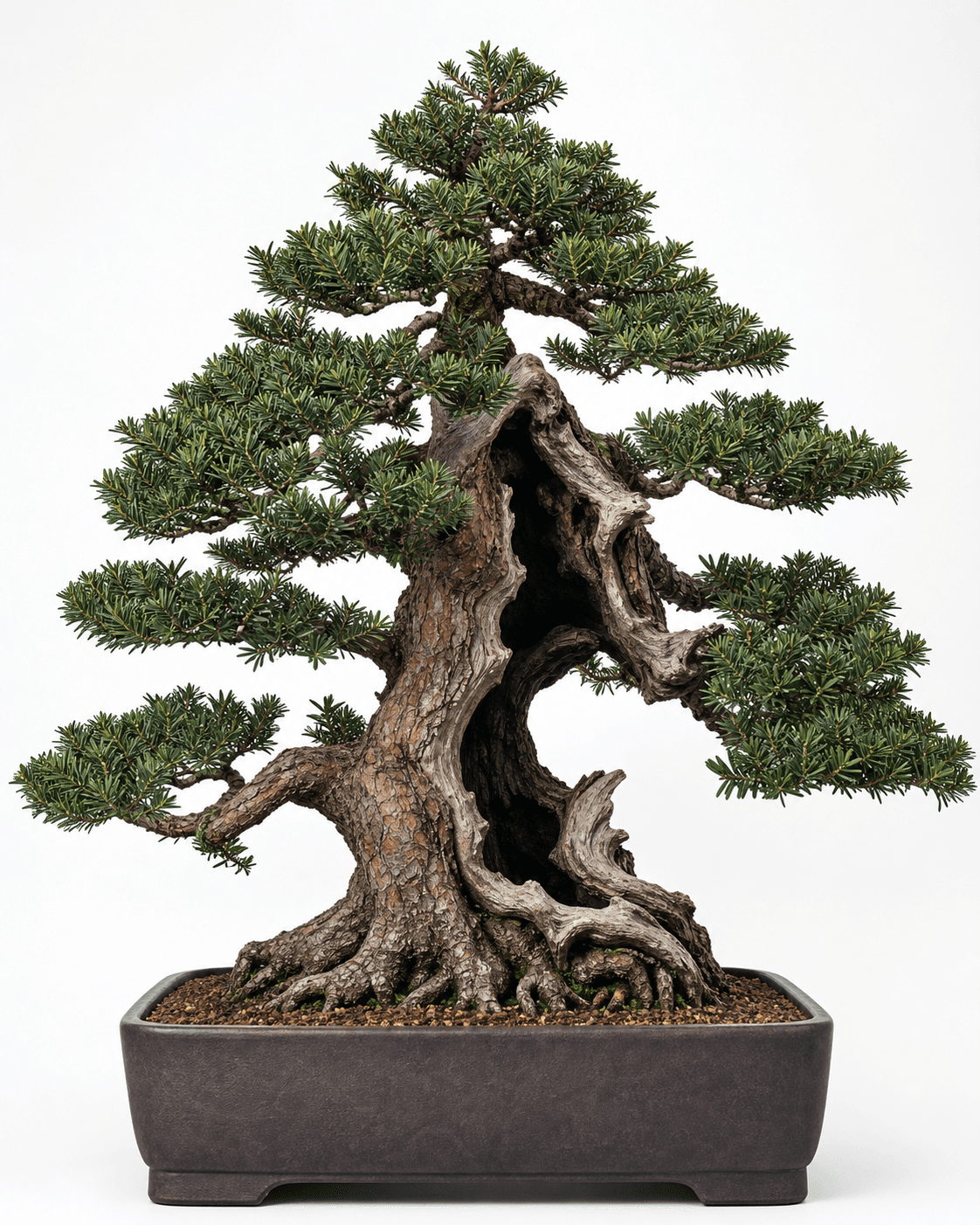
For design, the wild model is endurance in shade and snow rather than fast exposed growth. Old Taxus trunks often hollow from the inside outward, creating dark windows, shell-like walls, and low dense foliage masses. Japanese yew can support rugged deadwood, but the carving should follow that natural hollowing pattern. Bonsai Mirai LibraryBonsai Mirai / Asymmetry
Reading
Read Japanese yew by stored reserves, live buds, branch age, and root oxygen.
Mirai treats Taxus as an elongating conifer that stores major strength in trunk vascular tissue. A strong Japanese yew shows firm foliage, active interior buds, reliable extension, and enough root function to support a spring cutback or repotting window. Bonsai Mirai Library
Development and refinement ask for different behavior. Development branches need extension so the tree builds vascular strength and future cutback points. Refinement branches are pruned back to alternating usable buds, then only the strongest shoots are pinched after they outrun the silhouette. Bonsai Mirai Library
Read the wood before bending. Young Taxus growth can be placed, but mature cuspidata live tissue is less forgiving than many conifers and can separate from the deadwood during heavy moves. Old hollows, thin bark, and slow wound blending should shape the design before wire goes on. Bonsai Mirai Library
Pruning
Japanese yew refinement is built by pruning first and pinching sparingly.
Taxus cuspidata is one of the conifers where pruning can carry most of the refinement. Mirai uses reductive pruning to remove structural flaws, shorten overlong stems, preserve useful interior buds, and set up alternating right-left-right branchlet patterns toward the pad tip. Bonsai Mirai Library
Spring reductive pruning works best once the tree has rebuilt vigor. Remove inward-facing buds, reduce clustered junctions to pairs, shorten overly vertical shoots, and preserve dormant white bud sites so the spring sugar push has useful places to go. Bonsai Mirai Library
Pinching is a refinement tool for dominant elongating shoots. Moderate shoots and development branches should extend first because premature pinching can stop growth and reduce the stored energy that makes Taxus back-budding so valuable. Bonsai Mirai Library
Prepared Japanese yew can respond powerfully to post-freeze cutback. The tree must be strong, fed, and allowed to elongate through the growing season. Retain some old foliage on the branch, cut after the first hard freeze, then protect the tree from further freeze exposure for the rest of dormancy. Bonsai Mirai Library
Live Q&A 129 gives the refinement rhythm in plain terms: cut the tip pre-flush to push interior buds, let those buds strengthen through the year, then cut back further to them the next spring while always keeping some new growth to pull energy inward. Bonsai Mirai Library
Roots
Repot at bud swell and protect the soft, fleshy root system.
Mirai places the Taxus repotting window at spring terminal bud swell, when buds show white and before needles open far enough to reveal their shape. Once the new needles are open, severe root work has missed the most favorable recovery window. Bonsai Mirai Library
Taxus roots are soft, fine, and fleshy, closer in fragility to satsuki or juniper roots than to stiff pine roots. Keep viable roots damp while exposed, preserve the working root pad, and secure the tree so new roots are not torn by movement. Bonsai Mirai Library
Separate major root work from major foliage work. The Mirai corpus repeatedly warns that elongating conifers can take heavy work on one side of the system in a year, while heavy roots and heavy foliage together make survival unpredictable. Bonsai Mirai Library
Collected or old landscape yew should be transitioned in stages. Mirai recommends hard-pruning in the ground first when collection timing allows, so interior buds and vascular strength improve before roots are reduced later. Bonsai Mirai Library
Soil and pot
Use an akadama-heavy mineral mix and a pot that protects root function.
Mirai gives Taxus a mineral mix around 3 parts akadama, 1 part pumice, and 1 part lava. In drier climates the akadama share can move toward 4 parts to hold more water while retaining enough pumice and lava for oxygen. Bonsai Mirai Library
The public horticultural sources all point toward drainage. NC State calls for sandy or loamy neutral to acidic soil with good drainage, RHS says any well-drained soil, and Oregon State notes sun or part shade with cold-winter suitability. NC State ExtensionRHSOregon State Landscape Plants
For bonsai, drainage means more than water leaving the pot. The root zone should hold enough moisture for fleshy roots, shed enough water to prevent root rot, and avoid stale nursery cores that stay wet while the surface looks dry. Bonsai Mirai LibraryUSDA NRCS Plant Guide
Pot choice should support the design phase. Coarse, vigorous cuspidata in development often needs more root volume than the final image suggests. Old hollow-trunk material can carry deeper ovals or quiet rectangles, while compact cultivars can move into smaller pots only after roots are truly domesticated. Bonsai Mirai LibraryOregon State Landscape Plants
Climate
Japanese yew wants winter cold, summer root shade, and protection from exposed extremes.
Japanese yew is very cold hardy in the landscape. NC State lists Zones 4a to 7b, Oregon State lists Zone 4, NRCS recommends Zones 4 through 7, and RHS rates the species H7. Container bonsai still need root protection because shallow pots expose roots more than the ground does. NC State ExtensionOregon State Landscape PlantsUSDA NRCS Plant GuideRHS
Hot regions require adaptation. Mirai notes that containerized Taxus cannot take full summer sun in a temperate maritime climate and may need roughly 20 percent shade cloth there, with more shade in hotter regions. Keep the foliage bright enough for buds while shielding the pot and roots. Bonsai Mirai Library
Cold winter areas need wind management. Oregon State and NRCS both flag winter burn on exposed sites. Bonsai benches should reduce drying wind, protect the pot from freeze-thaw swings, and avoid late feeding that keeps tissue soft when freezes arrive. Oregon State Landscape PlantsUSDA NRCS Plant GuideBonsai Mirai Library
Warm-climate growers should be selective. Mirai suggests that successful warm-region Taxus culture may depend on heat-adapted cultivars, much as some rhododendrons tolerate the southeastern United States better than others. If summer nights stay warm and roots never cool, choose another conifer unless local evidence supports the material. Bonsai Mirai Library
Pests
Most Japanese yew problems start with exposure, drainage, or hidden sap feeders.
NC State lists winter burn, root rot from poor drainage, twig blight, needle blight, mealybugs, scale, and weevils for Japanese yew. RHS similarly lists vine weevil, gall mites, scale insects, tortrix moth, and Phytophthora root diseases. NC State ExtensionRHS
NRCS describes occasional winter burn on exposed sites, twig blight, needle blight, root rot in poorly drained soils, and regional weevil, mealybug, and scale pressure. In bonsai, those risks increase when pads are too dense, old soil holds water, or a newly worked tree sits in drying wind. USDA NRCS Plant GuideBonsai Mirai Library
Prevention is mostly structural: open pads for airflow, keep the tree tied down after root work, avoid decomposed organic cores, inspect the undersides of dense foliage, and treat identified pests with locally labeled controls rather than blanket spraying. Bonsai Mirai LibraryNC State Extension
Toxicity changes cleanup. NRCS documents severe livestock and wildlife poisoning from Japanese yew, including discarded clippings. Put cut foliage and carved waste in a secure trash stream rather than compost, browse piles, or areas accessible to animals. USDA NRCS Plant GuideNC State ExtensionRHS
Wiring
Wire lignified structure after pruning, and treat old live veins as advanced work.
Mirai frames Japanese yew as pruning-led. After reductive pruning has shortened overlong stems and selected usable buds, wire the remaining woody structure so each branch has direction without chasing every soft shoot. Bonsai Mirai Library
Use wire strong enough to control short, thick branchlets. The Taxus spring-work corpus notes that under-gauging leads to unnecessary wiring of fine pieces and weak directional control. Pair branchlets when possible so phototropic shoots stay down over time. Bonsai Mirai Library
Keep wire on lignified wood and off soft green growth. Finish secondary and tertiary wire over the top of the foliage mass to press Taxus growth down, then check often because thin bark scars can remain visible for years. Bonsai Mirai Library
Heavy bends on old Japanese yew require caution. The Kimura Taxus and Taxus structure files describe live tissue that can separate from deadwood; raffia, guy wires, live-vein thinning, and backup design options belong to advanced work on strong trees. Bonsai Mirai Library
Propagation
Use cuttings for cultivars, seed for variation, and air layers only with a safety branch.
NC State lists Japanese yew cultivars including Aurescens, Capitata, Dwarf Bright Gold, Emerald Spreader Monloo, and Nana Aurescens. Cuttings are the practical route for those named forms because seedlings will vary in sex, vigor, habit, and needle scale. NC State Extension
RHS recommends semi-ripe cuttings or sowing seed as soon as it is ripe outdoors. NRCS adds a seed stratification sequence of 150 to 210 days at 65 deg F followed by 60 to 120 days at 36 to 41 deg F, plus rooting cuttings with rooting hormones. RHSUSDA NRCS Plant Guide
Mirai treats Taxus air layering as difficult. It becomes realistic only when a living branch remains below the layer as a sap-flow safety net. Without that lower branch, the method carries poor odds. Bonsai Mirai Library
Field-grown or collected material is usually more valuable than seed-grown twigs when the goal is a bonsai with age. Prepare it by building interior buds first, then correcting roots later rather than extracting and styling in one season. Bonsai Mirai Library
Buying
Buy Japanese yew for trunk, roots, interior buds, and cultivar habit.
Good Japanese yew starter material has a visible base, healthy dark needles, active interior buds, branch options near the trunk, and a root system that can be moved toward bonsai soil without removing all strength at once. Bonsai Mirai Library
Landscape yew can be useful because it tolerates pruning and back-buds well. Inspect hedge stock carefully for straight trunks, buried root flares, reverse taper, dead interiors, ugly shearing scars, compacted peat, and branches too high for bonsai use. NC State ExtensionRHSBonsai Mirai Library
Cultivar habit matters. Oregon State lists Cross Spreading, Dwarf Bright Gold, Capitata Aurea, and Emerald Spreader; NC State lists Capitata and other compact or golden forms. Choose compact forms for smaller bonsai and upright forms only when their vertical habit fits the planned design. Oregon State Landscape PlantsNC State Extension
Verify labels before applying care assumptions. Taxus cuspidata, Taxus baccata, Taxus brevifolia, Taxus x media, Cephalotaxus, and Podocarpus are often confused in retail conversation. This page is for true Japanese yew, Taxus cuspidata. Kew POWONC State ExtensionBonsai Mirai Library
Troubleshooting
Diagnose Japanese yew by root oxygen, timing, bud strength, and exposure.
Symptom: weak growth after repotting. Likely cause: root work happened after needles opened, fleshy roots were torn, the tree moved in the pot, or foliage was reduced at the same time. Fix: stabilize shade, wind protection, watering, and tie-down; delay further work. Bonsai Mirai Library
Symptom: no interior buds after cutback. Likely cause: the tree was weak, pinched all season, unfed, or cut back without retained foliage. Fix: rebuild with extension, feeding, and better light before the next pruning cycle. Bonsai Mirai Library
Symptom: browning tips in winter. Likely cause: winter burn from exposed wind, dry frozen roots, or late soft growth. Fix: protect the pot, reduce wind, stop fertilizer before freezes, and keep roots slightly moist before cold events. Oregon State Landscape PlantsUSDA NRCS Plant GuideBonsai Mirai Library
Symptom: yellowing, sour smell, or branch dieback after wet weather. Likely cause: old organic soil, poor drainage, root rot, or Phytophthora pressure. Fix: correct watering first, then repot at the next safe spring bud-swell window if the tree is strong enough. RHSNC State ExtensionBonsai Mirai Library
Symptom: sticky needles, white clusters, stippling, or black film. Likely cause: scale, mealybugs, mites, or honeydew-producing pests hiding in dense pads. Fix: open the foliage, identify the pest, improve airflow, and treat with a locally labeled product. NC State ExtensionRHS
Symptom: a heavy bend opens a strip of live tissue. Likely cause: old Taxus live tissue separating from deadwood during repositioning. Fix: stop the bend, wrap and secure the tissue with raffia or a guy wire, and preserve an alternate design route. Bonsai Mirai Library
Design
Make Japanese yew design about hollow age, dense pads, and disciplined branch rebuilding.
The most important Taxus design fact is inside-out rot. The Kimura Taxus and Taxus structure files describe hollow trunks, shell-like shari, and interior shadow as species-character features. Carving should reveal foreground, background, and depth rather than decorate the outside with unrelated grooves. Bonsai Mirai LibraryBonsai Mirai / Asymmetry
Build pads flat first. Mirai lays Taxus primary branches flat, brings secondary growth into the primary line at acute angles, then lets later elongation and pruning build depth. Two to three years of extension and pruning can turn a planar branch into a mature cloud-shaped pad. Bonsai Mirai Library
The Kimura Taxus file is a useful cautionary model: when a historic Japanese yew loses trunk-base strength, the design has to be rebuilt around remaining merits, a new front, a credible defining branch, and the deadwood that still tells the story. Bonsai Mirai Library
Because cuspidata is coarse and strong, branch selection matters more than forcing refinement immediately. Choose a trunk line, defining branch, apex path, and pad scale that can absorb coarse needles and strong growth while still reading as old, quiet, and durable. Bonsai Mirai LibraryBonsai Mirai / Asymmetry
Cultivars
Capitata, Cross Spreading, Dwarf Bright Gold, Emerald Spreader, and nana forms change the starting point.
Kew accepts two infraspecific names under Taxus cuspidata: var. cuspidata and var. nana. For bonsai, that matters because dwarf or spreading material often starts closer to small-tree scale than upright landscape hedging stock. Kew POWO
NC State lists Aurescens, Capitata, Dwarf Bright Gold, Emerald Spreader Monloo, and Nana Aurescens. Oregon State lists Capitata Aurea, Cross Spreading, Dwarf Bright Gold, and Emerald Spreader, and notes Japanese yew as a bonsai subject. NC State ExtensionOregon State Landscape Plants
Capitata and Capitata Aurea can give upright structure quickly, but their pyramidal habit may need substantial branch selection. Cross Spreading, Emerald Spreader, Nana Aurescens, and Dwarf Bright Gold can suit compact bonsai if the trunk base has character and the graft or cutting origin is clean. NC State ExtensionOregon State Landscape PlantsBonsai Mirai Library
Separate Japanese yew from English yew before copying a page or schedule. Mirai describes baccata as finer and slightly lower in vigor, cuspidata as coarser and stronger, and brevifolia as more upright or columnar. Bonsai Mirai Library
History
Japanese yew has a long East Asian tree history and a modern bonsai lesson in restraint.
Kew records Taxus cuspidata as first published by Siebold and Zuccarini in 1846. The species sits in a broad East Asian and Russian Far East range, with cold forest habitat that explains why strong bonsai culture depends on real dormancy. Kew POWOUSDA NRCS Plant Guide
Oregon State explicitly notes Japanese yew as a bonsai subject, and the landscape trade keeps many cultivars in circulation. That availability makes the species approachable, while the best bonsai still need trunk age, root transition, and disciplined pruning rather than clipped hedge styling. Oregon State Landscape PlantsBonsai Mirai Library
The Mirai Kimura Taxus material centers on a historically significant Japanese yew in decline. The practical lesson is that a strong species can still lose design value when the base deteriorates, live tissue becomes risky to move, and styling fails to honor the remaining structure. Bonsai Mirai LibraryBonsai Mirai / Asymmetry
Exhibition-quality Japanese yew is usually time-intensive: old trunk first, roots corrected over stages, repeated pruning cycles, flat branches that mature into pads, and deadwood refined in passes so the hollow looks discovered rather than manufactured. Bonsai Mirai Library
Species questions
Answer the beginner questions before styling.
Can Japanese yew be grown as bonsai?
Yes. Japanese yew is a strong bonsai species when grown outdoors with cold dormancy, bright light, cool roots, oxygenated soil, and pruning-led refinement.
Can Japanese yew bonsai live indoors?
Japanese yew belongs outdoors. It needs outdoor light, air movement, seasonal temperature change, and winter dormancy for long-term health.
When should I repot Japanese yew bonsai?
Repot in spring when terminal buds swell and show white, before the new needles visibly open. Preserve fleshy roots and avoid heavy foliage reduction in the same year.
Does Japanese yew back-bud on old wood?
Japanese yew can back-bud strongly from older wood when it has built reserves through extension, feeding, and good health. Heavy cutback on weak trees is unreliable.
Should I pinch Japanese yew?
Pinch only the strongest refined shoots that extend beyond the silhouette. Development shoots and moderate shoots should usually extend before pruning.
What soil mix works for Japanese yew bonsai?
A Mirai-derived baseline is about 3 parts akadama, 1 part pumice, and 1 part lava. Use more akadama in dry climates, and avoid compacted old organic cores.
Is Japanese yew poisonous?
Yes. Leaves, bark, wood, and seeds are highly poisonous. Keep cuttings and carved waste away from pets, children, livestock, wildlife, and vegetable-garden compost.
How is Japanese yew different from English yew?
The Mirai corpus describes Japanese yew as coarser and stronger, English yew as finer and slightly lower in vigor, and Pacific yew as more upright or columnar.
Why is my Japanese yew turning brown?
Common causes include wet roots, root work after the safe window, winter burn, dry wind, hidden scale or mealybugs, and repeated pinching that weakens interior growth.
What styles suit Japanese yew bonsai?
Informal upright, hollow-trunk, clump, raft, forest, compact topiary-derived forms, and old collected images suit Japanese yew when the design respects coarse strength and hollow deadwood.
Sources
Species advice needs source discipline.
Next decisions
Plan the operation before copying the calendar.
A good care note for Japanese yew records the tree's stage, the work done, and the aftercare used. That record matters more than a month-name rule.
Related species
Compare nearby trees before transferring advice.
Subalpine fir
Abies lasiocarpa
Balsam fir
Abies balsamea
White fir
Abies concolor
Noble fir
Abies procera
Mountain hemlock
Tsuga mertensiana