
Species guide
Ming Aralia Bonsai Care
Polyscias fruticosa
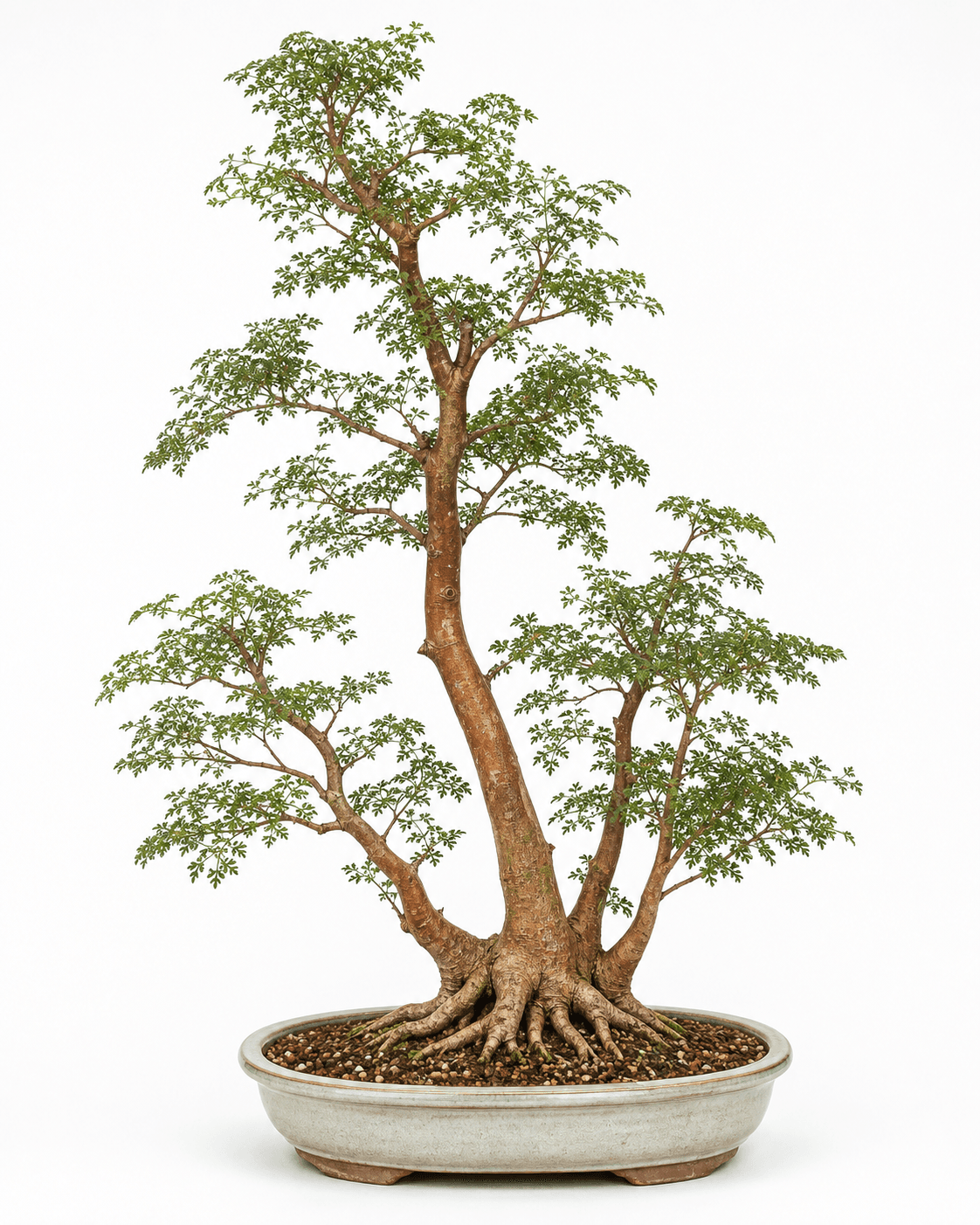
Ming aralia bonsai, Polyscias fruticosa, is a tropical broadleaf shrub or small tree grown for fine divided foliage, upright stems, smooth reddish-brown young wood, and houseplant availability. It works best as a protected warm-climate bonsai when you give it bright indirect light, steady warmth, draining soil, and pruning that preserves enough foliage to keep the roots active.
The local Bonsai Mirai corpus has no dedicated Ming aralia or Polyscias file. This profile transfers only broad tropical, watering, soil, repotting, propagation, wiring, energy, and design method from Mirai, then uses Kew, NC State Extension, and Useful Tropical Plants for identity, range, hardiness, habit, pests, uses, and propagation facts.
The practical answer is controlled patience. Ming aralia can look refined quickly because its foliage is naturally fine, but weak light, cold roots, dry indoor air, soggy soil, and repeated tip clipping can empty the interior and make the tree shed leaves.
Updated July 4, 2026. Written by EntGrove Editorial. Last verified July 4, 2026.
Care fingerprint
Read the species through its shared care pattern.
Treat indoor culture as a light-management problem first; prune and repot when the tree is actively growing and warm enough to recover. Use this as the starting point before local conditions and tree strength refine the calendar.
Note: Polyscias fruticosa is the target. Keep Ming aralia separate from false aralia, dwarf umbrella tree, Schefflera labels, Polyscias balfouriana, and Polyscias guilfoylei before applying this warm tropical profile.
Read the foliage first
Broadleaf stress usually shows in leaf color, leaf size, wilt, scorch, or delayed hardening before it becomes a branch problem.
Match work to dormancy
Deciduous, evergreen, tropical, succulent, and flowering broadleaf trees recover on different calendars.
Protect fine roots
Root work should preserve enough active fine roots for the tree to rehydrate quickly after the operation.
Care cadence
The calendar starts with the tree's seasonal state.
Placement
Timing: Keep in bright indirect light, partial shade outdoors after acclimation, and stable warmth. Move outside only after nights are consistently warm.
Watch for: Dim rooms, cold window glass, dry heater drafts, abrupt direct sun, pale extension, leaf drop after relocation, and foliage clustered only at branch tips.
NC State Extension: Polyscias fruticosaBonsai Mirai LibraryWatering
Timing: Water thoroughly when the upper root zone has begun to dry and the lower pot still has slight internal moisture. Reduce water in cool or low-light protection.
Watch for: Wet saucers, sour soil, yellowing leaves, root rot, hydrophobic peat, dry air, and mites after the soil has been kept too dry.
NC State Extension: Polyscias fruticosaBonsai Mirai LibraryFertilizer
Timing: Feed during active warm growth after the tree is extending and drying predictably. Use lighter feeding when leaf size or internode length is the current refinement goal.
Watch for: Fertilizer on cold wet roots, coarse shade growth, salt buildup indoors, and repeated clipping without replacing the energy spent.
Bonsai Mirai LibraryPruning
Timing: Prune in warm active growth after shoots extend enough to feed the tree. Cut back to useful leaves or nodes while keeping interior foliage alive.
Watch for: Constant tip clipping, empty interiors, removing all active tips from a weak tree, and cutting back leafless old stems without visible buds.
Bonsai Mirai LibraryNC State Extension: Polyscias fruticosaLeaf work
Timing: Use selective leaf thinning only to admit light, expose pests, or balance strong sections. Fine foliage usually needs health and light more than defoliation.
Watch for: Full stripping, leaf drop after relocation, dry indoor air, and watering a reduced canopy as though it still has full transpiration demand.
Bonsai Mirai LibraryRepotting
Timing: Repot in warm active growth when several warm weeks remain. Correct dense nursery soil in stages if the tree has weak roots or has recently dropped leaves.
Watch for: Bare-rooting a leafy tropical, root work during cold protection, unstable tie-downs, dense peat, and pairing heavy root pruning with heavy top reduction.
Bonsai Mirai LibraryNC State Extension: Polyscias fruticosaWiring
Timing: Wire young flexible shoots during active growth, then check often. Use pruning and directional shoot selection for most fine branch work.
Watch for: Wire bite on smooth stems, cracked older wood, branches wired after dehydration, and uniform bends that ignore the plant upright tropical habit.
Bonsai Mirai LibraryNC State Extension: Polyscias fruticosaPest checks
Timing: Inspect year-round indoors, especially during winter protection and after moving a houseplant outside for warm-season growth.
Watch for: Aphids, scale, mealybugs, whiteflies, nematodes, mites in dry conditions, sticky residue, webbing, and weak new growth.
NC State Extension: Polyscias fruticosaSpecies guide
Apply the species profile before copying another tree's calendar.
At a glance
Ming aralia is a fine-leaf tropical that needs warm restraint.
Polyscias fruticosa is the botanical anchor for this page. NC State records Ming Aralia and Ming Tree labels, places the plant in Araliaceae, and lists older Aralia fruticosa and Panax fruticosus names. NC State Extension: Polyscias fruticosaKew POWO search: Polyscias fruticosa
Its bonsai appeal is immediate: fine divided foliage, upright stems, smooth bark, and a naturally delicate texture. Those traits should be paired with a simple structure because the plant can shed interior foliage when light, warmth, or root oxygen slips. NC State Extension: Polyscias fruticosaBonsai Mirai / Asymmetry
The source caveat matters. A July 2026 scan found no dedicated Ming aralia or Polyscias file in the local Mirai corpus, so this page uses Mirai only for transferable tropical broadleaf method and public horticulture sources for species facts. Bonsai Mirai LibraryNC State Extension: Polyscias fruticosaUseful Tropical Plants: Polyscias fruticosa
Wild habit
Tropical lowland culture explains the warmth and humidity demand.
NC State gives Central Malesia to the Southwest Pacific as the origin and describes Ming aralia as a tropical evergreen shrub or short tree. Useful Tropical Plants records broad tropical cultivation as an ornamental, hedge, food, and medicinal plant. NC State Extension: Polyscias fruticosaUseful Tropical Plants: Polyscias fruticosa
That background points to warm air, humid conditions, bright filtered light, and soils that hold moisture while draining. In a bonsai pot, the roots have less buffer, so water must arrive fully and oxygen must return before the next full soak. NC State Extension: Polyscias fruticosaBonsai Mirai Library
For design, read the plant as an upright tropical shrub with fine foliage clustered near shoot tips. A believable image usually comes from a light canopy, a clean trunk line, and visible interior structure rather than dense clipped surface growth. NC State Extension: Polyscias fruticosaBonsai Mirai / Asymmetry
Reading
Judge strength by leaf hold, interior buds, and watering rhythm.
A strong Ming aralia has firm green leaflets, active shoot tips, a pot that dries predictably, and interior foliage close to useful branch structure. Weak trees shed older leaves, stall after pruning, or hold foliage only at the ends. NC State Extension: Polyscias fruticosaBonsai Mirai Library
Development and refinement need different choices. In development, let selected shoots extend to thicken a line and feed the roots. In refinement, shorten only after the shoot has created enough energy and hardened enough to leave useful buds. Bonsai Mirai Library
Leaf drop is a context signal. Check recent movement, light level, cold exposure, watering rhythm, humidity, and pest pressure before pruning harder or repotting a stressed tree. NC State Extension: Polyscias fruticosaBonsai Mirai Library
Pruning
Build structure with extension and cutback, then protect interior light.
Prune during warm active growth. Let useful shoots extend enough to strengthen roots and branches, then cut back to a leaf, node, or side shoot that supports the design. Bonsai Mirai Library
Repeated tip clipping can create a round outer shell and a weak interior. Open the canopy, remove congested junctions, and preserve small interior leaves that may become future branch options. Bonsai Mirai LibraryNC State Extension: Polyscias fruticosa
Fine foliage reduces the need for aggressive leaf work. Use selective leaf removal when a strong tree needs light access, pest inspection, or visual clarification, then adjust watering after canopy reduction. Bonsai Mirai Library
Roots
Repot warm and keep a functioning root mass attached.
Tropical broadleaf method places major root work during warm active growth, when recovery is visible and several warm weeks remain. Ming aralia should follow that recovery window, especially after indoor winter culture. Bonsai Mirai Library
Many plants arrive in peat-heavy houseplant soil. Remove that core in stages if the root system is weak, because bare-rooting a leafy tropical can collapse water uptake before new roots are ready. Bonsai Mirai LibraryNC State Extension: Polyscias fruticosa
Tie the tree firmly after repotting. Smooth upright stems and fine foliage invite styling attention, but root movement after a repot slows new root tips and can trigger leaf drop. Bonsai Mirai Library
Soil and pot
Use a moist tropical mix that still breathes.
NC State says Ming aralia grows in several soil textures with good drainage and performs best when the soil is neither too wet nor too dry. Bonsai soil should translate that into durable aggregate with moisture and air. NC State Extension: Polyscias fruticosa
A 1:1:1 akadama, pumice, and lava mix is a reasonable development starting point. In cool indoor rooms or humid houses, lean toward more durable drainage. In hot bright greenhouses, keep enough water retention to prevent hard dry-down. Bonsai Mirai Library
Pot choice should support the fine texture. Shallow oval, soft rectangle, round, or literati containers can work, but the first bonsai container should prioritize root recovery and tie-down stability over display thinness. Bonsai Mirai / Asymmetry
Climate
Treat Ming aralia as a protected tropical outside Zones 11-12.
NC State lists USDA Zones 11a-12b for landscape use and describes Ming aralia as an indoor container plant in North Carolina. Container bonsai roots need earlier protection than landscape plants. NC State Extension: Polyscias fruticosa
In cold-winter regions, grow it as a bright indoor, greenhouse, or warm-season outdoor tropical. Keep it away from cold windows, heater drafts, and low-light corners during winter protection. NC State Extension: Polyscias fruticosaBonsai Mirai Library
In hot climates, protect recently moved or recently repotted trees from harsh afternoon sun. Strong filtered light is valuable, but sudden sun on indoor-grown leaves can cause damage before the root system catches up. NC State Extension: Polyscias fruticosaBonsai Mirai Library
In dry interiors, humidity and airflow should be managed together. A pebble tray or humidifier can help the leaf environment, while still air and damp soil increase pest and root problems. NC State Extension: Polyscias fruticosa
Pests
Pests follow dry air, weak light, and stressed roots.
NC State lists aphids, scale, mealybugs, whiteflies, nematodes, and mites in dry conditions. Inspect leaf undersides, petiole bases, new shoot tips, and tight interior crotches. NC State Extension: Polyscias fruticosa
Root rot is the main disease pattern in bonsai culture. NC State warns that wet or overly moist soils can rot roots, and Mirai watering method ties that problem to low oxygen as much as water volume. NC State Extension: Polyscias fruticosaBonsai Mirai Library
Treat pests with identification and culture correction. Clean the canopy, isolate the tree if needed, improve light and airflow, and avoid fertilizing or repotting before the tree shows active recovery. Bonsai Mirai LibraryNC State Extension: Polyscias fruticosa
Wiring
Wire young flexible stems and let pruning carry refinement.
NC State describes smooth flexible reddish-brown stems. Use that flexibility while shoots are young, during active growth, and check wire often because swelling can mark smooth bark. NC State Extension: Polyscias fruticosaBonsai Mirai Library
Older stems should be moved cautiously. Use guy wires, cutback, and new leaders when a hard bend risks cracking, dehydration, or a dead section below fine foliage. Bonsai Mirai Library
Wire for branch direction and spacing, then refine with pruning. The small leaf texture can make overly busy wiring look artificial, so the design should keep a readable trunk, branch hierarchy, and airy canopy. Bonsai Mirai / Asymmetry
Propagation
Cuttings are the most useful bonsai propagation path.
NC State lists leaf cutting, seed, and stem cutting as propagation strategies. Useful Tropical Plants also records seed and stem cuttings, including 10 cm shoots and bottom heat around 21-23 C for rooting. NC State Extension: Polyscias fruticosaUseful Tropical Plants: Polyscias fruticosa
For bonsai, cuttings preserve a known foliage texture and branch habit. Take them during warm active growth, reduce excess foliage, use airy media, and wait for root evidence before feeding. Bonsai Mirai LibraryUseful Tropical Plants: Polyscias fruticosa
Air layering can reset tall houseplant material if a useful upper trunk has branch options. Layer in active growth and avoid additional root disturbance until the new root system hardens. Bonsai Mirai Library
Buying
Buy trunk potential, low buds, and root health before fine foliage.
Good material has a firm base, visible low buds, short internodes, active interior foliage, clean drainage holes, and stems that can be arranged into a simple upright or clump design. Bonsai Mirai / AsymmetryNC State Extension: Polyscias fruticosa
Reject plants with sour soil, leaf drop after minor handling, pests in tight foliage, dry brittle tips, no low branch options, or peat that stays wet for days. NC State Extension: Polyscias fruticosaBonsai Mirai Library
Keep labels precise. Ming aralia, false aralia, umbrella tree, dwarf umbrella tree, Aralia, Dizygotheca, Schefflera, Polyscias balfouriana, and Polyscias guilfoylei can be mixed in retail searches. This page applies to Polyscias fruticosa. NC State Extension: Polyscias fruticosaUseful Tropical Plants: Polyscias fruticosa
Troubleshooting
Start with light, warmth, water, and pests before cutting harder.
Symptom: sudden leaf drop after purchase or moving. Likely causes: light change, cold draft, dry air, missed watering, or root stress. Fix: stabilize warmth and light, water correctly, and wait for new growth before pruning. NC State Extension: Polyscias fruticosaBonsai Mirai Library
Symptom: yellow leaves with wet soil. Likely causes: low oxygen, cool roots, old peat, or standing water. Fix: improve drainage and warmth, empty saucers, and delay repotting until the tree can recover. NC State Extension: Polyscias fruticosaBonsai Mirai Library
Symptom: pale long shoots with sparse interior leaves. Likely causes: low light or fertilizer beyond the light budget. Fix: increase light gradually and prune only after stronger compact growth appears. Bonsai Mirai Library
Symptom: dry tips, webbing, or stippled leaflets. Likely causes: mites and dry indoor air. Fix: isolate, identify the pest, clean foliage, improve humidity and airflow, and keep the root zone evenly moist. NC State Extension: Polyscias fruticosa
Symptom: no back budding after hard pruning. Likely causes: weak roots, insufficient light, cold timing, or cuts below active nodes. Fix: restore vigor, let shoots run, and shorten only in warm growth. Bonsai Mirai Library
Design
Use the fine foliage to support a quiet tropical image.
Begin with base, trunk line, defining branch, and apex. Ming aralia often has many thin upright stems, so a strong design usually simplifies the number of trunks and gives each retained stem a role. Bonsai Mirai / Asymmetry
The foliage already reads fine. Avoid making the tree visually heavy with a clipped ball. Open windows, keep branch spacing readable, and let the leaf texture create softness around a clear structure. Bonsai Mirai / AsymmetryBonsai Mirai Library
Deadwood is rarely the main feature. The better language is living tropical delicacy: slender stems, fine foliage, light movement, visible branch hierarchy, and a pot that does not overpower the airy canopy. Bonsai Mirai / Asymmetry
Forms
Elegans and retail aralia labels need careful separation.
NC State lists Elegans as a dwarf, parsley-like form. That compact foliage can be useful for bonsai, but the label should be verified because several Polyscias and aralia-like houseplants share similar retail names. NC State Extension: Polyscias fruticosa
Useful Tropical Plants lists older synonym names around Polyscias fruticosa, including Aralia fruticosa, Nothopanax fruticosus, Panax fruticosus, and Tieghemopanax fruticosus. Useful Tropical Plants: Polyscias fruticosa
Choose individual material over cultivar romance. Root health, internode length, low buds, trunk movement, and a stable response to pruning matter more than a nursery name on a weak plant. Bonsai Mirai / AsymmetryBonsai Mirai Library
History
Its bonsai history is strongest in houseplant and tropical practice.
Useful Tropical Plants records Ming aralia as an ornamental, hedge, food, and medicinal plant in tropical cultivation. NC State frames it as a valued interiorscape specimen with fine foliage. Useful Tropical Plants: Polyscias fruticosaNC State Extension: Polyscias fruticosa
Compared with ficus, Satsuki azalea, Shimpaku, or Japanese maple, Ming aralia has a thinner public record of famous exhibition bonsai. A strong tree should therefore be judged by horticultural stability, proportion, and honest tropical design. Bonsai Mirai / Asymmetry
Records are especially useful because indoor conditions vary widely. Track light level, watering interval, repot dates, leaf drop events, pest checks, winter room temperature, humidity support, and response after each pruning. Bonsai Mirai Library
Species questions
Answer the beginner questions before styling.
Can Ming aralia be a bonsai?
Yes. Polyscias fruticosa can be trained as a tropical bonsai when it has bright indirect light, warm roots, draining soil, careful pruning, and enough foliage left after each operation to keep the root system active.
Is Ming aralia an indoor bonsai?
It is indoor-capable as a protected tropical, but it needs bright light, warmth, humidity support, airflow, and careful watering. Dim rooms usually produce leaf drop, long shoots, and weak recovery.
How often should I water Ming aralia bonsai?
Water when the upper root zone has begun to dry while the inner root ball still has slight moisture. Water thoroughly, drain fully, and reduce frequency in cool or low-light indoor conditions.
When should I repot Ming aralia bonsai?
Repot in warm active growth when several warm weeks remain. Inspect every 2-3 years and repot for poor drainage, old nursery soil, circling roots, poor anchoring, or a planned design change.
What soil is best for Ming aralia bonsai?
Use a fast-draining tropical broadleaf mix that holds some moisture. Equal parts akadama, pumice, and lava are a workable starting point, with more durable drainage in cool indoor rooms.
Why is my Ming aralia dropping leaves?
Common causes include sudden light changes, cold drafts, dry indoor air, inconsistent watering, root rot, low light, pests, or hard pruning before the tree is actively growing.
Can I defoliate Ming aralia bonsai?
Use selective leaf thinning only on vigorous trees. Routine full defoliation is risky because Ming aralia can shed foliage under stress and needs leaves to support tropical root recovery.
How do I propagate Ming aralia for bonsai?
Stem cuttings are the most useful route. Take cuttings during warm active growth, reduce excess foliage, use airy media, provide steady warmth, and wait for root evidence before feeding.
Is Ming aralia the same as false aralia or umbrella tree?
This page applies to Polyscias fruticosa. False aralia, umbrella tree, dwarf umbrella tree, and other Polyscias species have different labels, leaf forms, and care assumptions.
Sources
Species advice needs source discipline.
Next decisions
Plan the operation before copying the calendar.
A good care note for Ming aralia records the tree's stage, the work done, and the aftercare used. That record matters more than a month-name rule.
Related species
Compare nearby trees before transferring advice.
Ficus retusa / Indian laurel
Ficus microcarpa
Tigerbark ficus
Ficus microcarpa 'Tigerbark'
Willow-leaf ficus
Ficus salicaria
Benjamin fig
Ficus benjamina
Ginseng ficus
Ficus microcarpa 'Ginseng'