
Species guide
Money Tree Bonsai Care
Pachira aquatica
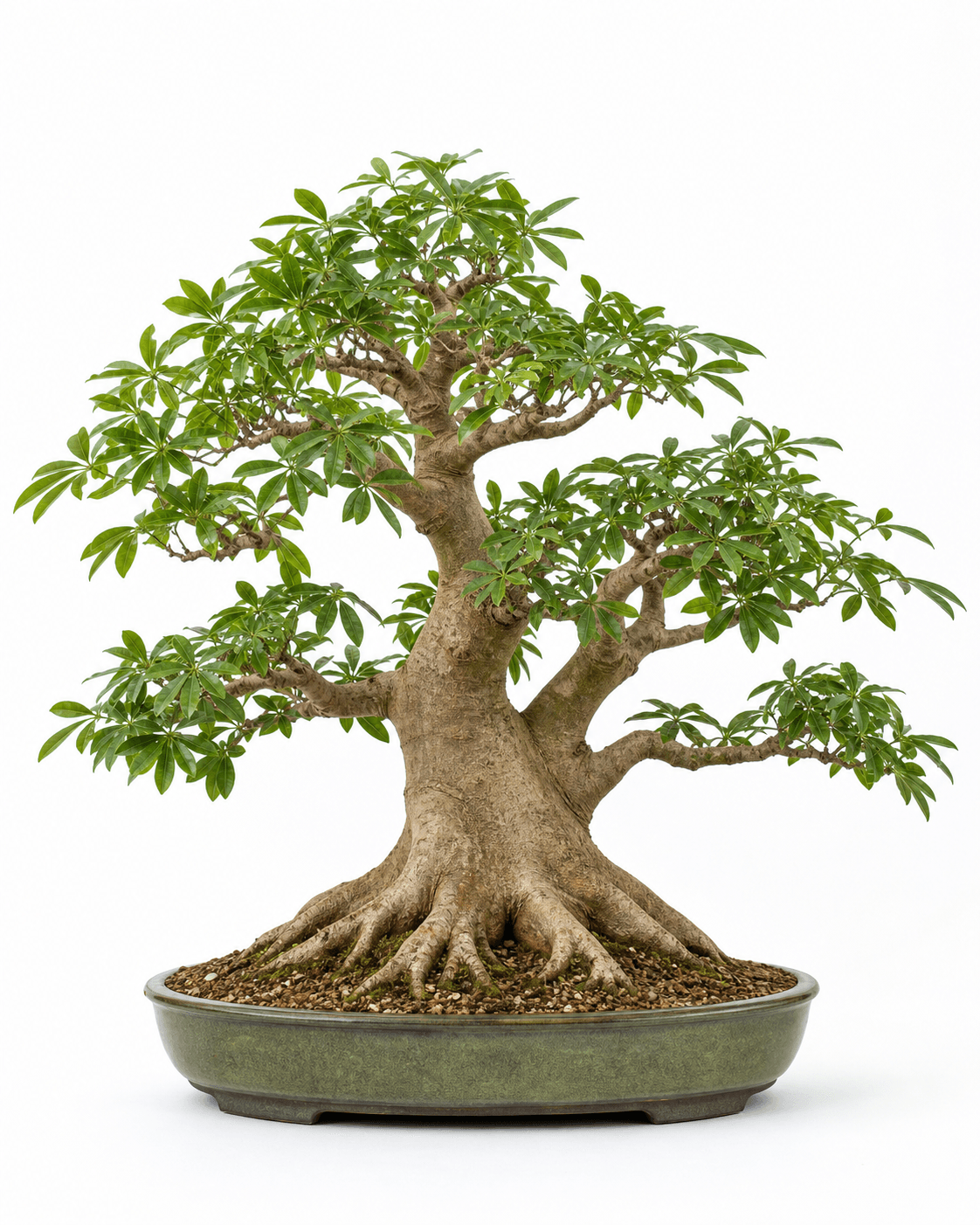
Money tree bonsai, Pachira aquatica, is a tropical broadleaf grown mostly from houseplant and interiorscape stock. It can be trained as bonsai when you give it bright warmth, a draining root system, and a design that respects its fast juvenile growth, swollen base, compound leaves, and common braided-trunk material.
The local Bonsai Mirai corpus has no dedicated Pachira or money-tree file. This profile transfers only broad tropical, watering, soil, repotting, propagation, wiring, energy, and design method from Mirai, then uses Kew, NC State Extension, and Useful Tropical Plants for identity, range, habitat, hardiness, morphology, common names, pests, and propagation facts.
The practical answer is restraint. Money tree is forgiving as a houseplant, but bonsai failures usually come from low light, soggy cachepots, cold roots, braided stems that hide problems, pruning without enough active leaves, and trying to make a tiny refined tree from material that wants a medium or larger tropical image.
Updated July 4, 2026. Written by EntGrove Editorial. Last verified July 4, 2026.
Care fingerprint
Read the species through its shared care pattern.
Treat indoor culture as a light-management problem first; prune and repot when the tree is actively growing and warm enough to recover. Use this as the starting point before local conditions and tree strength refine the calendar.
Read the foliage first
Broadleaf stress usually shows in leaf color, leaf size, wilt, scorch, or delayed hardening before it becomes a branch problem.
Match work to dormancy
Deciduous, evergreen, tropical, succulent, and flowering broadleaf trees recover on different calendars.
Protect fine roots
Root work should preserve enough active fine roots for the tree to rehydrate quickly after the operation.
Care cadence
The calendar starts with the tree's seasonal state.
Placement
Timing: Keep in bright stable warmth. Move outdoors only after nights are consistently near 60 F / 16 C or warmer, then acclimate from shade into stronger light.
Watch for: Cold glass, heater or air-conditioning drafts, abrupt direct sun, dim corners, long pale internodes, and leaflets that keep getting larger after purchase.
NC State Extension: Pachira aquaticaBonsai Mirai LibraryWatering
Timing: Water deeply when the surface is drying and the root ball is still slightly moist inside. Reduce water in cool rooms, low light, and after leaf loss.
Watch for: Standing water in a saucer, sour soil, yellow lower leaves, a soft trunk base, dry hydrophobic peat, and a braided trunk that hides rot at the soil line.
Useful Tropical Plants: Pachira aquaticaBonsai Mirai LibraryFertilizer
Timing: Feed only during active growth. Use moderate organic or dilute liquid feeding after new extension confirms the tree is using water well.
Watch for: Fertilizing cold wet roots, pushing coarse shade growth, salt buildup on indoor soil, and feeding immediately after a heavy repot.
Bonsai Mirai LibraryPruning
Timing: Prune in warm active growth after the tree is extending. Let sacrifice shoots run when you need trunk or branch thickening, then cut back to useful buds.
Watch for: Removing too much leaf mass, cutting a weak braided stem back below active buds, and constant tip clipping that leaves no branch options.
Bonsai Mirai LibraryLeaf work
Timing: Use selective leaf removal only on vigorous trees. Root maturation, strong light, and tip control reduce leaf size more reliably than repeated stripping.
Watch for: Full defoliation in low light, large leaves caused by shade, and watering a reduced canopy as though it still has full transpiration demand.
Bonsai Mirai LibraryRepotting
Timing: Repot in warm active growth when nights are near 60 F / 16 C or warmer and several warm weeks remain. Stage nursery-soil correction when roots are weak.
Watch for: Dense peat, circling roots, poor tie-down stability, a buried crown, braided stems constricting at the base, and pairing severe root work with severe top reduction.
Bonsai Mirai LibraryWiring
Timing: Wire flexible young shoots during active growth, then inspect often. Use clip-and-grow for most fine branching because compound leaves hide tiny wire work.
Watch for: Wire bite, cracked soft stems, bark bruising, and trying to bend braided trunks that are already fused, scarred, or internally weak.
Bonsai Mirai LibraryPest checks
Timing: Inspect year-round indoors, especially during winter protection and after moving outside for summer growth.
Watch for: Scale, mealybugs, mites, fungus gnats, sticky residue, cottony pockets, dull leaves, and pests hidden between braided stems.
NC State Extension: Pachira aquaticaBonsai Mirai LibrarySpecies guide
Apply the species profile before copying another tree's calendar.
At a glance
Money tree is a forgiving tropical houseplant with bonsai limits.
Pachira aquatica is the botanical anchor for this page. NC State records money tree, Malabar chestnut, Guiana chestnut, saba nut, French peanut, and provision tree labels, and places the species in Malvaceae. NC State Extension: Pachira aquaticaKew POWO search: Pachira aquatica
Most bonsai candidates are not old collected trees. They are interiorscape plants, braided houseplants, cuttings, or nursery trunks that need root conversion, light acclimation, and design simplification before refinement. NC State Extension: Pachira aquaticaBonsai Mirai / Asymmetry
The care rhythm is tropical broadleaf: bright warmth, thorough watering with oxygen return, major work only during active growth, and no heavy operation while the tree is cold, weak, or recently defoliated. Bonsai Mirai Library
Wild habit
Wet tropical habitat explains the water demand, not soggy-pot culture.
Useful Tropical Plants describes Pachira aquatica as a tropical American tree associated with wet places, river margins, and periodically flooded ground. That habitat explains why the tree can use water quickly in heat. Useful Tropical Plants: Pachira aquatica
A bonsai container changes the equation. Mirai watering method treats health as a balance of water and oxygen, so even wet-habitat species need particles, drainage, and enough dry-down for roots to respire. Bonsai Mirai Library
For design, read the species as a tropical canopy tree with compound leaves and a swollen base. A credible bonsai usually benefits from a wider tropical image, multiple stems, visible roots, or a sturdy trunk rather than tiny deciduous-style twigging. Bonsai Mirai / AsymmetryNC State Extension: Pachira aquatica
Reading the tree
Judge strength by leaf quality, root rhythm, and trunk-base firmness.
Strong money tree growth has firm green leaflets, active tips, a pot that dries predictably, and a base that stays hard. Weak growth is pale, drooping, long-jointed, sticky, or clustered only at the top after repeated pruning. Bonsai Mirai LibraryNC State Extension: Pachira aquatica
Development comes first. Let selected shoots extend when you need a stronger trunk, a new leader, or branch girth. Cut back only after the shoot has fed the tree and hardened enough to leave useful buds. Bonsai Mirai Library
Braided trunks need a separate inspection. Check the contact points, the soil line, and the interior of the braid for compression, rot, wire remnants, and stems that have died inside the braid. NC State Extension: Pachira aquaticaBonsai Mirai Library
Leaf size is a light and maturity signal. Mirai tropical method warns that leaves enlarge under weak light, while root maturation and tip control are the long-term route toward smaller foliage. Bonsai Mirai Library
Pruning
Use extension and cutback instead of constant clipping.
Prune during warm active growth. Remove coarse straight extensions only after they have produced energy, then cut to a node, side shoot, or branch line that supports the future canopy. Bonsai Mirai Library
Keep enough leaves to power recovery. Mirai tropical method treats heavy defoliation as a refinement or access tool for strong trees, while development trees need leaves to build roots, trunk, and branch structure. Bonsai Mirai Library
On braided material, decide whether the braid is part of the image or a temporary nursery feature. If the braid is weak or visually distracting, rebuild the bonsai from the strongest stem, an air layer, or a cutting rather than forcing all stems to remain. Bonsai Mirai / AsymmetryBonsai Mirai Library
Compound leaves make fine detail look coarse. Build branch placement, light access, and canopy outline first; pursue smaller leaflets only after the root system, light level, and pruning rhythm are stable. Bonsai Mirai Library
Roots
Repot warm, preserve function, and remove bad nursery soil in stages.
Mirai tropical repotting places major root work after nights are reliably near 60 F / 16 C or warmer. Money tree should be worked in that same recovery window, especially after indoor winter culture. Bonsai Mirai Library
Do not bare-root a full leafy tropical. Preserve part of the root mass, remove compacted or sour soil first, and stage the transition if the tree is weak, braided, top heavy, or growing in dense peat. Bonsai Mirai Library
Keep the crown and trunk base high. Mirai tropical repotting warns that burying the crown can keep bark wet and invite rot. Set the root flare as the high point and tie the tree firmly. Bonsai Mirai Library
After repotting, water through the whole column, confirm free drainage, protect from harsh afternoon sun and wind, and wait for new extension before hard pruning, wiring, or heavy feeding. Bonsai Mirai Library
Soil and pot
Give the wetland tree a pot that drains and breathes.
A practical bonsai starting mix is equal parts akadama, pumice, and lava. In cool indoor rooms or rainy climates, increase pumice, lava, or similarly durable aggregate so the root zone does not stay stale. Bonsai Mirai Library
Useful Tropical Plants points to wet habitat tolerance, but bonsai training should translate that into available water plus oxygen. A decorative cachepot with no drainage is the common indoor failure point. Useful Tropical Plants: Pachira aquaticaBonsai Mirai Library
Use a deeper training container while building the trunk, new roots, and branch framework. Move to a shallower display pot only after the root system is dense enough and the watering rhythm is predictable. Bonsai Mirai Library
Pot choice should support a tropical indoor tree: quiet glazed rectangles, ovals, or shallow rounds in muted earth, green, or warm neutral tones usually serve the palmate leaves and swollen base. Bonsai Mirai / Asymmetry
Climate
The calendar is governed by warmth and light, not the houseplant label.
In frost-free warm regions, money tree can grow outdoors with strong filtered light and steady water. Acclimate from indoor shade before giving more sun, because existing leaves can scorch after a sudden move. NC State Extension: Pachira aquaticaBonsai Mirai Library
In cold-winter regions, treat it as a protected tropical. Bring it inside before cold nights, give the brightest practical light, keep roots warm, reduce watering in low metabolism, and postpone major work until warm growth returns. Bonsai Mirai Library
In hot dry regions, watch container heat and dry wind. A tree that uses water freely in the ground can still lose leaves in a shallow pot if transpiration outruns root supply. Bonsai Mirai LibraryUseful Tropical Plants: Pachira aquatica
In humid rooms and greenhouses, airflow matters. Dense compound foliage, braided stems, and organic soil can hide pests and fungus, so clean old leaves and inspect the inner structure often. NC State Extension: Pachira aquaticaBonsai Mirai Library
Pests
Most pest and disease issues begin with indoor weakness or wet roots.
NC State lists insects and problems to watch on Pachira aquatica, including common indoor pest pressure. In bonsai culture, inspect for scale, mealybugs, mites, aphids, fungus gnats, and sticky residue. NC State Extension: Pachira aquatica
Check the underside of leaflets, petiole bases, branch junctions, and braided contact points. Pests thrive where low light, still air, and dense stems reduce the tree response. Bonsai Mirai LibraryNC State Extension: Pachira aquatica
Root disease usually looks like a watering mystery. Yellow leaves, soft base tissue, sour smell, and soil that stays wet point to low oxygen, old organic mix, cold roots, or trapped water in a decorative container. Bonsai Mirai Library
Do not fertilize or repot blindly when the tree is declining. First restore light, warmth, drainage, and watering rhythm; then intervene when new growth confirms that roots are functioning. Bonsai Mirai Library
Wiring
Wire young shoots, then inspect before swelling marks the bark.
Use wire on flexible young growth during active growth. Set primary direction and branch plane, then switch to pruning because compound leaves and fast tropical swelling make fine wiring less useful. Bonsai Mirai Library
Avoid forcing old braided trunks. A braid that has fused or compressed contains multiple vascular paths, and heavy bending can crack bark, crush contact points, or kill one stem inside the braid. Bonsai Mirai / AsymmetryBonsai Mirai Library
Check wire frequently in warm weather. Remove or cut off wire before it bites, and use guy wires with padding when a slow directional pull is safer than a tight coil. Bonsai Mirai Library
Practice on expendable growth before wiring a valued money tree. Mirai wiring method prioritizes continuous contact, consistent coil angle, and support behind every bend. Bonsai Mirai Library
Propagation
Cuttings and air layers are the bonsai routes; seed is slower and variable.
NC State and Useful Tropical Plants document propagation paths for Pachira aquatica. For bonsai, cuttings and air layers are most useful because they preserve a known trunk section, leaflet scale, and growth habit. NC State Extension: Pachira aquaticaUseful Tropical Plants: Pachira aquatica
Mirai cutting method uses warm nights above 60 F / 16 C, reduced foliage, airy media such as perlite, and no fertilizer until roots exist. Money tree cuttings should follow that tropical logic. Bonsai Mirai Library
Air layering can reset a tall braided or leggy houseplant. Layer above the weak base, root the selected top in active growth, and avoid additional root disturbance until the new root system hardens. Bonsai Mirai Library
Seed-grown plants are useful for clump and root experiments, but variation is expected. Track source, germination date, leaf size, internode length, and whether the plant is P. aquatica or another Pachira label. Useful Tropical Plants: Pachira aquaticaUseful Tropical Plants: Pachira glabra
Buying
Buy structure and roots before braid novelty.
Good material has a firm trunk base, visible root flare or layer potential, active low buds, short internodes, compact leaflets for the plant, clean drainage, and enough branch options to simplify the canopy. Bonsai Mirai / AsymmetryNC State Extension: Pachira aquatica
Braided stock can be useful, but inspect it ruthlessly. Red flags include soft stems, dead stems inside the braid, wire or tie marks, buried contact points, pest pockets, and no obvious leader or front. Bonsai Mirai Library
Many retail money trees sit in peat inside decorative pots. Before buying, lift the nursery pot if possible, check drainage holes, look for circling roots, and reject plants sitting in stagnant water. NC State Extension: Pachira aquaticaBonsai Mirai Library
Keep common names separate. Money tree, money plant, dwarf jade, jade plant, umbrella tree, and ficus can all appear in beginner retail searches. This page applies to Pachira aquatica. NC State Extension: Pachira aquaticaUseful Tropical Plants: Pachira glabra
Troubleshooting
Start diagnosis with light, water, warmth, soil, and braid health.
Symptom: yellow lower leaves with wet soil. Likely causes: low oxygen, cold roots, overwatering, old peat, or trapped saucer water. Fix: warm the root zone, improve drainage, and water only after oxygen returns. Bonsai Mirai Library
Symptom: drooping leaflets after drying hard. Likely causes: hydrophobic peat, a small reservoir, or a root system that cannot rehydrate evenly. Fix: soak thoroughly, confirm drainage, and plan a staged soil transition. Bonsai Mirai Library
Symptom: large leaves and long weak shoots. Likely causes: low light or excessive fertilizer in weak light. Fix: increase light gradually, reduce feeding, and prune only after stronger growth appears. Bonsai Mirai Library
Symptom: soft or dark tissue at the braid. Likely causes: buried stems, trapped moisture, dead interior stems, or rot from a cachepot. Fix: expose the base, remove dead material, improve airflow, and rebuild from healthy stems if needed. Bonsai Mirai Library
Symptom: sticky leaves, cottony spots, webbing, or raised bumps. Likely causes: scale, mealybugs, mites, aphids, or honeydew. Fix: isolate, identify the pest, clean the canopy, and improve light and airflow. NC State Extension: Pachira aquatica
Symptom: no back budding after pruning. Likely causes: weak roots, low light, cold timing, or cuts below viable buds. Fix: restore vigor, let new shoots run, and cut back only during warm active growth. Bonsai Mirai Library
Design
Style for a tropical canopy, swollen base, or honest multi-stem image.
Begin with base, trunk line, defining branch, and apex. If the braid is strong and convincing, it can become the design character. If it is weak, hidebound, or visually gimmicky, rebuild around the best living stem or air-layered section. Bonsai Mirai / AsymmetryBonsai Mirai Library
A broad tropical canopy usually suits money tree better than tight conifer pads. Let the compound leaves create a rounded mass, then open windows so branch structure and the base remain visible. Bonsai Mirai / Asymmetry
Root-over-rock and exposed-root work can be credible if roots are allowed to thicken undisturbed. Use training containers and years of growth before expecting the roots to read as old structure. Bonsai Mirai Library
Deadwood is rarely the primary feature. The stronger language is living tropical mass: a firm base, simple trunk movement, clean roots, compact foliage, and a canopy that looks supported by the tree. Bonsai Mirai / Asymmetry
Forms
Most bonsai differences come from source material, not named cultivars.
This page anchors on Pachira aquatica. Kew search and NC State provide the name context, while Useful Tropical Plants gives the tropical American habitat and common-name spread. Kew POWO search: Pachira aquaticaNC State Extension: Pachira aquaticaUseful Tropical Plants: Pachira aquatica
Some money-tree trade labels may involve Pachira glabra or unresolved Pachira material. Treat those as close relatives for comparison, then record the nursery label and do not transfer exact hardiness, flower, fruit, or size claims without verification. Useful Tropical Plants: Pachira glabraKew POWO search: Pachira aquatica
Braided, single-trunk, stump-cut, cutting-grown, and seedling material each behaves differently in bonsai design. Choose by root health, low buds, internode length, trunk firmness, and branch options before novelty. Bonsai Mirai / AsymmetryBonsai Mirai Library
History
Its bonsai history is tied to houseplant culture and tropical training.
NC State frames money tree as an interiorscape and houseplant species with multiple food-related common names. Useful Tropical Plants documents edible seed uses and broader tropical cultivation context. NC State Extension: Pachira aquaticaUseful Tropical Plants: Pachira aquatica
The braided money tree is a modern retail form, not a fixed bonsai requirement. It can be trained well, but the braid should earn its place through health, taper, root quality, and visual coherence. Bonsai Mirai / Asymmetry
Compared with Japanese black pine, Shimpaku, Satsuki azalea, and Japanese maple, money tree has a thinner public record of named exhibition specimens. A strong tree should therefore be judged by horticultural clarity and honest tropical design. Bonsai Mirai LibraryBonsai Mirai / Asymmetry
Records are especially valuable for indoor growers. Track light changes, watering interval, repot dates, pest checks, pruning response, winter room temperature, and whether the design kept, simplified, or replaced the braid. Bonsai Mirai Library
Species questions
Answer the beginner questions before styling.
Can a money tree be a bonsai?
Yes. Pachira aquatica can be trained as bonsai when it receives bright warmth, a draining root system, warm-season pruning and repotting, and a design sized to its compound leaves and trunk character.
Is money tree a good indoor bonsai?
It can be a good indoor tropical bonsai for bright homes or grow-light setups. It should not be treated as a low-light decoration because weak light causes long internodes, oversized leaves, pests, and slow recovery.
How often should I water money tree bonsai?
Water when the upper root zone is drying and the pot still has slight internal moisture. Water thoroughly, let it drain, empty saucers, and reduce frequency in cool or low-light rooms.
When should I repot money tree bonsai?
Repot in warm active growth after nights are near 60 F / 16 C or warmer. Repot for poor drainage, dense nursery soil, circling roots, instability, or a planned design change.
What soil is best for money tree bonsai?
Use a fast-draining tropical broadleaf mix. Equal parts akadama, pumice, and lava are a good starting point, with more durable drainage in cool indoor rooms, rainy climates, or decorative-pot setups.
Should I keep the braid on a money tree bonsai?
Keep the braid only if it is healthy, firm, and visually useful. If the braid hides rot, dead stems, wire scars, or poor taper, rebuild the tree from the best stem, cutting, or air-layered section.
Can I defoliate money tree bonsai?
Use selective leaf removal on vigorous trees, not routine full defoliation. Better leaf reduction comes from bright light, mature roots, controlled feeding, and pruning after shoots harden.
Why is my money tree dropping leaves?
Common causes include overwatering, cold roots, sudden light changes, low light, dry peat that stopped rewetting, pests, or stress after repotting. Check root oxygen and placement first.
Can money tree bonsai grow outside?
Yes, during warm weather. Move it outside after nights stay near 60 F / 16 C or warmer, acclimate it from shade, protect from harsh afternoon sun after repotting, and bring it in before cold nights.
Is money tree the same as jade plant or dwarf jade?
No. Money tree is Pachira aquatica in Malvaceae. Jade plant is Crassula ovata and dwarf jade is Portulacaria afra, both succulent broadleaf plants with different watering and pruning assumptions.
Sources
Species advice needs source discipline.
Next decisions
Plan the operation before copying the calendar.
A good care note for Money tree records the tree's stage, the work done, and the aftercare used. That record matters more than a month-name rule.
Related species
Compare nearby trees before transferring advice.
Ficus retusa / Indian laurel
Ficus microcarpa
Tigerbark ficus
Ficus microcarpa 'Tigerbark'
Willow-leaf ficus
Ficus salicaria
Benjamin fig
Ficus benjamina
Ginseng ficus
Ficus microcarpa 'Ginseng'