
Species guide
Nootka Cypress Bonsai Care
Callitropsis nootkatensis
Nootka cypress, Alaska cedar, and yellow-cedar refer to Callitropsis nootkatensis, a cool, humid Pacific Coast conifer that belongs outside in bonsai culture. Keep it bright, evenly moist, well drained, and protected from hot dry interiors or warm-winter root swings.
Direct Mirai coverage is limited but useful. This guide uses Mirai Alaskan yellow cedar mentions plus Thuja, Chamaecyparis, Cupressus, and coastal elongating-conifer method, then grounds taxonomy, native range, hardiness, cultivars, pests, and yellow-cedar decline in Kew, Oregon State, NC State, Missouri Botanical Garden, and USDA Forest Service sources.
Updated June 5, 2026. Written by EntGrove Editorial. Last verified June 5, 2026.
Care fingerprint
Read the species through its shared care pattern.
Avoid dry-wind stress, preserve interior growth, and distinguish cypress-style pad work from juniper refinement. Use this as the starting point before local conditions and tree strength refine the calendar.
Note: Kew accepts Callitropsis nootkatensis and places it from southern Alaska to northwestern California. Mirai has direct Alaskan yellow cedar mentions plus transferable Thuja, Chamaecyparis, Cupressus, and coastal elongating-conifer method; the species page grounds hardiness, cultivar, cool humid habitat, yellow-cedar decline, shoot blight, and synonym handling in Kew, Oregon State, NC State, Missouri Botanical Garden, and USDA Forest Service sources.
Do not prune like a pine
Elongating conifers extend from buds and shoots, so candle-cutting assumptions can remove the exact growth the tree needs.
Preserve interior growth
Spruce, fir, hemlock, cedar, redwood, cypress, and larch all become harder to design when interior buds are shaded out.
Keep recovery cool and steady
Many elongating conifers respond best when roots stay evenly moist, oxygenated, and protected from hot dry swings.
Care cadence
The calendar starts with the tree's seasonal state.
Repotting
Timing: Spring as tips swell or just begin to produce foliage
Watch for: Yellow-green tip movement, root congestion, sour old soil, slow drainage, and shallow roots that need a deeper insulated container position.
Bonsai Mirai LibraryUSDA Forest Service Alaska RegionStructural pruning
Timing: Early spring before the major push, or early fall once extreme heat has passed
Watch for: Runaway verticals, same-plane junctions, heavy shaded interiors, and winter-hardiness risk after major dormant reduction.
Bonsai Mirai LibraryRefinement pruning
Timing: Midsummer for frond reduction, then a lighter early-fall cleanup if the tree is vigorous
Watch for: Strong rope-like tips, browning spent fronds, crowded crotches, and cuts that need to finish at living laterals or visible buds.
Bonsai Mirai LibraryWatering
Timing: Check daily in warm weather and after wind; water when the upper soil begins to lose surface moisture
Watch for: Tip burn, dull gray foliage, root-zone heat, compacted organic pockets, and water that sits without draining.
Bonsai Mirai LibraryMissouri Botanical GardenWiring
Timing: After spring growth firms, or during the front edge of the fall vascular phase on established trees
Watch for: Wire bite during May and June thickening, frond orientation, shoulder tears, and branchlets that detach with rough handling.
Bonsai Mirai LibraryWinter protection
Timing: Before hard freezes, especially after root work or heavy reduction
Watch for: Shallow frozen pots, warm spells that deharden roots, low snow insulation, and yellow-red-brown crown discoloration.
USDA Forest Service Alaska RegionBonsai Mirai LibrarySpecies guide
Apply the species profile before copying another tree's calendar.
At a glance
Treat Nootka cypress as a cool, wet, outdoor elongating conifer.
Use Callitropsis nootkatensis as the accepted name. Kew lists the species as accepted and places it from southern Alaska to northwestern California in the temperate biome, while Oregon State notes older Chamaecyparis, Xanthocyparis, and Cupressus labels. Kew POWOOregon State Landscape Plants
The common names are unusually confusing. Alaska cedar, Alaska-cedar, Alaska yellow-cedar, yellow-cedar, Nootka cypress, and Nootka falsecypress may all point to this tree; eastern red cedar, western redcedar, Port-Orford-cedar, incense cedar, and true Cedrus need separate care. Oregon State Landscape PlantsUSDA Forest Service Silvics
For bonsai, the important care fingerprint is cool humid air, constant but oxygenated moisture, slow-to-medium extension, flattened scale foliage, and a strong response to directional pruning. Heat, drought, old compacted soil, and aggressive foliage rotation are the main avoidable problems. Bonsai Mirai LibraryMissouri Botanical Garden
Wild habitat
Its best bonsai design comes from wet coastal mountains and ancient yellow-cedar forests.
USDA FEIS describes yellow-cedar as a native evergreen tree along about 2,500 km of the Pacific Coast. It occurs from sea level to treeline in the north, then shifts upward toward montane and subalpine sites through Washington, Oregon, and northern California. USDA Forest Service FEIS
USDA Silvics describes the species as confined to cool humid climate. It grows along the Pacific coast of Alaska and British Columbia, in the Cascade Range of Oregon and Washington, and in scattered or isolated populations, usually within about 160 km of the Pacific coast. USDA Forest Service Silvics
In Alaska, FEIS notes that yellow-cedar often occupies wet marginal sites with saturated peatland soils, somewhat poorly drained soils, deep organic matter, and mixed western hemlock or yellow-cedar associations. At low elevations, establishment often happens on old logs or stumps where roots find oxygen above wet ground. USDA Forest Service FEIS
That habitat points to care: cool the pot, keep water moving, avoid dry root pockets, preserve oxygen, and give the tree enough sun to build compact foliage. A bonsai container cannot reproduce a peatland, so drainage and oxygen matter as much as moisture. Bonsai Mirai LibraryUSDA Forest Service FEIS
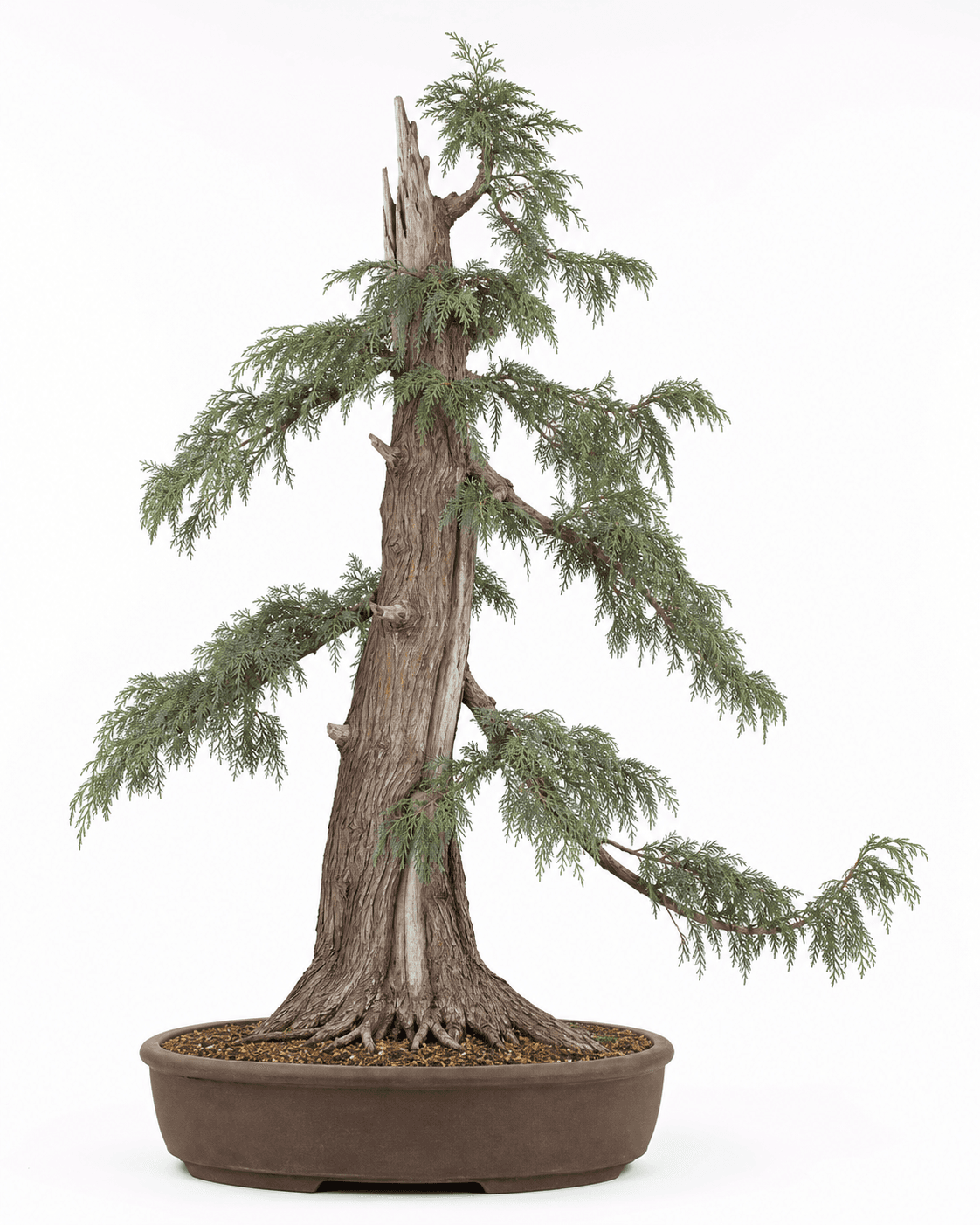
The same habitat points to design. Old Nootka cypress should read as wet mountain, fog belt, snow load, and slow age: drooping sprays, upright or leaning trunks, cylindrical deadwood, broken old tops, and layered negative space rather than tight generic pads. Bonsai Mirai / AsymmetryUSDA Forest Service FEIS
Reading the tree
Separate development, recovery, and refinement before you cut.
Mirai classifies this kind of material by physiology before calendar. Nootka cypress behaves as an elongating conifer whose stored strength sits largely in the vascular system of trunk and branches, so heavy root work and heavy foliage work should be separated by recovery time. Bonsai Mirai Library
In development, let shoots extend enough to reload the tree and build interior options. In refinement, reduce strong vertical or rope-like shoots back to living lateral fronds and keep energy from collecting only at the tips. Bonsai Mirai Library
Judge readiness by live interior fronds, firm new extension, healthy color, drainage speed, and response to last season. Top growth alone can overstate root recovery in elongating conifers, so recently collected or recently repotted trees need a conservative schedule. Bonsai Mirai Library
Read the foliage orientation before wiring. Nootka cypress has flattened fan-like branchlets closer in handling to Thuja and false-cypress than to juniper-like true Cupressus foliage. Rolled or inverted fans can sunburn and weaken. Oregon State Landscape PlantsBonsai Mirai Library
Pruning
Use directional frond pruning, not hedge shearing.
The safest refinement habit is to cut back to an interior lateral frond pointing in the desired direction. This preserves the fan structure, redirects energy, and avoids leaving blunt brown cuts across the face of a spray. Bonsai Mirai Library
Remove spent or weak fronds that detach with almost no pressure, strong vertical shoots that have abandoned ramification, and crowded crotch growth that blocks light. Keep weak interior growth when the tree needs density and photosynthate. Bonsai Mirai Library
Spring pruning is for structure and recovery planning. Midsummer pruning is for refined frond control after growth has enough strength. Early fall pruning is useful only at the front edge of vascular production, with every cut ending at a visible bud or live smaller shoot. Bonsai Mirai Library
Small shohin or kifu material may tolerate careful repeated pinching when compactness is the main goal, but larger Nootka cypress usually looks better when pruned with scissors to preserve drooping layered sprays. Bonsai Mirai Library
Avoid cutting back behind living foliage on old bare wood unless the design accepts that open space. Mirai treats Nootka-like fan foliage as a species group where reliable interior replacement depends on existing live fronds, not hope. Bonsai Mirai Library
Repotting
Repot at spring tip swell and protect shallow roots from temperature swings.
Mirai has one direct Alaskan yellow cedar timing claim: it can still be repotted while tips are swelling or just beginning to produce foliage, in the same general spring window used for other elongating cedar-family species. Bonsai Mirai Library
Make the repot exploratory when root history is unknown. Set front, angle, and tie-down plan before extraction; remove compacted perimeter soil deliberately; and avoid creating cavities under the trunk that cannot be refilled with new substrate. Bonsai Mirai Library
Never combine major root reduction with major foliage reduction on the same schedule. If the tree was heavily styled, wait at least a full growing season before serious root work. If it was repotted hard, let new growth prove recovery before styling. Bonsai Mirai Library
Yellow-cedar decline makes root temperature a real design and aftercare issue. USDA Forest Service attributes the decline to fine-root freezing injury on shallow soils with low snowpack, where premature spring dehardening leaves surface roots vulnerable to cold events. USDA Forest Service Alaska Region
After repotting, place the tree in bright protected conditions, stabilize moisture, avoid hard freezes around the pot, and keep fertilizer light until extension confirms root recovery. Bonsai Mirai LibraryUSDA Forest Service Alaska Region
Soil and pot
Build a cool, moist root system with oxygen at the center.
Oregon State describes Nootka cypress as preferring well-drained moist soil, and Missouri Botanical Garden says best performance comes in moist fertile soils in cool summer climates with above-average humidity or rainfall. Oregon State Landscape PlantsMissouri Botanical Garden
For bonsai, use inorganic soil that holds water without collapsing. A practical development mix is 2 parts akadama, 1 part pumice, and 1 part lava. Once old nursery or field soil is gone and roots are strong, 3 parts akadama, 1 part pumice, and 1 part lava can support finer growth. Bonsai Mirai Library
Keep the particle size fine enough for moisture and root division but coarse enough to drain. A 2 to 6 mm range is a useful starting point for established trees, adjusted upward for large development containers and downward for refined small trees. Bonsai Mirai Library
Pot choice should support the species image. Tall, narrow, or understated oval and rectangle pots suit weeping and upright forms; slab, forest, or shallow mountain containers can work when the root system is stable and the design evokes wet subalpine ridges. Bonsai Mirai / Asymmetry
Avoid shallow decorative containers too early. The species can be long-lived and slow, and root recovery matters more than immediate presentation during the first years of bonsai conversion. Bonsai Mirai Library
Climate
Cool summers are easy; hot interiors and warm winters need mitigation.
In coastal Pacific Northwest and similar climates, Nootka cypress can usually take full sun with regular water and moving air. In hot inland climates, give morning sun, afternoon shade, pot shading, and extra attention to wind-driven drying. Missouri Botanical GardenBonsai Mirai Library
NC State notes that Pendula does best in cool summer climates with plenty of rainfall and can be grown in the North Carolina mountains. Missouri Botanical Garden also cautions that plants may struggle where environmental conditions do not favor most conifers. NC State ExtensionMissouri Botanical Garden
Winter protection is about root stability, not keeping the tree warm like a tropical. Protect the pot from freeze-thaw swings, drying wind, and warm spells followed by hard freezes, especially after repotting. USDA Forest Service Alaska RegionBonsai Mirai Library
Warm winter conditions can be risky because USDA describes premature dehardening as part of yellow-cedar decline. Bonsai aftercare should preserve steady dormancy and avoid placing a shallow pot where sun warms roots early, then cold air freezes them again. USDA Forest Service Alaska Region
In very humid regions, maintain air movement and avoid wet compacted organic soil. The tree likes moisture, but the bonsai root zone still needs oxygen, clean drainage, and disease-aware watering. NC State ExtensionBonsai Mirai Library
Pests
Watch mites, borers, root problems, shoot blight, and decline symptoms.
NC State lists beetle borers, spider mites, Phytophthora, root rot, rust, occasional aphids, and blight on Pendula. Missouri Botanical Garden adds bagworms, juniper scale, red spider mite, root rot, and some blight susceptibility. NC State ExtensionMissouri Botanical Garden
USDA Forest Service identifies yellow-cedar shoot blight, caused by Kabatina thujae, on terminal and lateral shoots. It can kill 4 to 10 inches of new shoot growth in late winter or early spring and can be confused with frost damage. USDA Forest Service Alaska Region
Yellow-cedar decline is different from normal bonsai root rot. USDA attributes it to fine-root freezing injury on sites with shallow soils and low snowpack, with yellow-red-brown crown discoloration and gradual crown thinning after roots are injured. USDA Forest Service Alaska Region
In bonsai, prevent the familiar container version of those stresses: shallow roots exposed to rapid temperature swings, stale wet pockets, compacted nursery soil, hot dry wind, and recovery work stacked too close together. Bonsai Mirai LibraryUSDA Forest Service Alaska Region
Use local extension diagnosis before pesticide or fungicide treatment. Many symptoms overlap: mite stippling, frost damage, shoot blight, root freezing, drought, and root rot can all show as yellowing or browning tips. NC State ExtensionUSDA Forest Service Alaska Region
Wiring
Wire for branch architecture and leave the fronds alive.
Wire the structural branch, then use scissor pruning and light detail wiring to set sprays. Stop before the branchlet loses its natural droop or fan orientation. Bonsai Mirai Library
Handle bark and branch shoulders carefully. Mirai wiring method for rough or flaky bark keeps the supporting fingers between wire and bark during application so the wire does not cut or strip tissue. Bonsai Mirai Library
When raising or lowering a branch, seat wire where it supports the shoulder mechanically. For heavy bends, guy wires, padding, or a braced spacer can be more appropriate than forcing a fine fan branch with a long coil. Bonsai Mirai Library
Check wire frequently during active thickening. Mirai coastal-conifer method notes that contact points can swell quickly in May and June, especially on vigorous elongating material. Bonsai Mirai Library
Preserve the dark upper surface of flat sprays toward the light. Rotating fans aggressively can expose sun-sensitive undersides and make the tree rebuild new growth to correct orientation. Bonsai Mirai Library
Propagation
Use seed for variability, cuttings for forms, and grafting with taxonomic caution.
NC State lists seed, stem cuttings, and grafting for the species, and lists grafting plus stem cuttings for Pendula. Seed can produce variable form; cuttings and grafting preserve narrow, blue, gold, variegated, or weeping selections. NC State ExtensionNC State Extension
USDA FEIS notes that layering occurs in natural stands, especially in dry open stands where seedlings are fewer. That supports air-layering as a plausible bonsai technique when the branch remains vigorous and aftercare is cool and humid. USDA Forest Service FEIS
Mirai taxonomy cautions that graft compatibility depends on close genetic relationship. Because Nootka cypress has moved through Thuja, Chamaecyparis, Cupressus, Xanthocyparis, and Callitropsis labels, do not assume Hinoki, Thuja, or true Cupressus grafts will work without documented nursery evidence. Bonsai Mirai LibraryOregon State Landscape Plants
For bonsai propagation, prioritize same-species cuttings, layers, or nursery-proven grafted cultivars. Keep the rootstock and scion label with the tree because future root vigor, disease resistance, and cold response may depend on that pairing. NC State ExtensionBonsai Mirai Library
Buying
Buy labels, roots, and interior foliage before buying the silhouette.
Good Nootka cypress bonsai material has a clear label, visible root flare, live interior fronds, cold-season color without widespread dieback, clean bark, and roots that can be converted gradually. Oregon State Landscape PlantsBonsai Mirai Library
Avoid compacted peat balls, severe circling roots, nursery plants with dead brown interiors, topkill, mite stippling, root-rot smell, recent blight, and trees sold only for a dramatic weeping outline. NC State ExtensionMissouri Botanical Garden
Separate Nootka cypress from look-alikes before applying care. Oregon State specifically warns that Alaska-cedar is often confused with Port-Orford-cedar, and its leaves resemble western redcedar while differing in scale size and odor. Oregon State Landscape Plants
Wild collection requires legal permission, ecological restraint, and long recovery. USDA FEIS records ancient, slow-growing trees and important Pacific coastal forest roles, so nursery stock, salvaged legal material, or documented landscape removals are the practical sources for most growers. USDA Forest Service FEISUSDA Forest Service Silvics
For cultivar material, inspect the graft, rootstock, branch exits, and actual foliage scale. A narrow cultivar can solve silhouette, but it does not solve a poor root system or a trunk with no future branch story. NC State ExtensionBonsai Mirai / Asymmetry
Troubleshooting
Read the symptom, then check roots, heat, foliage handling, and timing.
Symptom: yellow-red-brown crown discoloration after winter or early spring. Likely cause: root temperature injury, dehardening, or a container version of yellow-cedar decline stress. Fix: protect the pot from freeze-thaw swings, keep roots insulated, avoid early warm exposure, and reduce work until vigor returns. USDA Forest Service Alaska Region
Symptom: 4 to 10 inches of terminal or lateral shoot dieback after late winter or early spring. Likely cause: shoot blight or frost injury. Fix: get local diagnosis, remove clearly dead tips after the tree resumes growth, improve air movement, and avoid pruning during wet disease-favorable weather. USDA Forest Service Alaska Region
Symptom: bronzing, stippling, or dull foliage in hot weather. Likely cause: spider mites, dry wind, or root-zone heat. Fix: inspect with a hand lens, rinse foliage when appropriate, cool the pot, and use extension-guided mite control. NC State ExtensionMissouri Botanical Garden
Symptom: the tree wilts or dulls while the soil stays wet. Likely cause: compacted organic soil, poor oxygen, Phytophthora, or root rot. Fix: stop keeping the pot saturated, improve drainage, shelter from heat, and plan a staged spring root conversion. NC State ExtensionBonsai Mirai Library
Symptom: pruning creates permanent bare gaps. Likely cause: cutting behind live fronds or relying on old bare wood. Fix: preserve interior laterals, grow new extensions before reduction, graft valuable trees when documented, or redesign around open space. Bonsai Mirai Library
Symptom: the top gets dense while lower branches weaken. Likely cause: apical and vertical dominance. Fix: reduce runaway verticals back to lateral fronds, keep lower foliage lit, and avoid styling that shades the lower tree. Bonsai Mirai Library
Design
Style for drooping sprays, wet mountain age, and old yellow-cedar character.
Start with the trunk line, defining branch, and apex. Mirai design method asks which wild trait makes the species distinct; for Nootka cypress, the strongest traits are drooping fan sprays, slender upright or leaning trunks, cool mountain habitat, and very old wet-climate wood. Bonsai Mirai / AsymmetryUSDA Forest Service FEIS
Use branch movement that drops, then props back up into layered sprays. This keeps the foliage legible as cedar-like fan foliage rather than turning the tree into a compact pine silhouette. Bonsai Mirai Library
Multi-apex, broken-top, literati, slender upright, and forest compositions can all work. USDA FEIS records very old yellow-cedars, including ancient Olympic Mountain groves, so age can be shown through quiet remnant structure rather than oversized foliage mass. USDA Forest Service FEISBonsai Mirai / Asymmetry
Deadwood should feel cylindrical, wet-climate, and weathered. Mirai Thuja method favors smooth, bark-stripped, tubular deadwood for cedar-family wet-climate material, with less torn sandblasted grain than arid junipers. Bonsai Mirai Library
For weeping cultivars, let the droop be a structural clue but give the tree a branch hierarchy. A mass of vertical strings can look like a landscape specimen; bonsai needs selected lines, negative space, and a clear apex decision. NC State ExtensionBonsai Mirai / Asymmetry
Cultivars
Weeping, narrow, gold, blue, and variegated forms are common in trade.
Oregon State lists Aurea, Pendula, Strict Weeping, and Variegata. NC State lists Aurea, Glauca, Green Arrow, Pendula, and Variegata for the species page. Oregon State Landscape PlantsNC State Extension
NC State describes Green Arrow as very narrow, Glauca as bluish foliage on weeping branches, Aurea as bright yellow new growth, and Variegata as green foliage with gold flecks. NC State Extension
Missouri Botanical Garden describes Pendula as a slender pyramidal, strongly weeping form that can reach 35 ft tall and 12 ft wide over 35 years, often smaller in cultivation. Missouri Botanical Garden
For bonsai, Green Arrow, Strict Weeping, Pendula, and Van den Akker-style narrow forms can give strong vertical character, but they still need root inspection, interior foliage, and branch choices. Color forms such as Aurea, Glauca, and Variegata should be judged for vigor as much as color. NC State ExtensionBonsai Mirai / Asymmetry
Keep cultivar names as labels, not care calendars. Most Nootka cypress forms share the same cool-root, moist-air, fan-foliage method, with adjustments for vigor, foliage density, and graft or cutting origin. Bonsai Mirai Library
History
Nootka cypress is ancient, culturally useful, and taxonomically complicated.
Oregon State explains that nootkatensis refers to Nootka Sound on Vancouver Island, where the tree was first described by Archibald Menzies during Captain George Vancouver's 1791 to 1795 expedition. Oregon State Landscape Plants
USDA FEIS describes yellow-cedar as long-lived, with average life often around 500 to 750 years and extremely old trees commonly reported beyond 1,000 years. A tree near Campbell River, British Columbia, was documented at 1,600 years. USDA Forest Service FEIS
The same FEIS review describes ancient Olympic Mountain groves containing Washington's oldest trees, including a 365 cm DBH yellow-cedar estimated at more than 2,000 years old. USDA Forest Service FEIS
NC State records durable, resinous wood used for cabinet making, boats, and carvings, plus inner-bark fibers used for mats and blankets. USDA notes yellow-cedar wood value in Alaska and British Columbia. NC State ExtensionUSDA Forest Service FEIS
Taxonomic instability is part of the story. Oregon State summarizes the move through Chamaecyparis, Xanthocyparis, Cupressus, and Callitropsis. For EntGrove pages, Callitropsis nootkatensis is the accepted page name, while older names remain searchable aliases. Oregon State Landscape PlantsKew POWO
Species questions
Answer the beginner questions before styling.
Can Nootka cypress be grown as bonsai?
Yes. Nootka cypress can be grown as outdoor bonsai when it gets cool bright conditions, even moisture, excellent drainage, careful spring repotting, and pruning that preserves live fan foliage.
Can Nootka cypress bonsai live indoors?
Grow it outdoors year-round. It needs outdoor light, moving air, seasonal dormancy, and a cool root rhythm. Brief indoor display is fine when the tree returns outside quickly.
When should I repot Nootka cypress bonsai?
Repot in spring as the tips swell or just begin to produce foliage. Avoid late repotting once the flush is active, and separate serious root work from serious foliage reduction.
What soil works for Nootka cypress bonsai?
Use a moisture-retentive inorganic mix. Start around 2 parts akadama, 1 part pumice, and 1 part lava while old soil remains, then use 3:1:1 on clean, established roots.
How much sun does Nootka cypress bonsai need?
Full sun works in cool maritime climates. In hot or inland climates, use morning sun with afternoon shade, cool the pot, and protect from dry wind.
Should Nootka cypress be pinched or pruned?
Use directional scissor pruning for most trees. Pinching can be reserved for very small refined material where compactness matters, but larger trees usually need their drooping fan character preserved.
Is Nootka cypress the same as Alaska cedar?
Yes. Nootka cypress, Alaska cedar, Alaska yellow-cedar, yellow-cedar, and Alaska cypress commonly refer to Callitropsis nootkatensis. Chamaecyparis, Cupressus, and Xanthocyparis nootkatensis are older or alternate labels.
Why is my Nootka cypress turning yellow or brown?
Common causes include spider mites, drought, hot wind, compacted soil, root rot, shoot blight, spring frost injury, or root temperature swings after premature dehardening. Check roots, mites, and recent weather first.
What cultivars of Nootka cypress are useful for bonsai?
Pendula, Green Arrow, Strict Weeping, Glauca, Aurea, Variegata, and narrow Van den Akker-style forms can be useful. Choose by root quality, trunk line, interior foliage, and vigor before color or silhouette.
What styles suit Nootka cypress bonsai?
Slender upright, informal upright, slanting, literati, weeping, group, forest, and old wet-mountain remnant forms suit the species when the design shows drooping sprays and cool-climate age.
Sources
Species advice needs source discipline.
Next decisions
Plan the operation before copying the calendar.
A good care note for Nootka cypress / Alaska cedar records the tree's stage, the work done, and the aftercare used. That record matters more than a month-name rule.
Related species
Compare nearby trees before transferring advice.
Coast redwood
Sequoia sempervirens
Sitka spruce
Picea sitchensis
Western hemlock
Tsuga heterophylla
Coastal Douglas-fir
Pseudotsuga menziesii var. menziesii
Monterey cypress
Hesperocyparis macrocarpa