
Species guide
Pachycormus Bonsai Care
Pachycormus discolor
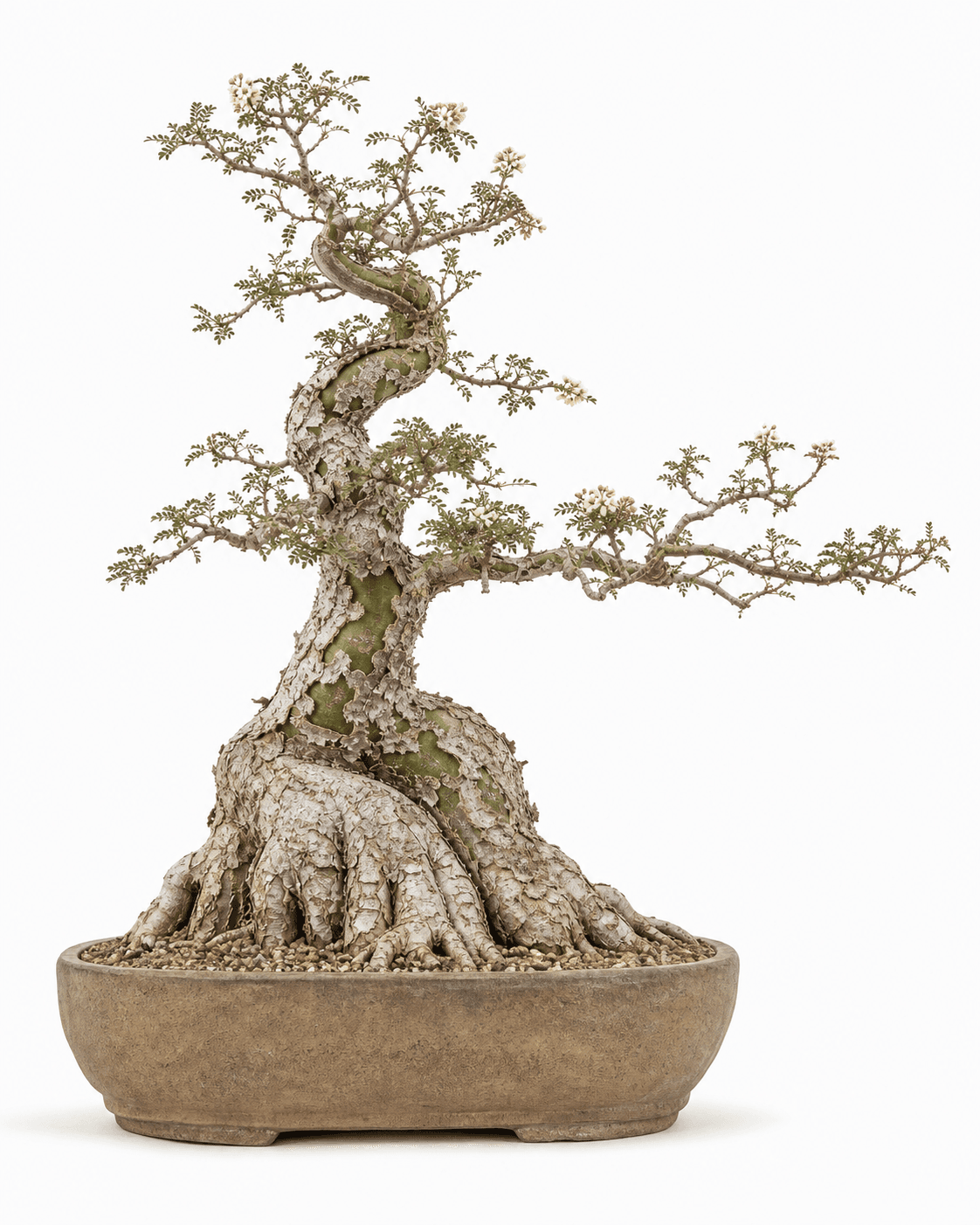
Pachycormus bonsai care starts with the swollen trunk. Pachycormus discolor, commonly sold as Baja elephant tree, is a drought-deciduous caudex tree from Baja California with exfoliating pale bark, photosynthetic inner bark, resinous tissue, tiny pinnate leaves, and seasonal flowers.
Treat it as Broadleaf > Succulent in EntGrove: bright light, mineral drainage, watering tied to active leaves, warm root work, sparse winter water, and frost protection in a bonsai pot. The bonsai design should make the caudex and dry-country silhouette clear before chasing fine branching.
The local Mirai corpus has no dedicated Pachycormus file. This guide transfers Mirai succulent, tropical, watering, soil, repotting, wiring, fertilizer, propagation, and design method transparently, while Kew, GBIF, the San Diego Natural History Museum Baja checklist, and public species summaries ground taxonomy, range, morphology, hardiness, and label handling.
Updated June 13, 2026. Written by EntGrove Editorial. Last verified June 13, 2026.
Care fingerprint
Read the species through its shared care pattern.
Err on mineral drainage, warm recovery, and conservative watering; many tolerate pruning but not cold wet roots. Use this as the starting point before local conditions and tree strength refine the calendar.
Note: Baja California caudex tree with drought-deciduous leaf rhythm, pale exfoliating bark, resinous tissue, and crowded elephant-tree labels. Verify Pachycormus discolor against Bursera microphylla, Operculicarya, Boojum tree, dwarf jade, desert rose, and Madagascar palm before applying care.
Read the foliage first
Broadleaf stress usually shows in leaf color, leaf size, wilt, scorch, or delayed hardening before it becomes a branch problem.
Match work to dormancy
Deciduous, evergreen, tropical, succulent, and flowering broadleaf trees recover on different calendars.
Protect fine roots
Root work should preserve enough active fine roots for the tree to rehydrate quickly after the operation.
Care cadence
The calendar starts with the tree's seasonal state.
Placement
Timing: Give full sun or the brightest protected light during warm active growth. Reintroduce strong sun gradually after winter protection, shipping, greenhouse culture, or repotting.
Watch for: Sudden bark or leaf scorch, cold windowsills, weak elongated shoots, a pot overheating against glass, and wind rocking a top-heavy caudex.
Public species summary: Pachycormus discolorBonsai Mirai LibraryWatering
Timing: Water deeply during active leaf growth after the mix dries. During cool, leafless, low-light, or post-repot periods, water much less and prioritize oxygen.
Watch for: Soft trunk base, sour soil, panic watering after normal leaf drop, long wet intervals, and dry hot wind on a small pot in active leaf.
Bonsai Mirai LibraryPublic species summary: Pachycormus discolorFeeding
Timing: Feed lightly to moderately only while leaves are active and light is strong. Stop pushing growth as the tree moves toward dry or cool rest.
Watch for: Feeding leafless roots, salt buildup in dry media, lush weak shoots indoors, and fertilizer applied before roots recover from repotting.
Bonsai Mirai LibraryPruning
Timing: Prune in warm active growth after shoots extend and begin to harden. Keep cuts small, preserve leaf-bearing tissue, and avoid late cuts before cold protection.
Watch for: Large wounds on resting plants, removing all lower trunk-building growth, and pruning to a generic branch map that hides the caudex.
Bonsai Mirai LibraryBonsai Mirai / AsymmetryLeaf work
Timing: Use leaf rhythm as a health signal. Selective leaf reduction belongs only on strong leafed plants in bright conditions; developing trunks should keep leaves to build reserves.
Watch for: Forced full defoliation, confusing dry-season leaf drop with fertilizer deficiency, and reducing leaves while roots are cold or wet.
Public species summary: Pachycormus discolorBonsai Mirai LibraryRepotting
Timing: Repot in warm active growth, usually late spring or early summer in cold-winter collections. Anchor firmly and reduce old organic soil in stages.
Watch for: Cold wet aftercare, torn fleshy roots, hard chopsticking, buried trunk crowns, and structural pruning in the same session as major root work.
Bonsai Mirai LibraryWiring
Timing: Wire young flexible shoots during active growth, then check often. Use pruning, guy wires, or front selection when older branches resist movement.
Watch for: Wire scars on swelling shoots, cracked resinous tissue, bends that ignore the natural trunk, and hiding the photosynthetic bark with dense pads.
Bonsai Mirai LibraryBonsai Mirai / AsymmetryWinter protection
Timing: Protect before frost and keep protected plants bright, airy, and drier. Leafless winter storage should be sparse-water storage, not wet dormancy.
Watch for: Wet cold roots, watering on a summer schedule, scale or mites indoors, and cold glass against soft tissue.
Public species summary: Pachycormus discolorBonsai Mirai LibraryPest and disease inspection
Timing: Inspect during greenhouse wintering, new leaf flushes, and after repotting. Cultural root rot is the main preventable failure.
Watch for: Scale, mealybug, aphids, mites, sticky residue, black roots, soft trunk tissue, and organic media that stays damp after leaf drop.
Bonsai Mirai LibrarySpecies guide
Apply the species profile before copying another tree's calendar.
At a glance
Pachycormus is a Baja caudex tree for advanced succulent bonsai culture.
Apply this page to Pachycormus discolor. Kew accepts the name and places it in Anacardiaceae, with a Mexico, Baja California range and a desert or dry shrubland biome. Kew POWO: Pachycormus discolorGBIF: Pachycormus discolor
The common-name field is crowded. Baja elephant tree, Magdalena elephant tree, Baja California elephant tree, Veatch elephant tree, copalquin, torote blanco, and plain elephant tree can all point toward Pachycormus, but elephant tree also appears on Bursera, Operculicarya, and other swollen-stem plants. San Diego Natural History Museum: Baja California checklistPublic species summary: Pachycormus discolor
EntGrove places it in Broadleaf > Succulent because the calendar follows caudex storage, drought-deciduous foliage, dry-cycle watering, warm root recovery, and rot avoidance. Bonsai Mirai LibraryKew POWO: Pachycormus discolor
The source-depth caveat matters. The local Mirai corpus has no dedicated Pachycormus file, so the bonsai technique here is transferred from Mirai succulent and tropical method, with botanical facts checked against Kew, GBIF, and Baja floristic sources. Bonsai Mirai LibraryKew POWO: Pachycormus discolorSan Diego Natural History Museum: Baja California checklist
Habitat
Baja desert and island ecology explain the leaf rhythm and trunk-first design.
Kew frames the species as a caudex tree of Mexican desert or dry shrubland. The Baja checklist gives a more detailed variety-level picture across Baja California and Baja California Sur, including Magdalena and Santa Margarita islands, Cedros and Natividad islands, the Vizcaino region, Gulf islands, and the Sierra de La Giganta area. Kew POWO: Pachycormus discolorSan Diego Natural History Museum: Baja California checklist
Public summaries describe a drought-deciduous tree that leafs after useful moisture, then sheds leaves as the dry cycle returns. That habitat should translate into bonsai culture as bright exposure, mineral soil, deep water during active leaf growth, and long oxygen-return intervals. Public species summary: Pachycormus discolorBonsai Mirai Library
For design, start from where the tree lives: wind, drought, exposed bark, sparse seasonal foliage, and a swollen trunk. The pot should show dry-country resilience rather than a dense green shrub. Bonsai Mirai / AsymmetrySan Diego Natural History Museum: Baja California checklist
Reading the tree
Read active leaves, trunk firmness, bark condition, and soil oxygen.
A strong Pachycormus has a firm caudex, clean exfoliating bark, active leaves or buds when warm and watered, and a drying mineral soil cycle. The root crown should stay high enough to dry quickly. Public species summary: Pachycormus discolorBonsai Mirai Library
Development means building the caudex, root flare, trunk line, and a few convincing branch options. Seedlings and young propagated plants may need years of generous warm growth before the defining trunk character becomes clear. Public species summary: Pachycormus discolorBonsai Mirai / Asymmetry
Refinement means restraint: fewer better branches, modest leaf work, careful wiring, and enough open space for the pale bark and swollen base to carry the design. Bonsai Mirai / AsymmetryBonsai Mirai Library
Pruning
Prune during warm leafed growth and respect dry-season rest.
Prune only when the plant is warm, leafed, and clearly moving water. Small cuts in active growth have a better chance of closing cleanly than late cuts before cool storage. Bonsai Mirai LibraryPublic species summary: Pachycormus discolor
Preserve sacrifice growth while the trunk and base are being built. Removing every low branch too early can leave a thin decorative top on a caudex that needed more development time. Bonsai Mirai / Asymmetry
Use leaf work sparingly. The leaves are naturally small and seasonal, and forced defoliation on weak or protected material spends stored energy that could be used for roots and trunk recovery. Public species summary: Pachycormus discolorBonsai Mirai Library
Large trunk chops are specialist decisions. Resinous, soft, water-storing tissue can rot or scar poorly when the wound is mistimed, so make major cuts only with warm aftercare ahead. Bonsai Mirai LibraryPublic species summary: Pachycormus discolor
Roots
Repot warm, keep the caudex proud, and preserve oxygen.
Use succulent and tropical timing for major root work: visible active growth, warm nights, bright light, and enough season for root regeneration. Early spring temperate timing is too cold for most protected collections. Bonsai Mirai Library
Handle roots as hydration tissue. Mirai succulent method emphasizes gentle work around fleshy roots, oxygen-rich media, and dry-cycle aftercare so new roots can initiate without rot. Bonsai Mirai Library
Set the caudex high and stable. A buried swollen base hides the main feature, holds moisture against bark, and increases crown-risk after watering. Bonsai Mirai LibraryBonsai Mirai / Asymmetry
After root work, avoid repeated movement. A heavy trunk can rock in fresh soil and break new roots, so tie down firmly and delay styling until water movement is obvious. Bonsai Mirai Library
Soil and pot
Use mineral soil and a quiet pot that frames the caudex.
A useful baseline is equal parts akadama, pumice, and lava, or a comparable mineral blend with decomposed granite or coarse sand where that fits local water quality and heat. Bonsai Mirai Library
Avoid peat-heavy nursery soil in a shallow display pot. If the core is old and wet, convert gradually over multiple warm repots rather than bare-rooting a rare plant into collapse. Bonsai Mirai Library
Development containers can be deeper and warmer to build roots and trunk. Display pots should be visually quiet and stable, often shallow-to-moderate ovals or rectangles that make the swollen trunk feel grounded. Bonsai Mirai / Asymmetry
Shape the soil surface so water moves away from the trunk crown. The bark and caudex should be visible, dry quickly, and remain firmly anchored. Bonsai Mirai LibraryPublic species summary: Pachycormus discolor
Climate
Give strong light, warm recovery, and frost-protected dry rest.
In warm dry regions, Pachycormus can spend much of the year outside in bright light, with water keyed to leaves, heat, pot size, and actual soil drying. Public species summary: Pachycormus discolorBonsai Mirai Library
In cold-winter regions, protect before freezing temperatures. Public succulent summaries put tip damage around 32 F / 0 C, and shallow bonsai pots remove the buffering that old habitat trunks have in the ground. Public species summary: Pachycormus discolorBonsai Mirai Library
In humid regions, prioritize airflow, mineral soil, and restrained watering. A Baja dry-shrubland tree can rot in a humid protected room even when the upper surface appears dry. Bonsai Mirai LibraryKew POWO: Pachycormus discolor
Indoor wintering works only as bright protected storage. Keep it warm enough, dry enough, and airy enough that resting roots are not asked to sit wet in weak light. Bonsai Mirai LibraryPublic species summary: Pachycormus discolor
Pests
Prevent rot first, then watch indoor succulent pests.
Root and crown rot are the failures to prevent. Soft trunk tissue, black roots, sour media, or a wet pot after leaf drop should stop all styling until warmth, drainage, and watering rhythm are corrected. Bonsai Mirai Library
Scale, mealybug, aphids, and spider mites are likely under greenhouse or indoor storage. Inspect fresh leaves, twig junctions, bark folds, and sheltered areas near the caudex. Bonsai Mirai Library
Treat pests as a culture signal. Low light, stale air, excess nitrogen, and extended wet media make pest and disease issues more persistent than the insect itself. Bonsai Mirai Library
Wiring
Wire young shoots lightly and let the trunk do most of the work.
Wire only flexible active shoots, then check frequently during warm swelling. Resinous soft tissue can mark quickly, and scars on the sparse branch structure stay visible. Bonsai Mirai LibraryPublic species summary: Pachycormus discolor
Large movement usually comes from front selection, planting angle, leader choice, and pruning. Forced bends on older branches can crack tissue and distract from the caudex. Bonsai Mirai / AsymmetryBonsai Mirai Library
Keep the branch system open. Dense pads hide the pale bark, gnarled trunk, and seasonal desert character that make Pachycormus worth training. Bonsai Mirai / AsymmetryPublic species summary: Pachycormus discolor
Propagation
Seed is best for caudex development and clean provenance.
Seed-grown material is the preferred bonsai route because public succulent summaries note that seed-grown plants develop the caudex most convincingly. Seedlings also let the grower guide root flare and trunk line early. Public species summary: Pachycormus discolorBonsai Mirai / Asymmetry
Cuttings are a specialist route. Apply Mirai succulent cutting principles: callus the cut, use warm bright conditions, keep the medium oxygen-rich, and water with restraint until roots are active. Bonsai Mirai Library
Air-layering and grafting are unusual default choices for this species. The trunk value, slow pace, and source ethics favor documented cultivated plants over heroic propagation experiments. Bonsai Mirai / AsymmetrySan Diego Natural History Museum: Baja California checklist
Because the Baja checklist shows narrow regional and island variety patterns, provenance matters. Keep collection records with seed or nursery plants whenever possible. San Diego Natural History Museum: Baja California checklist
Buying
Buy for identity, firm tissue, and documented cultivated origin.
Accept labels such as Pachycormus discolor, Baja elephant tree, elephant tree, copalquin, torote blanco, Magdalena elephant tree, Baja California elephant tree, or Veatch elephant tree, then verify against bark, caudex, leaflets, and records. Kew POWO: Pachycormus discolorSan Diego Natural History Museum: Baja California checklist
Look for a firm base, intact exfoliating bark, active buds or clean leaf scars, no sour wet soil, no soft dark crown tissue, and a planting angle that can become a convincing dryland tree. Bonsai Mirai LibraryBonsai Mirai / Asymmetry
Avoid vague wild-origin claims, recently chopped old trunks, plants sitting in cold wet peat, or generic elephant tree labels without botanical confirmation. Ethical cultivated seedlings are often the better long-term bonsai material. San Diego Natural History Museum: Baja California checklistPublic species summary: Pachycormus discolor
Separate Pachycormus from Bursera microphylla, Operculicarya, dwarf jade, Boojum, desert rose, Madagascar palm, and generic caudiciform labels before applying care advice. Kew POWO: Pachycormus discolorPublic species summary: Pachycormus discolorKew POWO: Operculicarya decaryi
Troubleshooting
Most failures trace to cold wet roots, low light, or misread leaf drop.
Leaves drop: check the season, recent water, heat, cold, and trunk firmness. A firm plant in a drying pot may be entering rest; a soft base in wet soil signals danger. Public species summary: Pachycormus discolorBonsai Mirai Library
Base softens: warm the plant, increase airflow, stop routine watering, and inspect drainage. Styling and feeding wait until the root problem is stable. Bonsai Mirai Library
Shoots stretch: increase light gradually and reduce nitrogen. Weak protected growth should be strengthened before it is pruned or wired. Bonsai Mirai Library
Bark scars or peels unevenly: separate normal exfoliation from wounds. Healthy bark can shed naturally; soft dark patches near the crown deserve immediate culture review. Public species summary: Pachycormus discolorBonsai Mirai Library
Caudex fails to develop: give seed-grown material more years, more active-season light, careful feeding, root room in development, and selected sacrifice growth. Public species summary: Pachycormus discolorBonsai Mirai / Asymmetry
Plant stalls after repotting: keep it warm, bright, and stable, then water only when the mix has dried enough to regain oxygen. Repeated unpotting breaks new roots. Bonsai Mirai Library
Design
Design from the caudex, bark, and dryland silhouette.
Start with base, trunk mass, trunk line, defining branch, and apex. Pachycormus has enough character in the caudex and exfoliating bark that the branch map can stay sparse. Bonsai Mirai / AsymmetryPublic species summary: Pachycormus discolor
Use asymmetry and negative space. A leaning coastal form, upright caudex tree, or low wind-shaped reading can feel more species-aware than a symmetrical dome. Bonsai Mirai / AsymmetrySan Diego Natural History Museum: Baja California checklist
Keep flowers and leaves as seasonal bonuses. The most reliable visual identity is the swollen trunk, pale peeling bark, small deciduous leaves, and dry-cycle rhythm. Public species summary: Pachycormus discolorBonsai Mirai / Asymmetry
Carving should be conservative. The bark, resinous tissue, and soft water-storing trunk already carry texture, and excessive deadwood can look forced while adding rot risk. Bonsai Mirai / AsymmetryBonsai Mirai Library
Forms
Variety names are regional identity cues, not separate bonsai calendars.
Kew lists Pachycormus discolor var. pubescens and var. veatchianus among accepted heterotypic synonyms under the species page. The Baja checklist still uses variety-level entries that matter for regional identity. Kew POWO: Pachycormus discolorSan Diego Natural History Museum: Baja California checklist
Var. discolor is tied to Baja California Sur, Magdalena and Santa Margarita islands, and the southern Sierra de La Giganta area. The checklist names it Magdalena elephant tree. San Diego Natural History Museum: Baja California checklist
Var. pubescens is the broadest Baja California elephant tree entry in the checklist, ranging from central Baja California south toward La Paz and several islands. San Diego Natural History Museum: Baja California checklist
Var. veatchiana is associated with Cedros Island, Natividad islands, and the western Vizcaino Peninsula, with Veatch elephant tree as the checklist common name. San Diego Natural History Museum: Baja California checklist
History
Pachycormus sits between Baja botany, succulent collecting, and bonsai design.
The scientific name points directly to a thick trunk, and public summaries emphasize the unusual swollen form, peeling bark, and resinous photosynthetic inner bark that made the tree memorable to Baja plant writers. Public species summary: Pachycormus discolorKew POWO: Pachycormus discolor
The Baja checklist gives the plant strong regional identity through local variety names and Spanish labels such as copalquin and torote blanco. San Diego Natural History Museum: Baja California checklist
A strong exhibition tree should show documented identity, ethical cultivated source, firm trunk tissue, stable roots, visible caudex, mineral soil, and a design that still reads as Pachycormus when leafless. Bonsai Mirai / AsymmetryBonsai Mirai Library
Species questions
Answer the beginner questions before styling.
Can Pachycormus discolor be grown as bonsai?
Yes. Pachycormus discolor can be trained as an advanced caudex or succulent bonsai when it has strong light, mineral drainage, warm active-growth work, sparse winter water, and frost protection.
Is Pachycormus the same as elephant tree?
Pachycormus discolor is often called Baja elephant tree or elephant tree, but elephant tree is ambiguous. Confirm the botanical name before applying this care page.
Is Pachycormus a cactus?
No. Pachycormus discolor is an Anacardiaceae caudex tree. It is treated like succulent bonsai material because it stores water and needs dry-cycle, high-oxygen care.
How much sun does Pachycormus bonsai need?
Use full sun or very bright protected light after acclimation. Move greenhouse, indoor, shipped, or recently repotted plants into stronger sun gradually.
How often should I water Pachycormus bonsai?
Water deeply during warm active leaf growth after the mineral mix dries. Water much less when the plant is leafless, cool, newly repotted, or in low light.
When should Pachycormus be repotted?
Repot during warm active growth, usually late spring or early summer in cold-winter collections. Anchor the caudex firmly and avoid cold wet aftercare.
What soil works for Pachycormus bonsai?
Use a mostly mineral mix such as akadama, pumice, lava, decomposed granite, or coarse sand. Avoid peat-heavy soil in shallow pots.
Why is my Pachycormus dropping leaves?
Leaf drop can be normal dry-cycle or cool-season behavior. Check trunk firmness and soil moisture first; a firm dry plant can rest, while a soft base with wet soil points to rot risk.
Can Pachycormus live indoors?
It can overwinter indoors only with very bright light, warmth, airflow, and restrained watering. Outdoor warm-season sun or a greenhouse is better for long-term strength.
How should I propagate Pachycormus for bonsai?
Seed-grown cultivated plants are the best route because they develop the caudex most cleanly and preserve provenance. Cuttings are specialist work with warm, dry, oxygen-rich aftercare.
Sources
Species advice needs source discipline.
Next decisions
Plan the operation before copying the calendar.
A good care note for Pachycormus records the tree's stage, the work done, and the aftercare used. That record matters more than a month-name rule.
Related species
Compare nearby trees before transferring advice.
Dwarf jade / elephant bush
Portulacaria afra
Jade plant
Crassula ovata
Madagascar palm
Pachypodium lamerei
Desert rose
Adenium obesum
Operculicarya
Operculicarya decaryi, Operculicarya pachypus