
Species guide
Pieris Bonsai Care
Pieris japonica
Pieris bonsai care starts with correct identity. Pieris japonica is a woody broadleaf evergreen in Ericaceae, commonly sold as Japanese pieris, Japanese andromeda, lily-of-the-valley shrub, pieris, or fetterbush.
Treat Pieris as an outdoor acid-root broadleaf evergreen with fine azalea-like roots, strong spring momentum, post-flush pruning, careful flower-bud timing, and steady water with oxygen return. The best material has an old trunk, active roots, compact leaves, visible lower branching, and enough vigor to tolerate shoot selection.
Unlike many lower-priority evergreen shrubs, Pieris has direct Mirai coverage. The local corpus includes dedicated Pieris structural-design and second-working files, so this page can use species-specific bonsai method while grounding taxonomy, hardiness, pests, flowers, and cultivar labels in NC State and Oregon State records.
Updated June 12, 2026. Written by EntGrove Editorial. Last verified June 12, 2026.
Care fingerprint
Read the species through its shared care pattern.
Protect from hard freezes when species demands it, prune with active foliage in mind, and repot when roots can recover without dormancy cues. Use this as the starting point before local conditions and tree strength refine the calendar.
Note: Ericaceae broadleaf evergreen with fine azalea-like roots, red new growth, drooping spring flower clusters, and terminal whorls that need shoot selection. Verify Pieris japonica before applying this page because andromeda, fetterbush, mountain laurel, azalea, camellia, Leucothoe, Enkianthus, and other Ericaceae labels can overlap in trade.
Read the foliage first
Broadleaf stress usually shows in leaf color, leaf size, wilt, scorch, or delayed hardening before it becomes a branch problem.
Match work to dormancy
Deciduous, evergreen, tropical, succulent, and flowering broadleaf trees recover on different calendars.
Protect fine roots
Root work should preserve enough active fine roots for the tree to rehydrate quickly after the operation.
Care cadence
The calendar starts with the tree's seasonal state.
Placement
Timing: Grow outdoors in bright filtered light, morning sun, or full sun only where roots stay cool. Shift recently repotted or heavily styled trees to wind-protected bright shade.
Watch for: Hot afternoon leaf scorch, dry wind, shaded interiors, weak flower buds, and nursery plants moved from shade into sun too quickly.
NC State Extension: Pieris japonicaBonsai Mirai LibraryWatering
Timing: Water thoroughly, then let oxygen return. Check daily in warm weather because Pieris dislikes drought but also declines in cold wet or compacted soil.
Watch for: Yellow foliage on wet soil, water bypass around an old root core, sour organic mix, wilt after dry wind, and surface moss hiding a dry interior.
Bonsai Mirai LibraryNC State Extension: Pieris japonicaFeeding
Timing: Feed moderately after spring growth confirms root function. Use lower nitrogen once refinement begins so internodes, leaves, and whorled tips stay controllable.
Watch for: Overlong shoots, coarse whorls, lace-bug pressure on lush foliage, and fertilizer applied before post-repot roots have recovered.
Bonsai Mirai LibraryNC State Extension: Lace BugsFlowering
Timing: Flower buds mature in late summer and show through fall and winter before spring bloom. Prune around that cycle if the next flower display matters.
Watch for: Late-season pruning that removes buds, fruit capsules on weak branchlets, and display goals that outrank root recovery.
NC State Extension: Pieris japonicaPruning
Timing: Use early spring before bud swell for major structural reductions on strong trees, then use late June through July after the spring flush hardens for refinement pruning.
Watch for: Three to six shoots at one tip, whorl swelling, cuts behind all foliage on weak branches, and spring pruning that creates a coarse unchecked flush.
Bonsai Mirai LibraryRepotting
Timing: Repot in spring as buds swell but before extension. Keep fine roots moist, anchor firmly, and preserve enough functioning root mass to support the retained foliage.
Watch for: Aggressive root-core disturbance, dry exposed fine roots, unanchored trunks, post-repot wind, and combining severe root work with heavy top work.
Bonsai Mirai LibraryWiring
Timing: Wire hardened current-season shoots and primary shoulders while the tree is strong. Use torsion, guy wires, and protected contact points on older wood.
Watch for: Kinks in fleshy green shoots, wire bite hidden by leaves, cracks left unsealed, and guy wires cutting across live veins.
Bonsai Mirai LibraryWinter protection
Timing: Protect shallow roots from hard freeze and evergreen foliage from drying winter wind, especially after late-season pruning or root work.
Watch for: Frozen roots paired with sun and wind, warm dark storage, wet cold organic soil, and spring dieback after hidden winter root damage.
Bonsai Mirai LibraryNC State Extension: Pieris japonicaPests and disease
Timing: Inspect leaf undersides through spring and summer. Keep roots draining and foliage open enough for light, airflow, and pest checks.
Watch for: Lace-bug stippling and black excrement under leaves, leaf spot, dieback, root rot, phytophthora blight, nematodes, and decline after overwatering.
NC State Extension: Pieris japonicaNC State Extension: Lace BugsNC State Extension: Phytophthora Root and Crown RotSpecies guide
Apply the species profile before copying another tree's calendar.
At a glance
Pieris bonsai is an ericaceous broadleaf evergreen with direct bonsai-source depth.
Pieris japonica is a woody broadleaf evergreen shrub in Ericaceae. NC State lists the common names fetterbush, Japanese andromeda, Japanese pieris, lily-of-the-valley shrub, and pieris, plus the older name Andromeda japonica. NC State Extension: Pieris japonica
Landscape records describe an upright, rounded, dense shrub that can mature around 8-12 feet tall in the ground, with leathery evergreen leaves, coppery to red new growth, spring urn-shaped flowers, and persistent small capsules. NC State Extension: Pieris japonicaOregon State Landscape Plants: Pieris japonica
In bonsai, Pieris belongs with broadleaf evergreens but has its own signatures: fine fuzzy ericaceous roots, three to six shoots at terminal tips, strong back-budding when vigorous, drought sensitivity, and poor tolerance for careless carving near live tissue. Bonsai Mirai Library
Use it as serious outdoor bonsai material rather than as a generic flowering shrub. The page calendar prioritizes spring root work, early-spring structure, post-flush refinement, flower-bud preservation, lace-bug prevention, and winter root protection. Bonsai Mirai LibraryNC State Extension: Pieris japonica
Habitat
Mountain-thicket ecology points to moisture, acidity, filtered light, and wind protection.
NC State gives the native range as southeast China, central to southern Japan, and Taiwan, with plants growing in mountain thickets. Oregon State gives Japan as the native baseline in its landscape profile. NC State Extension: Pieris japonicaOregon State Landscape Plants: Pieris japonica
The landscape requirements match that origin: moist, well-drained acidic soil, organic matter, full sun to partial shade, and winter-wind protection. In hotter southern gardens, NC State specifically prefers some shade. NC State Extension: Pieris japonica
For care, translate habitat into a bonsai root system that never goes stale. Water thoroughly, avoid drought, but preserve oxygen with akadama or akadama-pumice soil and careful watering rather than peat-heavy nursery mix. Bonsai Mirai LibraryNC State Extension: Pieris japonica
For design, read Pieris as an old mountain or urban shrub: dense terminal foliage, upright-to-spreading structure, small flowering chains, reddish new growth, hollow broadleaf wood, and old trunks that can carry age without conifer deadwood language. Bonsai Mirai / AsymmetryBonsai Mirai LibraryOregon State Landscape Plants: Pieris japonica
Reading the tree
Read vigor, root state, terminal whorls, and flower buds before pruning.
Start with roots. Mirai describes Pieris as having fine fuzzy azalea-like roots, so root disturbance, stale organic soil, and water-oxygen imbalance quickly become canopy problems. Bonsai Mirai Library
Read terminal growth carefully. Mirai records that Pieris often produces three to six shoots at every terminal tip, which means shoot selection down to two is required before whorls become swollen knuckles. Bonsai Mirai Library
Read development stage before deciding how hard to cut. A vigorous, energy-positive Pieris can back-bud strongly after structural reduction, while a weak tree may need retained crotch growth and foliage to keep water movement alive. Bonsai Mirai Library
Read flower buds separately from branch structure. NC State notes that next season blossoms appear on old growth, so late pruning can remove the flower display even when the branch structure survives. NC State Extension: Pieris japonica
Pruning
Use spring for structure, post-flush timing for refinement, and shoot selection at every whorl.
Early spring before bud swell is the clean window for major structural work on strong Pieris. Mirai also notes that heavy spring cuts release aggressive growth, so plan the follow-up work before making large reductions. Bonsai Mirai Library
The refinement window is after the spring flush hardens, usually late June through July in the Pieris files. At that point, prune overlong shoots, reduce groups of three or more to two, and keep lateral pairs when strength and crotch angle allow. Bonsai Mirai Library
Partial defoliation is a refinement tool for strong broadleaf evergreens, not a rescue technique. Mirai uses leaf-area reduction with pruning to suppress stored sugars and trigger finer lateral buds, while leaving weak interior foliage intact. Bonsai Mirai Library
For flowers, protect the late-summer buds if display matters. NC State says flower buds mature in late summer and are attractive in fall and winter before the spring bloom, so late pruning should be deliberate. NC State Extension: Pieris japonica
Roots
Repot before growth extends and keep the fine root system functioning.
Use spring as buds swell but before active extension. Mirai broadleaf-evergreen timing and the beginner repotting files both put root work in this pre-growth window, when the tree can rebuild before summer demand. Bonsai Mirai Library
Treat the roots as ericaceous and fine. Keep them moist while exposed, remove compacted or sour soil in stages, and avoid tearing out the core that is still feeding the canopy. Bonsai Mirai Library
Old landscape or urban-collected Pieris can have large vigorous roots because irrigated, repeatedly pruned shrubs are not stressed like mountain yamadori. Plan extraction, aftercare, and staged container transition rather than assuming the plant is weak. Bonsai Mirai Library
After repotting, anchor firmly, water in thoroughly, shelter from wind and hot sun, and wait for strong new growth before fertilizer, major pruning, or heavy wiring. Bonsai Mirai Library
Soil and pot
Use moisture-retentive mineral soil without burying the roots in stale organic mix.
Public horticultural sources want moist, well-drained acidic soil with organic matter. Bonsai narrows that requirement to a mineral mix that holds water, drains evenly, and keeps oxygen available in a shallow container. NC State Extension: Pieris japonicaOregon State Landscape Plants: Pieris japonicaBonsai Mirai Library
Mirai specifically notes that plain akadama served Pieris well. Treat kanuma as an azalea-specialist soil whose softness is useful for Satsuki roots, while Pieris can be managed successfully in akadama. Bonsai Mirai Library
A practical development mix is akadama with pumice, such as 70:30, especially where roots are weak, old nursery soil remains, or summer rain is heavy. Strong refined trees can move closer to akadama-heavy soil when watering skill is consistent. Bonsai Mirai Library
Choose pots with enough depth to buffer fine roots from heat and freeze. Glazed containers, soft rectangles, ovals, and subdued flower-compatible colors suit Pieris better than rugged conifer pots. Bonsai Mirai / AsymmetryNC State Extension: Pieris japonica
Climate
Hardy landscape numbers still need bonsai-pot interpretation.
NC State lists Zones 4b to 8b and Oregon State gives Zone 4b or 5 for landscape plants. In bonsai, shallow roots freeze and thaw faster, so container protection starts before the in-ground hardiness limit is reached. NC State Extension: Pieris japonicaOregon State Landscape Plants: Pieris japonicaBonsai Mirai Library
In cool maritime climates, Pieris can take more light and a longer working season. In hot dry summers, Mirai notes drought sensitivity, so afternoon shade, wind protection, and water checks become nonnegotiable. Bonsai Mirai LibraryNC State Extension: Pieris japonica
In humid regions, the risk shifts toward lace bugs, leaf spot, phytophthora blight, root rot, and stale organic cores. Airflow and soil conversion matter more than extra fertilizer. NC State Extension: Pieris japonicaNC State Extension: Phytophthora Root and Crown Rot
Winter storage should be bright, cold, and protected from drying wind. Warm indoor storage breaks the seasonal rhythm and usually weakens an outdoor Ericaceae bonsai. Bonsai Mirai Library
Pests
Lace bugs and root diseases are the practical Pieris watch list.
NC State flags lace bugs as a major Pieris problem. Its lace-bug publication explains that adults and nymphs feed mostly on leaf undersides, cause stippling on the upper surface, and leave dark excrement below. NC State Extension: Pieris japonicaNC State Extension: Lace Bugs
Control starts with culture: reduce plant stress, keep foliage accessible for underside inspection, avoid hot exposed placement on weak trees, and apply treatments only when the pest and timing are clear. NC State Extension: Lace BugsBonsai Mirai Library
NC State also lists leaf spot, dieback, phytophthora blight, root rot, and nematodes. Its Phytophthora publication connects root and crown rot with chlorosis, older foliage loss, decline, branch dieback, and wilting. NC State Extension: Pieris japonicaNC State Extension: Phytophthora Root and Crown Rot
For bonsai, root disease prevention is mainly water-oxygen management. Improve drainage, avoid overwatering and overfertilizing, remove compacted organic pockets, and keep tools and runoff from spreading contaminated soil. NC State Extension: Phytophthora Root and Crown RotBonsai Mirai Library
Wiring
Wire hardened shoots, protect live veins, and use torsion on older wood.
Mirai notes that reddish tint on current-season broadleaf shoots can mark tissue that has hardened enough to wire. Green fleshy shoots need round, unkinked curves because kinks can interrupt water movement to the tip. Bonsai Mirai Library
For thick Pieris branches, axial rotation is safer than straight cantilever bends. Torsion separates the vascular bundles enough to create mobility, while direct bends can crack. Bonsai Mirai Library
Use guy wires when structural wire cannot hold the bend. Pad every wire that crosses a live vein, and patch tears or cracks immediately with cut paste because small injuries can kill dependent branches. Bonsai Mirai Library
Wire primary shoulders first. In primary structural styling, Mirai advises avoiding fine-tip wiring because the desired future growth should come from interior buds that remain unstressed. Bonsai Mirai Library
Propagation
Cuttings preserve compact cultivars; air layers can solve good tops on poor roots.
NC State lists stem cutting as the propagation strategy for Pieris japonica. For bonsai, cuttings are useful when the source plant has compact leaves, short internodes, red new growth, or flower color worth preserving. NC State Extension: Pieris japonica
Seed is possible through capsules, but seedling variation is a slow route for bonsai unless the goal is selection. Keep parent records because cultivar and hybrid labels can change leaf scale, flower color, and growth habit. NC State Extension: Pieris japonicaOregon State Landscape Plants: Pieris japonica
Mirai broadleaf-evergreen layering guidance allows layers from pre-bud-break spring into early fall, but separation should wait until spring before bud push. Large trunk layers are multi-year projects. Bonsai Mirai Library
Grafting is unusual for ordinary Pieris bonsai. Reserve it for root correction, cultivar preservation, or branch replacement after the tree is strong enough to support the work. Bonsai Mirai / Asymmetry
Buying
Buy old trunk character, active roots, and usable low growth before cultivar novelty.
The best candidates are old landscape shrubs, urban removals, nursery plants with exposed lower trunks, compact cultivars, and material with visible surface roots and healthy interior shoots. Bonsai Mirai LibraryOregon State Landscape Plants: Pieris japonica
Inspect the root base, old soil, water entry, trunk movement, terminal whorls, flower buds, leaf undersides, and branch exits. Reject plants with severe lace-bug stippling, sour soil, hidden graft or stem flaws, or no workable lower structure. NC State Extension: Pieris japonicaNC State Extension: Lace BugsBonsai Mirai / Asymmetry
Compact nursery forms can be useful for shohin and small bonsai, while larger straight-species or old landscape plants give better trunks. Oregon State lists many cultivars, including Cavatine, Prelude, Mountain Fire, Valley Valentine, Variegata, Little Heath, and Pygmaea. Oregon State Landscape Plants: Pieris japonica
Keep toxicity in mind when sourcing, pruning, and disposing of clippings. NC State records high-severity poison characteristics, so avoid edible-display confusion and keep cut material away from pets and livestock. NC State Extension: Pieris japonica
Troubleshooting
Pieris problems usually show first in leaves, tips, roots, or flower buds.
Stippled, gray, or yellowed upper leaves with black specks underneath: inspect for lace bugs. Improve placement and stress first, then treat leaf undersides at the correct pest stage. NC State Extension: Lace Bugs
Yellow foliage on wet soil: suspect water-oxygen imbalance, compact organic mix, root rot, phytophthora, or low nutrition caused by poor root function. Correct drainage and root environment before feeding. NC State Extension: Pieris japonicaNC State Extension: Phytophthora Root and Crown RotBonsai Mirai Library
Knuckled branch tips: reduce terminal clusters to two shoots before three or more leaders thicken into a permanent swelling. Choose strength first, crotch angle second, orientation third. Bonsai Mirai Library
No flowers after a healthy year: check whether late-season pruning removed old-growth buds, whether the tree was too shaded, or whether development work rightly took priority over display. NC State Extension: Pieris japonica
Dieback after carving or branch removal: Pieris compartmentalizes decay poorly. Keep carving away from live tissue, seal accidental injuries, and use dead corridors as part of design rather than chasing clean cuts. Bonsai Mirai Library
Design
Design Pieris from old shrub structure, hollow broadleaf wood, and flowering terminal mass.
Start with base, trunk line, defining branch, and apex. Mirai emphasizes rotating collected material through every face before committing to a front, because the dramatic hollow is not always the strongest design anchor. Bonsai Mirai / AsymmetryBonsai Mirai Library
Pieris supports hollow broadleaf design. Mirai explains that broadleaf trees rot from the interior outward, so carving should preserve the outer shell, follow grain, and use multi-year natural decay rather than smooth conifer-style deadwood. Bonsai Mirai Library
Initial styling can be intentionally coarse. Set primary structure, protect live veins, and then plan 5-10 years of branch thickening, wound healing, foliar rebuilding, and refinement. Bonsai Mirai Library
Use flowers and red new growth as seasonal accents, not as substitutes for structure. A good Pieris bonsai should still read well after bloom because the old trunk, asymmetry, and terminal foliage architecture carry the design. Bonsai Mirai / AsymmetryNC State Extension: Pieris japonica
Forms
Cultivar names matter for scale, habit, flower color, and sourcing expectations.
Oregon State notes that many cultivars exist and that some are hybrids with Pieris floribunda. Treat cultivar labels as design clues rather than automatic care calendars. Oregon State Landscape Plants: Pieris japonica
Compact and small-leaf forms such as Cavatine, Prelude, Pygmaea, Brookside, and Little Heath can suit smaller bonsai, provided the roots and branch base are usable. Oregon State Landscape Plants: Pieris japonica
Color and flower forms such as Mountain Fire, Flaming Silver, Valley Valentine, Valley Rose, Dorothy Wyckoff, Flamingo, Forest Flame, and Variegata may carry excellent seasonal interest, but leaf size and internode length still decide bonsai value. Oregon State Landscape Plants: Pieris japonicaNC State Extension: Pieris japonica
Keep Pieris japonica separate from mountain laurel, azalea, camellia, Leucothoe, Enkianthus, Agarista, and other Ericaceae or lookalike evergreen shrubs until the label and morphology are verified. NC State Extension: Pieris japonica
History
Pieris enters bonsai through gardens, urban yamadori, and modern broadleaf evergreen technique.
Pieris japonica is better known as a garden shrub than as a classic Japanese bonsai species in English-language references. Its horticultural popularity comes from evergreen leaves, red new growth, winter-visible buds, and spring flowers. NC State Extension: Pieris japonicaOregon State Landscape Plants: Pieris japonica
The bonsai case is stronger than the general reputation suggests because the local Mirai corpus documents a large urban-collected Pieris through structural design, carving, wiring, second-working pruning, and broadleaf-evergreen refinement. Bonsai Mirai Library
That history matters for sourcing. Old irrigated landscape shrubs can have stronger roots and trunks than small ornamental nursery pots, but they require planned extraction, strong aftercare, and years of rebuilding before refinement. Bonsai Mirai Library
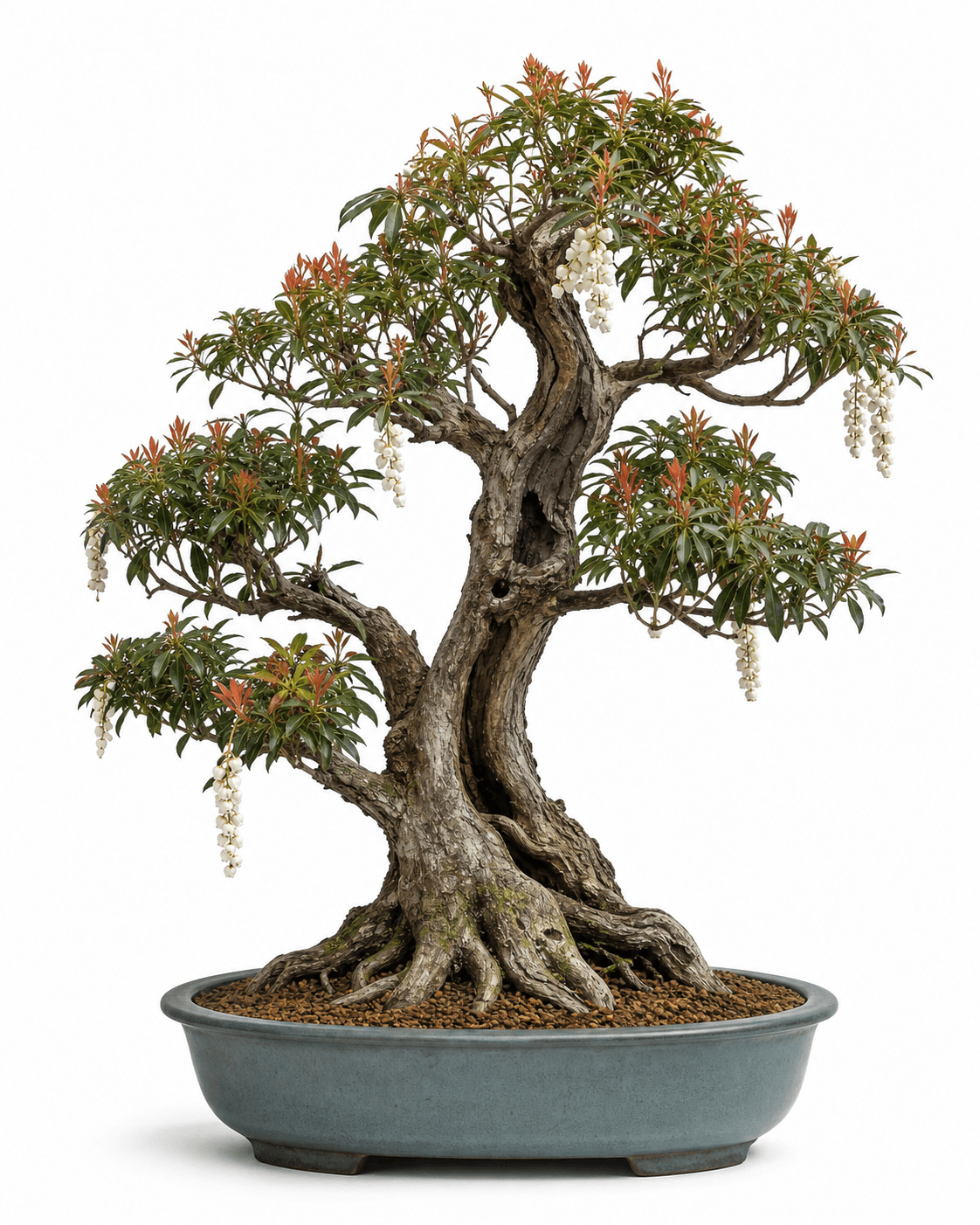
A mature Pieris bonsai should make its identity clear through terminal leaf clusters, red new growth, drooping flower racemes or buds, hollow broadleaf age, and carefully selected two-shoot branch division. Bonsai Mirai LibraryNC State Extension: Pieris japonica
Species questions
Answer the beginner questions before styling.
Can Pieris japonica be grown as bonsai?
Yes. Pieris japonica can be trained as an outdoor broadleaf evergreen bonsai when it has active roots, careful spring timing, post-flush pruning, steady moisture, mineral soil, and winter protection.
Is Pieris bonsai indoor or outdoor?
Pieris is outdoor bonsai. It needs seasonal rhythm, bright light, cool roots, airflow, and winter protection rather than warm indoor storage.
When should I repot Pieris bonsai?
Repot in spring as buds swell and before extension. Keep fine roots moist, preserve enough functioning root mass, anchor firmly, and shelter from wind, heat, and frost afterward.
What soil is best for Pieris bonsai?
Use moisture-retentive mineral soil with good oxygen. Akadama-heavy soil works well, and akadama with pumice is useful during development, old-soil conversion, or wet-climate culture.
Should Pieris bonsai be planted in kanuma?
Kanuma should not be automatic for Pieris. Mirai found plain akadama reliable and cautions that kanuma softness, which suits azalea roots, may break down too quickly for this use.
How do I prune Pieris bonsai?
Use early spring before bud swell for major structural cuts on strong trees, then prune after the spring flush hardens. Reduce terminal whorls to two shoots before swelling forms.
Why are my Pieris leaves stippled or gray?
Check the undersides for lace bugs and dark excrement. Stippling is classic lace-bug feeding damage, and stressed sunny plants are more vulnerable.
Why did my Pieris bonsai stop flowering?
Common causes are late pruning that removed old-growth buds, weak light, root stress, or a development year where pruning and recovery correctly took priority over flowers.
Can I hard prune Pieris bonsai?
Strong Pieris can back-bud well after structural reduction, but hard pruning belongs on vigorous trees in the right season. Weak trees need retained foliage and staged work.
Is Pieris poisonous?
Yes. NC State flags Pieris japonica as highly poisonous if ingested. Keep leaves, nectar, flowers, and clippings away from children, pets, horses, goats, and livestock.
Sources
Species advice needs source discipline.
Next decisions
Plan the operation before copying the calendar.
A good care note for Pieris records the tree's stage, the work done, and the aftercare used. That record matters more than a month-name rule.
Related species
Compare nearby trees before transferring advice.
English boxwood
Buxus sempervirens
Japanese boxwood
Buxus microphylla
Korean boxwood
Buxus sinica var. insularis
English holly
Ilex aquifolium
Japanese holly
Ilex crenata