
Species guide
Strawberry Tree Bonsai Care
Arbutus unedo
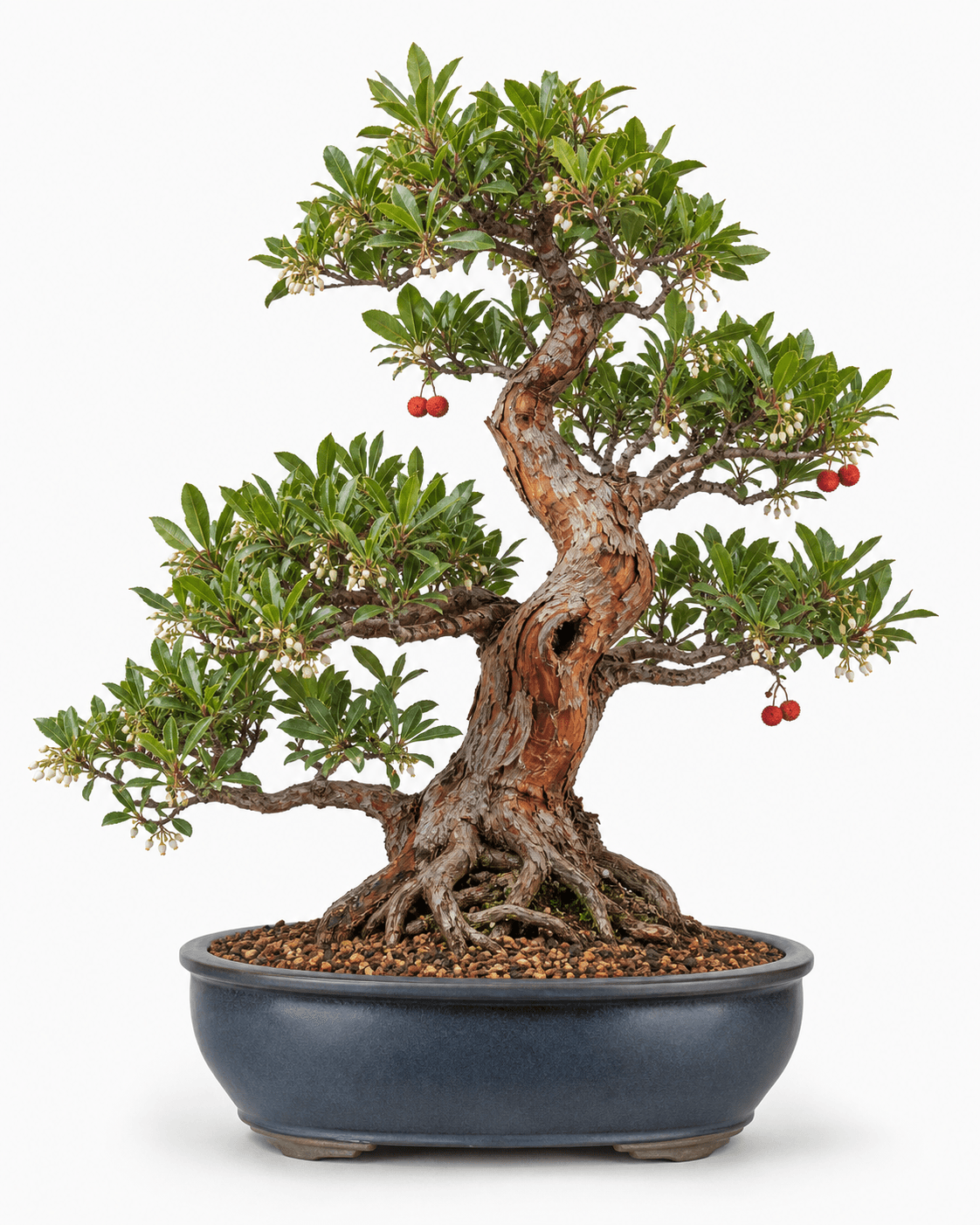
Strawberry tree bonsai is Arbutus unedo, a Mediterranean and western European broadleaf evergreen in the heath family. It is grown for glossy evergreen leaves, exfoliating reddish bark, white urn-shaped flowers, and red fruit that can be present while the next flowers open.
Treat Arbutus unedo as Broadleaf > Evergreen with ericaceous root caution: use strong outdoor light, acidic to neutral well-drained mineral soil, careful watering with oxygen return, spring root work, and conservative post-harden pruning.
The source-depth caveat matters. The local Mirai corpus has no dedicated Arbutus unedo class, so this guide transfers broadleaf-evergreen, Mediterranean-source, and madrone recovery cautions, then grounds identity, hardiness, common labels, flowers, fruit, pests, and root risks in NC State, Oregon State, and Kew sources.
Updated June 12, 2026. Written by EntGrove Editorial. Last verified June 12, 2026.
Care fingerprint
Read the species through its shared care pattern.
Protect from hard freezes when species demands it, prune with active foliage in mind, and repot when roots can recover without dormancy cues. Use this as the starting point before local conditions and tree strength refine the calendar.
Note: Mediterranean and western European ericaceous broadleaf evergreen with exfoliating bark, fall to winter urn-shaped flowers, red fruit, and root-disturbance sensitivity. Verify Arbutus unedo before applying this page because Pacific madrone, manzanita, Greek strawberry tree, hybrid strawberry tree, Jamaican cherry, Chinese bayberry, and actual strawberries are different care subjects.
Read the foliage first
Broadleaf stress usually shows in leaf color, leaf size, wilt, scorch, or delayed hardening before it becomes a branch problem.
Match work to dormancy
Deciduous, evergreen, tropical, succulent, and flowering broadleaf trees recover on different calendars.
Protect fine roots
Root work should preserve enough active fine roots for the tree to rehydrate quickly after the operation.
Care cadence
The calendar starts with the tree's seasonal state.
Placement
Timing: Grow outdoors in full sun to partial shade. Use morning sun and afternoon protection after repotting, during hot inland weather, or when the tree is recovering from root stress.
Watch for: Long weak internodes in shade, scorch after sudden exposure, humid still-air decline, and leaf dullness after root work.
NC State Extension: Arbutus unedoOregon State Landscape Plants: Arbutus unedoBonsai Mirai LibraryWatering
Timing: Water to runoff, then wait until surface particles and the upper root zone show oxygen has returned. Water more often when the crown is leafy, fruiting, hot, windy, or newly full of roots.
Watch for: Frequent shallow sips, wet organic cores, yellow leaves, black root tips, and the mistake of translating landscape drought tolerance directly to a shallow pot.
Bonsai Mirai LibraryNC State Extension: Arbutus unedoFeeding
Timing: Feed moderately in development after active growth confirms root function. In refinement, feed lightly every 6-8 weeks after spring elongation rather than pushing coarse leaves.
Watch for: Long coarse shoots, oversized leaves, fruit load on weak branches, fertilizer immediately after repotting, and fall nitrogen that delays winter hardening.
Bonsai Mirai LibraryPruning
Timing: Let spring growth harden, then prune back to viable interior buds or leaves. Use heavier structural work in early spring only on vigorous trees with a clear recovery plan.
Watch for: Repeated shearing, removing all interior leaves, pruning during yellow-root stress, and chasing fruit at the expense of branch structure.
Bonsai Mirai LibraryNC State Extension: Arbutus unedoLeaf and fruit work
Timing: Use selective exterior leaf reduction only on vigorous refined trees after the flush hardens. Remove excess fruit on development trees and weak branches.
Watch for: Routine full defoliation, cut leaves before display, fruit dragging down weak shoots, and removing the foliage needed to rebuild roots.
Bonsai Mirai LibraryNC State Extension: Arbutus unedoRepotting
Timing: Repot in spring as buds swell and before strong extension. Work in stages, preserve a functional root zone, tie the tree firmly, and shelter it bright after repotting.
Watch for: Full bare-rooting, old acidic organic cores that stay wet, water bypass around dense roots, wobble in the pot, and repotting while fruit or stress is heavy.
Bonsai Mirai LibraryNC State Extension: Arbutus unedoWiring
Timing: Wire young lignified shoots after growth hardens. Support bark carefully and check frequently because slow bark repair makes scars linger.
Watch for: Wire hidden under evergreen leaves, cracked older wood, peeling bark scuffs, bends made soon after repotting, and branch tips wired into shade.
Bonsai Mirai LibraryBonsai Mirai / AsymmetryWinter protection
Timing: Protect bonsai roots before hard freezes. In colder Zone 7 sites and refined containers, use bright cold shelter, wind protection, and careful watering rather than dark storage.
Watch for: Frozen pots, wet cold soil, spring push followed by dieback, dry indoor heat, and winter flowers exhausting a weak tree.
NC State Extension: Arbutus unedoOregon State Landscape Plants: Arbutus unedoBonsai Mirai LibraryPests and disease
Timing: Inspect before buying, before wiring, through humid spells, and during winter shelter. Keep foliage open enough for light, airflow, and pest checks.
Watch for: Scale, thrips, anthracnose, rust, Phytophthora, root rot, leaf spots, fruit mess near the pot, and humid stagnant placement.
NC State Extension: Arbutus unedoOregon State Landscape Plants: Arbutus unedoBonsai Mirai LibrarySpecies guide
Apply the species profile before copying another tree's calendar.
At a glance
Strawberry tree is an ericaceous broadleaf evergreen with flowers, red fruit, and peeling bark.
Strawberry tree is Arbutus unedo, an evergreen shrub or small tree in Ericaceae. NC State lists Killarney strawberry tree, madrono, strawberry madrone, and strawberry tree as common names. NC State Extension: Arbutus unedoKew POWO search: Arbutus unedo
The bonsai value is seasonal and structural at the same time: glossy serrated leaves, red stems, white to light pink urn-shaped flowers, rough red berries, and gray-brown bark that peels to reddish-brown underneath. NC State Extension: Arbutus unedoOregon State Landscape Plants: Arbutus unedo
The care frame is Broadleaf > Evergreen with Ericaceae root caution. The tree wants light, drainage, oxygen, acid-to-neutral soil, spring root work, and restrained pruning once growth hardens. Bonsai Mirai LibraryNC State Extension: Arbutus unedoOregon State Landscape Plants: Arbutus unedo
NC State lists Zones 7a-10b. In bonsai, a small pot lowers that margin, so protect the roots earlier than a landscape strawberry tree would need. NC State Extension: Arbutus unedoBonsai Mirai Library
Habitat
Mediterranean and western European origin explains the bark, fruit, drainage, and winter limits.
NC State describes Arbutus unedo as native to the Mediterranean region and western Europe. Oregon State gives the practical range as southwestern Ireland to the Mediterranean region. NC State Extension: Arbutus unedoOregon State Landscape Plants: Arbutus unedo
Oregon State describes full sun, well-drained acid to neutral soil, no summer water once established in the ground, and poor performance in humid climates. Bonsai culture keeps the drainage lesson and changes the water lesson. Oregon State Landscape Plants: Arbutus unedoBonsai Mirai Library
For care, translate habitat into a mineral root zone, full watering followed by oxygen return, bright outdoor exposure, and winter protection for shallow roots. A bonsai pot removes the taproot and soil mass that make landscape drought tolerance possible. Bonsai Mirai LibraryNC State Extension: Arbutus unedo
For design, let the tree read as a Mediterranean evergreen shrub or small tree. Show the peeling bark, keep branch exits visible, and use flowers or fruit as a seasonal accent rather than the whole reason for the tree. Bonsai Mirai / AsymmetryNC State Extension: Arbutus unedo
Reading the tree
Read identity, root condition, and fruit load before touching the canopy.
Start with identity. This page is for Arbutus unedo, the Mediterranean strawberry tree, and should be separated from Pacific madrone, manzanita, Arbutus andrachne, Arbutus x andrachnoides, Muntingia calabura, Myrica rubra, and true strawberries in Fragaria. NC State Extension: Arbutus unedoOregon State Landscape Plants: Arbutus unedoKew POWO search: Arbutus unedo
Then read root behavior. NC State places the tree in Ericaceae and says it prefers good drainage; Mirai broadleaf-evergreen method warns against full bare-rooting retained-foliage material because root biology and microbial relationships matter. NC State Extension: Arbutus unedoBonsai Mirai Library
Read stage through leaf size, interior buds, bark maturity, and water movement. Development trees need root conversion and branch extension. Refined trees need controlled feeding, post-harden cutback, and selective leaf work. Bonsai Mirai LibraryNC State Extension: Arbutus unedo
Read fruit as an energy signal. A healthy refined tree may carry a few berries for display, while a development tree or recently repotted tree should shed excess fruit so roots and branches can rebuild. NC State Extension: Arbutus unedoBonsai Mirai Library
Pruning
Prune after hardening, then protect the interior leaves that keep branches alive.
Let the first flush extend and harden before ordinary refinement pruning. In the Mirai broadleaf-evergreen framework, pruning after energy-positive hardening can produce a finer second response than early cutting. Bonsai Mirai Library
Cut back to viable interior leaves or buds, and preserve small interior foliage whenever possible. Strawberry tree leaves are larger than classic shohin material, so branch density and line matter more than trying to miniaturize every leaf immediately. Bonsai Mirai LibraryNC State Extension: Arbutus unedo
Use selective exterior leaf reduction only when the tree is vigorous, refined, and already growing in reliable soil. Remove large exterior leaves or reduce them enough to admit light, while weak interior shoots keep their solar panels. Bonsai Mirai Library
Avoid a clipped hedge shell. The plant can be used as a shrub or screen in landscapes, but bonsai needs visible branch exits, layered depth, and light through the crown. NC State Extension: Arbutus unedoBonsai Mirai / Asymmetry
Roots
Repot in spring and protect the ericaceous root system from stale wet soil.
Use spring bud-swell as the standard repotting window. The tree has enough stored energy to respond, and new roots can form before heat, flowers, and fruit add demand. Bonsai Mirai Library
Work the root system in stages. Remove compacted or sour nursery soil where water is failing, but keep a functional portion of roots and associated soil on weak or old material. Bonsai Mirai LibraryNC State Extension: Arbutus unedo
Arbutus and related broadleaf evergreens are poor candidates for casual bare-rooting. The local corpus directly flags madrone as difficult after collection, and Mirai broadleaf-evergreen work emphasizes preserving root biology and foliage during recovery. Bonsai Mirai Library
After root work, tie the tree firmly, water thoroughly, keep it bright, shelter from hot wind, and wait for active extension before fertilizing, wiring, or reducing more foliage. Bonsai Mirai Library
Soil and pot
Use acid-to-neutral drainage, high oxygen, and enough depth while roots are being rebuilt.
NC State lists acid to neutral pH, good drainage, and occasional dryness as cultural conditions. Oregon State also calls for well-drained acid to neutral soil. NC State Extension: Arbutus unedoOregon State Landscape Plants: Arbutus unedo
For nursery-stock conversion, use a pumice-forward 1:1:1 akadama:pumice:lava baseline or a similar acid-friendly mineral mix. The goal is complete wetting followed by oxygen return, not a rich organic potting soil. Bonsai Mirai LibraryNC State Extension: Arbutus unedo
For refined, healthy trees, more akadama can support finer roots and ramification if the grower can control winter wetness and watering frequency. Weak roots, wet climates, and old organic cores justify more pumice. Bonsai Mirai Library
Choose a pot with enough depth to buffer heat and cold while the tree is being domesticated. Quiet glazed ovals, soft rectangles, and deeper training containers usually suit the broad evergreen image better than extremely shallow pots. Bonsai Mirai / AsymmetryNC State Extension: Arbutus unedo
Climate
Adjust around humidity, summer heat, and winter root protection.
In mild Mediterranean or coastal climates, strawberry tree can live outside year-round with drainage, wind protection after root work, and careful monitoring during fruit load. NC State Extension: Arbutus unedoOregon State Landscape Plants: Arbutus unedo
In hot inland climates, use strong morning sun, afternoon observation, and a soil mix that dries predictably without becoming hydrophobic. Freshly repotted trees deserve shade during heat spikes. Bonsai Mirai LibraryNC State Extension: Arbutus unedo
In humid climates, Oregon State and NC State both flag difficulty or disease pressure. Increase spacing, airflow, and drainage; avoid overhead wet foliage late in the day; and watch leaves and roots closely. NC State Extension: Arbutus unedoOregon State Landscape Plants: Arbutus unedo
In cold climates, treat landscape Zone 7 as only a starting point. Refined twigs and shallow roots lose hardiness, so use bright cold protection before deep freezes and keep the soil slightly moist rather than saturated. Bonsai Mirai LibraryNC State Extension: Arbutus unedo
Health
Scale, thrips, anthracnose, rust, Phytophthora, and root rot are the watch list.
NC State lists susceptibility to scale and thrips, with anthracnose, Phytophthora, root rot, and rust as occasional disease problems. Those risks rise when foliage is dense, humid, wet, or weak from root stress. NC State Extension: Arbutus unedo
Use prevention first: strong light, open branch structure, good airflow, clean tools, quarantine for new nursery material, and a root zone that never stays anaerobic. Bonsai Mirai LibraryNC State Extension: Arbutus unedo
Inspect leaf undersides, branch crotches, and winter-shelter trees for scale and thrips. Treat only after identifying the pest, and avoid broad prophylactic spraying that masks the horticultural cause. NC State Extension: Arbutus unedoBonsai Mirai Library
Root disease prevention is more important than rescue. If water stops entering evenly, leaves yellow, or the pot smells sour, stop pruning and solve drainage, oxygen, and old-soil problems before styling. Bonsai Mirai LibraryNC State Extension: Arbutus unedo
Wiring
Wire young lignified shoots and protect bark that should become a feature.
Wire after shoots have hardened enough to hold a set. Younger branches are safer than old wood, and bends should be distributed over longer spans instead of forced into one point. Bonsai Mirai Library
Use the off hand to support each bend, keep coils visible, and check frequently. Strawberry tree bark is part of the design value, so wire scars and scraped exfoliating bark matter. Bonsai Mirai LibraryNC State Extension: Arbutus unedo
Guy wires, clip-and-grow, and pruning to directional buds are often better than dramatic bends on older branches. The image should stay broadleaf and shrub-like, with tips returning toward light. Bonsai Mirai / AsymmetryBonsai Mirai Library
Do not wire heavily right after repotting. Evergreen leaves must keep feeding new roots, and a wired branch moved into shade can weaken even if the bend itself succeeds. Bonsai Mirai Library
Propagation
Seed, layering, and stem cuttings are public propagation routes; bonsai use rewards selection.
NC State lists layering, seed, and stem cuttings as recommended propagation strategies. Seedlings can vary in leaf size, bark color, fruiting, vigor, and cold response. NC State Extension: Arbutus unedo
Cuttings and layers are useful when a grower finds compact foliage, good bark, and manageable internodes. Keep young material bright, evenly moist, and sharply drained until roots are proven. NC State Extension: Arbutus unedoBonsai Mirai Library
Air-layering should be treated conservatively unless local growers have proven the exact stock. Do not sacrifice a promising trunk before testing whether the plant roots reliably in your climate. Bonsai Mirai Library
Grafting is uncommon for ordinary strawberry tree bonsai. Reserve it for root correction, cultivar preservation, or advanced experiments after the tree has strong roots and a clear design need. Bonsai Mirai / Asymmetry
Buying
Buy bark, base, and verified identity; assume nursery roots need staged conversion.
Good candidates are small landscape shrubs, older container stock, legally sourced hedge removals, and compact cultivars with clear Arbutus unedo labels. NC State Extension: Arbutus unedoOregon State Landscape Plants: Arbutus unedo
Inspect the base, bark, branch exits, interior leaves, root flare, and water movement through the pot. A tree with fruit and flowers still needs a usable trunk and healthy roots. Bonsai Mirai / AsymmetryBonsai Mirai Library
Separate Arbutus unedo from Pacific madrone, manzanita, Greek strawberry tree, hybrid strawberry tree, Jamaican cherry, Chinese bayberry, and actual strawberries before buying. NC State Extension: Arbutus unedoOregon State Landscape Plants: Arbutus unedoKew POWO search: Arbutus unedo
Red flags include humid-greenhouse weakness, scale, thrips, leaf spots, dead interiors, peat-heavy root balls, fruiting on a weak plant, and labels that say only madrone or strawberry tree without a botanical name. NC State Extension: Arbutus unedoBonsai Mirai Library
Troubleshooting
Most failures trace to roots, humidity, fruit load, or label confusion.
Yellow leaves: check root oxygen first. Common causes are wet organic soil, compacted old nursery cores, cold root damage, Phytophthora risk, or watering that never fully penetrates the root mass. Bonsai Mirai LibraryNC State Extension: Arbutus unedo
Leaf spotting or rusty marks: improve airflow, reduce late-day foliage wetness, remove badly affected leaves when appropriate, and identify the disease before spraying. NC State Extension: Arbutus unedoBonsai Mirai Library
Sticky leaves or stippled foliage: inspect for scale and thrips. Clean the plant, improve light and airflow, and treat the actual pest instead of spraying on a schedule. NC State Extension: Arbutus unedoBonsai Mirai Library
No fruit: flowers and berries depend on age, weather, pruning timing, and vigor. A bonsai in development may be healthier when fruit is removed before it drains weak branches. NC State Extension: Arbutus unedoBonsai Mirai Library
Advice conflict: recheck the plant identity. Pacific madrone, manzanita, Arbutus hybrids, and Jamaican cherry all circulate near the strawberry tree name and deserve different assumptions. NC State Extension: Arbutus unedoOregon State Landscape Plants: Arbutus unedo
Design
Design from bark, fruit, and old evergreen shrub character.
Start with the base and trunk line. Strawberry tree can become a dense rounded shrub or small tree, so a bonsai design should reveal the trunk rather than bury it under a round canopy. NC State Extension: Arbutus unedoBonsai Mirai / Asymmetry
Choose one defining branch or movement idea, then use foliage masses to frame the exfoliating bark. Keep negative space around bark transitions, flowers, and fruit clusters. Bonsai Mirai / AsymmetryNC State Extension: Arbutus unedo
Use fruit sparingly in design. Red berries can be compelling, but they also create weight, mess, and energy demand. A few well-placed berries on a strong tree are more convincing than a crowded fruit display on weak branches. NC State Extension: Arbutus unedoBonsai Mirai / Asymmetry
Deadwood should be restrained. Broadleaf evergreen wood can decay quickly once disconnected from live tissue, so hollows and scars should support the story without becoming a juniper-style deadwood exercise. Bonsai Mirai LibraryBonsai Mirai / Asymmetry
Forms
Compact forms can help bonsai scale, but identity and root health come first.
NC State lists Compacta and Elfin King as cultivars or varieties, with Compacta reaching 6-10 feet tall and Elfin King noted as dwarf. NC State Extension: Arbutus unedo
Oregon State notes Arbutus andrachne as Greek strawberry tree and describes it as resembling Arbutus menziesii but smaller. Keep Greek strawberry tree and hybrids separate from this Arbutus unedo page. Oregon State Landscape Plants: Arbutus unedo
Dwarf forms can make leaf scale and container size easier, but they may also grow slowly. Evaluate branch density, internode length, bark, fruit size, and recovery after pruning before promising a refined schedule. Bonsai Mirai LibraryNC State Extension: Arbutus unedo
The madrono and Killarney labels can be useful identity clues, while generic madrone remains ambiguous in North America. Ask for the botanical name before buying or applying care advice. NC State Extension: Arbutus unedoOregon State Landscape Plants: Arbutus unedo
History
Strawberry tree brings Mediterranean and Irish garden history into bonsai without a fixed Japanese canon.
Oregon State describes the native range as southwestern Ireland to the Mediterranean region, which explains why Killarney strawberry tree is a common ornamental label. Oregon State Landscape Plants: Arbutus unedoNC State Extension: Arbutus unedo
The common name comes from the rough red fruit, which resembles a strawberry in appearance. In bonsai copy, that fruit should be treated as a seasonal feature and energy cost, not as proof of kinship with Fragaria strawberries. NC State Extension: Arbutus unedo
As a bonsai subject, Arbutus unedo belongs with Mediterranean and ericaceous broadleaf evergreens such as olive, cork oak, common myrtle, Bay laurel, and Pieris, where ecology and root management govern the technique. Bonsai Mirai LibraryBonsai Mirai / Asymmetry
The best strawberry tree bonsai will likely come from patient nursery-stock conversion: stabilize roots first, reveal bark and trunk line second, then refine leaves, flowers, and fruit once the tree is strong. Bonsai Mirai LibraryNC State Extension: Arbutus unedo
Species questions
Answer the beginner questions before styling.
Can strawberry tree be grown as bonsai?
Yes. Arbutus unedo can work as an outdoor broadleaf evergreen bonsai when it receives strong light, acidic to neutral mineral drainage, careful watering, conservative spring root work, and winter protection for shallow roots.
Is strawberry tree bonsai an indoor bonsai?
Use outdoor culture as the baseline. Indoor placement is only short display or bright cool winter protection; warm low-light rooms increase pest, leaf, and root problems.
How often should I water strawberry tree bonsai?
Water when the soil has dried back enough for oxygen to return, then water to runoff. Hot wind, fruit load, and a full root system increase frequency; cool winter shelter lowers it.
When should I repot strawberry tree bonsai?
Repot in spring as buds swell. Inspect every 3-4 years, but act based on water entry, soil breakdown, root density, and tree strength rather than the calendar alone.
Can I bare-root Arbutus unedo?
Avoid full bare-rooting. Work old soil out in stages, preserve functioning roots and foliage, and protect the tree bright and sheltered while new roots establish.
Can I defoliate strawberry tree bonsai?
Use selective exterior leaf reduction only on vigorous refined trees after the flush hardens. Routine full defoliation is too risky for a root-sensitive evergreen.
Why are my strawberry tree leaves turning yellow?
Check roots first. Yellow leaves often come from wet organic soil, poor oxygen, cold root damage, Phytophthora or root rot risk, or a compacted nursery core that does not wet evenly.
Should I keep fruit on strawberry tree bonsai?
Keep a small amount of fruit only on strong refined branches. Remove fruit from weak, recently repotted, or developing trees so the tree can invest in roots and branch structure.
Is strawberry tree the same as Pacific madrone?
No. This page is for Arbutus unedo. Pacific madrone is Arbutus menziesii, and generic madrone labels should be verified before applying care advice.
What pests and diseases affect strawberry tree bonsai?
NC State lists scale and thrips as insect issues and anthracnose, Phytophthora, root rot, and rust as occasional disease problems. Bonsai prevention starts with drainage, airflow, light, and clean sourcing.
Sources
Species advice needs source discipline.
Next decisions
Plan the operation before copying the calendar.
A good care note for Strawberry tree records the tree's stage, the work done, and the aftercare used. That record matters more than a month-name rule.
Related species
Compare nearby trees before transferring advice.
English boxwood
Buxus sempervirens
Japanese boxwood
Buxus microphylla
Korean boxwood
Buxus sinica var. insularis
English holly
Ilex aquifolium
Japanese holly
Ilex crenata