
Species guide
Powderpuff Bonsai Care
Calliandra tergemina var. emarginata, Calliandra haematocephala, Calliandra surinamensis
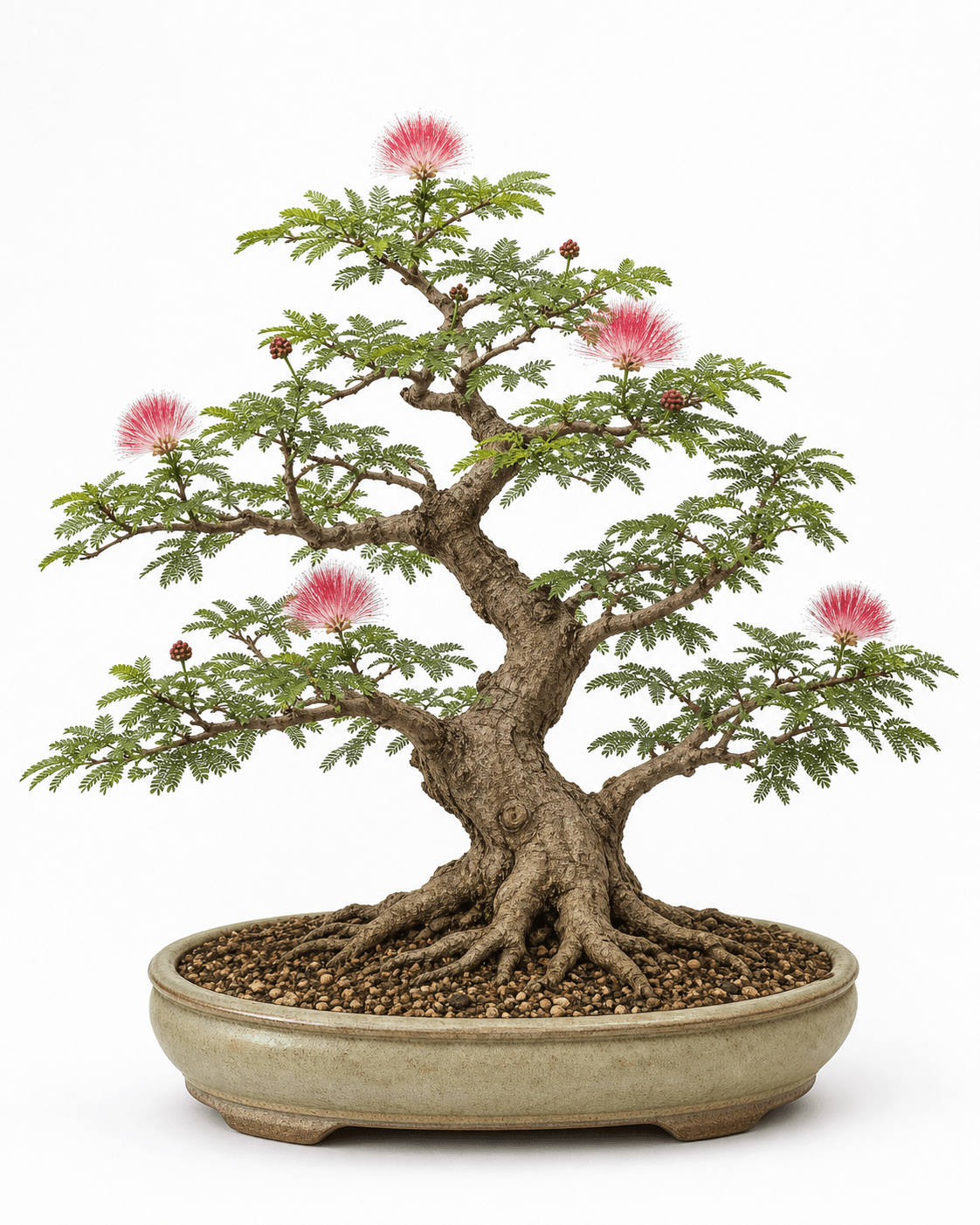
Powderpuff bonsai are tropical Calliandra broadleaf trees grown for fine compound foliage, raspberry-like buds, round stamen flowers, and fast warm-season response. Treat them as Broadleaf > Tropical material: high light, warm roots, mineral drainage, steady water, strong feeding in development, and major work only while the tree is actively growing.
The strongest bonsai source is the local Bonsai Mirai dwarf powderpuff primer, which focuses on the common bonsai trade plant Calliandra emarginata. Kew currently treats that name as a synonym of Calliandra tergemina var. emarginata, while Calliandra haematocephala and Calliandra surinamensis are separate powderpuff shrubs also sold into bonsai and container culture.
The main horticultural lesson is timing plus restraint. Calliandra can grow fast, flower freely, and back bud, but stiff wood, slow wound closure, fragile young roots, flower energy, and pollinator-sensitive pest treatment make it an intermediate tropical rather than a casual windowsill tree.
Updated June 20, 2026. Written by EntGrove Editorial. Last verified June 20, 2026.
Care fingerprint
Read the species through its shared care pattern.
Treat indoor culture as a light-management problem first; prune and repot when the tree is actively growing and warm enough to recover. Use this as the starting point before local conditions and tree strength refine the calendar.
Note: Use this parent page for Calliandra powderpuff bonsai labels. Kew treats Calliandra emarginata as a synonym of Calliandra tergemina var. emarginata; C. haematocephala and C. surinamensis remain separate powderpuff taxa in the trade.
Read the foliage first
Broadleaf stress usually shows in leaf color, leaf size, wilt, scorch, or delayed hardening before it becomes a branch problem.
Match work to dormancy
Deciduous, evergreen, tropical, succulent, and flowering broadleaf trees recover on different calendars.
Protect fine roots
Root work should preserve enough active fine roots for the tree to rehydrate quickly after the operation.
Care cadence
The calendar starts with the tree's seasonal state.
Placement
Timing: Move outside or into very bright greenhouse conditions once nights are consistently above 60 F / 16 C. Protect before freezing and before cold nights keep leaves closed.
Watch for: Closed foliage in cool weather, weak indoor shoots, scorched foliage after an abrupt move to sun, and a tree that flowers while the root system is cold.
Bonsai Mirai LibraryRHSUF/IFAS ExtensionWatering
Timing: Water deeply during warm growth when the upper soil is drying and the tree is using water. In cool protection, reduce frequency and keep the root zone airy.
Watch for: Soggy nursery soil, sour smell, closed leaflets, limp new growth, flower-heavy branches drying quickly, and indoor pots that stay wet for days.
University of North Florida Botanical GardenBonsai Mirai LibraryFertilizer
Timing: Feed strongly while building trunks and branches. Mirai flags Calliandra as a heavy feeder and notes elevated phosphorus need, with balanced 20-20-20 otherwise adequate.
Watch for: Flowering on a tree that still needs wood, salt buildup in heat, weak post-repot roots, and fertilizer applied while the tree is cold and slow.
Bonsai Mirai LibraryPruning
Timing: In development, let selected shoots extend, then cut back hard enough to build taper and branch placement. In refinement, clip after growth hardens and preserve useful tip growth after strong cutback.
Watch for: Large front-facing wounds, old nubs, equal-height water shoots, reverse taper from clustered back buds, and flower buds left on branches that need leaf-driven recovery.
Bonsai Mirai LibraryFlowers
Timing: Allow bloom on strong refined trees. For planned display, Mirai describes removing unopened buds together to force a synchronized flush roughly 20-25 days later in Miami-like conditions or 35-45 days later in central Florida-like conditions.
Watch for: Flower energy competing with structural growth, pollinator traffic after pest treatment, old flowers setting pods, and buds removed too late for a planned event.
Bonsai Mirai LibraryLeaf work
Timing: Reserve full defoliation for pest emergencies rather than routine ramification. Use selective leaf removal only on vigorous trees in active growth when light access or pest inspection requires it.
Watch for: Defoliation for wiring convenience, weak auxiliary back budding, low-light oversized leaves, post-repot foliage removal, and repeated flower plus leaf removal in the same window.
Bonsai Mirai LibraryWiring
Timing: Wire young shoots early while the wood is still flexible. Once Calliandra wood hardens, movement becomes difficult, and clip-and-grow becomes the cleaner refinement method.
Watch for: Stiff xylem cracking, uniform bends without small inflections, wire bite during warm feeding, crowded interiors, and bends applied to branches already thick enough to resist.
Bonsai Mirai LibraryRepotting
Timing: Repot in stable warm growth after the canopy has recovered from structural work. Keep a working root system attached, anchor firmly, and avoid disturbing young fragile roots.
Watch for: Repotting immediately after a trunk chop, breaking new air-layer roots, decomposed nursery peat, buried crowns, poor anchoring, and a pot that stays wet indoors.
Bonsai Mirai LibraryPropagation
Timing: Use seed, cuttings, or air layers in warmth. Mirai gives detailed air-layer handling: keep the root column intact at separation and move it without rotating or breaking fresh roots.
Watch for: Air layers left until interior tissue rots, sphagnum bags opened during separation, fresh roots exposed to handling, and separated layers placed into saturated media.
Bonsai Mirai LibraryUF/IFAS ExtensionRHSPests
Timing: Inspect flowers, buds, tender shoots, and leaf undersides through warm growth and indoor protection. Remove flowers before treating pest outbreaks so pollinators are less exposed.
Watch for: Aphids, leaf beetles, mites, caterpillars, chewing damage, ants in flowers, ants nesting in the pot, and systemic pesticides used on a flowering pollinator plant.
Bonsai Mirai LibraryUF/IFAS ExtensionSpecies guide
Apply the species profile before copying another tree's calendar.
At a glance
Powderpuff is a warm-growing flowering legume with bonsai power and horticultural limits.
The practical bonsai target is a Calliandra group. Kew accepts Calliandra tergemina var. emarginata for the plant long sold as Calliandra emarginata, accepts Calliandra haematocephala for red powderpuff, and accepts Calliandra surinamensis for pink powderpuff. Kew POWOKew POWOKew POWO
All three behave as tropical broadleaf bonsai. Give them warmth, strong light, oxygenated soil, generous water in active growth, and active recovery time before pruning, wiring, flowering display, or root work. Bonsai Mirai LibraryUniversity of North Florida Botanical GardenRHS
The species rewards precision. A healthy tree can flower, back bud, air-layer, and grow quickly, but old wood sets hard, wounds close slowly, and fragile new roots punish rough handling. Bonsai Mirai Library
Wild habitat
The genus gives you two useful design signals: tropical growth and open flowering structure.
Kew places Calliandra tergemina var. emarginata from Mexico to Venezuela in seasonally dry tropical habitat. It places Calliandra haematocephala in Bolivia, also seasonally dry tropical, and Calliandra surinamensis across South Tropical America in wet tropical habitat. Kew POWOKew POWOKew POWO
That habitat range explains why care advice can feel contradictory. Some powderpuffs tolerate seasonal dryness once established, while others respond to regular water in sandy full-sun sites. In bonsai, the constant is oxygenated warmth. University of North Florida Botanical GardenUF/IFAS ExtensionBonsai Mirai Library
For care, grow the tree warm and bright, then adjust water by pot size, foliage mass, flower load, wind, and root activity. Avoid cold wet soil because tropical metabolism slows before a shallow container dries safely. Bonsai Mirai LibraryRHS
For design, the natural image is a small tropical shrub or tree with airy fine leaflets and flowers held at the branch tips. Old-trunk character should support that lightness rather than overpower it. University of North Florida Botanical GardenUF/IFAS ExtensionBonsai Mirai / Asymmetry
Reading the tree
Read powderpuff through extension, flower load, wound age, and root maturity.
A developing powderpuff needs leaves. Mirai recommends removing open and pending flowers after hard pruning so energy moves into leaf growth, which drives trunk and branch thickening. Bonsai Mirai Library
A refined powderpuff shows shorter internodes, smaller compound leaves, repeated bifurcation, controlled flowers, and a canopy that stays open enough for light to reach interior growth. Bonsai Mirai Library
Watch wounds by age. Mirai notes that young trees close cuts more readily, while mature powderpuff wounds can remain visible for a long time. Plan major cuts on the back or sides when possible. Bonsai Mirai Library
Watch roots by stage. Fresh air-layer roots are fragile and easily torn, while hardened roots become strong. That difference should determine whether the next operation is separation, recovery, or styling. Bonsai Mirai Library
Pruning
Build structure with decisive cuts, then flower only after the tree has earned it.
Mirai recommends deciding the intended final size early. A large trunk strategy means free growth, then a planned trunk chop with the wound hidden from the future front. A small-tree strategy starts branch control sooner. Bonsai Mirai Library
Clean cuts matter. Use a sharp blade for final wound cleanup because smooth tissue edges scar less than ragged cuts, especially on a species that closes mature wounds slowly. Bonsai Mirai Library
After hard pruning, remove flowers and unopened buds so the tree rebuilds foliage. Leave selected tip growth where you need energy pulled through a branch and back budding controlled below it. Bonsai Mirai Library
For display timing, Mirai describes removing all unopened raspberry-like buds together to reset the bloom clock. In Miami-like subtropical conditions, a flush may follow in about 20-25 days; in central Florida-like conditions, the window may stretch to 35-45 days. Bonsai Mirai Library
Roots
Repot in warmth and handle young roots as if they are temporary scaffolding.
Repot powderpuff only during stable warm growth, after the canopy has recovered from heavy pruning. Mirai warns against asking the top and bottom of the tree to rebuild at the same time. Bonsai Mirai Library
Use root work to solve a specific problem: slow drainage, decomposed soil, a buried crown, circling nursery roots, poor anchoring, a weak nebari, or a design angle that cannot be supported in the current pot. Bonsai Mirai Library
Air-layer roots need special handling. Keep the sphagnum root column intact during separation, place it into perlite or another airy transition medium, and avoid rotating or loosening the fresh roots. Bonsai Mirai Library
Anchor firmly and return the tree to bright protected warmth. A powderpuff with leaves and flowers uses water quickly, while a newly worked root system needs time to restore fine-root contact. Bonsai Mirai LibraryUniversity of North Florida Botanical Garden
Soil and pot
Use a tropical mix that holds water without stealing oxygen.
UNF describes Calliandra haematocephala as adaptable in well-drained soil and poor in soggy soil. UF/IFAS says pink powderpuff grows rapidly in sandy soils and full sun when watered regularly while young. University of North Florida Botanical GardenUF/IFAS Extension
For bonsai, start with a mineral tropical mix such as equal parts akadama, pumice, and lava. In humid or indoor-protected climates, increase pumice or lava. In dry heat, keep enough akadama or organic-free water retention for a full day of root activity. Bonsai Mirai Library
A training pot should prioritize growth, anchoring, and oxygen. A show pot can be shallower once branch structure, root density, and watering rhythm are stable. Bonsai Mirai / AsymmetryBonsai Mirai Library
Pot pairing should support the flower. Warm unglazed clay, quiet cream, muted green, or shallow oval forms can frame red or pink powderpuffs without making the composition visually loud. Bonsai Mirai / Asymmetry
Climate
Warm regions grow powderpuff as an outdoor tropical; cooler regions grow it as protected seasonal material.
UF/IFAS lists pink powderpuff for Zones 9A through 11 and says freezing temperatures damage plants although Zone 9 landscape shrubs may regrow from the base in spring. UNF describes red powderpuff as near its northern limit in Jacksonville, with winter dieback likely outside protected sites. A bonsai pot has less thermal buffer than the ground, so protect well before landscape dieback thresholds. UF/IFAS ExtensionUniversity of North Florida Botanical Garden
RHS protected-culture guidance for Calliandra surinamensis calls for full light, shade from hot sun, and a minimum year-round temperature of 13 C / 55 F. That is a useful indoor or greenhouse safety target. RHS
In hot humid climates, manage airflow, fungal pressure, and saturated soil after storms. In dry heat, protect recently repotted or newly moved trees from harsh afternoon exposure until the roots are working. Bonsai Mirai LibraryUniversity of North Florida Botanical Garden
In winter protection, keep the tree bright, warm, and slightly drier than summer. Closed leaflets, stalled buds, and persistent wet soil mean the environment is below the tree active range. Bonsai Mirai LibraryRHS
Pests
Flowers change pest management because nectar attracts both insects and pollinators.
UF/IFAS says pink powderpuff is usually pest free, with occasional mites, caterpillars, or other chewing insects. Mirai adds bonsai-specific concerns around aphids, leaf beetles, ants, and flower-driven pest decisions. UF/IFAS ExtensionBonsai Mirai Library
Ants on powderpuff flowers do not always mean aphids. Mirai notes that exposed nectar can feed ants directly, so inspect the pot for a nest and inspect tender growth before choosing a treatment. Bonsai Mirai Library
For pest treatment, remove flowers first, then use a targeted contact treatment such as insecticidal soap where appropriate. Mirai cautions against systemic pesticides on a pollinator-attracting flowering bonsai because the active material can move into nectar. Bonsai Mirai Library
Root problems usually begin with environment: cold wet soil, soggy organic cores, poor anchoring, or repotting before warmth. Correct the root zone before chasing rare disease explanations. University of North Florida Botanical GardenBonsai Mirai Library
Wiring
Wire early, then rely on pruning once the wood stiffens.
Mirai describes dwarf powderpuff wood as unusually stiff for a tropical broadleaf, closer in feel to maple or elm. Movement becomes progressively harder as the xylem thickens. Bonsai Mirai Library
Wire young shoots while they are green and flexible. Use a gauge that supports the bend, set movement at each coil, and distribute bends through the branch instead of forcing one large curve. Bonsai Mirai Library
Avoid congesting the interior while wiring. Too many branches in one zone reduce light per leaf and suppress the fine twigging that makes powderpuff foliage read well at bonsai scale. Bonsai Mirai Library
Once primary angle is set, build secondary structure with clip-and-grow. This keeps scars smaller and fits the species tendency to respond with new shoots after directional pruning. Bonsai Mirai Library
Propagation
Seed and cuttings are straightforward; air layers need careful timing and handling.
UF/IFAS lists seed or cuttings for pink powderpuff, and RHS lists seed, semi-hardwood cuttings, and layering for Calliandra surinamensis. Seed is useful for forests and clumps, while cuttings preserve a known flower color or compact habit. UF/IFAS ExtensionRHS
Mirai gives the strongest bonsai detail for air layers. Layering while a branch remains attached to the mother plant can create movement and trunk mass faster than separating a small cutting first. Bonsai Mirai Library
Separate layers before the interior wood rots, but only after the roots have enough mass to survive. At separation, keep the moss and root column intact, then transition into perlite or another airy recovery medium. Bonsai Mirai Library
After separation, treat the new plant as a recovery project. Keep it warm, bright, humid enough for new roots, and protected from styling until the roots harden and new extension confirms strength. Bonsai Mirai Library
Buying
Buy the base, branch options, and verified identity before the flower color.
Confirm the plant is Calliandra and ask which form it is. Dwarf powderpuff, red powderpuff, pink powderpuff, and Rose Cascade material can differ in ultimate size, flower color, branch habit, and how quickly old wood stiffens. Kew POWOKew POWOKew POWOBonsai Mirai Library
Good bonsai candidates have a low trunk line, visible root flare, useful branch options close to the trunk, small leaves, short internodes, and a potting medium you can transition without destroying every working root. Bonsai Mirai / AsymmetryBonsai Mirai Library
Avoid material whose appeal is only flowers on a straight stick. Also avoid buried crowns, sour organic soil, ant nests, old front-facing chops, reverse taper from untrimmed back budding, and branches already too stiff to move. Bonsai Mirai LibraryUniversity of North Florida Botanical Garden
UF/IFAS assessment currently treats Calliandra haematocephala as suitable for recommendation in Florida assessment zones. Local rules can still differ, so warm-climate growers should confirm regional guidance before planting landscape extras. UF/IFAS Assessment
Troubleshooting
Most powderpuff failures come from cold, soggy soil, flower energy, or rough root handling.
Symptom: leaflets close and stay closed. Likely causes: cool temperatures, low light, water stress, or environmental shock. Fix: warm the tree, improve light, check root moisture, and pause styling until active growth returns. Bonsai Mirai LibraryRHS
Symptom: new growth is long, weak, and flowerless. Likely causes: low light, depleted fertility, cold roots, or a pot that stays wet. Fix: increase light and warmth, feed in active growth, and reset the watering rhythm. Bonsai Mirai LibraryUniversity of North Florida Botanical Garden
Symptom: a trunk chop leaves a visible scar for years. Likely causes: mature wood, a front-facing cut, or rough wound cleanup. Fix: plan future large cuts toward the back or side and clean final edges with a sharp blade. Bonsai Mirai Library
Symptom: a fresh air layer collapses after separation. Likely causes: roots disturbed during transfer, separation too early, or saturated recovery media. Fix: keep the root column intact and recover in an airy medium under warm protected light. Bonsai Mirai Library
Symptom: ants appear around flowers. Likely causes: nectar feeding, aphids, or an ant nest in the pot. Fix: inspect flowers, shoots, and soil before treating, then remove flowers before pest control if treatment is needed. Bonsai Mirai Library
Symptom: the tree flowers but stops thickening. Likely causes: too much display on a developing tree. Fix: remove flowers and buds after structural pruning and let leaves rebuild wood. Bonsai Mirai Library
Design
Design powderpuff as a flowering tropical broadleaf with visible air between branches.
Start with base, trunk line, defining branch, and apex. Mirai design fundamentals use those elements to decide whether a tree reads as harmonious, tense, or dynamic. Bonsai Mirai / AsymmetryBonsai Mirai Library
Powderpuff usually reads best as a light tropical broadleaf: a clear trunk, fine compound foliage, an open branch framework, and flowers used as seasonal accents rather than a dense hedge surface. Bonsai Mirai / AsymmetryUF/IFAS Extension
Because wood stiffens and old wounds remain visible, decide the image before thickening begins. Shohin and small trees need early movement; larger trees need planned sacrifice growth and hidden cuts. Bonsai Mirai Library
Broom and informal upright images fit Calliandra schultzei and C. surinamensis tendencies, while dwarf powderpuff can also make compact flowering clumps and airy small-tree forms. Bonsai Mirai LibraryBonsai Mirai / Asymmetry
Forms
Keep the powderpuff group together until search demand proves separate pages are needed.
Kew accepts Calliandra tergemina var. emarginata and treats Calliandra emarginata as a synonym. Bonsai trade still commonly uses Calliandra emarginata for dwarf powderpuff, so both labels should route here. Kew POWOBonsai Mirai Library
Calliandra haematocephala is red powderpuff or powderpuff tree, a shrub or tree native to Bolivia. Calliandra surinamensis is usually pink powderpuff, a taller arching shrub or small tree in warm climates. Kew POWOUF/IFAS AssessmentKew POWOUF/IFAS Extension
Mirai also discusses Calliandra schultzei and notes that Rose Cascade-like material shares the care pattern while differing in appearance and growth habit. Treat those as powderpuff variants until a verified taxonomy and search case warrants a separate page. Bonsai Mirai Library
For EntGrove routing, powderpuff, powder puff, dwarf powderpuff, red powderpuff, pink powderpuff, Calliandra emarginata, C. tergemina var. emarginata, C. haematocephala, C. surinamensis, and Rose Cascade powderpuff should resolve to this page. Kew POWOKew POWOKew POWO
History
Powderpuff bonsai sits at the edge of tropical nursery culture and serious flowering-broadleaf technique.
Kew records Calliandra haematocephala as first published in 1855, Calliandra surinamensis in 1844, and Calliandra tergemina var. emarginata in its current accepted variety combination in 1998. Kew POWOKew POWOKew POWO
The horticultural appeal is obvious: fine leaves, colorful stamens, long flowering potential, and container suitability in warm regions. UF/IFAS describes pink powderpuff as useful for hedges, small specimen trees, patios, and containers. UF/IFAS Extension
In bonsai, powderpuff remains less standardized than ficus, Brazilian rain tree, or buttonwood. The Mirai primer is valuable because it treats the species as real bonsai material with root, pruning, flowering, pest, and design constraints. Bonsai Mirai LibraryBonsai Mirai / Asymmetry
A strong powderpuff bonsai should show more than flowers. The credible image is a warm-climate tree with planned trunk movement, clean wound placement, open branch architecture, healthy compound foliage, and bloom used at the right stage. Bonsai Mirai LibraryBonsai Mirai / Asymmetry
Species questions
Answer the beginner questions before styling.
Can powderpuff be grown as bonsai?
Yes. Calliandra powderpuff can be grown as tropical flowering bonsai, especially from dwarf powderpuff, red powderpuff, pink powderpuff, or compact nursery material with a good base and low branch options.
Which Calliandra is best for powderpuff bonsai?
Dwarf powderpuff is the most bonsai-focused source in the local Mirai corpus. Kew treats the old trade name Calliandra emarginata as Calliandra tergemina var. emarginata, while C. haematocephala and C. surinamensis are also common powderpuff forms.
Can powderpuff bonsai grow indoors?
It can be protected indoors for winter with strong light, warmth, airflow, and careful watering. It is healthier outdoors or in a greenhouse during warm weather.
How cold can powderpuff bonsai tolerate?
UF/IFAS lists pink powderpuff for USDA Zones 9A through 11 and notes freezing damage in Zone 9 landscape plants. Bonsai pots should be protected before frost and ideally kept above about 55 F / 13 C in winter protection.
When should I repot powderpuff bonsai?
Repot in stable warm growth after the canopy has recovered from heavy pruning. Inspect every 2-3 years and repot for drainage, root correction, anchoring, or decomposed soil.
What soil is best for powderpuff bonsai?
Use a fast-draining mineral tropical mix. Equal parts akadama, pumice, and lava are a useful starting point, adjusted toward more pumice or lava in humid or indoor-protected conditions.
Should I let powderpuff bonsai flower?
Let strong refined trees flower. On developing or recently pruned trees, remove flowers and buds so the tree spends energy on leaves, branches, roots, and wound response.
Can I defoliate powderpuff bonsai?
Use defoliation only for pest emergencies or very selective light access on vigorous trees. Mirai discourages defoliation for wiring convenience because leaves support growth and back budding.
Can powderpuff bonsai be air-layered?
Yes. Mirai gives detailed air-layer guidance: separate in warmth, keep the new root column intact, avoid rotating or opening the sphagnum mass, and recover the layer in an airy medium.
Why are ants on my powderpuff bonsai?
Powderpuff flowers expose nectar, so ants may be feeding on flowers, tending aphids, or nesting in the pot. Inspect before treating and remove flowers before pest control when pollinators are present.
Sources
Species advice needs source discipline.
Next decisions
Plan the operation before copying the calendar.
A good care note for Powderpuff records the tree's stage, the work done, and the aftercare used. That record matters more than a month-name rule.
Related species
Compare nearby trees before transferring advice.
Ficus retusa / Indian laurel
Ficus microcarpa
Tigerbark ficus
Ficus microcarpa 'Tigerbark'
Willow-leaf ficus
Ficus salicaria
Benjamin fig
Ficus benjamina
Ginseng ficus
Ficus microcarpa 'Ginseng'