
Species guide
Tamarind Bonsai Care
Tamarindus indica
Tamarind bonsai, Tamarindus indica, is a frost-tender tropical broadleaf grown for feathery compound foliage, rough fissured bark, edible brown pods, and a broad shade-tree silhouette. It belongs in Broadleaf > Tropical care: full sun, warmth, strong light indoors only for protection, and root-zone oxygen after every watering.
The species is widely cultivated across the tropics, while current source language differs on origin. Kew lists Comoros and Madagascar as native, UF/IFAS describes tropical Africa and Madagascar, and both agree that tamarind is a seasonally dry or frost-free tropical tree.
The local Mirai corpus has no dedicated tamarind styling file, so this guide uses Mirai tropical-broadleaf method plus one explicit tamarind air-layering note. That means the advice is strongest on timing, water, roots, defoliation restraint, and design reading, while species facts come from Kew, UF/IFAS, Purdue, and NTBG.
Updated June 19, 2026. Written by EntGrove Editorial. Last verified June 19, 2026.
Care fingerprint
Read the species through its shared care pattern.
Treat indoor culture as a light-management problem first; prune and repot when the tree is actively growing and warm enough to recover. Use this as the starting point before local conditions and tree strength refine the calendar.
Read the foliage first
Broadleaf stress usually shows in leaf color, leaf size, wilt, scorch, or delayed hardening before it becomes a branch problem.
Match work to dormancy
Deciduous, evergreen, tropical, succulent, and flowering broadleaf trees recover on different calendars.
Protect fine roots
Root work should preserve enough active fine roots for the tree to rehydrate quickly after the operation.
Care cadence
The calendar starts with the tree's seasonal state.
Placement
Timing: Grow outside in full sun once nights are consistently above 60 F / 16 C. Bring the tree into bright protection before nights approach the cold-damage range of 28-32 F / -2 to 0 C.
Watch for: Weak indoor extension, oversized leaflets, cold wind, sudden moves from shade to full sun, and fruiting trees that dry faster than expected.
UF/IFAS ExtensionUF/IFAS ExtensionBonsai Mirai LibraryWatering
Timing: During warm active growth, water thoroughly when the upper soil is drying and the pot is using water. In winter protection, reduce frequency and wait for the substrate to approach dryness.
Watch for: Large foliar mass in a small pot, hot wind, stale wet organic soil, yellowing leaves from low oxygen, and pods or flowers increasing water demand.
Bonsai Mirai LibraryUF/IFAS ExtensionFertilizer
Timing: Feed only while the tree is actively extending. Use stronger feeding during trunk and branch development, then reduce to lighter maintenance once internode length and canopy density matter.
Watch for: Long coarse shoots on refined trees, weak growth after repotting, slow breakdown of organic fertilizer in cool protection, and salt stress before roots have recovered.
Bonsai Mirai LibraryPruning
Timing: Let developmental shoots extend and harden, then cut back during warm growth to a useful branch direction. Refined trees can be pruned more often to hold a broad canopy silhouette.
Watch for: Long straight seedling trunks, equal-height branches, coarse shoots from heavy nitrogen, and cuts made while the tree is below its active temperature range.
Bonsai Mirai LibraryUF/IFAS ExtensionLeaf work
Timing: Use partial leaf reduction only on vigorous trees in active growth. Preserve foliage after repotting and on weak trees so wounds and roots keep receiving energy.
Watch for: Full defoliation on a developing tree, indoor stress, weak roots, soft immature leaves, and leaf size driven by low light rather than refinement.
Bonsai Mirai LibraryWiring
Timing: Wire young flexible shoots during warm growth and check often. Use pruning as the main refinement tool once branches harden.
Watch for: Fast wire bite in heat, drooping branches that need structural placement, rough bark on older wood, and bends concentrated in one point.
UF/IFAS ExtensionBonsai Mirai LibraryRepotting
Timing: Repot in stable warmth after nights are above 60 F / 16 C. Keep part of the root mass intact and return to full sun only after new growth confirms recovery.
Watch for: Heavy top work paired with root reduction, buried root crowns, poor anchoring, decomposed organic soil, and cool aftercare.
Bonsai Mirai LibraryPropagation
Timing: Seed is straightforward, and UF/IFAS also lists cuttings. Air layers, grafts, and shield budding are used when fruit quality or a known selection matters.
Watch for: Layering before warm nights, exposed moss in bright sun, separating a layer before the new roots harden, and expecting seed-grown material to show old bark quickly.
UF/IFAS ExtensionBonsai Mirai LibraryWinter protection
Timing: In non-tropical climates, protect tamarind before frost risk and keep it bright, warm, airy, and drier than summer. Reserve heavy work for the warm season.
Watch for: Cold wet roots, low-light leaf drop, spider mites or scale in still air, and watering on the summer schedule while growth has slowed.
UF/IFAS ExtensionBonsai Mirai LibrarySpecies guide
Apply the species profile before copying another tree's calendar.
At a glance
Tamarind is a true tropical shade tree scaled down for bonsai.
Tamarindus indica L. is the accepted botanical target for tamarind bonsai. UF/IFAS lists the family as Fabaceae, USDA Zones 10A through 11, full-sun culture, moderate growth, evergreen compound foliage, and a mature landscape size of about 40-65 ft tall. Kew POWOUF/IFAS Extension
The bonsai translation is straightforward: warmth first, sun second, root oxygen always. A tree in a shallow pot has less drought buffer than a landscape tamarind, so the high-drought-tolerance fact should guide soil choice and timing more than watering neglect. UF/IFAS ExtensionBonsai Mirai Library
Use this as a tropical broadleaf guide with an evidence caveat. Mirai has broad tropical guidance and one tamarind air-layering note, while Kew, UF/IFAS, Purdue, and NTBG supply the botanical, horticultural, and cultural facts. Bonsai Mirai LibraryKew POWOUF/IFAS ExtensionPurdue UniversityNational Tropical Botanical Garden
Wild habitat
The care image is a dry-season tropical tree with a broad airy crown.
Kew describes tamarind as a tree of the seasonally dry tropical biome and lists Comoros and Madagascar as its native range. UF/IFAS uses a broader origin phrase, tropical Africa and Madagascar, which reflects a tree cultivated and moved across warm regions for a very long time. Kew POWOUF/IFAS Extension
The landscape profile gives the practical ecology: full sun, high drought tolerance, well-drained soil across several soil textures, and low to moderate salt-spray tolerance. In bonsai, those traits point to sun, airflow, and drainage before they point to a dry root ball. UF/IFAS Extension
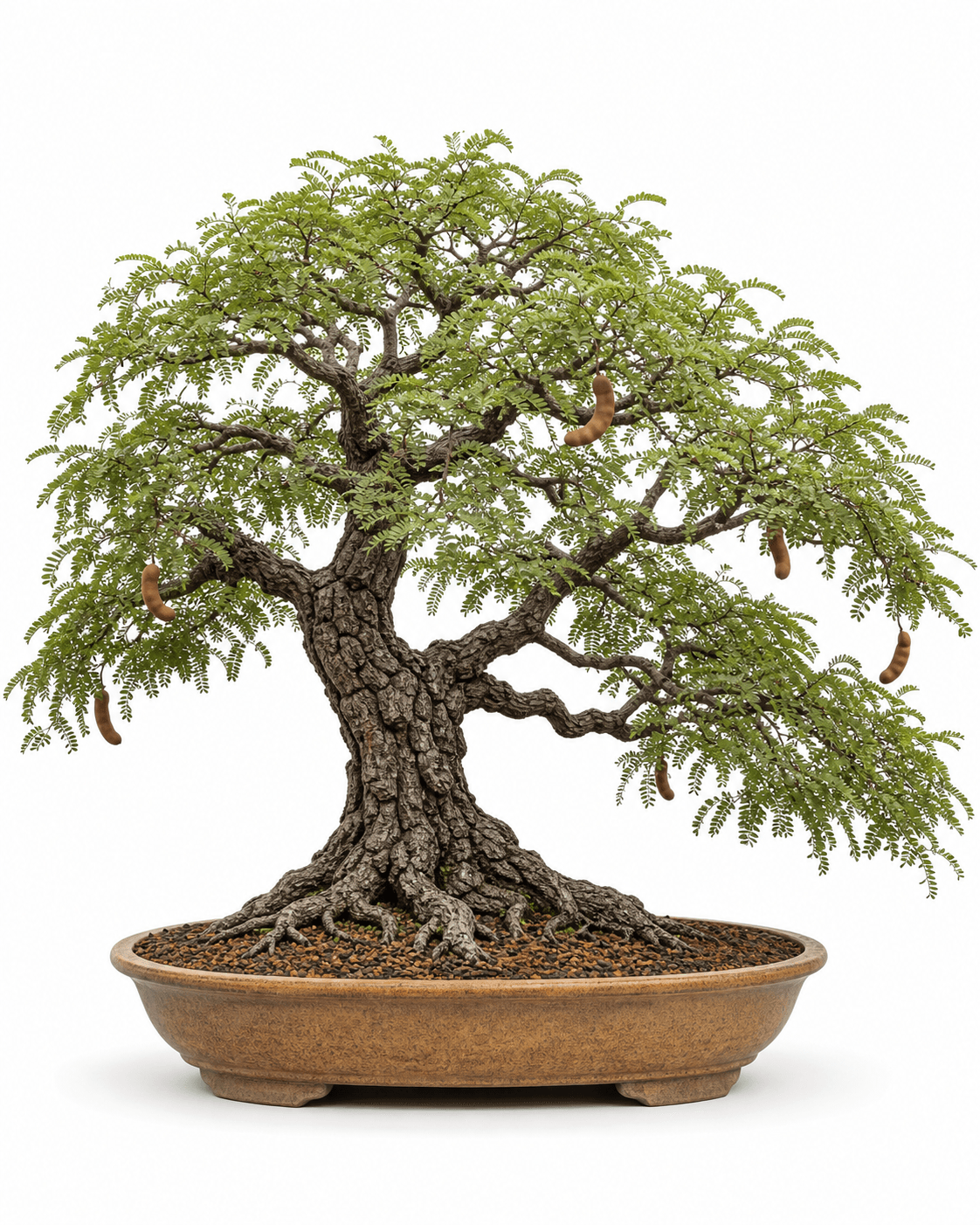
The natural design signal is a dome-shaped shade tree with drooping branches, fine leaflets, rough bark, and brown pods. A convincing tamarind bonsai should feel warm, spreading, and lightly textured rather than tight and conifer-like. UF/IFAS ExtensionBonsai Mirai / Asymmetry
Seasonally dry tropical ecology also explains winter handling. In cool climates, the indoor or greenhouse period is a low-metabolism protection season. Keep light high, reduce water, and delay structural work until the tree is warm enough to grow through the response. Bonsai Mirai LibraryUF/IFAS Extension
Reading the tree
Read tamarind by heat, extension, leaf size, and branch scale.
A developing tamarind needs extension. Mirai general tropical method treats running shoots as the engine for roots, trunk thickening, branch strength, and future back-budding zones. Cutting too early keeps the tree small without making it refined. Bonsai Mirai Library
A refined tamarind shows smaller leaves, shorter internodes, secondary branching, and a stable broad silhouette. Root maturity and light drive that shift. Repeated full defoliation spends energy on replacement leaves and slows the deeper development that makes refinement durable. Bonsai Mirai Library
The foliage is compound, with 10-15 pairs of small leaflets according to UF/IFAS. Judge scale at the whole-leaf level, not only by individual leaflet size. Shohin tamarind can be charming as a seedling exercise, but medium and larger trees give the foliage room to read naturally. UF/IFAS Extension
Pods change the energy picture. Flowers and pods are part of the tree character, but a weak or recently repotted bonsai should prioritize roots and canopy recovery. Remove fruit load when it competes with health or design. UF/IFAS ExtensionBonsai Mirai Library
Pruning
Build structure with extension, then refine with measured cutback.
UF/IFAS notes that tamarind needs pruning for strong structure. That is useful bonsai guidance because seedlings often grow straight, upright, and branch-light unless the grower intentionally builds taper and primary placement. UF/IFAS Extension
In development, let a branch run until it has thickened the section you need, then cut back to a bud or side branch that continues the intended line. This follows the Mirai energy principle that growth is proof of surplus and that new extension strengthens the branch before refinement. Bonsai Mirai Library
For refinement, reduce the strongest shoots first and preserve weaker interior shoots until they strengthen. Use partial leaf reduction, branch-by-branch, to balance vigor only after the current flush has hardened and the tree is clearly growing. Bonsai Mirai Library
Avoid pairing heavy pruning with root work. A leafy tropical recovering from repotting needs foliage to pull water, produce sugars, and close wounds. Bonsai Mirai Library
Roots
Repot only in warmth and keep part of the root system functioning.
Mirai tropical repotting guidance opens the safe work window once ambient warmth is consistent, with nights above 60 F / 16 C as the practical threshold. Tamarind should be treated inside that warm-window rule. Bonsai Mirai Library
The best reasons to repot are slow drainage, decomposed soil, root correction, poor anchoring, or a design change. A healthy tamarind in a durable mix can often wait, especially in a cooler climate where growth is slow for part of the year. Bonsai Mirai Library
Keep a portion of the root mass intact because the tree carries leaves year-round. Bare-rooting a leafy tropical interrupts hydration, and heavy top reduction in the same session removes the foliage that helps new roots recover. Bonsai Mirai Library
Anchor the tree firmly. Tamarind can become broad and top-heavy, and new roots need physical stability. After repotting, give bright protection with morning sun or filtered light until new extension proves recovery. Bonsai Mirai LibraryUF/IFAS Extension
Soil and pot
Use a mineral tropical mix and give the crown enough visual scale.
UF/IFAS lists tamarind as tolerant of clay, sand, loam, alkaline soil, acidic soil, and well-drained soil. A bonsai container narrows that range because roots need stable oxygen, structure, and water availability in a shallow volume. UF/IFAS ExtensionBonsai Mirai Library
A reliable starting mix is equal parts akadama, pumice, and lava. Add pumice or lava in humid, rainy, or indoor-protected conditions; add slightly more water-holding structure when heat and wind dry the tree too fast. Bonsai Mirai Library
Move seedlings out of dense nursery or fruit-tree soil gradually. The goal is a root system that can accept thorough watering and then breathe again before evening respiration. Bonsai Mirai Library
Pot choice should support the shade-tree image. Rectangular, oval, or softly rounded containers suit broad canopies and compound foliage better than very tiny pots that make the leaves look oversized. Bonsai Mirai / AsymmetryUF/IFAS Extension
Climate
In frost-free climates it is outdoor material; elsewhere it is a protected tropical.
UF/IFAS lists tamarind for USDA Zones 10A through 11 and says it should be grown in frost-free regions. A south Florida fruit-crop table places cold damage around 28-32 F / -2 to 0 C, which is a landscape threshold rather than a bonsai-pot safety target. UF/IFAS ExtensionUF/IFAS Extension
In tropical and subtropical climates, give full sun, strong airflow, and a free-draining container. Repot and style during the warm growing season, then let the tree recover before any cool or dry-season slowdown. UF/IFAS ExtensionBonsai Mirai Library
In temperate climates, treat the outdoor season as the productive season. Move the tree outside only after stable warm nights, and use the protected season for observation, pest checks, light management, and restrained watering. Bonsai Mirai Library
Heat can also slow work. Mirai general watering guidance puts peak photosynthesis near 85 F / 30 C and notes that very hot conditions shift trees toward cooling and stress management. In a heat wave, protect recently worked tamarind from afternoon intensity. Bonsai Mirai Library
Pests
The extension profile is clean; bonsai stress creates most problems.
UF/IFAS describes tamarind as free of serious pests and diseases in the landscape profile. That is helpful, but a bonsai pot adds stress: confined roots, indoor protection, reduced airflow, and occasional under-lighting. UF/IFAS ExtensionBonsai Mirai Library
The most common bonsai failure mode is root-zone imbalance. Yellowing leaves, sour soil smell, weak extension, and lingering surface moisture point to low oxygen or cold wet roots before they point to a species-specific disease. Bonsai Mirai Library
During indoor protection, inspect tender shoots and leaf undersides for scale, mealybugs, aphids, spider mites, and whitefly. Treat the identified pest early and improve light and airflow so the tree can resume growth. Bonsai Mirai Library
Pod litter is a management issue. UF/IFAS notes brown pods can be objectionable where they fall on hard surfaces. On bonsai benches, remove pods before they invite pests, weigh down weak branches, or pull energy from recovery. UF/IFAS Extension
Wiring
Wire young shoots, then let pruning carry the mature image.
UF/IFAS describes tamarind branches as drooping, resistant to breakage, and needing structural pruning. For bonsai, that means early branch placement matters because the mature image depends on well-spaced primary branches. UF/IFAS Extension
Wire during warm active growth when shoots are still flexible enough to accept direction. Check frequently because tropical growth can swell quickly after warmth and fertilizer return. Bonsai Mirai Library
Use wire to set primary angle, branch spread, and canopy rhythm. Use cutback to create most secondary and tertiary structure, especially on older rough-barked wood where wire scars would linger. Bonsai Mirai LibraryBonsai Mirai / Asymmetry
Avoid wiring immediately after repotting or during winter protection. A tree below its active photosynthetic range cannot respond well to bend stress, bark damage, or foliage loss. Bonsai Mirai Library
Propagation
Seed is easy; air layers need hardwood-tropical patience.
UF/IFAS says tamarind propagates by seeds that germinate readily or by cuttings. It also notes that air-layering, grafting, or shield budding are used when quality fruit is desired. UF/IFAS Extension
For bonsai, seed is useful for forests, clumps, and long development projects. Scarify or soak seed according to normal horticultural practice, then grow seedlings in warmth and strong light before selecting trunks with movement. Purdue UniversityBonsai Mirai Library
The Mirai air-layering primer explicitly names tamarind as a hardwood tropical that behaves like deciduous cold-hardy trees or conifers for layering purposes. Start only after nights are consistently above 60 F / 16 C and root-zone warmth is in the 70 F range. Bonsai Mirai Library
After separation, treat the layer like collected material. The Mirai air-layering primer uses pure perlite under mist for 30-45 days as the new-root hardening step, then avoids additional root or styling stress for 2-3 years while the new system matures. Bonsai Mirai Library
Buying
Buy for trunk movement and climate fit, not just for pods.
Tamarind material usually comes from seed, tropical fruit nurseries, pre-bonsai growers, or landscape-grown stock in frost-free regions. Confirm the plant is Tamarindus indica rather than another tree with tamarind in the common name. Kew POWOUF/IFAS Extension
Good bonsai candidates have low movement, a visible root flare, branch options near the trunk, roughening bark, and a canopy scale that can support compound leaves. A tall straight seedling may be better chopped early than nursed into a skinny formal tree. Bonsai Mirai / AsymmetryUF/IFAS Extension
Inspect the root system. Dense fruit-tree soil, circling nursery roots, a buried crown, or weak anchoring will create the first serious work session. Buy the healthiest root base you can find. Bonsai Mirai Library
UF/IFAS currently marks tamarind as a recommended landscape tree and not a problem species in its Florida assessment language. Regional planting rules can differ, so confirm local status before growing it outdoors from seed in warm climates. UF/IFAS Extension
Troubleshooting
Most problems trace back to light, warmth, roots, or timing.
Symptom: leaflets yellow and fall during winter protection. Likely causes: weak light, cool nights, wet soil, or low airflow. Fix: raise light and warmth, reduce watering, and delay pruning until extension resumes. Bonsai Mirai Library
Symptom: new growth is long, pale, and sparse. Likely causes: indoor light below tropical needs, too much nitrogen in weak light, or a pot kept too wet. Fix: increase light, move outdoors in warm weather, and rebalance water. Bonsai Mirai Library
Symptom: the tree wilts after repotting. Likely causes: too much root reduction, poor anchoring, full sun before recovery, or repotting before stable warmth. Fix: stabilize the tree, provide bright protection, and manage water carefully. Bonsai Mirai Library
Symptom: pods form but branches weaken. Likely causes: fruit load on a small or recently stressed tree. Fix: remove some or all pods and return the tree to vegetative growth before the next major work. UF/IFAS ExtensionBonsai Mirai Library
Symptom: no interior budding after cutback. Likely causes: cutting before a shoot had built surplus, insufficient light, or a branch still in development. Fix: let growth run, feed during warmth, and cut only after the branch strengthens. Bonsai Mirai Library
Symptom: pests appear indoors. Likely causes: still air, warm protected conditions, and a tree growing below full strength. Fix: identify the pest, clean the canopy, improve airflow, and restore outdoor sun when safe. Bonsai Mirai Library
Design
Design tamarind as a miniature tropical shade tree.
Start with the base, trunk line, defining branch, and apex. Mirai design fundamentals use those three elements to decide whether a tree reads as harmonious, tense, or dynamic. Tamarind often benefits from harmony or gentle tension because the species already gives fine texture and a broad crown. Bonsai Mirai / AsymmetryBonsai Mirai Library
The UF/IFAS description gives the species image: upright dome-shaped tree, broad spreading crown, delicate leaflets, rough fissured bark, and drooping branches. Let that guide branch placement and silhouette. UF/IFAS Extension
A good tamarind bonsai usually needs scale. Medium and large designs allow compound leaves to read as fine texture. Broom, informal upright, twin-trunk, clump, forest, and shade-tree silhouettes suit the species. UF/IFAS ExtensionBonsai Mirai / Asymmetry
Fruit can be a seasonal accent on a healthy mature tree, but pods should support the design rather than dominate it. Keep branch structure legible and use pods sparingly when the tree has enough strength. UF/IFAS ExtensionBonsai Mirai Library
Forms
Common names matter more than bonsai cultivar names right now.
Search and trade labels include tamarind, tamarindo, Indian date, imli, and many regional food names. The botanical target for this page is Tamarindus indica. Kew POWOPurdue University
Fruit horticulture may use air-layered, grafted, or budded selections when pod quality matters. Bonsai selection should prioritize base, trunk movement, branch placement, leaf scale, and verified health. UF/IFAS ExtensionBonsai Mirai / Asymmetry
Avoid common-name confusion. Manila tamarind, native tamarind, wild tamarind, and beach tamarind are different plants in different genera. Verify the scientific name before applying this care calendar. Kew POWO
For EntGrove routing, tamarind, tamarindo, Indian date, imli, and Tamarindus indica should resolve to this page. Fruit-selected clones can stay here until bonsai search demand justifies separate pages. Kew POWOUF/IFAS Extension
History
Tamarind carries food history before bonsai history.
Kew records Tamarindus indica as first published in Species Plantarum in 1753. The species has since become a widely cultivated tropical food and shade tree, which explains why regional origin and name language can vary by source. Kew POWOPurdue University
Purdue documents food uses for leaves, shoots, flowers, fruit pulp, and seeds across parts of India, Nigeria, and Sudan. NTBG records cultural lore and herbarium specimens, underscoring how broadly the tree appears in tropical plant culture. Purdue UniversityNational Tropical Botanical Garden
In bonsai, tamarind is less codified than ficus, Brazilian rain tree, or buttonwood. Its strongest contribution is a tropical shade-tree image: textured bark, fine leaflets, pods on mature material, and a wide canopy built by patient pruning. UF/IFAS ExtensionBonsai Mirai / Asymmetry
A canonical tamarind guide should be honest about evidence depth. The tree is bonsai-capable, but the best current method comes from tropical-broadleaf principles, verified plant facts, and careful observation of the individual tree. Bonsai Mirai LibraryKew POWOUF/IFAS Extension
Species questions
Answer the beginner questions before styling.
Can tamarind be grown as bonsai?
Yes. Tamarindus indica can be grown as tropical bonsai, especially as medium or larger trees where the compound foliage fits the design scale.
Can tamarind bonsai grow indoors?
It can be protected indoors for winter with strong light, warmth, airflow, and restrained watering. It should spend the warm season outdoors in full sun when local temperatures allow.
How cold can tamarind bonsai tolerate?
UF/IFAS lists landscape tamarind for USDA Zones 10A through 11 and a south Florida fruit table gives cold damage around 28-32 F / -2 to 0 C. Bonsai containers should be protected before that range.
When should I repot tamarind bonsai?
Repot during stable warm growth after nights are consistently above 60 F / 16 C. Repot for drainage, soil condition, root health, or a design change.
What soil is best for tamarind bonsai?
Use a fast-draining mineral tropical mix. Equal parts akadama, pumice, and lava are a useful starting point, adjusted toward more drainage in humid or protected conditions.
How often should I water tamarind bonsai?
Water thoroughly during warm growth when the upper soil is drying and the tree is using water. In cool indoor protection, reduce frequency and let oxygen return to the root zone.
Can I defoliate tamarind bonsai?
Use partial leaf reduction only on vigorous trees in active growth. Full defoliation is usually unnecessary and can slow development, especially on young or recovering trees.
Can tamarind bonsai be grown from seed?
Yes. UF/IFAS says tamarind seeds germinate readily. Seedlings are useful for forests, clumps, and long-term trunk development.
Can I air-layer tamarind?
Yes, but treat it as a hardwood tropical. The Mirai air-layering primer names tamarind in that group and recommends starting only after stable warm nights.
Why are my tamarind leaves yellowing indoors?
Likely causes include weak light, cool temperatures, wet soil, low airflow, or pests. Fix the environment before pruning more foliage.
Sources
Species advice needs source discipline.
Next decisions
Plan the operation before copying the calendar.
A good care note for Tamarind records the tree's stage, the work done, and the aftercare used. That record matters more than a month-name rule.
Related species
Compare nearby trees before transferring advice.
Ficus retusa / Indian laurel
Ficus microcarpa
Tigerbark ficus
Ficus microcarpa 'Tigerbark'
Willow-leaf ficus
Ficus salicaria
Benjamin fig
Ficus benjamina
Ginseng ficus
Ficus microcarpa 'Ginseng'