
Species guide
Sandpaper Tree Bonsai Care
Streblus asper
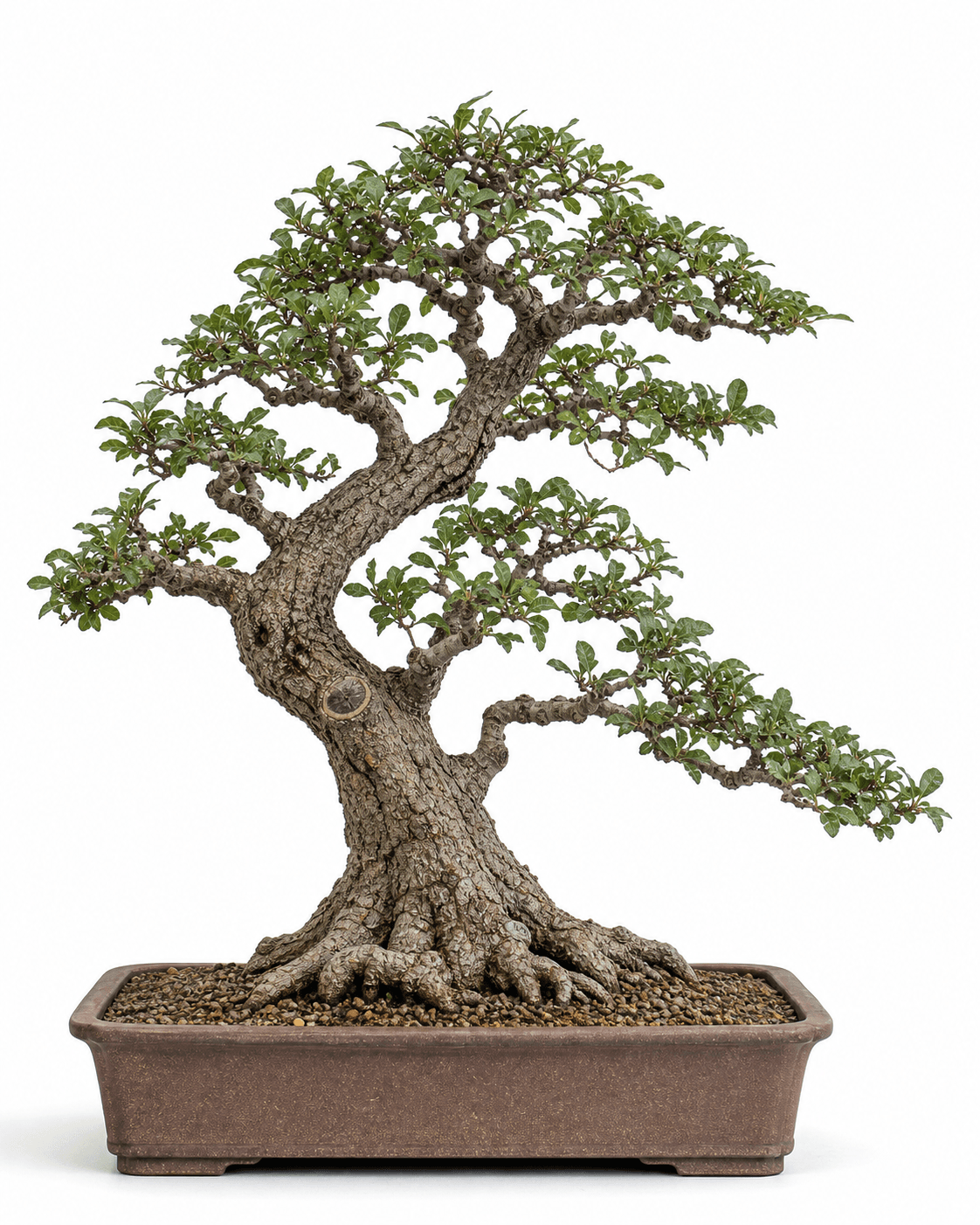
Sandpaper tree bonsai, Streblus asper, is a tropical to subtropical Moraceae species better known in bonsai searches as serut, khoi, Siamese rough bush, or toothbrush tree. Treat it as advanced tropical broadleaf material: bright warmth, careful water and oxygen balance, conservative root work, and design sized around rough small leaves and strong old-wood character.
The local Bonsai Mirai corpus has no dedicated Streblus, serut, or sandpaper-tree file. This profile transfers only tropical broadleaf, broadleaf evergreen, watering, soil, repotting, propagation, wiring, energy, and design method from Mirai, then uses Kew search workflow and Useful Tropical Plants for identity, range, habitat, growth habit, dioecious fruiting, and traditional-use facts.
The practical answer is restraint. Serut can be compelling because the foliage is textural and the trunks can look old, but bonsai failures usually come from weak imported or recently collected stock, cold wet roots, aggressive bare-rooting, and treating a thinly sourced tropical species like a forgiving beginner ficus.
Updated July 4, 2026. Written by EntGrove Editorial. Last verified July 4, 2026.
Care fingerprint
Read the species through its shared care pattern.
Treat indoor culture as a light-management problem first; prune and repot when the tree is actively growing and warm enough to recover. Use this as the starting point before local conditions and tree strength refine the calendar.
Read the foliage first
Broadleaf stress usually shows in leaf color, leaf size, wilt, scorch, or delayed hardening before it becomes a branch problem.
Match work to dormancy
Deciduous, evergreen, tropical, succulent, and flowering broadleaf trees recover on different calendars.
Protect fine roots
Root work should preserve enough active fine roots for the tree to rehydrate quickly after the operation.
Care cadence
The calendar starts with the tree's seasonal state.
Placement
Timing: Grow in bright warmth with airflow. After import, shipping, or repotting, start in protected bright shade, then move toward stronger light as new extension confirms root function.
Watch for: Cold nights, stagnant indoor corners, abrupt sun on greenhouse leaves, hot wind after root work, and old leaves staying green while new tips fail to move.
Bonsai Mirai LibraryWatering
Timing: Water deeply when the upper root zone is drying and the interior still has slight moisture. Adjust by foliage mass, pot reservoir, sun, wind, and temperature.
Watch for: A dry field core, water sheeting around the root ball, sour soil, yellowing after cool wet periods, and repeated misting used in place of real root hydration.
Bonsai Mirai LibraryFertilizer
Timing: Feed during active growth after the tree is moving water predictably. Use moderate organic surface feed or dilute liquid feed, then pause after heavy root work or leaf loss.
Watch for: Pushing long weak shade shoots, feeding cold wet roots, salt buildup in indoor protection, and fertilizing imported material before roots have stabilized.
Bonsai Mirai LibraryPruning
Timing: Prune in warm active growth after shoots extend and harden enough to have fed the tree. Let selected sacrifice shoots run when trunk or branch thickening matters.
Watch for: Constant clipping, hard cutback below active buds, removing too much foliage from a weak root system, and reducing branches before the design role is clear.
Bonsai Mirai LibraryBonsai Mirai / AsymmetryLeaf work
Timing: Use selective leaf reduction only on vigorous trees. Treat full defoliation as an occasional refinement tool, not a routine response to large or rough leaves.
Watch for: Defoliating during weak light, cold protection, post-import recovery, or the same season as major root correction.
Bonsai Mirai LibraryRepotting
Timing: Repot in warm active growth when nights are near 60 F / 16 C or warmer and several warm weeks remain. Stage old-soil correction if roots are weak.
Watch for: Bare-rooting a leafy tropical, combining severe root work with severe top pruning, burying the trunk base, and leaving an unstable tree in a shallow pot.
Bonsai Mirai LibraryWiring
Timing: Wire young flexible shoots during active growth, then inspect often. Use guy wires, clip-and-grow, and staged bends for older or brittle branches.
Watch for: Wire bite under fast tropical swelling, bark bruising, cracks at old branch shoulders, and wiring before root recovery is visible.
Bonsai Mirai LibraryPest checks
Timing: Inspect year-round in protected culture and after import. Specific Streblus bonsai pest literature is thin, so use tropical broadleaf hygiene until a local diagnosis is made.
Watch for: Scale, mealybugs, mites, aphids, fungus gnats, sooty residue, root rot, and pests hidden in dense old foliage or under rough bark.
Bonsai Mirai LibrarySpecies guide
Apply the species profile before copying another tree's calendar.
At a glance
Serut is promising tropical material with a thin bonsai evidence base.
Streblus asper is the botanical anchor for this page. Useful Tropical Plants lists Moraceae placement, the sandpaper tree common name, and synonyms including Streblus monoicus. Useful Tropical Plants: Streblus asperKew POWO search: Streblus asper
In bonsai trade, the same plant may appear as serut, khoi, Siamese rough bush, toothbrush tree, sandpaper tree, or simply Streblus. Record the source label and update it only after botanical verification. Useful Tropical Plants: Streblus asper
The care rhythm is tropical broadleaf: warm active growth for major work, thorough watering with oxygen return, no bare-rooting while leafy, and patience while roots mature before refinement. Bonsai Mirai Library
Wild habit
Seasonal open-country ecology explains the bonsai design direction.
Useful Tropical Plants places Streblus asper across southern China, India, Sri Lanka, mainland Southeast Asia, Malaysia, Indonesia, and the Philippines. Useful Tropical Plants: Streblus asper
The same source describes seasonal climates, village surroundings, open areas, rice-field borders, and secondary forest from sea level to about 1,000 m, with an explicit absence from rain forest. Useful Tropical Plants: Streblus asper
For care, that points toward warmth, strong light after acclimation, and a root zone that can dry enough to breathe. For design, it points toward an old hedgerow or open-grown tropical tree rather than a wet-jungle image. Useful Tropical Plants: Streblus asperBonsai Mirai / Asymmetry
Reading the tree
Read roots and new extension before trusting old foliage.
A strong serut has firm new tips, leaves that harden without collapse, predictable water use, and roots that hold the tree steady. Green old leaves alone do not prove readiness for work. Bonsai Mirai Library
Development comes first. Let extension build root strength, trunk girth, and branch options before repeated clip-and-grow refinement. Bonsai Mirai Library
Imported or collected material should be staged as recovery material. Confirm that the old field core takes water, that drainage is open, and that the tree can push new growth after shipping or collection stress. Bonsai Mirai Library
Leaf texture is part of the identity. The goal is smaller, cleaner, better placed leaves through light, roots, and pruning rhythm, not stripping every rough leaf on a stressed tree. Bonsai Mirai LibraryUseful Tropical Plants: Streblus asper
Pruning
Build structure with extension, then refine only after hardening.
Prune during warm active growth. Let a shoot extend when it is feeding a branch, thickening a junction, or proving root recovery, then cut back to a useful node or side shoot. Bonsai Mirai Library
For rough or oversized leaves, improve light and root maturity first. Mirai tropical method treats root maturation as the main path toward finer foliage and ramification. Bonsai Mirai Library
Use partial leaf removal to open dense areas on strong trees. Preserve weak interior leaves so they can photosynthesize and keep a branch alive. Bonsai Mirai Library
Avoid calendar defoliation. A full strip belongs only on a vigorous tree in active growth when the design needs access or a controlled refinement response. Bonsai Mirai Library
Roots
Repot warm, leave functioning roots, and stage old-soil correction.
Use the tropical repotting window: nights near 60 F / 16 C or warmer, active growth, and enough warm time left for new roots before protection season. Bonsai Mirai Library
Do not bare-root a leafy serut. Leave a working root section, correct the worst old soil first, and avoid pairing root reduction with heavy top reduction. Bonsai Mirai Library
Old imported or field soil can be hydrophobic inside and wet outside. Test water penetration before root work, then remove compacted pockets in stages rather than combing everything clean at once. Bonsai Mirai Library
Tie the tree firmly. A newly worked tropical broadleaf that rocks in the pot loses fine roots and may stall before it can replace the foliage demand. Bonsai Mirai Library
Soil and pot
Use a tropical mix that stores water without going stale.
A practical starting mix is equal parts akadama, pumice, and lava. Adjust toward more pumice, lava, or durable local aggregate when the tree winters indoors, sits in rainy weather, or comes from dense old soil. Bonsai Mirai Library
The habitat record points to seasonal open places rather than saturated rainforest. In a bonsai pot, translate that into full watering followed by oxygen return. Useful Tropical Plants: Streblus asperBonsai Mirai Library
Use training containers while building roots and primary structure. Move to a display pot after drainage, anchoring, and water rhythm are predictable. Bonsai Mirai Library
Pot pairing should honor the rough leaves and old-bark character. Quiet glazed rectangles, ovals, or unglazed warm-earth containers usually suit serut better than bright decorative pots. Bonsai Mirai / Asymmetry
Climate
Warmth governs the calendar more than the common name.
In tropical and subtropical regions, grow serut outdoors with bright light, airflow, and protection after major root work. Acclimate greenhouse or shade-grown material gradually before full sun. Bonsai Mirai Library
In cold climates, overwinter in bright protected warmth. Reduce water to actual demand, keep roots away from cold glass or cold benches, and delay pruning until active growth returns. Bonsai Mirai Library
Seasonal-origin ecology suggests some drought and heat adaptation once established, but a shallow bonsai pot removes the deep-soil buffer. Do not copy landscape drought tolerance into container care. Useful Tropical Plants: Streblus asperBonsai Mirai Library
Pests
Treat pest guidance as tropical broadleaf triage until identified locally.
The cited species sources do not provide a bonsai-specific pest list. In protected culture, inspect for common tropical broadleaf problems: scale, mealybugs, mites, aphids, fungus gnats, and sooty residue. Bonsai Mirai Library
Root disease is the main cultural risk. Yellowing after cool wet periods, sour soil, loose anchoring, stalled tips, and water that does not penetrate the root core all point back to oxygen and root health. Bonsai Mirai Library
Clean before spraying. Improve light, airflow, and watering rhythm, isolate new imports, and use local extension or product-label guidance only after the tree is hydrated and out of heat stress. Bonsai Mirai Library
Wiring
Wire flexible growth, then let pruning carry the finer image.
Use structural wire to set trunk and primary branch direction while shoots are flexible and the tree is actively growing. Keep coils even, supported, and in contact without constricting bark. Bonsai Mirai Library
Older serut branches may be stiff, brittle, or slow to heal after a hard bend. Use staged bends, guy wires with padding, or cutback to a new leader when a branch resists. Bonsai Mirai LibraryBonsai Mirai / Asymmetry
Inspect often in warm growth. Wire bite on rough or character bark can become a permanent distraction, and fast tropical swelling can overtake a coil quickly. Bonsai Mirai Library
Propagation
Seed is documented; cuttings and layers need source-specific caution.
Useful Tropical Plants lists seed under propagation and notes the species is dioecious, so fruit and seed require male and female plants. Useful Tropical Plants: Streblus asper
For bonsai, seed is slow but useful for clean roots and known origin. Track sowing date, source, leaf texture, internode length, and whether the plant was grown locally or imported. Useful Tropical Plants: Streblus asperBonsai Mirai / Asymmetry
Cuttings and air layers are plausible tropical-broadleaf techniques, but this profile lacks a species-specific Streblus rooting source. Try them only as experiments on vigorous surplus growth and record results. Bonsai Mirai Library
Buying
Buy documented, rooted, actively growing material.
Good material has a verified Streblus asper or serut label, active new tips, a firm trunk base, compact leaves, visible low branch options, and a rootball that accepts water. Useful Tropical Plants: Streblus asperBonsai Mirai / Asymmetry
Red flags include freshly collected trunks with no post-collection growth, sealed mud cores, weak imports, unlabeled tropical hedge stock, recent severe styling plus recent repotting, and roots hidden under moss. Bonsai Mirai Library
Ask how the tree was propagated, how long it has been in its current pot, whether it has survived one local winter, and whether it has pushed new growth after any root work. Bonsai Mirai Library
Avoid wild-collection romance. Useful Tropical Plants notes village and semi-cultivated context, so nursery-grown or locally propagated material is the cleaner first choice for most growers. Useful Tropical Plants: Streblus asper
Troubleshooting
Diagnose by warmth, roots, water penetration, and new growth.
Symptom: leaves stay green but no new shoots appear. Likely causes: weak roots, low light, cold protection, or import stress. Fix: stabilize warmth, increase light gradually, and wait before pruning. Bonsai Mirai Library
Symptom: yellow leaves with wet soil. Likely causes: cold wet roots, decomposed organic soil, or low oxygen. Fix: improve warmth and drainage, empty saucers, and plan staged root correction. Bonsai Mirai Library
Symptom: crispy tips after moving outside. Likely causes: abrupt sun, hot wind, small reservoir, or roots that cannot keep up. Fix: step back to bright shade and rebuild water rhythm. Bonsai Mirai Library
Symptom: water runs down the pot wall but the trunk loosens. Likely causes: hydrophobic old core or hidden field soil. Fix: soak, probe gently, and correct the core during a warm repotting window. Bonsai Mirai Library
Symptom: pests keep returning indoors. Likely causes: low light, dense foliage, dry air, or weak roots. Fix: isolate, clean, improve culture, and prune only after recovery growth appears. Bonsai Mirai Library
Design
Style it as old tropical broadleaf material, not as a miniature juniper.
Begin with base, trunk line, defining branch, and apex. Serut often works best when the rough foliage and old trunk character support a simple asymmetric silhouette. Bonsai Mirai / Asymmetry
Use the habitat signal. A credible image can read as open-country, village-edge, hedgerow, or secondary-forest material with light reaching through the canopy. Useful Tropical Plants: Streblus asperBonsai Mirai / Asymmetry
Avoid flat conifer pads. Open windows, keep branch hierarchy visible, and let the rough leaf texture create character around a readable trunk. Bonsai Mirai / Asymmetry
Deadwood should be earned by the material. Treat live vein health, callus response, and branch recovery as gates before carving imported or recently collected trunks. Bonsai Mirai LibraryBonsai Mirai / Asymmetry
Forms
The main form problem is label accuracy, not cultivar selection.
This page treats Streblus asper as the parent profile. Useful Tropical Plants lists synonyms including Streblus monoicus and Diplothorax tonkinensis, but bonsai trade may use regional common names instead. Useful Tropical Plants: Streblus asper
Serut, khoi, Siamese rough bush, toothbrush tree, and sandpaper tree can all refer to this species in searches. Keep purchase records because common names move across regions and languages. Useful Tropical Plants: Streblus asper
Choose individual quality over named form. Root health, trunk movement, low buds, compact foliage, and post-work recovery matter more than a romantic import label. Bonsai Mirai / AsymmetryBonsai Mirai Library
History
Its cultural history is stronger than its public bonsai record.
Useful Tropical Plants records paper fiber, rough leaves used like sandpaper, edible fruit, and village or semi-cultivated uses. Those uses explain several common names and the tactile foliage reputation. Useful Tropical Plants: Streblus asper
The public record of famous serut bonsai is thinner than for ficus, Japanese maple, Satsuki azalea, pines, and junipers. Judge the tree by horticultural clarity and design honesty. Bonsai Mirai / Asymmetry
Records matter more because source depth is thin. Track origin, import date, repot dates, soil core notes, winter minimums, pruning response, pest events, and whether each major operation produced new growth. Bonsai Mirai Library
Species questions
Answer the beginner questions before styling.
Can sandpaper tree be a bonsai?
Yes. Streblus asper can be trained as tropical broadleaf bonsai when the material is healthy, rooted, warm, bright, and worked conservatively. It is better for intermediate growers than first-tree beginners.
Is serut the same as sandpaper tree?
In bonsai searches, serut commonly refers to Streblus asper, also called sandpaper tree, khoi, Siamese rough bush, and toothbrush tree. Verify the botanical label before applying this care page.
Can sandpaper tree bonsai grow indoors?
It can be protected indoors during cold weather under strong light, warmth, and airflow, but it should not be treated as a low-light indoor bonsai. Warm outdoor growth is better when climate allows.
When should I repot serut bonsai?
Repot during warm active growth after nights are near 60 F / 16 C or warmer. Preserve part of the working root mass and stage old-soil correction if the tree is imported, collected, or weak.
What soil is best for sandpaper tree bonsai?
Use a granular tropical broadleaf mix that drains and breathes. Equal parts akadama, pumice, and lava are a starting point, adjusted toward more durable aggregate in wet or indoor conditions.
How often should I water serut bonsai?
Water when the upper root zone is drying and the interior still has slight moisture. Water thoroughly, confirm percolation through the whole rootball, and let oxygen return before watering again.
Can I defoliate sandpaper tree bonsai?
Use selective leaf work only on vigorous trees in warm active growth. Routine full defoliation is risky, especially after import, root work, low-light protection, or any period of weak extension.
How do I propagate sandpaper tree bonsai?
Useful Tropical Plants documents seed propagation and notes the species is dioecious, so male and female plants are needed for fruit and seed. Cuttings and air layers should be treated as experiments unless your source has proven local results.
Why is my serut bonsai not growing?
Common causes include weak roots, cold nights, low light, a compacted field core, import stress, or water failing to penetrate the rootball. Stabilize culture before pruning or repotting hard.
Is sandpaper tree a beginner bonsai?
Usually no. Serut is interesting tropical material, but source documentation is thin and many trees enter collections as imports or collected trunks that need careful staging.
Sources
Species advice needs source discipline.
Next decisions
Plan the operation before copying the calendar.
A good care note for Sandpaper tree / serut records the tree's stage, the work done, and the aftercare used. That record matters more than a month-name rule.
Related species
Compare nearby trees before transferring advice.
Ficus retusa / Indian laurel
Ficus microcarpa
Tigerbark ficus
Ficus microcarpa 'Tigerbark'
Willow-leaf ficus
Ficus salicaria
Benjamin fig
Ficus benjamina
Ginseng ficus
Ficus microcarpa 'Ginseng'