
Species guide
Water Jasmine Bonsai Care
Wrightia religiosa
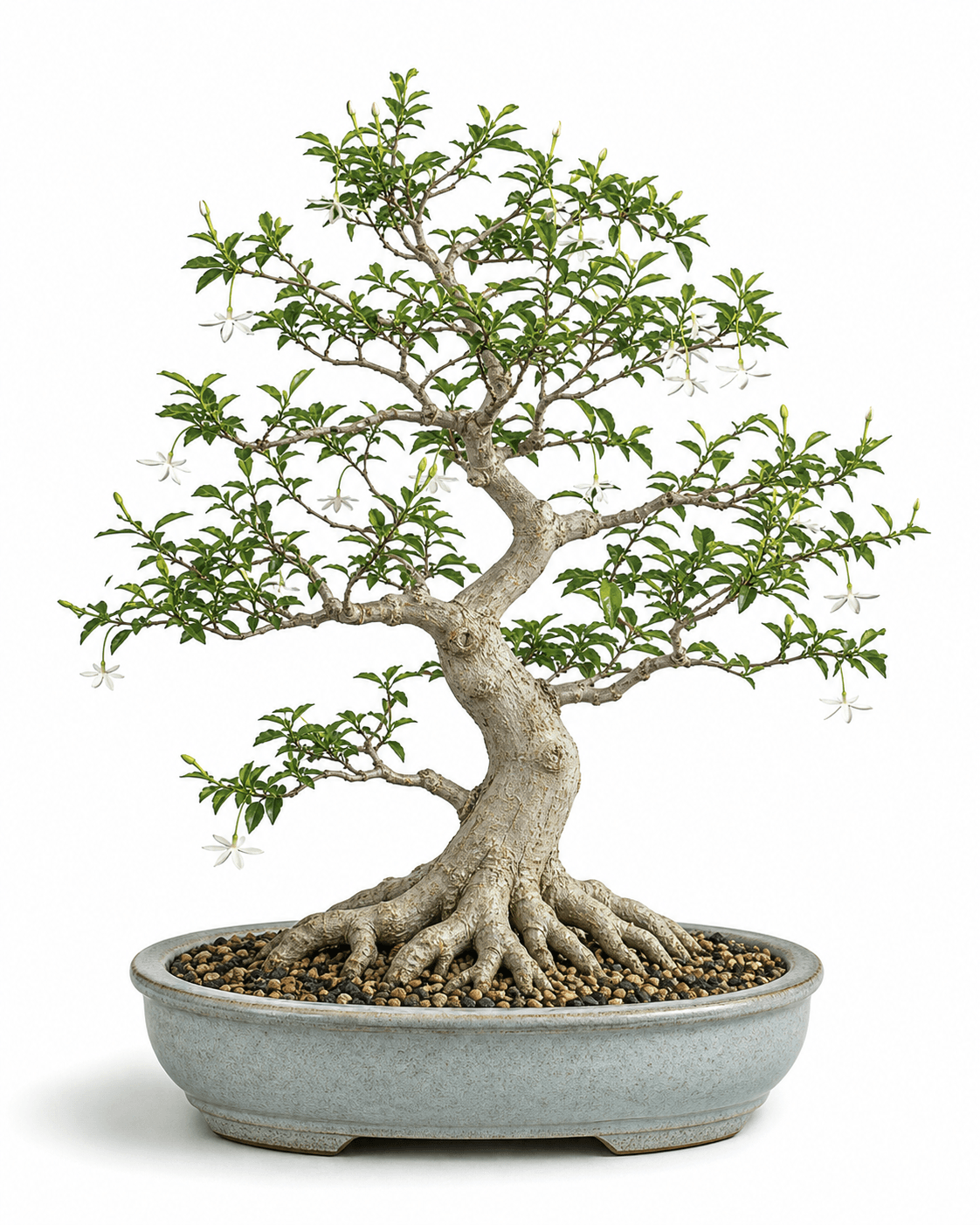
Water jasmine bonsai, Wrightia religiosa, is a fast tropical broadleaf best grown in high light, steady warmth, free-draining soil, and active-growth timing. Its appeal is clear: opposite leaves, fragrant white flowers, quick recovery, and strong back budding when cuts are clean and the roots stay oxygenated.
Treat water jasmine as Broadleaf > Tropical in the EntGrove taxonomy. Major work belongs in warm active growth, winter protection begins before cold slows metabolism, and flowering is managed by pruning rhythm because the flowers form at branch tips.
This profile has direct local Mirai coverage from water-jasmine-management, then uses Kew, NParks, and Plant Pono for taxonomy, public horticulture, climate, and weed-risk checks. Western extension coverage is sparse, so the page is transparent about where the evidence is strong.
Updated June 20, 2026. Written by EntGrove Editorial. Last verified June 20, 2026.
Care fingerprint
Read the species through its shared care pattern.
Treat indoor culture as a light-management problem first; prune and repot when the tree is actively growing and warm enough to recover. Use this as the starting point before local conditions and tree strength refine the calendar.
Read the foliage first
Broadleaf stress usually shows in leaf color, leaf size, wilt, scorch, or delayed hardening before it becomes a branch problem.
Match work to dormancy
Deciduous, evergreen, tropical, succulent, and flowering broadleaf trees recover on different calendars.
Protect fine roots
Root work should preserve enough active fine roots for the tree to rehydrate quickly after the operation.
Care cadence
The calendar starts with the tree's seasonal state.
Placement
Timing: Grow in full sun to bright filtered light after acclimation. Indoors, use the brightest warm protected position available and move outside only after stable warm nights.
Watch for: Large pale leaves, long internodes, reduced flowers, cold windows, dry indoor heat, or shade that weakens the interior canopy.
NParks Flora & Fauna WebBonsai Mirai LibraryWatering
Timing: Water thoroughly when the root zone is ready, then let drainage restore oxygen. Judge the pot by actual drainage behavior, not a fixed daily rule.
Watch for: A dry-looking surface over a wet lower pot, water bypassing a rootbound core, blocked drain holes, or a cold wet center in an oversized container.
Bonsai Mirai LibraryNParks Flora & Fauna WebFlowering
Timing: Preserve branch tips when flowers matter. A heavy cutback can remove the emerging spring crop, with full bloom returning about 90 days after major cutback in Mirai guidance.
Watch for: Pruning away all flower tips, trying to force bloom in low light, or reading flower rebound after stress as a stable health signal without checking roots.
Bonsai Mirai LibraryNParks Flora & Fauna WebPruning
Timing: In active growth, cut back to two leaf pairs when you want controlled bifurcation, and remove water shoots while they are still green.
Watch for: Four or five shoots from one point, hardened upright water shoots, bar-branch swelling, or rough cuts that trigger more juvenile growth around wounds.
Bonsai Mirai LibraryFertilizer
Timing: Feed during warm active extension. Use stronger nutrition for development, then reduce once internode length, flower timing, and leaf scale matter.
Watch for: Coarse rank growth, fertilizer on cold roots, feeding after heavy root work before recovery, or starving a tree that is being cut back repeatedly.
Bonsai Mirai LibraryBonsai Mirai / AsymmetryRepotting
Timing: Inspect yearly. Repot during warm active growth when roots fill the pot, drainage slows, or container progression needs the next stage.
Watch for: Rushing into a shallow bonsai pot, over-potting into a cold wet center, blocking drain holes on a flat bench, or combining heavy root work with heavy top work.
Bonsai Mirai LibraryWounds
Timing: Clean large cuts sharply, shape them to shed water, seal the cambium, and let sealant dry before wiring across the area.
Watch for: Concave cuts that hold water, peeled cambium after unsupported saw cuts, sealant stripped by wire, or water shoots around an unsealed wound edge.
Bonsai Mirai LibraryPropagation
Timing: Air layers can root in roughly 30 days. Pencil-sized cuttings can root in 30-45 days in perlite and humidity when warmth is steady.
Watch for: Layers placed without a parent-tree design reason, cold propagation media, leaves left to transpire beyond the new roots, or cuttings kept saturated.
Bonsai Mirai LibraryNParks Flora & Fauna WebWinter protection
Timing: Protect before nights fall below roughly 40-45 F / 4-7 C. In cold climates, keep it bright, warm enough, and lightly worked until active growth resumes.
Watch for: Leaf drop from cold, heavy winter pruning, wet roots in a dim room, or moving between indoors and outdoors without acclimation.
Bonsai Mirai LibraryPlant Pono assessment reportPests and disorders
Timing: Inspect protected trees during warm indoor or greenhouse periods, especially leaf undersides, tender tips, and crowded interiors.
Watch for: Spider mites under glass, scale, mealybugs, root rot from stagnant soil, wound rot, or ants that signal honeydew pests nearby.
Plant Pono assessment reportBonsai Mirai LibrarySpecies guide
Apply the species profile before copying another tree's calendar.
At a glance
Water jasmine is a warm, fast, flowering tropical that rewards clean repeated work.
The botanical target is Wrightia religiosa in Apocynaceae. Kew accepts the name and lists the species as a shrub of the seasonally dry tropical biome, while NParks records water jasmine, wild water plum, sacred Buddhist, and Chinese water-plum labels. Kew POWONParks Flora & Fauna Web
For bonsai, the practical identity is a fast-metabolizing tropical broadleaf. It has opposite leaves, fragrant white flowers, flexible young shoots, quick rooting, and a strong tendency to produce juvenile water shoots after large or poorly sealed cuts. Bonsai Mirai LibraryNParks Flora & Fauna Web
The tree is best for growers who can provide bright warmth, frequent observation, and annual root checks. Its most common failures are cold protection mistakes, shallow-pot drainage problems, over-potting, unsealed wounds, and pruning that removes the flower crop before it opens. Bonsai Mirai LibraryPlant Pono assessment report
Wild habit
Its wild and cultivated story points to heat, drainage, and constant growth.
Kew gives a broad accepted range from Bangladesh through southern China and northwestern Peninsular Malaysia. NParks gives Thailand and Malaysia and describes a tropical terrestrial shrub. Plant Pono adds the important caveat that wide cultivation has made the natural distribution obscure in parts of Malesia. Kew POWONParks Flora & Fauna WebPlant Pono
That ecology gives the care baseline. Water jasmine uses a warm-climate rhythm with active roots, air movement, a well-drained medium, and enough light for compact leaves and flower initiation. Bonsai Mirai LibraryNParks Flora & Fauna Web
The design implication is equally clear. Water jasmine should read as a tropical flowering shrub or small tree with active live tissue, clean wounds, flexible new growth, and a canopy that stays open enough for light to feed the interior. Bonsai Mirai LibraryBonsai Mirai / Asymmetry
Reading
Read vigor through extension, leaf size, flowers, and water-shoot behavior.
Strong water jasmine extends quickly in warmth. Mirai calls it fast-metabolizing, which means a healthy tree can repair, root, flower, and thicken quickly when the pot, light, and temperature are aligned. Bonsai Mirai Library
Leaf size is a placement signal before it becomes a technique problem. Mirai notes that higher light keeps leaves smaller and weaker light makes leaves enlarge. Improve light and root function before chasing small leaves with defoliation. Bonsai Mirai Library
Flowers require a branch-tip calendar. Heavy spring cutback removes emerging flowers because blooms form at branch tips. If display timing matters, prune with the roughly 90-day return-to-bloom window in mind. Bonsai Mirai LibraryNParks Flora & Fauna Web
Water shoots are a diagnostic. Upright juvenile shoots near cuts or wound edges usually say the tree is trying to repair damage or restore flow. Remove them green, or cut back farther when a congested junction has already hardened. Bonsai Mirai Library
Pruning
Prune for two outcomes: controlled forks and managed flowers.
The clean refinement cut is back to two leaf pairs. Because water jasmine has opposite leaves, that cut leaves two useful bud sites and usually creates two new shoots where the branch can bifurcate. Bonsai Mirai Library
Development branches should usually extend and harden before post-flush cutback, unless a water shoot is stealing flow or thickening a bad junction. That rhythm keeps the branch energy-positive before the next reduction. Bonsai Mirai LibraryBonsai Mirai / Asymmetry
Full defoliation has a narrow role. Mirai prefers selective cutback because keeping leaves at target bud sites gives more control over where new growth breaks and avoids unnecessary stress on immature trees. Bonsai Mirai Library
Remove water shoots while they are still green and soft. Once they harden, the collar and swelling become harder to clean, and removing a middle shoot from a hardened pitchfork can create a bar-branch problem. Bonsai Mirai Library
Fall cutback can be useful before greenhouse storage. Mirai frames it as a way to reduce canopy bulk, improve light to lower branches, and make protected storage more efficient without waiting until winter has slowed recovery. Bonsai Mirai Library
Repotting
Annual root inspection is normal because the tree fills containers quickly.
Mirai gives an unusually direct rule: even mature water jasmine can need annual repotting because roots fill the container within a year. The point is root evidence, not ritual. Inspect drainage, root density, soil condition, and anchoring each warm season. Bonsai Mirai Library
Container progression matters. Deep narrow growing pots accelerate development, shallow bulb pans slow downward growth while moving toward bonsai proportions, and bonsai pots should wait until the primary structure is built. Bonsai Mirai Library
Over-potting creates a hidden failure pattern. Mirai describes roots circling the perimeter with a sparse cold center when the pot is too large for the root system. In that case, the wet center can look harmless from the surface while roots avoid it. Bonsai Mirai Library
Bench contact can defeat a shallow pot. Mirai warns that small drain holes placed flat on a solid surface can trap wet muck below while the surface appears ready for water. Use feet, grates, or a bench that leaves drain holes open. Bonsai Mirai Library
Soil and pot
Use a tropical mix and pot geometry that move water through the column.
NParks lists moist, well-drained soils and moderate water. In bonsai, that means a granular mix that accepts a full watering, drains cleanly, then restores oxygen before the next irrigation. NParks Flora & Fauna WebBonsai Mirai Library
A good starting mix is akadama, pumice, and lava adjusted by climate. Use more retention where sun, wind, or heat dry the pot too fast, and more pumice or lava where protected culture or rain keeps the lower layer wet. Bonsai Mirai Library
Pot selection should follow development stage. Use deeper training containers while trunks and primaries are being built; move to shallower ovals, rounds, or soft rectangles only after root mass and branch structure can support the slower pot. Bonsai Mirai LibraryBonsai Mirai / Asymmetry
For display, warm glazed containers often suit the fragrant white flowers and tropical leaf texture. Keep the pot visually quiet if the trunk movement, exposed roots, or flower mass already carry the design. Bonsai Mirai / Asymmetry
Climate
Warm regions get growth speed; cold regions need engineered protection.
In tropical and subtropical climates, water jasmine can grow outside for much of the year with high light, frequent watering checks, and repeated pruning. NParks lists the preferred climate zone as tropical and describes frequent flowering. NParks Flora & Fauna Web
In temperate climates, treat the outdoor season as a warm work window. Mirai uses consistent nights above 60 F / 16 C as a general tropical benchmark for outdoor movement and major work, then flags water jasmine protection below roughly 40-45 F / 4-7 C. Bonsai Mirai Library
Winter care should preserve function, not force growth. Give the tree the brightest protected space available, keep roots slightly less wet as metabolism slows, avoid heavy work, and wait for active extension before major pruning or repotting. Bonsai Mirai Library
Regional risk is currently modest in Hawaii according to Plant Pono, which rates the species low risk and notes no documented naturalization in the Hawaiian Islands. Warm-climate growers should still remove unwanted seed pods and check local guidance. Plant PonoPlant Pono assessment report
Pests
Most problems start as culture problems, then pests exploit the weakness.
Water jasmine is usually discussed more for root, wound, and pruning issues than for a signature pest. The Plant Pono assessment compiles notes that insects are usually limited, while spider mites can appear under glass. Plant Pono assessment report
Protected tropical culture still needs routine inspection. Look for spider mites on leaf undersides, scale and mealybugs on tender shoots or branch forks, and honeydew or ants that point to sap-feeding pests nearby. Plant Pono assessment reportBonsai Mirai Library
Root rot and wound rot are bigger bonsai risks. Stale wet soil, blocked drains, cold over-potting, concave cuts, and water under old sealant all create problems that can look like nutrient deficiency or random leaf drop. Bonsai Mirai Library
Treat the cause first. Improve light, drainage, airflow, and temperature before reaching for pesticide, and use labeled horticultural oil or soap only when the tree is hydrated and out of heat stress. Bonsai Mirai LibraryPlant Pono assessment report
Wiring
Wire young growth lightly and protect every wound you cross.
Young water jasmine shoots can be positioned, but pruning does much of the structural work because the tree back buds and bifurcates readily after correct cutback. Use wire to place a branch that pruning alone cannot align. Bonsai Mirai Library
Let wound sealant dry before wiring near a cut. Mirai notes that uncured sealant can adhere to wire and get stripped away later, reopening the very wound it was supposed to protect. Bonsai Mirai Library
Support soft tropical wood during branch removal. If a branch snaps before the saw cut finishes, cambium can peel back into the trunk and create a larger repair problem. Bonsai Mirai Library
Inspect wire often during warm growth. Fast metabolism, water, and fertilizer can swell shoots quickly, and wire bite is more damaging when the branch is also trying to close a nearby wound. Bonsai Mirai Library
Propagation
Cuttings and air layers are practical, fast, and design-useful.
Mirai gives strong water-jasmine propagation benchmarks: air layers can root in sphagnum in roughly 30 days, and pencil-sized cuttings can root in 30-45 days in 100 percent perlite under humidity. Bonsai Mirai Library
For cuttings, use visible lenticels as a placement clue and cut just below an internode where those lenticels are strongest. That gives the cutting a better rooting zone before humidity and warmth do the rest. Bonsai Mirai Library
NParks lists stem cutting and root cutting as propagation methods. That makes clones the practical route when a grower wants a known leaf size, flower form, growth rate, or trunk movement. NParks Flora & Fauna Web
Place air layers where the parent tree also improves. Mirai recommends selecting a layer site that creates a viable secondary tree and leaves a better line or branch structure behind after removal. Bonsai Mirai Library
Seed is possible when fruit matures, and Plant Pono notes reproduction by seed, but seedlings are slower to become known bonsai material. Use seed for variation and cuttings for predictable traits. Plant Pono assessment reportNParks Flora & Fauna Web
Buying
Buy root function, clean cuts, and usable low structure before flowers.
Good stock has firm green foliage, short internodes, visible low branch options, a stable root base, and a pot that drains quickly after a full watering. Flowers are a bonus only after those basics are present. Bonsai Mirai LibraryNParks Flora & Fauna Web
Check the wounds. Large ragged cuts, concave wounds that hold water, unsealed scars with rings of water shoots, and peeled cambium all forecast future cleanup work. Bonsai Mirai Library
Check the container. A tree in a shallow display pot before primary branches are built may develop slowly, while an over-large nursery pot can hide a cold wet center. The best material matches pot depth to development stage. Bonsai Mirai Library
For cold-climate growers, ask how the tree was wintered. A water jasmine that has lived in consistent tropical warmth needs a careful transition into any indoor-protected or greenhouse routine. Bonsai Mirai LibraryPlant Pono assessment report
Troubleshooting
Diagnose water jasmine by root oxygen, temperature, cuts, and light.
Symptom: leaves enlarge and shoots stretch. Likely causes: weak light, too much feeding for the light level, or a tree still in development growth. Fix: increase light gradually, prune after usable extension, and reduce refinement feeding. Bonsai Mirai Library
Symptom: flowers disappear after spring work. Likely causes: branch tips were removed during cutback. Fix: schedule cuts around the display goal and use the roughly 90-day bloom-return benchmark. Bonsai Mirai Library
Symptom: upright brittle shoots appear around cuts. Likely causes: water shoots after injury, unsealed wounds, or rough pruning. Fix: rub them off green, clean the wound, and seal the cambium. Bonsai Mirai Library
Symptom: weak growth after repotting. Likely causes: cold roots, too much root reduction, blocked drainage, or heavy top work in the same window. Fix: stabilize warmth, improve drainage, hold fertilizer briefly, and wait for new extension. Bonsai Mirai Library
Symptom: lower soil stays wet while the surface dries. Likely causes: shallow pot geometry, blocked drain holes, solid bench contact, or over-potting. Fix: lift the pot on feet or grates, check the lower layer, and resize at the next warm repot. Bonsai Mirai Library
Symptom: leaf drop after cold nights. Likely causes: temperatures near or below the protection threshold, wet roots, or sudden relocation. Fix: move to bright protected warmth, water by demand, and avoid heavy work until active growth returns. Bonsai Mirai LibraryPlant Pono assessment report
Design
Style water jasmine as an elegant tropical with movement, flowers, and clean growth rhythm.
Start with trunk line, root base, defining branch, and apex. Mirai design method asks where the tree has visual movement and where the current growth can support the future image. Bonsai Mirai / AsymmetryBonsai Mirai Library
Informal upright, slanting, clump, exposed-root, semi-cascade, and literati-adjacent tropical forms can all work when the tree already has the line. The flowers and opposite leaves work best in an open, airy canopy with enough depth and light. Bonsai Mirai LibraryBonsai Mirai / Asymmetry
Use water shoots as design material only when they serve a role early. Most should be removed green, but a well-placed juvenile shoot can replace a branch, extend a trunk line, or become a sacrifice if it is chosen deliberately. Bonsai Mirai Library
Wounds should disappear into the design. Shape cuts so they shed water, seal them, and include callus formation in the refinement plan below the flowers. Bonsai Mirai Library
Forms
Keep forms on one parent page until care differences are proven.
NParks treats Wrightia religiosa as the main Flora and Fauna Web species and links related Wrightia records. For the current EntGrove taxonomy, water jasmine means Wrightia religiosa unless a grower verifies a different Wrightia species. NParks Flora & Fauna WebKew POWO
The Plant Pono assessment notes cultivated single and double flower forms in its source record. Use the same care calendar unless a specific form shows different vigor, flower fertility, or leaf scale in the tree being grown. Plant Pono assessment report
Trade names can be regional. Labels such as water jasmine, wild water plum, sacred Buddhist, and Wrightia often point to the same care subject, but genus-level Wrightia labels should be checked before hardiness or propagation assumptions are copied. NParks Flora & Fauna WebKew POWO
History
Water jasmine carries a Southeast Asian bonsai identity more than a Western nursery identity.
NParks records the cultural name sacred Buddhist and notes that Buddhist monks in Thailand often plant the species near temples. The same record lists the plant as suitable for bonsai, balcony use, and fragrant gardens. NParks Flora & Fauna Web
Plant Pono describes Wrightia religiosa as commonly cultivated as bonsai and notes fragrant white flowers as the reason behind the water jasmine name. That cultivated bonsai identity is especially important because many Western databases have only sparse horticultural detail. Plant Pono
A widely cited global list of named water jasmine masterpieces is thinner than the record for pines, junipers, maples, and azaleas. The species is still important because it teaches tropical timing, flowering management, clean wound work, and container progression with unusually fast feedback. Bonsai Mirai LibraryBonsai Mirai / Asymmetry
Species questions
Answer the beginner questions before styling.
Is Water jasmine a good beginner bonsai?
It can be a good beginner tropical for someone with bright warm space and daily watering judgment. Ficus or dwarf jade give more margin, but water jasmine responds quickly when light, roots, and temperature are right.
Can Water jasmine bonsai live indoors?
Yes, as bright protected tropical culture. Use the strongest light available, steady warmth, airflow, and careful watering. Move it outside during warm weather only after acclimation.
How cold can Water jasmine bonsai get?
Protect before nights fall below roughly 40-45 F / 4-7 C. The Plant Pono assessment compiles hardiness references around USDA Zones 10a through 11, and bonsai pots need extra caution.
How often should I water Water jasmine bonsai?
Water thoroughly when the root zone is ready, then let drainage restore oxygen. Check the pot often in heat, but avoid a clock schedule that keeps the lower soil constantly wet.
When should I repot Water jasmine bonsai?
Inspect every year and repot in warm active growth when roots fill the pot, drainage slows, or the tree needs a different container stage. Mirai says even mature trees can fill a container within a year.
Why did my Water jasmine stop flowering?
Common causes include low light, recent heavy cutback, cold protection stress, or pruning away branch tips where flowers form. A major cutback can reset bloom timing by roughly 90 days.
What are water shoots on Water jasmine?
They are juvenile upright shoots that often appear near cuts or after injury. Remove them while green unless a specific shoot has a design role, because hardened water shoots can create swelling and scars.
Can I defoliate Water jasmine?
Use selective leaf work and cutback first. Full defoliation is a mature-tree refinement tool, while selective cutback leaves leaves at target bud sites and gives better control over branch placement.
Can Water jasmine be propagated from cuttings?
Yes. Mirai gives pencil-sized cuttings rooting in 30-45 days in perlite and humidity, while NParks lists stem and root cuttings as propagation methods.
What soil is best for Water jasmine bonsai?
Use a granular tropical mix that stays evenly moist but drains fast. Akadama, pumice, and lava are a good starting point, adjusted for local heat, rain, indoor protection, and pot depth.
Sources
Species advice needs source discipline.
Next decisions
Plan the operation before copying the calendar.
A good care note for Water jasmine records the tree's stage, the work done, and the aftercare used. That record matters more than a month-name rule.
Related species
Compare nearby trees before transferring advice.
Ficus retusa / Indian laurel
Ficus microcarpa
Tigerbark ficus
Ficus microcarpa 'Tigerbark'
Willow-leaf ficus
Ficus salicaria
Benjamin fig
Ficus benjamina
Ginseng ficus
Ficus microcarpa 'Ginseng'