
Species guide
Pemphis Bonsai Care
Pemphis acidula
Pemphis acidula, often sold as bantigue, mentigi, or small-leaved mangrove, is a tropical coastal shrub for growers who can provide strong light, warmth, airflow, and strict legal sourcing. Its bonsai value comes from tiny leathery leaves, hard gnarled wood, salt-coast character, and naturally angular branching.
The local Bonsai Mirai corpus has no dedicated Pemphis technique file. This guide is source-depth-aware: it uses Mirai tropical hardiness and broad tropical bonsai method only where transferable, then uses PROTA, Urban Forest, Useful Tropical Plants, and Kew search grounding for taxonomy, habitat, morphology, trade, and conservation context.
Treat Pemphis as Broadleaf > Tropical, with a bright frost-free coastal-style setup, warm-season work, careful root oxygen, conservative pruning on old wood, and propagated or legally documented material rather than collected wild plants.
Updated July 4, 2026. Written by EntGrove Editorial. Last verified July 4, 2026.
Care fingerprint
Read the species through its shared care pattern.
Treat indoor culture as a light-management problem first; prune and repot when the tree is actively growing and warm enough to recover. Use this as the starting point before local conditions and tree strength refine the calendar.
Read the foliage first
Broadleaf stress usually shows in leaf color, leaf size, wilt, scorch, or delayed hardening before it becomes a branch problem.
Match work to dormancy
Deciduous, evergreen, tropical, succulent, and flowering broadleaf trees recover on different calendars.
Protect fine roots
Root work should preserve enough active fine roots for the tree to rehydrate quickly after the operation.
Care cadence
The calendar starts with the tree's seasonal state.
Placement
Timing: Grow in bright warmth during the active season. Move from protected quarters only after nights are reliably near 60 F / 16 C or warmer, and acclimate to sun and wind in stages.
Watch for: Cold nights, weak indoor light, sudden dry wind after winter storage, salt crust on the pot, and material that was shaded in transit or import holding.
Bonsai Mirai LibraryPROTA4U: Pemphis acidulaWatering
Timing: Water the whole root ball during warm growth, then let air return before watering again. Flush with fresh water after any salt exposure or coastal wind event.
Watch for: A dry inner core, a sour wet root base, salt accumulation, leaf dullness after wind, and water beading off an old organic nursery core.
Bonsai Mirai LibraryUseful Tropical Plants: Pemphis acidulaFertilizer
Timing: Feed during active warm growth after the tree is extending. Use lighter feeding after repotting until new tips prove root recovery.
Watch for: Pushing coarse extension in weak light, fertilizing a cold wet tree, and salt buildup from fertilizer plus coastal exposure.
Bonsai Mirai LibraryPruning
Timing: Prune when the tree has warm active growth and enough foliage to recover. Build with extension first, then cut back to useful interior nodes or side shoots.
Watch for: Cutting old hard wood without a replacement shoot, repeated tip clipping before branch strength is built, and removing the foliage that must rebuild roots.
Bonsai Mirai LibraryPROTA4U: Pemphis acidulaRepotting
Timing: Repot in the warmest reliable window, usually when nights are near 60 F / 16 C or warmer and several warm weeks remain.
Watch for: Bare-rooting a leafy tree, root work followed by cold protection, heavy top reduction in the same session, and poor anchoring in a windy position.
Bonsai Mirai LibraryWiring
Timing: Wire younger flexible shoots during active growth and inspect often. Use guy-wires, clip-and-grow, and replacement branches for older hard wood.
Watch for: Wire bite on slow-healing bark, forced bends in dense old wood, and styling that erases the coastal angular habit.
PROTA4U: Pemphis acidulaBonsai Mirai LibraryPropagation
Timing: Prefer propagated or legally sourced material. Seed and live-plant trade are documented, and seed production begins once plants reach small-shrub size in suitable habitat.
Watch for: Wild-collected material, missing collection papers, protected local populations, and air layers or cuttings attempted without strong heat and humidity.
PROTA4U: Pemphis acidulaUseful Tropical Plants: Pemphis acidulaUrban Forest: Flora of Singapore and Southeast AsiaCold protection
Timing: Protect before nights approach 45 F / 7 C. Keep the tree bright, warm, and drier while growth is slow, then wait for warm extension before serious work.
Watch for: Cold wet roots, blackened or dull foliage after near-freeze exposure, and pruning during winter holding because the tree still looks green.
Bonsai Mirai LibrarySpecies guide
Apply the species profile before copying another tree's calendar.
At a glance
Pemphis is a coastal tropical specialist with strict indoor limits.
Pemphis acidula is a Lythraceae shrub or small tree of tropical shorelines. PROTA describes gnarled much-branched trunks, hairy angular twigs, opposite leathery leaves, small six-part flowers, and capsule fruit. Urban Forest records the Singapore common names mentigi, dakul, and bungor. PROTA4U: Pemphis acidulaUrban Forest: Flora of Singapore and Southeast Asia
For bonsai, the attraction is clear: tiny leaves, hard old-looking wood, coastal movement, and compact branching. The risk is just as clear. The local Mirai corpus has only scattered direct Pemphis mentions, so this page transfers tropical method cautiously and keeps species claims tied to botanical and coastal-habitat sources. Bonsai Mirai LibraryPROTA4U: Pemphis acidula
The working care answer is bright frost-free culture, strong airflow, warm-season work, fresh-water flushing, oxygenated roots, and legal propagated sourcing. The plant can handle shoreline stress in habitat, while a bonsai pot still punishes stale water, cold roots, and rough timing. Useful Tropical Plants: Pemphis acidulaBonsai Mirai Library
Wild habitat
Its shoreline habitat explains the design and the care limits.
PROTA places Pemphis on the landward side of mangroves, sometimes ocean-exposed but partly sheltered by rocky shore, and occasionally below the high-water mark. Useful Tropical Plants adds sandy shores, mangrove inlets, coral-rag thicket, limestone outcrops, salt spray, and dry swamp margins. PROTA4U: Pemphis acidulaUseful Tropical Plants: Pemphis acidula
That ecology argues for sun, moving air, salt tolerance, and an open root zone. It also argues against treating salt as a fertilizer or keeping the pot permanently wet. In nature, water moves, wind dries, and roots occupy a habitat built around drainage, rock, sand, coral, or mangrove edges. Useful Tropical Plants: Pemphis acidulaBonsai Mirai Library
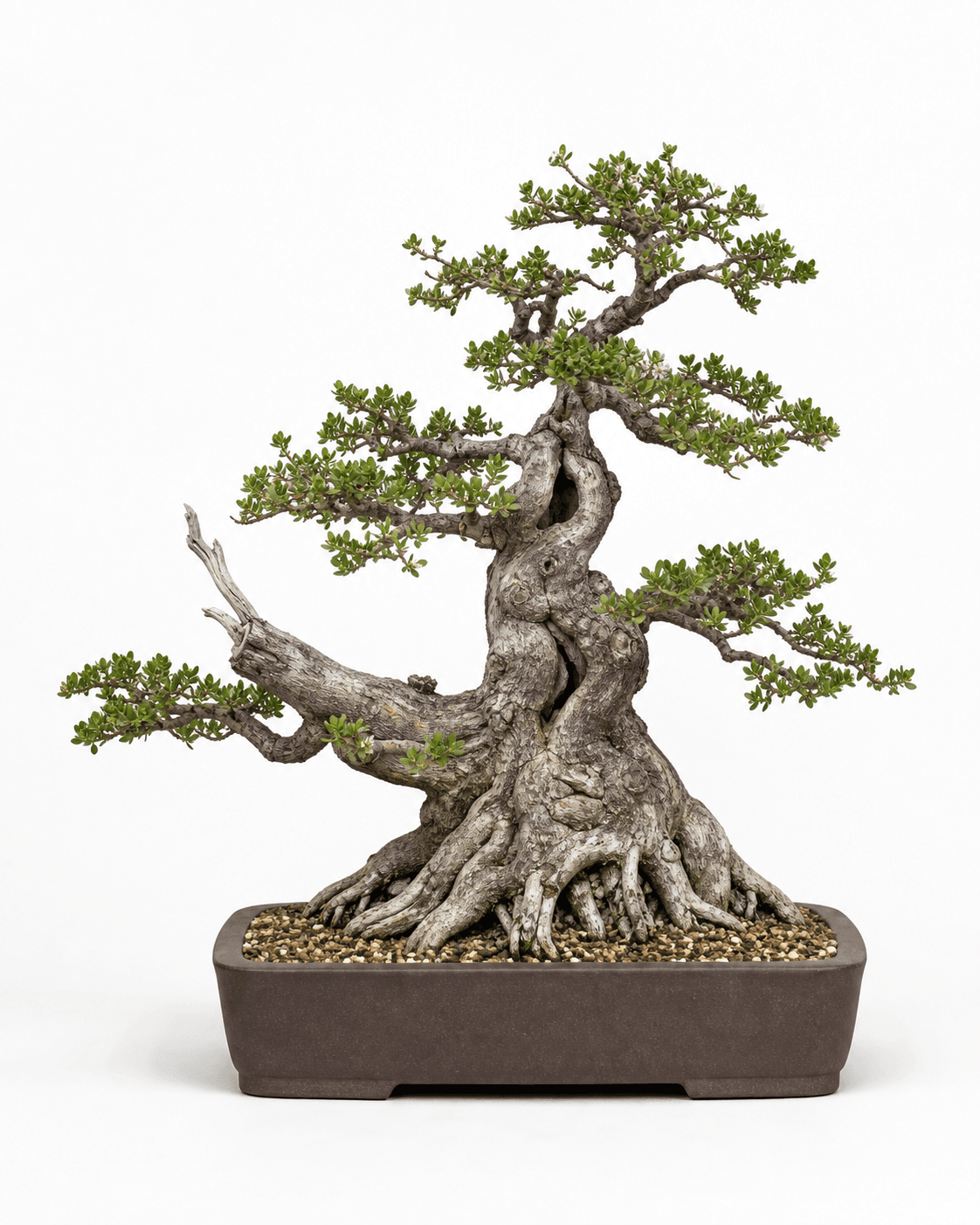
Design should read as coastal. Low trunks, flared bases, hard gray bark, angular movement, exposed root lines, sparse crowns, and wind-shaped branch placement fit the species better than a soft indoor-ficus canopy. PROTA4U: Pemphis acidulaBonsai Mirai / Asymmetry
Reading the tree
Judge Pemphis by active tips, root rhythm, and old-wood limits.
A healthy Pemphis should have firm small leaves, active growing tips in warmth, and a pot that dries predictably after thorough watering. Weak light, cold protection, or a sealed old soil core can make a tree look alive while growth stalls. Bonsai Mirai Library
Development and refinement need separate goals. In development, let selected shoots extend enough to thicken, feed the root system, and create future cutback points. In refinement, cut back to interior shoots after the flush has proved its strength. Bonsai Mirai Library
Old wood is part of the species character, but it is also the handling limit. PROTA describes very hard, very strong wood. That is excellent for aged visual character and poor for forcing last-minute bends into mature branches. PROTA4U: Pemphis acidula
Pruning
Build with extension, then cut back while warmth remains.
Use clip-and-grow as the default. Let a shoot run past the place where you want branch division, then cut back to a visible side shoot or node while the tree still has warm recovery weather. Bonsai Mirai Library
Avoid stripping the canopy to chase instant miniaturization. Mirai tropical method treats root maturation, light, and tip management as the durable path to smaller leaves, while aggressive defoliation spends stored energy on replacement foliage. Bonsai Mirai Library
Prune old branches only when the replacement path is clear. The species can look ancient because of gnarled wood, but a bonsai still needs living vascular lines and active tips behind cuts. PROTA4U: Pemphis acidulaBonsai Mirai / Asymmetry
Roots
Repot in warmth and preserve enough foliage to pull water.
Mirai tropical method puts root work after stable warmth, often once nights are around 60 F / 16 C or warmer. That matters more for Pemphis than calendar spring because cold roots after repotting leave a tropical tree unable to replace fine roots. Bonsai Mirai Library
Repot for a reason: drainage has slowed, the soil has decomposed, the root base needs correction, the planting angle changes, or the tree is unstable. If the tree was recently imported or collected, let it regain active growth before aesthetic root work. Bonsai Mirai LibraryPROTA4U: Pemphis acidula
Keep a portion of the root mass intact on a leafy tree. Mirai tropical repotting method warns against bare-rooting material that must keep foliage hydrated. After repotting, secure the trunk, water through, protect from harsh wind, and wait for new growth before pruning. Bonsai Mirai Library
Soil and pot
Use drainage, reservoir, and fresh-water flushing as one system.
A starting soil can be equal parts akadama, pumice, and lava for warm bonsai culture. In very wet, humid, or indoor-protected settings, increase pumice or lava so the pot does not stay airless. Bonsai Mirai Library
Do not confuse coastal salt tolerance with a desire for stagnant salt in the container. Salt spray and brackish edges are part of the habitat, while container roots need periodic fresh-water flushing so salts and fertilizer residues do not concentrate. Useful Tropical Plants: Pemphis acidulaBonsai Mirai Library
Pot form should read low, weathered, and stable. Unglazed earth tones, shallow ovals, rugged rectangles, and small coastal slabs can work once the root system is ready. Training boxes are better while recovering old or imported material. Bonsai Mirai / Asymmetry
Climate
The safer calendar is tropical heat with coastal airflow.
In frost-free coastal tropics, Pemphis can grow outdoors year-round if the pot drains, the tree is not trapped in stale nursery media, and salt buildup is managed. Work can happen across more than one warm cycle when the tree is actively extending. PROTA4U: Pemphis acidulaBonsai Mirai Library
In cold-winter regions, treat it as a greenhouse or high-light protected tropical. Protect before nights approach 45 F / 7 C, reduce winter water, and avoid structural pruning, repotting, or defoliation until warmth returns. Bonsai Mirai Library
In dry inland heat, the issue is wind and reservoir. Give bright light, but protect freshly repotted or recently shipped trees from desiccating afternoon exposure until roots and foliage are synchronized. Bonsai Mirai LibraryUseful Tropical Plants: Pemphis acidula
Pests
The common bonsai risks are root decline, salt concentration, and stress pests.
Direct pest evidence for Pemphis bonsai is sparse in the local corpus and public extension sources. That means the first diagnostic pass should be horticultural: light, warmth, water movement, drainage, salt buildup, and recent work. Bonsai Mirai Library
Root decline will often appear as dull leaves, stalled tips, or twig dieback. Likely causes include cold wet soil, decomposed media, too much root work, or an old inner core that never takes fresh water evenly. Bonsai Mirai Library
Check tender growth for sucking insects and dense interiors for fungal film, especially during warm humid protection. Mirai tropical guidance treats canopy cleaning and airflow as normal maintenance in wet tropical conditions. Bonsai Mirai Library
Wiring
Wire young growth, then let hard wood keep the old character.
PROTA describes Pemphis wood as very heavy, very hard, and very strong. That is a design advantage on old trunks and a warning for styling. Mature branches should usually be redirected through pruning, guy-wires, or replacement growth rather than forced bends. PROTA4U: Pemphis acidula
Wire young shoots when they are still flexible and the tree is in active growth. Use smooth coils, support the branch while bending, and inspect often because tropical swelling can mark bark quickly once growth resumes. Bonsai Mirai Library
Keep bends consistent with the plant. Coastal angularity, low shoulder lines, and wind-affected movement suit Pemphis better than soft S-curves. The wire should reveal shoreline pressure while preserving age and restraint. Bonsai Mirai / AsymmetryPROTA4U: Pemphis acidula
Propagation
Use propagated or legally documented material.
PROTA documents significant trade in seeds and live plants for bonsai, especially in Asia. Useful Tropical Plants notes the tree can generate new roots and buds quickly in suitable conditions and begins flowering and setting seed at small-shrub size. PROTA4U: Pemphis acidulaUseful Tropical Plants: Pemphis acidula
Seed is the cleanest ethical route when available from legal sources. Cuttings and air layers should be attempted only in strong warmth and humidity, and the grower should expect species-specific results rather than assuming ficus-level reliability. Bonsai Mirai LibraryPROTA4U: Pemphis acidula
Wild collection is the red flag. Urban Forest records Pemphis as critically endangered in Singapore, and PROTA names habitat loss and mangrove decline as conservation issues. Buy from reputable nurseries, keep paperwork, and respect local coastal-plant law. Urban Forest: Flora of Singapore and Southeast AsiaPROTA4U: Pemphis acidula
Buying
The first buying question is legal provenance.
Ask whether the tree is seed-grown, cutting-grown, nursery propagated, imported with documentation, or collected. If a seller cannot explain provenance, walk away. Old coastal material is exactly where conservation and trade pressure become real. PROTA4U: Pemphis acidulaUrban Forest: Flora of Singapore and Southeast Asia
Good material has a visible base, active tips close to the trunk, small firm leaves, old but clean bark, stable roots, and branch options that already suggest coastal movement. A dramatic dead trunk with no inner growth signals risk rather than shortcut material. PROTA4U: Pemphis acidulaBonsai Mirai / Asymmetry
Inspect the soil and salt history. Avoid trees with sour compact soil, dried salt crust, black soft roots, loose trunks, sudden leaf dullness after shipping, or heavy cuts made before import recovery. Bonsai Mirai Library
Troubleshooting
Diagnose by warmth, salt, roots, and recent work.
Symptom: leaves dull and tips stop extending. Likely causes: cold root zone, weak light, recent shipping, or soil that is staying wet inside. Fix: increase warmth and light, check drainage, hold fertilizer, and wait for active tips before pruning. Bonsai Mirai Library
Symptom: leaf edges brown after coastal wind or salt exposure. Likely causes: salt concentration, dry wind, or roots unable to replace water. Fix: flush thoroughly with fresh water, reduce wind, and stabilize watering. Useful Tropical Plants: Pemphis acidulaBonsai Mirai Library
Symptom: branch cracks while styling. Likely causes: old dense wood or a bend forced into one point. Fix: stop bending, support the branch, and rebuild the line from younger growth or pruning. PROTA4U: Pemphis acidulaBonsai Mirai Library
Symptom: decline after repotting. Likely causes: cold aftercare, too much root reduction, unstable tie-down, or severe pruning paired with root work. Fix: warm protected light, careful water, no more cuts, and patience for new root evidence. Bonsai Mirai Library
Symptom: fine growth dies inside the canopy. Likely causes: shaded interiors, stagnant humidity, pest pressure, or old branches with no active tips behind them. Fix: improve light and airflow, clean dead twigs, and cut only to living growth. Bonsai Mirai LibraryPROTA4U: Pemphis acidula
Symptom: seller claims wild coastal age but has no paperwork. Likely cause: risky or illegal sourcing. Fix: decline the tree and choose documented propagated material. PROTA4U: Pemphis acidulaUrban Forest: Flora of Singapore and Southeast Asia
Design
Style Pemphis from shoreline pressure and hard old wood.
Start with the base, trunk line, defining branch, and live growth. A good Pemphis design should look grown by light, salt, wind, and stone rather than clipped into a generic indoor-tree outline. Bonsai Mirai / AsymmetryPROTA4U: Pemphis acidula
The branch architecture can stay sparse. PROTA describes a gnarled, much-branched shrub or small tree, and Urban Forest describes very rare coastal material with hairy young branches and gray bark. Negative space can make those traits readable. PROTA4U: Pemphis acidulaUrban Forest: Flora of Singapore and Southeast Asia
Deadwood and old bark can be powerful, but only when live veins and branch tips remain believable. Do not hollow or carve just to imitate a juniper. Let natural hard wood, old wounds, and coastal austerity do the work. PROTA4U: Pemphis acidulaBonsai Mirai / Asymmetry
Names and forms
Most variation is habitat form and local naming rather than cultivar care.
Pemphis acidula is the botanical anchor. PROTA says Pemphis comprises a single species in its treatment, while Urban Forest lists Lythrum pemphis and Pemphis angustifolia as synonyms and mentigi, dakul, and bungor as common names. PROTA4U: Pemphis acidulaUrban Forest: Flora of Singapore and Southeast Asia
Bantigue, mentigi, stigi, santigi, small-leaved mangrove, and bois matelot should be treated as label clues, then verified by leaves, bark, coastal habit, and documentation. Do not assume every old tropical shrub sold under a regional name is Pemphis. PROTA4U: Pemphis acidulaUseful Tropical Plants: Pemphis acidula
Habitat form matters. Plants exposed to wind and salt can be low, tight, and gnarled, while sheltered plants can grow taller. Style the actual growth habit in front of you instead of forcing one regional image onto every specimen. Useful Tropical Plants: Pemphis acidulaPROTA4U: Pemphis acidula
History
Its bonsai history is inseparable from coastal culture and conservation.
PROTA records hard durable wood uses, ornamental planting in Asia, and significant seed and live-plant trade for bonsai. Useful Tropical Plants also notes bonsai trade pressure alongside habitat loss in some regions. PROTA4U: Pemphis acidulaUseful Tropical Plants: Pemphis acidula
The species is culturally important because old shoreline material can look ancient at small size. That same appeal creates conservation pressure. The best modern standard is legally propagated material trained with the same patience given to older collected trees. PROTA4U: Pemphis acidulaUrban Forest: Flora of Singapore and Southeast Asia
For EntGrove records, track source provenance, repot dates, salt exposure, winter lows, sun transitions, and major cuts. Those notes decide whether a Pemphis is ready for technique or still recovering from the supply chain. Bonsai Mirai Library
Species questions
Answer the beginner questions before styling.
Is Pemphis acidula good for bonsai?
Yes, for advanced tropical growers. It has tiny leaves, gnarled coastal wood, and strong bonsai character, but it needs frost-free bright culture, careful root oxygen, and legal documented sourcing.
Is bantigue the same as Pemphis?
In bonsai trade, bantigue commonly refers to Pemphis acidula. Mentigi, stigi, santigi, small-leaved mangrove, and bois matelot are also associated labels, but the plant should be verified botanically and legally.
Can Pemphis bonsai grow indoors?
Only as protected tropical holding under strong light, warmth, airflow, and careful watering. It is better treated as an outdoor or greenhouse tropical bonsai in frost-free conditions.
How cold can Pemphis bonsai tolerate?
Use a conservative tropical threshold. Protect before nights approach 45 F / 7 C, and avoid serious pruning, wiring, repotting, or propagation until warm active growth returns.
Should I add salt water to Pemphis bonsai?
No routine salt watering is recommended. Pemphis tolerates coastal salt in habitat, but bonsai containers concentrate salts. Use fresh water and flush the pot after salt spray or fertilizer buildup.
When should I repot Pemphis bonsai?
Repot in stable warmth, usually after nights are around 60 F / 16 C or warmer and several warm weeks remain. Repot for drainage, soil condition, roots, anchoring, or a design change.
What soil is best for Pemphis bonsai?
Use a fast-draining tropical broadleaf mix. Equal parts akadama, pumice, and lava are a practical starting point, adjusted for heat, wind, humidity, and how quickly the pot dries.
Can I wire Pemphis bonsai?
Wire young flexible shoots during active growth and check often. Mature Pemphis wood is very hard, so old branches are usually safer shaped by pruning, guy-wires, or replacement growth.
Why is wild-collected Pemphis risky?
Old coastal Pemphis is valuable and vulnerable. Public sources document habitat loss, rare local populations, and bonsai trade pressure. Buy propagated or legally documented plants and keep the paperwork.
Why is my Pemphis declining after import or shipping?
Likely causes include low light, cold roots, stale soil, salt buildup, root disturbance, or sudden wind and sun. Stabilize warmth, light, water movement, and drainage before doing design work.
Sources
Species advice needs source discipline.
Next decisions
Plan the operation before copying the calendar.
A good care note for Pemphis records the tree's stage, the work done, and the aftercare used. That record matters more than a month-name rule.
Related species
Compare nearby trees before transferring advice.
Ficus retusa / Indian laurel
Ficus microcarpa
Tigerbark ficus
Ficus microcarpa 'Tigerbark'
Willow-leaf ficus
Ficus salicaria
Benjamin fig
Ficus benjamina
Ginseng ficus
Ficus microcarpa 'Ginseng'