
Species guide
Shore Juniper Bonsai Care
Juniperus conferta
Shore juniper is a low, creeping, needle-leaved coastal juniper from Japan and southern Sakhalin that can work as outdoor bonsai when the grower respects its mat-forming habit, drainage needs, and foliage-powered recovery. Treat it as Juniper > Mounding in EntGrove taxonomy while keeping the botanical note in view: several public conifer references place it close to Juniperus rigida as Juniperus rigida subsp. conferta.
The local Mirai corpus has no dedicated shore-juniper episode. This guide uses the direct shore-juniper mention in the needle-juniper styling corpus, transferred mounding and procumbens juniper method, and public horticultural sources for taxonomy, coastal habitat, morphology, hardiness, Blue Pacific separation, and pest context.
Separate shore juniper from Blue Pacific, procumbens nana, Blue Star, Juniperus squamata, common juniper, needle juniper, Pfitzer labels, San Jose, Blaauw, Foemina, and eastern red cedar before applying timing. Similar low mats and prickly blue-green foliage can hide different root work, vigor, and refinement behavior.
Updated June 10, 2026. Written by EntGrove Editorial. Last verified June 10, 2026.
Care fingerprint
Read the species through its shared care pattern.
Open pads for light, avoid stripping all low growth, and understand that cheap starter junipers still need outdoor recovery. Use this as the starting point before local conditions and tree strength refine the calendar.
Note: Low coastal Japanese and Sakhalin juniper with no dedicated local Mirai file; public taxonomy sources often treat it as Juniperus rigida subsp. conferta, while bonsai navigation keeps it with mounding starter junipers. Separate it from Blue Pacific, procumbens, Blue Star, squamata, common juniper, needle juniper, Pfitzer labels, San Jose, Blaauw, Foemina, and eastern red cedar before applying care.
Keep foliage strong
Junipers recover through active foliage, so styling choices should leave enough healthy tips to power the tree.
Protect live veins
Old junipers often depend on narrow live veins between roots and foliage; root work and carving should respect that path.
Do not stack major work
Heavy bending, major foliage reduction, carving, and repotting belong in a staged plan rather than the same weekend.
Care cadence
The calendar starts with the tree's seasonal state.
Placement
Timing: Grow outdoors year round in sun and moving air. Give recently repotted or heavily cleaned trees morning sun and afternoon protection until growth firms.
Watch for: Indoor display, shaded patios, hot reflected walls, dry wind after root work, and cold benches that freeze small pots before the ground freezes.
NC State ExtensionOregon State Landscape PlantsBonsai Mirai LibraryWatering
Timing: Water in repeated passes until the entire rootball drains, then wait for the upper soil to begin drying before watering again.
Watch for: Hydrophobic sand or peat pockets, water running around the root mass, saturated organic nursery cores, and drought assumptions copied from landscape groundcovers.
NC State ExtensionBonsai Mirai LibraryFeeding
Timing: Feed healthy development trees during active growth. Use lighter feeding after refinement pruning or when the design depends on compact tufts and short internodes.
Watch for: Soft coarse runners, mite-prone dense foliage, fertilizer on weak roots, and starving a tree that still needs branch and root development.
Bonsai Mirai LibraryFoliage maintenance
Timing: Let spring growth strengthen and harden, then clean pad undersides, reduce selected crotch congestion, and shorten long tips back to living side growth.
Watch for: Pinching, shearing into a uniform groundcover ball, cutting to bare stems, and removing every low shoot before the trunk line is chosen.
Bonsai Mirai LibraryRepotting
Timing: Repot during spring movement on a strong tree, with enough foliage left to power new roots. Correct old nursery cores over staged cycles.
Watch for: Bare-rooting, root work after a heavy pruning session, loose tie-downs, old sand staying dry in the center, and oversized wet containers.
Bonsai Mirai LibraryWiring
Timing: Wire lignified branches when the tree is hydrated and growth has firmed. Use enough support to set low creeping branches without repeated bending.
Watch for: Crushed needle tufts, hidden wire bite inside mats, torn crotches, brittle old branch bases, and wire that disappears under dense foliage.
Bonsai Mirai LibraryPropagation
Timing: Use cuttings or layering to preserve named cultivars. Seed can produce shore juniper, but seedlings do not preserve Blue Pacific or other cultivar traits.
Watch for: Seed-grown plants sold as named cultivars, weak cuttings stripped of too much foliage, and undocumented graft unions on landscape stock.
NC State Extension Blue PacificBonsai Mirai LibraryPests and disease
Timing: Inspect dense mats in wet springs, humid summers, dry hot spells, winter shelter, and after nursery-stock reduction.
Watch for: Twig and tip blights, cedar-apple rust, Phytophthora-style root rot, spider mites, scale, aphids, bagworms, twig borers, webworms, and interior browning from shade.
NC State ExtensionClemson Extension juniper pestsUC IPM JuniperWinter protection
Timing: Keep dormant outdoors and protect shallow pots from hard freezes, drying wind, and thaw-refreeze cycles, especially after pruning or repotting.
Watch for: Warm indoor overwintering, frozen dry roots, freshly cut roots exposed to cold rain, and late heavy pruning before winter.
NC State ExtensionOregon State Landscape PlantsBonsai Mirai LibrarySpecies guide
Apply the species profile before copying another tree's calendar.
At a glance
Shore juniper is a creeping coastal needle juniper with mounding bonsai behavior.
For search and nursery work, record the tree as Juniperus conferta. For taxonomy, keep the Juniperus rigida subsp. conferta treatment in the notes because Oregon State and The Gymnosperm Database use that rank. NC State ExtensionOregon State Landscape PlantsThe Gymnosperm Database
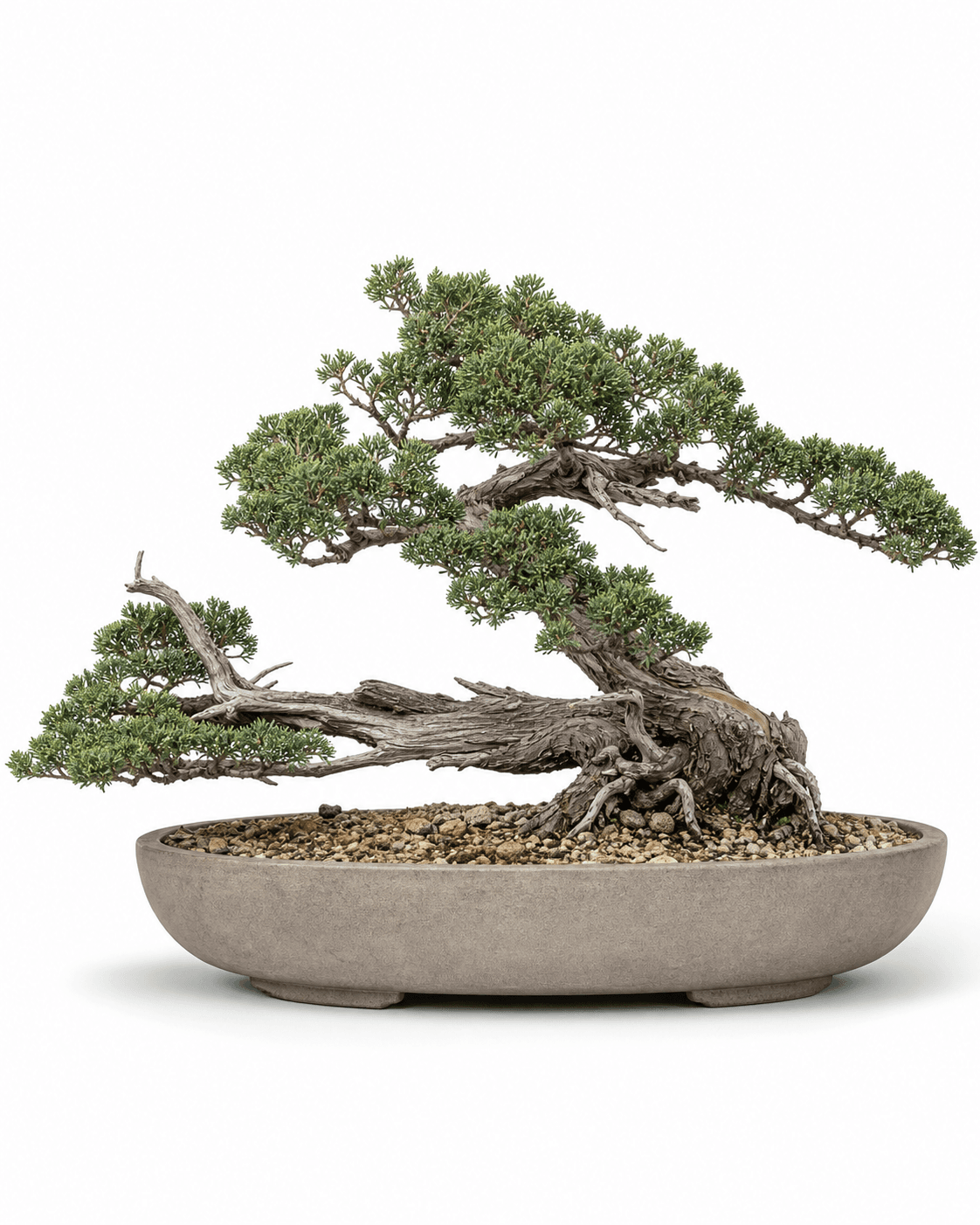
As bonsai material, the practical image is low, dense, and coastal. The tree wants outdoor sun, sharp drainage, full rootball watering, and foliage-preserving work more than frequent surface grooming. NC State ExtensionBonsai Mirai Library
The source caveat matters. Mirai mentions Juniperus conferta in the needle-juniper styling corpus but has no dedicated shore-juniper file, so this profile transfers the conservative parts of mounding, procumbens, and general juniper method. Bonsai Mirai Library
Wild habitat
The wild plant is a sandy maritime mat, and that should shape care and design.
NC State places shore juniper on the sea coasts of Japan and Sakhalin Island. Oregon State adds the practical phrase that it is at home on sandy ocean beaches, and The Gymnosperm Database records sandy soils near the sea in Japan and southern Sakhalin. NC State ExtensionOregon State Landscape PlantsThe Gymnosperm Database
For care, translate that habitat into full outdoor exposure, drainage, salt and wind tolerance, and roots that hate stagnant wetness. A shallow pot can dry faster than a dune and freeze harder than beach sand, so water and winter protection still need judgment. NC State ExtensionOregon State Landscape PlantsBonsai Mirai Library
For design, the wild image argues for low movement, wind-shaped pads, exposed roots, rock edges, and negative space around a creeping trunk. Tall formal-upright ideas usually fight the plant more than they reveal it. Bonsai Mirai / AsymmetryThe Gymnosperm Database
Use the mat habit deliberately. A branch that seems too low on a generic juniper may become the defining branch, cascade line, raft extension, or coastal groundline on shore juniper. Bonsai Mirai / AsymmetryBonsai Mirai Library
Reading the tree
Read shore juniper by extension, root wetting, interior light, and label evidence.
Strong shore juniper has firm prickly foliage, visible extension, and enough density to fuel root work. A static green mat can hide weak roots, shaded interior growth, or an old core that no longer wets evenly. Bonsai Mirai LibraryNC State Extension
Open the canopy before choosing branches. Low groundcover material often carries usable trunk movement under surface foliage, but it also hides dead crotches, crossing shoots, and interior branches that will disappear if shaded. Bonsai Mirai Library
Read the rootball with water. If water runs around the side, pools on old peat, or drains from one edge while the center stays dry, root conversion should precede ambitious styling. Bonsai Mirai Library
Read the label with skepticism. Shore juniper, Blue Pacific, procumbens, Blue Star, common juniper, and juvenile Chinese juniper can all look low, prickly, and blue-green in nursery settings. Record the best evidence and let growth behavior refine the care plan. NC State ExtensionNC State Extension Blue PacificBonsai Mirai Library
Foliage work
Use selective scissor pruning, not pinching or hedge-shearing.
Mirai juniper method is clear on pinching: preserve strength, let growth harden, and prune with sharp scissors to living interior growth. Tearing the tips weakens the foliage system that powers roots. Bonsai Mirai Library
Begin by cleaning underside growth that obscures the pad line and by removing dead, shaded, or clearly useless interior pieces. Keep useful low shoots until the trunk line and defining branch are settled. Bonsai Mirai Library
Avoid cutting the mat back to bare stems. Junipers are poor bets for random bare-wood budding, and shore juniper should be built from preserved active growth rather than from hope after a hard strip. Bonsai Mirai Library
In refinement, shorten long runners back to living side growth and hide cuts inside the canopy. On a low mat, a visible brown cut tip can dominate the whole silhouette. Bonsai Mirai Library
Roots
Root work is mostly old-core conversion and tie-down discipline.
Shore juniper landscape stock often arrives with nursery media, sand-heavy cores, or organic pockets that behave differently from bonsai soil. The first repot should improve water movement without removing every old root support. Bonsai Mirai LibraryNC State Extension
Use spring movement on a vigorous tree, keep active foliage, and secure the rootball firmly. A loose low mat can rock in the pot and tear new roots each time wind moves the canopy. Bonsai Mirai Library
Stage old-core correction. If the center is hydrophobic or sour, open channels and remove the worst material over cycles, then judge success by even wetting, quick drainage, and new fine roots. Bonsai Mirai Library
Because public taxonomy places shore juniper close to Juniperus rigida, treat weak trees conservatively. The safe shared rule across junipers is robust foliage before invasive root work. The Gymnosperm DatabaseBonsai Mirai Library
Soil and pot
Use mineral drainage and a pot that reads like coast, not lawn.
A 1:1:1 akadama:pumice:lava mix is a practical starting point for developed shore juniper bonsai. Screen fines, match particle size to pot depth, and adjust for local heat, wind, and watering skill. Bonsai Mirai Library
NC State and Oregon State both emphasize dry, sandy, well-drained conditions and intolerance of excess water. Bonsai soil should preserve that oxygen preference while still letting the entire rootball hydrate. NC State ExtensionOregon State Landscape Plants
Pot choice should support the creeping image. Shallow ovals, quiet rectangles, slabs, crescent containers, and rock plantings can make the mat look intentional. A deep nursery-style pot can make the same tree read unfinished. Bonsai Mirai / Asymmetry
Avoid decorative topdressing that traps moisture against the trunk or hides dry pockets. A visible mineral surface is often easier to water correctly than a moss blanket over old nursery soil. Bonsai Mirai Library
Climate
Adapt a coastal species to inland heat, humid rain, cold roots, and salt exposure.
In cool maritime gardens, give the tree maximum light and airflow. The natural coastal pattern supports wind, salt influence, and sandy drainage, but small pots still need complete watering during dry spells. Oregon State Landscape PlantsNC State Extension
In hot inland gardens, protect the pot and recently worked trees from afternoon heat while keeping foliage bright. Weak roots in a black pot can overheat faster than the foliage shows stress. Bonsai Mirai Library
In humid regions, drainage and airflow become the main disease prevention. NC State lists blights in rainy wet conditions, and Clemson ties juniper dieback problems to poor siting, overhead watering, and stress. NC State ExtensionClemson Extension juniper pests
In colder climates, use landscape hardiness as a starting point, then protect the container. NC State lists winter injury when temperatures drop to minus 10 F, and bonsai roots carry less insulation than in-ground roots. NC State ExtensionBonsai Mirai Library
Pests and diseases
Most problems start with wet roots, dense interiors, or stressed foliage.
NC State reports no serious insect or disease problems for well-sited shore juniper, while also naming blights, cedar-apple rust, root rot in poor drainage, aphids, bagworms, twig borers, webworms, scale, and spider mites as possible issues. NC State Extension
Clemson adds the practical diagnostic pattern: tip and twig blights brown shoot tips or whole shoots, with warm wet weather favoring Phomopsis and other blights. Air circulation, dry foliage, resistant stock, and sanitation matter more than routine spraying. Clemson Extension juniper pests
Spider mites and scale are easy to miss inside dense mats. Use a white-paper tap test for mites, inspect needle undersides for scale, and avoid broad insecticide habits that remove beneficial predators. Clemson Extension juniper pestsUC IPM Juniper
Root rot prevention is cultural. Shore juniper prefers good drainage; if the pot stays wet, the fix begins with soil, pot angle, watering rhythm, and airflow. NC State ExtensionClemson Extension juniper pests
Wiring
Wire the woody line, then let foliage become a compact coastal pad.
Wire lignified branches, not green needle tufts. Shore juniper often needs branch placement more than detail wiring because the foliage mass is compact and the tree image is low. Bonsai Mirai Library
Support crotches before bending. Low mats can have short, rigid branch angles that tear when forced into sudden cascades or raft lines. Bonsai Mirai Library
Check wire frequently during recovery. Dense foliage hides bite, and a small trunk can thicken enough in one season to make a wire mark part of the design forever. Bonsai Mirai Library
Use directional pruning after the first structure is set. On refined mounding junipers, Mirai method favors cutback to useful interior growth over wiring every terminal tip. Bonsai Mirai Library
Propagation
Cuttings preserve cultivars; seed only preserves species potential.
Species shore juniper can be seed-grown, but seed does not preserve a named cultivar. Use vegetative propagation for Blue Pacific, Blue Lagoon, Silver Mist, Golden Pacific, and similar selections. NC State ExtensionNC State Extension Blue Pacific
Cuttings are the practical bonsai path for cultivar material because they preserve foliage color, mat density, and growth habit. Keep enough foliage on cuttings to support turgor and root initiation. Bonsai Mirai LibraryNC State Extension Blue Pacific
Layering is useful when a landscape mat has one good trunk line but a poor root base. Air-layer only vigorous material and keep the parent foliage strong during the process. Bonsai Mirai Library
Grafting is possible in junipers, but shore juniper is usually valued on its own roots or as landscape-derived material. Document any graft union before pricing or styling. Bonsai Mirai Library
Buying
Buy for trunk line, root health, and label clarity before foliage color.
Good shore juniper material has a low trunk or branch line worth revealing, firm foliage, even water uptake, and roots that can be converted without a full reset. Bonsai Mirai Library
Inspect underneath the mat. Look for inverse taper, dead interior branches, circling roots, graft scars, buried trunk sections, and old media that either stays swampy or refuses water. Bonsai Mirai LibraryClemson Extension juniper pests
Separate species and cultivar labels. NC State treats Blue Pacific as a Juniperus conferta cultivar introduced to nursery trade in 1972 and sometimes incorrectly listed as Blue Shore. That cultivar deserves its own expectations. NC State Extension Blue Pacific
A cheap groundcover can be excellent practice material when the grower accepts the scale. Paying premium prices requires evidence: clone, age, root work, trunk line, and why the plant is stronger than ordinary landscape stock. Bonsai Mirai / AsymmetryBonsai Mirai Library
Troubleshooting
Diagnose the pattern before cutting more foliage.
Symptom: green outer mat with brown interior. Likely cause: shaded interior, natural old-needle shedding, mites, or twig blight. Fix: inspect with light and magnification, clean gradually, improve airflow, and keep usable interior shoots. Clemson Extension juniper pestsBonsai Mirai Library
Symptom: tips brown after wet weather. Likely cause: twig or tip blight on tender growth. Fix: prune infected shoots in dry weather, remove debris, improve spacing, and protect new growth before infection if local extension guidance supports treatment. Clemson Extension juniper pests
Symptom: water drains fast while the tree wilts. Likely cause: hydrophobic old core or water channeling around the root mass. Fix: soak carefully, open channels at the next safe repot, and replace problem media in stages. Bonsai Mirai Library
Symptom: entire plant fades after repotting. Likely cause: too much root removal, poor tie-down, weak foliage before the operation, or stale wet soil. Fix: stabilize sun and wind, correct watering, stop pruning, and rebuild foliage. Bonsai Mirai Library
Symptom: salt-tolerant landscape plant declines in a bonsai pot. Likely cause: treating coastal tolerance as permission for chronic drought, fertilizer salts, or hot reflected exposure. Fix: flush thoroughly, protect the pot, and balance water with oxygen. NC State ExtensionBonsai Mirai Library
Design
Design from the creeping line, the exposed root, and the coastal pad.
Start with the base and the best moving line. Shore juniper often offers a low trunk hidden under foliage; reveal that line before deciding whether the tree wants to be cascade, raft, exposed-root, or small informal upright. Bonsai Mirai / AsymmetryBonsai Mirai Library
Choose a defining branch that explains the low habit. A single branch can carry the coastal direction, with smaller body branches providing density and the apex staying quiet. Bonsai Mirai / Asymmetry
Use negative space inside the mat. A bonsai shore juniper should read as branches and pads in relationship, rather than a trimmed landscape pillow. Bonsai Mirai / AsymmetryBonsai Mirai Library
Deadwood can work when it grows from the material. Fine shari, weathered jins, and exposed live veins suit coastal stress; oversized desert-juniper deadwood can overwhelm a small mat-form tree. Bonsai Mirai / AsymmetryBonsai Mirai Library
Cultivars
Blue Pacific is related, common, and worth separating.
This page covers species-level shore juniper. Blue Pacific shore juniper is a named Juniperus conferta cultivar with a trailing habit, blue-green foliage, and a separate taxonomy route in EntGrove. NC State Extension Blue Pacific
NC State lists several shore juniper cultivars, including All Gold, Blue Lagoon, Blue Pacific, Emerald Sea, Golden Pacific, Silver Mist, and Variegata. Oregon State lists Blue Pacific, Emerald Sea, Silver Mist, and All Gold. NC State ExtensionOregon State Landscape Plants
Blue Pacific can be excellent small material, but its lower, bluer, trailing nursery identity should be evaluated separately from generic Juniperus conferta seedling or landscape stock. NC State Extension Blue PacificBonsai Mirai Library
Compare Blue Star and procumbens nana before buying by color alone. Blue Star is a Juniperus squamata cultivar, while procumbens nana is Juniperus procumbens Nana. Similar low habit does not make the labels interchangeable. Bonsai Mirai LibraryNC State Extension
History
Shore juniper is more important as accessible coastal material than as a famous exhibition name.
The public record for shore juniper is horticultural and botanical: a Japanese and Sakhalin coastal mat, widely used in landscapes for groundcover, rock gardens, slopes, massing, and erosion control. NC State ExtensionOregon State Landscape PlantsThe Gymnosperm Database
That makes it useful for bonsai education. It teaches outdoor conifer culture, rootball conversion, mounding-juniper cleaning, and design from humble nursery material. Bonsai Mirai LibraryBonsai Mirai / Asymmetry
The exhibition standard should be scale-appropriate: a clean root system, visible line, deliberate pad bottoms, compact foliage, and a pot or slab that explains the coastal image. Bonsai Mirai / Asymmetry
A strong shore juniper bonsai usually succeeds by honesty. Let it look like a small coastal juniper refined by time, wind, roots, and careful hands. Bonsai Mirai / AsymmetryBonsai Mirai Library
Species questions
Answer the beginner questions before styling.
Can shore juniper be used for bonsai?
Yes. Shore juniper can be used for outdoor bonsai, especially low mounding, cascade, raft, exposed-root, root-over-rock, and small coastal designs.
Can shore juniper live indoors?
Shore juniper is outdoor bonsai material. It needs sun, airflow, seasonal change, and dormancy, with brief indoor display at most.
Is shore juniper the same as Blue Pacific juniper?
Blue Pacific is a named Juniperus conferta cultivar. This page covers species-level shore juniper; Blue Pacific should be evaluated as lower, bluer, trailing cultivar material.
Is Juniperus conferta the accepted name?
Juniperus conferta is the common horticultural and search label. Oregon State and The Gymnosperm Database treat it as Juniperus rigida subsp. conferta, so keep both names in records.
When should shore juniper be repotted?
Repot during spring movement on a strong tree, keep active foliage, and convert old nursery cores in stages rather than bare-rooting.
What soil is best for shore juniper bonsai?
Use open mineral soil such as 1:1:1 akadama:pumice:lava, screened for the pot size and adjusted for climate. Avoid compact wet organic cores.
Should shore juniper be pinched?
Avoid pinching. Let growth harden and prune with sharp scissors to living side growth while preserving enough foliage to power roots.
Why is my shore juniper brown inside?
Common causes include shaded interior foliage, natural old-needle shedding, spider mites, scale, twig blight, or root stress. Inspect before spraying and open the mat gradually.
Is shore juniper salt tolerant?
Landscape references describe shore juniper as coastal and salt tolerant, but bonsai still need complete watering, drainage, and protection from fertilizer salt buildup in small pots.
How is shore juniper different from procumbens nana?
Both are low outdoor junipers used as starter material, but shore juniper is Juniperus conferta or Juniperus rigida subsp. conferta, while procumbens nana is Juniperus procumbens Nana. Keep the labels separate before copying timing.
Sources
Species advice needs source discipline.
Next decisions
Plan the operation before copying the calendar.
A good care note for Shore juniper records the tree's stage, the work done, and the aftercare used. That record matters more than a month-name rule.
Related species
Compare nearby trees before transferring advice.
Procumbens nana
Juniperus procumbens 'Nana'
Green mound juniper
Juniperus procumbens 'Nana'
Blue Star juniper
Juniperus squamata 'Blue Star'
Blue Pacific shore juniper
Juniperus conferta 'Blue Pacific'
Common juniper 'Compressa'
Juniperus communis 'Compressa'